What is Medical Informatics? Dr Sanjoy Sanyal Associate Professor and Consultant Surgeon MBBS, MS (Surgery), MSc (Health Informatics, UK), ADPHA, ADHRD [email_address]
Erroneous opinions and misconceptions There is great confusion regarding the ‘definition’ of Medical Informatics. Often used to describe a broad range of intertwined disciplines Involving all of medical computing and any related disciplines. Let us trace the genesis of the term and the discipline of ‘Medical Informatics’
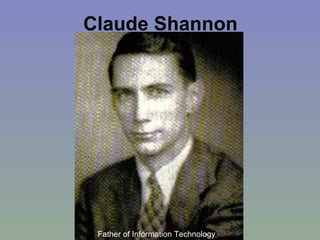
Claude Shannon Father of Information Technology
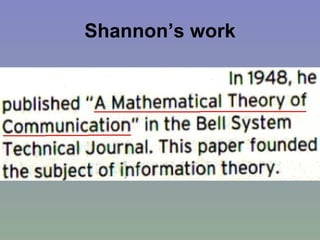
Shannon’s work
Origin of Medical Informatics Field of Medical Informatics is >30 years Origins of general discipline of ‘informatics’ traced to a Russian publication Oznovy Informatiki   ( Foundations of Informatics ) – 1968
Origin of Medical Informatics Concept of  information science  was described within context of an  emerging computer age . Focussed on structure and effects of  medical information NOT  the electronic scaffolding necessary to shuttle the electronic signals to and fro.
OED Definition ‘Informatics is the discipline of science which investigates the structure and properties of scientific information’  1976 Oxford English Dictionary (Collen,1996) Thus,  medical informatics  is the discipline which investigates the  structure  and  properties  of  medical information .
Medical Informatics Discipline   Medical Informatics  recognized as a discipline presumably in 1974 1 st  described in document:  Education in Informatics of Health Personnel  (1974). Although this is the earliest this  discipline  was given a name, informatics  principles  date much earlier.
Dr Roget – Scottish surgeon Devised novel method of representing knowledge on the principle that: All things are ‘ concepts ’  Concepts could be described by ‘ terms’   Different terms that described the same concept were called ‘ synonyms’ Developed  thesaurus  to address problem of synonymy Roget’s Thesaurus of English Words and Phrases – 1852
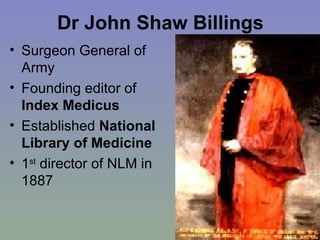
Dr John Shaw Billings Surgeon General of Army  Founding editor of  Index Medicus Established  National Library of Medicine 1 st  director of NLM in 1887
Dr John Shaw Billings Dr. Billings was charged with tabulating the U.S. census Devised specific methods of information storage and data manipulation – 1890 Conceptualized the genesis of  information revolution   Described  electromechanical device  that would tabulate census automatically through punch cards.
Herman Hollerith – Govt statistician Given job of making this concept a reality Constructed punch-card tabulating machine 56 Hollerith machines were used in 1890 Processed census information for 62 m. people Completed 2 years ahead of schedule!  $5 million under budget!!
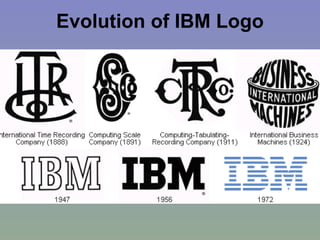
Herman Hollerith Hollerith left government job in 1896 Establish  International Tabulating Machines Became  International Business Machines  (IBM); a.k.a. Deep Blue in 1924  (Collen,1986).
Evolution of IBM Logo
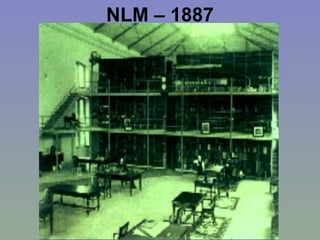
National Library of Medicine – 1887 Dr John Shaw Billings established and became 1 st  director of NLM. 1 st  stacks of NLM were his personal medical library donations
NLM – 1887
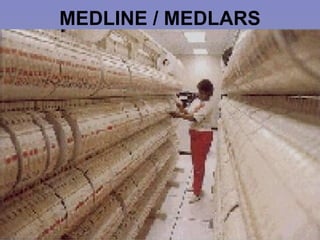
MEDLINE / MEDLARS Dr. Billings’ work intersected technology again in  1966   Computerization of  Index Medicus   The resulting system known as  MEDLARS 1 st  publicly accessible online information system.  Today, such systems are ubiquitous in many aspect of our lives
MEDLINE / MEDLARS
Medical Informatics  comes of age Formalization of Medical Informatics discipline from 1974 through 1990’s into new millennium Medical Informatics became increasingly recognized as an important component of the overall practice of medicine (Collen,1996).
Shortliffe and Perrault   Defined Medical Informatics thus in 1990: ‘ ..the rapidly advancing scientific field that deals with the storage, retrieval, and optimal use of biomedical information, data, and knowledge for problem solving and decision making.’  (Shortliffe and Perrault,1990)
Shortliffe’s definition Shortliffe’s definition made no mention of  computers  or  information technology Focussed on subject matter –  Information , rather than tool – Computer. Medical informatics is about information – capture, use, and storage  rather than equipment that makes it possible
Hardware / software However, understanding relationships and properties of information is as important to medical computing as hardware / software necessary for its distribution.  This is vital to understanding the field of Medical Informatics and how it will impact medical computing in the future.
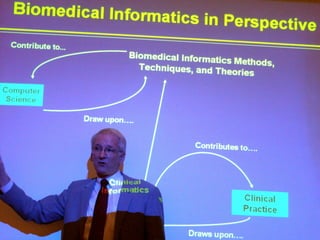
Medical Informatics – Revised concept Next slide shows Edward H. Shortliffe describing the inter-relationships between:  biomedical and clinical informatics clinical practice and clinical informatics computer science and biomedical informatics  (Amsterdam, 2007)
 
Progress of Medical Informatics   Many Medical Informatics research centres developed computerized medical record systems  Incorporating Medical Informatics design principles. With the shift to clinician-driven designs… Many of these survived today and others are making a resurgence
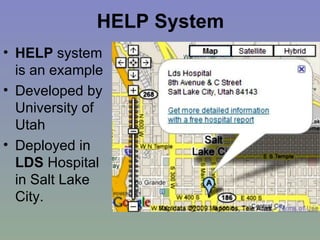
HELP System HELP  system is an example  Developed by University of Utah Deployed in  LDS  Hospital in Salt Lake City.
Other Systems Other examples of Medical Informatics groups developing medical computing systems include: TMR  (The Medical Record) @ Duke University  Regenstrief  Medical Record System @ University of Indiana .
Regenstrief System The  Regenstrief system   Contains >1.5 million patient encounters in digital format  One of the most extensive repository of medical record information in the world (MacDonald, 1997)
Modernization of NLM 1986  –  Dr. Don Lindberg  (pathologist) became director of NLM and ushered in a new era in Medical Informatics NLM began emerging as a staunch supporter of discipline of and research in Medical Informatics  This period saw emergence of Medical Informatics in USA
Dr. Don Lindberg Led NLM through major changes Development of  Unified Medical Language System (UMLS)  in 1986 Refinement of  MEDLINE Establishment of  Visible Human Project (Male / Female) Secured funding of numerous Internet connections to rural hospitals
UMLS Meta-thesaurus It is a medical component of a large vocabulary system  It addresses need for  standardized medical vocabulary Such vocabulary necessary for  categorizing biomedical information  sources In order to enhance  information retrieval UMLS also popular as a  vocabulary for computerized medical systems .   (NLM,1997).
UMLS Meta-thesaurus Based on  Roget’s  original methodology Roget’s Thesaurus  concept provided a scalable system that addressed differences in concept descriptions (synonymy) encountered in medicine UMLS Meta-thesaurus : Massive project Encompasses >500,000  terms  / 252,000  concepts
Future of Medical Informatics Medical computing has contributed significantly to improvements in healthcare There are still tremendous challenges for future medical informaticians It is often assumed benefits of a paperless record will be immediately realized once all information available on paper is digitized. However…
Shortliffe’s study Shortliffe’s study – 168 consecutive visits to an Internal Medicine clinic Those with missing charts, reports were excluded from study Among the remainder, despite having complete medical chart, all laboratory, radiology reports etc… In 81% of physician visits, some important information was not available.
Shortliffe’s study The required information had not been captured in the process of generating the standard medical record This problem is unlikely to be solved by digitizing paper-based information resources already available to physicians. It is an  information problem , not a computer problem.
Other studies Workgroup for Electronic Data Interchange  ( WEDI ) study found 50% of paper-based medical records are missing or incomplete  WEDI, 1996. Institute of Medicine  ( IOM ) reported 30% of treatment orders were not documented  IOM, 1996.
Barriers These are problems of  information acquisition They require intimate knowledge of: Information content  Environment in which they are collected Technology used to capture them These are essential tools of medical informatician
Summary Medical Informatics discipline is not new Yet appears to only be in its infancy in terms of enhancing medical practice Medical Informatics has the potential to benefit patient care as much as a newly discovered drug / therapy Yet direct benefits will not come in classic form – therapeutic interventions.
Summary Instead, they will be derived from enhancing our ability to care for patients Through improved delivery of medical knowledge and information.  This is the promise of Medical Informatics It will be evident as medical practice forges ahead in the information age.
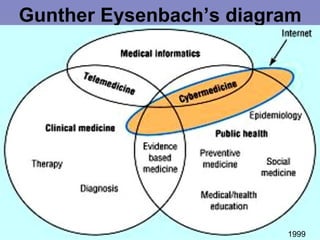
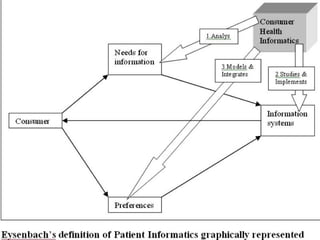
Summary Medical Informatics promises to  Reduce medical risks Improve patient care Cut costs of treatment Therefore, the term ‘Medical Informatics’ itself has undergone a transformation The generally accepted terminology now is  Health(care) Informatics This includes (Bio)Medical-, Clinical-, Health-, Patient-, Nursing-, Public Health Informatics
Gunther Eysenbach’s diagram 1999
 
Conclusion As an academic discipline, Health Informatics is still in infancy University of Bath / Royal College Surgeons Edinburgh jointly started courses in 2002 When I enrolled there for MSc in 2004 (and when I graduated in 2007), I was one among a handful worldwide. Now, more and more universities worldwide are incorporating it in their degree curricula.
References A History of Medical Informatics in the United States: 1950-1990 (Collen, AMIA Press 1996) Information Retrieval: A Health Care Perspective (Hersch, Springer-Verlag, 1996) Medical Informatics : Computer Applications in Health Care (Shortliffe, Addison Wesley, 1990). Collen MF. Origins of Medical Informatics. West J Med. 1986 Dec; 145:778-785.
References Eysenbach G, Ryoung Sa E, Diepgen TL. Shopping around the Internet today and tomorrow: towards the millennium of cybermedicine. BMJ 1999;319:1294   Lindberg DA. The National Library of Medicine and Medical Informatics. West J Med 1986 Dec;145:786-790. Altman RB. Informatics in the Care of Patients: Ten Notable Challenges. West J Med 1997 Feb.

What Is Medical Informatics?

  • 1.
    What is MedicalInformatics? Dr Sanjoy Sanyal Associate Professor and Consultant Surgeon MBBS, MS (Surgery), MSc (Health Informatics, UK), ADPHA, ADHRD [email_address]
  • 2.
    Erroneous opinions andmisconceptions There is great confusion regarding the ‘definition’ of Medical Informatics. Often used to describe a broad range of intertwined disciplines Involving all of medical computing and any related disciplines. Let us trace the genesis of the term and the discipline of ‘Medical Informatics’
  • 3.
    Claude Shannon Fatherof Information Technology
  • 4.
  • 5.
    Origin of MedicalInformatics Field of Medical Informatics is >30 years Origins of general discipline of ‘informatics’ traced to a Russian publication Oznovy Informatiki ( Foundations of Informatics ) – 1968
  • 6.
    Origin of MedicalInformatics Concept of information science was described within context of an emerging computer age . Focussed on structure and effects of medical information NOT the electronic scaffolding necessary to shuttle the electronic signals to and fro.
  • 7.
    OED Definition ‘Informaticsis the discipline of science which investigates the structure and properties of scientific information’ 1976 Oxford English Dictionary (Collen,1996) Thus, medical informatics is the discipline which investigates the structure and properties of medical information .
  • 8.
    Medical Informatics Discipline Medical Informatics recognized as a discipline presumably in 1974 1 st described in document: Education in Informatics of Health Personnel (1974). Although this is the earliest this discipline was given a name, informatics principles date much earlier.
  • 9.
    Dr Roget –Scottish surgeon Devised novel method of representing knowledge on the principle that: All things are ‘ concepts ’ Concepts could be described by ‘ terms’ Different terms that described the same concept were called ‘ synonyms’ Developed thesaurus to address problem of synonymy Roget’s Thesaurus of English Words and Phrases – 1852
  • 10.
    Dr John ShawBillings Surgeon General of Army Founding editor of Index Medicus Established National Library of Medicine 1 st director of NLM in 1887
  • 11.
    Dr John ShawBillings Dr. Billings was charged with tabulating the U.S. census Devised specific methods of information storage and data manipulation – 1890 Conceptualized the genesis of information revolution Described electromechanical device that would tabulate census automatically through punch cards.
  • 12.
    Herman Hollerith –Govt statistician Given job of making this concept a reality Constructed punch-card tabulating machine 56 Hollerith machines were used in 1890 Processed census information for 62 m. people Completed 2 years ahead of schedule! $5 million under budget!!
  • 13.
    Herman Hollerith Hollerithleft government job in 1896 Establish International Tabulating Machines Became International Business Machines (IBM); a.k.a. Deep Blue in 1924 (Collen,1986).
  • 14.
  • 15.
    National Library ofMedicine – 1887 Dr John Shaw Billings established and became 1 st director of NLM. 1 st stacks of NLM were his personal medical library donations
  • 16.
  • 17.
    MEDLINE / MEDLARSDr. Billings’ work intersected technology again in 1966 Computerization of Index Medicus The resulting system known as MEDLARS 1 st publicly accessible online information system. Today, such systems are ubiquitous in many aspect of our lives
  • 18.
  • 19.
    Medical Informatics comes of age Formalization of Medical Informatics discipline from 1974 through 1990’s into new millennium Medical Informatics became increasingly recognized as an important component of the overall practice of medicine (Collen,1996).
  • 20.
    Shortliffe and Perrault Defined Medical Informatics thus in 1990: ‘ ..the rapidly advancing scientific field that deals with the storage, retrieval, and optimal use of biomedical information, data, and knowledge for problem solving and decision making.’ (Shortliffe and Perrault,1990)
  • 21.
    Shortliffe’s definition Shortliffe’sdefinition made no mention of computers or information technology Focussed on subject matter – Information , rather than tool – Computer. Medical informatics is about information – capture, use, and storage rather than equipment that makes it possible
  • 22.
    Hardware / softwareHowever, understanding relationships and properties of information is as important to medical computing as hardware / software necessary for its distribution. This is vital to understanding the field of Medical Informatics and how it will impact medical computing in the future.
  • 23.
    Medical Informatics –Revised concept Next slide shows Edward H. Shortliffe describing the inter-relationships between: biomedical and clinical informatics clinical practice and clinical informatics computer science and biomedical informatics (Amsterdam, 2007)
  • 24.
  • 25.
    Progress of MedicalInformatics Many Medical Informatics research centres developed computerized medical record systems Incorporating Medical Informatics design principles. With the shift to clinician-driven designs… Many of these survived today and others are making a resurgence
  • 26.
    HELP System HELP system is an example Developed by University of Utah Deployed in LDS Hospital in Salt Lake City.
  • 27.
    Other Systems Otherexamples of Medical Informatics groups developing medical computing systems include: TMR (The Medical Record) @ Duke University Regenstrief Medical Record System @ University of Indiana .
  • 28.
    Regenstrief System The Regenstrief system Contains >1.5 million patient encounters in digital format One of the most extensive repository of medical record information in the world (MacDonald, 1997)
  • 29.
    Modernization of NLM1986 – Dr. Don Lindberg (pathologist) became director of NLM and ushered in a new era in Medical Informatics NLM began emerging as a staunch supporter of discipline of and research in Medical Informatics This period saw emergence of Medical Informatics in USA
  • 30.
    Dr. Don LindbergLed NLM through major changes Development of Unified Medical Language System (UMLS) in 1986 Refinement of MEDLINE Establishment of Visible Human Project (Male / Female) Secured funding of numerous Internet connections to rural hospitals
  • 31.
    UMLS Meta-thesaurus Itis a medical component of a large vocabulary system It addresses need for standardized medical vocabulary Such vocabulary necessary for categorizing biomedical information sources In order to enhance information retrieval UMLS also popular as a vocabulary for computerized medical systems . (NLM,1997).
  • 32.
    UMLS Meta-thesaurus Basedon Roget’s original methodology Roget’s Thesaurus concept provided a scalable system that addressed differences in concept descriptions (synonymy) encountered in medicine UMLS Meta-thesaurus : Massive project Encompasses >500,000 terms / 252,000 concepts
  • 33.
    Future of MedicalInformatics Medical computing has contributed significantly to improvements in healthcare There are still tremendous challenges for future medical informaticians It is often assumed benefits of a paperless record will be immediately realized once all information available on paper is digitized. However…
  • 34.
    Shortliffe’s study Shortliffe’sstudy – 168 consecutive visits to an Internal Medicine clinic Those with missing charts, reports were excluded from study Among the remainder, despite having complete medical chart, all laboratory, radiology reports etc… In 81% of physician visits, some important information was not available.
  • 35.
    Shortliffe’s study Therequired information had not been captured in the process of generating the standard medical record This problem is unlikely to be solved by digitizing paper-based information resources already available to physicians. It is an information problem , not a computer problem.
  • 36.
    Other studies Workgroupfor Electronic Data Interchange ( WEDI ) study found 50% of paper-based medical records are missing or incomplete WEDI, 1996. Institute of Medicine ( IOM ) reported 30% of treatment orders were not documented IOM, 1996.
  • 37.
    Barriers These areproblems of information acquisition They require intimate knowledge of: Information content Environment in which they are collected Technology used to capture them These are essential tools of medical informatician
  • 38.
    Summary Medical Informaticsdiscipline is not new Yet appears to only be in its infancy in terms of enhancing medical practice Medical Informatics has the potential to benefit patient care as much as a newly discovered drug / therapy Yet direct benefits will not come in classic form – therapeutic interventions.
  • 39.
    Summary Instead, theywill be derived from enhancing our ability to care for patients Through improved delivery of medical knowledge and information. This is the promise of Medical Informatics It will be evident as medical practice forges ahead in the information age.
  • 40.
    Summary Medical Informaticspromises to Reduce medical risks Improve patient care Cut costs of treatment Therefore, the term ‘Medical Informatics’ itself has undergone a transformation The generally accepted terminology now is Health(care) Informatics This includes (Bio)Medical-, Clinical-, Health-, Patient-, Nursing-, Public Health Informatics
  • 41.
  • 42.
  • 43.
    Conclusion As anacademic discipline, Health Informatics is still in infancy University of Bath / Royal College Surgeons Edinburgh jointly started courses in 2002 When I enrolled there for MSc in 2004 (and when I graduated in 2007), I was one among a handful worldwide. Now, more and more universities worldwide are incorporating it in their degree curricula.
  • 44.
    References A Historyof Medical Informatics in the United States: 1950-1990 (Collen, AMIA Press 1996) Information Retrieval: A Health Care Perspective (Hersch, Springer-Verlag, 1996) Medical Informatics : Computer Applications in Health Care (Shortliffe, Addison Wesley, 1990). Collen MF. Origins of Medical Informatics. West J Med. 1986 Dec; 145:778-785.
  • 45.
    References Eysenbach G,Ryoung Sa E, Diepgen TL. Shopping around the Internet today and tomorrow: towards the millennium of cybermedicine. BMJ 1999;319:1294 Lindberg DA. The National Library of Medicine and Medical Informatics. West J Med 1986 Dec;145:786-790. Altman RB. Informatics in the Care of Patients: Ten Notable Challenges. West J Med 1997 Feb.

Editor's Notes

  • #2 Original PDF is in Monash, Internet Technologies Folder