Title TextTitle TextOpen DataOpen Data
IILF 2019IILF 2019
Ko wai ahau?Ko wai ahau?
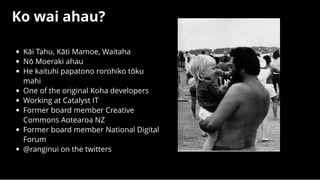
Kāi Tahu, Kāti Mamoe, Waitaha
Nō Moeraki ahau
He kaituhi papatono rorohiko tōku
mahi
One of the original Koha developers
Working at Catalyst IT
Former board member Creative
Commons Aotearoa NZ
Former board member National Digital
Forum
@ranginui on the twitters
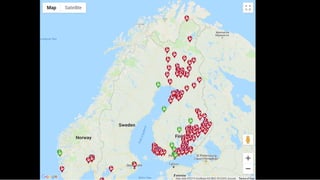
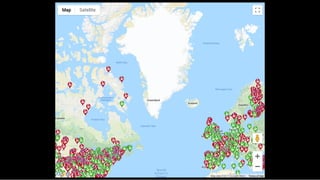
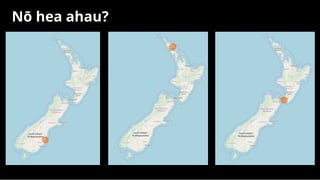
Nō hea ahau?Nō hea ahau?
CyleDeGuzman
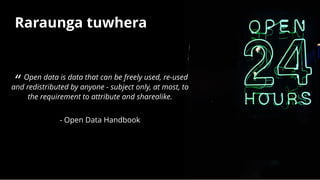
Raraunga tuwheraRaraunga tuwhera
“ Open data is data that can be freely used, re-used
and redistributed by anyone - subject only, at most, to
the requirement to attribute and sharealike.
 
- Open Data Handbook
Raraunga tuwheraRaraunga tuwhera
 
Availability and AccessAvailability and Access
 
Re-use and RedistributionRe-use and Redistribution
 
Universal ParticipationUniversal Participation
He aha ai?He aha ai?
Interoperability
Pai nē rā?Pai nē rā?
Kia tūpatoKia tūpato
 
The key point is that when opening up
data, the focus is on non-personal data,
that is, data which does not contain
information about specific individuals.
Pai tonu?Pai tonu?
When released in its raw form, data is not open to
the public in any meaningful sense. It is only open to
a small elite of technical specialists (and those who
can afford to hire them) who know how to interpret
and use it.
 
It's only open, if it's open all the way down.
He raru ki utaHe raru ki uta
Inaccurate data
 
Flawed interpretation
 
Ētahi atu raruraruĒtahi atu raruraru
He raru ki taiHe raru ki tai
The Investment Approach to Justice: Taking Integrated Offender Management to Police,
Justice and the wider social sector - Tim Hughes Principal Adviser, Ministry of Justice
 
“ These life-course risk models will be built on the Integrated Data Infrastructure at
Statistics NZ. This powerful database hosts a very wide range of anonymised
information about all New Zealanders, including records about tax, earnings and
employment records, health, education, and welfare receipt. We will use factors such
as age, and early CYF involvement, to predict future offending and victimisation for
the resident population of New Zealand.
Tētahi atu raru ki taiTētahi atu raru ki tai
“ Individuals in general experience the dispossession of their data, but
marginalized persons and groups experience additional ways in which
their data is “colonized” and used to further discriminate against them.
(Big) Data and the North-in-South:
Australia’s Informational Imperialism and
Digital Colonialism
- Monique Mann and Angela Daly
Can we get past these problems?Can we get past these problems?
Power based analysisPower based analysis
Maximise autonomy by keeping data private (mana motuhake)
 
While maximising control over the state by being able to see the
data they are using
 
Very simplisticallyVery simplistically
View it through the lens of the power differential, those with the
power should be open, those without, not so much.
We are used to asking:
What do we do with all these data?
How do we catalogue them?
How should we use them?
 
Less often we consider the questions:
Should we collect, aggregate, catalogue and exploit these data?
If so, how?
What would be ethical means for doing so?
The Good Data ManifestoThe Good Data Manifesto
Good Data -Edited by Angela Daly, S. Kate
Devitt and Monique Mann.
 
http://networkcultures.org/blog/publicatio
n/tod-29-good-data/
Te Mana Rarauranga
US Indigenous Data Sovereignty Network (USIDSN)
OCAP® (Ownership, Control, Access, Possession)
Maiam nayri Wingara
 
Organisations working onOrganisations working on
Data sovereigntyData sovereignty
Nā reiraNā reira
Data can be good, or bad, and used for
good or bad
Open data makes bad data worse, and
good data better (maybe)
 
Be very careful, once released under an
open license you can never unrelease it.
Nā reiraNā reira
Data can be good, or bad, and used for
good or bad
Open data makes bad data worse, and
good data better (maybe)
 
Be very careful, once released under an
open license you can never unrelease it.
 
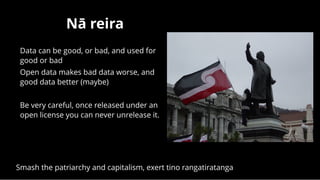
Smash the patriarchy and capitalism, exert tino rangatiratanga

Open data

  • 1.
    Title TextTitle TextOpenDataOpen Data IILF 2019IILF 2019
  • 2.
    Ko wai ahau?Kowai ahau? Kāi Tahu, Kāti Mamoe, Waitaha Nō Moeraki ahau He kaituhi papatono rorohiko tōku mahi One of the original Koha developers Working at Catalyst IT Former board member Creative Commons Aotearoa NZ Former board member National Digital Forum @ranginui on the twitters
  • 6.
  • 7.
    CyleDeGuzman Raraunga tuwheraRaraunga tuwhera “Open data is data that can be freely used, re-used and redistributed by anyone - subject only, at most, to the requirement to attribute and sharealike.   - Open Data Handbook
  • 8.
    Raraunga tuwheraRaraunga tuwhera   Availabilityand AccessAvailability and Access   Re-use and RedistributionRe-use and Redistribution   Universal ParticipationUniversal Participation
  • 9.
    He aha ai?Heaha ai? Interoperability
  • 10.
  • 11.
    Kia tūpatoKia tūpato   Thekey point is that when opening up data, the focus is on non-personal data, that is, data which does not contain information about specific individuals.
  • 12.
  • 14.
    When released inits raw form, data is not open to the public in any meaningful sense. It is only open to a small elite of technical specialists (and those who can afford to hire them) who know how to interpret and use it.   It's only open, if it's open all the way down. He raru ki utaHe raru ki uta
  • 15.
  • 16.
    He raru kitaiHe raru ki tai The Investment Approach to Justice: Taking Integrated Offender Management to Police, Justice and the wider social sector - Tim Hughes Principal Adviser, Ministry of Justice   “ These life-course risk models will be built on the Integrated Data Infrastructure at Statistics NZ. This powerful database hosts a very wide range of anonymised information about all New Zealanders, including records about tax, earnings and employment records, health, education, and welfare receipt. We will use factors such as age, and early CYF involvement, to predict future offending and victimisation for the resident population of New Zealand.
  • 17.
    Tētahi atu raruki taiTētahi atu raru ki tai “ Individuals in general experience the dispossession of their data, but marginalized persons and groups experience additional ways in which their data is “colonized” and used to further discriminate against them. (Big) Data and the North-in-South: Australia’s Informational Imperialism and Digital Colonialism - Monique Mann and Angela Daly
  • 18.
    Can we getpast these problems?Can we get past these problems?
  • 19.
    Power based analysisPowerbased analysis Maximise autonomy by keeping data private (mana motuhake)   While maximising control over the state by being able to see the data they are using   Very simplisticallyVery simplistically View it through the lens of the power differential, those with the power should be open, those without, not so much.
  • 20.
    We are usedto asking: What do we do with all these data? How do we catalogue them? How should we use them?   Less often we consider the questions: Should we collect, aggregate, catalogue and exploit these data? If so, how? What would be ethical means for doing so? The Good Data ManifestoThe Good Data Manifesto Good Data -Edited by Angela Daly, S. Kate Devitt and Monique Mann.   http://networkcultures.org/blog/publicatio n/tod-29-good-data/
  • 21.
    Te Mana Rarauranga USIndigenous Data Sovereignty Network (USIDSN) OCAP® (Ownership, Control, Access, Possession) Maiam nayri Wingara   Organisations working onOrganisations working on Data sovereigntyData sovereignty
  • 23.
    Nā reiraNā reira Datacan be good, or bad, and used for good or bad Open data makes bad data worse, and good data better (maybe)   Be very careful, once released under an open license you can never unrelease it.
  • 24.
    Nā reiraNā reira Datacan be good, or bad, and used for good or bad Open data makes bad data worse, and good data better (maybe)   Be very careful, once released under an open license you can never unrelease it.   Smash the patriarchy and capitalism, exert tino rangatiratanga