Positive feedback
 old industrial economy was driven by economics of
scale while the new information economy is driven by the
economics of network, called positive feedback
 networks have a fundamental economic
characteristic: the value of connecting to a network
depends on the number of other people already
connected to it
Positive feedback
 Positive feedback makes the strong get stronger and
the weak get weaker
 Dominance of market by a single firm or a technology
 Negative feedback
 In a negative-feedback system, the strong get weaker
and the weak get stronger
 larger firms became burdened with high costs, while
smaller firms found profitable niches
Positive feedback
 Market is tippy
 it can tip in favor of one player or another. It is
unlikely that all will survive
 Positive-feedback systems follow a predictable
pattern
a. flat during launch, then
b. a steep rise during takeoff as positive feedback kicks in
c. leveling off as saturation is reached
Demand-side economies of
scale
 In the information economy, positive feedback has
appeared in a new, more virulent form based on the
demand side of the market, not just the supply side
 Microsoft's dominance is based on demand-side economies
of scale. Microsoft's customers value its operating systems
because they are widely used
 positive relationship between popularity and value
 Popularity Adds Value in a Network Industry
Demand-side economies of
scale
 Supply side economies of scale
 Effect of declining average cost with increased
quantity
 double whammy
 Mixture of supply side and demand side economies of
scale in which growth on the demand side both
reduces cost on the supply side and makes the product
more attractive to other users
Network externalities
 Information product
 large networks are more attractive to users than small
ones
 Network externalities, usefully highlights two aspects of
information systems crucial for competitive strategy
 Network.
 Collection of users, managed by a sponsor
 Externalities
 consequence of an economic activity experienced by
unrelated third parties
Network externalities
 Negative externality
 economic activity that imposes a negative effect on an
unrelated third party
 can arise either during the production or the
consumption of a good or service.
 Pollution is termed an externality because it imposes
costs on people who are "external" to the producer and
consumer of the polluting product
Collective Switching Costs
 Challenge to companies seeking to introduce new
but incompatible technology into the market
 to build network size by overcoming the collective
switching costs—that is, the combined switching costs of all
users
 Convincing ten people connected in a network to
switch to your incompatible network is more than
ten times as hard as getting one customer to swith
Collective Switching Costs
 Control over a large installed base of users can be the
greatest asset you can have
Igniting positive feedback:
performance vs. compatibility
 There are two basic approaches for dealing with the
problem of consumer inertia
 evolution strategy of compatibility
 Revolution strategy of compelling performance
 Revolution
 Wipe the slate clean and come up with the best
product possible
 Evolution
 give up some performance to ensure compatibility and
thus ease consumer adoption
Evolution Strategy
 Focus on offering consumers an easy migration path
 centers on reducing switching costs so that
consumers can gradually try your new technology
 The key to the evolution strategy is to build a new
network by linking it first to the old one
 To lure customers, the migration path must be
smooth
Obstacles of Evolution
 Technical Obstacles
 Early 1990s, the Europeans promoted a standard for
the transmission of HDTV signals that conventional
TV sets could decipher.
 But, the signal was not as sharp as true HDTV, and the
technology was in difficulty
 Basic compatibility is not enough sometimes. We
require a fair bit of performance too
Obstacles of Evolution
 Legal Obstacles
 need to obtain the legal right to sell products that are
compatible with the established installed base of
products
 intellectual property rights over an older generation of
technology
Strategies for smooth user
migration paths
to newer technologies
 Use creative design
 Good engineering and product design can greatly ease
the compatibility/performance trade-off
 Think in terms of the system
 User cares with whole system despite the fact that we
manufacture one component
 Consider converters and bridge technologies
 Example
 Purchase of digital signal converters by analog TV owners
for compatibility of HDTV technology
Revolution: offer compelling
performance
 Revolution strategy involves brute force:
 Offer a product so much better than what people are
using that enough users will bear the pain of
switching to it
 first attracting customers who care the most about
performance and working down from there to the
mass market
Revolution: offer compelling
performance
 Trick
 Offer compelling performance to first attract
pioneering and influential users,
 then use this base to start up a bandwagon propelled
by self-fulfilling consumer beliefs in the inevitable
success of your product
 HDTV set manufacturers are hoping to first sell to
the so-called vidiots, those who simply must have
the very best quality video and the largest TV sets
available
Revolution: offer compelling
performance
 If the market is growing rapidly, or if consumer lock-
in is relatively mild, performance looms larger
relative to backward compatibility
 Revolution strategy is inherently risky.
 It cannot work on a small scale
 Difficult to tell early on whether your technology will
take off or crash
 So, it is better to start off slowly and accelerate from
there
Igniting positive feedback:
openness vs. control
 Anyone launching a new technology must also face a
second fundamental trade-off, in addition to the
performance/compatibility trade-off
 Do we choose an "open" approach by offering to make the
necessary interfaces and specifications available to others,
 or do you attempt to maintain control by keeping your
system proprietary?
 In choosing between openness and control,
 Your ultimate goal is to maximize the value of your
technology, not your control over it
 Your reward =
(Total value added to industry) x (your share of
industry value)
 openness emphasize the first term in this formula
 Total value added to the industry.
 Strategies to achieve control emphasize the second
term
 Your share of industry value
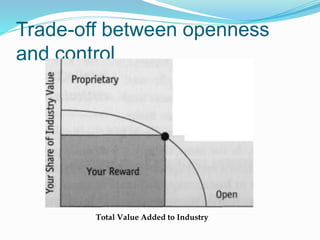
Trade-off between openness
and control
Total Value Added to Industry
Openness
 If the new technology draws on contributions from
several different companies, each agrees to sacrifice
control over its piece in order to create an attractive
package:
 Principle: the whole is greater than the sum of the
parts.
Approaches of Openness
 Under Full openness approach,
 anybody has the right to make products complying with
the standard, whether they contributed to its development
or not.
 Under An alliance approach,
 Each member of the alliance contributes something toward
the standard, and, in exchange, each is allowed to make
products complying with the standard.
 In other words, the alliance members all have guaranteed
(usually free) access to the network they have created, but
outsiders may be blocked from accessing it or required to
pay a special fee for such access.
Control
 Only those in the strongest position can hope to exert
strong control over newly introduced information
technologies
 Companies strong enough to unilaterally control product
standards and interfaces have power
 however, they have much to lose by promoting poorly
conceived standards
 Examples:
 VISA , Microsoft, Intel, Apple, etc
Control
 Proprietary control will be exceedingly valuable if your
product or system takes off
 You do not face rivals who can offer products to locked-
in customers
 Network is far more valuable if you can control the
ability of others to interconnect with you
 However, failure to open up a technology can spell its
demise, if consumers fear lock-in or if you face a strong
rival whose system offers comparable performance but is
nonproprietary
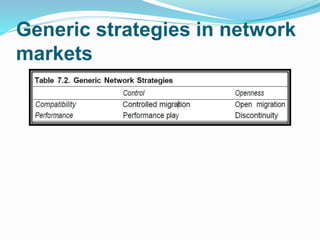
Generic strategies in network
markets
Generic strategies in network
markets
 Performance Play
 Involves the introduction of a new, incompatible
technology over which the vendor retains strong
proprietary control
 Makes the most sense if your advantage of a striking new
technology that offers users substantial advantages over
existing technology
 Entrants and upstarts with compelling new technology can
more easily afford to ignore backward compatibility
 Controlled Migration
 consumers are offered a new and improved technology that
is compatible with their existing technology, but is
proprietary
 Open Migration
 new product is supplied by many vendors and
requires little by way of switching costs
 makes the most sense if your advantage is primarily
based on manufacturing capabilities.
 In that case, you will benefit from a larger total market
and scale economies to shine
 Discontinuity
 New product or technology is incompatible with
existing technology but is available from multiple
suppliers
 favors suppliers that are either efficient manufacturers
or that are best provide value-added services or
software enhancements (in the case of software)
Metcalfe’ Law
 Named After Bob Metcalfe, the inventor of Ethernet.
 Value of a network of a network goes up as a square of a number of users
 If there are n people in a network, and the value of the network to each of
them is proportional to the number of other users, then
 The total value of the network is n2
 If the value of a network to a single user is $1 for each other user on the network,
then a network of size 10 has a total value of roughly $100. In contrast, a
network of size 100 has a total value of roughly $10,000.
 More the users, more connections or linkage
 More linkage, more value to the network
 But eliminate copy of connections and own’s connection too
 Formula
 If n users exists, then
 Connections = (n(n-1))/2

EIC-Unit-7.pptx

  • 2.
    Positive feedback  oldindustrial economy was driven by economics of scale while the new information economy is driven by the economics of network, called positive feedback  networks have a fundamental economic characteristic: the value of connecting to a network depends on the number of other people already connected to it
  • 3.
    Positive feedback  Positivefeedback makes the strong get stronger and the weak get weaker  Dominance of market by a single firm or a technology  Negative feedback  In a negative-feedback system, the strong get weaker and the weak get stronger  larger firms became burdened with high costs, while smaller firms found profitable niches
  • 4.
    Positive feedback  Marketis tippy  it can tip in favor of one player or another. It is unlikely that all will survive  Positive-feedback systems follow a predictable pattern a. flat during launch, then b. a steep rise during takeoff as positive feedback kicks in c. leveling off as saturation is reached
  • 5.
    Demand-side economies of scale In the information economy, positive feedback has appeared in a new, more virulent form based on the demand side of the market, not just the supply side  Microsoft's dominance is based on demand-side economies of scale. Microsoft's customers value its operating systems because they are widely used  positive relationship between popularity and value  Popularity Adds Value in a Network Industry
  • 6.
    Demand-side economies of scale Supply side economies of scale  Effect of declining average cost with increased quantity  double whammy  Mixture of supply side and demand side economies of scale in which growth on the demand side both reduces cost on the supply side and makes the product more attractive to other users
  • 7.
    Network externalities  Informationproduct  large networks are more attractive to users than small ones  Network externalities, usefully highlights two aspects of information systems crucial for competitive strategy  Network.  Collection of users, managed by a sponsor  Externalities  consequence of an economic activity experienced by unrelated third parties
  • 8.
    Network externalities  Negativeexternality  economic activity that imposes a negative effect on an unrelated third party  can arise either during the production or the consumption of a good or service.  Pollution is termed an externality because it imposes costs on people who are "external" to the producer and consumer of the polluting product
  • 9.
    Collective Switching Costs Challenge to companies seeking to introduce new but incompatible technology into the market  to build network size by overcoming the collective switching costs—that is, the combined switching costs of all users  Convincing ten people connected in a network to switch to your incompatible network is more than ten times as hard as getting one customer to swith
  • 10.
    Collective Switching Costs Control over a large installed base of users can be the greatest asset you can have
  • 11.
    Igniting positive feedback: performancevs. compatibility  There are two basic approaches for dealing with the problem of consumer inertia  evolution strategy of compatibility  Revolution strategy of compelling performance  Revolution  Wipe the slate clean and come up with the best product possible  Evolution  give up some performance to ensure compatibility and thus ease consumer adoption
  • 12.
    Evolution Strategy  Focuson offering consumers an easy migration path  centers on reducing switching costs so that consumers can gradually try your new technology  The key to the evolution strategy is to build a new network by linking it first to the old one  To lure customers, the migration path must be smooth
  • 13.
    Obstacles of Evolution Technical Obstacles  Early 1990s, the Europeans promoted a standard for the transmission of HDTV signals that conventional TV sets could decipher.  But, the signal was not as sharp as true HDTV, and the technology was in difficulty  Basic compatibility is not enough sometimes. We require a fair bit of performance too
  • 14.
    Obstacles of Evolution Legal Obstacles  need to obtain the legal right to sell products that are compatible with the established installed base of products  intellectual property rights over an older generation of technology
  • 15.
    Strategies for smoothuser migration paths to newer technologies  Use creative design  Good engineering and product design can greatly ease the compatibility/performance trade-off  Think in terms of the system  User cares with whole system despite the fact that we manufacture one component  Consider converters and bridge technologies  Example  Purchase of digital signal converters by analog TV owners for compatibility of HDTV technology
  • 16.
    Revolution: offer compelling performance Revolution strategy involves brute force:  Offer a product so much better than what people are using that enough users will bear the pain of switching to it  first attracting customers who care the most about performance and working down from there to the mass market
  • 17.
    Revolution: offer compelling performance Trick  Offer compelling performance to first attract pioneering and influential users,  then use this base to start up a bandwagon propelled by self-fulfilling consumer beliefs in the inevitable success of your product  HDTV set manufacturers are hoping to first sell to the so-called vidiots, those who simply must have the very best quality video and the largest TV sets available
  • 18.
    Revolution: offer compelling performance If the market is growing rapidly, or if consumer lock- in is relatively mild, performance looms larger relative to backward compatibility  Revolution strategy is inherently risky.  It cannot work on a small scale  Difficult to tell early on whether your technology will take off or crash  So, it is better to start off slowly and accelerate from there
  • 19.
    Igniting positive feedback: opennessvs. control  Anyone launching a new technology must also face a second fundamental trade-off, in addition to the performance/compatibility trade-off  Do we choose an "open" approach by offering to make the necessary interfaces and specifications available to others,  or do you attempt to maintain control by keeping your system proprietary?  In choosing between openness and control,  Your ultimate goal is to maximize the value of your technology, not your control over it
  • 20.
     Your reward= (Total value added to industry) x (your share of industry value)  openness emphasize the first term in this formula  Total value added to the industry.  Strategies to achieve control emphasize the second term  Your share of industry value
  • 21.
    Trade-off between openness andcontrol Total Value Added to Industry
  • 22.
    Openness  If thenew technology draws on contributions from several different companies, each agrees to sacrifice control over its piece in order to create an attractive package:  Principle: the whole is greater than the sum of the parts.
  • 23.
    Approaches of Openness Under Full openness approach,  anybody has the right to make products complying with the standard, whether they contributed to its development or not.  Under An alliance approach,  Each member of the alliance contributes something toward the standard, and, in exchange, each is allowed to make products complying with the standard.  In other words, the alliance members all have guaranteed (usually free) access to the network they have created, but outsiders may be blocked from accessing it or required to pay a special fee for such access.
  • 24.
    Control  Only thosein the strongest position can hope to exert strong control over newly introduced information technologies  Companies strong enough to unilaterally control product standards and interfaces have power  however, they have much to lose by promoting poorly conceived standards  Examples:  VISA , Microsoft, Intel, Apple, etc
  • 25.
    Control  Proprietary controlwill be exceedingly valuable if your product or system takes off  You do not face rivals who can offer products to locked- in customers  Network is far more valuable if you can control the ability of others to interconnect with you  However, failure to open up a technology can spell its demise, if consumers fear lock-in or if you face a strong rival whose system offers comparable performance but is nonproprietary
  • 26.
    Generic strategies innetwork markets
  • 27.
    Generic strategies innetwork markets  Performance Play  Involves the introduction of a new, incompatible technology over which the vendor retains strong proprietary control  Makes the most sense if your advantage of a striking new technology that offers users substantial advantages over existing technology  Entrants and upstarts with compelling new technology can more easily afford to ignore backward compatibility  Controlled Migration  consumers are offered a new and improved technology that is compatible with their existing technology, but is proprietary
  • 28.
     Open Migration new product is supplied by many vendors and requires little by way of switching costs  makes the most sense if your advantage is primarily based on manufacturing capabilities.  In that case, you will benefit from a larger total market and scale economies to shine  Discontinuity  New product or technology is incompatible with existing technology but is available from multiple suppliers  favors suppliers that are either efficient manufacturers or that are best provide value-added services or software enhancements (in the case of software)
  • 29.
    Metcalfe’ Law  NamedAfter Bob Metcalfe, the inventor of Ethernet.  Value of a network of a network goes up as a square of a number of users  If there are n people in a network, and the value of the network to each of them is proportional to the number of other users, then  The total value of the network is n2  If the value of a network to a single user is $1 for each other user on the network, then a network of size 10 has a total value of roughly $100. In contrast, a network of size 100 has a total value of roughly $10,000.  More the users, more connections or linkage  More linkage, more value to the network  But eliminate copy of connections and own’s connection too  Formula  If n users exists, then  Connections = (n(n-1))/2