The IAEA Legal Framework for  Nuclear Safety: At a Glance
International Instruments
Convention on Nuclear Safety, 1994 (INFCIRC/449)  Joint Convention on the Safety of Spent Fuel Management and on the Safety of Radioactive Waste Management, 1997 (INFCIRC/546) Convention on Early Notification of a Nuclear Accident, 1986 (INFCIRC/335) Convention on Assistance in the Case of a Nuclear Accident or Radiological Emergency, 1986 (INFCIRC/336) Code of Conduct on the Safety and Security of Radioactive Sources, 2003 (INFCIRC/663) Code of Conduct on the Safety of Research Reactors, 2004 (IAEA/CODEOC/RR/2006) International Instruments contd.
To provide a  legal framework  for conducting activities related to the peaceful uses of  nuclear energy  and  ionizing radiation  in a manner which adequately  protects  individuals, property and the environment Objective
Convention on Nuclear Safety (CNS) The CNS applies to: The safety of nuclear installations: “ Nuclear installation" defined as  any land-based civil nuclear power plant including such storage, handling and treatment facilities for radioactive materials as are on the same site and are directly related to the operation of the nuclear power plant Does  not  apply to research reactors At present 72 Contracting Parties
“ Peer Review Process” Preparatory Meeting: April 1997 To-date, five Review Meetings:  1999, 2002, 2005, 2008 and 2011 Extraordinary Meeting scheduled for 2012, inter alia, to  analyse the relevant issues arising from the accident at the Fukushima Daiichi NPP Contracting Parties must report to Review Meetings on how they implement each of the obligations under the Convention (Article 20)
Key Points: Considered as an “incentive” convention i.e. no enforcement mechanism “ Peer Review Process”
Joint Convention on the Safety of Spent Fuel Management and on the Safety of Radioactive Waste Management  The Joint Convention applies to: spent fuel and radioactive waste when the spent fuel results from civilian applications/ nuclear reactors uranium mining and milling wastes discharges from regulated activities At present 58 Contracting Parties
Generally does not apply to: spent fuel held at reprocessing facilities as part of a reprocessing activity waste containing only naturally occurring radioactive materials (NORM) and which is outside the nuclear fuel cycle  spent fuel and radioactive waste from military or defense programes Scope of Application contd.
“ Peer Review Process” Contracting Parties must report to Review Meetings on how they implement each of the obligations under the Convention (Article 32)  Preparatory Meeting: Dec. 2001 To-date, three Review Meetings: 2003, 2006 and 2009 Also, an Extraordinary Meeting held in Nov. 2005 4 th  Review Meeting scheduled for 2012
Key Points: Relevant to all states (with or without a nuclear power programme) Specific (miscellaneous) provisions on transboundary movement of spent fuel and radioactive waste (Article 27) and disused sealed sources (Article 28)  As for the CNS, “incentive” convention and  “Peer Review Process”
Obligation to notify nuclear accidents Inform and assist in a nuclear accident or radiological emergency Based on a system of competent authorities and national contact points for information exchange Detailed information must be made known  through these contact points so as to facilitate counter measures   Early Notification & Assistance Conventions
The  Conventions are supplemented by: Bilateral agreements between neighbouring States Standards, practical arrangements and mechanisms e.g: Early Notification & Assistance Conventions contd.
Key Points: More than 100 parties to each of the Conventions However, the system is not yet consolidated Early Notification & Assistance Conventions contd.
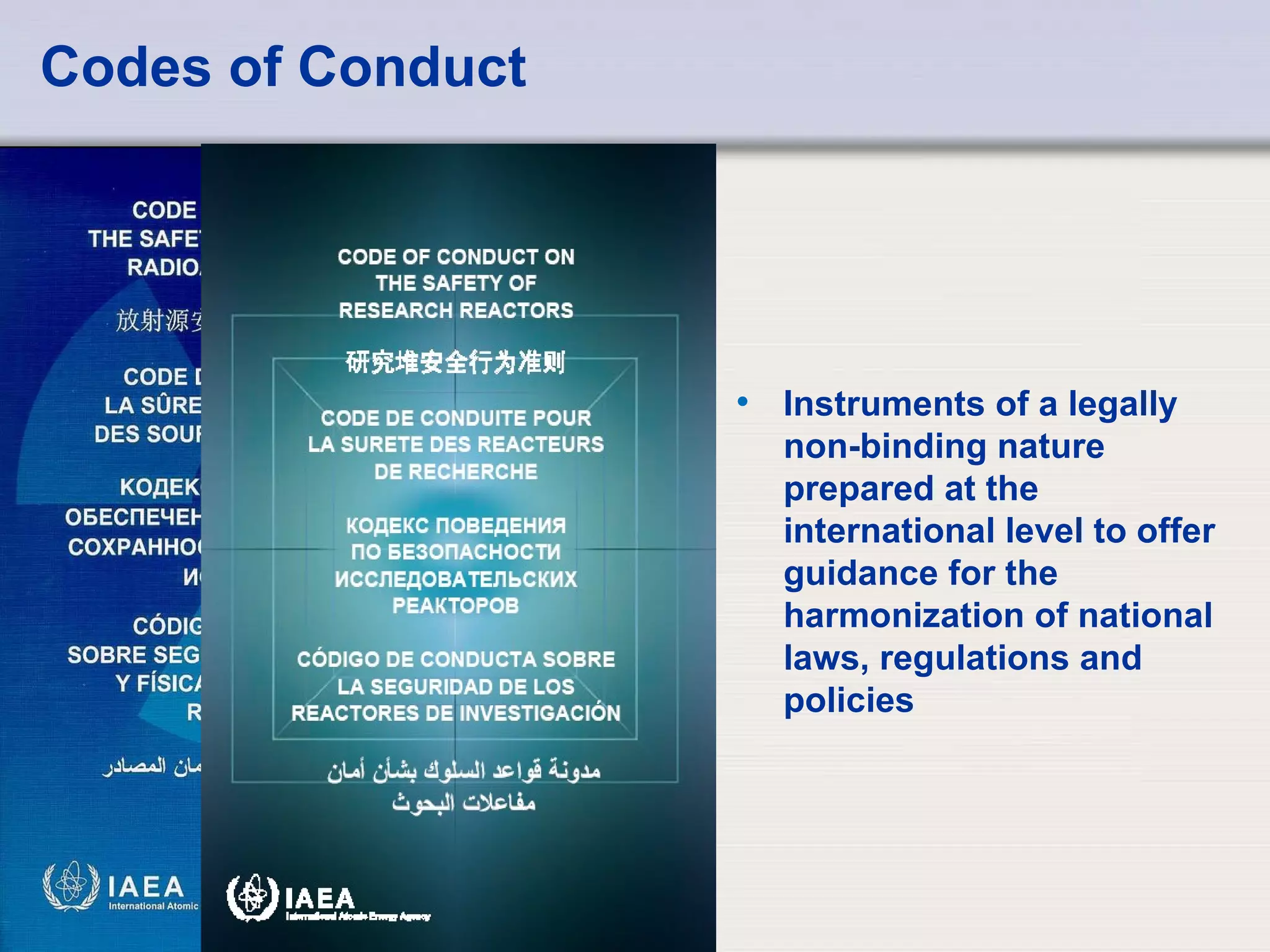
Codes of Conduct Instruments of a legally non-binding nature prepared at the international level to offer guidance for the harmonization of national laws, regulations and policies
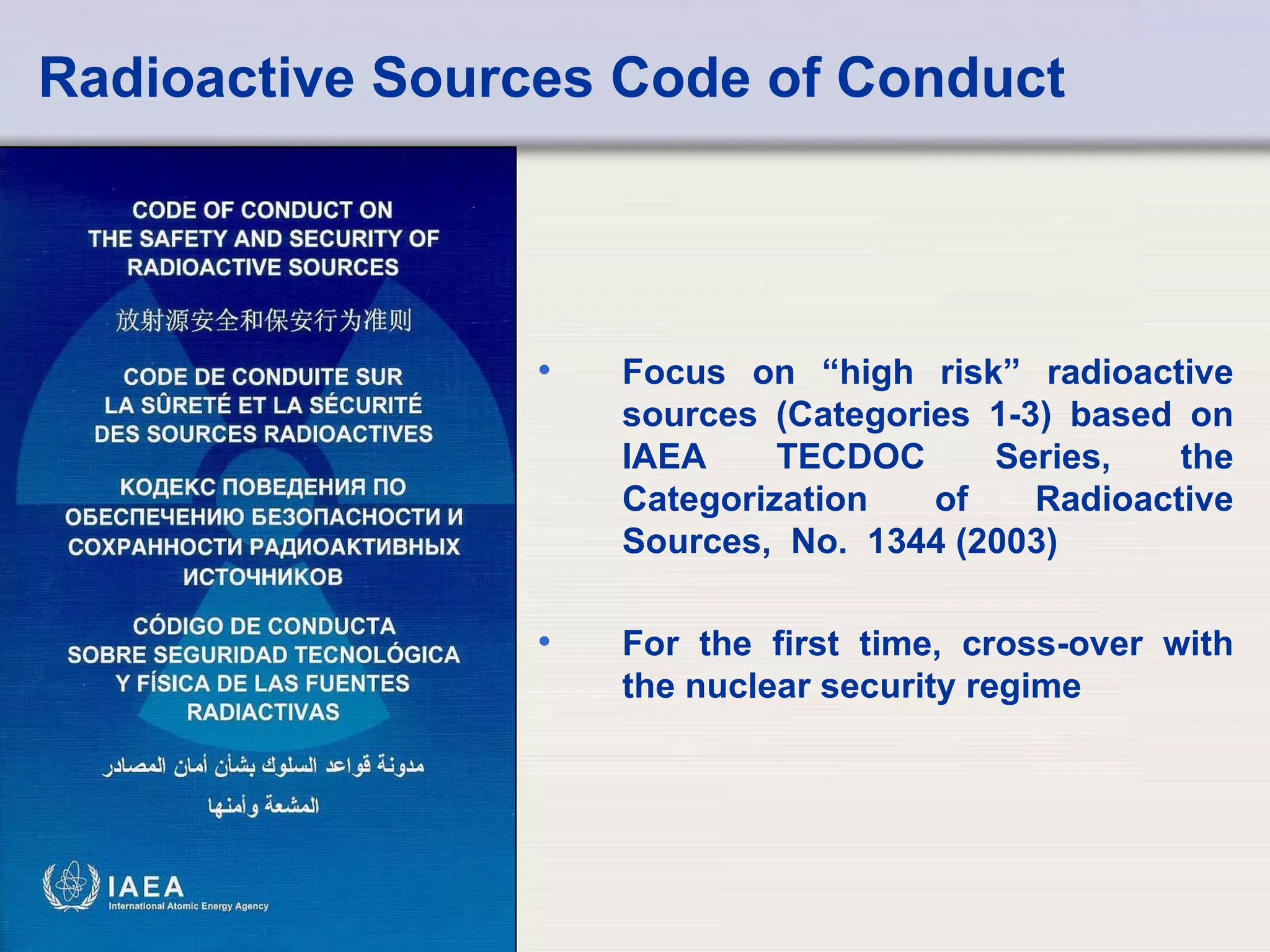
Radioactive Sources Code of Conduct Focus on “high risk” radioactive sources (Categories 1-3) based on IAEA TECDOC Series, the  Categorization of Radioactive Sources,  No.  1344 (2003) For the first time, cross-over with the nuclear security regime
Radioactive Sources Code of Conduct Contd. Key Points: A non-binding legal instrument No “Peer Review Process” but an informal review process More than 100 “political commitments” given to-date pursuant to GC resolution Supplemented by import/ export Guidance (also with “political commitments” pursuant to GC resolution)
Research Reactors Code of Conduct Safety of “research reactors” i.e. nuclear reactors used mainly for the generation and utilization of neutron flux and ionising radiation for research and other purposes  Addresses not only the role of the State and the Regulatory Body but also the Operating Organization
Key Points: Also a non-binding legal instrument but no “political commitments” Covers all stages of Research Reactors lives from siting to decommissioning No “Peer Review Process” but ongoing activities including to examine progress and to promote sharing knowledge Research Reactors Code of Conduct contd.
IAEA Safety Standards Series: Statutory basis – Article III.A(6) The Safety Standards Series comprises of:  Safety Fundamentals;  Safety Requirements; and  Safety Guides Publications of a regulatory nature covering various fields of nuclear safety International Legal Instruments on Nuclear Safety contd.
Some important publications: Fundamental Safety Principles, No. SF-1 (2006) Governmental, Legal and Regulatory Framework for Safety, No. GSR Part 1 (2010) International Basic Safety Standards for Protection against Ionizing Radiation and for the Safety of Radiation Sources, No. 115 (1996) Regulations for the Safe Transport of Radioactive Material, TS-R-1 (2009) International Legal Instruments on Nuclear Safety contd.
IAEA Office of Legal Affairs Website: http://ola.iaea.org/OLA/default.asp  Further Information

The IAEA Legal Framework for Nuclear Safety

  • 1.
    The IAEA LegalFramework for Nuclear Safety: At a Glance
  • 2.
  • 3.
    Convention on NuclearSafety, 1994 (INFCIRC/449) Joint Convention on the Safety of Spent Fuel Management and on the Safety of Radioactive Waste Management, 1997 (INFCIRC/546) Convention on Early Notification of a Nuclear Accident, 1986 (INFCIRC/335) Convention on Assistance in the Case of a Nuclear Accident or Radiological Emergency, 1986 (INFCIRC/336) Code of Conduct on the Safety and Security of Radioactive Sources, 2003 (INFCIRC/663) Code of Conduct on the Safety of Research Reactors, 2004 (IAEA/CODEOC/RR/2006) International Instruments contd.
  • 4.
    To provide a legal framework for conducting activities related to the peaceful uses of nuclear energy and ionizing radiation in a manner which adequately protects individuals, property and the environment Objective
  • 5.
    Convention on NuclearSafety (CNS) The CNS applies to: The safety of nuclear installations: “ Nuclear installation" defined as any land-based civil nuclear power plant including such storage, handling and treatment facilities for radioactive materials as are on the same site and are directly related to the operation of the nuclear power plant Does not apply to research reactors At present 72 Contracting Parties
  • 6.
    “ Peer ReviewProcess” Preparatory Meeting: April 1997 To-date, five Review Meetings: 1999, 2002, 2005, 2008 and 2011 Extraordinary Meeting scheduled for 2012, inter alia, to analyse the relevant issues arising from the accident at the Fukushima Daiichi NPP Contracting Parties must report to Review Meetings on how they implement each of the obligations under the Convention (Article 20)
  • 7.
    Key Points: Consideredas an “incentive” convention i.e. no enforcement mechanism “ Peer Review Process”
  • 8.
    Joint Convention onthe Safety of Spent Fuel Management and on the Safety of Radioactive Waste Management The Joint Convention applies to: spent fuel and radioactive waste when the spent fuel results from civilian applications/ nuclear reactors uranium mining and milling wastes discharges from regulated activities At present 58 Contracting Parties
  • 9.
    Generally does notapply to: spent fuel held at reprocessing facilities as part of a reprocessing activity waste containing only naturally occurring radioactive materials (NORM) and which is outside the nuclear fuel cycle spent fuel and radioactive waste from military or defense programes Scope of Application contd.
  • 10.
    “ Peer ReviewProcess” Contracting Parties must report to Review Meetings on how they implement each of the obligations under the Convention (Article 32) Preparatory Meeting: Dec. 2001 To-date, three Review Meetings: 2003, 2006 and 2009 Also, an Extraordinary Meeting held in Nov. 2005 4 th Review Meeting scheduled for 2012
  • 11.
    Key Points: Relevantto all states (with or without a nuclear power programme) Specific (miscellaneous) provisions on transboundary movement of spent fuel and radioactive waste (Article 27) and disused sealed sources (Article 28) As for the CNS, “incentive” convention and “Peer Review Process”
  • 12.
    Obligation to notifynuclear accidents Inform and assist in a nuclear accident or radiological emergency Based on a system of competent authorities and national contact points for information exchange Detailed information must be made known through these contact points so as to facilitate counter measures Early Notification & Assistance Conventions
  • 13.
    The Conventionsare supplemented by: Bilateral agreements between neighbouring States Standards, practical arrangements and mechanisms e.g: Early Notification & Assistance Conventions contd.
  • 14.
    Key Points: Morethan 100 parties to each of the Conventions However, the system is not yet consolidated Early Notification & Assistance Conventions contd.
  • 15.
    Codes of ConductInstruments of a legally non-binding nature prepared at the international level to offer guidance for the harmonization of national laws, regulations and policies
  • 16.
    Radioactive Sources Codeof Conduct Focus on “high risk” radioactive sources (Categories 1-3) based on IAEA TECDOC Series, the Categorization of Radioactive Sources, No.  1344 (2003) For the first time, cross-over with the nuclear security regime
  • 17.
    Radioactive Sources Codeof Conduct Contd. Key Points: A non-binding legal instrument No “Peer Review Process” but an informal review process More than 100 “political commitments” given to-date pursuant to GC resolution Supplemented by import/ export Guidance (also with “political commitments” pursuant to GC resolution)
  • 18.
    Research Reactors Codeof Conduct Safety of “research reactors” i.e. nuclear reactors used mainly for the generation and utilization of neutron flux and ionising radiation for research and other purposes Addresses not only the role of the State and the Regulatory Body but also the Operating Organization
  • 19.
    Key Points: Alsoa non-binding legal instrument but no “political commitments” Covers all stages of Research Reactors lives from siting to decommissioning No “Peer Review Process” but ongoing activities including to examine progress and to promote sharing knowledge Research Reactors Code of Conduct contd.
  • 20.
    IAEA Safety StandardsSeries: Statutory basis – Article III.A(6) The Safety Standards Series comprises of: Safety Fundamentals; Safety Requirements; and Safety Guides Publications of a regulatory nature covering various fields of nuclear safety International Legal Instruments on Nuclear Safety contd.
  • 21.
    Some important publications:Fundamental Safety Principles, No. SF-1 (2006) Governmental, Legal and Regulatory Framework for Safety, No. GSR Part 1 (2010) International Basic Safety Standards for Protection against Ionizing Radiation and for the Safety of Radiation Sources, No. 115 (1996) Regulations for the Safe Transport of Radioactive Material, TS-R-1 (2009) International Legal Instruments on Nuclear Safety contd.
  • 22.
    IAEA Office ofLegal Affairs Website: http://ola.iaea.org/OLA/default.asp Further Information