
IAEA BULLETIN
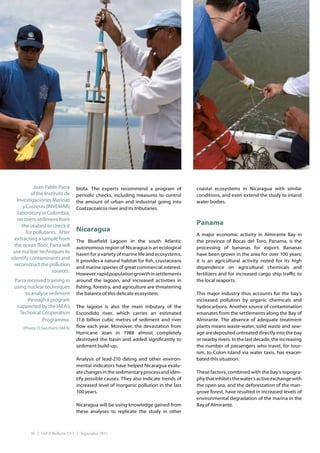
                    INTERNATIONAL ATOMIC ENERGY AGENCY
                                  September 2011 | 53-1 | www.iaea.org/bulletin


                            too little,
                             too hard to find


Water for Santa Elena • Farming When the Rains Fail • Protecting Coastal Waters
The International Atomic Energy Agency serves
as the world’s foremost intergovernmental forum
for scientific and technical cooperation in the
peaceful use of nuclear technology. Established as
an autonomous organization under the United
Nations in 1957, the IAEA carries out programmes
to maximize the useful contribution of nuclear
technology to society while verifying its peaceful use.

The IAEA helps its Member States pursue their
developmental goals by supporting the responsible
planning and use of nuclear science and technology.
The IAEA facilitates the transfer of the knowledge
and technology needed by developing Member
States to utilize these technologies peacefully.

By developing nuclear safety standards, the IAEA
promotes the achievement and maintenance of high
levels of safety in nuclear energy applications, as well
as protecting human health and the environment
against ionizing radiation.

The IAEA also verifies through its inspection system
that Member States comply with their commitments
under the Non-Proliferation Treaty and other
non-proliferation agreements to use nuclear
material and facilities only for peaceful purposes.

The work is multi-faceted and engages a wide variety
of partners at the national, regional and international
levels. IAEA programmes and budgets are set
through decisions of its policymaking bodies — the
35-member Board of Governors and the General
Conference of all Member States.

The IAEA is headquartered at the Vienna
International Centre. Field and liaison offices are
located in Geneva, New York,Tokyo and Toronto.
The IAEA operates scientific laboratories in Monaco,
Seibersdorf and Vienna. In addition, the IAEA
supports and provides funding to the Abdus Salam
International Centre for Theoretical Physics,Trieste.
IAEA BULLETIN
CONTENTS
                                                                     INTERNATIONAL ATOMIC ENERGY AGENCY
                                                                                   September 2011 | 53-1 | www.iaea.org/bulletin


IAEA Bulletin 53-1 | September 2011

Why Water Matters 2
by Yukiya Amano

Too Little, Too Hard to Find 3                                               too little,
by Sasha Henriques
Sidebar: Assessing Water Needs
                                                                              too hard to find

Tackling the Water Crisis 6
by Mollie Rock Zuccato
Sidebar: Optimal Results                         Water for Santa Elena • Farming When the Rains Fail • Protecting Coastal Waters


                                                                            IAEA BULLETIN
Complex Science Saving Lives in Bangladesh 10                            is produced by the
by Sasha Henriques                                              Division of Public Information
                                                           International Atomic Energy Agency
                                                            P.O. Box 100, A-1400 Vienna, Austria
IAEA Helps Parched Santa Elena Find Water 12
                                                                    Phone: (43-1) 2600-21270
by Maureen MacNeill                                                   Fax: (43-1) 2600-29610
                                                                      IAEABulletin@iaea.org
Treasure Maps 14
by Peter Kaiser                                                 Division of Public Information
                                                                  Editor-in-Chief: Peter Kaiser
All About Water 17                                           Assistant Editor/Design: Ritu Kenn
Facts and figures on the water crisis
                                                            IAEA BULLETIN is available online at
Improving Farming with Nuclear Techniques 21                          www.iaea.org/bulletin
                                                            Past editions are archived on-line at
by Sasha Henriques
                                                                www.iaea.org/bulletinarchive
Sidebar: Making the Most of it

Farming When the Rains Fail 23                    Extracts from the IAEA material contained in the
by Louise Potterton                             IAEA Bulletin may be freely used elsewhere provided
Sidebar: Seeing Through Soil                      acknowledgement of their source is made. If the
                                                 attribution indicates that the author is not an IAEA
                                                staff member, permission to republish other than for
If I Had Water... 26
                                                the use of review must be sought from the author or
by Louise Potterton
                                                                    originating organization.

No Rain, No Food 29                              Views expressed in any signed article appearing in
by Louise Potterton
                                                the IAEA Bulletin do not necessarily represent those
                                                of the International Atomic Energy Agency and the
Sustainable Management of Coastal Waters 32              IAEA accepts no responsibility for them.
by Rodolfo Quevenco
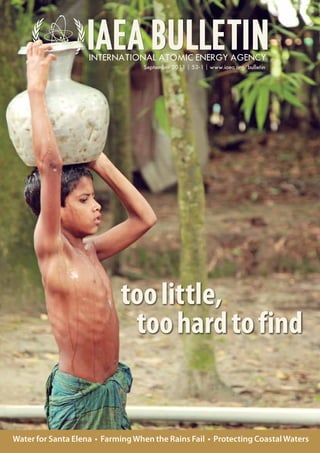
                                                     Cover Photo: A young boy from Kishoreganj
Detecting a Killer Toxin 38                     District in central Bangladesh carries water through
by Rodolfo Quevenco                                 his village. Kishoreganj is one of several areas
                                                    in Bangladesh which has been affected by the
Protection From a Toxic Menace 41                  presence of arsenic in its groundwater supply.
by Sasha Henriques                                              To learn more, turn to page 10.
                                                              (D. Sacchetti/IAEA, August 2011)
An Ocean of Knowledge 43
by Peter Kaiser                                        IAEA Bulletin is printed in Vienna, Austria.

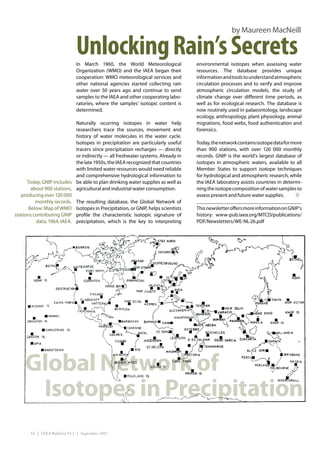
Sidebar: Unlocking Rain’s Secrets

                                                       IAEA Bulletin 49-2 | March 2008 | 1
by Yukiya Amano

                       Why Water Matters
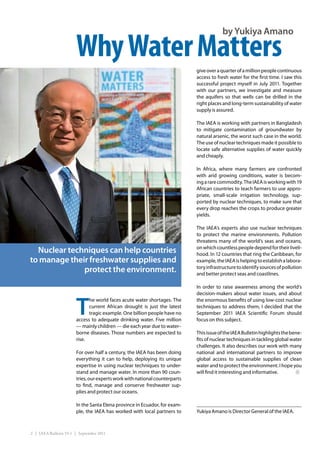
                                                                            give over a quarter of a million people continuous
                                                                            access to fresh water for the first time. I saw this
                                                                            successful project myself in July 2011. Together
                                                                            with our partners, we investigate and measure
                                                                            the aquifers so that wells can be drilled in the
                                                                            right places and long-term sustainability of water
                                                                            supply is assured.

                                                                            The IAEA is working with partners in Bangladesh
                                                                            to mitigate contamination of groundwater by
                                                                            natural arsenic, the worst such case in the world.
                                                                            The use of nuclear techniques made it possible to
                                                                            locate safe alternative supplies of water quickly
                                                                            and cheaply.

                                                                            In Africa, where many farmers are confronted
                                                                            with arid growing conditions, water is becom-
                                                                            ing a rare commodity. The IAEA is working with 19
                                                                            African countries to teach farmers to use appro-
                                                                            priate, small-scale irrigation technology, sup-
                                                                            ported by nuclear techniques, to make sure that
                                                                            every drop reaches the crops to produce greater
                                                                            yields.

                                                                            The IAEA’s experts also use nuclear techniques
                                                                            to protect the marine environments. Pollution
                                                                            threatens many of the world’s seas and oceans,
                                                                            on which countless people depend for their liveli-
  Nuclear techniques can help countries                                     hood. In 12 countries that ring the Caribbean, for
to manage their freshwater supplies and                                     example, the IAEA is helping to establish a labora-
              protect the environment.                                      tory infrastructure to identify sources of pollution
                                                                            and better protect seas and coastlines.

                                                                            In order to raise awareness among the world’s
                                                                            decision-makers about water issues, and about


                       T
                             he world faces acute water shortages. The      the enormous benefits of using low-cost nuclear
                             current African drought is just the latest     techniques to address them, I decided that the
                             tragic example. One billion people have no     September 2011 IAEA Scientific Forum should
                       access to adequate drinking water. Five million      focus on this subject.
                       — mainly children — die each year due to water–
                       borne diseases. Those numbers are expected to        This issue of the IAEA Bulletin highlights the bene-
                       rise.                                                fits of nuclear techniques in tackling global water
                                                                            challenges. It also describes our work with many
                       For over half a century, the IAEA has been doing     national and international partners to improve
                       everything it can to help, deploying its unique      global access to sustainable supplies of clean
                       expertise in using nuclear techniques to under-      water and to protect the environment. I hope you
                       stand and manage water. In more than 90 coun-        will find it interesting and informative.
                       tries, our experts work with national counterparts
                       to find, manage and conserve freshwater sup-
                       plies and protect our oceans.

                       In the Santa Elena province in Ecuador, for exam-
                       ple, the IAEA has worked with local partners to      Yukiya Amano is Director General of the IAEA.


2 | IAEA Bulletin 53-1 | September 2011
by Sasha Henriques

  too little, too hard to find
  Addressing the Global Water Crisis


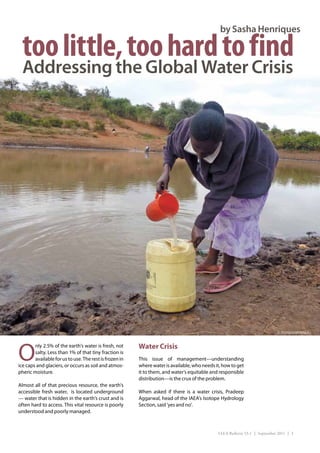
                                                                                                                            (L.Potterton/IAEA)


O                                                        Water Crisis
        nly 2.5% of the earth’s water is fresh, not
        salty. Less than 1% of that tiny fraction is
        available for us to use. The rest is frozen in   This issue of management—understanding
ice caps and glaciers, or occurs as soil and atmos-      where water is available, who needs it, how to get
pheric moisture.                                         it to them, and water’s equitable and responsible
                                                         distribution—is the crux of the problem.
Almost all of that precious resource, the earth’s
accessible fresh water, is located underground           When asked if there is a water crisis, Pradeep
— water that is hidden in the earth’s crust and is       Aggarwal, head of the IAEA’s Isotope Hydrology
often hard to access. This vital resource is poorly      Section, said ‘yes and no’. 
understood and poorly managed.


                                                                                              IAEA Bulletin 53-1 | September 2011 | 3
Too Little, Too Hard to Find


                                                                                       But there are technological developments which
                                                                                       are leading to less water consumption, while
                                                                                       maintaining or improving crop yields. These
                                                                                       developments include genetic and non-genetic
                                                                                       crop modification and drip irrigation.

                                                                                       “If there were to be further developments in
                                                                                       agricultural technology, and if these were to
                                                                                       be adopted more quickly, there might just be
                                                                                       enough water to grow food to feed a growing
                                                                                       world population.”

                                                                                       Beyond expanding urban populations and more
                                                                                       demand for food, there is the issue of climate
                                                                                       change, which leads to too much rain at one time,
                                                                                       causing flooding, rather than sufficient water
                                                                                       going into the ground to recharge aquifers.

                                                                                       “Also, poor distribution mechanisms; inadequate
                                                                                       protection of water sources to ensure they remain
                                                                                       clean; and financial strain all conspire to increase
                                                                                       governments’ inability to provide sufficient pota-
                                                                                       ble water to their populations,” said Aggarwal.

                                                                                       The need to understand and manage water is
                                                                                       becoming more urgent for many countries. The
                                                                                       IAEA, knowing how much water matters, is help-
   Understanding where          In high demand places, like urban areas and the        ing them do just that, using isotope hydrology.
  water is available, who       arid and semi-arid areas of Asia and Africa, there
needs it and how to get it      often isn’t enough water. But many low demand
to them is the crux of the      places have quite a lot.
                                                                                       Detective Work
                problem.                                                               Isotope hydrology helps scientists and
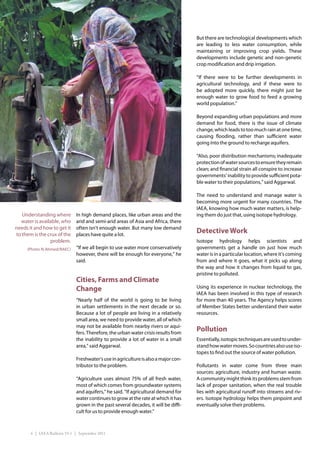
     (Photo: N.Ahmed/BAEC)      “If we all begin to use water more conservatively      governments get a handle on just how much
                                however, there will be enough for everyone,” he        water is in a particular location, where it’s coming
                                said.                                                  from and where it goes, what it picks up along
                                                                                       the way and how it changes from liquid to gas,
                                                                                       pristine to polluted.
                                Cities, Farms and Climate
                                Change                                                 Using its experience in nuclear technology, the
                                                                                       IAEA has been involved in this type of research
                                “Nearly half of the world is going to be living        for more than 40 years. The Agency helps scores
                                in urban settlements in the next decade or so.         of Member States better understand their water
                                Because a lot of people are living in a relatively     resources.
                                small area, we need to provide water, all of which
                                may not be available from nearby rivers or aqui-
                                fers. Therefore, the urban water crisis results from
                                                                                       Pollution
                                the inability to provide a lot of water in a small     Essentially, isotopic techniques are used to under-
                                area,” said Aggarwal.                                  stand how water moves. So countries also use iso-
                                                                                       topes to find out the source of water pollution.
                                Freshwater’s use in agriculture is also a major con-
                                tributor to the problem.                               Pollutants in water come from three main
                                                                                       sources: agriculture, industry and human waste.
                                “Agriculture uses almost 75% of all fresh water,       A community might think its problems stem from
                                most of which comes from groundwater systems           lack of proper sanitation, when the real trouble
                                and aquifers,” he said. “If agricultural demand for    lies with agricultural runoff into streams and riv-
                                water continues to grow at the rate at which it has    ers. Isotope hydrology helps them pinpoint and
                                grown in the past several decades, it will be diffi-   eventually solve their problems.
                                cult for us to provide enough water.”


       4 | IAEA Bulletin 53-1 | September 2011
Too Little, Too Hard to Find


Let’s Take Nitrogen as an                                 Because these isotopes decay over time, their
                                                          concentrations decrease as the years go by.
Example                                                   Higher concentrations mean “younger” water
                                                          and lower concentrations mean “older” water. For
Nitrate is a common pollutant. Nitrogen has two           example, groundwater with lots of tritium may be
isotopes: N-14 which is lighter than N-15. The ratio      less than 50 years old, whereas groundwater with
of N-15 to N-14 in fertilizers is different from the      no tritium must be older.
ratio in human or animal waste. Many fertiliz-
ers are made using nitrogen from the air, while           Tritium works for groundwater younger than
humans and animals absorb nitrogen and change             about 50 years, carbon-14 for waters up to several
its isotopic ratio, through a biological process. By      tens of thousands years old, and krypton-81 iden-
looking at the N-15 to N-14 ratio, a scientist can tell   tifies waters that can be a million years old.
the source of the pollution.
                                                          Understanding water’s age gives scientists and
                                                          governments a good idea of how quickly new
Movement                                                  water is getting into aquifers.
Other pressing problems countries face include
understanding where fresh water comes from,               Knowing if one’s water source is being replen-
how much there is at any given time, and some-            ished, and how quickly, helps governments plan
times, most importantly, will this source continue        how best to use the water that is now, and will be,
to provide freshwater. Isotopes are used as trac-         available in the future.
ers, providing the answers to these questions.

Radioactive isotopes such as tritium, carbon-14,
and krypton-81 can be used to figure out how old          Sasha Henriques, Division of Public Information.
groundwater is.                                           E-mail: S.Henriques@iaea.org


Assessing Water Needs                                                                                        by Sasha Henriques

IAEA Water Availability Enhancement Project to Assess Global Water
Management and Resources
As     industrialisation    and     urbanisation
       increase, and the demand for food rises,
fresh water stores are being depleted more
                                                          ject, which should build on, and
                                                          complement, other interna-
                                                          tional, regional, and national ini-
quickly. Comprehensive information about water            tiatives to provide decision mak-
quality, how much there is, where it’s located, as        ers with reliable tools for better
well as how this water is replenished, will prove         management of their water
invaluable when determining how best to allo-             resources.
cate water resources to meet the needs of city
dwellers, farmers and industry.                           “By becoming more knowledge-
                                                          able about your own resources,
The IAEA Water Availability Enhancement Project           not only do you improve your
(IWAVE) will help Member States identify and fill         water use and availability, but
gaps in existing hydrological information, ena-           you are also better able to
bling national experts to conduct independent             deal with and cooperate with
assessments, as well as continually update hydro-         your neighbours who share
logical information.                                      your resources,” said Charles
                                                          Dunning, Water Resources
IWAVE will also help countries interpret water            Advisor in the IAEA’s Isotope
resources data, and use advanced techniques to            Hydrology Section.
simulate hydrological systems for resource man-                                                 Comprehensive information about
agement.                                                  Sasha Henriques, Division of          water quality, will prove invaluable
                                                          Public Information. E-mail:           when determining how best to allocate
Oman, the Philippines and Costa Rica are now              S.Henriques@iaea.org                  water resources to meet the needs of
participating in the pilot phase of the IWAVE pro-                                              city dwellers, farmers and industry.
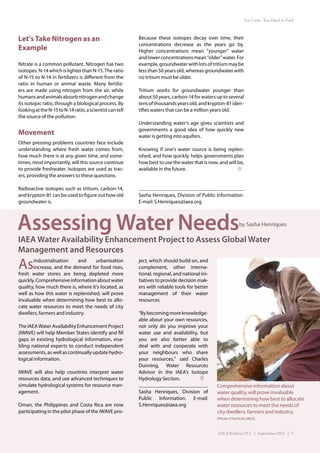
                                                                                                (Photo: P.Pavlicek/IAEA)


                                                                                                IAEA Bulletin 53-1 | September 2011 | 5
by Mollie Rock Zuccato

               Tackling the Water Crisis
                IAEA Technical Cooperation Delivers
                Know-How in Sustainability


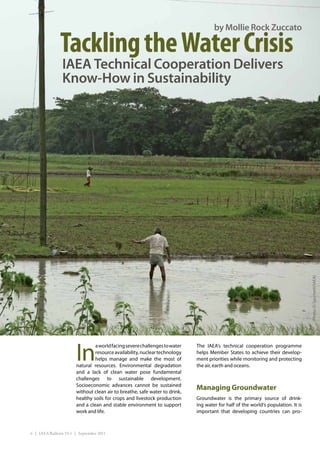
                                                                                                                                  (Photo: D. Sacchetti/IAEA)


                       In
                                a world facing severe challenges to water   The IAEA’s technical cooperation programme
                                resource availability, nuclear technology   helps Member States to achieve their develop-
                                helps manage and make the most of           ment priorities while monitoring and protecting
                       natural resources. Environmental degradation         the air, earth and oceans.
                       and a lack of clean water pose fundamental
                       challenges to sustainable development.
                       Socioeconomic advances cannot be sustained
                       without clean air to breathe, safe water to drink,
                                                                            Managing Groundwater
                       healthy soils for crops and livestock production     Groundwater is the primary source of drink-
                       and a clean and stable environment to support        ing water for half of the world’s population. It is
                       work and life.                                       important that developing countries can pro-


6 | IAEA Bulletin 53-1 | September 2011
Tackling the Water Crisis


tect and optimize what limited groundwater
resources they have. Groundwater that has been
contaminated due to land use activities affects
public health and the environment. Industry is
the greatest source of water pollution for devel-
oping countries. Rain runoff, especially flood
water, is another major polluting agent because
of the many different substances that it carries
into freshwater systems.

IAEA technical cooperation projects promote
the use of isotopic techniques to understand the
source, extent and behaviour of water resources,
as well as their vulnerability to pollution. Isotope
hydrology also helps to identify the origin and
extent of pollution or saline water intrusion, and
provides valuable inputs for sustainable water
resource management.

IAEA projects support the development of com-
prehensive national and transboundary water
resource plans for domestic, livestock, fishery,       Improving Crop Growth                                 Harmful algal blooms in
irrigation and other water uses, and help Member                                                             oceans can severely affect
States to develop regulations, procedures, stand-      To be certain that every drop of rainwater or irri-   local and international
ards, minimum requirements and guidelines for          gation water reaches crops, isotopic techniques       trade. The IAEA helps in
sustainable water management. Regional moni-           are used to optimize soil-water-cropping prac-        finding quicker and more
toring networks and databases on isotopes and          tices and fertilizer technologies. This research      accurate means of detect-
the chemical constituents of surface water and         improves the soil’s fertility and quality to grow     ing the presence of toxins
groundwater can also help to improve water             more nutrient-rich and higher-yielding crops.         in marine life.
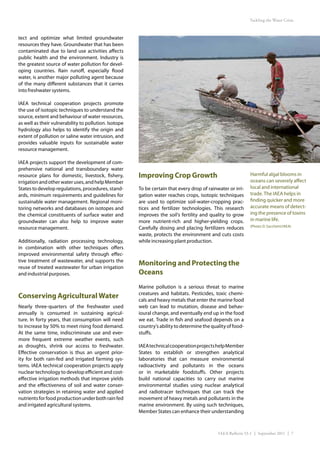
                                                                                                             (Photo: D. Sacchetti/IAEA)
resource management.                                   Carefully dosing and placing fertilizers reduces
                                                       waste, protects the environment and cuts costs
Additionally, radiation processing technology,         while increasing plant production.
in combination with other techniques offers
improved environmental safety through effec-
tive treatment of wastewater, and supports the
reuse of treated wastewater for urban irrigation
                                                       Monitoring and Protecting the
and industrial purposes.                               Oceans
                                                       Marine pollution is a serious threat to marine
                                                       creatures and habitats. Pesticides, toxic chemi-
Conserving Agricultural Water                          cals and heavy metals that enter the marine food
Nearly three-quarters of the freshwater used           web can lead to mutation, disease and behav-
annually is consumed in sustaining agricul-            ioural change, and eventually end up in the food
ture. In forty years, that consumption will need       we eat. Trade in fish and seafood depends on a
to increase by 50% to meet rising food demand.         country’s ability to determine the quality of food-
At the same time, indiscriminate use and ever-         stuffs.
more frequent extreme weather events, such
as droughts, shrink our access to freshwater.          IAEA technical cooperation projects help Member
Effective conservation is thus an urgent prior-        States to establish or strengthen analytical
ity for both rain-fed and irrigated farming sys-       laboratories that can measure environmental
tems. IAEA technical cooperation projects apply        radioactivity and pollutants in the oceans
nuclear technology to develop efficient and cost-      or in marketable foodstuffs. Other projects
effective irrigation methods that improve yields       build national capacities to carry out marine
and the effectiveness of soil and water conser-        environmental studies using nuclear analytical
vation strategies in retaining water and applied       and radiotracer techniques that can track the
nutrients for food production under both rain fed      movement of heavy metals and pollutants in the
and irrigated agricultural systems.                    marine environment. By using such techniques,
                                                       Member States can enhance their understanding


                                                                                             IAEA Bulletin 53-1 | September 2011 | 7
Tackling the Water Crisis


                                                                                           Training and fellowships prepare local person-
                                                                                           nel to take over the responsibilities of soil-water-
                                                                                           crop management, air quality and water resource
                                                                                           assessment, and freshwater/marine water envi-
                                                                                           ronmental impact evaluation in Member States.

                                                                                           Conferences, symposia and seminars are
                                                                                           designed for the exchange of ideas between
                                                                                           scientists from various countries.

                                                                                           Equipment and materials provided by the IAEA
                                                                                           are used to establish or enhance sustainable envi-
                                                                                           ronment, water resource assessment and land
                                                                                           and agricultural water management.


                                                                                           Partnerships
                                                                                           Technical cooperation projects involve collabo-
                                                                                           ration between governments, IAEA partners and
                                                                                           Member States, keeping in mind priority national
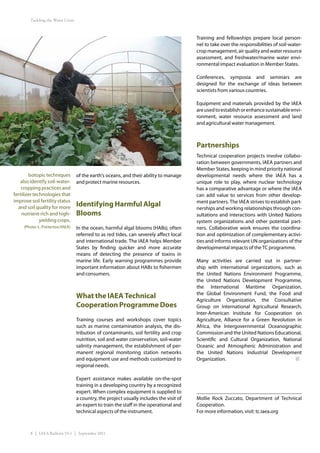
        Isotopic techniques         of the earth’s oceans, and their ability to manage     developmental needs where the IAEA has a
   also identify soil-water-        and protect marine resources.                          unique role to play, where nuclear technology
    cropping practices and                                                                 has a comparative advantage or where the IAEA
fertilizer technologies that                                                               can add value to services from other develop-
improve soil fertility status                                                              ment partners. The IAEA strives to establish part-
  and soil quality for more         Identifying Harmful Algal                              nerships and working relationships through con-
    nutrient-rich and high-         Blooms                                                 sultations and interactions with United Nations
              yielding crops.                                                              system organizations and other potential part-
     (Photo: L. Potterton/IAEA)     In the ocean, harmful algal blooms (HABs), often       ners. Collaborative work ensures the coordina-
                                    referred to as red tides, can severely affect local    tion and optimization of complementary activi-
                                    and international trade. The IAEA helps Member         ties and informs relevant UN organizations of the
                                    States by finding quicker and more accurate            developmental impacts of the TC programme.
                                    means of detecting the presence of toxins in
                                    marine life. Early warning programmes provide          Many activities are carried out in partner-
                                    important information about HABs to fishermen          ship with international organizations, such as
                                    and consumers.                                         the United Nations Environment Programme,
                                                                                           the United Nations Development Programme,
                                                                                           the International Maritime Organization,
                                                                                           the Global Environment Fund, the Food and
                                    What the IAEA Technical                                Agriculture Organization, the Consultative
                                    Cooperation Programme Does                             Group on International Agricultural Research,
                                                                                           Inter-American Institute for Cooperation on
                                    Training courses and workshops cover topics            Agriculture, Alliance for a Green Revolution in
                                    such as marine contamination analysis, the dis-        Africa, the Intergovernmental Oceanographic
                                    tribution of contaminants, soil fertility and crop     Commission and the United Nations Educational,
                                    nutrition, soil and water conservation, soil-water     Scientific and Cultural Organization, National
                                    salinity management, the establishment of per-         Oceanic and Atmospheric Administration and
                                    manent regional monitoring station networks            the United Nations Industrial Development
                                    and equipment use and methods customized to            Organization.
                                    regional needs.

                                    Expert assistance makes available on-the-spot
                                    training in a developing country by a recognized
                                    expert. When complex equipment is supplied to
                                    a country, the project usually includes the visit of   Mollie Rock Zuccato, Department of Technical
                                    an expert to train the staff in the operational and    Cooperation.
                                    technical aspects of the instrument.                   For more information, visit: tc.iaea.org


        8 | IAEA Bulletin 53-1 | September 2011
Tackling the Water Crisis


Optimal Results                                                        by Juanita Perez-Vargas

IAEA Supports Water Research in Latin America
Jane Gerardo-Abaya, Programme Management Officer for Latin America in the IAEA’s Technical
Cooperation Division discusses in this interview the Agency’s support in handling water
challenges in Latin America and the Caribbean:

Gerardo-Abaya: The IAEA extensively studies this
problem because the region is severely affected
by inadequate safe water supplies. The region has
large water resources, however, most population
centres are located in coastal areas where water
availability is limited or vulnerable to contamina-
tion due to seawater intrusion into aquifers when
there is excessive water extraction.

The population is heavily dependent on the use
of groundwater which is generally limited. And
while a small portion of the urban population has
no access to water, a large portion of rural areas
have no access to drinking water.

This also has to do with water which, although at


                                                                                                            Juanita Perez-Vargas
times available, is contaminated. Access to sanita-
tion is a problem for the region, especially where
wastewater remains untreated, and can reach the
groundwater, contaminating this scarce resource.
In addition, agriculture can be a problem because
pesticides and fertilizers eventually flow into the    Specifically, the IAEA provides both laboratory
groundwater or surface water. It is important to       and field training. The IAEA teaches best practice
note that agriculture uses water largely for irriga-   in sample collection, analysis, and data interpre-
tion, livestock and aquaculture production, com-       tation to be certain we can understand the pro-
prising 70% of global water consumption.               cesses at work. The IAEA also provides expert
                                                       assistance and supports upgrades for Member
How does the IAEA help Member States                   State laboratories to help them achieve optimum
address water supply problems?                         performance in research.

Gerardo-Abaya: The IAEA enhances Member                What kind of results have these projects
States’ ability to acquire a scientific understand-    achieved in Latin America ?
ing of the occurrence, flow and water dynamics
and to understand the mechanisms of contami-           Gerardo-Abaya: Seven coastal aquifers and
nation. This is achieved by using isotope hydrol-      their characteristics are now under study by the
ogy that adds value in obtaining conclusive            authorities, nuclear institutions and universi-
results, which are not normally achievable with        ties in Argentina, Costa Rica, Cuba, Ecuador, and
traditional hydrological techniques alone.             Uruguay. Our specific achievements have been
                                                       to increase the number of qualified specialists in
There is a growing need for scientific information     groundwater management, as well as increasing
among decision makers to support effective pol-        research capacity in laboratories and in the field
icy formulation and resource management. In            thanks to equipment provided by the IAEA.
this area, the IAEA’s support for Member States’
scientific research is very valuable.                  Juanita Perez-Vargas, Division of Public
                                                       Information. E-mail: J.Perez-Vargas@iaea.org


                                                                                            IAEA Bulletin 53-1 | September 2011 | 9
Complex Science Saving


                                B
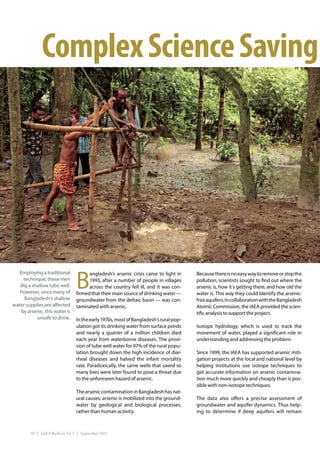
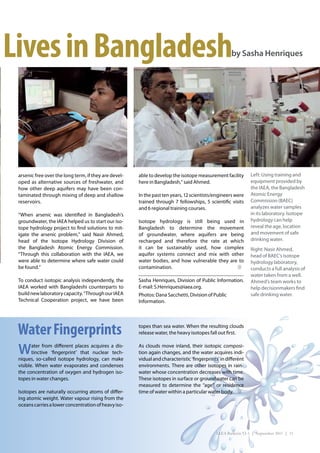
   Employing a traditional            angladesh’s arsenic crisis came to light in     Because there is no easy way to remove or stop the
     technique, these men             1993, after a number of people in villages      pollution, scientists sought to find out where the
   dig a shallow tube well.           across the country fell ill, and it was con-    arsenic is, how it´s getting there, and how old the
   However, since many of       firmed that their main source of drinking water —     water is. This way they could identify the arsenic-
      Bangladesh’s shallow      groundwater from the deltaic basin — was con-         free aquifers. In collaboration with the Bangladesh
water supplies are affected     taminated with arsenic.                               Atomic Commission, the IAEA provided the scien-
    by arsenic, this water is                                                         tific analysis to support the project.
           unsafe to drink.     In the early 1970s, most of Bangladesh’s rural pop-
                                ulation got its drinking water from surface ponds     Isotope hydrology, which is used to track the
                                and nearly a quarter of a million children died       movement of water, played a significant role in
                                each year from waterborne diseases. The provi-        understanding and addressing the problem.
                                sion of tube well water for 97% of the rural popu-
                                lation brought down the high incidence of diar-       Since 1999, the IAEA has supported arsenic miti-
                                rheal diseases and halved the infant mortality        gation projects at the local and national level by
                                rate. Paradoxically, the same wells that saved so     helping institutions use isotope techniques to
                                many lives were later found to pose a threat due      get accurate information on arsenic contamina-
                                to the unforeseen hazard of arsenic.                  tion much more quickly and cheaply than is pos-
                                                                                      sible with non-isotope techniques.
                                The arsenic contamination in Bangladesh has nat-
                                ural causes: arsenic is mobilized into the ground-    The data also offers a precise assessment of
                                water by geological and biological processes,         groundwater and aquifer dynamics. Thus help-
                                rather than human activity.                           ing to determine if deep aquifers will remain


         10 | IAEA Bulletin 53-1 | September 2011
Lives in Bangladesh                                                                                  by Sasha Henriques


 arsenic free over the long term, if they are devel-   able to develop the isotope measurement facility        Left: Using training and
 oped as alternative sources of freshwater, and        here in Bangladesh,” said Ahmed.                        equipment provided by
 how other deep aquifers may have been con-                                                                    the IAEA, the Bangladesh
 taminated through mixing of deep and shallow          In the past ten years, 12 scientists/engineers were     Atomic Energy
 reservoirs.                                           trained through 7 fellowships, 5 scientific visits      Commission (BAEC)
                                                       and 6 regional training courses.                        analyzes water samples
 “When arsenic was identified in Bangladesh’s                                                                  in its laboratory. Isotope
 groundwater, the IAEA helped us to start our iso-     Isotope hydrology is still being used in                hydrology can help
 tope hydrology project to find solutions to mit-      Bangladesh to determine the movement                    reveal the age, location
 igate the arsenic problem,” said Nasir Ahmed,         of groundwater, where aquifers are being                and movement of safe
 head of the Isotope Hydrology Division of             recharged and therefore the rate at which               drinking water.
 the Bangladesh Atomic Energy Commission.              it can be sustainably used, how complex                 Right: Nasir Ahmed,
 “Through this collaboration with the IAEA, we         aquifer systems connect and mix with other              head of BAEC’s isotope
 were able to determine where safe water could         water bodies, and how vulnerable they are to            hydrology laboratory,
 be found.”                                            contamination.                                          conducts a full analysis of
                                                                                                               water taken from a well.
 To conduct isotopic analysis independently, the       Sasha Henriques, Division of Public Information.        Ahmed’s team works to
 IAEA worked with Bangladeshi counterparts to          E-mail: S.Henriques@iaea.org.                           help decisionmakers find
 build new laboratory capacity. “Through our IAEA      Photos: Dana Sacchetti, Division of Public              safe drinking water.
 Technical Cooperation project, we have been           Information.


 Water Fingerprints                                    topes than sea water. When the resulting clouds
                                                       release water, the heavy isotopes fall out first.


 W      ater from different places acquires a dis-
        tinctive ‘fingerprint’ that nuclear tech-
 niques, so-called isotope hydrology, can make
                                                       As clouds move inland, their isotopic composi-
                                                       tion again changes, and the water acquires indi-
                                                       vidual and characteristic ‘fingerprints’ in different
 visible. When water evaporates and condenses          environments. There are other isotopes in rain-
 the concentration of oxygen and hydrogen iso-         water whose concentration decreases with time.
 topes in water changes.                               These isotopes in surface or groundwater can be
                                                       measured to determine the “age” or residence
 Isotopes are naturally occurring atoms of differ-     time of water within a particular water body.
 ing atomic weight. Water vapour rising from the
 oceans carries a lower concentration of heavy iso-


                                                                                              IAEA Bulletin 53-1 | September 2011 | 11
IAEA Helps Parched Santa
                              T
                                     he thirsty residents of Manglaralto on the      The problems facing the Santa Elena Peninsula
                                     Santa Elena peninsula on Ecuador’s south-       and the 250 000 inhabitants of the area — 100 000
                                     ern central coast have been feeling a gush      in the countryside are particularly hard hit — are
                              of relief. A joint IAEA project to find water in the   not uncommon in many parts of the world. The
                              area has led to an abundant water flow where           study area is characterized by arid to semi-arid
                              before there was barely a trickle.                     tropical climate conditions, where more water
                                                                                     is lost through evaporation and transpired by
                                                                                     plants,—so-called evapotranspiration— than
                                                                                     can be replaced through annual precipitation.
                                                                                     Rivers are seasonal and recharge to aquifers is
                                                                                     limited, so dependence on groundwater is ris-
                                                                                     ing. Local aquifers are affected by seawater intru-
                                                                                     sion, with the salinity of soil water and groundwa-
                                                                                     ter increasing due to intensive pumping. In some
                                                                                     areas the groundwater is no longer fit for human
                                                                                     consumption, and the situation has been dis-
                                                                                     tressing for both residents and farmers.

                                                                                     ESPOL applied for an IAEA Technical Cooperation
                                                                                     project and the first project — implemented in
                                                                                     collaboration with local groups — began in 2007.
                                                                                     The IAEA has contributed to training, provided
                                                                                     experts, equipment, mapping tools, as well as a
                                                                                     solid foundation for the project.

                                                                                     But the project has been able to accomplish
                                                                                     something beyond a standard water assessment.

                                                                                     “For the first time it belongs to them,” says Luis
                                                                                     Araguás Araguás, a scientific officer from the
                                                                                     IAEA’s Isotope Hydrology Section involved in
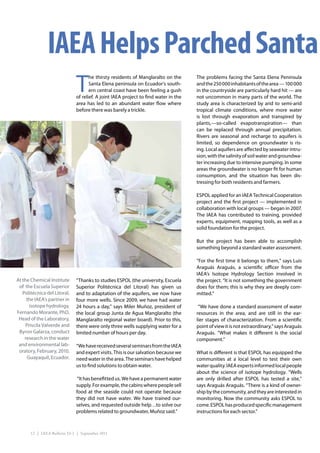
At the Chemical Institute     “Thanks to studies ESPOL (the university, Escuela      the project. “It is not something the government
 of the Escuela Superior      Superior Politécnica del Litoral) has given us         does for them; this is why they are deeply com-
   Politécnica del Litoral,   and to adaptation of the aquifers, we now have         mitted.”
     the IAEA’s partner in    four more wells. Since 2009, we have had water
       isotope hydrology,     24 hours a day,” says Miler Muñoz, president of         “We have done a standard assessment of water
Fernando Morante, PhD.        the local group Junta de Agua Manglaralto (the         resources in the area, and are still in the ear-
 Head of the Laboratory,      Manglaralto regional water board). Prior to this,      lier stages of characterization. From a scientific
     Priscila Valverde and    there were only three wells supplying water for a      point of view it is not extraordinary,” says Araguás
 Byron Galarza, conduct       limited number of hours per day.                       Araguás. “What makes it different is the social
    research in the water                                                            component.”
 and environmental lab-       “We have received several seminars from the IAEA
 oratory, February, 2010,     and expert visits. This is our salvation because we    What is different is that ESPOL has equipped the
      Guayaquil, Ecuador.     need water in the area. The seminars have helped       communities at a local level to test their own
                              us to find solutions to obtain water.                  water quality. IAEA experts informed local people
                                                                                     about the science of isotope hydrology. “Wells
                               “It has benefitted us. We have a permanent water      are only drilled after ESPOL has tested a site,”
                              supply. For example, the cabins where people sell      says Araguás Araguás. “There is a kind of owner-
                              food at the seaside could not operate because          ship by the community, and they are interested in
                              they did not have water. We have trained our-          monitoring. Now the community asks ESPOL to
                              selves, and requested outside help…to solve our        come. ESPOL has produced specific management
                              problems related to groundwater, Muñoz said.”          instructions for each sector.”


       12 | IAEA Bulletin 53-1 | September 2011
COLOMBIA


                                                                                                        ECUADOR


Elena Find Water
                                                                                          Santa Elena


                                                                                                                               BRAZIL
                                                                                                              PERU
                          by Maureen MacNeill
 The communities have been integrated in this
 programme, says Emilio Rodríguez, president of
 the local Junta Regional de Agua Olón (the Olón
 regional water board). “They are an active com-
 ponent of this process. These studies are not easy
 to perform due to high costs and lack of equip-
 ment.”

 Many changes have occurred as a result of two
 IAEA projects underway in the peninsula, accord-
 ing to Gricelda Herrera Franco an ESPOL counter-
 part. “First the communities worked in associa-
 tion with the university and they use technology
 and techniques. The communities then worked
 on the projects and they developed a new cul-
 ture for working in teams. Finally, the commu-
 nities now have a permanent water supply (365
 days a year). Before this was not possible.

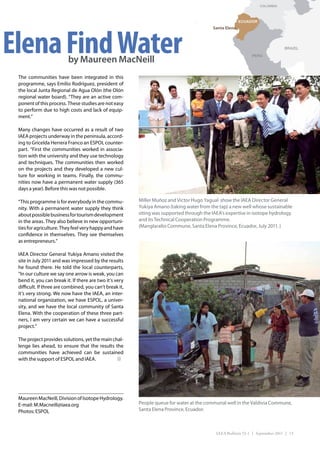
 “This programme is for everybody in the commu-          Miller Muñoz and Victor Hugo Yagual show the IAEA Director General
 nity. With a permanent water supply they think          Yukiya Amano (taking water from the tap) a new well whose sustainable
 about possible business for tourism development         siting was supported through the IAEA’s expertise in isotope hydrology
 in the areas. They also believe in new opportuni-       and its Technical Cooperation Programme.
 ties for agriculture. They feel very happy and have     (Manglaralto Commune, Santa Elena Province, Ecuador, July 2011. )
 confidence in themselves. They see themselves
 as entrepreneurs.”

 IAEA Director General Yukiya Amano visited the
 site in July 2011 and was impressed by the results
 he found there. He told the local counterparts,
 “In our culture we say one arrow is weak, you can
 bend it, you can break it. If there are two it’s very
 difficult. If three are combined, you can’t break it,
 it’s very strong. We now have the IAEA, an inter-
 national organization, we have ESPOL, a univer-
 sity, and we have the local community of Santa
 Elena. With the cooperation of these three part-
 ners, I am very certain we can have a successful
 project.”

 The project provides solutions, yet the main chal-
 lenge lies ahead, to ensure that the results the
 communities have achieved can be sustained
 with the support of ESPOL and IAEA.


 Maureen MacNeill, Division of Isotope Hydrology.
 E-mail: M.Macneill@iaea.org                             People queue for water at the communal well in the Valdivia Commune,
 Photos: ESPOL                                           Santa Elena Province, Ecuador.


                                                                                            IAEA Bulletin 53-1 | September 2011 | 13
Treasure Maps
                                                                                                             by Peter Kaiser


                             The IAEA’s Hydrological Atlases Reveal Hidden Resources


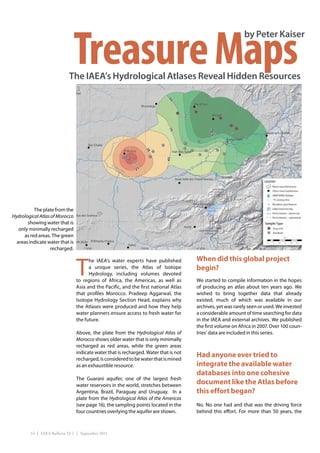
          The plate from the
Hydrological Atlas of Morocco
       showing water that is
   only minimally recharged
     as red areas. The green
  areas indicate water that is
                   recharged.


                                 T
                                       he IAEA’s water experts have published          When did this global project
                                       a unique series, the Atlas of Isotope           begin?
                                       Hydrology, including volumes devoted
                                 to regions of Africa, the Americas, as well as        We started to compile information in the hopes
                                 Asia and the Pacific, and the first national Atlas    of producing an atlas about ten years ago. We
                                 that profiles Morocco. Pradeep Aggarwal, the          wished to bring together data that already
                                 Isotope Hydrology Section Head, explains why          existed, much of which was available in our
                                 the Atlases were produced and how they help           archives, yet was rarely seen or used. We invested
                                 water planners ensure access to fresh water for       a considerable amount of time searching for data
                                 the future.                                           in the IAEA and external archives. We published
                                                                                       the first volume on Africa in 2007. Over 100 coun-
                                 Above, the plate from the Hydrological Atlas of       tries’ data are included in this series.
                                 Morocco shows older water that is only minimally
                                 recharged as red areas, while the green areas
                                 indicate water that is recharged. Water that is not
                                 recharged, is considered to be water that is mined
                                                                                       Had anyone ever tried to
                                 as an exhaustible resource.                           integrate the available water
                                                                                       databases into one cohesive
                                 The Guarani aquifer, one of the largest fresh
                                 water reservoirs in the world, stretches between
                                                                                       document like the Atlas before
                                 Argentina, Brazil, Paraguay and Uruguay. In a         this effort began?
                                 plate from the Hydrological Atlas of the Americas
                                 (see page 16), the sampling points located in the     No. No one had and that was the driving force
                                 four countries overlying the aquifer are shown.       behind this effort. For more than 50 years, the


         14 | IAEA Bulletin 53-1 | September 2011
Treasure Maps


IAEA has been publishing the Global Isotopes in        When an expert views these
Precipitation databases, which are used to under-      maps, what can they decipher
stand hydrology. The Atlases contain data col-
lected mainly through IAEA projects conducted          from these symbols and
in developing countries. These data were not           figures?
available to anyone outside these projects. It was
a great concern to us that the countries whose         For instance, if you compare the isotopic data in
water systems were studied could not access this       groundwater with precipitation at a given loca-
data.                                                  tion, you can determine whether the under-
                                                       ground reserves are being recharged and
As a result, when we visited countries in the 1990s    can help identify the source of the water that
and early 2000s, we would come upon a situation        recharges the reserve, such as a local source
in which no one knew whether studies had been          or a distant mountain. If the precipitation and
previously conducted, thus projects were con-          the groundwater data do not match, regardless
ducted without understanding what was done in          whether you compare local sources or distant
the past. If we did learn that a project had been      sources upstream in the mountains, then poten-
conducted previously, the data was often no            tially the underground reserve was recharged in
longer accessible. Therefore, to be able to offer      the past by a very different climate system.
Member States a resource that can be used to
achieve progress, rather than treading water by        Therefore the isotopic database and the Atlas
repeating studies that simply collect similar infor-   can help you understand a vital process for water
mation, as well as to offer researchers around         management, whether an underground reserve
the world comprehensive data, we decided to            is recharging and how quickly.
produce these Atlases to advance the science of
hydrology.
                                                       Does this Atlas help planners
                                                       find water and use it
What insights can be gained
                                                       sustainably?
from a database of isotopes in
precipitation?                                         Yes, it will. The primary purpose for using iso-
                                                       topes is to acquire information about the water
Isotopes in precipitation help us understand cli-      system in a timely and cost-effective manner. I
matic systems. The product of a hydrological sys-      could spend 50 years in a country, measuring the
tem is precipitation. So, we are trying to under-      rain and water levels in rivers and aquifers, and
stand atmospheric processes by using isotopes          I would have a reasonably accurate picture of
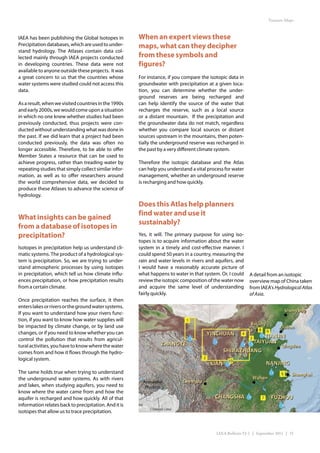
in precipitation, which tell us how climate influ-     what happens to water in that system. Or, I could    A detail from an isotopic
ences precipitation, or how precipitation results      review the isotopic composition of the water now     overview map of China taken
from a certain climate.                                and acquire the same level of understanding          from IAEA’s Hydrological Atlas
                                                       fairly quickly.                                      of Asia.
Once precipitation reaches the surface, it then
enters lakes or rivers or the ground water systems.
If you want to understand how your rivers func-
tion, if you want to know how water supplies will
be impacted by climate change, or by land use
changes, or if you need to know whether you can
control the pollution that results from agricul-
tural activities, you have to know where the water
comes from and how it flows through the hydro-
logical system.

The same holds true when trying to understand
the underground water systems. As with rivers
and lakes, when studying aquifers, you need to
know where the water came from and how the
aquifer is recharged and how quickly. All of that
information relates back to precipitation. And it is
isotopes that allow us to trace precipitation.


                                                                                           IAEA Bulletin 53-1 | September 2011 | 15
Treasure Maps


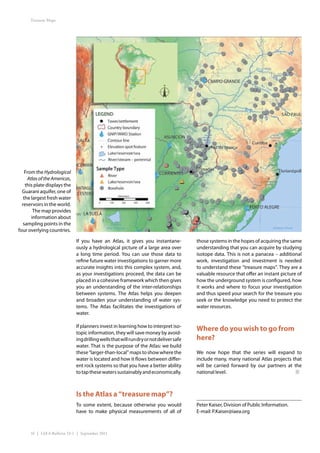
    From the Hydrological
     Atlas of the Americas,
    this plate displays the
  Guarani aquifer, one of
   the largest fresh water
  reservoirs in the world.
        The map provides
       information about
   sampling points in the
four overlying countries.

                              If you have an Atlas, it gives you instantane-             those systems in the hopes of acquiring the same
                              ously a hydrological picture of a large area over          understanding that you can acquire by studying
                              a long time period. You can use those data to              isotope data. This is not a panacea – additional
                              refine future water investigations to garner more          work, investigation and investment is needed
                              accurate insights into this complex system, and,           to understand these “treasure maps”. They are a
                              as your investigations proceed, the data can be            valuable resource that offer an instant picture of
                              placed in a cohesive framework which then gives            how the underground system is configured, how
                              you an understanding of the inter-relationships            it works and where to focus your investigation
                              between systems. The Atlas helps you deepen                and thus speed your search for the treasure you
                              and broaden your understanding of water sys-               seek or the knowledge you need to protect the
                              tems. The Atlas facilitates the investigations of          water resources.
                              water.

                              If planners invest in learning how to interpret iso-
                              topic information, they will save money by avoid-
                                                                                         Where do you wish to go from
                              ing drilling wells that will run dry or not deliver safe   here?
                              water. That is the purpose of the Atlas: we build
                              these “larger-than-local” maps to show where the           We now hope that the series will expand to
                              water is located and how it flows between differ-          include many, many national Atlas projects that
                              ent rock systems so that you have a better ability         will be carried forward by our partners at the
                              to tap these waters sustainably and economically.          national level.


                              Is the Atlas a “treasure map”?
                              To some extent, because otherwise you would                Peter Kaiser, Division of Public Information.
                              have to make physical measurements of all of               E-mail: P.Kaiser@iaea.org


      16 | IAEA Bulletin 53-1 | September 2011
all about Water

         .5% of a
  n ly 2         ll t
 O arth is fre
 ne             sh
                     he wat


o
                       wa er
                          ter


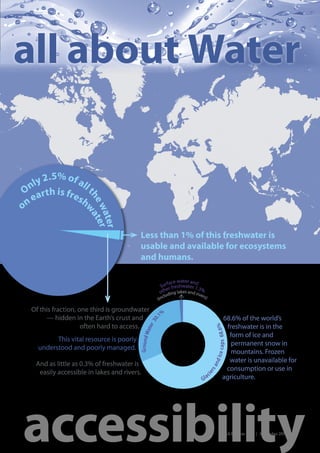
                                           Less than 1% of this freshwater is
                                           usable and available for ecosystems
                                           and humans.

                                                                       ate
                                                                face w r and
                                                            Sur r freshwater 1.3
                                                               e                  %
                                                            oth ding lakes and rive
                                                               clu                rs)
                                                           (in

  Of this fraction, one third is groundwater                 %
       — hidden in the Earth’s crust and                                                                 68.6% of the world’s
                                                      .1
                                                   30


                     often hard to access.                                                                 freshwater is in the
                                                                                             Ice c a p s 6 8.6 %
                                                       r
                                                   ate


                                                                                                            form of ice and
                                           Ground W


           This vital resource is poorly
                                                                                                             permanent snow in
     understood and poorly managed.
                                                                                                             mountains. Frozen
                                                                                                            water is unavailable for
                                                                                             nd


    And as little as 0.3% of freshwater is
                                                                                                          consumption or use in
                                                                                         sa


     easily accessible in lakes and rivers.
                                                                                      ie r


                                                                                        ac               agriculture.
                                                                                  Gl


accessibility                                                                                        IAEA Bulletin 53-1 | September 2011 | 17
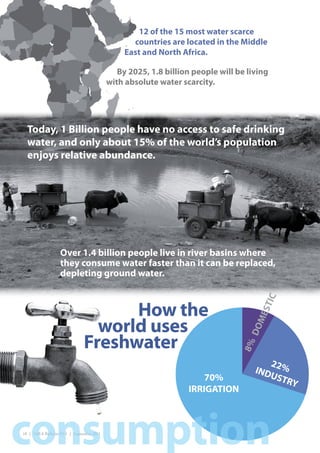
12 of the 15 most water scarce
                                                  countries are located in the Middle
                                                East and North Africa.

                                              By 2025, 1.8 billion people will be living
                                           with absolute water scarcity.


  Today, 1 Billion people have no access to safe drinking
  water, and only about 15% of the world’s population
  enjoys relative abundance.


                   Over 1.4 billion people live in river basins where
                   they consume water faster than it can be replaced,
                   depleting ground water.                                             C


                                     How the
                                                                                     STI
                                                                                   ME


                                 world uses
                                                                                  DO


                               Freshwater
                                                                                8%


                                                                                           22%
                                                                                     IND
                                                                     70%                   UST
                                                                                               RY
                                                                 IRRIGATION


consumption
18 | IAEA Bulletin 53-1 | September 2011
 
                 
                
                 
                  
                  
urbanisation 
                 
               
                
            
               
                 
              
               
        
        
                
        
                   
                    
      
             
        
             
              
      
         
                    
     
      
            
          
                 
       
               
                
                
           
             
  
      
      
       
       
   
                 
               
               
                
                
               
               
                
        
           
       
   
       
      
             
               
    
      
 
    
        
       
              
     
                  
                
                  
                
                  
  
        
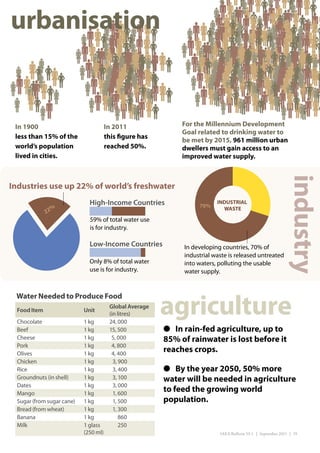
                                                          For the Millennium Development
 In 1900                               In 2011
                                                              Goal related to drinking water to
 less than 15% of the                  this figure has
                                                              be met by 2015, 961 million urban
 world’s population                    reached 50%.           dwellers must gain access to an
 lived in cities.                                             improved water supply.


                                                                                                              industry
Industries use up 22% of world’s freshwater
                              High-Income Countries                70%
                                                                          INDUSTRIAL
              22%                                                           WASTE

                              59% of total water use
                              is for industry.

                              Low-Income Countries            In developing countries, 70% of
                                                              industrial waste is released untreated
                              Only 8% of total water          into waters, polluting the usable
                              use is for industry.            water supply.


                                                         agriculture
 Water Needed to Produce Food
                                        Global Average
  Food Item                 Unit
                                        (in litres)
  Chocolate                 1 kg        24, 000
  Beef                      1 kg        15, 500          ● In rain-fed agriculture, up to
  Cheese                    1 kg         5, 000          85% of rainwater is lost before it
  Pork                      1 kg         4, 800
  Olives                    1 kg         4, 400
                                                         reaches crops.
  Chicken                   1 kg          3, 900
  Rice                      1 kg          3, 400         ● By the year 2050, 50% more
  Groundnuts (in shell)     1 kg          3, 100         water will be needed in agriculture
  Dates                     1 kg          3, 000
  Mango                     1 kg          1, 600
                                                         to feed the growing world
  Sugar (from sugar cane)   1 kg          1, 500         population.
  Bread (from wheat)        1 kg          1, 300
  Banana                    1 kg             860
  Milk                      1 glass          250
                            (250 ml)                                       IAEA Bulletin 53-1 | September 2011 | 19
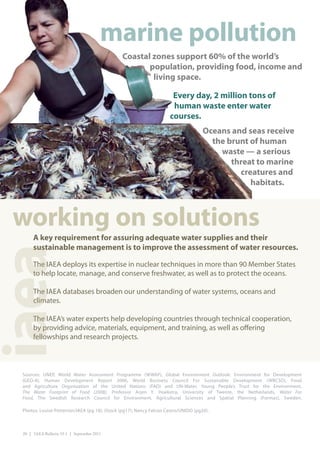
marine pollution
                                               Coastal zones support 60% of the world’s
                                                      population, providing food, income and
                                                       living space.

                                                                      Every day, 2 million tons of
                                                                      human waste enter water
                                                                     courses.
                                                                                     Oceans and seas receive
                                                                                       the brunt of human
                                                                                         waste — a serious
                                                                                            threat to marine
                                                                                              creatures and
                                                                                                 habitats.


 working on solutions
      A key requirement for assuring adequate water supplies and their
      sustainable management is to improve the assessment of water resources.
iaea


      The IAEA deploys its expertise in nuclear techniques in more than 90 Member States
      to help locate, manage, and conserve freshwater, as well as to protect the oceans. 

      The IAEA databases broaden our understanding of water systems, oceans and
      climates.

      The IAEA’s water experts help developing countries through technical cooperation,
      by providing advice, materials, equipment, and training, as well as offering
      fellowships and research projects.


 Sources: UNEP, World Water Assessment Programme (WWAP), Global Environment Outlook: Environment for Development
 (GEO-4), Human Development Report 2006, World Business Council For Sustainable Development (WBCSD), Food
 and Agriculture Organization of the United Nations (FAO) and UN-Water, Young People’s Trust for the Environment,
 The Water Footprint of Food (2008), Professor Arjen Y. Hoekstra, University of Twente, the Netherlands, Water For
 Food, The Swedish Research Council for Environment, Agricultural Sciences and Spatial Planning (Formas), Sweden.

 Photos: Louise Potterton/IAEA (pg 18); iStock (pg17); Nancy Falcon Castro/UNIDO (pg20).


 20 | IAEA Bulletin 53-1 | September 2011
Improving Farming with
Nuclear Techniques                                                                                    by Sasha Henriques


S
     oil erosion, land degradation, the excessive         slopes and hence improve downstream water
     or inappropriate use of fertilisers in agricul-      quality. Emilio Sanchez from the La Roblería vine-
     ture and poor water quality are threats to           yard in Apalta says, “The vineyard associations
the environment and hamper development.                   have been open to embrace nuclear research
                                                          techniques as it has been a win-win relationship
IAEA projects apply nuclear technology to evalu-          for the farmers of the region.”
ate these risks and find ways to make better use
of water and soil resources. Many countries have          In Kenya, agriculture is the second largest contrib-
benefited from this programme, including Qatar,           utor to gross domestic product, with 70% of the
Chile, Kenya, Turkey, Vietnam and Bangladesh.             population working in the sector. Yet the major-
                                                          ity of farmland is arid or semi-arid, with low and
Qatar is one of the 10 most water-scarce coun-            erratic rainfall. And food production is low with
tries in the world and all its arable land is irrigated   frequent crop failures. The IAEA worked with the
with groundwater. But, more than half of the              local scientists to develop small-scale, low-cost
water being used doesn’t reach the crops, evap-           drip irrigation technologies for poor farmers.
orating from the soil to the atmosphere. As more
groundwater was used for irrigation, and levels
fell, seawater and saline water from deeper aqui-
fers intruded on the supply of fresh groundwater.
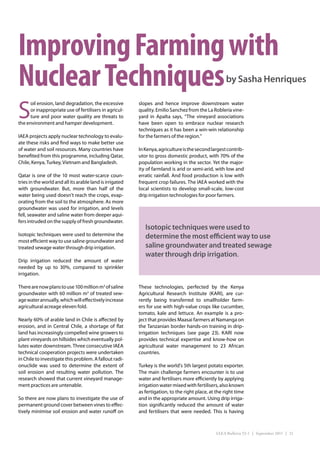
                                                             Isotopic techniques were used to
Isotopic techniques were used to determine the               determine the most efficient way to use
most efficient way to use saline groundwater and
treated sewage water through drip irrigation.                saline groundwater and treated sewage
                                                             water through drip irrigation.
Drip irrigation reduced the amount of water
needed by up to 30%, compared to sprinkler
irrigation.

There are now plans to use 100 million m3 of saline       These technologies, perfected by the Kenya
groundwater with 60 million m3 of treated sew-            Agricultural Research Institute (KARI), are cur-
age water annually, which will effectively increase       rently being transferred to smallholder farm-
agricultural acreage eleven fold.                         ers for use with high-value crops like cucumber,
                                                          tomato, kale and lettuce. An example is a pro-
Nearly 60% of arable land in Chile is affected by         ject that provides Maasai farmers at Namanga on
erosion, and in Central Chile, a shortage of flat         the Tanzanian border hands-on training in drip-
land has increasingly compelled wine growers to           irrigation techniques (see page 23). KARI now
plant vineyards on hillsides which eventually pol-        provides technical expertise and know-how on
lutes water downstream. Three consecutive IAEA            agricultural water management to 23 African
technical cooperation projects were undertaken            countries.
in Chile to investigate this problem. A fallout radi-
onuclide was used to determine the extent of              Turkey is the world’s 5th largest potato exporter.
soil erosion and resulting water pollution. The           The main challenge farmers encounter is to use
research showed that current vineyard manage-             water and fertilisers more efficiently by applying
ment practices are untenable.                             irrigation water mixed with fertilisers, also known
                                                          as fertigation, to the right place, at the right time
So there are now plans to investigate the use of          and in the appropriate amount. Using drip irriga-
permanent ground cover between vines to effec-            tion significantly reduced the amount of water
tively minimise soil erosion and water runoff on          and fertilisers that were needed. This is having


                                                                                                 IAEA Bulletin 53-1 | September 2011 | 21
Improving Farming with Nuclear Techniques


                        a major impact on Turkey’s potato production,                  ant crop varieties during the project, have ena-
                        yielding substantial savings for farmers.                      bled farmers to introduce and harvest a second
                                                                                       crop, in addition to aman (paddy) rice, on poten-
                        Vietnam has also been affected by erosion, loss                tially up to 2.6 million hectares of highly fertile
                        of soil nutrients, as well as water and fertilizer use         coastal lands. This could, for example, possibly
                        efficiency problems. They sought the IAEA’s help.              add an additional 4 million tonnes of wheat to the
                        Compound-specific stable isotope techniques                    national bread basket.
                        were used to identify areas of land degradation.
                        The findings of the project have been used to                  Abdul Aziz, who is a farmer from Noakhali,
                        raise farmers’ awareness and to help them adopt                Bangladesh, says, “I used to leave my family in the
                        strategies to mitigate the impact of typhoons on               village and go to Dhaka in search of a job because
                        agriculture in north-western Vietnam.                          I could not grow any crop from August to April
                                                                                       due to the high salt content in the soil. Now, I earn
                        Soil salinization is a major threat to crop pro-               about US $2000 per hectare each year from the
                        duction in Bangladesh; such that about 90% of                  cultivation of newly introduced groundnuts and
                        potentially arable lands in the coastal area remain            wheat.”
                        unused during the dry season. Improved water
                        management practices through drip irrigation,                  Sasha Henriques, Division of Public Information.
                        coupled with the identification of saline-toler-               E-mail: S.Henriques@iaea.org


           Making the Most of It                                                                                  by Peter Kaiser

           Radiation technology cleans polluted water for re-use
          T   oday, cities host rapidly growing populations and
              expanding industries. The flow and severity of the
          pollution that transforms freshwater into wastewater is
                                                                                 ing radioactive contamination due to the low energy of
                                                                                 the electrons.

          increasing as a result. Common chemical contaminants                   At an industrial textile dyeing complex in Daegu, Korea,
          in water include persistent organic pollutants, petro-                 the first electron beam waste water treatment plant has
          chemicals, pesticides, dyes, heavy metal ions, as well as              been working successfully since 2006 The treatment
          excreted pharmaceuticals. These complex compounds                      plant handles 10 000 cubic meters of textile wastewa-
          are difficult, often impossible, to remove or degrade                  ter daily, or approximately the volume of four Olympic
          using conventional means, and remain in the water                      swimming pools.
          to pose new and worsening health risks. Neutralizing
          these risks makes wastewater management challeng-                      The Daegu plant has demonstrated that “the process
          ing and more expensive. Cities and industries need                     is safe and effective” said Bumsoo S. Han, an interna-
          cost-competitive solutions to treat water to be able to                tional expert on electron beam wastewater treatment.
          reuse it responsibly.                                                  Han compared the performance of the existing tech-
                                                                                 nologies and concluded that “the electron beam tech-
          Frequently, cities face a water shortage, which they                   nology produces the desired quality of effluent water at
          hope to alleviate by treating wastewater so that it can                lower cost, without additives. It is a win for the environ-
          be utilized for tasks such as fire fighting, street cleaning,          ment and a win for the industry.”
          urban park and horticultural irrigation, industrial cool-
          ing and laundry, and boiler water for heating that do                  Together with its international partners, UNIDO and
          not require drinking-water quality. This “reuse water”                 national institutions, the IAEA supports research and
          can be produced through a variety of means, includ-                    expert collaboration in the field and is pursuing waste-
          ing treatment with energy delivered by an electron                     water treatment projects in  Hungary, Iran, Morocco,
          accelerator. Electron energy leads to the formation of                 Portugal, Republic of Korea, Romania, Sri Lanka, and
          highly reactive free radicals that inactivate toxic micro-             Turkey.
          organisms, parasites and also decomposes the com-
          plex pollutants into less harmful and more easily treat-               Peter Kaiser, Division of Public Information.
          able substance, which other means and agents cannot.                   E-mail: P.Kaiser@iaea.org
          Radiation treatment using electrons, causing no linger-                Agnes Safrany, IAEA Nuclear Applications, contributed
                                                                                 to this article.


22 | IAEA Bulletin 53-1 | September 2011
Farming
                                                                                            by Louise Potterton


  when the Rains Fail
     Nuclear techniques are helping the Maasai in Kenya
     improve their livelihoods.


On
                                                                                                                          (P.Pavlicek/IAEA)
              a dusty, dry patch of land in south-    Medical and Research Foundation, they now have
              east Kenya a lone Maasai man            access to freshwater for irrigation via a borehole.
              admires a thriving fruit and vegeta-    By harvest time, they will have nutritious crops to
ble plot. Mangoes, papaya and spinach flourish        eat and produce to sell at market.
under the searing heat of the African sun.
                                                      This project is one of many across Africa that is
This is a rare sight here in Ng’atataek on the        operating within an IAEA Technical Cooperation
Tanzanian border, an arid region where rainfall       project that supports the use of drip irrigation
is scarce and the little water available is usually   for high-value crops. With the help of nuclear
reserved for the livestock.                           technology, the system enables farmers to
                                                      grow healthy crops using very little water in dry
But this Maasai community is fortunate. Thanks        conditions.
to financial support from AMREF, the African


                                                                                           IAEA Bulletin 53-1 | September 2011 | 23
Towards Sustainable Agriculture


                                                                                       ods without having a scientific basis, we might fail
                                                                                       and could come into conflict with a community
                                                                                       that still considers water to be more important to
                                                                                       their livestock than to any other activity.”

                                                                                       The Maasai site is one of nine projects that are
                                                                                       being coordinated by the KARI under the IAEA’s
                                                                                       Technical Cooperation Programme to promote
                                                                                       the use of small-scale drip irrigation, supported
                                                                                       by nuclear science.

                                                                                       With drip irrigation, water is applied in droplets
                                                                                       near the plant’s root zone through small tubes
                                                                                       called drip-lines. It is the most efficient form of
                                                                                       irrigation, using up to 70 percent less water than
                                                                                       other techniques, and can improve crop yields
                                                                                       threefold.
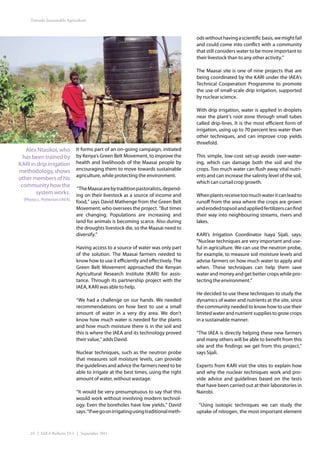
   Alex Ntasikoi, who          It forms part of an on-going campaign, initiated
  has been trained by          by Kenya’s Green Belt Movement, to improve the          This simple, low-cost set-up avoids over-water-
KARI in drip irrigation        health and livelihoods of the Maasai people by          ing, which can damage both the soil and the
methodology, shows             encouraging them to move towards sustainable            crops. Too much water can flush away vital nutri-
                               agriculture, while protecting the environment.          ents and can increase the salinity level of the soil,
other members of his
                                                                                       which can curtail crop growth.
 community how the
                               “The Maasai are by tradition pastoralists, depend-
       system works.           ing on their livestock as a source of income and        When plants receive too much water it can lead to
  (Photo: L. Potterton/IAEA)
                               food,” says David Mathenge from the Green Belt          runoff from the area where the crops are grown
                               Movement, who oversees the project. “But times          and eroded topsoil and applied fertilizers can find
                               are changing. Populations are increasing and            their way into neighbouring streams, rivers and
                               land for animals is becoming scarce. Also during        lakes.
                               the droughts livestock die, so the Maasai need to
                               diversify.”                                             KARI’s Irrigation Coordinator Isaya Sijali, says:
                                                                                       “Nuclear techniques are very important and use-
                               Having access to a source of water was only part        ful in agriculture. We can use the neutron probe,
                               of the solution. The Maasai farmers needed to           for example, to measure soil moisture levels and
                               know how to use it efficiently and effectively. The     advise farmers on how much water to apply and
                               Green Belt Movement approached the Kenyan               when. These techniques can help them save
                               Agricultural Research Institute (KARI) for assis-       water and money and get better crops while pro-
                               tance. Through its partnership project with the         tecting the environment.”
                               IAEA, KARI was able to help.
                                                                                       He decided to use these techniques to study the
                               “We had a challenge on our hands. We needed             dynamics of water and nutrients at the site, since
                               recommendations on how best to use a small              the community needed to know how to use their
                               amount of water in a very dry area. We don’t            limited water and nutrient supplies to grow crops
                               know how much water is needed for the plants            in a sustainable manner.
                               and how much moisture there is in the soil and
                               this is where the IAEA and its technology proved        “The IAEA is directly helping these new farmers
                               their value,” adds David.                               and many others will be able to benefit from this
                                                                                       site and the findings we get from this project,”
                               Nuclear techniques, such as the neutron probe           says Sijali.
                               that measures soil moisture levels, can provide
                               the guidelines and advice the farmers need to be        Experts from KARI visit the sites to explain how
                               able to irrigate at the best times, using the right     and why the nuclear techniques work and pro-
                               amount of water, without wastage.                       vide advice and guidelines based on the tests
                                                                                       that have been carried out at their laboratories in
                               “It would be very presumptuous to say that this         Nairobi.
                               would work without involving modern technol-
                               ogy. Even the boreholes have low yields,” David          “Using isotopic techniques we can study the
                               says. “If we go on irrigating using traditional meth-   uptake of nitrogen, the most important element


     24 | IAEA Bulletin 53-1 | September 2011
Towards Sustainable Agriculture


required by the plant, and advise the farmer on
how to get the most benefit from the fertilizer
                                                        Seeing Through Soil
that’s been applied,” Sijali adds.                      by Peter Kaiser
In the Maasai community, Alex Ntasikoi, who has         Nuclear technology helps farmers make
been trained by KARI in drip irrigation method-         the most of water
ology, shows other members of his community
how the system works.

“We’ve really seen the benefits of drip irrigation,”
                                                        I rrigation consumes seven of
                                                          every ten litres of fresh water used
                                                        daily around the world. As global
he says. “The system is cheap and requires lit-         population rises, so too does the
tle water, which is very important in our region        demand for food, which is satisfied by
because we have so little of it. Also, the plants get   expanding cultivation and increasing
less disease because the water goes into the roots      irrigation. If irrigation efficiency can
and not on the leaves,” Ntasikoi says.                  be boosted, much can be done to
                                                        reduce farming’s thirst for fresh water,
But the real beneficiaries of this project are the      and help preserve this irreplaceable
Maasai women. The men can be away for up to a           resource.
year in pursuit of grazing land for their livestock,
while the women and children remain in the com-         One of the nuclear technologies
munity.                                                 employed in tackling water scarcity
                                                        and saving water in agriculture is a
“Drip irrigation is a new technology for us and         “soil moisture probe”, or “neutron
since it’s been introduced we can plant our own         probe”, which is used to measure how
vegetables and don’t have to depend on live-            much water is present in the soil sur-
stock alone,” says Mary Kashu. “We can improve          rounding the probe. Measurement
our children’s nutrition and raise some income.         across a farm plot provides the farmer
We can use the money to pay school fees and to          invaluable insights into an otherwise
maintain the pump to get more water from the            invisible phenomenon: how much of
borehole.”                                              the irrigation or rainwater is held in                                      (P.Pavlicek/IAEA)
                                                        the soil and how much of that water is accessible and used
The IAEA is currently implementing the drip irri-       by plants.
gation project in 19 countries in Africa. Lee Heng,
a water specialist who manages the project, says:       In the hands of a trained and licensed operator, a probe can
“We hope that this project will empower the farm-       literally see through soil to detect the faintest traces of water.
ers to farm in an efficient, productive and sustain-    The device is so sensitive it can even calculate how much
able manner.”                                           water a plant consumes.

She adds that agriculture is responsible for            By flicking a switch, the operator can trigger a specially
around 70% of freshwater use and for most of            shielded, tiny radioactive source that emits a thin stream of
the world’s groundwater depletion. However, on          neutrons. They travel at great speed through the soil. The
average, only 37% of this water is used efficiently,    passage of those neutrons that struck hydrogen atoms in
due to inappropriate irrigation technology and          water molecules is dramatically slowed. After the neutrons
farming practices.                                      collide with other particles, they are reflected back towards
                                                        the probe, which measures the speed of the returning neu-
“As water becomes more and more scarce and              trons. Water’s braking effect on the neutrons is registered
growing populations demand more food, it is of          by a detector within the probe. Thus, the amount of return-
paramount importance that we manage agricul-            ing, slower-moving neutrons counted by the detector indi-
tural water better to grow more crops for every         cates the soil’s hydrogen content. The probe translates this
drop of water we use in both rain-fed and irri-         data into an exact soil-water content measurement, which is
gated agriculture,” says Lee.                           expressed in millimetres of water. That data is exactly what
                                                        the farmer needs to immediately plan irrigation and water
                                                        storage strategies that make the most of water for irrigation.

                                                        The probe itself does not cause any radioactive contamina-
                                                        tion, nor are any radioactive traces left in the soil.
Louise Potterton, Division of Public Information.
E-mail: L. J. Potterton@iaea.org                        Peter Kaiser, Division of Public Information.
                                                        E-mail: P.Kaiser@iaea.org

                                                                                                IAEA Bulletin 53-1 | September 2011 | 25
If I Had
Farmers in Kimutwa, Machakos county, Kenya are “praying” that it will rain. It’s been declared
a failed season for agriculture and rainfall is becoming more infrequent.


     Cecilia and Philip Munguti run a small farm in Kimutwa.        Around 80% of Kenyan farmland is classified as arid and
1    “It’s a disaster, my crops have dried up because there’s
     not enough rain. We could have eaten them or sold          2   semi-arid with low and erratic rainfall. But with no water
                                                                    for irrigation, from wells or boreholes, most farmers rely
     them. If I could get water from a borehole, I could            on the rains.
     irrigate; it would not be like this,” says Cecilia.


     The Munguti family used to have water that came                Dried up rivers, ponds and empty water tanks are a
3    directly from the hills into their village tank, but now
     the tank is empty.                                         4   common site in Kenya. Whether for farming or domestic
                                                                    use, there’s simply not enough water. One farmer says:
                                                                    “We’re in trouble, facing starvation.”


    26 | IAEA Bulletin 53-1 | September 2011
Water...                                                        by Louise Potterton


    An IAEA project is showing these farmers, who depend on rain-fed agriculture, how to grow crops
    in the driest of seasons using isotope-based water, soil and nutrient management practices.


    The Munguti family uses this rain-filled pond, the Kwa-           Cecilia and her family rely on this water, there’s no
5   Aka dam, for water for washing, cooking and drinking.
    The water is heavily polluted with animal waste and from      6   alternative: “The water is dirty. We have to boil it before
                                                                      we use it. Some animals even die when they drink it.
    soil erosion.                                                     There are worms and liver flukes in there,” she says.


    Philip Munguti says: “The water in the pond is dangerous,         People walk for up to 10 kilometres to reach the Kwa-
7   animals come here too to drink and they pollute it. It’s
    used by nearly 2,000 people. People walk far to get here,     8   Aka dam. One local woman explains: “We need to get our
                                                                      water for domestic use from here. We use our backs to
    but when the water is gone, we will need to go even               carry it. It’s dirty. It makes people ill. There are people in
    further to get it.”                                               the local hospital with typhoid.”


                                                                                           IAEA Bulletin 53-1 | September 2011 | 27
The IAEA is working with the Kenya Agricultural                         KARI soil scientist Kizito Kwena, who was trained by the
     Research Institute (KARI) to help farmers like the                      IAEA in Vienna, Austria, is using nuclear science to conduct
 9   ones in Machakos, grow healthy crops despite the                   10   research on plants that thrive with little water, retain
     lack of rain with the support of nuclear and isotopic                   moisture and improve soil fertility. He shares that knowledge
     techniques.                                                             with local farmers.


     Some farmers’ crops have withered in the drought.                       At this IAEA experimental site the crops are thriving despite
     The little water available to this community from                       the lack of rainfall. Kizito Kwena says: “We have a variety
11   the Kwa-Aka pond is needed for domestic use and                    12   of crops under different cropping systems and we need to
     is insufficient for irrigation. One farmer says: “Our                   figure out the most water efficient ones and this is where
     season was so bad, there’s not enough food.”                            nuclear techniques play an important role.”


     The IAEA project is also supporting the cultivation                     For some farmers in Machakos, the IAEA project is showing
     of the legume “pigeon pea” in Kenya. Nuclear-                           benefits. Many crops have indeed died, but the pigeon pea
13   based research has shown that the plant is not                     14   and cassava are surviving, thanks to good soil and water
     only drought-tolerant but also improves the soil’s                      management practices, supported by nuclear science. “I’ve
     capacity to retain water. Furthermore, it acts as a                     used pigeon pea as a fertilizer and it’s working really well,”
     natural fertilizer for present and future crops.                        says Cecilia.


                   Since these photos were taken in June 2011 the Kwa-Aka dam has dried up.
                         Photos: Louise Potterton and Petr Pavlicek/Division of Public Information • Text: Louise Potterton


     28 | IAEA Bulletin 53-1 | September 2011
by Louise Potterton


     No Rain, No Food
      How Nuclear Techniques can Support
      Agriculture in Dry Conditions


A
        ccess to sufficient water supplies is essen-     Louise Potterton spoke to IAEA soil and water             In many parts of the world,
        tial for successful and sustainable farm-        expert, Karuppan Sakadevan.                               either too much or too
        ing.  Without water, crops die, farmers lose                                                               little rain falls, often at the
their income and people go hungry.                                                                                 wrong time, leading to
                                                                                                                   water scarcity, droughts
There are two types of cropping systems namely
                                                         What are the major challenges                             and crop failure.
irrigated and rain-fed.                                  to rain-fed agriculture and how                           (Photo: P. Pavlicek/IAEA)

                                                         is it different from irrigated
Agriculture that depends upon rainwater repre-
sents about 80 % of the total area under cultiva-        agriculture?
tion and produces the majority, or about 60%, of
global food.                                             Rain-fed agriculture is a low-input system.
                                                         Depending on total annual rainfall and its distri-
In many parts of the world, either too much or too       bution as well as the type of soils, productivity
little rain falls, often at the wrong time, leading to   can vary greatly from moderate to low.
water scarcity, droughts and crop failure.
                                                         Agriculture that depends on rain is more risky
The IAEA’s Soil and Water Management and Crop            with the possibility of crop failures in drier areas
Nutrition section is using nuclear and nuclear-          due to erratic and unpredictable rains. Rain-fed
related techniques to help farmers in the devel-         agriculture is generally more successful on soils
oping world to conserve water and cope better            that can store a lot of rainfall (i.e. loamy and clayey
under dry conditions.                                    soils).


                                                                                                 IAEA Bulletin 53-1 | September 2011 | 29
No Rain, No Food


                       On the other hand, irrigated agriculture can be       to design the size and identify best locations for
                       highly productive with low risk but at a high input   developing these farm ponds and wetlands.
                       cost (i.e. irrigation equipment, energy)
                                                                             Since oxygen is a major element of water, the
                                                                             use of oxygen-18 isotope can help to separate
                                                                             the water loss from soil by evaporation and plant
                       How can the IAEA help                                 uptake. This helps in developing management
                       farmers who practice rain-                            practices such as tillage, residue retention, plant
                       fed agriculture conserve and                          density and crop rotation for reducing soil evap-
                                                                             oration losses.
                       manage water?
                                                                             A crop’s ability to capture every drop of water
                       The IAEA through its Research and Technical           depends on its health. That is why it is important
                       Cooperation Programmes has implemented 30             to know whether a nutrient such as nitrogen,
                       water conservation projects in rain-fed agricul-      a major building block of crop growth, is
                       ture in IAEA Member States in Asia, Africa and        sufficiently available. Nitrogen-15, a stable
                       Latin America. These projects focus on practises      isotope of nitrogen can be used to measure the
                       such as minimum tillage, crop residue retention       efficient use of applied fertilizer nitrogen to crops
                       and crop rotation.                                    under different management practices and thus
                                                                             determine the efficient use of water by crops.
                       On average, 65% of rainwater is lost and not avail-
                       able to crops in rain-fed agriculture. Farmers need   Since carbon is another major component in
                       to capture and store water so they can use it dur-    plant growth, the amount of carbon stable iso-
                       ing the dry period.                                   topes in light (carbon-12) and heavy (carbon-13)
                                                                             fractions can help us to identify crops that are tol-
                       Conservation or minimum tillage is a farming          erant to drought.
                       practice in which crops are grown with minimum
                       soil disturbance. It reduces the breakdown of soil    We also use the neutron probe, an instrument
                       organic matter and therefore increases the water      used to measure the amount of water stored in
                       holding capacity of the soil. This tillage practice   the soil and to assess the effect of different man-
                       along with crop residue incorporation into the        agement practices such as tillage and crop resi-
                       soil reduces water loss through evaporation and       due retention on soil moisture holding capacity.
                       the impact of rainfall on soil erosion.

                       Another example of addressing water scarcity
                       is water harvesting. This involves collecting and
                                                                             Can you give me more details
                       storing runoff water in natural or man-made farm      about water harvesting?
                       ponds and wetlands that can be used for supple-
                       mentary irrigation or drinking water for livestock.   Water harvesting and storage is gaining increas-
                       We also run programmes that support the selec-        ing importance in arid and semi-arid regions
                       tion of drought and salinity-tolerant crops, such     throughout the world as water becomes increas-
                       as rice and wheat.                                    ingly scarce, due to changing climatic conditions,
                                                                             erratic weather events or the unsustainable use
                                                                             of existing water. With this technique, rain water
                                                                             is captured, usually in a pond on a farm.
                       What are the nuclear
                       techniques involved?                                  Water harvesting acts as a buffer against drought,
                                                                             providing water for livestock and a limited capac-
                       In order to save every drop of water, we need to      ity for irrigation and fire protection.
                       know where the water goes. Isotopic techniques
                       can help to trace the movement of water between
                       soil, plant and atmosphere.
                                                                             Can you give me an example
                       In water harvesting, the oxygen isotope (oxy-         of an IAEA project where these
                       gen-18) is used to identify water sources such as     practices are working?
                       surface runoff and seepage flow entering into
                       farm ponds and wetlands. This will allow farmers      IAEA has implemented water harvesting
                                                                             technology in China, Estonia, Iran, Lesotho,


30 | IAEA Bulletin 53-1 | September 2011
No Rain, No Food


Nigeria, Romania, Tunisia and Uganda to increase
the productivity of rice, wheat and vegetable
crops through a network of coordinated research
projects.

Through both Technical Cooperation projects
and coordinated research projects, conserva-
tion agriculture practices have been imple-
mented in Argentina, Brazil, Chile, India, Kenya,
Morocco, Mexico, Niger, Pakistan, Turkey, Uganda
and Uzbekistan to increase water availability for
crops during the growing period. And our pro-
jects have achieved good results. In Niger, cow-
pea production increased nine-fold by using crop
rotation with millet and crop residue retention. In
Pakistan, crop residue retention and crop rota-
tion increased wheat yield by 18%.


What about extreme drought
situations — how can nuclear
techniques help here?
Extreme drought situations arise when a region
receives below average or no rain for months or
years. During prolonged droughts, losses in crop           The amount of water that is retained within the         The physical properties of
and livestock production can reach 50% or more.            root zone for crop use also depends on the activ-       the soil, such as particle
The projects we operate that support water con-            ity of soil organisms and earthworms that influ-        sizes and the proportions
servation and harvesting are useful in these con-          ence water runoff along the soil surface or water       of clay, silt and sand, its
ditions, since water stored in farm ponds and wet-         movement and retention within the soil. So tech-        chemical properties and its
lands can be helpful for irrigating crops for one or       nologies that help to improve the physical, chem-       mineralogy can determine
two growing seasons.                                       ical, and biological properties of soils are vital to   how much water the soil
                                                           improving agricultural water management.                holds, for how long and to
Also we have projects that use nuclear-based                                                                       what depth.
research to support the cultivation of drought-                                                                    (Photo: P. Pavlicek/IAEA)
tolerant crops. For example, pigeon pea and cow-
pea are tolerant to drought as they develop deep
                                                           Which nuclear techniques are
roots and extract water from depths up to two              used to improve soil fertility?
meters below the soil surface.
                                                           Stable isotopes of nitrogen and carbon are used.
                                                           These techniques are not used directly to improve
                                                           soil fertility, but help us to identify on-farm man-
The IAEA also develops soil                                agement factors that influence the extent of the
management techniques. Does                                movement of nutrient of added organic matter
soil play an important role in                             between soil and plant across agricultural land-
                                                           scapes.
water management?
                                                           This information is useful to provide advice on
It certainly does. Soil is different all over the world.   the best soil and nutrient management practices
Certain crops thrive better in certain soils and dif-      that enhances soil fertility and reduce soil
ferent soils can hold varying amounts of water.            degradation.

The physical properties of the soil, such as parti-
cle sizes and the proportions of clay, silt and sand,
its chemical properties and its mineralogy can
determine how much water the soil holds, for               Louise Potterton, Division of Public Information.
how long and to what depth.                                E-mail: L.J.Potterton@iaea.org


                                                                                                  IAEA Bulletin 53-1 | September 2011 | 31
by Rodolfo Quevenco

SUSTAINABLE MANAGEMENT
 OF COASTAL WATERS
              A profile of the history and levels of coastal
              pollution in the Caribbean emerges

                        F
                               ive years is but an instant in the course of   ◆ The coastal areas in the Caribbean are mainly
                               centuries recorded by the science of ocean     used for tourism, fishing, industry and commerce,
                               sediment core sampling. But for the marine     seaports, and as shelter for marine biodiversity;
                        scientists gathered in Monaco in Spring 2011, the
                        last five years yielded a treasure trove of data on   ◆ Coastal pollution has been steadily rising and
                        the study and understanding of coastal pollution      results mostly from domestic sewage discharges,
                        in the Caribbean.                                     industrial waste dumping, residue from oil and
                                                                              other fossil fuels, shipping and port activities,
                        The scientists represented countries sharing          hurricanes and other natural, agricultural runoffs,
                        the coastal resources of the Caribbean Sea --         and deforestation and soil erosion;
                        Colombia, Costa Rica, Cuba, Dominican Republic,
                        Guatemala, Haiti, Honduras, Jamaica, Mexico,          ◆ The most common types of coastal pollution
                        Nicaragua, Panama, and Venezuela. Joined by           result from high concentrations of heavy metals
                        experts from the IAEA, Spain and its Environment      (lead, mercury), inorganic elements (cobalt, chro-
                        Laboratory in Monaco, they met in a special ses-      mium, zinc, nickel), and organic pollutants (pes-
                        sion on the Caribbean during the International        ticides and polynuclear aromatic hydrocarbons).
                        Symposium on Isotopes, Marine Ecosystems and
                        Climate Change.

                        The session aimed to assess results of a regional
                                                                              Colombia
                        project using nuclear techniques to measure           The Bay of Cartagena is one of Colombia’s major
                        the paths of coastal pollution in the participat-     waterways. It is a hub for tourism, for fishing and
                        ing Caribbean countries. First launched in 2007       for industry. It also has one of the largest ports in
                        under an IAEA Technical Cooperation project           the Caribbean and a manufacturing base for hun-
                        (RLA/7012), the project involved taking sediment      dreds of small and medium factories.
                        core samples in all 12 countries, and analyzing
                        these samples to determine the trend and his-         Pollution in the Bay of Cartagena can be attrib-
                        tory of pollution from heavy metals and organic       uted to domestic sewage discharges; industrial
                        contents for the last 100 years to support deci-      dumping; leachate landfills; and sediments from
                        sion makers’ appropriate environmental man-           the Canal del Dique.
                        agement decisions. Equipment and training were
                        provided under the project to strengthen the          Built over 300 years ago to connect Magdalena
                        analytical capabilities of participating countries’   River to the Bay of Cartagena and the islands of
                        scientific institutions.                              Rosario and Barbacoa, Canal del Dique is con-
                                                                              sidered to be the major source of sediment dis-
                        To date, about 6000 data points have been gener-      charge for the bay. Its impact has been cata-
                        ated from the analysis of the sediment cores sub-     strophic for the bay’s ecosystems, leading to the
                        mitted by the participating countries. This infor-    existing coral reefs’ destruction, as well as of all
                        mation, including the trend of mercury pollution      sea grass. Dating tests indicate an increase in
                        analyzed in the sediments, is the first-ever com-     the sedimentation rate in recent years, due most
                        prehensive results reported in the area.              likely to changing land use and climatic events
                                                                              affecting the canal watershed.
                        There are similarities across the region and com-
                        mon pollution trends. For example:


 32 | IAEA Bulletin 53-1 | September 2011
Mercury pollution is also evident in Cartagena          Overall, measurements continue to indicate pol-         Across the Caribbean,
Bay, according to the analysis presented, with          lution levels are higher than values prior to val-      pollution by heavy
high concentrations detected in the deeper sedi-        ues from the 19th century but that management           metals, including
ment layers.                                            measures implemented in the bay since 1990              mercury, is causing
                                                        have helped restore the natural flow of sediments       increasing concern about
Efforts are invested in ensuring the canal’s navi-      in the marine ecosystem.                                its effects on tourism,
gability, but not the sustainability of the ecosys-                                                             clean beaches, and
tem. Dredging can further mobilize mercury pre-         Data collected have made it possible to under-          fishing. The presence
sent in sediments, thus emphasizing the need
                                                                                                                of mercury in fish can
                                                        stand the evolution and current state of pollu-
                                                                                                                be a health issue. This
and importance of heavy metal pollution control         tion, and demonstrate the impact of rehabili-
                                                                                                                fisherman in Nicaragua
in Cartagena Bay.                                       tation programs to restore the environmental
                                                                                                                relies upon clean water to
                                                        quality of the ecosystem.
                                                                                                                catch fish that are safe for
                                                                                                                him and his family to eat.
Cuba                                                                                                            (Photo: D.Sacchetti/IAEA)
The Bay of Havana is Cuba’s major waterway and
                                                        Dominican Republic
gateway to its capital city. The coastline is densely   Huge volumes of agricultural pollutants and
populated and includes a large number of indus-         industrial and municipal waste make their way
tries that dump their sewage into the water. An         into Rio Haina from industrial areas in the basin
oil refinery and the sewage system built as part of     and from the city of Santo Domingo. The coun-
industrialization and urbanization have contrib-        try conducted its first studies to assess the extent
uted to oil and organic pollution in the bay.           of the contamination in the mid-90’s. From 1995
                                                        onwards, a recovery program was implemented
Sedimentation rates show an increase from 1890          to reduce the effects of pollution. Some improve-
to 1980 with peaks attributed to severe weather         ments have already been reported.
events that have hit the area. From 1990 there
has been a reduction of sediment accumulation           Analysis of the sedimentation at Rio Haina indi-
rates, coinciding with efforts to reduce socio-eco-     cate peaks during periods of extreme weather
nomic activities and implement sound pollution          events, for example, strong hurricanes that struck
reduction measures.                                     the area in 1940, 1945, 1979 and, again, in 1998.


                                                                                              IAEA Bulletin 53-1 | September 2011 | 33
Sustainable Growth of Coastal Waters


                         While recorded levels of organic and inorganic        tal areas around the bay. In addi-
                         pollutants are low, there is an increased trend in    tion, continued deforestation and
                         the presence of lead, arsenic and other organic       high soil erosion in Haiti’s water-
                         pollutants in the area.                               sheds contributed to a significant          MEXICO
                                                                               increase in sedimentation rates in
                         Pesticide pollution – from DDTs – fluctuated in       the last hundred years, affecting the
                         correlation with their use in farming activities,     ecosystem’s health, in particular the coral
                         decreasing from the 1980s onwards as use of           reef.
                         these pesticides were gradually discouraged.
                                                                               Although industrial activity in Port-au-Prince
                                                                               Bay is limited, the generation of solid and liquid
                                                                               waste dumped into the bay — estimated at 1500
                         Guatemala                                             tonnes per day — resulted in a steady increase of
                         Amatique Bay is a semi-enclosed body of water         heavy metals in the water, particularly lead and
                         along the eastern coast of Guatemala hosting a        mercury. This represents a potential danger to
                         complex ecosystem of coastal lagoons, swamps,         public health from the consumption of marine
                         marshes, river systems and channels that connect      organisms.
                         protected waters and the adjacent continental
                         shelf. Fishing, tourism, shipping and marine con-     Information and data gathered so far on the
                         servation are among the main activities in the        evolution and state of pollution in the bay is
                         bay. Coastal and marine tourism alone accounts        expected to serve as baseline for evaluating
                         for 2% of Guatemala’s gross domestic product;         policies and coastal management programmes
                         tourist visits have steadily increased through the    to be established.
                         years.

                         These activities are believed to contribute to con-
                         tamination, in terms of leachate from solid waste;
                                                                               Honduras
                         industrial effluent discharges; agrochemical run-     The bay in the coastal city of Puerto Cortes in
                         offs and domestic sewage. However, it is soil ero-    Honduras is the site for its fuel and mineral stor-
                         sion and deforestation that has been identi-          age industries, fertilizer plants, and textile manu-
                         fied as the main environmental problem in the         facturing. Central America’s largest port – a hub
                         Amatique Bay.                                         for cargo vessels and luxury cruise ships – is also
                                                                               located along the bay. These activities, coupled
                         According to a 2006 environmental profile of          with rapid population growth, constitute the
                         Guatemala, the country lost 11% of its forest area    main sources of pollution in the bay area.
                         in the last 10 years, resulting in increased sedi-
                         mentation rates in the bay area.                      At the same time, the high rates of erosion in
                                                                               the region, prolonged flooding of the coastal
                         The continuous growth in sedimentation rates          zone, and uncontrolled disposal of urban waste
                         increases the vulnerability of fragile reef systems   have contributed to increased sedimentation in
                         in the Atlantic region of Guatemala, and could        the coastal areas. Hurricanes’ seasonal passage
                         directly impact the fisheries of the region.          aggravates the situation, resulting in increased
                                                                               pollution load and heavy metals discharge into
                         Increased traces of heavy metal pollution have        the marine environment. The rate of sedimen-
                         also been detected, but this has been attributed      tation has tripled in Puerto Cortes in the last 50
                         more to increased sedimentation rather than the       years, and is expected to double its current rate in
                         level of industrial activity.                         the next 20 years if left unchecked.

                                                                               At the current rate of sedimentation, Honduras
                                                                               expects that the frequency and cost of dredg-
                         Haiti                                                 ing the harbour area may increase in the near
                         Port-au-Prince Bay acts as a natural harbour for      future. Urgent measures may also have to be
                         Haiti’s like-named capital city. It hosts much of     taken along the upper basins of the rivers Ulua
                         the country’s industrial activities, such as load-    and Chameleon to control soil erosion.
                         ing docks, fuel storage, food processing, cement
                         manufacturing, and metal processing, which
                         constitute the major sources of pollution for cos-


34 | IAEA Bulletin 53-1 | September 2011
Sustainable Growth of Coastal Waters


                                               Havana Bay★ ★ Sagua Estuary                          THE BAHAMAS
                                         Gulf of Batabanó ★ ★ Cienfuegos Bay

                                                                                 CUBA            DOM. REP.
Río Coatzacoalcos ★                                                                Port-au Prince Bay
                                                                                            ★
                                                                      JAMAICA                         ★
                                                                                 ★      HAITI
                                       BELIZE                            Kingston Bay               Haina Estuary

                   Amatique Bay ★ ★ Puerto Cortés

               GUATEMALA                HONDURAS
                         EL SALVADOR

                                     NICARAGUA              ★ Blue elds Bay                Cartagena Bay
                                                                                                  ★
                                                                                                                               Gulf of Cariaco
                                                                                                                                      ★
                                           COSTA RICA
    Jamaica                                                     ★ Almirante Bay

    Kingston Harbour provides fishing, port and air-               PANAMA                                                  VENEZUELA
    port facilities for Jamaica. It is the site for thou-
    sands of industrial and commercial enterprises,
    as well as home for nearly one million people.
    However, the water quality has badly degraded,
                                                                                            COLOMBIA
    and the surrounding area has deteriorated,
    thus reducing its environmental use and tour-
    istic attractiveness. Pollution and alien species
    brought by shipping additionally threaten its rich
    biodiversity.

    Environmental studies at Kingston Harbour high-                      ECUADOR
    light two major problem areas: severe eutrophi-
    cation (increased presence of chemical nutrients
    in the water) and continuing deterioration of the
    water quality from untreated industrial wastewa-
    ter, disposal of agrochemicals and sewage, and
    an increased sedimentation rate in Hunts Bay
    caused by the Portmore Causeway, a bridge con-              est in the country. Waste water from industrial
    necting Portsmore to Kingston.                              processes and expanding human settlements
                                                                have dramatically altered the environmental pro-
    Higher levels of polynuclear aromatic hydrocar-             file of this important river basin.
    bons have also been detected since the 1980s.
                                                                Dating measurements using lead-210 showed
    At the same time, high levels of metals were                that an increased rate in sedimentation and asso-
    found in some sediments. The experts advise that            ciated pollutants began to appear with the rapid
    the government should take this into account in             urban growth and industrial expansion between
    coastal management efforts, and should also                 1970 and 1990. The increase in average sediment
    consider studying the uptake of metals by marine            accumulation rates is most likely a result of soil
    biota.                                                      erosion caused by changes in land use to support
                                                                industrial and urban development in this area.

                                                                Increased oil pollution is also evident in the river
    Mexico                                                      estuary. Concentrations of organic pollutants
    The Coatzacoalcos River is the third largest river          in core sediments point to the burning of fossil
    in Mexico. The industrial corridor built along its          fuels as a probable cause. From 1980 onwards,
    banks is home to about 65 petrochemical plants              heavy metal concentrations in the area have
    including the Lazaro Cardenas refinery, the old-            reached levels that could pose a risk to marine


                                                                                                      IAEA Bulletin 53-1 | September 2011 | 35
Sustainable Growth of Coastal Waters


            Juan Pablo Parra      biota. The experts recommend a program of             coastal ecosystems in Nicaragua with similar
          of the Instituto de     periodic checks, including measures to control        conditions, and even extend the study to inland
   Investigaciones Marinas        the amount of urban and industrial going into         water bodies.
      y Costeras (INVEMAR)        Coatzacoalcos river and its tributaries.
    laboratory in Colombia,
   recovers sediment from
      the seabed to check it                                                            Panama
        for pollutants. After     Nicaragua
                                                                                        A major economic activity in Almirante Bay in
  extracting a sample from        The Bluefield Lagoon in the south Atlantic            the province of Bocas del Toro, Panama, is the
  the ocean floor, Parra will     autonomous region of Nicaragua is an ecological       processing of bananas for export. Bananas
 use nuclear techniques to        haven for a variety of marine life and ecosystems.    have been grown in the area for over 100 years;
identify contaminants and         It provides a natural habitat for fish, crustaceans   it is an agricultural activity noted for its high
  reconstruct the pollution
                                  and marine species of great commercial interest.      dependence on agricultural chemicals and
                     sources.
                                  However, rapid population growth in settlements       fertilizers and for increased cargo ship traffic to
 Parra received training in       around the lagoon, and increased activities in        the local seaports.
 using nuclear techniques         fishing, forestry, and agriculture are threatening
      to analyse sediment         the balance of this delicate ecosystem.               This major industry thus accounts for the bay’s
       through a program                                                                increased pollution by organic chemicals and
  supported by the IAEA’s         The lagoon is also the main tributary of the          hydrocarbons. Another source of contamination
   Technical Cooperation          Escondido river, which carries an estimated           emanates from the settlements along the Bay of
              Programme.          11.6 billion cubic metres of sediment and river       Almirante. The absence of adequate treatment
     (Photo: D.Sacchetti/IAEA)    flow each year. Moreover, the devastation from        plants means waste-water, solid waste and sew-
                                  Hurricane Joan in 1988 almost completely              age are deposited untreated directly into the bay
                                  destroyed the basin and added significantly to        or nearby rivers. In the last decade, the increasing
                                  sediment build-up.                                    the number of passengers who travel, for tour-
                                                                                        ism, to Colon Island via water taxis, has exacer-
                                  Analysis of lead-210 dating and other environ-        bated this situation.
                                  mental indicators have helped Nicaragua evalu-
                                  ate changes in the sedimentary process and iden-      These factors, combined with the bay’s topogra-
                                  tify possible causes. They also indicate trends of    phy that inhibits the water’s active exchange with
                                  increased level of inorganic pollution in the last    the open sea, and the deforestation of the man-
                                  100 years.                                            grove forest, have resulted in increased levels of
                                                                                        environmental degradation of the marina in the
                                  Nicaragua will be using knowledge gained from         Bay of Almirante.
                                  these analyses to replicate the study in other


         36 | IAEA Bulletin 53-1 | September 2011
Sustainable Growth of Coastal Waters


                                                         Counterpart Institutes
                                                         The following national institutes participated in the
                                                         regional project for sustainable coastal management of
                                                         the Caribbean:

                                                         ❖ Instituto de Investigaciones Marinas y Costeras (INVEMAR),
                                                         Colombia (Institute of Marine and Coastal Research)

                                                         ❖ Universidad de Costa Rica (UCR), Costa Rica
                                                         (University of Costa Rica)

                                                         ❖ Instituto Costarricense de Acueductos y Alcantarillados, Costa Rica
                                                         (Costa Rica Institute of Aqueducts and Sewage Systems)

                                                         ❖ Japdeva, Costa Rica

                                                         ❖ Ministerio de Ciencia, Tecnología y Medio Ambiente, Cuba
                                                         (Ministry of Science, Technology and Environment)

Each of these country reports stress that data on the    ❖ Universidad Autónoma de Santo Domingo, República Dominicana
trends in heavy metal and organic pollution gath-        (Autonomous University of Santo Domingo)
ered for the last 100 years will be a useful tool for
decision makers in crafting strategies for sustainable   ❖ Ministerio de Energía y Minas (MEM), Guatemala
coastal management.                                      (Ministry of Energy and Mines)

                                                         ❖ Empresa Portuaria Quetzal, Guatemala
                                                         (Quetzal Port Enterprise)
The Next Steps
The project on the sustainable management of the         ❖ Ministère de l’environnement, Haïti
Caribbean Sea is scheduled for full completion in        (Ministry of the environment)
2012.
                                                         ❖ Secretaria de Recursos Naturales y Ambiente (SERNA), Honduras
Until then, follow-up training on the use of lead -210   (Secretary of Natural Resources and Environment)
for dating sediments and a review meeting for all
counterparts are still foreseen. More important are      ❖ National Environment and Planning Agency, Jamaica
strategies to make these reports available — in full
and concise form— to as wide an audience as possi-       ❖ Universidad Nacional Autónoma de México, México
ble. The results will be presented at an inter-govern-   (National Autonomous University of Mexico)
mental meeting of the United Nations Environment
Programme in the Caribbean for higher-level dissem-      ❖ Universidad Nacional Autónoma de Nicaragua, Nicaragua
ination.                                                 (National Autonomous University of Nicaragua)

Strategies to further support Caribbean countries in     ❖ Autoridad de Recursos Acuáticos de Panamá, Panamá
developing and sustaining their individual capabili-     (Authority for Aquatic Resources of Panama)
ties for environmental monitoring and management
should thereafter be developed to lend meaning to        ❖ Centro de Investigaciones Energéticas, Medioambientales y
these valuable scientific results.                       Tecnológicas (CIEMAT), Spain
                                                         (Centre for Energy, Environment and Technology Research)

Rodolfo Quevenco, Division of Public Information.        ❖ Universidad del Oriente, Venezuela
E-mail: R.Quevenco.iaea.org.                             (University of the Orient)
Staff from the Department of Technical Cooperation
and Nuclear Science and Nuclear Applications
contributed to this article.


                                                                                      IAEA Bulletin 53-1 | September 2011 | 37
DETECTING A                                                      colonies of algae—simple ocean plants that live
                                                                                      in the sea—grow out of control and produce tox-
                                                                                      ins that can poison fish, shellfish and other marine
                                                                                      life, and pose a major threat to people’s health
                                                                                      and fishermen’s livelihoods.

                                                                                      Not all algal blooms are harmful. In fact, most of
                                                                                      them sustain marine life, providing a vital source
                                                                                      of nutrients for a host of sea creatures. Certain
                                                                                      algal species produce poisons called saxitoxins.
                                                                                      When conditions are ideal – i.e., higher nutrients
                                                                                      in water through coastal upwelling or agricultural
                                                                                      runoffs - these algae can “bloom” and overpopu-
                                                                                      late, inevitably resulting in the release of massive
                                                                                      amounts of toxin that kill fish and can accumulate
                                                                                      in clams, mussels and shellfish, making them dan-
                                                                                      gerous to eat. Paralytic Shellfish Poisoning (PSP),
                                                                                      characterized by death through paralysis of the
                                                                                      respiratory system, is one of the most common
                                                                                      health threats from eating contaminated shell-
                                                                                      fish.

                                                                                      Despite its ‘red’ moniker, many outbreaks of HABs
                                                                                      often do not discolour the water, or may have
                                                                                      other colours like green or yellow. In fact, most
                                                                                      blooms are difficult to detect with the naked
                                                                                      eye. Undetected, the risk of spoiled fish harvests
                                                                                      and/or contaminated sea products entering the
                                                                                      human food chain increases many times over.

                                                                                      The global impact that HABs can have on human
                                                                                      health, economies and the ecosystem, makes
                                                                                      it one of the most serious, naturally occurring
                                                                                      coastal problems in the world. As outbreaks of
                                                                                      these poisonous blooms of algae become wide-
                                                                                      spread and more frequent, the IAEA is stepping


                                T
      A sudden onset of               hey are the seas’ silent killers, toxin-laden   up efforts to help countries understand the phe-
  harmful algal blooms                patches of algae that amass along coastal       nomenon and use more reliable methods for
 (HABs) can poison fish,              shores and wreck havoc on marine eco-           early detection and monitoring so as to limit
     shellfish and other        systems. They appear with no warning and out-         HABs’ adverse effects on coastal communities
 marine life, and pose a        breaks have become more frequent. Virtually           everywhere.
major threat to peopleís        every coastal country in the world has suffered
 health and fishermen’s         from their effects.
             livelihoods.
     (Photo: F. Boisson/IAEA)   These are harmful algal blooms (HABs), more
                                                                                      Detection as the Best Form of
                                commonly known as ‘red tides’ because their           Prevention
                                ominous presence is sometimes characterized
                                by a massive red patch of water encroaching the       Early detection is key in HABs control. For dec-
                                shorelines. Often outbreaks are invisible and thus    ades, the conventional method to test for impend-
                                pose an even greater threat. HABs occur when          ing red tide events was through mouse bioassay.


        38 | IAEA Bulletin 53-1 | September 2011
KILLER TOXIN
                                                                      by Rodolfo Quevenco


Scientists would inject toxin extracts from sus-
pect algae or shellfish samples into a laboratory
mouse and measure how long it would take for
the mouse to die. The mouse bioassay method
is considered to have a low sensitivity, and is not
able to precisely pinpoint levels of toxicity.

A nuclear-based technique using receptor bind-
ing assay (RBA) is benign, quicker and much more
precise. RBA works by mixing a shellfish sample
with a ‘marker’ — in most cases, tritium-labeled
saxitoxin — then exposing the mixture to a tis-
sue sample. If the shellfish is contaminated, the
poisons compete with each other to “bind” to the
nerve cells of the tissue, with the radioactive toxin
being displaced or “bumped off’ its receptors by
poison already present in the shellfish. By meas-
uring the amounts or radioactivity left, scientists
can then pinpoint exactly what the levels of toxic      Florence Boisson, a scientific consultant of the       Philippine Nuclear
concentrations are.                                     Principality of Monaco working at NAEL, believes       Research Institute
                                                        the IAEA has a clear leadership role in delivering     Director, Alumanda de la
RBA is thus a far more sensitive and precise meas-      the benefits of the RBA to its Member States.          Rosa, says completion of
uring method, and the IAEA has long been spear-                                                                major modifications to
heading efforts to widen its use among as many          To further understand the paths used by the HABs       the receptor binding
countries as possible. To this end, it has entered      toxin to enter seafoods, NAEL Monaco works with        assay technique would
into partnership agreements with international          its Collaborating Centre — the Philippine Nuclear      enable the technology to
organizations involved with HABS; it actively           Research Institute (PNRI) — to apply RBA in field      be brought to the field.
facilitates international collaboration on the use      studies at selected aquaculture areas in the coun-     (Photo: D. Calma/IAEA)
and advancement of RBA, and supports several            try. PNRI’s pioneering work in RBA since the late
regional and national projects.                         1990s, and the country’s rich aquatic resources,
                                                        makes it an ideal partner for research and devel-
Currently 23 IAEA Member States have active             opment work. Experts are giving special atten-
technical cooperation projects dealing with the         tion to measuring the transfer and elimination
monitoring and early warning of seafood toxicity        of the biotoxin which causes PSP, and tracing the
using the RBA method. Several successful appli-         transfer of the toxin from the shellfish all the way
cations of RBA for HABs have been reported and          up the human food chain.
documented in Chile, El Salvador, Namibia, and
the Philippines, to name a few.                         With technical support from NAEL Monaco, the
                                                        Philippines is also extending R&D work to mod-
                                                        ify the procedure and instrumentation — for
                                                        example using iodine-125 instead of tritium and
RBA Research and Deployment                             a gamma counter instead of liquid scintillation
Leading the IAEA’s efforts on HABs is its               — which would allow the procedure to be per-
Environment Laboratories in Monaco (NAEL). For          formed in the field or in small laboratories in the
years, the laboratory has been at the forefront         coast. Analytic results would be quicker, and alerts
of promoting the use of RBA for early detection         of impending red tide events can be announced
and monitoring of HABs occurrences in Member            at a shorter notice.
States.
                                                        PNRI, whose status as IAEA Collaborating Centre
                                                        on HABs was renewed in July 2011, hopes to fin-


                                                                                              IAEA Bulletin 53-1 | September 2011 | 39
Detecting a Killer Toxin


                                                                                         project (INT/7/017) to provide coordinated sup-
                                                                                         port for using RBA to address impacts of harmful
                                                                                         algal toxins in seafoods.

                                                                                         One overall project aim is to build a support struc-
                                                                                         ture to allow countries to develop and implement
                                                                                         strategies and programmes on HABs. Another is
                                                                                         to upgrade regional capabilities in receptor bind-
                                                                                         ing assay through training and technology trans-
                                                                                         fer.

                                                                                         As a part of the tripartite agreement between
                                                                                         the IAEA, UNEP and UNESCO’s International
                                                                                         Oceanographic Commission (IOC), signed on 25
                                                                                         February 2011, a long-term collaboration began
                                                                                         with the IOC to build countries’ capacity to moni-
                                                                                         tor HABs.  This collaboration has already resulted
                                                                                         in regional initiatives in Africa and Latin America
                                                                                         aimed at strengthening these regions’ capacity
                                   ish major RBA modifications this year. When com-      to monitor outbreaks of harmful algal blooms.
 A fisherman in Sorsogon           pleted the technology will then be shared with
Bay in the Philippines sets        other IAEA Member States through an IAEA tech-        “One overall project aim is to build a support struc-
 out at dawn for the early         nical cooperation project.                            ture to allow countries to develop and implement
           morning catch.                                                                strategies and programmes on HABs. Another is
      (Photo: F.Boisson/IAEA)      “It is an honour for the Philippines that our peers   to upgrade regional capabilities in receptor bind-
                                   recognize the work that we have done in this          ing assay through training and technology trans-
                                   area”, says PNRI Director Alumanda de la Rosa.        fer”, says Boisson.
                                   “ We are also glad that our R&D strategies have
                                   become the model that other regions can use in        A direct offshoot of this international coordina-
                                   studying their HABs problem.”                         tion is a Manual of Methods for Harmful Algal Toxin
                                                                                         Detection Using RBA, due for issue in late 2011. A
                                                                                         joint endeavor by the IAEA and NOAA, the manual
                                                                                         will serve as a useful guide for developing coun-
                                   Horizons of International                             tries wanting to use RBA for HABs. It is another
                                   Cooperation                                           step forward in the growing acceptance – and use
                                                                                         – of RBA to help detect and forecast the location
                                   In early 2011, IAEA and the US National Oceanic       of harmful algal blooms.
                                   and Atmospheric Administration (NOAA) signed
                                   a practical arrangement formalizing their col-        Controlling the toxic menace from the sea will
                                   laboration to provide technical assistance in the     continue to be an elusive goal for years to come.
                                   management of the impacts of HABs.                    Continued research in technologies like RBA are
                                                                                         helping to bridge the gap in understanding the
                                   This announcement followed in the heels of a          phenomenon of the ‘red tide; and forewarning of
                                   major meeting of an international scientific advi-    its coming.
                                   sory committee on harmful algal blooms organ-
                                   ized by the IAEA in March 2010. Held in Charleston,   With health and livelihood in the balance, these
                                   South Carolina, the meeting brought together          are potent tools for countries that need them the
                                   international experts known for their expertise in    most.
                                   the use of receptor binding assay for HABs.

                                   The meeting reviewed reports on existing appli-
                                   cations of RBA for HABs; addressed issues of sup-     Rodolfo Quevenco, Division of Public Information.
                                   ply for radio-labeled reagent toxins; defined         E-mail: R.Quevenco@iaea.org
                                   strategies for further development; and plotted
                                   the course for strengthened international col-        Staff from the IAEA’s Department of Technical
                                   laboration among organizations involved with          Cooperation and the Environmental Laboratory
                                   HABs. It was held as part of an IAEA inter-regional   contributed to this article.


         40 | IAEA Bulletin 53-1 | September 2011
Protection from a
Toxic Menace
IAEA helps El Salvador handle the threat from
                                                                                        by Sasha Henriques


Harmful Algal Blooms

T
      he potentially deadly toxins released by       This system depends on a network of monitoring
      Harmful Algal Blooms (HABs) threaten El        stations located in fishing parks. Samples from
      Salvador’s shellfish harvest and pose a        the monitoring station are brought to the facility
grave health risk. Through several of the IAEA’s     for analysis. The new toxin detection methods are
Technical Cooperation projects, scientists at the    faster and allow scientists to analyse more sam-
Laboratory of Marine Toxins of the University of     ples, and thus provide an early warning of a HAB-
El Salvador (LABTOX-UES) have received sup-          induced spread of toxins.
port from the IAEA’s Technical Cooperation
Programme in setting up a permanent monitor-         The concept was proven when an early warning
ing system that provides early warning of toxins     of a “red tide” was issued in 2010. LABTOX-UES
in microalgae and seafood products.                  publishes its analyses online (http://toxinasmari-
                                                     nas.cimat.ues.edu.sv) to support early warnings
The IAEA equipped the laboratory and provided        of algal outbreaks and help reduce the health
training on specialized detection equipment that     threat posed by this natural killer.
is used to monitor HABs. This is a unique capabil-
ity that no other laboratory in the region has yet                                                        HAB events have
developed.                                           What is the IAEA doing                               become a common
                                                     globally?                                            problem both in
The government relies on the facility to detect                                                           developed and
toxicity in HABs for its early warning system,       The IAEA’s Department of Technical Cooperation,      developing countries,
which is used to alert fisherman and locals as       together with international and national organ-      affecting public health
soon as there is a dangerous concentration of tox-   isations around the world, works with national       and the shellfish and fish
ins in the water.                                    marine institutes and governments to tackle the      farming industry.
                                                     issue.                                               (Photos: Nancy Falcon Castro/
                                                                                                          UNIDO)


                                                                                         IAEA Bulletin 53-1 | September 2011 | 41
The IAEA equipped the
      Laboratory of Marine
Toxins of the University of
 El Salvador and provided
    training on specialized
     detection equipment
    used to monitor HABs.
 (Photos: Nancy Falcon Castro/
                      UNIDO)


                                 In addition to its work in El Salvador, the IAEA       These facilities are prime examples of the benefits
                                 works with the Philippine Nuclear Research             of cooperation between the IAEA and Member
                                 Institute, which is the only IAEA collaborating cen-   States to protect national food security, public
                                 tre on HABs in the world. The Institute undertakes     health and the economy.
                                 research with the IAEA Environment Laboratories
                                 in Monaco to track the impact and fate of biotox-      They contribute to the sustainable management
                                 ins in the marine food-chain.                          of fishery products and the coastal economy,
                                                                                        increase food security and are a resource for fac-
                                 Through the Technical Cooperation programme,           ulty, students and the Government: all benefits
                                 14 marine laboratories were established in Africa,     that will last long into the future.
                                 Asia and in Central and Latin America. Through
                                 an on-going project in the Caribbean and Latin
                                 America, the IAEA will be establishing three more
                                 laboratories by 2013 and will develop the capabil-
                                 ities of eight other countries to detect HABs.         Sasha Henriques, Division of Public Information.
                                                                                        E-mail: S.Henriques@iaea.org
                                 Also, a new regional project in Asia will enhance
                                 the capacity to monitor the impact of toxic algae      The IAEA’s Technical Cooperation Department’s
                                 by addressing ciguatera (a disease contracted          Communication staff also contributed to this
                                 when one eats fish contaminated by toxins).            article.


        42 | IAEA Bulletin 53-1 | September 2011
by Peter Kaiser

An Ocean of Knowledge
On        10 March 1961, the IAEA con-
          cluded with the Principality
                                            ocean. The research is buttressed
                                            by strategic partnerships with other
                                                                                         Two years after UNEP was founded
                                                                                         in 1972, the Laboratory provided the
of Monaco and the Oceanographic             UN ocean agencies such as the                essential scientific and analytical sup-
Institute, then directed by Jacques         Intergovernmental Oceanographic              port for a landmark study of radio-
Cousteau, their first agreement on a        Commission, which also celebrates            active and non-radioactive pollut-
research project on the effects of radi-    this year its 50th anniversary, as well      ant levels in all principal seas. The
oactivity in the sea. Fifty years later,    as the United Nations Environmental          Laboratories have undertaken world-
that cooperation expanded signif-           Program, the United Nations                  wide radioactivity baseline studies of
icantly through collaboration with          Development Program (UNEP), the              the Atlantic, North and South Pacific,
international and regional organi-          United Nations Educational, Scientific       Indian, Arctic and Antarctic Oceans
zations, as well as national laborato-      and Cultural Organization, and the           and the Far Eastern, Mediterranean,
ries. The Laboratories that grew from       International Maritime Organization.         and Black Seas. Regional studies have
this initial agreement comprise the                                                      been conducted in the Gulf, the Irish,
only marine laboratory in the United        Many Member States’ national lab-            Kara and Caspian Seas, New Caledonia
Nations system that undertakes              oratories rely upon the Laboratory’s         and the Mururoa and Fangataufa
research, while providing training and      accurate analyses of sea water, sedi-        Atolls.
support services for the study of the       ment and marine life samples. These
oceans and marine environments.             analyses help assure the quality of the      By 1986, the Marine Environmental
                                            research conducted by collaborating          Studies Laboratory was established in
Initially, the Laboratory was hosted in     laboratories  engaged in joint environ-      Monaco. This Laboratory is concerned
Monaco’s Oceanographic Museum.              mental studies, utilizing the IAEA’s reli-   mainly with non-radioactive pollut-
The Laboratory’s subsequent, and its        able reference materials at an afford-       ants such as pesticides, polychlorin-
current permanent premises, were            able cost.                                   ated biphenyls (PCBs), petroleum
also provided by the Principality of                                                     hydrocarbons, polycyclic aromatic
Monaco, considerably expanding and          In Monaco, the Radiometrics                  hydrocarbons (PAHs), antifouling
enhancing the quality of laboratory         Laboratory uses radionuclides as envi-       paint booster biocides, and recently
space over this period, now named           ronmental tracers, in collaboration          also dealing with radioactive contam-
the Environment Laboratories. The           with leading research centres around         inants. In cooperation with regional
Laboratory began its work by stud-          the world, to quantify ocean circu-          laboratories, the Laboratory pro-
ying radioactive substances in the          lation, the transport of pollutants in       vides training and implements marine
marine environment and their effects        coastal ecosystems, sedimentation            monitoring programmes, while act-


   marine
on marine life.                             and submarine groundwater dis-               ing as the analytical support centre
                                            charge.                                      for regional organizations protecting
Unique data derived from the                                                             marine environments.
application of nuclear and isotopic         The Radioecology Laboratory studies
techniques     improve    scientists’       the impacts of contaminants on sea-
knowledge of oceanic processes,             food safety (including Harmful Algal         Peter Kaiser, Division of Public
marine ecosystems and support               Blooms), of climate change and ocean         Information.
pollution    impacts   assessments.         acidification on marine organisms, as        E-mail: P.Kaiser@iaea.org
These     studies    support     the        well as the ocean’s ability to seques-       Staff of IAEA’s Environmental
sustainable development of the              ter CO2.                                     Laboratory contributed to this article.


laboratory
By 1986, the Marine Environmental Studies Laboratory was established in Monaco.
This Laboratory is concerned mainly with non-radioactive pollutants radioactive contaminants. (Photos: IAEA)


                                                                                           IAEA Bulletin 53-1 | September 2011 | 43
by Maureen MacNeill

                              Unlocking Rain’s Secrets
                              In March 1960, the World Meteorological            environmental isotopes when assessing water
                              Organization (WMO) and the IAEA began their        resources. The database provides unique
                              cooperation: WMO meteorological services and       information and tools to understand atmospheric
                              other national agencies started collecting rain    circulation processes and to verify and improve
                              water over 50 years ago and continue to send       atmospheric circulation models, the study of
                              samples to the IAEA and other cooperating labo-    climate change over different time periods, as
                              ratories, where the samples’ isotopic content is   well as for ecological research. The database is
                              determined.                                        now routinely used in palaeontology, landscape
                                                                                 ecology, anthropology, plant physiology, animal
                            Naturally ocurring isotopes in water help            migrations, food webs, food authentication and
                            researchers trace the sources, movement and          forensics. 
                            history of water molecules in the water cycle.
                            Isotopes in precipitation are particularly useful    Today, the network contains isotope data for more
                            tracers since precipitation recharges — directly     than 900 stations, with over 120  000 monthly
                            or indirectly — all freshwater systems. Already in   records. GNIP is the world’s largest database of
                            the late 1950s, the IAEA recognized that countries   isotopes in atmospheric waters, available to all
                            with limited water resources would need reliable     Member States to support isotope techniques
                            and comprehensive hydrological information to        for hydrological and atmospheric research, while
      Today, GNIP includes be able to plan drinking water supplies as well as    the IAEA laboratory assists countries in determi-
        about 900 stations, agricultural and industrial water consumption.       ning the isotope composition of water samples to
   producing over 120 000                                                        assess present and future water supplies.
          monthly records. The resulting database, the Global Network of
       Below: Map of WMO Isotopes in Precipitation, or GNIP, helps scientists    This newsletter offers more information on GNIP’s
stations contributing GNIP profile the characteristic isotopic signature of      history: www-pub.iaea.org/MTCD/publications/
          data, 1964, IAEA. precipitation, which is the key to interpreting      PDF/Newsletters/WE-NL-26.pdf


    Global Network of
     Isotopes in Precipitation
       44 | IAEA Bulletin 53-1 | September 2011
Photo: Caribbean surf lands at a beach
                                                       near Puerto La Libertad, El Salvador.

                                                       The sea is never far from home. In fact, it’s
                                                       just two kilometres away from the homes
                                                       of four out of ten people who live in the
                                                       Caribbean region. Home to 14% of the
                                                       world’s coral reefs, the Sea boasts some
                                                       of the planet’s most diverse mangrove
                                                       and sea-grass coverage, according to
                                                       the United Nations’ Environmental
                                                       Programme (UNEP).

                                                       The reefs and coastal habitats support
                                                       fisheries, and attract tourists, providing
                                                       Caribbean nations annual revenues of
                                                       between $3.1 and $4.6 billion.

                                                       The continued loss of coastal habitats and
                                                       reefs can impede the region’s economic
                                                       and environmental resiliency. Pollution
                                                       and sedimentation are two of the main
                                                       threats to this delicate environment’s
                                                       health and diversity.

                                                       The IAEA is working with 12 Caribbean
                                                       nations, providing support in the use of
                                                       nuclear techniques to localize pollution
                                                       sources and quantify their effects on
                                                       coastal environments. Preserving the
                                                       Caribbean’s biodiversity is essential
                                                       for regional development, according
                                                       to UNEP’s Caribbean Environment
                                                       Programme.


11-0711   ISSN 0020-6067   Nancy Falcon Castro/UNIDO
fetching water
    an everyday story for a billion people


fetching
Eight-year old cousins, Mutuku and Mwania, live in Kimutwa in eastern Kenya.  
The rain-filled Kwa-Aka dam is their community’s only water source. They walk
five kilometers to reach the dam where they fetch water for their families. The water
is polluted and needs to be boiled thoroughly before it can be consumed. Mutuku
and Mwania built wooden barrows to haul the heavy water canisters home.  


Water is scarce in this region; the rains are unpredictable and infrequent. People
have few alternative water sources. When the dam water dries up, Mutuku, Mwania
and others in their village will have to walk 20 km further to find water. A trek they
will make until the rains refill the dam.
These photos were taken in June 2011, meanwhile the pond is empty.
The next rain is expected in October.

                                             Text: Louise Potterton ♦ Photos: L. Potterton & P. Pavlicek

IAEA Bulletin September 2011

  • 1.
    IAEA BULLETIN INTERNATIONAL ATOMIC ENERGY AGENCY September 2011 | 53-1 | www.iaea.org/bulletin too little, too hard to find Water for Santa Elena • Farming When the Rains Fail • Protecting Coastal Waters
  • 2.
    The International AtomicEnergy Agency serves as the world’s foremost intergovernmental forum for scientific and technical cooperation in the peaceful use of nuclear technology. Established as an autonomous organization under the United Nations in 1957, the IAEA carries out programmes to maximize the useful contribution of nuclear technology to society while verifying its peaceful use. The IAEA helps its Member States pursue their developmental goals by supporting the responsible planning and use of nuclear science and technology. The IAEA facilitates the transfer of the knowledge and technology needed by developing Member States to utilize these technologies peacefully. By developing nuclear safety standards, the IAEA promotes the achievement and maintenance of high levels of safety in nuclear energy applications, as well as protecting human health and the environment against ionizing radiation. The IAEA also verifies through its inspection system that Member States comply with their commitments under the Non-Proliferation Treaty and other non-proliferation agreements to use nuclear material and facilities only for peaceful purposes. The work is multi-faceted and engages a wide variety of partners at the national, regional and international levels. IAEA programmes and budgets are set through decisions of its policymaking bodies — the 35-member Board of Governors and the General Conference of all Member States. The IAEA is headquartered at the Vienna International Centre. Field and liaison offices are located in Geneva, New York,Tokyo and Toronto. The IAEA operates scientific laboratories in Monaco, Seibersdorf and Vienna. In addition, the IAEA supports and provides funding to the Abdus Salam International Centre for Theoretical Physics,Trieste.
  • 3.
    IAEA BULLETIN CONTENTS INTERNATIONAL ATOMIC ENERGY AGENCY September 2011 | 53-1 | www.iaea.org/bulletin IAEA Bulletin 53-1 | September 2011 Why Water Matters 2 by Yukiya Amano Too Little, Too Hard to Find 3 too little, by Sasha Henriques Sidebar: Assessing Water Needs too hard to find Tackling the Water Crisis 6 by Mollie Rock Zuccato Sidebar: Optimal Results Water for Santa Elena • Farming When the Rains Fail • Protecting Coastal Waters IAEA BULLETIN Complex Science Saving Lives in Bangladesh 10 is produced by the by Sasha Henriques Division of Public Information International Atomic Energy Agency P.O. Box 100, A-1400 Vienna, Austria IAEA Helps Parched Santa Elena Find Water 12 Phone: (43-1) 2600-21270 by Maureen MacNeill Fax: (43-1) 2600-29610 IAEABulletin@iaea.org Treasure Maps 14 by Peter Kaiser Division of Public Information Editor-in-Chief: Peter Kaiser All About Water 17 Assistant Editor/Design: Ritu Kenn Facts and figures on the water crisis IAEA BULLETIN is available online at Improving Farming with Nuclear Techniques 21 www.iaea.org/bulletin Past editions are archived on-line at by Sasha Henriques www.iaea.org/bulletinarchive Sidebar: Making the Most of it Farming When the Rains Fail 23 Extracts from the IAEA material contained in the by Louise Potterton IAEA Bulletin may be freely used elsewhere provided Sidebar: Seeing Through Soil acknowledgement of their source is made. If the attribution indicates that the author is not an IAEA staff member, permission to republish other than for If I Had Water... 26 the use of review must be sought from the author or by Louise Potterton originating organization. No Rain, No Food 29 Views expressed in any signed article appearing in by Louise Potterton the IAEA Bulletin do not necessarily represent those of the International Atomic Energy Agency and the Sustainable Management of Coastal Waters 32 IAEA accepts no responsibility for them. by Rodolfo Quevenco Cover Photo: A young boy from Kishoreganj Detecting a Killer Toxin 38 District in central Bangladesh carries water through by Rodolfo Quevenco his village. Kishoreganj is one of several areas in Bangladesh which has been affected by the Protection From a Toxic Menace 41 presence of arsenic in its groundwater supply. by Sasha Henriques To learn more, turn to page 10. (D. Sacchetti/IAEA, August 2011) An Ocean of Knowledge 43 by Peter Kaiser IAEA Bulletin is printed in Vienna, Austria. Sidebar: Unlocking Rain’s Secrets IAEA Bulletin 49-2 | March 2008 | 1
  • 4.
    by Yukiya Amano Why Water Matters give over a quarter of a million people continuous access to fresh water for the first time. I saw this successful project myself in July 2011. Together with our partners, we investigate and measure the aquifers so that wells can be drilled in the right places and long-term sustainability of water supply is assured. The IAEA is working with partners in Bangladesh to mitigate contamination of groundwater by natural arsenic, the worst such case in the world. The use of nuclear techniques made it possible to locate safe alternative supplies of water quickly and cheaply. In Africa, where many farmers are confronted with arid growing conditions, water is becom- ing a rare commodity. The IAEA is working with 19 African countries to teach farmers to use appro- priate, small-scale irrigation technology, sup- ported by nuclear techniques, to make sure that every drop reaches the crops to produce greater yields. The IAEA’s experts also use nuclear techniques to protect the marine environments. Pollution threatens many of the world’s seas and oceans, on which countless people depend for their liveli- Nuclear techniques can help countries hood. In 12 countries that ring the Caribbean, for to manage their freshwater supplies and example, the IAEA is helping to establish a labora- protect the environment. tory infrastructure to identify sources of pollution and better protect seas and coastlines. In order to raise awareness among the world’s decision-makers about water issues, and about T he world faces acute water shortages. The the enormous benefits of using low-cost nuclear current African drought is just the latest techniques to address them, I decided that the tragic example. One billion people have no September 2011 IAEA Scientific Forum should access to adequate drinking water. Five million focus on this subject. — mainly children — die each year due to water– borne diseases. Those numbers are expected to This issue of the IAEA Bulletin highlights the bene- rise. fits of nuclear techniques in tackling global water challenges. It also describes our work with many For over half a century, the IAEA has been doing national and international partners to improve everything it can to help, deploying its unique global access to sustainable supplies of clean expertise in using nuclear techniques to under- water and to protect the environment. I hope you stand and manage water. In more than 90 coun- will find it interesting and informative. tries, our experts work with national counterparts to find, manage and conserve freshwater sup- plies and protect our oceans. In the Santa Elena province in Ecuador, for exam- ple, the IAEA has worked with local partners to Yukiya Amano is Director General of the IAEA. 2 | IAEA Bulletin 53-1 | September 2011
  • 5.
    by Sasha Henriques too little, too hard to find Addressing the Global Water Crisis (L.Potterton/IAEA) O Water Crisis nly 2.5% of the earth’s water is fresh, not salty. Less than 1% of that tiny fraction is available for us to use. The rest is frozen in This issue of management—understanding ice caps and glaciers, or occurs as soil and atmos- where water is available, who needs it, how to get pheric moisture.  it to them, and water’s equitable and responsible distribution—is the crux of the problem. Almost all of that precious resource, the earth’s accessible fresh water, is located underground When asked if there is a water crisis, Pradeep — water that is hidden in the earth’s crust and is Aggarwal, head of the IAEA’s Isotope Hydrology often hard to access. This vital resource is poorly Section, said ‘yes and no’.  understood and poorly managed. IAEA Bulletin 53-1 | September 2011 | 3
  • 6.
    Too Little, TooHard to Find But there are technological developments which are leading to less water consumption, while maintaining or improving crop yields. These developments include genetic and non-genetic crop modification and drip irrigation. “If there were to be further developments in agricultural technology, and if these were to be adopted more quickly, there might just be enough water to grow food to feed a growing world population.” Beyond expanding urban populations and more demand for food, there is the issue of climate change, which leads to too much rain at one time, causing flooding, rather than sufficient water going into the ground to recharge aquifers. “Also, poor distribution mechanisms; inadequate protection of water sources to ensure they remain clean; and financial strain all conspire to increase governments’ inability to provide sufficient pota- ble water to their populations,” said Aggarwal. The need to understand and manage water is becoming more urgent for many countries. The IAEA, knowing how much water matters, is help- Understanding where In high demand places, like urban areas and the ing them do just that, using isotope hydrology. water is available, who arid and semi-arid areas of Asia and Africa, there needs it and how to get it often isn’t enough water. But many low demand to them is the crux of the places have quite a lot. Detective Work problem. Isotope hydrology helps scientists and (Photo: N.Ahmed/BAEC) “If we all begin to use water more conservatively governments get a handle on just how much however, there will be enough for everyone,” he water is in a particular location, where it’s coming said. from and where it goes, what it picks up along the way and how it changes from liquid to gas, pristine to polluted. Cities, Farms and Climate Change Using its experience in nuclear technology, the IAEA has been involved in this type of research “Nearly half of the world is going to be living for more than 40 years. The Agency helps scores in urban settlements in the next decade or so. of Member States better understand their water Because a lot of people are living in a relatively resources. small area, we need to provide water, all of which may not be available from nearby rivers or aqui- fers. Therefore, the urban water crisis results from Pollution the inability to provide a lot of water in a small Essentially, isotopic techniques are used to under- area,” said Aggarwal. stand how water moves. So countries also use iso- topes to find out the source of water pollution. Freshwater’s use in agriculture is also a major con- tributor to the problem. Pollutants in water come from three main sources: agriculture, industry and human waste. “Agriculture uses almost 75% of all fresh water, A community might think its problems stem from most of which comes from groundwater systems lack of proper sanitation, when the real trouble and aquifers,” he said. “If agricultural demand for lies with agricultural runoff into streams and riv- water continues to grow at the rate at which it has ers. Isotope hydrology helps them pinpoint and grown in the past several decades, it will be diffi- eventually solve their problems. cult for us to provide enough water.” 4 | IAEA Bulletin 53-1 | September 2011
  • 7.
    Too Little, TooHard to Find Let’s Take Nitrogen as an Because these isotopes decay over time, their concentrations decrease as the years go by. Example Higher concentrations mean “younger” water and lower concentrations mean “older” water. For Nitrate is a common pollutant. Nitrogen has two example, groundwater with lots of tritium may be isotopes: N-14 which is lighter than N-15. The ratio less than 50 years old, whereas groundwater with of N-15 to N-14 in fertilizers is different from the no tritium must be older. ratio in human or animal waste. Many fertiliz- ers are made using nitrogen from the air, while Tritium works for groundwater younger than humans and animals absorb nitrogen and change about 50 years, carbon-14 for waters up to several its isotopic ratio, through a biological process. By tens of thousands years old, and krypton-81 iden- looking at the N-15 to N-14 ratio, a scientist can tell tifies waters that can be a million years old. the source of the pollution. Understanding water’s age gives scientists and governments a good idea of how quickly new Movement water is getting into aquifers. Other pressing problems countries face include understanding where fresh water comes from, Knowing if one’s water source is being replen- how much there is at any given time, and some- ished, and how quickly, helps governments plan times, most importantly, will this source continue how best to use the water that is now, and will be, to provide freshwater. Isotopes are used as trac- available in the future. ers, providing the answers to these questions. Radioactive isotopes such as tritium, carbon-14, and krypton-81 can be used to figure out how old Sasha Henriques, Division of Public Information. groundwater is. E-mail: S.Henriques@iaea.org Assessing Water Needs by Sasha Henriques IAEA Water Availability Enhancement Project to Assess Global Water Management and Resources As industrialisation and urbanisation increase, and the demand for food rises, fresh water stores are being depleted more ject, which should build on, and complement, other interna- tional, regional, and national ini- quickly. Comprehensive information about water tiatives to provide decision mak- quality, how much there is, where it’s located, as ers with reliable tools for better well as how this water is replenished, will prove management of their water invaluable when determining how best to allo- resources. cate water resources to meet the needs of city dwellers, farmers and industry. “By becoming more knowledge- able about your own resources, The IAEA Water Availability Enhancement Project not only do you improve your (IWAVE) will help Member States identify and fill water use and availability, but gaps in existing hydrological information, ena- you are also better able to bling national experts to conduct independent deal with and cooperate with assessments, as well as continually update hydro- your neighbours who share logical information. your resources,” said Charles Dunning, Water Resources IWAVE will also help countries interpret water Advisor in the IAEA’s Isotope resources data, and use advanced techniques to Hydrology Section. simulate hydrological systems for resource man- Comprehensive information about agement. Sasha Henriques, Division of water quality, will prove invaluable Public Information. E-mail: when determining how best to allocate Oman, the Philippines and Costa Rica are now S.Henriques@iaea.org water resources to meet the needs of participating in the pilot phase of the IWAVE pro- city dwellers, farmers and industry. (Photo: P.Pavlicek/IAEA) IAEA Bulletin 53-1 | September 2011 | 5
  • 8.
    by Mollie RockZuccato Tackling the Water Crisis IAEA Technical Cooperation Delivers Know-How in Sustainability (Photo: D. Sacchetti/IAEA) In a world facing severe challenges to water The IAEA’s technical cooperation programme resource availability, nuclear technology helps Member States to achieve their develop- helps manage and make the most of ment priorities while monitoring and protecting natural resources. Environmental degradation the air, earth and oceans. and a lack of clean water pose fundamental challenges to sustainable development. Socioeconomic advances cannot be sustained without clean air to breathe, safe water to drink, Managing Groundwater healthy soils for crops and livestock production Groundwater is the primary source of drink- and a clean and stable environment to support ing water for half of the world’s population. It is work and life. important that developing countries can pro- 6 | IAEA Bulletin 53-1 | September 2011
  • 9.
    Tackling the WaterCrisis tect and optimize what limited groundwater resources they have. Groundwater that has been contaminated due to land use activities affects public health and the environment. Industry is the greatest source of water pollution for devel- oping countries. Rain runoff, especially flood water, is another major polluting agent because of the many different substances that it carries into freshwater systems. IAEA technical cooperation projects promote the use of isotopic techniques to understand the source, extent and behaviour of water resources, as well as their vulnerability to pollution. Isotope hydrology also helps to identify the origin and extent of pollution or saline water intrusion, and provides valuable inputs for sustainable water resource management. IAEA projects support the development of com- prehensive national and transboundary water resource plans for domestic, livestock, fishery, Improving Crop Growth Harmful algal blooms in irrigation and other water uses, and help Member oceans can severely affect States to develop regulations, procedures, stand- To be certain that every drop of rainwater or irri- local and international ards, minimum requirements and guidelines for gation water reaches crops, isotopic techniques trade. The IAEA helps in sustainable water management. Regional moni- are used to optimize soil-water-cropping prac- finding quicker and more toring networks and databases on isotopes and tices and fertilizer technologies. This research accurate means of detect- the chemical constituents of surface water and improves the soil’s fertility and quality to grow ing the presence of toxins groundwater can also help to improve water more nutrient-rich and higher-yielding crops. in marine life. (Photo: D. Sacchetti/IAEA) resource management. Carefully dosing and placing fertilizers reduces waste, protects the environment and cuts costs Additionally, radiation processing technology, while increasing plant production. in combination with other techniques offers improved environmental safety through effec- tive treatment of wastewater, and supports the reuse of treated wastewater for urban irrigation Monitoring and Protecting the and industrial purposes. Oceans Marine pollution is a serious threat to marine creatures and habitats. Pesticides, toxic chemi- Conserving Agricultural Water cals and heavy metals that enter the marine food Nearly three-quarters of the freshwater used web can lead to mutation, disease and behav- annually is consumed in sustaining agricul- ioural change, and eventually end up in the food ture. In forty years, that consumption will need we eat. Trade in fish and seafood depends on a to increase by 50% to meet rising food demand. country’s ability to determine the quality of food- At the same time, indiscriminate use and ever- stuffs. more frequent extreme weather events, such as droughts, shrink our access to freshwater. IAEA technical cooperation projects help Member Effective conservation is thus an urgent prior- States to establish or strengthen analytical ity for both rain-fed and irrigated farming sys- laboratories that can measure environmental tems. IAEA technical cooperation projects apply radioactivity and pollutants in the oceans nuclear technology to develop efficient and cost- or in marketable foodstuffs. Other projects effective irrigation methods that improve yields build national capacities to carry out marine and the effectiveness of soil and water conser- environmental studies using nuclear analytical vation strategies in retaining water and applied and radiotracer techniques that can track the nutrients for food production under both rain fed movement of heavy metals and pollutants in the and irrigated agricultural systems. marine environment. By using such techniques, Member States can enhance their understanding IAEA Bulletin 53-1 | September 2011 | 7
  • 10.
    Tackling the WaterCrisis Training and fellowships prepare local person- nel to take over the responsibilities of soil-water- crop management, air quality and water resource assessment, and freshwater/marine water envi- ronmental impact evaluation in Member States. Conferences, symposia and seminars are designed for the exchange of ideas between scientists from various countries. Equipment and materials provided by the IAEA are used to establish or enhance sustainable envi- ronment, water resource assessment and land and agricultural water management. Partnerships Technical cooperation projects involve collabo- ration between governments, IAEA partners and Member States, keeping in mind priority national Isotopic techniques of the earth’s oceans, and their ability to manage developmental needs where the IAEA has a also identify soil-water- and protect marine resources. unique role to play, where nuclear technology cropping practices and has a comparative advantage or where the IAEA fertilizer technologies that can add value to services from other develop- improve soil fertility status ment partners. The IAEA strives to establish part- and soil quality for more Identifying Harmful Algal nerships and working relationships through con- nutrient-rich and high- Blooms sultations and interactions with United Nations yielding crops. system organizations and other potential part- (Photo: L. Potterton/IAEA) In the ocean, harmful algal blooms (HABs), often ners. Collaborative work ensures the coordina- referred to as red tides, can severely affect local tion and optimization of complementary activi- and international trade. The IAEA helps Member ties and informs relevant UN organizations of the States by finding quicker and more accurate developmental impacts of the TC programme. means of detecting the presence of toxins in marine life. Early warning programmes provide Many activities are carried out in partner- important information about HABs to fishermen ship with international organizations, such as and consumers. the United Nations Environment Programme, the United Nations Development Programme, the International Maritime Organization, the Global Environment Fund, the Food and What the IAEA Technical Agriculture Organization, the Consultative Cooperation Programme Does Group on International Agricultural Research, Inter-American Institute for Cooperation on Training courses and workshops cover topics Agriculture, Alliance for a Green Revolution in such as marine contamination analysis, the dis- Africa, the Intergovernmental Oceanographic tribution of contaminants, soil fertility and crop Commission and the United Nations Educational, nutrition, soil and water conservation, soil-water Scientific and Cultural Organization, National salinity management, the establishment of per- Oceanic and Atmospheric Administration and manent regional monitoring station networks the United Nations Industrial Development and equipment use and methods customized to Organization. regional needs. Expert assistance makes available on-the-spot training in a developing country by a recognized expert. When complex equipment is supplied to a country, the project usually includes the visit of Mollie Rock Zuccato, Department of Technical an expert to train the staff in the operational and Cooperation. technical aspects of the instrument. For more information, visit: tc.iaea.org 8 | IAEA Bulletin 53-1 | September 2011
  • 11.
    Tackling the WaterCrisis Optimal Results by Juanita Perez-Vargas IAEA Supports Water Research in Latin America Jane Gerardo-Abaya, Programme Management Officer for Latin America in the IAEA’s Technical Cooperation Division discusses in this interview the Agency’s support in handling water challenges in Latin America and the Caribbean: Gerardo-Abaya: The IAEA extensively studies this problem because the region is severely affected by inadequate safe water supplies. The region has large water resources, however, most population centres are located in coastal areas where water availability is limited or vulnerable to contamina- tion due to seawater intrusion into aquifers when there is excessive water extraction. The population is heavily dependent on the use of groundwater which is generally limited. And while a small portion of the urban population has no access to water, a large portion of rural areas have no access to drinking water. This also has to do with water which, although at Juanita Perez-Vargas times available, is contaminated. Access to sanita- tion is a problem for the region, especially where wastewater remains untreated, and can reach the groundwater, contaminating this scarce resource. In addition, agriculture can be a problem because pesticides and fertilizers eventually flow into the Specifically, the IAEA provides both laboratory groundwater or surface water. It is important to and field training. The IAEA teaches best practice note that agriculture uses water largely for irriga- in sample collection, analysis, and data interpre- tion, livestock and aquaculture production, com- tation to be certain we can understand the pro- prising 70% of global water consumption. cesses at work. The IAEA also provides expert assistance and supports upgrades for Member How does the IAEA help Member States State laboratories to help them achieve optimum address water supply problems? performance in research. Gerardo-Abaya: The IAEA enhances Member What kind of results have these projects States’ ability to acquire a scientific understand- achieved in Latin America ? ing of the occurrence, flow and water dynamics and to understand the mechanisms of contami- Gerardo-Abaya: Seven coastal aquifers and nation. This is achieved by using isotope hydrol- their characteristics are now under study by the ogy that adds value in obtaining conclusive authorities, nuclear institutions and universi- results, which are not normally achievable with ties in Argentina, Costa Rica, Cuba, Ecuador, and traditional hydrological techniques alone. Uruguay. Our specific achievements have been to increase the number of qualified specialists in There is a growing need for scientific information groundwater management, as well as increasing among decision makers to support effective pol- research capacity in laboratories and in the field icy formulation and resource management. In thanks to equipment provided by the IAEA. this area, the IAEA’s support for Member States’ scientific research is very valuable. Juanita Perez-Vargas, Division of Public Information. E-mail: J.Perez-Vargas@iaea.org IAEA Bulletin 53-1 | September 2011 | 9
  • 12.
    Complex Science Saving B Employing a traditional angladesh’s arsenic crisis came to light in Because there is no easy way to remove or stop the technique, these men 1993, after a number of people in villages pollution, scientists sought to find out where the dig a shallow tube well. across the country fell ill, and it was con- arsenic is, how it´s getting there, and how old the However, since many of firmed that their main source of drinking water — water is. This way they could identify the arsenic- Bangladesh’s shallow groundwater from the deltaic basin — was con- free aquifers. In collaboration with the Bangladesh water supplies are affected taminated with arsenic. Atomic Commission, the IAEA provided the scien- by arsenic, this water is tific analysis to support the project. unsafe to drink. In the early 1970s, most of Bangladesh’s rural pop- ulation got its drinking water from surface ponds Isotope hydrology, which is used to track the and nearly a quarter of a million children died movement of water, played a significant role in each year from waterborne diseases. The provi- understanding and addressing the problem. sion of tube well water for 97% of the rural popu- lation brought down the high incidence of diar- Since 1999, the IAEA has supported arsenic miti- rheal diseases and halved the infant mortality gation projects at the local and national level by rate. Paradoxically, the same wells that saved so helping institutions use isotope techniques to many lives were later found to pose a threat due get accurate information on arsenic contamina- to the unforeseen hazard of arsenic. tion much more quickly and cheaply than is pos- sible with non-isotope techniques. The arsenic contamination in Bangladesh has nat- ural causes: arsenic is mobilized into the ground- The data also offers a precise assessment of water by geological and biological processes, groundwater and aquifer dynamics. Thus help- rather than human activity. ing to determine if deep aquifers will remain 10 | IAEA Bulletin 53-1 | September 2011
  • 13.
    Lives in Bangladesh by Sasha Henriques arsenic free over the long term, if they are devel- able to develop the isotope measurement facility Left: Using training and oped as alternative sources of freshwater, and here in Bangladesh,” said Ahmed. equipment provided by how other deep aquifers may have been con- the IAEA, the Bangladesh taminated through mixing of deep and shallow In the past ten years, 12 scientists/engineers were Atomic Energy reservoirs. trained through 7 fellowships, 5 scientific visits Commission (BAEC) and 6 regional training courses. analyzes water samples “When arsenic was identified in Bangladesh’s in its laboratory. Isotope groundwater, the IAEA helped us to start our iso- Isotope hydrology is still being used in hydrology can help tope hydrology project to find solutions to mit- Bangladesh to determine the movement reveal the age, location igate the arsenic problem,” said Nasir Ahmed, of groundwater, where aquifers are being and movement of safe head of the Isotope Hydrology Division of recharged and therefore the rate at which drinking water. the Bangladesh Atomic Energy Commission. it can be sustainably used, how complex Right: Nasir Ahmed, “Through this collaboration with the IAEA, we aquifer systems connect and mix with other head of BAEC’s isotope were able to determine where safe water could water bodies, and how vulnerable they are to hydrology laboratory, be found.” contamination. conducts a full analysis of water taken from a well. To conduct isotopic analysis independently, the Sasha Henriques, Division of Public Information. Ahmed’s team works to IAEA worked with Bangladeshi counterparts to E-mail: S.Henriques@iaea.org. help decisionmakers find build new laboratory capacity. “Through our IAEA Photos: Dana Sacchetti, Division of Public safe drinking water. Technical Cooperation project, we have been Information. Water Fingerprints topes than sea water. When the resulting clouds release water, the heavy isotopes fall out first. W ater from different places acquires a dis- tinctive ‘fingerprint’ that nuclear tech- niques, so-called isotope hydrology, can make As clouds move inland, their isotopic composi- tion again changes, and the water acquires indi- vidual and characteristic ‘fingerprints’ in different visible. When water evaporates and condenses environments. There are other isotopes in rain- the concentration of oxygen and hydrogen iso- water whose concentration decreases with time. topes in water changes. These isotopes in surface or groundwater can be measured to determine the “age” or residence Isotopes are naturally occurring atoms of differ- time of water within a particular water body. ing atomic weight. Water vapour rising from the oceans carries a lower concentration of heavy iso- IAEA Bulletin 53-1 | September 2011 | 11
  • 14.
    IAEA Helps ParchedSanta T he thirsty residents of Manglaralto on the The problems facing the Santa Elena Peninsula Santa Elena peninsula on Ecuador’s south- and the 250 000 inhabitants of the area — 100 000 ern central coast have been feeling a gush in the countryside are particularly hard hit — are of relief. A joint IAEA project to find water in the not uncommon in many parts of the world. The area has led to an abundant water flow where study area is characterized by arid to semi-arid before there was barely a trickle. tropical climate conditions, where more water is lost through evaporation and transpired by plants,—so-called evapotranspiration— than can be replaced through annual precipitation. Rivers are seasonal and recharge to aquifers is limited, so dependence on groundwater is ris- ing. Local aquifers are affected by seawater intru- sion, with the salinity of soil water and groundwa- ter increasing due to intensive pumping. In some areas the groundwater is no longer fit for human consumption, and the situation has been dis- tressing for both residents and farmers. ESPOL applied for an IAEA Technical Cooperation project and the first project — implemented in collaboration with local groups — began in 2007. The IAEA has contributed to training, provided experts, equipment, mapping tools, as well as a solid foundation for the project. But the project has been able to accomplish something beyond a standard water assessment. “For the first time it belongs to them,” says Luis Araguás Araguás, a scientific officer from the IAEA’s Isotope Hydrology Section involved in At the Chemical Institute “Thanks to studies ESPOL (the university, Escuela the project. “It is not something the government of the Escuela Superior Superior Politécnica del Litoral) has given us does for them; this is why they are deeply com- Politécnica del Litoral, and to adaptation of the aquifers, we now have mitted.” the IAEA’s partner in four more wells. Since 2009, we have had water isotope hydrology, 24 hours a day,” says Miler Muñoz, president of “We have done a standard assessment of water Fernando Morante, PhD. the local group Junta de Agua Manglaralto (the resources in the area, and are still in the ear- Head of the Laboratory, Manglaralto regional water board). Prior to this, lier stages of characterization. From a scientific Priscila Valverde and there were only three wells supplying water for a point of view it is not extraordinary,” says Araguás Byron Galarza, conduct limited number of hours per day. Araguás. “What makes it different is the social research in the water component.” and environmental lab- “We have received several seminars from the IAEA oratory, February, 2010, and expert visits. This is our salvation because we What is different is that ESPOL has equipped the Guayaquil, Ecuador. need water in the area. The seminars have helped communities at a local level to test their own us to find solutions to obtain water. water quality. IAEA experts informed local people about the science of isotope hydrology. “Wells “It has benefitted us. We have a permanent water are only drilled after ESPOL has tested a site,” supply. For example, the cabins where people sell says Araguás Araguás. “There is a kind of owner- food at the seaside could not operate because ship by the community, and they are interested in they did not have water. We have trained our- monitoring. Now the community asks ESPOL to selves, and requested outside help…to solve our come. ESPOL has produced specific management problems related to groundwater, Muñoz said.” instructions for each sector.” 12 | IAEA Bulletin 53-1 | September 2011
  • 15.
    COLOMBIA ECUADOR Elena Find Water Santa Elena BRAZIL PERU by Maureen MacNeill The communities have been integrated in this programme, says Emilio Rodríguez, president of the local Junta Regional de Agua Olón (the Olón regional water board). “They are an active com- ponent of this process. These studies are not easy to perform due to high costs and lack of equip- ment.” Many changes have occurred as a result of two IAEA projects underway in the peninsula, accord- ing to Gricelda Herrera Franco an ESPOL counter- part. “First the communities worked in associa- tion with the university and they use technology and techniques. The communities then worked on the projects and they developed a new cul- ture for working in teams. Finally, the commu- nities now have a permanent water supply (365 days a year). Before this was not possible. “This programme is for everybody in the commu- Miller Muñoz and Victor Hugo Yagual show the IAEA Director General nity. With a permanent water supply they think Yukiya Amano (taking water from the tap) a new well whose sustainable about possible business for tourism development siting was supported through the IAEA’s expertise in isotope hydrology in the areas. They also believe in new opportuni- and its Technical Cooperation Programme. ties for agriculture. They feel very happy and have (Manglaralto Commune, Santa Elena Province, Ecuador, July 2011. ) confidence in themselves. They see themselves as entrepreneurs.” IAEA Director General Yukiya Amano visited the site in July 2011 and was impressed by the results he found there. He told the local counterparts, “In our culture we say one arrow is weak, you can bend it, you can break it. If there are two it’s very difficult. If three are combined, you can’t break it, it’s very strong. We now have the IAEA, an inter- national organization, we have ESPOL, a univer- sity, and we have the local community of Santa Elena. With the cooperation of these three part- ners, I am very certain we can have a successful project.” The project provides solutions, yet the main chal- lenge lies ahead, to ensure that the results the communities have achieved can be sustained with the support of ESPOL and IAEA. Maureen MacNeill, Division of Isotope Hydrology. E-mail: M.Macneill@iaea.org People queue for water at the communal well in the Valdivia Commune, Photos: ESPOL Santa Elena Province, Ecuador. IAEA Bulletin 53-1 | September 2011 | 13
  • 16.
    Treasure Maps by Peter Kaiser The IAEA’s Hydrological Atlases Reveal Hidden Resources The plate from the Hydrological Atlas of Morocco showing water that is only minimally recharged as red areas. The green areas indicate water that is recharged. T he IAEA’s water experts have published When did this global project a unique series, the Atlas of Isotope begin? Hydrology, including volumes devoted to regions of Africa, the Americas, as well as We started to compile information in the hopes Asia and the Pacific, and the first national Atlas of producing an atlas about ten years ago. We that profiles Morocco. Pradeep Aggarwal, the wished to bring together data that already Isotope Hydrology Section Head, explains why existed, much of which was available in our the Atlases were produced and how they help archives, yet was rarely seen or used. We invested water planners ensure access to fresh water for a considerable amount of time searching for data the future. in the IAEA and external archives. We published the first volume on Africa in 2007. Over 100 coun- Above, the plate from the Hydrological Atlas of tries’ data are included in this series. Morocco shows older water that is only minimally recharged as red areas, while the green areas indicate water that is recharged. Water that is not recharged, is considered to be water that is mined Had anyone ever tried to as an exhaustible resource. integrate the available water databases into one cohesive The Guarani aquifer, one of the largest fresh water reservoirs in the world, stretches between document like the Atlas before Argentina, Brazil, Paraguay and Uruguay. In a this effort began? plate from the Hydrological Atlas of the Americas (see page 16), the sampling points located in the No. No one had and that was the driving force four countries overlying the aquifer are shown. behind this effort. For more than 50 years, the 14 | IAEA Bulletin 53-1 | September 2011
  • 17.
    Treasure Maps IAEA hasbeen publishing the Global Isotopes in When an expert views these Precipitation databases, which are used to under- maps, what can they decipher stand hydrology. The Atlases contain data col- lected mainly through IAEA projects conducted from these symbols and in developing countries. These data were not figures? available to anyone outside these projects. It was a great concern to us that the countries whose For instance, if you compare the isotopic data in water systems were studied could not access this groundwater with precipitation at a given loca- data. tion, you can determine whether the under- ground reserves are being recharged and As a result, when we visited countries in the 1990s can help identify the source of the water that and early 2000s, we would come upon a situation recharges the reserve, such as a local source in which no one knew whether studies had been or a distant mountain. If the precipitation and previously conducted, thus projects were con- the groundwater data do not match, regardless ducted without understanding what was done in whether you compare local sources or distant the past. If we did learn that a project had been sources upstream in the mountains, then poten- conducted previously, the data was often no tially the underground reserve was recharged in longer accessible. Therefore, to be able to offer the past by a very different climate system. Member States a resource that can be used to achieve progress, rather than treading water by Therefore the isotopic database and the Atlas repeating studies that simply collect similar infor- can help you understand a vital process for water mation, as well as to offer researchers around management, whether an underground reserve the world comprehensive data, we decided to is recharging and how quickly. produce these Atlases to advance the science of hydrology. Does this Atlas help planners find water and use it What insights can be gained sustainably? from a database of isotopes in precipitation? Yes, it will. The primary purpose for using iso- topes is to acquire information about the water Isotopes in precipitation help us understand cli- system in a timely and cost-effective manner. I matic systems. The product of a hydrological sys- could spend 50 years in a country, measuring the tem is precipitation. So, we are trying to under- rain and water levels in rivers and aquifers, and stand atmospheric processes by using isotopes I would have a reasonably accurate picture of in precipitation, which tell us how climate influ- what happens to water in that system. Or, I could A detail from an isotopic ences precipitation, or how precipitation results review the isotopic composition of the water now overview map of China taken from a certain climate. and acquire the same level of understanding from IAEA’s Hydrological Atlas fairly quickly. of Asia. Once precipitation reaches the surface, it then enters lakes or rivers or the ground water systems. If you want to understand how your rivers func- tion, if you want to know how water supplies will be impacted by climate change, or by land use changes, or if you need to know whether you can control the pollution that results from agricul- tural activities, you have to know where the water comes from and how it flows through the hydro- logical system. The same holds true when trying to understand the underground water systems. As with rivers and lakes, when studying aquifers, you need to know where the water came from and how the aquifer is recharged and how quickly. All of that information relates back to precipitation. And it is isotopes that allow us to trace precipitation. IAEA Bulletin 53-1 | September 2011 | 15
  • 18.
    Treasure Maps From the Hydrological Atlas of the Americas, this plate displays the Guarani aquifer, one of the largest fresh water reservoirs in the world. The map provides information about sampling points in the four overlying countries. If you have an Atlas, it gives you instantane- those systems in the hopes of acquiring the same ously a hydrological picture of a large area over understanding that you can acquire by studying a long time period. You can use those data to isotope data. This is not a panacea – additional refine future water investigations to garner more work, investigation and investment is needed accurate insights into this complex system, and, to understand these “treasure maps”. They are a as your investigations proceed, the data can be valuable resource that offer an instant picture of placed in a cohesive framework which then gives how the underground system is configured, how you an understanding of the inter-relationships it works and where to focus your investigation between systems. The Atlas helps you deepen and thus speed your search for the treasure you and broaden your understanding of water sys- seek or the knowledge you need to protect the tems. The Atlas facilitates the investigations of water resources. water. If planners invest in learning how to interpret iso- topic information, they will save money by avoid- Where do you wish to go from ing drilling wells that will run dry or not deliver safe here? water. That is the purpose of the Atlas: we build these “larger-than-local” maps to show where the We now hope that the series will expand to water is located and how it flows between differ- include many, many national Atlas projects that ent rock systems so that you have a better ability will be carried forward by our partners at the to tap these waters sustainably and economically. national level. Is the Atlas a “treasure map”? To some extent, because otherwise you would Peter Kaiser, Division of Public Information. have to make physical measurements of all of E-mail: P.Kaiser@iaea.org 16 | IAEA Bulletin 53-1 | September 2011
  • 19.
    all about Water .5% of a n ly 2 ll t O arth is fre ne sh he wat o wa er ter Less than 1% of this freshwater is usable and available for ecosystems and humans. ate face w r and Sur r freshwater 1.3 e % oth ding lakes and rive clu rs) (in Of this fraction, one third is groundwater % — hidden in the Earth’s crust and 68.6% of the world’s .1 30 often hard to access. freshwater is in the Ice c a p s 6 8.6 % r ate form of ice and Ground W This vital resource is poorly permanent snow in understood and poorly managed. mountains. Frozen water is unavailable for nd And as little as 0.3% of freshwater is consumption or use in sa easily accessible in lakes and rivers. ie r ac agriculture. Gl accessibility IAEA Bulletin 53-1 | September 2011 | 17
  • 20.
    12 of the15 most water scarce countries are located in the Middle East and North Africa. By 2025, 1.8 billion people will be living with absolute water scarcity. Today, 1 Billion people have no access to safe drinking water, and only about 15% of the world’s population enjoys relative abundance. Over 1.4 billion people live in river basins where they consume water faster than it can be replaced, depleting ground water. C How the STI ME world uses DO Freshwater 8% 22% IND 70% UST RY IRRIGATION consumption 18 | IAEA Bulletin 53-1 | September 2011
  • 21.
                   urbanisation                                                                                                                                                                        For the Millennium Development In 1900 In 2011 Goal related to drinking water to less than 15% of the this figure has be met by 2015, 961 million urban world’s population reached 50%. dwellers must gain access to an lived in cities. improved water supply. industry Industries use up 22% of world’s freshwater High-Income Countries 70% INDUSTRIAL 22% WASTE 59% of total water use is for industry. Low-Income Countries In developing countries, 70% of industrial waste is released untreated Only 8% of total water into waters, polluting the usable use is for industry. water supply. agriculture Water Needed to Produce Food Global Average Food Item Unit (in litres) Chocolate 1 kg 24, 000 Beef 1 kg 15, 500 ● In rain-fed agriculture, up to Cheese 1 kg 5, 000 85% of rainwater is lost before it Pork 1 kg 4, 800 Olives 1 kg 4, 400 reaches crops. Chicken 1 kg 3, 900 Rice 1 kg 3, 400 ● By the year 2050, 50% more Groundnuts (in shell) 1 kg 3, 100 water will be needed in agriculture Dates 1 kg 3, 000 Mango 1 kg 1, 600 to feed the growing world Sugar (from sugar cane) 1 kg 1, 500 population. Bread (from wheat) 1 kg 1, 300 Banana 1 kg 860 Milk 1 glass 250 (250 ml) IAEA Bulletin 53-1 | September 2011 | 19
  • 22.
    marine pollution Coastal zones support 60% of the world’s population, providing food, income and living space. Every day, 2 million tons of human waste enter water courses. Oceans and seas receive the brunt of human waste — a serious threat to marine creatures and habitats. working on solutions A key requirement for assuring adequate water supplies and their sustainable management is to improve the assessment of water resources. iaea The IAEA deploys its expertise in nuclear techniques in more than 90 Member States to help locate, manage, and conserve freshwater, as well as to protect the oceans.  The IAEA databases broaden our understanding of water systems, oceans and climates. The IAEA’s water experts help developing countries through technical cooperation, by providing advice, materials, equipment, and training, as well as offering fellowships and research projects. Sources: UNEP, World Water Assessment Programme (WWAP), Global Environment Outlook: Environment for Development (GEO-4), Human Development Report 2006, World Business Council For Sustainable Development (WBCSD), Food and Agriculture Organization of the United Nations (FAO) and UN-Water, Young People’s Trust for the Environment, The Water Footprint of Food (2008), Professor Arjen Y. Hoekstra, University of Twente, the Netherlands, Water For Food, The Swedish Research Council for Environment, Agricultural Sciences and Spatial Planning (Formas), Sweden. Photos: Louise Potterton/IAEA (pg 18); iStock (pg17); Nancy Falcon Castro/UNIDO (pg20). 20 | IAEA Bulletin 53-1 | September 2011
  • 23.
    Improving Farming with NuclearTechniques by Sasha Henriques S oil erosion, land degradation, the excessive slopes and hence improve downstream water or inappropriate use of fertilisers in agricul- quality. Emilio Sanchez from the La Roblería vine- ture and poor water quality are threats to yard in Apalta says, “The vineyard associations the environment and hamper development. have been open to embrace nuclear research techniques as it has been a win-win relationship IAEA projects apply nuclear technology to evalu- for the farmers of the region.” ate these risks and find ways to make better use of water and soil resources. Many countries have In Kenya, agriculture is the second largest contrib- benefited from this programme, including Qatar, utor to gross domestic product, with 70% of the Chile, Kenya, Turkey, Vietnam and Bangladesh. population working in the sector. Yet the major- ity of farmland is arid or semi-arid, with low and Qatar is one of the 10 most water-scarce coun- erratic rainfall. And food production is low with tries in the world and all its arable land is irrigated frequent crop failures. The IAEA worked with the with groundwater. But, more than half of the local scientists to develop small-scale, low-cost water being used doesn’t reach the crops, evap- drip irrigation technologies for poor farmers. orating from the soil to the atmosphere. As more groundwater was used for irrigation, and levels fell, seawater and saline water from deeper aqui- fers intruded on the supply of fresh groundwater. Isotopic techniques were used to Isotopic techniques were used to determine the determine the most efficient way to use most efficient way to use saline groundwater and treated sewage water through drip irrigation. saline groundwater and treated sewage water through drip irrigation. Drip irrigation reduced the amount of water needed by up to 30%, compared to sprinkler irrigation. There are now plans to use 100 million m3 of saline These technologies, perfected by the Kenya groundwater with 60 million m3 of treated sew- Agricultural Research Institute (KARI), are cur- age water annually, which will effectively increase rently being transferred to smallholder farm- agricultural acreage eleven fold. ers for use with high-value crops like cucumber, tomato, kale and lettuce. An example is a pro- Nearly 60% of arable land in Chile is affected by ject that provides Maasai farmers at Namanga on erosion, and in Central Chile, a shortage of flat the Tanzanian border hands-on training in drip- land has increasingly compelled wine growers to irrigation techniques (see page 23). KARI now plant vineyards on hillsides which eventually pol- provides technical expertise and know-how on lutes water downstream. Three consecutive IAEA agricultural water management to 23 African technical cooperation projects were undertaken countries. in Chile to investigate this problem. A fallout radi- onuclide was used to determine the extent of Turkey is the world’s 5th largest potato exporter. soil erosion and resulting water pollution. The The main challenge farmers encounter is to use research showed that current vineyard manage- water and fertilisers more efficiently by applying ment practices are untenable. irrigation water mixed with fertilisers, also known as fertigation, to the right place, at the right time So there are now plans to investigate the use of and in the appropriate amount. Using drip irriga- permanent ground cover between vines to effec- tion significantly reduced the amount of water tively minimise soil erosion and water runoff on and fertilisers that were needed. This is having IAEA Bulletin 53-1 | September 2011 | 21
  • 24.
    Improving Farming withNuclear Techniques a major impact on Turkey’s potato production, ant crop varieties during the project, have ena- yielding substantial savings for farmers. bled farmers to introduce and harvest a second crop, in addition to aman (paddy) rice, on poten- Vietnam has also been affected by erosion, loss tially up to 2.6 million hectares of highly fertile of soil nutrients, as well as water and fertilizer use coastal lands. This could, for example, possibly efficiency problems. They sought the IAEA’s help. add an additional 4 million tonnes of wheat to the Compound-specific stable isotope techniques national bread basket. were used to identify areas of land degradation. The findings of the project have been used to Abdul Aziz, who is a farmer from Noakhali, raise farmers’ awareness and to help them adopt Bangladesh, says, “I used to leave my family in the strategies to mitigate the impact of typhoons on village and go to Dhaka in search of a job because agriculture in north-western Vietnam.  I could not grow any crop from August to April due to the high salt content in the soil. Now, I earn Soil salinization is a major threat to crop pro- about US $2000 per hectare each year from the duction in Bangladesh; such that about 90% of cultivation of newly introduced groundnuts and potentially arable lands in the coastal area remain wheat.” unused during the dry season. Improved water management practices through drip irrigation, Sasha Henriques, Division of Public Information. coupled with the identification of saline-toler- E-mail: S.Henriques@iaea.org Making the Most of It by Peter Kaiser Radiation technology cleans polluted water for re-use T oday, cities host rapidly growing populations and expanding industries. The flow and severity of the pollution that transforms freshwater into wastewater is ing radioactive contamination due to the low energy of the electrons. increasing as a result. Common chemical contaminants At an industrial textile dyeing complex in Daegu, Korea, in water include persistent organic pollutants, petro- the first electron beam waste water treatment plant has chemicals, pesticides, dyes, heavy metal ions, as well as been working successfully since 2006 The treatment excreted pharmaceuticals. These complex compounds plant handles 10 000 cubic meters of textile wastewa- are difficult, often impossible, to remove or degrade ter daily, or approximately the volume of four Olympic using conventional means, and remain in the water swimming pools. to pose new and worsening health risks. Neutralizing these risks makes wastewater management challeng- The Daegu plant has demonstrated that “the process ing and more expensive. Cities and industries need is safe and effective” said Bumsoo S. Han, an interna- cost-competitive solutions to treat water to be able to tional expert on electron beam wastewater treatment. reuse it responsibly. Han compared the performance of the existing tech- nologies and concluded that “the electron beam tech- Frequently, cities face a water shortage, which they nology produces the desired quality of effluent water at hope to alleviate by treating wastewater so that it can lower cost, without additives. It is a win for the environ- be utilized for tasks such as fire fighting, street cleaning, ment and a win for the industry.” urban park and horticultural irrigation, industrial cool- ing and laundry, and boiler water for heating that do Together with its international partners, UNIDO and not require drinking-water quality. This “reuse water” national institutions, the IAEA supports research and can be produced through a variety of means, includ- expert collaboration in the field and is pursuing waste- ing treatment with energy delivered by an electron water treatment projects in  Hungary, Iran, Morocco, accelerator. Electron energy leads to the formation of Portugal, Republic of Korea, Romania, Sri Lanka, and highly reactive free radicals that inactivate toxic micro- Turkey. organisms, parasites and also decomposes the com- plex pollutants into less harmful and more easily treat- Peter Kaiser, Division of Public Information. able substance, which other means and agents cannot. E-mail: P.Kaiser@iaea.org Radiation treatment using electrons, causing no linger- Agnes Safrany, IAEA Nuclear Applications, contributed to this article. 22 | IAEA Bulletin 53-1 | September 2011
  • 25.
    Farming by Louise Potterton when the Rains Fail Nuclear techniques are helping the Maasai in Kenya improve their livelihoods. On (P.Pavlicek/IAEA) a dusty, dry patch of land in south- Medical and Research Foundation, they now have east Kenya a lone Maasai man access to freshwater for irrigation via a borehole. admires a thriving fruit and vegeta- By harvest time, they will have nutritious crops to ble plot. Mangoes, papaya and spinach flourish eat and produce to sell at market. under the searing heat of the African sun. This project is one of many across Africa that is This is a rare sight here in Ng’atataek on the operating within an IAEA Technical Cooperation Tanzanian border, an arid region where rainfall project that supports the use of drip irrigation is scarce and the little water available is usually for high-value crops. With the help of nuclear reserved for the livestock. technology, the system enables farmers to grow healthy crops using very little water in dry But this Maasai community is fortunate. Thanks conditions. to financial support from AMREF, the African IAEA Bulletin 53-1 | September 2011 | 23
  • 26.
    Towards Sustainable Agriculture ods without having a scientific basis, we might fail and could come into conflict with a community that still considers water to be more important to their livestock than to any other activity.” The Maasai site is one of nine projects that are being coordinated by the KARI under the IAEA’s Technical Cooperation Programme to promote the use of small-scale drip irrigation, supported by nuclear science. With drip irrigation, water is applied in droplets near the plant’s root zone through small tubes called drip-lines. It is the most efficient form of irrigation, using up to 70 percent less water than other techniques, and can improve crop yields threefold. Alex Ntasikoi, who It forms part of an on-going campaign, initiated has been trained by by Kenya’s Green Belt Movement, to improve the This simple, low-cost set-up avoids over-water- KARI in drip irrigation health and livelihoods of the Maasai people by ing, which can damage both the soil and the methodology, shows encouraging them to move towards sustainable crops. Too much water can flush away vital nutri- agriculture, while protecting the environment. ents and can increase the salinity level of the soil, other members of his which can curtail crop growth. community how the “The Maasai are by tradition pastoralists, depend- system works. ing on their livestock as a source of income and When plants receive too much water it can lead to (Photo: L. Potterton/IAEA) food,” says David Mathenge from the Green Belt runoff from the area where the crops are grown Movement, who oversees the project. “But times and eroded topsoil and applied fertilizers can find are changing. Populations are increasing and their way into neighbouring streams, rivers and land for animals is becoming scarce. Also during lakes. the droughts livestock die, so the Maasai need to diversify.” KARI’s Irrigation Coordinator Isaya Sijali, says: “Nuclear techniques are very important and use- Having access to a source of water was only part ful in agriculture. We can use the neutron probe, of the solution. The Maasai farmers needed to for example, to measure soil moisture levels and know how to use it efficiently and effectively. The advise farmers on how much water to apply and Green Belt Movement approached the Kenyan when. These techniques can help them save Agricultural Research Institute (KARI) for assis- water and money and get better crops while pro- tance. Through its partnership project with the tecting the environment.” IAEA, KARI was able to help. He decided to use these techniques to study the “We had a challenge on our hands. We needed dynamics of water and nutrients at the site, since recommendations on how best to use a small the community needed to know how to use their amount of water in a very dry area. We don’t limited water and nutrient supplies to grow crops know how much water is needed for the plants in a sustainable manner. and how much moisture there is in the soil and this is where the IAEA and its technology proved “The IAEA is directly helping these new farmers their value,” adds David. and many others will be able to benefit from this site and the findings we get from this project,” Nuclear techniques, such as the neutron probe says Sijali. that measures soil moisture levels, can provide the guidelines and advice the farmers need to be Experts from KARI visit the sites to explain how able to irrigate at the best times, using the right and why the nuclear techniques work and pro- amount of water, without wastage. vide advice and guidelines based on the tests that have been carried out at their laboratories in “It would be very presumptuous to say that this Nairobi. would work without involving modern technol- ogy. Even the boreholes have low yields,” David “Using isotopic techniques we can study the says. “If we go on irrigating using traditional meth- uptake of nitrogen, the most important element 24 | IAEA Bulletin 53-1 | September 2011
  • 27.
    Towards Sustainable Agriculture requiredby the plant, and advise the farmer on how to get the most benefit from the fertilizer Seeing Through Soil that’s been applied,” Sijali adds. by Peter Kaiser In the Maasai community, Alex Ntasikoi, who has Nuclear technology helps farmers make been trained by KARI in drip irrigation method- the most of water ology, shows other members of his community how the system works. “We’ve really seen the benefits of drip irrigation,” I rrigation consumes seven of every ten litres of fresh water used daily around the world. As global he says. “The system is cheap and requires lit- population rises, so too does the tle water, which is very important in our region demand for food, which is satisfied by because we have so little of it. Also, the plants get expanding cultivation and increasing less disease because the water goes into the roots irrigation. If irrigation efficiency can and not on the leaves,” Ntasikoi says. be boosted, much can be done to reduce farming’s thirst for fresh water, But the real beneficiaries of this project are the and help preserve this irreplaceable Maasai women. The men can be away for up to a resource. year in pursuit of grazing land for their livestock, while the women and children remain in the com- One of the nuclear technologies munity. employed in tackling water scarcity and saving water in agriculture is a “Drip irrigation is a new technology for us and “soil moisture probe”, or “neutron since it’s been introduced we can plant our own probe”, which is used to measure how vegetables and don’t have to depend on live- much water is present in the soil sur- stock alone,” says Mary Kashu. “We can improve rounding the probe. Measurement our children’s nutrition and raise some income. across a farm plot provides the farmer We can use the money to pay school fees and to invaluable insights into an otherwise maintain the pump to get more water from the invisible phenomenon: how much of borehole.” the irrigation or rainwater is held in (P.Pavlicek/IAEA) the soil and how much of that water is accessible and used The IAEA is currently implementing the drip irri- by plants. gation project in 19 countries in Africa. Lee Heng, a water specialist who manages the project, says: In the hands of a trained and licensed operator, a probe can “We hope that this project will empower the farm- literally see through soil to detect the faintest traces of water. ers to farm in an efficient, productive and sustain- The device is so sensitive it can even calculate how much able manner.” water a plant consumes. She adds that agriculture is responsible for By flicking a switch, the operator can trigger a specially around 70% of freshwater use and for most of shielded, tiny radioactive source that emits a thin stream of the world’s groundwater depletion. However, on neutrons. They travel at great speed through the soil. The average, only 37% of this water is used efficiently, passage of those neutrons that struck hydrogen atoms in due to inappropriate irrigation technology and water molecules is dramatically slowed. After the neutrons farming practices. collide with other particles, they are reflected back towards the probe, which measures the speed of the returning neu- “As water becomes more and more scarce and trons. Water’s braking effect on the neutrons is registered growing populations demand more food, it is of by a detector within the probe. Thus, the amount of return- paramount importance that we manage agricul- ing, slower-moving neutrons counted by the detector indi- tural water better to grow more crops for every cates the soil’s hydrogen content. The probe translates this drop of water we use in both rain-fed and irri- data into an exact soil-water content measurement, which is gated agriculture,” says Lee. expressed in millimetres of water. That data is exactly what the farmer needs to immediately plan irrigation and water storage strategies that make the most of water for irrigation. The probe itself does not cause any radioactive contamina- tion, nor are any radioactive traces left in the soil. Louise Potterton, Division of Public Information. E-mail: L. J. Potterton@iaea.org Peter Kaiser, Division of Public Information. E-mail: P.Kaiser@iaea.org IAEA Bulletin 53-1 | September 2011 | 25
  • 28.
    If I Had Farmersin Kimutwa, Machakos county, Kenya are “praying” that it will rain. It’s been declared a failed season for agriculture and rainfall is becoming more infrequent. Cecilia and Philip Munguti run a small farm in Kimutwa. Around 80% of Kenyan farmland is classified as arid and 1 “It’s a disaster, my crops have dried up because there’s not enough rain. We could have eaten them or sold 2 semi-arid with low and erratic rainfall. But with no water for irrigation, from wells or boreholes, most farmers rely them. If I could get water from a borehole, I could on the rains. irrigate; it would not be like this,” says Cecilia. The Munguti family used to have water that came Dried up rivers, ponds and empty water tanks are a 3 directly from the hills into their village tank, but now the tank is empty. 4 common site in Kenya. Whether for farming or domestic use, there’s simply not enough water. One farmer says: “We’re in trouble, facing starvation.” 26 | IAEA Bulletin 53-1 | September 2011
  • 29.
    Water... by Louise Potterton An IAEA project is showing these farmers, who depend on rain-fed agriculture, how to grow crops in the driest of seasons using isotope-based water, soil and nutrient management practices. The Munguti family uses this rain-filled pond, the Kwa- Cecilia and her family rely on this water, there’s no 5 Aka dam, for water for washing, cooking and drinking. The water is heavily polluted with animal waste and from 6 alternative: “The water is dirty. We have to boil it before we use it. Some animals even die when they drink it. soil erosion. There are worms and liver flukes in there,” she says. Philip Munguti says: “The water in the pond is dangerous, People walk for up to 10 kilometres to reach the Kwa- 7 animals come here too to drink and they pollute it. It’s used by nearly 2,000 people. People walk far to get here, 8 Aka dam. One local woman explains: “We need to get our water for domestic use from here. We use our backs to but when the water is gone, we will need to go even carry it. It’s dirty. It makes people ill. There are people in further to get it.” the local hospital with typhoid.” IAEA Bulletin 53-1 | September 2011 | 27
  • 30.
    The IAEA isworking with the Kenya Agricultural KARI soil scientist Kizito Kwena, who was trained by the Research Institute (KARI) to help farmers like the IAEA in Vienna, Austria, is using nuclear science to conduct 9 ones in Machakos, grow healthy crops despite the 10 research on plants that thrive with little water, retain lack of rain with the support of nuclear and isotopic moisture and improve soil fertility. He shares that knowledge techniques. with local farmers. Some farmers’ crops have withered in the drought. At this IAEA experimental site the crops are thriving despite The little water available to this community from the lack of rainfall. Kizito Kwena says: “We have a variety 11 the Kwa-Aka pond is needed for domestic use and 12 of crops under different cropping systems and we need to is insufficient for irrigation. One farmer says: “Our figure out the most water efficient ones and this is where season was so bad, there’s not enough food.” nuclear techniques play an important role.” The IAEA project is also supporting the cultivation For some farmers in Machakos, the IAEA project is showing of the legume “pigeon pea” in Kenya. Nuclear- benefits. Many crops have indeed died, but the pigeon pea 13 based research has shown that the plant is not 14 and cassava are surviving, thanks to good soil and water only drought-tolerant but also improves the soil’s management practices, supported by nuclear science. “I’ve capacity to retain water. Furthermore, it acts as a used pigeon pea as a fertilizer and it’s working really well,” natural fertilizer for present and future crops. says Cecilia. Since these photos were taken in June 2011 the Kwa-Aka dam has dried up. Photos: Louise Potterton and Petr Pavlicek/Division of Public Information • Text: Louise Potterton 28 | IAEA Bulletin 53-1 | September 2011
  • 31.
    by Louise Potterton No Rain, No Food How Nuclear Techniques can Support Agriculture in Dry Conditions A ccess to sufficient water supplies is essen- Louise Potterton spoke to IAEA soil and water In many parts of the world, tial for successful and sustainable farm- expert, Karuppan Sakadevan. either too much or too ing.  Without water, crops die, farmers lose little rain falls, often at the their income and people go hungry. wrong time, leading to water scarcity, droughts There are two types of cropping systems namely What are the major challenges and crop failure. irrigated and rain-fed. to rain-fed agriculture and how (Photo: P. Pavlicek/IAEA) is it different from irrigated Agriculture that depends upon rainwater repre- sents about 80 % of the total area under cultiva- agriculture? tion and produces the majority, or about 60%, of global food. Rain-fed agriculture is a low-input system. Depending on total annual rainfall and its distri- In many parts of the world, either too much or too bution as well as the type of soils, productivity little rain falls, often at the wrong time, leading to can vary greatly from moderate to low. water scarcity, droughts and crop failure. Agriculture that depends on rain is more risky The IAEA’s Soil and Water Management and Crop with the possibility of crop failures in drier areas Nutrition section is using nuclear and nuclear- due to erratic and unpredictable rains. Rain-fed related techniques to help farmers in the devel- agriculture is generally more successful on soils oping world to conserve water and cope better that can store a lot of rainfall (i.e. loamy and clayey under dry conditions. soils). IAEA Bulletin 53-1 | September 2011 | 29
  • 32.
    No Rain, NoFood On the other hand, irrigated agriculture can be to design the size and identify best locations for highly productive with low risk but at a high input developing these farm ponds and wetlands. cost (i.e. irrigation equipment, energy) Since oxygen is a major element of water, the use of oxygen-18 isotope can help to separate the water loss from soil by evaporation and plant How can the IAEA help uptake. This helps in developing management farmers who practice rain- practices such as tillage, residue retention, plant fed agriculture conserve and density and crop rotation for reducing soil evap- oration losses. manage water? A crop’s ability to capture every drop of water The IAEA through its Research and Technical depends on its health. That is why it is important Cooperation Programmes has implemented 30 to know whether a nutrient such as nitrogen, water conservation projects in rain-fed agricul- a major building block of crop growth, is ture in IAEA Member States in Asia, Africa and sufficiently available. Nitrogen-15, a stable Latin America. These projects focus on practises isotope of nitrogen can be used to measure the such as minimum tillage, crop residue retention efficient use of applied fertilizer nitrogen to crops and crop rotation. under different management practices and thus determine the efficient use of water by crops. On average, 65% of rainwater is lost and not avail- able to crops in rain-fed agriculture. Farmers need Since carbon is another major component in to capture and store water so they can use it dur- plant growth, the amount of carbon stable iso- ing the dry period. topes in light (carbon-12) and heavy (carbon-13) fractions can help us to identify crops that are tol- Conservation or minimum tillage is a farming erant to drought. practice in which crops are grown with minimum soil disturbance. It reduces the breakdown of soil We also use the neutron probe, an instrument organic matter and therefore increases the water used to measure the amount of water stored in holding capacity of the soil. This tillage practice the soil and to assess the effect of different man- along with crop residue incorporation into the agement practices such as tillage and crop resi- soil reduces water loss through evaporation and due retention on soil moisture holding capacity. the impact of rainfall on soil erosion. Another example of addressing water scarcity is water harvesting. This involves collecting and Can you give me more details storing runoff water in natural or man-made farm about water harvesting? ponds and wetlands that can be used for supple- mentary irrigation or drinking water for livestock. Water harvesting and storage is gaining increas- We also run programmes that support the selec- ing importance in arid and semi-arid regions tion of drought and salinity-tolerant crops, such throughout the world as water becomes increas- as rice and wheat. ingly scarce, due to changing climatic conditions, erratic weather events or the unsustainable use of existing water. With this technique, rain water is captured, usually in a pond on a farm. What are the nuclear techniques involved? Water harvesting acts as a buffer against drought, providing water for livestock and a limited capac- In order to save every drop of water, we need to ity for irrigation and fire protection. know where the water goes. Isotopic techniques can help to trace the movement of water between soil, plant and atmosphere. Can you give me an example In water harvesting, the oxygen isotope (oxy- of an IAEA project where these gen-18) is used to identify water sources such as practices are working? surface runoff and seepage flow entering into farm ponds and wetlands. This will allow farmers IAEA has implemented water harvesting technology in China, Estonia, Iran, Lesotho, 30 | IAEA Bulletin 53-1 | September 2011
  • 33.
    No Rain, NoFood Nigeria, Romania, Tunisia and Uganda to increase the productivity of rice, wheat and vegetable crops through a network of coordinated research projects. Through both Technical Cooperation projects and coordinated research projects, conserva- tion agriculture practices have been imple- mented in Argentina, Brazil, Chile, India, Kenya, Morocco, Mexico, Niger, Pakistan, Turkey, Uganda and Uzbekistan to increase water availability for crops during the growing period. And our pro- jects have achieved good results. In Niger, cow- pea production increased nine-fold by using crop rotation with millet and crop residue retention. In Pakistan, crop residue retention and crop rota- tion increased wheat yield by 18%. What about extreme drought situations — how can nuclear techniques help here? Extreme drought situations arise when a region receives below average or no rain for months or years. During prolonged droughts, losses in crop The amount of water that is retained within the The physical properties of and livestock production can reach 50% or more. root zone for crop use also depends on the activ- the soil, such as particle The projects we operate that support water con- ity of soil organisms and earthworms that influ- sizes and the proportions servation and harvesting are useful in these con- ence water runoff along the soil surface or water of clay, silt and sand, its ditions, since water stored in farm ponds and wet- movement and retention within the soil. So tech- chemical properties and its lands can be helpful for irrigating crops for one or nologies that help to improve the physical, chem- mineralogy can determine two growing seasons. ical, and biological properties of soils are vital to how much water the soil improving agricultural water management. holds, for how long and to Also we have projects that use nuclear-based what depth. research to support the cultivation of drought- (Photo: P. Pavlicek/IAEA) tolerant crops. For example, pigeon pea and cow- pea are tolerant to drought as they develop deep Which nuclear techniques are roots and extract water from depths up to two used to improve soil fertility? meters below the soil surface. Stable isotopes of nitrogen and carbon are used. These techniques are not used directly to improve soil fertility, but help us to identify on-farm man- The IAEA also develops soil agement factors that influence the extent of the management techniques. Does movement of nutrient of added organic matter soil play an important role in between soil and plant across agricultural land- scapes. water management? This information is useful to provide advice on It certainly does. Soil is different all over the world. the best soil and nutrient management practices Certain crops thrive better in certain soils and dif- that enhances soil fertility and reduce soil ferent soils can hold varying amounts of water. degradation. The physical properties of the soil, such as parti- cle sizes and the proportions of clay, silt and sand, its chemical properties and its mineralogy can determine how much water the soil holds, for Louise Potterton, Division of Public Information. how long and to what depth. E-mail: L.J.Potterton@iaea.org IAEA Bulletin 53-1 | September 2011 | 31
  • 34.
    by Rodolfo Quevenco SUSTAINABLEMANAGEMENT OF COASTAL WATERS A profile of the history and levels of coastal pollution in the Caribbean emerges F ive years is but an instant in the course of ◆ The coastal areas in the Caribbean are mainly centuries recorded by the science of ocean used for tourism, fishing, industry and commerce, sediment core sampling. But for the marine seaports, and as shelter for marine biodiversity; scientists gathered in Monaco in Spring 2011, the last five years yielded a treasure trove of data on ◆ Coastal pollution has been steadily rising and the study and understanding of coastal pollution results mostly from domestic sewage discharges, in the Caribbean. industrial waste dumping, residue from oil and other fossil fuels, shipping and port activities, The scientists represented countries sharing hurricanes and other natural, agricultural runoffs, the coastal resources of the Caribbean Sea -- and deforestation and soil erosion; Colombia, Costa Rica, Cuba, Dominican Republic, Guatemala, Haiti, Honduras, Jamaica, Mexico, ◆ The most common types of coastal pollution Nicaragua, Panama, and Venezuela. Joined by result from high concentrations of heavy metals experts from the IAEA, Spain and its Environment (lead, mercury), inorganic elements (cobalt, chro- Laboratory in Monaco, they met in a special ses- mium, zinc, nickel), and organic pollutants (pes- sion on the Caribbean during the International ticides and polynuclear aromatic hydrocarbons). Symposium on Isotopes, Marine Ecosystems and Climate Change. The session aimed to assess results of a regional Colombia project using nuclear techniques to measure The Bay of Cartagena is one of Colombia’s major the paths of coastal pollution in the participat- waterways. It is a hub for tourism, for fishing and ing Caribbean countries. First launched in 2007 for industry. It also has one of the largest ports in under an IAEA Technical Cooperation project the Caribbean and a manufacturing base for hun- (RLA/7012), the project involved taking sediment dreds of small and medium factories. core samples in all 12 countries, and analyzing these samples to determine the trend and his- Pollution in the Bay of Cartagena can be attrib- tory of pollution from heavy metals and organic uted to domestic sewage discharges; industrial contents for the last 100 years to support deci- dumping; leachate landfills; and sediments from sion makers’ appropriate environmental man- the Canal del Dique. agement decisions. Equipment and training were provided under the project to strengthen the Built over 300 years ago to connect Magdalena analytical capabilities of participating countries’ River to the Bay of Cartagena and the islands of scientific institutions. Rosario and Barbacoa, Canal del Dique is con- sidered to be the major source of sediment dis- To date, about 6000 data points have been gener- charge for the bay. Its impact has been cata- ated from the analysis of the sediment cores sub- strophic for the bay’s ecosystems, leading to the mitted by the participating countries. This infor- existing coral reefs’ destruction, as well as of all mation, including the trend of mercury pollution sea grass. Dating tests indicate an increase in analyzed in the sediments, is the first-ever com- the sedimentation rate in recent years, due most prehensive results reported in the area. likely to changing land use and climatic events affecting the canal watershed. There are similarities across the region and com- mon pollution trends. For example: 32 | IAEA Bulletin 53-1 | September 2011
  • 35.
    Mercury pollution isalso evident in Cartagena Overall, measurements continue to indicate pol- Across the Caribbean, Bay, according to the analysis presented, with lution levels are higher than values prior to val- pollution by heavy high concentrations detected in the deeper sedi- ues from the 19th century but that management metals, including ment layers. measures implemented in the bay since 1990 mercury, is causing have helped restore the natural flow of sediments increasing concern about Efforts are invested in ensuring the canal’s navi- in the marine ecosystem. its effects on tourism, gability, but not the sustainability of the ecosys- clean beaches, and tem. Dredging can further mobilize mercury pre- Data collected have made it possible to under- fishing. The presence sent in sediments, thus emphasizing the need of mercury in fish can stand the evolution and current state of pollu- be a health issue. This and importance of heavy metal pollution control tion, and demonstrate the impact of rehabili- fisherman in Nicaragua in Cartagena Bay. tation programs to restore the environmental relies upon clean water to quality of the ecosystem. catch fish that are safe for him and his family to eat. Cuba (Photo: D.Sacchetti/IAEA) The Bay of Havana is Cuba’s major waterway and Dominican Republic gateway to its capital city. The coastline is densely Huge volumes of agricultural pollutants and populated and includes a large number of indus- industrial and municipal waste make their way tries that dump their sewage into the water. An into Rio Haina from industrial areas in the basin oil refinery and the sewage system built as part of and from the city of Santo Domingo. The coun- industrialization and urbanization have contrib- try conducted its first studies to assess the extent uted to oil and organic pollution in the bay. of the contamination in the mid-90’s. From 1995 onwards, a recovery program was implemented Sedimentation rates show an increase from 1890 to reduce the effects of pollution. Some improve- to 1980 with peaks attributed to severe weather ments have already been reported. events that have hit the area. From 1990 there has been a reduction of sediment accumulation Analysis of the sedimentation at Rio Haina indi- rates, coinciding with efforts to reduce socio-eco- cate peaks during periods of extreme weather nomic activities and implement sound pollution events, for example, strong hurricanes that struck reduction measures. the area in 1940, 1945, 1979 and, again, in 1998. IAEA Bulletin 53-1 | September 2011 | 33
  • 36.
    Sustainable Growth ofCoastal Waters While recorded levels of organic and inorganic tal areas around the bay. In addi- pollutants are low, there is an increased trend in tion, continued deforestation and the presence of lead, arsenic and other organic high soil erosion in Haiti’s water- pollutants in the area. sheds contributed to a significant MEXICO increase in sedimentation rates in Pesticide pollution – from DDTs – fluctuated in the last hundred years, affecting the correlation with their use in farming activities, ecosystem’s health, in particular the coral decreasing from the 1980s onwards as use of reef. these pesticides were gradually discouraged. Although industrial activity in Port-au-Prince Bay is limited, the generation of solid and liquid waste dumped into the bay — estimated at 1500 Guatemala tonnes per day — resulted in a steady increase of Amatique Bay is a semi-enclosed body of water heavy metals in the water, particularly lead and along the eastern coast of Guatemala hosting a mercury. This represents a potential danger to complex ecosystem of coastal lagoons, swamps, public health from the consumption of marine marshes, river systems and channels that connect organisms. protected waters and the adjacent continental shelf. Fishing, tourism, shipping and marine con- Information and data gathered so far on the servation are among the main activities in the evolution and state of pollution in the bay is bay. Coastal and marine tourism alone accounts expected to serve as baseline for evaluating for 2% of Guatemala’s gross domestic product; policies and coastal management programmes tourist visits have steadily increased through the to be established. years. These activities are believed to contribute to con- tamination, in terms of leachate from solid waste; Honduras industrial effluent discharges; agrochemical run- The bay in the coastal city of Puerto Cortes in offs and domestic sewage. However, it is soil ero- Honduras is the site for its fuel and mineral stor- sion and deforestation that has been identi- age industries, fertilizer plants, and textile manu- fied as the main environmental problem in the facturing. Central America’s largest port – a hub Amatique Bay. for cargo vessels and luxury cruise ships – is also located along the bay. These activities, coupled According to a 2006 environmental profile of with rapid population growth, constitute the Guatemala, the country lost 11% of its forest area main sources of pollution in the bay area. in the last 10 years, resulting in increased sedi- mentation rates in the bay area. At the same time, the high rates of erosion in the region, prolonged flooding of the coastal The continuous growth in sedimentation rates zone, and uncontrolled disposal of urban waste increases the vulnerability of fragile reef systems have contributed to increased sedimentation in in the Atlantic region of Guatemala, and could the coastal areas. Hurricanes’ seasonal passage directly impact the fisheries of the region. aggravates the situation, resulting in increased pollution load and heavy metals discharge into Increased traces of heavy metal pollution have the marine environment. The rate of sedimen- also been detected, but this has been attributed tation has tripled in Puerto Cortes in the last 50 more to increased sedimentation rather than the years, and is expected to double its current rate in level of industrial activity. the next 20 years if left unchecked. At the current rate of sedimentation, Honduras expects that the frequency and cost of dredg- Haiti ing the harbour area may increase in the near Port-au-Prince Bay acts as a natural harbour for future. Urgent measures may also have to be Haiti’s like-named capital city. It hosts much of taken along the upper basins of the rivers Ulua the country’s industrial activities, such as load- and Chameleon to control soil erosion. ing docks, fuel storage, food processing, cement manufacturing, and metal processing, which constitute the major sources of pollution for cos- 34 | IAEA Bulletin 53-1 | September 2011
  • 37.
    Sustainable Growth ofCoastal Waters Havana Bay★ ★ Sagua Estuary THE BAHAMAS Gulf of Batabanó ★ ★ Cienfuegos Bay CUBA DOM. REP. Río Coatzacoalcos ★ Port-au Prince Bay ★ JAMAICA ★ ★ HAITI BELIZE Kingston Bay Haina Estuary Amatique Bay ★ ★ Puerto Cortés GUATEMALA HONDURAS EL SALVADOR NICARAGUA ★ Blue elds Bay Cartagena Bay ★ Gulf of Cariaco ★ COSTA RICA Jamaica ★ Almirante Bay Kingston Harbour provides fishing, port and air- PANAMA VENEZUELA port facilities for Jamaica. It is the site for thou- sands of industrial and commercial enterprises, as well as home for nearly one million people. However, the water quality has badly degraded, COLOMBIA and the surrounding area has deteriorated, thus reducing its environmental use and tour- istic attractiveness. Pollution and alien species brought by shipping additionally threaten its rich biodiversity. Environmental studies at Kingston Harbour high- ECUADOR light two major problem areas: severe eutrophi- cation (increased presence of chemical nutrients in the water) and continuing deterioration of the water quality from untreated industrial wastewa- ter, disposal of agrochemicals and sewage, and an increased sedimentation rate in Hunts Bay caused by the Portmore Causeway, a bridge con- est in the country. Waste water from industrial necting Portsmore to Kingston. processes and expanding human settlements have dramatically altered the environmental pro- Higher levels of polynuclear aromatic hydrocar- file of this important river basin. bons have also been detected since the 1980s. Dating measurements using lead-210 showed At the same time, high levels of metals were that an increased rate in sedimentation and asso- found in some sediments. The experts advise that ciated pollutants began to appear with the rapid the government should take this into account in urban growth and industrial expansion between coastal management efforts, and should also 1970 and 1990. The increase in average sediment consider studying the uptake of metals by marine accumulation rates is most likely a result of soil biota. erosion caused by changes in land use to support industrial and urban development in this area. Increased oil pollution is also evident in the river Mexico estuary. Concentrations of organic pollutants The Coatzacoalcos River is the third largest river in core sediments point to the burning of fossil in Mexico. The industrial corridor built along its fuels as a probable cause. From 1980 onwards, banks is home to about 65 petrochemical plants heavy metal concentrations in the area have including the Lazaro Cardenas refinery, the old- reached levels that could pose a risk to marine IAEA Bulletin 53-1 | September 2011 | 35
  • 38.
    Sustainable Growth ofCoastal Waters Juan Pablo Parra biota. The experts recommend a program of coastal ecosystems in Nicaragua with similar of the Instituto de periodic checks, including measures to control conditions, and even extend the study to inland Investigaciones Marinas the amount of urban and industrial going into water bodies. y Costeras (INVEMAR) Coatzacoalcos river and its tributaries. laboratory in Colombia, recovers sediment from the seabed to check it Panama for pollutants. After Nicaragua A major economic activity in Almirante Bay in extracting a sample from The Bluefield Lagoon in the south Atlantic the province of Bocas del Toro, Panama, is the the ocean floor, Parra will autonomous region of Nicaragua is an ecological processing of bananas for export. Bananas use nuclear techniques to haven for a variety of marine life and ecosystems. have been grown in the area for over 100 years; identify contaminants and It provides a natural habitat for fish, crustaceans it is an agricultural activity noted for its high reconstruct the pollution and marine species of great commercial interest. dependence on agricultural chemicals and sources. However, rapid population growth in settlements fertilizers and for increased cargo ship traffic to Parra received training in around the lagoon, and increased activities in the local seaports. using nuclear techniques fishing, forestry, and agriculture are threatening to analyse sediment the balance of this delicate ecosystem. This major industry thus accounts for the bay’s through a program increased pollution by organic chemicals and supported by the IAEA’s The lagoon is also the main tributary of the hydrocarbons. Another source of contamination Technical Cooperation Escondido river, which carries an estimated emanates from the settlements along the Bay of Programme. 11.6 billion cubic metres of sediment and river Almirante. The absence of adequate treatment (Photo: D.Sacchetti/IAEA) flow each year. Moreover, the devastation from plants means waste-water, solid waste and sew- Hurricane Joan in 1988 almost completely age are deposited untreated directly into the bay destroyed the basin and added significantly to or nearby rivers. In the last decade, the increasing sediment build-up. the number of passengers who travel, for tour- ism, to Colon Island via water taxis, has exacer- Analysis of lead-210 dating and other environ- bated this situation. mental indicators have helped Nicaragua evalu- ate changes in the sedimentary process and iden- These factors, combined with the bay’s topogra- tify possible causes. They also indicate trends of phy that inhibits the water’s active exchange with increased level of inorganic pollution in the last the open sea, and the deforestation of the man- 100 years. grove forest, have resulted in increased levels of environmental degradation of the marina in the Nicaragua will be using knowledge gained from Bay of Almirante. these analyses to replicate the study in other 36 | IAEA Bulletin 53-1 | September 2011
  • 39.
    Sustainable Growth ofCoastal Waters Counterpart Institutes The following national institutes participated in the regional project for sustainable coastal management of the Caribbean: ❖ Instituto de Investigaciones Marinas y Costeras (INVEMAR), Colombia (Institute of Marine and Coastal Research) ❖ Universidad de Costa Rica (UCR), Costa Rica (University of Costa Rica) ❖ Instituto Costarricense de Acueductos y Alcantarillados, Costa Rica (Costa Rica Institute of Aqueducts and Sewage Systems) ❖ Japdeva, Costa Rica ❖ Ministerio de Ciencia, Tecnología y Medio Ambiente, Cuba (Ministry of Science, Technology and Environment) Each of these country reports stress that data on the ❖ Universidad Autónoma de Santo Domingo, República Dominicana trends in heavy metal and organic pollution gath- (Autonomous University of Santo Domingo) ered for the last 100 years will be a useful tool for decision makers in crafting strategies for sustainable ❖ Ministerio de Energía y Minas (MEM), Guatemala coastal management. (Ministry of Energy and Mines) ❖ Empresa Portuaria Quetzal, Guatemala (Quetzal Port Enterprise) The Next Steps The project on the sustainable management of the ❖ Ministère de l’environnement, Haïti Caribbean Sea is scheduled for full completion in (Ministry of the environment) 2012. ❖ Secretaria de Recursos Naturales y Ambiente (SERNA), Honduras Until then, follow-up training on the use of lead -210 (Secretary of Natural Resources and Environment) for dating sediments and a review meeting for all counterparts are still foreseen. More important are ❖ National Environment and Planning Agency, Jamaica strategies to make these reports available — in full and concise form— to as wide an audience as possi- ❖ Universidad Nacional Autónoma de México, México ble. The results will be presented at an inter-govern- (National Autonomous University of Mexico) mental meeting of the United Nations Environment Programme in the Caribbean for higher-level dissem- ❖ Universidad Nacional Autónoma de Nicaragua, Nicaragua ination. (National Autonomous University of Nicaragua) Strategies to further support Caribbean countries in ❖ Autoridad de Recursos Acuáticos de Panamá, Panamá developing and sustaining their individual capabili- (Authority for Aquatic Resources of Panama) ties for environmental monitoring and management should thereafter be developed to lend meaning to ❖ Centro de Investigaciones Energéticas, Medioambientales y these valuable scientific results. Tecnológicas (CIEMAT), Spain (Centre for Energy, Environment and Technology Research) Rodolfo Quevenco, Division of Public Information. ❖ Universidad del Oriente, Venezuela E-mail: R.Quevenco.iaea.org. (University of the Orient) Staff from the Department of Technical Cooperation and Nuclear Science and Nuclear Applications contributed to this article. IAEA Bulletin 53-1 | September 2011 | 37
  • 40.
    DETECTING A colonies of algae—simple ocean plants that live in the sea—grow out of control and produce tox- ins that can poison fish, shellfish and other marine life, and pose a major threat to people’s health and fishermen’s livelihoods. Not all algal blooms are harmful. In fact, most of them sustain marine life, providing a vital source of nutrients for a host of sea creatures. Certain algal species produce poisons called saxitoxins. When conditions are ideal – i.e., higher nutrients in water through coastal upwelling or agricultural runoffs - these algae can “bloom” and overpopu- late, inevitably resulting in the release of massive amounts of toxin that kill fish and can accumulate in clams, mussels and shellfish, making them dan- gerous to eat. Paralytic Shellfish Poisoning (PSP), characterized by death through paralysis of the respiratory system, is one of the most common health threats from eating contaminated shell- fish. Despite its ‘red’ moniker, many outbreaks of HABs often do not discolour the water, or may have other colours like green or yellow. In fact, most blooms are difficult to detect with the naked eye. Undetected, the risk of spoiled fish harvests and/or contaminated sea products entering the human food chain increases many times over. The global impact that HABs can have on human health, economies and the ecosystem, makes it one of the most serious, naturally occurring coastal problems in the world. As outbreaks of these poisonous blooms of algae become wide- spread and more frequent, the IAEA is stepping T A sudden onset of hey are the seas’ silent killers, toxin-laden up efforts to help countries understand the phe- harmful algal blooms patches of algae that amass along coastal nomenon and use more reliable methods for (HABs) can poison fish, shores and wreck havoc on marine eco- early detection and monitoring so as to limit shellfish and other systems. They appear with no warning and out- HABs’ adverse effects on coastal communities marine life, and pose a breaks have become more frequent. Virtually everywhere. major threat to peopleís every coastal country in the world has suffered health and fishermen’s from their effects. livelihoods. (Photo: F. Boisson/IAEA) These are harmful algal blooms (HABs), more Detection as the Best Form of commonly known as ‘red tides’ because their Prevention ominous presence is sometimes characterized by a massive red patch of water encroaching the Early detection is key in HABs control. For dec- shorelines. Often outbreaks are invisible and thus ades, the conventional method to test for impend- pose an even greater threat. HABs occur when ing red tide events was through mouse bioassay. 38 | IAEA Bulletin 53-1 | September 2011
  • 41.
    KILLER TOXIN by Rodolfo Quevenco Scientists would inject toxin extracts from sus- pect algae or shellfish samples into a laboratory mouse and measure how long it would take for the mouse to die. The mouse bioassay method is considered to have a low sensitivity, and is not able to precisely pinpoint levels of toxicity. A nuclear-based technique using receptor bind- ing assay (RBA) is benign, quicker and much more precise. RBA works by mixing a shellfish sample with a ‘marker’ — in most cases, tritium-labeled saxitoxin — then exposing the mixture to a tis- sue sample. If the shellfish is contaminated, the poisons compete with each other to “bind” to the nerve cells of the tissue, with the radioactive toxin being displaced or “bumped off’ its receptors by poison already present in the shellfish. By meas- uring the amounts or radioactivity left, scientists can then pinpoint exactly what the levels of toxic Florence Boisson, a scientific consultant of the Philippine Nuclear concentrations are. Principality of Monaco working at NAEL, believes Research Institute the IAEA has a clear leadership role in delivering Director, Alumanda de la RBA is thus a far more sensitive and precise meas- the benefits of the RBA to its Member States. Rosa, says completion of uring method, and the IAEA has long been spear- major modifications to heading efforts to widen its use among as many To further understand the paths used by the HABs the receptor binding countries as possible. To this end, it has entered toxin to enter seafoods, NAEL Monaco works with assay technique would into partnership agreements with international its Collaborating Centre — the Philippine Nuclear enable the technology to organizations involved with HABS; it actively Research Institute (PNRI) — to apply RBA in field be brought to the field. facilitates international collaboration on the use studies at selected aquaculture areas in the coun- (Photo: D. Calma/IAEA) and advancement of RBA, and supports several try. PNRI’s pioneering work in RBA since the late regional and national projects. 1990s, and the country’s rich aquatic resources, makes it an ideal partner for research and devel- Currently 23 IAEA Member States have active opment work. Experts are giving special atten- technical cooperation projects dealing with the tion to measuring the transfer and elimination monitoring and early warning of seafood toxicity of the biotoxin which causes PSP, and tracing the using the RBA method. Several successful appli- transfer of the toxin from the shellfish all the way cations of RBA for HABs have been reported and up the human food chain. documented in Chile, El Salvador, Namibia, and the Philippines, to name a few. With technical support from NAEL Monaco, the Philippines is also extending R&D work to mod- ify the procedure and instrumentation — for example using iodine-125 instead of tritium and RBA Research and Deployment a gamma counter instead of liquid scintillation Leading the IAEA’s efforts on HABs is its — which would allow the procedure to be per- Environment Laboratories in Monaco (NAEL). For formed in the field or in small laboratories in the years, the laboratory has been at the forefront coast. Analytic results would be quicker, and alerts of promoting the use of RBA for early detection of impending red tide events can be announced and monitoring of HABs occurrences in Member at a shorter notice. States. PNRI, whose status as IAEA Collaborating Centre on HABs was renewed in July 2011, hopes to fin- IAEA Bulletin 53-1 | September 2011 | 39
  • 42.
    Detecting a KillerToxin project (INT/7/017) to provide coordinated sup- port for using RBA to address impacts of harmful algal toxins in seafoods. One overall project aim is to build a support struc- ture to allow countries to develop and implement strategies and programmes on HABs. Another is to upgrade regional capabilities in receptor bind- ing assay through training and technology trans- fer. As a part of the tripartite agreement between the IAEA, UNEP and UNESCO’s International Oceanographic Commission (IOC), signed on 25 February 2011, a long-term collaboration began with the IOC to build countries’ capacity to moni- tor HABs.  This collaboration has already resulted in regional initiatives in Africa and Latin America aimed at strengthening these regions’ capacity ish major RBA modifications this year. When com- to monitor outbreaks of harmful algal blooms. A fisherman in Sorsogon pleted the technology will then be shared with Bay in the Philippines sets other IAEA Member States through an IAEA tech- “One overall project aim is to build a support struc- out at dawn for the early nical cooperation project. ture to allow countries to develop and implement morning catch. strategies and programmes on HABs. Another is (Photo: F.Boisson/IAEA) “It is an honour for the Philippines that our peers to upgrade regional capabilities in receptor bind- recognize the work that we have done in this ing assay through training and technology trans- area”, says PNRI Director Alumanda de la Rosa. fer”, says Boisson. “ We are also glad that our R&D strategies have become the model that other regions can use in A direct offshoot of this international coordina- studying their HABs problem.” tion is a Manual of Methods for Harmful Algal Toxin Detection Using RBA, due for issue in late 2011. A joint endeavor by the IAEA and NOAA, the manual will serve as a useful guide for developing coun- Horizons of International tries wanting to use RBA for HABs. It is another Cooperation step forward in the growing acceptance – and use – of RBA to help detect and forecast the location In early 2011, IAEA and the US National Oceanic of harmful algal blooms. and Atmospheric Administration (NOAA) signed a practical arrangement formalizing their col- Controlling the toxic menace from the sea will laboration to provide technical assistance in the continue to be an elusive goal for years to come. management of the impacts of HABs. Continued research in technologies like RBA are helping to bridge the gap in understanding the This announcement followed in the heels of a phenomenon of the ‘red tide; and forewarning of major meeting of an international scientific advi- its coming. sory committee on harmful algal blooms organ- ized by the IAEA in March 2010. Held in Charleston, With health and livelihood in the balance, these South Carolina, the meeting brought together are potent tools for countries that need them the international experts known for their expertise in most. the use of receptor binding assay for HABs. The meeting reviewed reports on existing appli- cations of RBA for HABs; addressed issues of sup- Rodolfo Quevenco, Division of Public Information. ply for radio-labeled reagent toxins; defined E-mail: R.Quevenco@iaea.org strategies for further development; and plotted the course for strengthened international col- Staff from the IAEA’s Department of Technical laboration among organizations involved with Cooperation and the Environmental Laboratory HABs. It was held as part of an IAEA inter-regional contributed to this article. 40 | IAEA Bulletin 53-1 | September 2011
  • 43.
    Protection from a ToxicMenace IAEA helps El Salvador handle the threat from by Sasha Henriques Harmful Algal Blooms T he potentially deadly toxins released by This system depends on a network of monitoring Harmful Algal Blooms (HABs) threaten El stations located in fishing parks. Samples from Salvador’s shellfish harvest and pose a the monitoring station are brought to the facility grave health risk. Through several of the IAEA’s for analysis. The new toxin detection methods are Technical Cooperation projects, scientists at the faster and allow scientists to analyse more sam- Laboratory of Marine Toxins of the University of ples, and thus provide an early warning of a HAB- El Salvador (LABTOX-UES) have received sup- induced spread of toxins. port from the IAEA’s Technical Cooperation Programme in setting up a permanent monitor- The concept was proven when an early warning ing system that provides early warning of toxins of a “red tide” was issued in 2010. LABTOX-UES in microalgae and seafood products. publishes its analyses online (http://toxinasmari- nas.cimat.ues.edu.sv) to support early warnings The IAEA equipped the laboratory and provided of algal outbreaks and help reduce the health training on specialized detection equipment that threat posed by this natural killer. is used to monitor HABs. This is a unique capabil- ity that no other laboratory in the region has yet HAB events have developed. What is the IAEA doing become a common globally? problem both in The government relies on the facility to detect developed and toxicity in HABs for its early warning system, The IAEA’s Department of Technical Cooperation, developing countries, which is used to alert fisherman and locals as together with international and national organ- affecting public health soon as there is a dangerous concentration of tox- isations around the world, works with national and the shellfish and fish ins in the water. marine institutes and governments to tackle the farming industry. issue. (Photos: Nancy Falcon Castro/ UNIDO) IAEA Bulletin 53-1 | September 2011 | 41
  • 44.
    The IAEA equippedthe Laboratory of Marine Toxins of the University of El Salvador and provided training on specialized detection equipment used to monitor HABs. (Photos: Nancy Falcon Castro/ UNIDO) In addition to its work in El Salvador, the IAEA These facilities are prime examples of the benefits works with the Philippine Nuclear Research of cooperation between the IAEA and Member Institute, which is the only IAEA collaborating cen- States to protect national food security, public tre on HABs in the world. The Institute undertakes health and the economy. research with the IAEA Environment Laboratories in Monaco to track the impact and fate of biotox- They contribute to the sustainable management ins in the marine food-chain. of fishery products and the coastal economy, increase food security and are a resource for fac- Through the Technical Cooperation programme, ulty, students and the Government: all benefits 14 marine laboratories were established in Africa, that will last long into the future. Asia and in Central and Latin America. Through an on-going project in the Caribbean and Latin America, the IAEA will be establishing three more laboratories by 2013 and will develop the capabil- ities of eight other countries to detect HABs. Sasha Henriques, Division of Public Information. E-mail: S.Henriques@iaea.org Also, a new regional project in Asia will enhance the capacity to monitor the impact of toxic algae The IAEA’s Technical Cooperation Department’s by addressing ciguatera (a disease contracted Communication staff also contributed to this when one eats fish contaminated by toxins). article. 42 | IAEA Bulletin 53-1 | September 2011
  • 45.
    by Peter Kaiser AnOcean of Knowledge On 10 March 1961, the IAEA con- cluded with the Principality ocean. The research is buttressed by strategic partnerships with other Two years after UNEP was founded in 1972, the Laboratory provided the of Monaco and the Oceanographic UN ocean agencies such as the essential scientific and analytical sup- Institute, then directed by Jacques Intergovernmental Oceanographic port for a landmark study of radio- Cousteau, their first agreement on a Commission, which also celebrates active and non-radioactive pollut- research project on the effects of radi- this year its 50th anniversary, as well ant levels in all principal seas. The oactivity in the sea. Fifty years later, as the United Nations Environmental Laboratories have undertaken world- that cooperation expanded signif- Program, the United Nations wide radioactivity baseline studies of icantly through collaboration with Development Program (UNEP), the the Atlantic, North and South Pacific, international and regional organi- United Nations Educational, Scientific Indian, Arctic and Antarctic Oceans zations, as well as national laborato- and Cultural Organization, and the and the Far Eastern, Mediterranean, ries. The Laboratories that grew from International Maritime Organization. and Black Seas. Regional studies have this initial agreement comprise the been conducted in the Gulf, the Irish, only marine laboratory in the United Many Member States’ national lab- Kara and Caspian Seas, New Caledonia Nations system that undertakes oratories rely upon the Laboratory’s and the Mururoa and Fangataufa research, while providing training and accurate analyses of sea water, sedi- Atolls. support services for the study of the ment and marine life samples. These oceans and marine environments. analyses help assure the quality of the By 1986, the Marine Environmental research conducted by collaborating Studies Laboratory was established in Initially, the Laboratory was hosted in laboratories  engaged in joint environ- Monaco. This Laboratory is concerned Monaco’s Oceanographic Museum. mental studies, utilizing the IAEA’s reli- mainly with non-radioactive pollut- The Laboratory’s subsequent, and its able reference materials at an afford- ants such as pesticides, polychlorin- current permanent premises, were able cost.  ated biphenyls (PCBs), petroleum also provided by the Principality of hydrocarbons, polycyclic aromatic Monaco, considerably expanding and In Monaco, the Radiometrics hydrocarbons (PAHs), antifouling enhancing the quality of laboratory Laboratory uses radionuclides as envi- paint booster biocides, and recently space over this period, now named ronmental tracers, in collaboration also dealing with radioactive contam- the Environment Laboratories. The with leading research centres around inants. In cooperation with regional Laboratory began its work by stud- the world, to quantify ocean circu- laboratories, the Laboratory pro- ying radioactive substances in the lation, the transport of pollutants in vides training and implements marine marine environment and their effects coastal ecosystems, sedimentation monitoring programmes, while act- marine on marine life. and submarine groundwater dis- ing as the analytical support centre charge. for regional organizations protecting Unique data derived from the marine environments. application of nuclear and isotopic The Radioecology Laboratory studies techniques improve scientists’ the impacts of contaminants on sea- knowledge of oceanic processes, food safety (including Harmful Algal Peter Kaiser, Division of Public marine ecosystems and support Blooms), of climate change and ocean Information. pollution impacts assessments. acidification on marine organisms, as E-mail: P.Kaiser@iaea.org These studies support the well as the ocean’s ability to seques- Staff of IAEA’s Environmental sustainable development of the ter CO2. Laboratory contributed to this article. laboratory By 1986, the Marine Environmental Studies Laboratory was established in Monaco. This Laboratory is concerned mainly with non-radioactive pollutants radioactive contaminants. (Photos: IAEA) IAEA Bulletin 53-1 | September 2011 | 43
  • 46.
    by Maureen MacNeill Unlocking Rain’s Secrets In March 1960, the World Meteorological environmental isotopes when assessing water Organization (WMO) and the IAEA began their resources. The database provides unique cooperation: WMO meteorological services and information and tools to understand atmospheric other national agencies started collecting rain circulation processes and to verify and improve water over 50 years ago and continue to send atmospheric circulation models, the study of samples to the IAEA and other cooperating labo- climate change over different time periods, as ratories, where the samples’ isotopic content is well as for ecological research. The database is determined. now routinely used in palaeontology, landscape ecology, anthropology, plant physiology, animal Naturally ocurring isotopes in water help migrations, food webs, food authentication and researchers trace the sources, movement and forensics.  history of water molecules in the water cycle. Isotopes in precipitation are particularly useful Today, the network contains isotope data for more tracers since precipitation recharges — directly than 900 stations, with over 120  000 monthly or indirectly — all freshwater systems. Already in records. GNIP is the world’s largest database of the late 1950s, the IAEA recognized that countries isotopes in atmospheric waters, available to all with limited water resources would need reliable Member States to support isotope techniques and comprehensive hydrological information to for hydrological and atmospheric research, while Today, GNIP includes be able to plan drinking water supplies as well as the IAEA laboratory assists countries in determi- about 900 stations, agricultural and industrial water consumption. ning the isotope composition of water samples to producing over 120 000 assess present and future water supplies. monthly records. The resulting database, the Global Network of Below: Map of WMO Isotopes in Precipitation, or GNIP, helps scientists This newsletter offers more information on GNIP’s stations contributing GNIP profile the characteristic isotopic signature of history: www-pub.iaea.org/MTCD/publications/ data, 1964, IAEA. precipitation, which is the key to interpreting PDF/Newsletters/WE-NL-26.pdf Global Network of Isotopes in Precipitation 44 | IAEA Bulletin 53-1 | September 2011
  • 47.
    Photo: Caribbean surflands at a beach near Puerto La Libertad, El Salvador. The sea is never far from home. In fact, it’s just two kilometres away from the homes of four out of ten people who live in the Caribbean region. Home to 14% of the world’s coral reefs, the Sea boasts some of the planet’s most diverse mangrove and sea-grass coverage, according to the United Nations’ Environmental Programme (UNEP). The reefs and coastal habitats support fisheries, and attract tourists, providing Caribbean nations annual revenues of between $3.1 and $4.6 billion. The continued loss of coastal habitats and reefs can impede the region’s economic and environmental resiliency. Pollution and sedimentation are two of the main threats to this delicate environment’s health and diversity. The IAEA is working with 12 Caribbean nations, providing support in the use of nuclear techniques to localize pollution sources and quantify their effects on coastal environments. Preserving the Caribbean’s biodiversity is essential for regional development, according to UNEP’s Caribbean Environment Programme. 11-0711 ISSN 0020-6067 Nancy Falcon Castro/UNIDO
  • 48.
    fetching water an everyday story for a billion people fetching Eight-year old cousins, Mutuku and Mwania, live in Kimutwa in eastern Kenya.   The rain-filled Kwa-Aka dam is their community’s only water source. They walk five kilometers to reach the dam where they fetch water for their families. The water is polluted and needs to be boiled thoroughly before it can be consumed. Mutuku and Mwania built wooden barrows to haul the heavy water canisters home.   Water is scarce in this region; the rains are unpredictable and infrequent. People have few alternative water sources. When the dam water dries up, Mutuku, Mwania and others in their village will have to walk 20 km further to find water. A trek they will make until the rains refill the dam. These photos were taken in June 2011, meanwhile the pond is empty. The next rain is expected in October. Text: Louise Potterton ♦ Photos: L. Potterton & P. Pavlicek