The IAEA’s  Technical Cooperation Programme: Science Serving People   August 2010
IAEA at a Glance Founded in 1957 151 member states 2300 professional and  support staff Headquarters in Vienna 2 scientific laboratories and research centres Budget in 2009 Regular Budget: € 291 m (33% ODA) Technical Coop. Fund: US$ 85 m (100% ODA) Budget for Technical Cooperation Programme: US$ 131 m
The IAEA and its Mission   Maximizing the contribution of nuclear technology to the world while verifying its peaceful use
Six Departments: Nuclear Energy Nuclear Sciences and Applications Nuclear Safety and Security Safeguards Management Technical Cooperation Organisational Setup
Department of Technical Cooperation Interface between Member States and the Secretariat for technical cooperation assistance financed by the TC Programme Management of TC Programme with input from technical departments Vehicle to support programme implementation and monitoring across the IAEA Regional and country focus rooted in policy priorities of Member States
Selected Interventions Human Health Food and Agriculture Water and Environment Nuclear Energy Safety and Security
Human Health: Helping States Enhance Prevention, Treatment and Control of Diseases Cancer:  Challenges and opportunities Cardiovascular and other Chronic Diseases : Enhancing diagnostics Malnutrition:  Finding the facts with isotopes Quality Assurance in Radiation Medicine:  Protecting patients and workers
Food and Agriculture: Helping States Increase Productivity and Quality Crop Production:  Producing more with less Insect Pest Control:  Protecting food, agriculture, livestock, humans and the environment Livestock Production: A chieving better health and productivity Food Safety and Quality : Focus on the food chain and standards
Water and Environment: Helping States to Sustain Water and Other Natural Resources Freshwater:  Stronger facts for water resources management Oceans:  Protecting the marine environment Land:  Protecting the terrestrial environment
Nuclear Energy:  Helping States Expand Their Options Energy Planning:  A step by step approach Energy Production:  Operation and innovation Nuclear Fuel Cycle:  From mining to spent fuel Radioactive Waste Management:  Guiding safe and effective implementation Decommissioning and Environmental Remediation:  Cleaning up afterwards
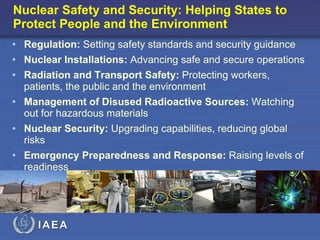
Nuclear Safety and Security: Helping States to Protect People and the Environment Regulation:  Setting safety standards and security guidance Nuclear Installations:  Advancing safe and secure operations Radiation and Transport Safety:  Protecting workers, patients, the public and the environment Management of Disused Radioactive Sources:  Watching out for hazardous materials Nuclear Security:  Upgrading capabilities, reducing global risks Emergency Preparedness and Response:  Raising levels of readiness
Countries Considering Introduction / Expansion of Nuclear Power Operating (30) Considering (43) Countries having expressed interest (25)
The Need for Partnerships with UN Organizations Limited knowledge of IAEA’s contribution to development in 125 countries Most national counterparts are nuclear scientists with little exposure to UN development issues 68% of TC programme are in areas where the IAEA does not possess the lead UN mandate No socioeconomic impact without involvement of UN development partners UNDG
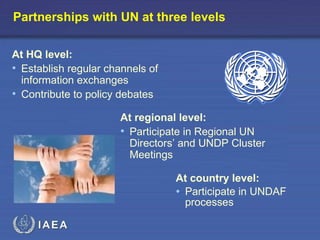
Partnerships with UN at three levels At country level: Participate in UNDAF processes At HQ level: Establish regular channels of information exchanges Contribute to policy debates At regional level: Participate in Regional UN Directors’ and UNDP Cluster Meetings
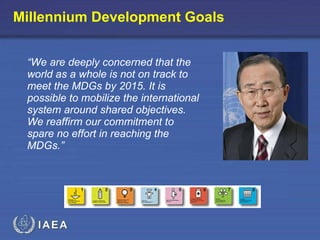
Millennium Development Goals “ We are deeply concerned that the world as a whole is not on track to meet the MDGs by 2015. It is possible to mobilize the international system around shared objectives. We reaffirm our commitment to spare no effort in reaching the MDGs.”
Contact International Atomic Energy Agency Department of Technical cooperation Vienna International Centre PO Box 100 1400 Vienna, Austria Telephone: (+43-1) 2600-0 Fax: (+43-1) 2600-7 Email: Official.Mail@iaea.org Web site: http://tc.iaea.org

Tc programme presentation UN audience

  • 1.
    The IAEA’s Technical Cooperation Programme: Science Serving People August 2010
  • 2.
    IAEA at aGlance Founded in 1957 151 member states 2300 professional and support staff Headquarters in Vienna 2 scientific laboratories and research centres Budget in 2009 Regular Budget: € 291 m (33% ODA) Technical Coop. Fund: US$ 85 m (100% ODA) Budget for Technical Cooperation Programme: US$ 131 m
  • 3.
    The IAEA andits Mission Maximizing the contribution of nuclear technology to the world while verifying its peaceful use
  • 4.
    Six Departments: NuclearEnergy Nuclear Sciences and Applications Nuclear Safety and Security Safeguards Management Technical Cooperation Organisational Setup
  • 5.
    Department of TechnicalCooperation Interface between Member States and the Secretariat for technical cooperation assistance financed by the TC Programme Management of TC Programme with input from technical departments Vehicle to support programme implementation and monitoring across the IAEA Regional and country focus rooted in policy priorities of Member States
  • 6.
    Selected Interventions HumanHealth Food and Agriculture Water and Environment Nuclear Energy Safety and Security
  • 7.
    Human Health: HelpingStates Enhance Prevention, Treatment and Control of Diseases Cancer: Challenges and opportunities Cardiovascular and other Chronic Diseases : Enhancing diagnostics Malnutrition: Finding the facts with isotopes Quality Assurance in Radiation Medicine: Protecting patients and workers
  • 8.
    Food and Agriculture:Helping States Increase Productivity and Quality Crop Production: Producing more with less Insect Pest Control: Protecting food, agriculture, livestock, humans and the environment Livestock Production: A chieving better health and productivity Food Safety and Quality : Focus on the food chain and standards
  • 9.
    Water and Environment:Helping States to Sustain Water and Other Natural Resources Freshwater: Stronger facts for water resources management Oceans: Protecting the marine environment Land: Protecting the terrestrial environment
  • 10.
    Nuclear Energy: Helping States Expand Their Options Energy Planning: A step by step approach Energy Production: Operation and innovation Nuclear Fuel Cycle: From mining to spent fuel Radioactive Waste Management: Guiding safe and effective implementation Decommissioning and Environmental Remediation: Cleaning up afterwards
  • 11.
    Nuclear Safety andSecurity: Helping States to Protect People and the Environment Regulation: Setting safety standards and security guidance Nuclear Installations: Advancing safe and secure operations Radiation and Transport Safety: Protecting workers, patients, the public and the environment Management of Disused Radioactive Sources: Watching out for hazardous materials Nuclear Security: Upgrading capabilities, reducing global risks Emergency Preparedness and Response: Raising levels of readiness
  • 12.
    Countries Considering Introduction/ Expansion of Nuclear Power Operating (30) Considering (43) Countries having expressed interest (25)
  • 13.
    The Need forPartnerships with UN Organizations Limited knowledge of IAEA’s contribution to development in 125 countries Most national counterparts are nuclear scientists with little exposure to UN development issues 68% of TC programme are in areas where the IAEA does not possess the lead UN mandate No socioeconomic impact without involvement of UN development partners UNDG
  • 14.
    Partnerships with UNat three levels At country level: Participate in UNDAF processes At HQ level: Establish regular channels of information exchanges Contribute to policy debates At regional level: Participate in Regional UN Directors’ and UNDP Cluster Meetings
  • 15.
    Millennium Development Goals“ We are deeply concerned that the world as a whole is not on track to meet the MDGs by 2015. It is possible to mobilize the international system around shared objectives. We reaffirm our commitment to spare no effort in reaching the MDGs.”
  • 16.
    Contact International AtomicEnergy Agency Department of Technical cooperation Vienna International Centre PO Box 100 1400 Vienna, Austria Telephone: (+43-1) 2600-0 Fax: (+43-1) 2600-7 Email: Official.Mail@iaea.org Web site: http://tc.iaea.org