Marine Environment MonitoringAssessment of IAEA Environment Laboratories on Data from the Marine Environment provided by JapanUpdate 05 May 2011IAEA Environment Laboratories, MonacoH. Nies, M. Betti, I. Osvath, E. Bosc
General commentsThe contamination of the marine environment has occurred both through atmospheric deposition or washout with precipitation, and through discharges of contaminated water into the sea
Authorized discharge of low level contaminated water (beginning of April for about 5 days)
There is a further continuous discharge of contaminated water into the marine environment.
TEPCO and MEXT are continuing to conduct programmes for sea water sampling and to perform measurements. Further sampling positions were added recently about 15 km offshore and at the Ibaraki coast.
Also marine food and one sediment station is now monitored.6 May 2011H. Nies, M. Betti, I. Osvath, E. Bosc
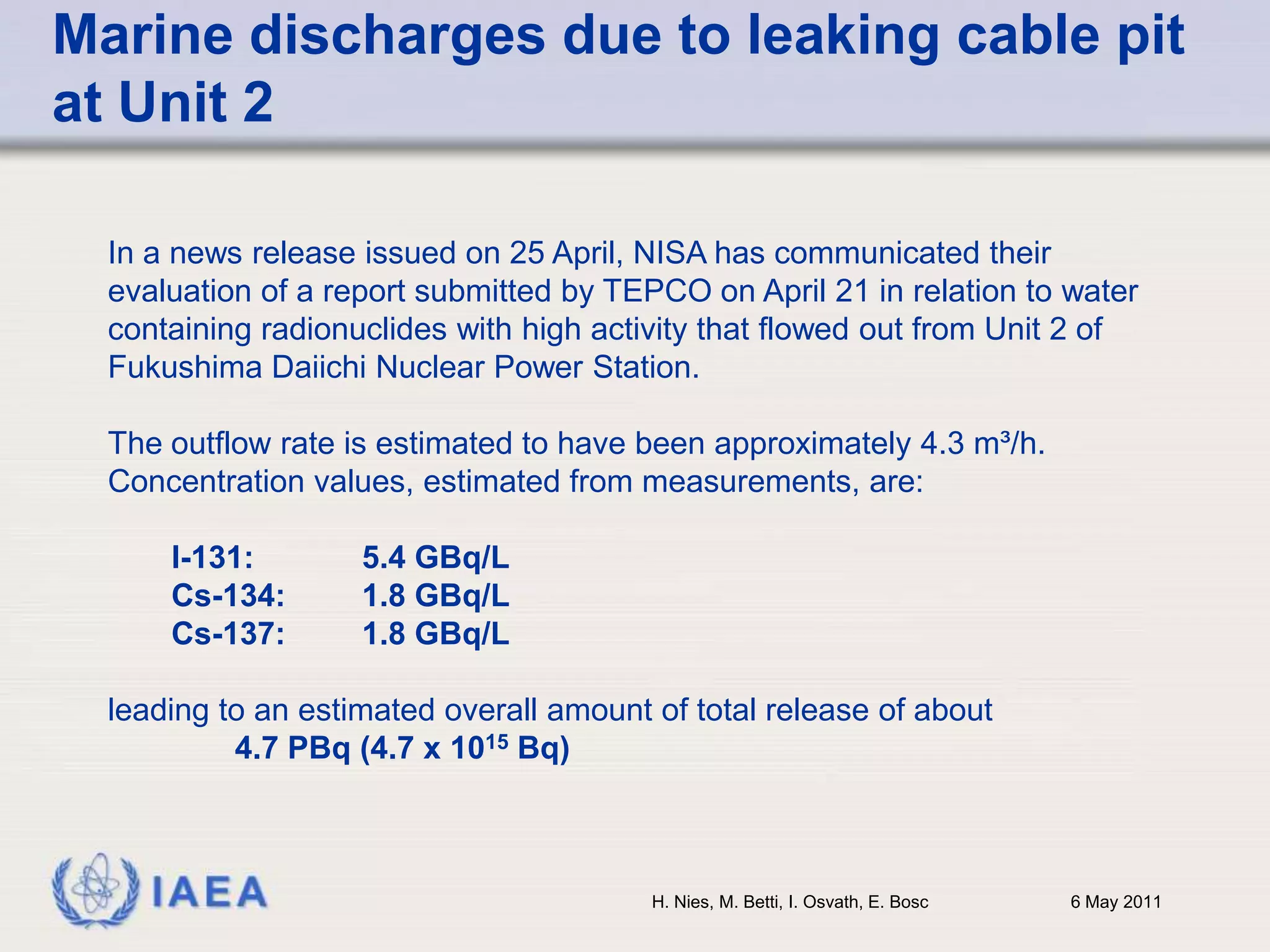
Marine discharges due to leaking cable pit at Unit 2In a news release issued on 25 April, NISA has communicated their evaluation of a report submitted by TEPCO on April 21 in relation to water containing radionuclides with high activity that flowed out from Unit 2 of Fukushima Daiichi Nuclear Power Station. The outflow rate is estimated to have been approximately 4.3 m³/h. Concentration values, estimated from measurements, are: I-131:   	5.4 GBq/L  Cs-134:  	1.8 GBq/LCs-137:	1.8 GBq/L leading to an estimated overall amount of total release of about 	4.7 PBq(4.7 x 10¹⁵Bq)6 May 2011H. Nies, M. Betti, I. Osvath, E. Bosc
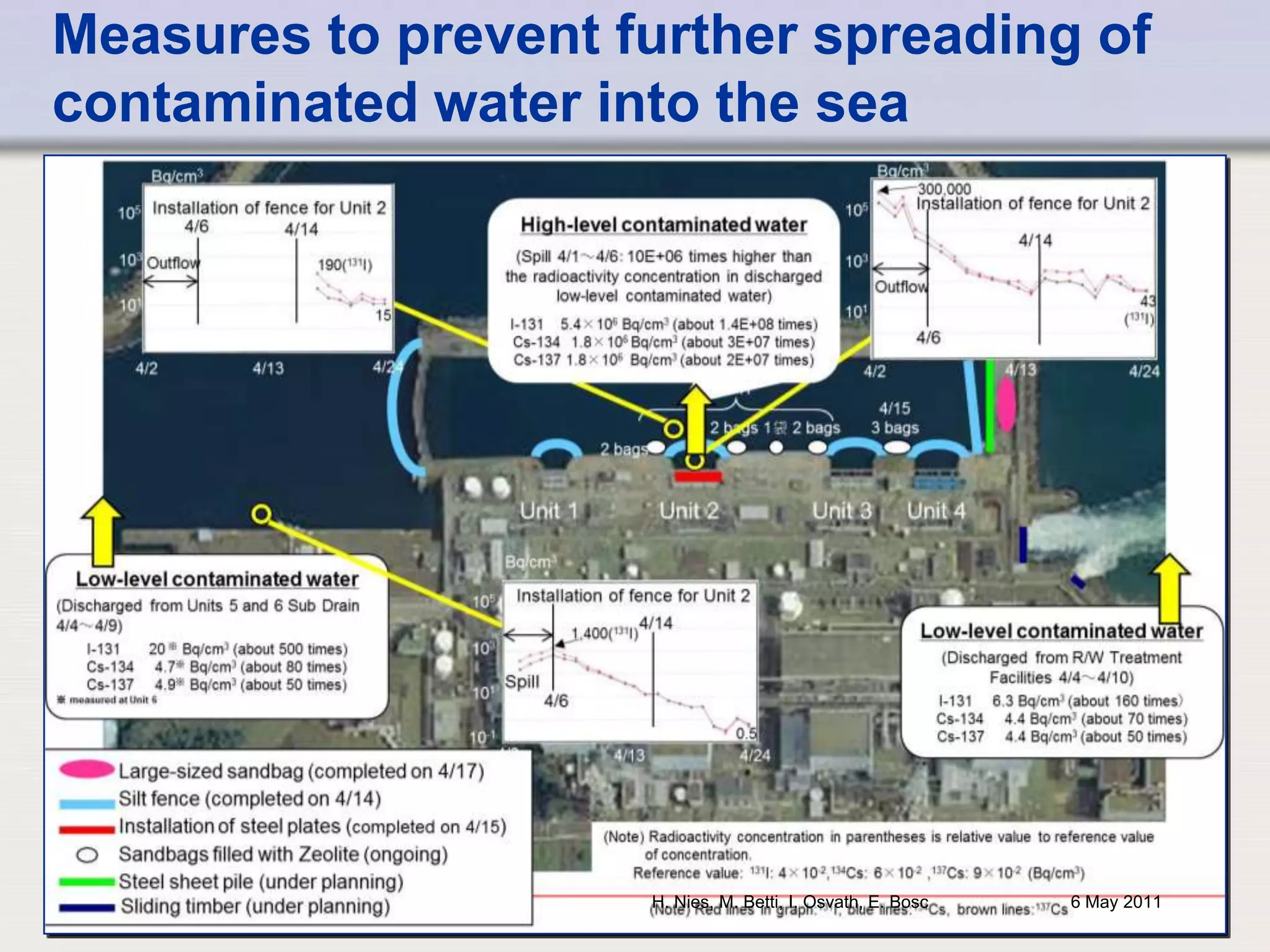
Measures to prevent further spreading of contaminated water into the sea6 May 2011H. Nies, M. Betti, I. Osvath, E. Bosc
Activity concentration in sea water at the screen of Unit 2The activity concentrations of I-131, Cs-134 and Cs-137 (in Bq/cm3) in sea water at the screen of Unit 2 from 02 April 2011 until 02 May 20116 May 2011H. Nies, M. Betti, I. Osvath, E. Bosc
Seawater sampling carried out by TEPCO and MEXTTEPCO is sampling four near- shore stations (TEPCO1-4)
Since 5th of April six points situated 15 km off-shore along a north-south transect (TEPCO 5-10)
Following a Directive from NISA, on 16 April TEPCO announced that they will increase the number of sampling points. Four points will be added at 3 km from the coast and two points at 8 km from the coast.6 May 2011H. Nies, M. Betti, I. Osvath, E. Bosc
Concentrations in sea water near discharge point of TEPCO 1-46 May 2011H. Nies, M. Betti, I. Osvath, E. Bosc
ActivityconcentrationsI-131Cs-134Cs-137in sea wateratcoastaland off-shorestationsSurfacewater, middlelayerandnearseafloor6 May 2011H. Nies, M. Betti, I. Osvath, E. Bosc
New sea water sampling stations by MEXT near the Ibaraki prefectureMEXT also launched sampling at 5 off-shore points in Ibaraki Prefecture. The samples are taken by the Japanese Coast Guard and analysed by TEPCO.Map 16 May 2011H. Nies, M. Betti, I. Osvath, E. Bosc
Monitoring of marine foodSampling locations of marine fish products as of 30 April (issued by the Japanese Ministry of Agriculture, Forestry and Fisheries)In Ibarakiprefecture, three samples of seafood (sand lance) from 28 April: one sample 29 April: two samples were above the regulation values set by the Japanese authorities for Cs-134/Cs-137Sand lances are so far the only fish species, which showed levels above the recommended limits.6 May 2011H. Nies, M. Betti, I. Osvath, E. Bosc
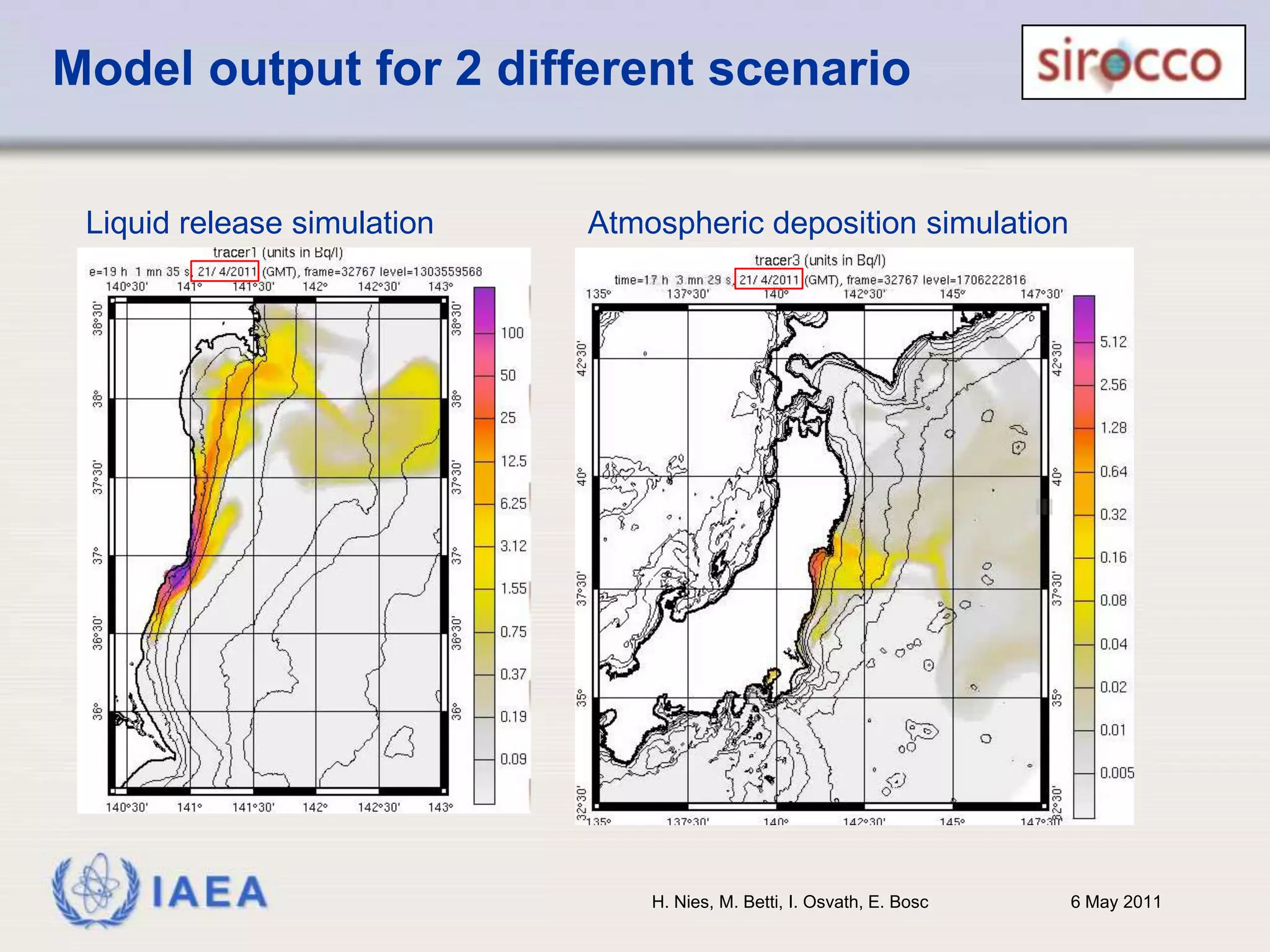
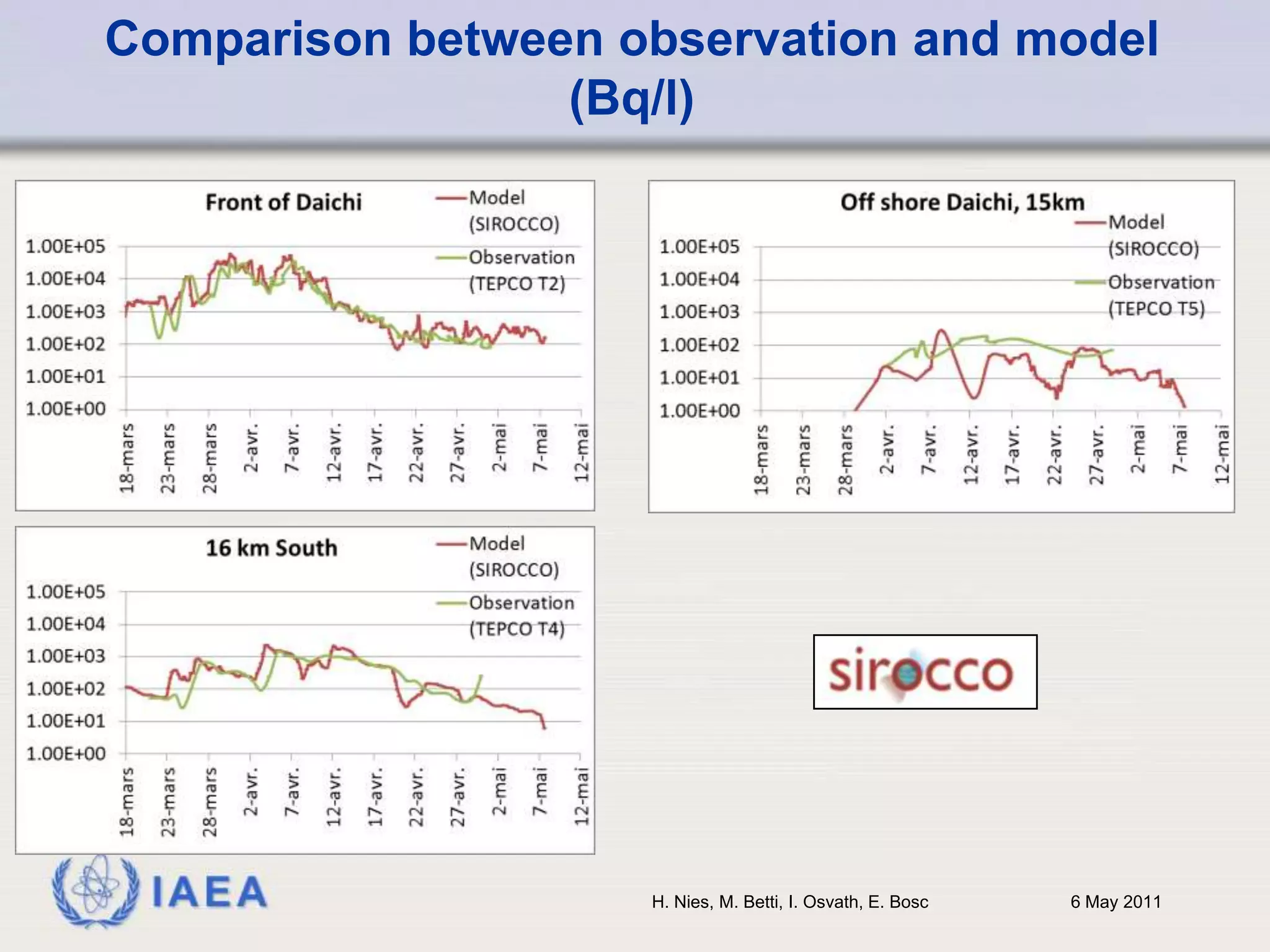
Modelling Activities by the Group SciroccoModel prediction for two different scenariosThe group SIROCCO of the University of Toulouse continues with the modelling of the ocean impact. The modelling results are continuously compared with the measurements.  Atmospheric deposition simulationLiquid release simulation6 May 2011H. Nies, M. Betti, I. Osvath, E. Bosc
Model output for 2 different scenarioAtmospheric deposition simulationLiquid release simulation6 May 2011H. Nies, M. Betti, I. Osvath, E. Bosc
Comparison between observation and model (Bq/l) 6 May 2011H. Nies, M. Betti, I. Osvath, E. Bosc
IAEA Environment Laboratories: Monitoring of atmospheric radioactivity in MonacoProgramme started in 1986Sampling of atmospheric aerosols and deposition currently in 2 locationsRoof of Oceanographic MuseumRoof of building at Quai Antoine6 May 2011H. Nies, M. Betti, I. Osvath, E. Bosc
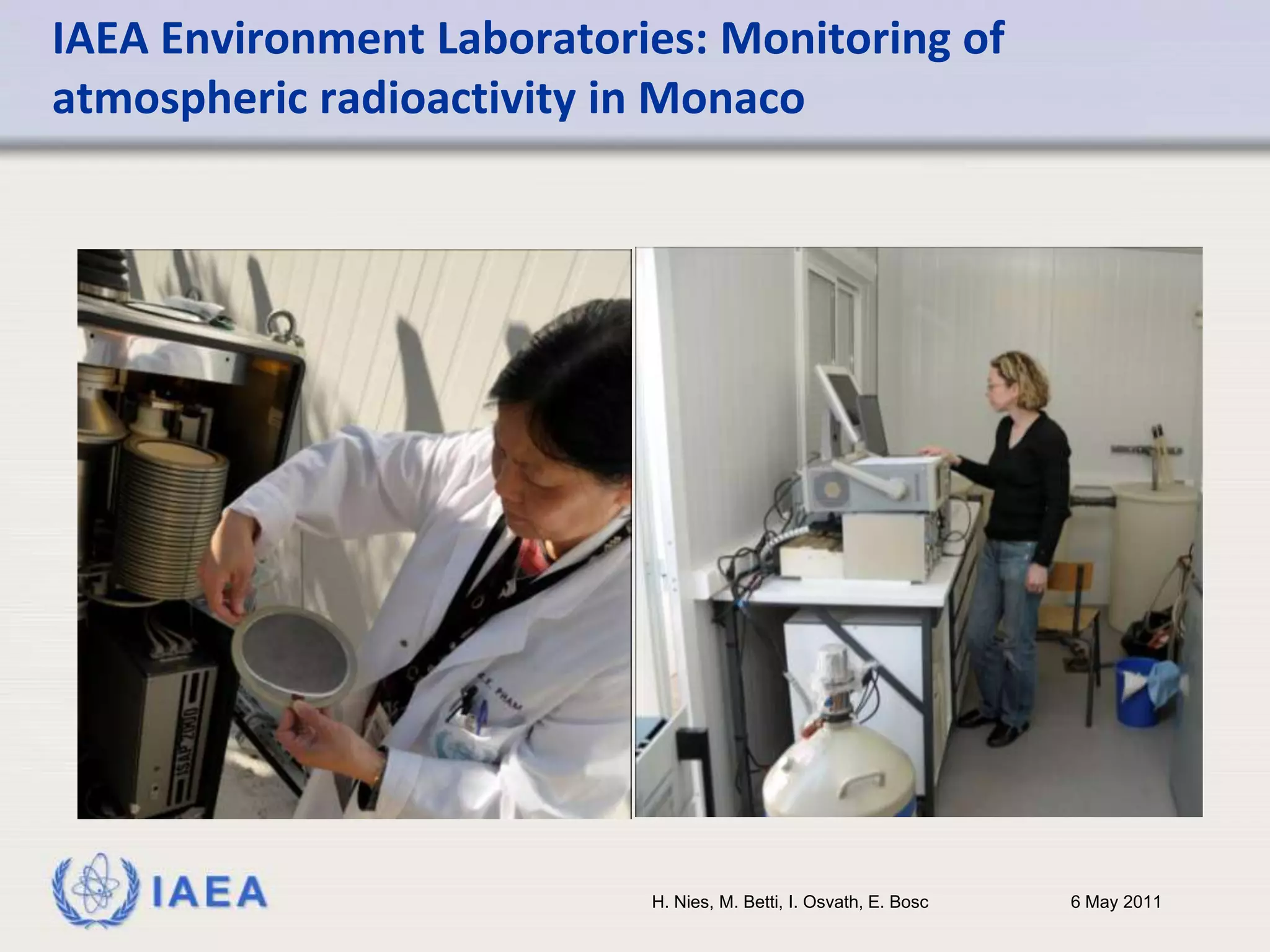
Routine monthly sampling and analysis of gamma emitters (e.g. Cesium-137), beta emitters (e.g. Strontium-90) and alpha emitters (Plutonium and Americium)Increased frequency of sampling and measurements in special situations: aerosol samples collected twice daily, wet and dry deposition collected as often as relevantIAEA Environment Laboratories: Monitoring of atmospheric radioactivity in Monaco6 May 2011H. Nies, M. Betti, I. Osvath, E. Bosc
IAEA Environment Laboratories: Monitoring of atmospheric radioactivity in Monaco6 May 2011H. Nies, M. Betti, I. Osvath, E. Bosc
Additional measurements during March-April 2011:Detector continuously monitoring ambient gamma emittersHourly and two-hourly measurements of ambient dose-rate with hand-held devices (stationary, continuous monitor with on-line access to measurement results is necessary)IAEA Environment Laboratories: Monitoring of atmospheric radioactivity in Monaco6 May 2011H. Nies, M. Betti, I. Osvath, E. Bosc
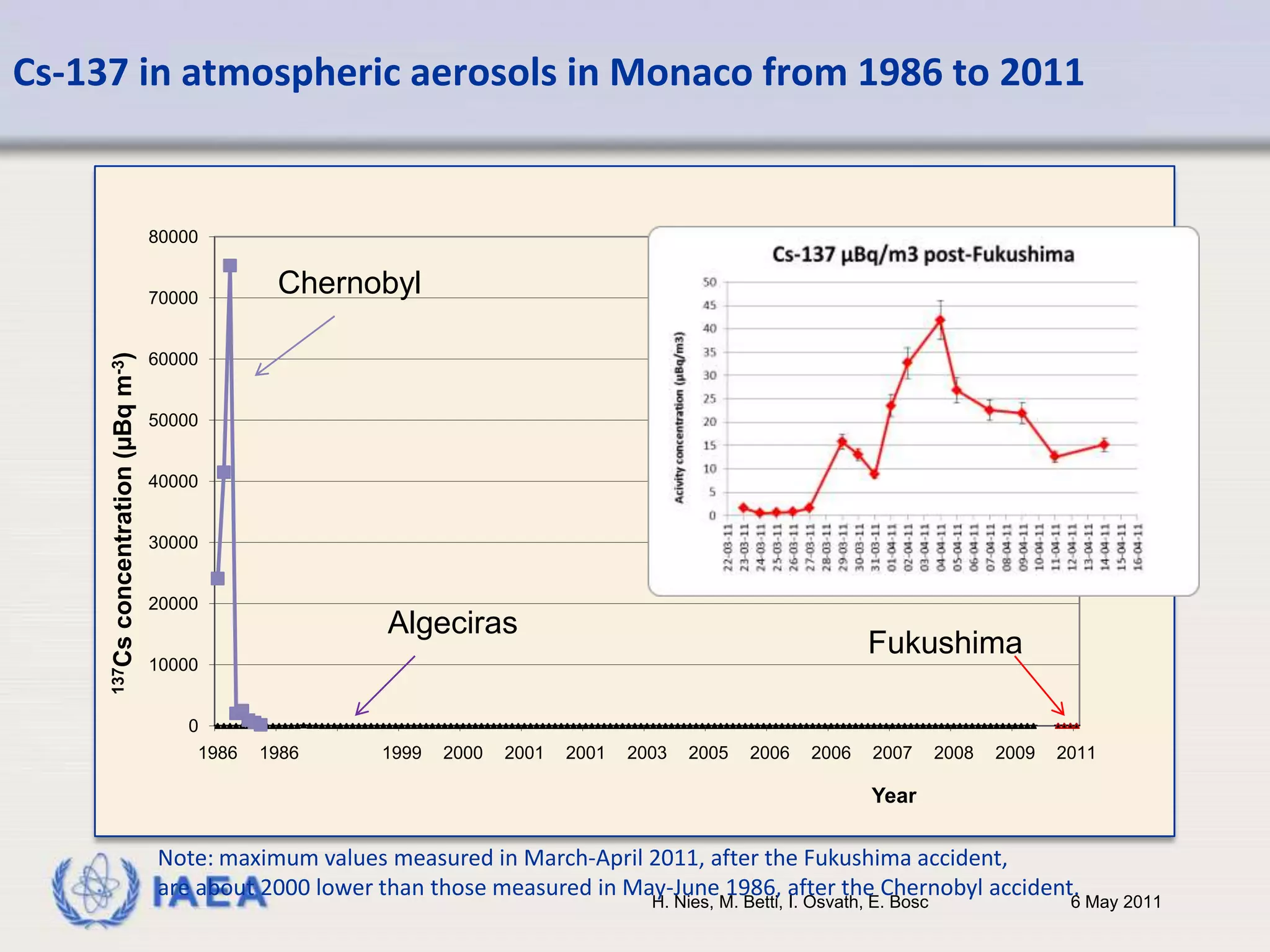
Cs-137 in atmospheric aerosols in Monaco from 1986 to 2011Note: maximum values measured in March-April 2011, after the Fukushima accident,are about 2000 lower than those measured in May-June 1986, after the Chernobyl accident.6 May 2011H. Nies, M. Betti, I. Osvath, E. Bosc
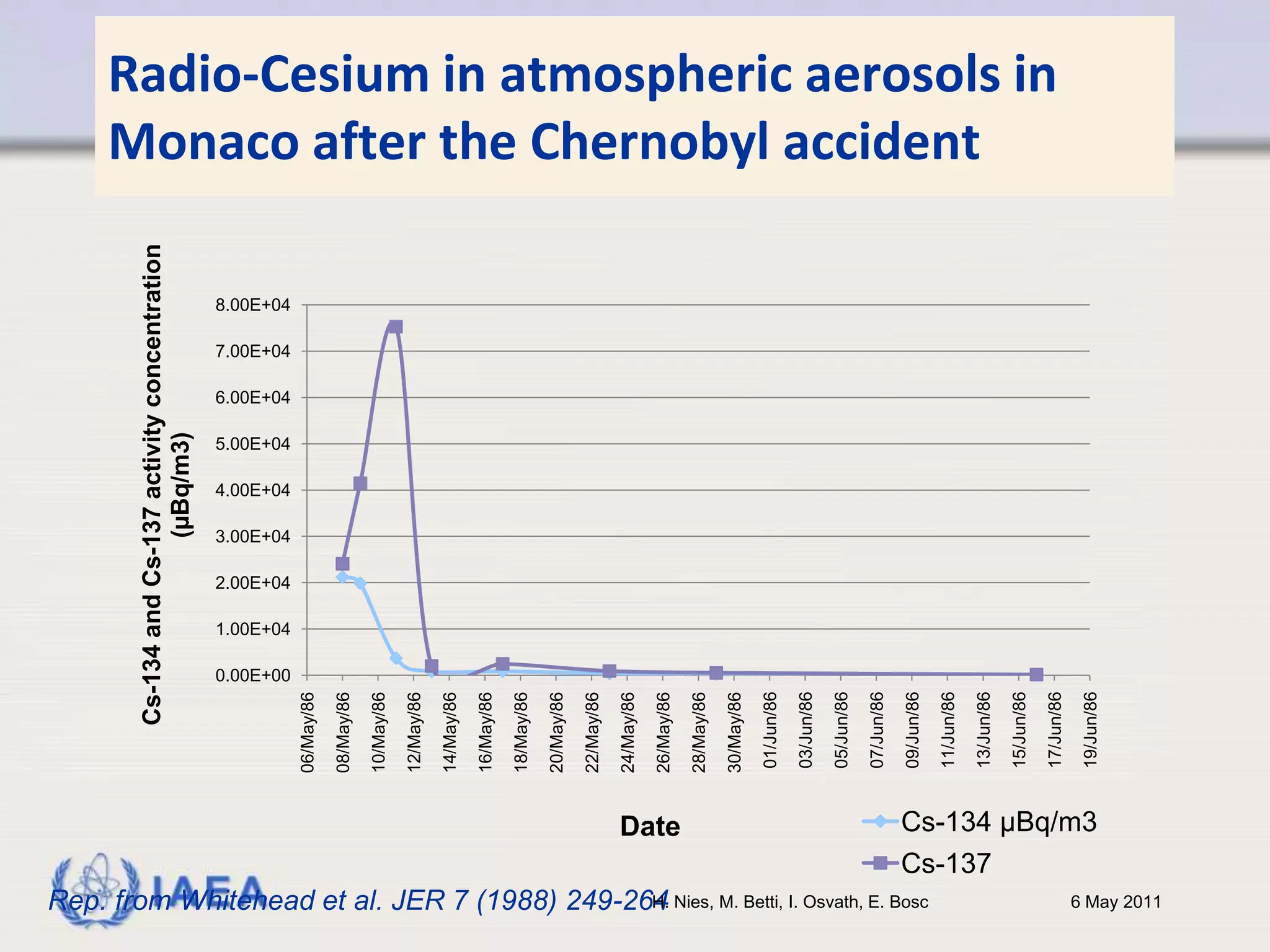
Radio-Cesium in atmospheric aerosols in Monaco after the Chernobyl accidentRep. from Whitehead et al. JER 7 (1988) 249-2646 May 2011H. Nies, M. Betti, I. Osvath, E. Bosc
Iodine-131 in atmospheric aerosols in Monaco after the Chernobyl accidentData from Chernobyl accident6 May 2011H. Nies, M. Betti, I. Osvath, E. Bosc

Fukushima Marine Environment Monitoring - 5 May 2011

  • 1.
    Marine Environment MonitoringAssessmentof IAEA Environment Laboratories on Data from the Marine Environment provided by JapanUpdate 05 May 2011IAEA Environment Laboratories, MonacoH. Nies, M. Betti, I. Osvath, E. Bosc
  • 2.
    General commentsThe contaminationof the marine environment has occurred both through atmospheric deposition or washout with precipitation, and through discharges of contaminated water into the sea
  • 3.
    Authorized discharge oflow level contaminated water (beginning of April for about 5 days)
  • 4.
    There is afurther continuous discharge of contaminated water into the marine environment.
  • 5.
    TEPCO and MEXTare continuing to conduct programmes for sea water sampling and to perform measurements. Further sampling positions were added recently about 15 km offshore and at the Ibaraki coast.
  • 6.
    Also marine foodand one sediment station is now monitored.6 May 2011H. Nies, M. Betti, I. Osvath, E. Bosc
  • 7.
    Marine discharges dueto leaking cable pit at Unit 2In a news release issued on 25 April, NISA has communicated their evaluation of a report submitted by TEPCO on April 21 in relation to water containing radionuclides with high activity that flowed out from Unit 2 of Fukushima Daiichi Nuclear Power Station. The outflow rate is estimated to have been approximately 4.3 m³/h. Concentration values, estimated from measurements, are: I-131: 5.4 GBq/L Cs-134: 1.8 GBq/LCs-137: 1.8 GBq/L leading to an estimated overall amount of total release of about 4.7 PBq(4.7 x 10¹⁵Bq)6 May 2011H. Nies, M. Betti, I. Osvath, E. Bosc
  • 8.
    Measures to preventfurther spreading of contaminated water into the sea6 May 2011H. Nies, M. Betti, I. Osvath, E. Bosc
  • 9.
    Activity concentration insea water at the screen of Unit 2The activity concentrations of I-131, Cs-134 and Cs-137 (in Bq/cm3) in sea water at the screen of Unit 2 from 02 April 2011 until 02 May 20116 May 2011H. Nies, M. Betti, I. Osvath, E. Bosc
  • 10.
    Seawater sampling carriedout by TEPCO and MEXTTEPCO is sampling four near- shore stations (TEPCO1-4)
  • 11.
    Since 5th ofApril six points situated 15 km off-shore along a north-south transect (TEPCO 5-10)
  • 12.
    Following a Directivefrom NISA, on 16 April TEPCO announced that they will increase the number of sampling points. Four points will be added at 3 km from the coast and two points at 8 km from the coast.6 May 2011H. Nies, M. Betti, I. Osvath, E. Bosc
  • 13.
    Concentrations in seawater near discharge point of TEPCO 1-46 May 2011H. Nies, M. Betti, I. Osvath, E. Bosc
  • 14.
    Concentrations in seawater near discharge point of TEPCO 1-46 May 2011H. Nies, M. Betti, I. Osvath, E. Bosc
  • 15.
    ActivityconcentrationsI-131Cs-134Cs-137in sea wateratcoastalandoff-shorestationsSurfacewater, middlelayerandnearseafloor6 May 2011H. Nies, M. Betti, I. Osvath, E. Bosc
  • 16.
    New sea watersampling stations by MEXT near the Ibaraki prefectureMEXT also launched sampling at 5 off-shore points in Ibaraki Prefecture. The samples are taken by the Japanese Coast Guard and analysed by TEPCO.Map 16 May 2011H. Nies, M. Betti, I. Osvath, E. Bosc
  • 17.
    Monitoring of marinefoodSampling locations of marine fish products as of 30 April (issued by the Japanese Ministry of Agriculture, Forestry and Fisheries)In Ibarakiprefecture, three samples of seafood (sand lance) from 28 April: one sample 29 April: two samples were above the regulation values set by the Japanese authorities for Cs-134/Cs-137Sand lances are so far the only fish species, which showed levels above the recommended limits.6 May 2011H. Nies, M. Betti, I. Osvath, E. Bosc
  • 18.
    Modelling Activities bythe Group SciroccoModel prediction for two different scenariosThe group SIROCCO of the University of Toulouse continues with the modelling of the ocean impact. The modelling results are continuously compared with the measurements. Atmospheric deposition simulationLiquid release simulation6 May 2011H. Nies, M. Betti, I. Osvath, E. Bosc
  • 19.
    Model output for2 different scenarioAtmospheric deposition simulationLiquid release simulation6 May 2011H. Nies, M. Betti, I. Osvath, E. Bosc
  • 20.
    Comparison between observationand model (Bq/l) 6 May 2011H. Nies, M. Betti, I. Osvath, E. Bosc
  • 21.
    IAEA Environment Laboratories:Monitoring of atmospheric radioactivity in MonacoProgramme started in 1986Sampling of atmospheric aerosols and deposition currently in 2 locationsRoof of Oceanographic MuseumRoof of building at Quai Antoine6 May 2011H. Nies, M. Betti, I. Osvath, E. Bosc
  • 22.
    Routine monthly samplingand analysis of gamma emitters (e.g. Cesium-137), beta emitters (e.g. Strontium-90) and alpha emitters (Plutonium and Americium)Increased frequency of sampling and measurements in special situations: aerosol samples collected twice daily, wet and dry deposition collected as often as relevantIAEA Environment Laboratories: Monitoring of atmospheric radioactivity in Monaco6 May 2011H. Nies, M. Betti, I. Osvath, E. Bosc
  • 23.
    IAEA Environment Laboratories:Monitoring of atmospheric radioactivity in Monaco6 May 2011H. Nies, M. Betti, I. Osvath, E. Bosc
  • 24.
    Additional measurements duringMarch-April 2011:Detector continuously monitoring ambient gamma emittersHourly and two-hourly measurements of ambient dose-rate with hand-held devices (stationary, continuous monitor with on-line access to measurement results is necessary)IAEA Environment Laboratories: Monitoring of atmospheric radioactivity in Monaco6 May 2011H. Nies, M. Betti, I. Osvath, E. Bosc
  • 25.
    Cs-137 in atmosphericaerosols in Monaco from 1986 to 2011Note: maximum values measured in March-April 2011, after the Fukushima accident,are about 2000 lower than those measured in May-June 1986, after the Chernobyl accident.6 May 2011H. Nies, M. Betti, I. Osvath, E. Bosc
  • 26.
    Radio-Cesium in atmosphericaerosols in Monaco after the Chernobyl accidentRep. from Whitehead et al. JER 7 (1988) 249-2646 May 2011H. Nies, M. Betti, I. Osvath, E. Bosc
  • 27.
    Iodine-131 in atmosphericaerosols in Monaco after the Chernobyl accidentData from Chernobyl accident6 May 2011H. Nies, M. Betti, I. Osvath, E. Bosc
  • 28.
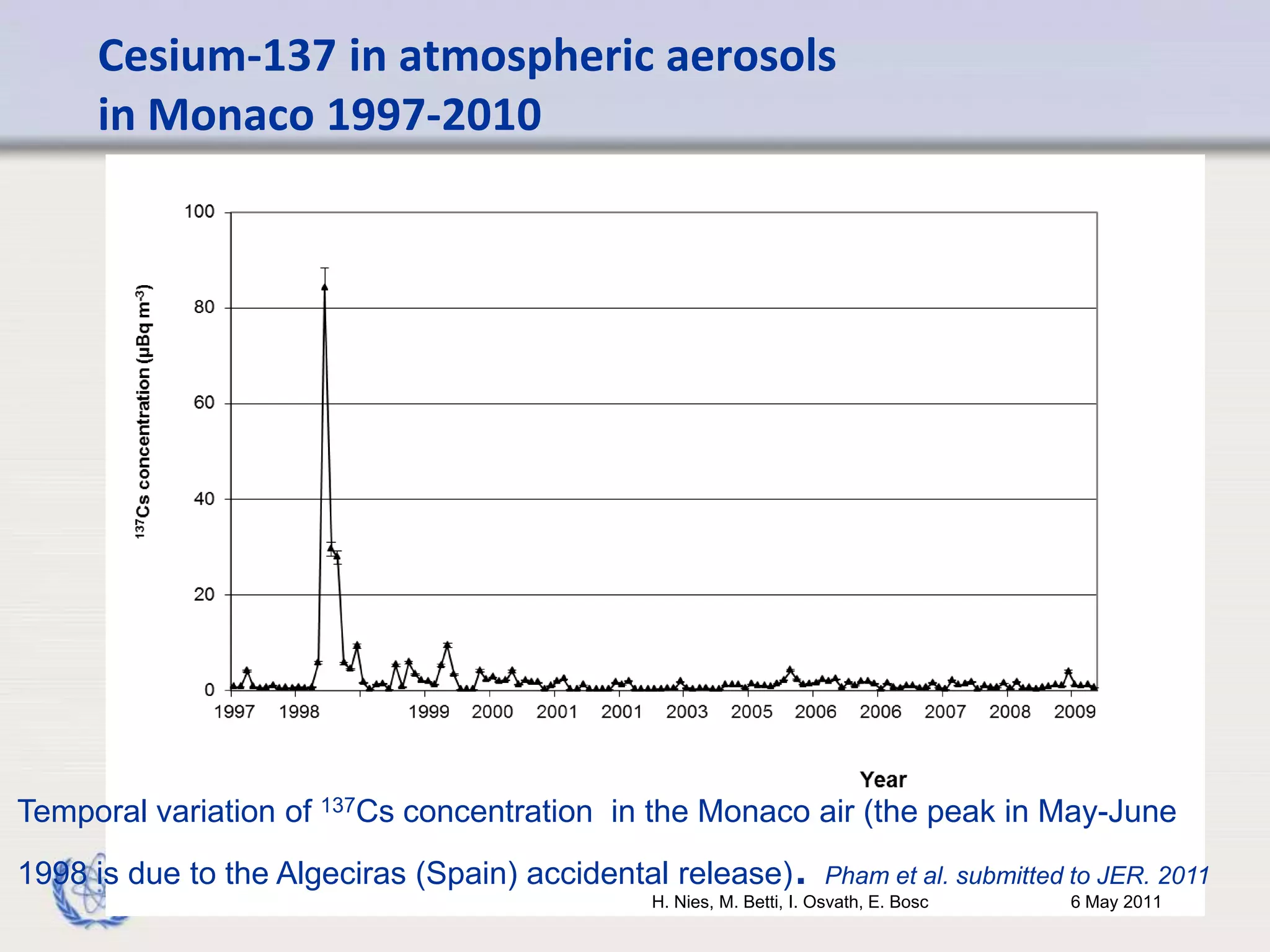
    Cesium-137 in atmosphericaerosols in Monaco 1997-2010Temporal variation of 137Cs concentration in the Monaco air (the peak in May-June 1998 is due to the Algeciras (Spain) accidental release). Pham et al. submitted to JER. 20116 May 2011H. Nies, M. Betti, I. Osvath, E. Bosc
  • 29.
    Radio-Cesium in atmosphericaerosols measured in Monaco after the Fukushima accident6 May 2011H. Nies, M. Betti, I. Osvath, E. Bosc
  • 30.
    Iodine-131 in atmosphericaerosols measured in Monaco after the Fukushima accident6 May 2011H. Nies, M. Betti, I. Osvath, E. Bosc
  • 31.
    Comparison between levelsof radionuclides in atmospheric aerosols measured in Monaco after Chernobyl and Fukushima accidentsMaximum levels measured after the Fukushima accident (March-April 2011) are much lower than those measured after the Chernobyl accident (May-June 1986) I-131 120 times lowerCs-134 700 times lowerCs-137 2000 times lowerLevels are similar to those measured elsewhere in Europe (France, Italy, Germany)6 May 2011H. Nies, M. Betti, I. Osvath, E. Bosc
  • 32.
    Conclusions on theimpact to the marine environment in the PacificThe highest levels are still measured close to the Nuclear Power Stations Fukushima, namely at the screen of Unit 2, 30 m, 330 m and 10 km near-shore even though with a decreasing trend.
  • 33.
    Concentration data fromabout 30 km off-shore show a generally decreasing temporal trend and partly, the concentrations are below the limit of detection at the applied methods.
  • 34.
    It can beexpected that, if no additional releases occur, the levels measured at the stations 30 km off-shore will continue to decrease significantly by dilution into deeper layers and dispersion by ocean currents6 May 2011H. Nies, M. Betti, I. Osvath, E. Bosc
  • 35.
    ConclusionsIt can beexpected that the traces from the discharge and deposition to the marine environment from Fukushima NPPs will be taken up by the Kuroshio current system in the north PacificIt will be possible to follow these traces – mainly Cs-137 and Cs-134 - over the next few years in the northern PacificWater with such traces will reach the Canadian and US Coast probably in one to two years’ timeIAEA environmental Laboratories in Monaco will be part of international teams to measure these impact to the Pacific and will support and co-ordinate initiated environment assessment studies6 May 2011H. Nies, M. Betti, I. Osvath, E. Bosc