The human side of design
A little about me
Hi! My name is Max


 this is Som Tum (papaya salad)
I am a user experience consultant
I love snowboarding
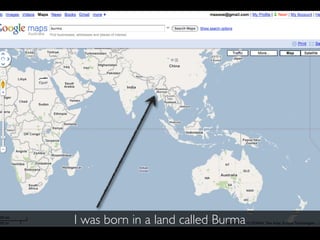
I was born in a land called Burma
© irrawaddy.org


                                                          © drea
                                                                   mstime
                                                                          .com


My dream...                            © guardian.co.uk


              is to one day start up a school in Burma
other things I’ve done...
Now... let’s talk about the human side of
design

(and why I’m here)
The human side of design needs to
be considered so that products are
usable
Why must things be usable?
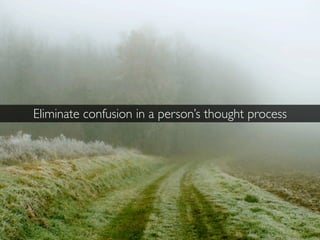
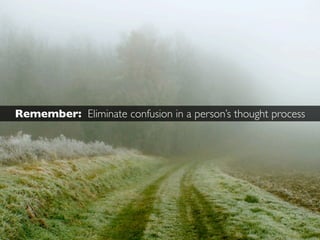
Eliminate confusion in a person’s thought process
Eliminate confusion with

• effectiveness   (does a specific task well)
Eliminate confusion with

• effectiveness   (does a specific task well)

• learnability
Eliminate confusion with

• effectiveness   (does a specific task well)

• learnability

• efficiency   (doesn’t take up more resources/time than needed)
Eliminate confusion with

• effectiveness   (does a specific task well)

• learnability

• efficiency   (doesn’t take up more resources/time than needed)

• memorability    (easy to remember)
Eliminate confusion with

• effectiveness   (does a specific task well)

• learnability

• efficiency   (doesn’t take up more resources/time than needed)

• memorability    (easy to remember)

• error   prevention (car gears - reverse)
Eliminate confusion with

• effectiveness   (does a specific task well)

• learnability

• efficiency   (doesn’t take up more resources/time than needed)

• memorability     (easy to remember)

• error   prevention (car gears - reverse)

• satisfaction   (a sense of accomplishment)
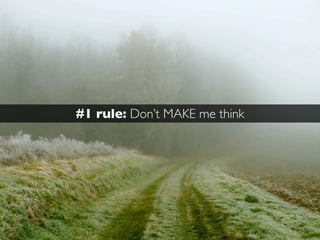
#1 rule: Don’t MAKE me think
Remember: Eliminate confusion in a person’s thought process
Eliminate confusion such as:

• “Why   is it called _____?”
Eliminate confusion such as:

• “Why     is it called _____?”

• “I   thought _____ does something else”
Eliminate confusion such as:

• “Why     is it called _____?”

• “I   thought _____ does something else”

• “Can    I press it?” / “Should I press it?”
Eliminate confusion such as:

• “Why     is it called _____?”

• “I   thought _____ does something else”

• “Can    I press it?” / “Should I press it?”

  • If   something is not a button, DO NOT make it look like one
Eliminate confusion such as:

• “Why     is it called _____?”

• “I   thought _____ does something else”

• “Can    I press it?” / “Should I press it?”

  • If   something is not a button, DO NOT make it look like one

• “Where      did they put _____?”
Ultimately you are designing for people
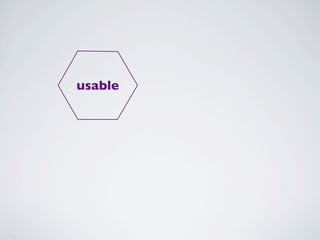
usable
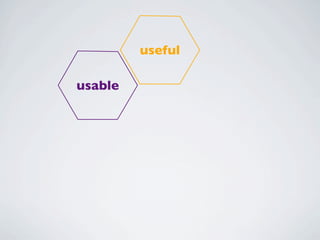
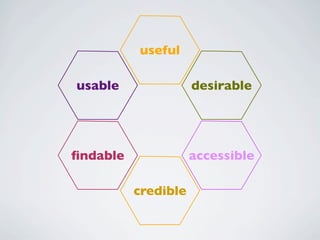
useful

usable
useful

usable            desirable
useful

usable            desirable


                  accessible
useful

usable              desirable


                    accessible

         credible
useful

usable               desirable


findable              accessible

          credible
useful

usable               desirable

          valuable

findable              accessible

          credible
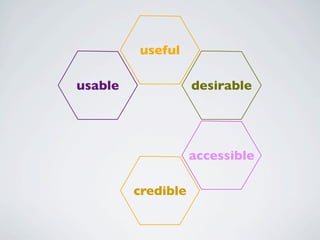
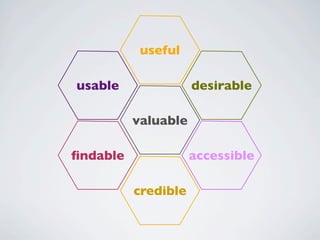
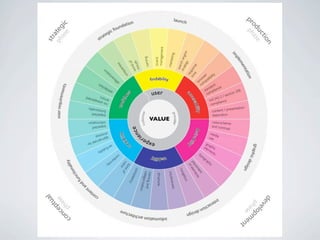
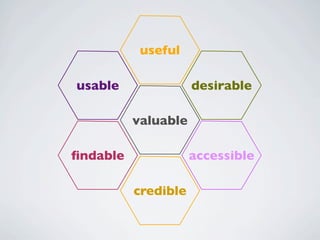
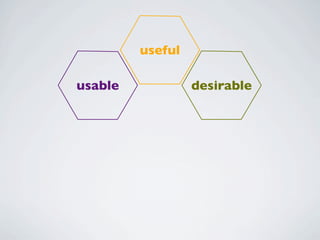
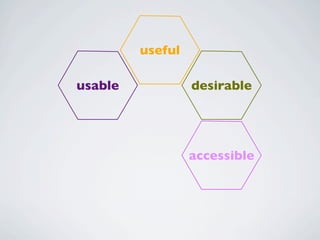
These factors must be combined for success
useful

usable               desirable

          valuable

findable              accessible

          credible
Why is any of this important?
Why should you care?
It is necessary for success
•   Too difficult » people ditch your design for something
    simpler
•   Too difficult » people ditch your design for something
    simpler

•   Lost in a process » people ditch your design
•   Too difficult » people ditch your design for something
    simpler

•   Lost in a process » people ditch your design

•   Too hard to understand (cues) » people ditch your design
•   Don’t understand what to do next » people ditch your
    design
•   Don’t understand what to do next » people ditch your
    design

•   Too much to do » people ditch your design
•   Don’t understand what to do next » people ditch your
    design

•   Too much to do » people ditch your design

•   overwhelming information » people ditch your design
Beyond designing for humans
•   not pretty colours

•   not a creativity killer
•   not pretty colours

•   not a creativity killer

•   not about focus groups
•   not pretty colours

•   not a creativity killer

•   not about focus groups

•   not about customer satisfaction surveys
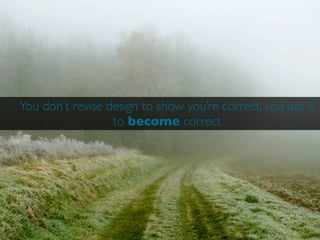
You don’t revise design to show you’re correct, you use it
                  to become correct
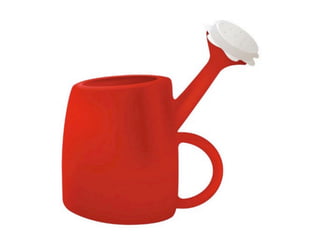
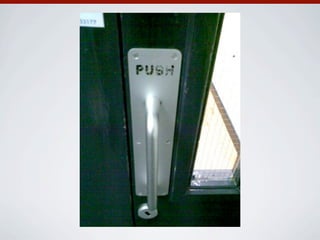
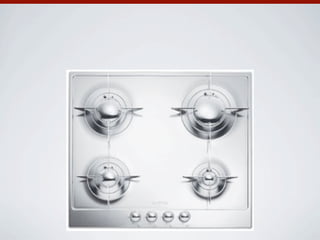
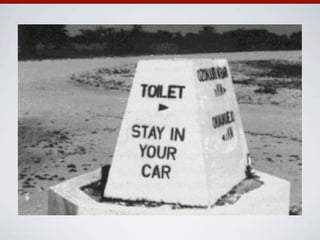
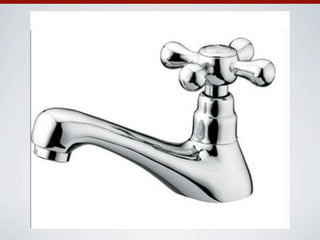
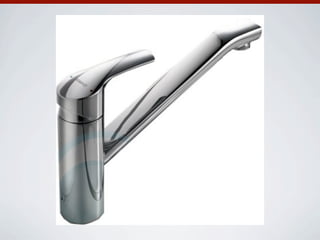
Examples of overlooked designs
When to factor people in design
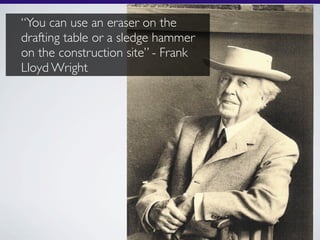
“You can use an eraser on the
drafting table or a sledge hammer
on the construction site” - Frank
Lloyd Wright
Considering people in design should come:

•   Before the requirements
Considering people in design should come:

•   Before the requirements

•   Before the visuals
Considering people in design should come:

•   Before the requirements

•   Before the visuals

•   Before the development
Human factors are key to your strategy
            Get in early
How do we go about doing this?
Understand what works and what doesn’t:

•   Before starting a new design, test how the old one is doing
Understand what works and what doesn’t:

•   Before starting a new design, test how the old one is doing

•   Analyse your competitor’s design, test it with people
Understand your audience

•   Understand their natural habitat » conduct a field study
Understand your audience

•   Understand their natural habitat » conduct a field study

•   Create prototypes » test them with people
Iterate. Learn for past designs

•   You shouldn’t need to (and cannot) be perfect straight
    away
Iterate. Learn for past designs

•   You shouldn’t need to (and cannot) be perfect straight
    away

•   But it must be usable
Iterate. Learn for past designs

•   You shouldn’t need to (and cannot) be perfect straight
    away

•   But it must be usable

•   Improve on each revision
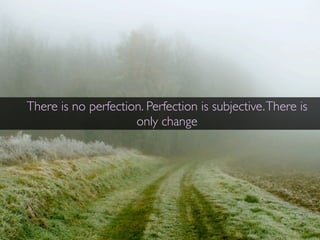
There is no perfection. Perfection is subjective. There is
                     only change
To wrap things up...
•   Don’t make me think

•   Not usable » lose out
•   Don’t make me think

•   Not usable » lose out

•   Good experience » increases productivity » saves time and
    money » people will love you
•   Start factoring people as soon as possible

•   Don’t try to get everything right at once, perfection is subjective
•   Start factoring people as soon as possible

•   Don’t try to get everything right at once, perfection is subjective

•   Revise changes
And most importantly...
Create and design for people
Real people
People with passions
People with dreams


© irrawaddy.org


                                     © drea
                                              mstime
                                                     .com


                  © guardian.co.uk
The design should adapt to people, not the other
way around
Questions?
www.maxsoe.com     find maxsoe on:

maxsoe@gmail.com

The human side of design

  • 1.
    The human sideof design
  • 2.
  • 3.
    Hi! My nameis Max this is Som Tum (papaya salad)
  • 4.
    I am auser experience consultant
  • 5.
  • 6.
    I was bornin a land called Burma
  • 7.
    © irrawaddy.org © drea mstime .com My dream... © guardian.co.uk is to one day start up a school in Burma
  • 9.
  • 11.
    Now... let’s talkabout the human side of design (and why I’m here)
  • 12.
    The human sideof design needs to be considered so that products are usable
  • 13.
    Why must thingsbe usable?
  • 14.
    Eliminate confusion ina person’s thought process
  • 16.
  • 17.
    Eliminate confusion with •effectiveness (does a specific task well)
  • 18.
    Eliminate confusion with •effectiveness (does a specific task well) • learnability
  • 19.
    Eliminate confusion with •effectiveness (does a specific task well) • learnability • efficiency (doesn’t take up more resources/time than needed)
  • 20.
    Eliminate confusion with •effectiveness (does a specific task well) • learnability • efficiency (doesn’t take up more resources/time than needed) • memorability (easy to remember)
  • 21.
    Eliminate confusion with •effectiveness (does a specific task well) • learnability • efficiency (doesn’t take up more resources/time than needed) • memorability (easy to remember) • error prevention (car gears - reverse)
  • 22.
    Eliminate confusion with •effectiveness (does a specific task well) • learnability • efficiency (doesn’t take up more resources/time than needed) • memorability (easy to remember) • error prevention (car gears - reverse) • satisfaction (a sense of accomplishment)
  • 23.
    #1 rule: Don’tMAKE me think
  • 24.
    Remember: Eliminate confusionin a person’s thought process
  • 26.
  • 27.
    Eliminate confusion suchas: • “Why is it called _____?”
  • 28.
    Eliminate confusion suchas: • “Why is it called _____?” • “I thought _____ does something else”
  • 29.
    Eliminate confusion suchas: • “Why is it called _____?” • “I thought _____ does something else” • “Can I press it?” / “Should I press it?”
  • 30.
    Eliminate confusion suchas: • “Why is it called _____?” • “I thought _____ does something else” • “Can I press it?” / “Should I press it?” • If something is not a button, DO NOT make it look like one
  • 31.
    Eliminate confusion suchas: • “Why is it called _____?” • “I thought _____ does something else” • “Can I press it?” / “Should I press it?” • If something is not a button, DO NOT make it look like one • “Where did they put _____?”
  • 33.
    Ultimately you aredesigning for people
  • 35.
  • 36.
  • 37.
    useful usable desirable
  • 38.
    useful usable desirable accessible
  • 39.
    useful usable desirable accessible credible
  • 40.
    useful usable desirable findable accessible credible
  • 41.
    useful usable desirable valuable findable accessible credible
  • 43.
    These factors mustbe combined for success
  • 44.
    useful usable desirable valuable findable accessible credible
  • 45.
    Why is anyof this important? Why should you care?
  • 46.
    It is necessaryfor success
  • 48.
    Too difficult » people ditch your design for something simpler
  • 49.
    Too difficult » people ditch your design for something simpler • Lost in a process » people ditch your design
  • 50.
    Too difficult » people ditch your design for something simpler • Lost in a process » people ditch your design • Too hard to understand (cues) » people ditch your design
  • 52.
    Don’t understand what to do next » people ditch your design
  • 53.
    Don’t understand what to do next » people ditch your design • Too much to do » people ditch your design
  • 54.
    Don’t understand what to do next » people ditch your design • Too much to do » people ditch your design • overwhelming information » people ditch your design
  • 55.
  • 57.
    not pretty colours
  • 58.
    not pretty colours • not a creativity killer
  • 59.
    not pretty colours • not a creativity killer • not about focus groups
  • 60.
    not pretty colours • not a creativity killer • not about focus groups • not about customer satisfaction surveys
  • 61.
    You don’t revisedesign to show you’re correct, you use it to become correct
  • 62.
  • 70.
    When to factorpeople in design
  • 71.
    “You can usean eraser on the drafting table or a sledge hammer on the construction site” - Frank Lloyd Wright
  • 73.
    Considering people indesign should come:
  • 74.
    Considering people indesign should come: • Before the requirements
  • 75.
    Considering people indesign should come: • Before the requirements • Before the visuals
  • 76.
    Considering people indesign should come: • Before the requirements • Before the visuals • Before the development
  • 77.
    Human factors arekey to your strategy Get in early
  • 78.
    How do wego about doing this?
  • 80.
    Understand what worksand what doesn’t:
  • 81.
    Understand what worksand what doesn’t: • Before starting a new design, test how the old one is doing
  • 82.
    Understand what worksand what doesn’t: • Before starting a new design, test how the old one is doing • Analyse your competitor’s design, test it with people
  • 84.
  • 85.
    Understand your audience • Understand their natural habitat » conduct a field study
  • 86.
    Understand your audience • Understand their natural habitat » conduct a field study • Create prototypes » test them with people
  • 88.
    Iterate. Learn forpast designs
  • 89.
    Iterate. Learn forpast designs • You shouldn’t need to (and cannot) be perfect straight away
  • 90.
    Iterate. Learn forpast designs • You shouldn’t need to (and cannot) be perfect straight away • But it must be usable
  • 91.
    Iterate. Learn forpast designs • You shouldn’t need to (and cannot) be perfect straight away • But it must be usable • Improve on each revision
  • 92.
    There is noperfection. Perfection is subjective. There is only change

  • 93.
  • 95.
    Don’t make me think
  • 96.
    Don’t make me think • Not usable » lose out
  • 97.
    Don’t make me think • Not usable » lose out • Good experience » increases productivity » saves time and money » people will love you
  • 99.
    Start factoring people as soon as possible
  • 100.
    Start factoring people as soon as possible • Don’t try to get everything right at once, perfection is subjective
  • 101.
    Start factoring people as soon as possible • Don’t try to get everything right at once, perfection is subjective • Revise changes
  • 102.
  • 103.
  • 104.
  • 105.
  • 106.
    People with dreams ©irrawaddy.org © drea mstime .com © guardian.co.uk
  • 107.
    The design shouldadapt to people, not the other way around
  • 108.
  • 109.
    www.maxsoe.com find maxsoe on: maxsoe@gmail.com