Human Excretory Organs
1. Skin
2. Lungs
3. Kidneys
Excretory System
Excretion – removes cellular waste
The process that collects & removes
harmful or useless substances that
form in the body or are taken into the
body from the blood, tissues, and cells.
Excretory System
Although the urinary system has a major role in
excretion, other organs contribute to the excretory
function.
Three Organs of the Excretory System
•The lungs in the respiratory system excrete some
waste products, such as carbon dioxide and water.
•The skin is another excretory organ that rids the
body of wastes through the sweat glands.
•The major task of excretion still belongs to the
kidneys, the major organ in the urinary system. If it
fails the other organs cannot take over and
compensate adequately.
Cellular Waste
Heat
Water
Salts
CO2
Urea
Without excretion poisonous wastes
build up in blood, cells, and tissues.
Could lead to serious illness &
eventually DEATH!
Lungs –Main Function
Alveoli - Exchange O2 & CO2 between air and
blood (through process of diffusion)
Lungs excrete CO2 when you EXHALE
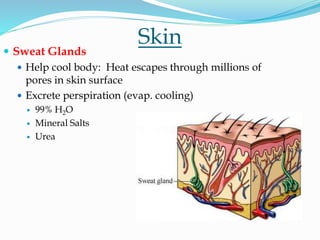
Skin
 Sweat Glands
 Help cool body: Heat escapes through millions of
pores in skin surface
 Excrete perspiration (evap. cooling)
 99% H2O
 Mineral Salts
 Urea
Kidneys & Urinary System
 Urinary System – excretes waste and maintains
homeostasis of body fluids.
 Kidneys (main organ of the system)
 Ureters
 Bladder
 Urethra
Kidneys & Urinary System
 Kidneys
 Two
 Fist sized
 Bean shaped
Kidneys- Functional Units & Product
Nephron (about one million per kidney)
 Microscopic units that filter blood of wastes.
 H2O and waste taken from blood into nephron
Form URINE
 Glomerulus (clump of capillaries)
 At end of each nephron
 Network of coiled tubes – diffusion of wastes -
while useful substances & water are reabsorbed
 Urine
 Pale yellow solution
 Urea, H20, salts, other trace solutions (toxins…)
Urinary System - continued
Ureters
 Narrow muscular tubes
 Connect Kidney  Bladder
 Bladder
 Muscular sac
 Stores Urine
 Expand to fill
 Muscle relaxes
 Urine squeezed into Urethra
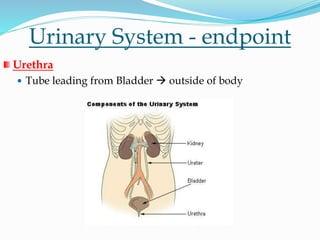
Urinary System - endpoint
Urethra
 Tube leading from Bladder  outside of body
Failures of Homeostasis
 Bladder & Kidney Infections caused by bacteria from
colon/rectum entering urethra.
 Kidney Stones - crystallization of mineral salts & uric
acid that block passage of urine
 Kidney Disease - caused by long term diabetes,
infections, & chemical poisoning
 Gout – form of arthritis where excess production of
uric acid leads to deposits of crystals in joints (esp.
toes)

The Human Excretory Organs

  • 1.
    Human Excretory Organs 1.Skin 2. Lungs 3. Kidneys
  • 2.
    Excretory System Excretion –removes cellular waste The process that collects & removes harmful or useless substances that form in the body or are taken into the body from the blood, tissues, and cells.
  • 3.
    Excretory System Although theurinary system has a major role in excretion, other organs contribute to the excretory function.
  • 4.
    Three Organs ofthe Excretory System •The lungs in the respiratory system excrete some waste products, such as carbon dioxide and water. •The skin is another excretory organ that rids the body of wastes through the sweat glands. •The major task of excretion still belongs to the kidneys, the major organ in the urinary system. If it fails the other organs cannot take over and compensate adequately.
  • 5.
    Cellular Waste Heat Water Salts CO2 Urea Without excretionpoisonous wastes build up in blood, cells, and tissues. Could lead to serious illness & eventually DEATH!
  • 6.
    Lungs –Main Function Alveoli- Exchange O2 & CO2 between air and blood (through process of diffusion) Lungs excrete CO2 when you EXHALE
  • 7.
    Skin  Sweat Glands Help cool body: Heat escapes through millions of pores in skin surface  Excrete perspiration (evap. cooling)  99% H2O  Mineral Salts  Urea
  • 8.
    Kidneys & UrinarySystem  Urinary System – excretes waste and maintains homeostasis of body fluids.  Kidneys (main organ of the system)  Ureters  Bladder  Urethra
  • 9.
    Kidneys & UrinarySystem  Kidneys  Two  Fist sized  Bean shaped
  • 10.
    Kidneys- Functional Units& Product Nephron (about one million per kidney)  Microscopic units that filter blood of wastes.  H2O and waste taken from blood into nephron Form URINE  Glomerulus (clump of capillaries)  At end of each nephron  Network of coiled tubes – diffusion of wastes - while useful substances & water are reabsorbed  Urine  Pale yellow solution  Urea, H20, salts, other trace solutions (toxins…)
  • 11.
    Urinary System -continued Ureters  Narrow muscular tubes  Connect Kidney  Bladder  Bladder  Muscular sac  Stores Urine  Expand to fill  Muscle relaxes  Urine squeezed into Urethra
  • 12.
    Urinary System -endpoint Urethra  Tube leading from Bladder  outside of body
  • 13.
    Failures of Homeostasis Bladder & Kidney Infections caused by bacteria from colon/rectum entering urethra.  Kidney Stones - crystallization of mineral salts & uric acid that block passage of urine  Kidney Disease - caused by long term diabetes, infections, & chemical poisoning  Gout – form of arthritis where excess production of uric acid leads to deposits of crystals in joints (esp. toes)