Labor Migration and the Global FilipinoR.N.G. SalvadorPS 201S.Y. 2010-2011
i. Facts and FiguresSince 1970s, the Philippines — a country of about 7,000 islands peopled by diverse ethno-linguistic groups — has supplied all kinds of skilled and low-skilled workers to the world's more developed regionsAs of December 2004, an estimated 8.1 million Filipinos — nearly 10 percent of the country's 85 million people — were working and/or residing in close to 200 countries and territories
The foreign population in the Philippines consists of people of Chinese origin (some 80 percent of overseas Chinese are in Southeast Asia) and some people of Indian origin who came to settle in the country years agoIn the last 30 years, a "culture of migration" has emerged, with millions of Filipinos eager to work abroad, despite the risks and vulnerabilities they are likely to face
ii. Determinants of MigrationsEconomic – disparities in per capita income; limited growth for career advancements; inconsistent economic growth which hampers employment generationDemography – high population growth compared to neighbouring countriesPolitical – long running political unrest in the country especially in the SouthEnvironment– frequency of storms and the weak disaster preparedness schemes
iii. Status: LaborExporter
OFWStatisticsStockEstimate
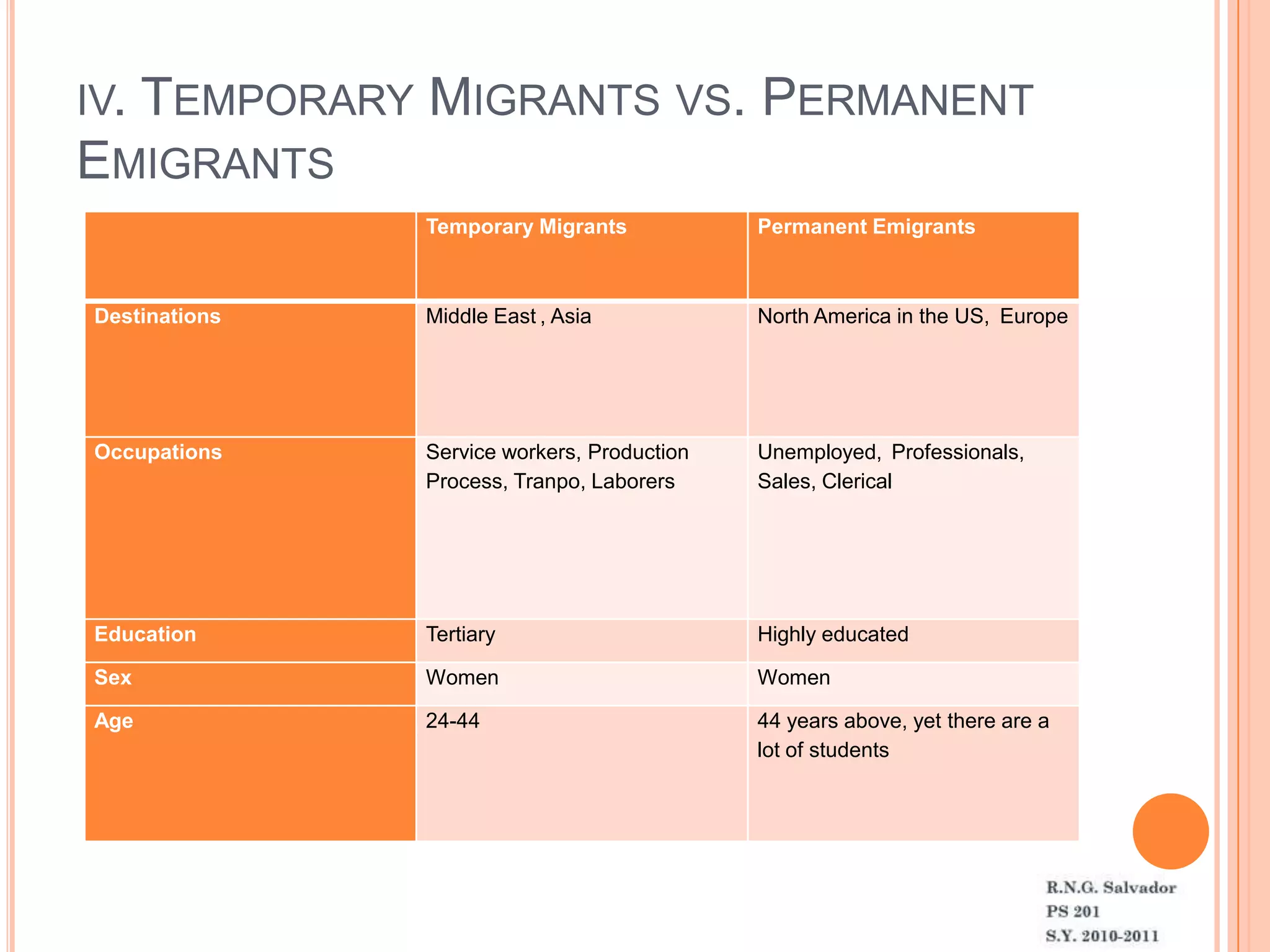
iv. Temporary Migrants vs. Permanent Emigrants
v. Series of Unfortunate Events1. Global recession – open economies in SEA and EA were badly hit because of the slow down in major markets - Demand for health workers and sea fearers declined2. War in the Middle East – ME is a labor importing country. - For protection purposes, many laborers were sent by the consulate offices back home until the war finally subsides.
vii. Workers’ Protection OrderThe Migrant Women - face particular vulnerabilities. Aside from the usual problems that plague migrants, their jobs in domestic work and entertainment usually mean long working hours, surveillance and control by employers, and abusive conditions, including violence and sexual harassment. Given the "private" context in which they work, the problems encountered by migrant women in these sectors go unnoticed. (Asis, 2006)
In general, compared to other national groups, Filipino workers are relatively better protected because they are more educated, more likely to speak English, and they are better organized. NGOs for migrants in the Philippines and their networks abroad not only provide services and support to migrants, but, more importantly, they advocate for migrants' rights.
RA 8042: The Migrant Workers and Overseas Filipinos Act - first among the countries of origin in Asia to craft a law that aims "to establish a higher standard of protection and promotion of the welfare of migrant workers, their families and overseas Filipinos in distress."
Anti-Trafficking in Persons Act of 2003, which establishes policies and institutional mechanisms to provide support to trafficked personsOverseas Absentee Voting Act of 2003, which gives qualified overseas Filipinos the right to vote in national electionsthe Citizenship Retention and Reacquisition Act of 2003, which allows for dual citizenship
viii. RemittancesAccording to a 2005 World Bank report, the Philippines is the fifth-largest recipient of remittance flows after India, China, Mexico, and France.
The BangkoSentralngPilipinas is also working on enforcing minimum standards for banks and other players in the remittance business to protect OFWs and their families from fly-by-night operators, excessive fees, unfair foreign currency conversion, and delivery problems. 
ReferencesAbrigo, Michael and Orbeta, Aniceto Jr. 2009. Philippine International Labour Migration in the Past 30 Years: Trends and Prospects. Philippine Institute for Development Studies. Disc Paper Series No. 2009-33. Asis, Maruja M.B. 2005. "Caring for the World: Filipino Domestic Workers Gone Global." In Asian Women as Transnational Domestic Workers. Edited by Shirlena Huang, Brenda Yeoh and Noor Abdul Rahman. Singapore: Marshall and Cavendish Academic. Pp 21-53. _____. 1992 "The Overseas Employment Program Policy." In Philippine Labor Migration: Impact and Policy. Edited by GrazianoBattistella and Anthony Paganoni, Quezon City: Scalabrini Migration Center. Pp. 68-112. Cariño, Benjamin V., ed. 1998. Filipinos on the Move: Trends, Dilemmas and Policy Options. Quezon City: Philippine Migration Research Network. Gonzales, Joaquin III. 1998. Philippine Labour Migration: Critical Dimensions of Public Policy. Singapore: Institute of Southeast Asian Studies. Sto. Tomas, Patricia. 2002. "Managing the Overseas Employment Program: Lessons Learned and New Directives," Asian Migrant, 15(4):94-98. World Bank. "Global Economic Prospects 2006." November 2005.http://www.migrationinformation.org/USFocus/display.cfm?ID=364http://dirp3.pids.gov.ph/ris/dps/pidsdps0933.pdf http://www.ilo.org/public/english/protection/migrant/download/imp/imp51e.pdf http://www.poea.gov.ph/stats/Stock%20Estmate%202009.pdf

PS 201 Labor Migration And The Global Filipino

  • 1.
    Labor Migration andthe Global FilipinoR.N.G. SalvadorPS 201S.Y. 2010-2011
  • 2.
    i. Facts andFiguresSince 1970s, the Philippines — a country of about 7,000 islands peopled by diverse ethno-linguistic groups — has supplied all kinds of skilled and low-skilled workers to the world's more developed regionsAs of December 2004, an estimated 8.1 million Filipinos — nearly 10 percent of the country's 85 million people — were working and/or residing in close to 200 countries and territories
  • 3.
    The foreign populationin the Philippines consists of people of Chinese origin (some 80 percent of overseas Chinese are in Southeast Asia) and some people of Indian origin who came to settle in the country years agoIn the last 30 years, a "culture of migration" has emerged, with millions of Filipinos eager to work abroad, despite the risks and vulnerabilities they are likely to face
  • 4.
    ii. Determinants ofMigrationsEconomic – disparities in per capita income; limited growth for career advancements; inconsistent economic growth which hampers employment generationDemography – high population growth compared to neighbouring countriesPolitical – long running political unrest in the country especially in the SouthEnvironment– frequency of storms and the weak disaster preparedness schemes
  • 5.
  • 7.
  • 8.
    iv. Temporary Migrantsvs. Permanent Emigrants
  • 9.
    v. Series ofUnfortunate Events1. Global recession – open economies in SEA and EA were badly hit because of the slow down in major markets - Demand for health workers and sea fearers declined2. War in the Middle East – ME is a labor importing country. - For protection purposes, many laborers were sent by the consulate offices back home until the war finally subsides.
  • 10.
    vii. Workers’ ProtectionOrderThe Migrant Women - face particular vulnerabilities. Aside from the usual problems that plague migrants, their jobs in domestic work and entertainment usually mean long working hours, surveillance and control by employers, and abusive conditions, including violence and sexual harassment. Given the "private" context in which they work, the problems encountered by migrant women in these sectors go unnoticed. (Asis, 2006)
  • 11.
    In general, comparedto other national groups, Filipino workers are relatively better protected because they are more educated, more likely to speak English, and they are better organized. NGOs for migrants in the Philippines and their networks abroad not only provide services and support to migrants, but, more importantly, they advocate for migrants' rights.
  • 12.
    RA 8042: TheMigrant Workers and Overseas Filipinos Act - first among the countries of origin in Asia to craft a law that aims "to establish a higher standard of protection and promotion of the welfare of migrant workers, their families and overseas Filipinos in distress."
  • 13.
    Anti-Trafficking in PersonsAct of 2003, which establishes policies and institutional mechanisms to provide support to trafficked personsOverseas Absentee Voting Act of 2003, which gives qualified overseas Filipinos the right to vote in national electionsthe Citizenship Retention and Reacquisition Act of 2003, which allows for dual citizenship
  • 14.
    viii. RemittancesAccording toa 2005 World Bank report, the Philippines is the fifth-largest recipient of remittance flows after India, China, Mexico, and France.
  • 16.
    The BangkoSentralngPilipinas isalso working on enforcing minimum standards for banks and other players in the remittance business to protect OFWs and their families from fly-by-night operators, excessive fees, unfair foreign currency conversion, and delivery problems. 
  • 17.
    ReferencesAbrigo, Michael andOrbeta, Aniceto Jr. 2009. Philippine International Labour Migration in the Past 30 Years: Trends and Prospects. Philippine Institute for Development Studies. Disc Paper Series No. 2009-33. Asis, Maruja M.B. 2005. "Caring for the World: Filipino Domestic Workers Gone Global." In Asian Women as Transnational Domestic Workers. Edited by Shirlena Huang, Brenda Yeoh and Noor Abdul Rahman. Singapore: Marshall and Cavendish Academic. Pp 21-53. _____. 1992 "The Overseas Employment Program Policy." In Philippine Labor Migration: Impact and Policy. Edited by GrazianoBattistella and Anthony Paganoni, Quezon City: Scalabrini Migration Center. Pp. 68-112. Cariño, Benjamin V., ed. 1998. Filipinos on the Move: Trends, Dilemmas and Policy Options. Quezon City: Philippine Migration Research Network. Gonzales, Joaquin III. 1998. Philippine Labour Migration: Critical Dimensions of Public Policy. Singapore: Institute of Southeast Asian Studies. Sto. Tomas, Patricia. 2002. "Managing the Overseas Employment Program: Lessons Learned and New Directives," Asian Migrant, 15(4):94-98. World Bank. "Global Economic Prospects 2006." November 2005.http://www.migrationinformation.org/USFocus/display.cfm?ID=364http://dirp3.pids.gov.ph/ris/dps/pidsdps0933.pdf http://www.ilo.org/public/english/protection/migrant/download/imp/imp51e.pdf http://www.poea.gov.ph/stats/Stock%20Estmate%202009.pdf