The gaming world is flat
But you can tilt it in your direction
Dean Takahashi, lead writer for
GamesBeat
 I have covered technology news for 25 years and games for 20 years
 VentureBeat: founded 11 years ago. 12 million readers a month
 GamesBeat: Started 9 years ago when I joined
 GamesBeat events: GamesBeat Summit in spring 2017; GamesBeat 2017 in fall
2017
 Web site: GamesBeat channel and subchannels for AR/VR, esports, PC gaming,
and other game stories. We do reviews, news, and interviews.
 I wrote two books, “Opening the Xbox” (2002) and “The Xbox 360 Uncloaked”
(2006)
The places I’ve been
 I have been lucky to talk to game developers about the economic growth of
games in Helsinki, London, Marseilles, Shanghai, Tel Aviv, Los Angeles, San
Francisco, Seattle, Dallas, New York, Montreal, Amsterdam, Berlin, Hamburg,
and Las Vegas.
 This is my first trip to Japan in 24 years
 All of that has taught me that the world is flat when it comes to making
games. I borrowed that idea from best-selling author Thomas Friedman of the
New York Times.
 Competition is global. And it’s a non-zero-sum game
My favorite game: The Last of Us
You can make a game anywhere
 Siberian brothers employ 100 in Yakutsk; 30 million downloads
 MyTona made 15 games, and their last one was a big hit
 North America, Europe, and Japan dominated PC/console
 Mobile games can be made anywhere
 Globalization has helped games spread everywhere
 Costs are shifting and so our audiences
 Workforces are educated
But strong regions tilt the odds in your
favor
 San Francisco, Los Angeles, Seattle, Tokyo, Vancouver, and Montreal are
strong
 Regions have their advantages in history, culture, and costs
 Related industries can help a region thrive, like the proximity to Hollywood
 Science fiction, tech, and games
 It works best if you have a gaming hub. Example: Japan has strong hubs for
gaming, while India is only emerging.
History is the strongest way to succeed
 Silicon Valley started in 1940s
 Atari and Homebrew Computer Club started in 1970s
 Nintendo and Sega rise in Japan in 1980s
 Demo Scene in Helsinki started in 1990s
 Id Software started in 1990s in Dallas
 3D animation software started in 1980s in Montreal
What are the ingredients?
 Strong technology sector
 Entertainment industry
 Good universities
 Favorable business climate
 Cultural engagement
 Leadership
 Specialization
 Government support
 Legal protection
 Financial support
 International talent
Silicon Valley vs Boston
 Regional Advantage: Culture and Competition in Silicon Valley and Route 128
 Silicon Valley won, as it embraced the horizontal business model, while
Boston stayed with the older vertical model. Horizontal firms like Intel and
Microsoft won the PC market, while vertical companies like Digital Equipment
lost.
 Annalee Saxenian’s Regional Advantage book captured this story
 The platform owners hold the power
 Bay Area platforms: Oculus, Facebook, Google, Apple, Intel
 The Bay Area has stronger venture capital investment
The U.S.
 Strong regions: San Francisco, Seattle, Los Angeles, New York, Dallas, Austin,
Boston
 Top states: California, Texas, Washington, New York, Massachusetts
 1641 companies, 546 in California
 406 universities with full game programs
 Silicon Valley
 150,000 jobs
 Jobs growing at four times the rate of the overall U.S. economy 2009-2012
 $94,747 average salary (source: The ESA)
The top 10 public game companies in
2014
 1. Tencent
 2. Sony
 3. Microsoft
 4. EA
 5. Activision Blizzard
 6. Apple
 7. Google
 8. King
 9. Nintendo
 10. Ubisoft
Nothing stays the same
 The game business and its leaders are always changing
 But games are always growing, topping $100 billion and reaching billions
 Supercell with 200 employees is valued at $10 billion
 Ubisoft with 10,000 employees is valued at $3.7 billion
The top 10 public game companies in
2015
 1. Tencent
 2. Sony
 3. Activision Blizzard
 4. Microsoft
 5. Apple
 6. EA
 7. NetEase
 8. Google
 9. Bandai Namco
 10 Mixi
Japan
 Long history with Sony, Nintendo, and Sega
 Strong third-party companies
 Arcade industry
 Succeeded without a real Hollywood
 Strong gaming culture
 Influential throughout the world
Canada
 Government help
 Better measurement
 472 active studios, 143 new since 2013
 $3 billion annual revenue, up 31% since 2013
 20,400 game jobs in Canada; 36,500 equivalent full-time jobs
 Major companies with Canadian studios: EA, Capcom, Ubisoft, Activision
Blizzard, Microsoft, Nintendo, Sony, Disney, Warner Bros., Square Enix, Sega,
and Bandai Namco
 Home grown: BioWare (EA), Ludia, Behaviour, Relic Entertainment
 Costs are 25% of U.S.
 1/10th the size of U.S., but 1/3 as many studios
New platforms
 Virtual reality
 Augmented reality
 Mobile
 Television
 Toys to life
 Esports
Success story: Behaviour Interactive
 Started in 1992 in Montreal
 1996 Multimedia Interactive and Behaviour merged
 1999 Founder Remi Racine buys back, renames it A2M
 2008 Acquires Chile’s Wanako Games
 2010 Renamed Behaviour Interactive
 2015 Fallout Shelter
 2016 Dead by Daylight, Warhammer 40,000: Eternal Crusade
 It started as an amoeba, and it has evolved and hit the next level in the food
chain
China
 Urging worldwide expansion
 Strong shows like ChinaJoy
 Strong in PC and mobile. Not much console
 Big push into VR
 Financial power and geographic arbitrage
 Tencent has bought stakes in Supercell, Actvision Blizzard, Riot Games, and
Epic
 Problems with censorship, trade restrictions
Israel, Finland, and others
 Israel specialized in online gambling, social casino, marketing tech, mobile
 Finland specialized in mobile
 Canada is broad-based across Montreal, Vancouver, Edmonton, Quebec City,
and Toronto
 Technology, entertainment, and games inspire each other
 How do you become fast?
 How do you create a gaming culture? Finland has to export
Acquisitions and failures
 Regions can suffer
 Layoffs affect places such as Boston, Austin
 Geopolitics matter in Israel, Ukraine
 Silicon Valley has become too expensive
 Immigration policies should be friendly
 Political climate should be stable and welcoming
 Some companies in Canada failed, like Roadhouse and United Front Games.
But Kabam’s Vancouver is driving enterprise value
 Mino Games decided to leave SF and move to Montreal
What is coming next?
 Emerging territories of AR, VR, toys-to-life, Internet of Things, drones,
robotics, esports, retro and more
 VR is strong in the U.S. and China
 Silicon Valley is strong in AI
 Montreal and Toronto are strong in AI
 The intersection of sci-fi, tech, and games
 Westworld
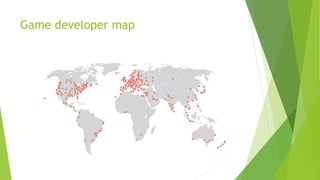
Game developer map
The game industry map that matters?
 San Francisco: Pokemon Go, Game of War, The Sims, Star Wars, Plants vs
Zombies
 Los Angeles: The Last of Us, Uncharted, Crash Bandicoot, Call of Duty, Diablo,
Hearthstone, World of Warcraft, StarCraft, Overwatch, God of War, League of
Legends
 Dallas: Doom, Quake, Age of Empires
 Montreal: Assassin’s Creed, Fallout Shelter, Deus Ex
 Edmonton: Mass Effect, Dragon Age
 Vancouver: Need for Speed, Gears of War
 Maryland: Civilization, Fallout, Skyrim
 New York: Grand Theft Auto, Red Dead Redemption
 Seattle: Halo, Half Life
 Tokyo: Final Fantasy, Pokemon, Kingdom Hearts, Sonic, Ico, Gran Turismo
Game industry map continued
 Osaka: Resident Evil, Street Fighter
 Kyoto: Mario, Zelda, Wii Sports, Mario Kart, Nintendogs
 Helsinki: Angry Birds, Clash of Clans, Clash Royale
 Stockholm: Candy Crush Saga, Minecraft, Battlefield
 Moscow/Honolulu: Tetris
 Florida: Fifa, Madden
 England: Tomb Raider
 Boston: Rock Band
 South Korea: CrossFire
Reducing your risks as a game company
 Why multiple territories make sense
 Wider talent pools
 Cultural expertise
 Diversity works
 No one has a monopoly on good ideas
Games find a way
 Conclusions
 You can’t just think about building a company. You have to build a region. And
that region has to produce blockbusters.
 You can build a video game economy, but it takes time
 Cost isn’t the only advantage
 A gaming hub needs veterans, fresh talent, a culture of fun, low costs, a
critical mass of companies, and government support
 If games have this, they will take over the world
You have to take games seriously

The gaming world is flat

  • 1.
    The gaming worldis flat But you can tilt it in your direction
  • 2.
    Dean Takahashi, leadwriter for GamesBeat  I have covered technology news for 25 years and games for 20 years  VentureBeat: founded 11 years ago. 12 million readers a month  GamesBeat: Started 9 years ago when I joined  GamesBeat events: GamesBeat Summit in spring 2017; GamesBeat 2017 in fall 2017  Web site: GamesBeat channel and subchannels for AR/VR, esports, PC gaming, and other game stories. We do reviews, news, and interviews.  I wrote two books, “Opening the Xbox” (2002) and “The Xbox 360 Uncloaked” (2006)
  • 3.
    The places I’vebeen  I have been lucky to talk to game developers about the economic growth of games in Helsinki, London, Marseilles, Shanghai, Tel Aviv, Los Angeles, San Francisco, Seattle, Dallas, New York, Montreal, Amsterdam, Berlin, Hamburg, and Las Vegas.  This is my first trip to Japan in 24 years  All of that has taught me that the world is flat when it comes to making games. I borrowed that idea from best-selling author Thomas Friedman of the New York Times.  Competition is global. And it’s a non-zero-sum game
  • 4.
    My favorite game:The Last of Us
  • 5.
    You can makea game anywhere  Siberian brothers employ 100 in Yakutsk; 30 million downloads  MyTona made 15 games, and their last one was a big hit  North America, Europe, and Japan dominated PC/console  Mobile games can be made anywhere  Globalization has helped games spread everywhere  Costs are shifting and so our audiences  Workforces are educated
  • 6.
    But strong regionstilt the odds in your favor  San Francisco, Los Angeles, Seattle, Tokyo, Vancouver, and Montreal are strong  Regions have their advantages in history, culture, and costs  Related industries can help a region thrive, like the proximity to Hollywood  Science fiction, tech, and games  It works best if you have a gaming hub. Example: Japan has strong hubs for gaming, while India is only emerging.
  • 7.
    History is thestrongest way to succeed  Silicon Valley started in 1940s  Atari and Homebrew Computer Club started in 1970s  Nintendo and Sega rise in Japan in 1980s  Demo Scene in Helsinki started in 1990s  Id Software started in 1990s in Dallas  3D animation software started in 1980s in Montreal
  • 8.
    What are theingredients?  Strong technology sector  Entertainment industry  Good universities  Favorable business climate  Cultural engagement  Leadership  Specialization  Government support  Legal protection  Financial support  International talent
  • 9.
    Silicon Valley vsBoston  Regional Advantage: Culture and Competition in Silicon Valley and Route 128  Silicon Valley won, as it embraced the horizontal business model, while Boston stayed with the older vertical model. Horizontal firms like Intel and Microsoft won the PC market, while vertical companies like Digital Equipment lost.  Annalee Saxenian’s Regional Advantage book captured this story  The platform owners hold the power  Bay Area platforms: Oculus, Facebook, Google, Apple, Intel  The Bay Area has stronger venture capital investment
  • 10.
    The U.S.  Strongregions: San Francisco, Seattle, Los Angeles, New York, Dallas, Austin, Boston  Top states: California, Texas, Washington, New York, Massachusetts  1641 companies, 546 in California  406 universities with full game programs  Silicon Valley  150,000 jobs  Jobs growing at four times the rate of the overall U.S. economy 2009-2012  $94,747 average salary (source: The ESA)
  • 11.
    The top 10public game companies in 2014  1. Tencent  2. Sony  3. Microsoft  4. EA  5. Activision Blizzard  6. Apple  7. Google  8. King  9. Nintendo  10. Ubisoft
  • 12.
    Nothing stays thesame  The game business and its leaders are always changing  But games are always growing, topping $100 billion and reaching billions  Supercell with 200 employees is valued at $10 billion  Ubisoft with 10,000 employees is valued at $3.7 billion
  • 13.
    The top 10public game companies in 2015  1. Tencent  2. Sony  3. Activision Blizzard  4. Microsoft  5. Apple  6. EA  7. NetEase  8. Google  9. Bandai Namco  10 Mixi
  • 14.
    Japan  Long historywith Sony, Nintendo, and Sega  Strong third-party companies  Arcade industry  Succeeded without a real Hollywood  Strong gaming culture  Influential throughout the world
  • 15.
    Canada  Government help Better measurement  472 active studios, 143 new since 2013  $3 billion annual revenue, up 31% since 2013  20,400 game jobs in Canada; 36,500 equivalent full-time jobs  Major companies with Canadian studios: EA, Capcom, Ubisoft, Activision Blizzard, Microsoft, Nintendo, Sony, Disney, Warner Bros., Square Enix, Sega, and Bandai Namco  Home grown: BioWare (EA), Ludia, Behaviour, Relic Entertainment  Costs are 25% of U.S.  1/10th the size of U.S., but 1/3 as many studios
  • 16.
    New platforms  Virtualreality  Augmented reality  Mobile  Television  Toys to life  Esports
  • 17.
    Success story: BehaviourInteractive  Started in 1992 in Montreal  1996 Multimedia Interactive and Behaviour merged  1999 Founder Remi Racine buys back, renames it A2M  2008 Acquires Chile’s Wanako Games  2010 Renamed Behaviour Interactive  2015 Fallout Shelter  2016 Dead by Daylight, Warhammer 40,000: Eternal Crusade  It started as an amoeba, and it has evolved and hit the next level in the food chain
  • 18.
    China  Urging worldwideexpansion  Strong shows like ChinaJoy  Strong in PC and mobile. Not much console  Big push into VR  Financial power and geographic arbitrage  Tencent has bought stakes in Supercell, Actvision Blizzard, Riot Games, and Epic  Problems with censorship, trade restrictions
  • 19.
    Israel, Finland, andothers  Israel specialized in online gambling, social casino, marketing tech, mobile  Finland specialized in mobile  Canada is broad-based across Montreal, Vancouver, Edmonton, Quebec City, and Toronto  Technology, entertainment, and games inspire each other  How do you become fast?  How do you create a gaming culture? Finland has to export
  • 20.
    Acquisitions and failures Regions can suffer  Layoffs affect places such as Boston, Austin  Geopolitics matter in Israel, Ukraine  Silicon Valley has become too expensive  Immigration policies should be friendly  Political climate should be stable and welcoming  Some companies in Canada failed, like Roadhouse and United Front Games. But Kabam’s Vancouver is driving enterprise value  Mino Games decided to leave SF and move to Montreal
  • 21.
    What is comingnext?  Emerging territories of AR, VR, toys-to-life, Internet of Things, drones, robotics, esports, retro and more  VR is strong in the U.S. and China  Silicon Valley is strong in AI  Montreal and Toronto are strong in AI  The intersection of sci-fi, tech, and games  Westworld
  • 22.
  • 23.
    The game industrymap that matters?  San Francisco: Pokemon Go, Game of War, The Sims, Star Wars, Plants vs Zombies  Los Angeles: The Last of Us, Uncharted, Crash Bandicoot, Call of Duty, Diablo, Hearthstone, World of Warcraft, StarCraft, Overwatch, God of War, League of Legends  Dallas: Doom, Quake, Age of Empires  Montreal: Assassin’s Creed, Fallout Shelter, Deus Ex  Edmonton: Mass Effect, Dragon Age  Vancouver: Need for Speed, Gears of War  Maryland: Civilization, Fallout, Skyrim  New York: Grand Theft Auto, Red Dead Redemption  Seattle: Halo, Half Life  Tokyo: Final Fantasy, Pokemon, Kingdom Hearts, Sonic, Ico, Gran Turismo
  • 24.
    Game industry mapcontinued  Osaka: Resident Evil, Street Fighter  Kyoto: Mario, Zelda, Wii Sports, Mario Kart, Nintendogs  Helsinki: Angry Birds, Clash of Clans, Clash Royale  Stockholm: Candy Crush Saga, Minecraft, Battlefield  Moscow/Honolulu: Tetris  Florida: Fifa, Madden  England: Tomb Raider  Boston: Rock Band  South Korea: CrossFire
  • 25.
    Reducing your risksas a game company  Why multiple territories make sense  Wider talent pools  Cultural expertise  Diversity works  No one has a monopoly on good ideas
  • 26.
    Games find away  Conclusions  You can’t just think about building a company. You have to build a region. And that region has to produce blockbusters.  You can build a video game economy, but it takes time  Cost isn’t the only advantage  A gaming hub needs veterans, fresh talent, a culture of fun, low costs, a critical mass of companies, and government support  If games have this, they will take over the world
  • 27.
    You have totake games seriously