The future of
online TESOL
Presentation by Beatriz Rodríguez Rivera
rodriguezriverabeatriz@gmail.com
Online TESOL
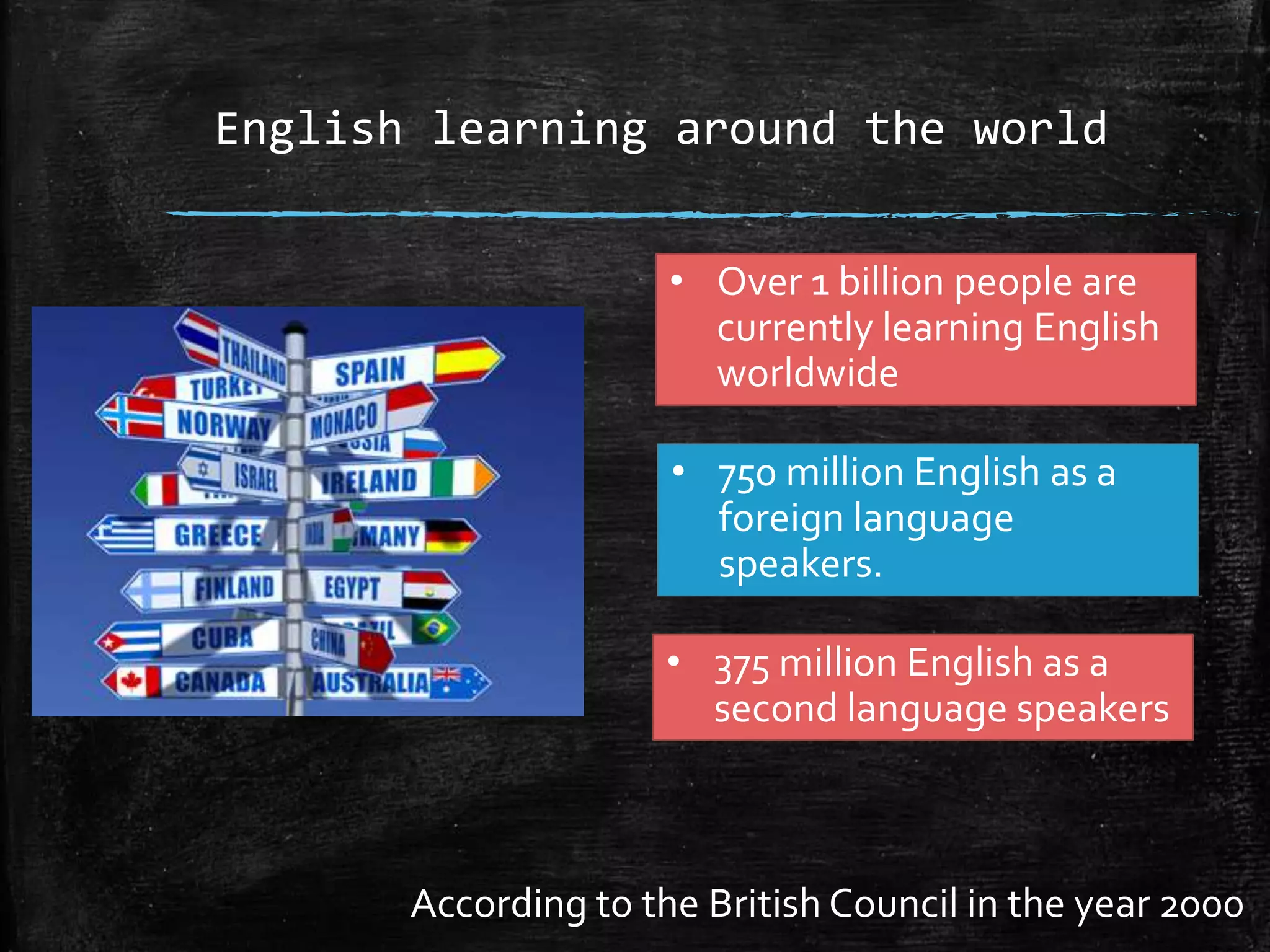
English learning around the world
• Over 1 billion people are
currently learning English
worldwide
• 750 million English as a
foreign language
speakers.
• 375 million English as a
second language speakers
According to the British Council in the year 2000
ESL or EFL?
 ESL: Speakers use
English on a daily
basis.
 EFL: Speakers use the
English language
ocassionally.
How many EFL or ESL students
will study online?
Greater number of online students = Greater need for teachers
Advantages of online distance
programs
 Flexibility
 High quality
 Easy access
 Available even in areas
which there may be
limitedTESOL
preparation courses.
How will online distance TESOL
instructors be prepared in the
future?
Criticism about online
distance TESOL
 “For those of us who love
technology and gadgets it can be
tempting to integrate such
options into our courses just
because they´re there…or
because their neat and we have
became enamored with them”
Henry and Meadow (2008)
Number of TESOL programs online
gradschools.com
http://www.gradschools.com/programs/esl-tesol/online?page=1
72 results
in 2011
Online
TESOL
search
Issues for the future of
Learning Online at a distance
Who will enroll inTESOL courses and
programs online?
Where will they teach?
How many students will seek online
distance courses?
What will their goals be for
professional education?
Who will enroll in TESOL
courses and programs online?
 There is no reliable
statistics on the
number of online
distanceTESOL
programs.
 From more than
2500 colleges in the
USA it was learned
that approximately
5.6 million students
were enrolled in at
least one online
course by 2009. hackschooling makes me
happy video
edx.org
edx.org
edx.org
To what extend can we
identify contexts, goals,
ages and proficiency for
those English language
learners who seek online
distance courses and
programs of study?
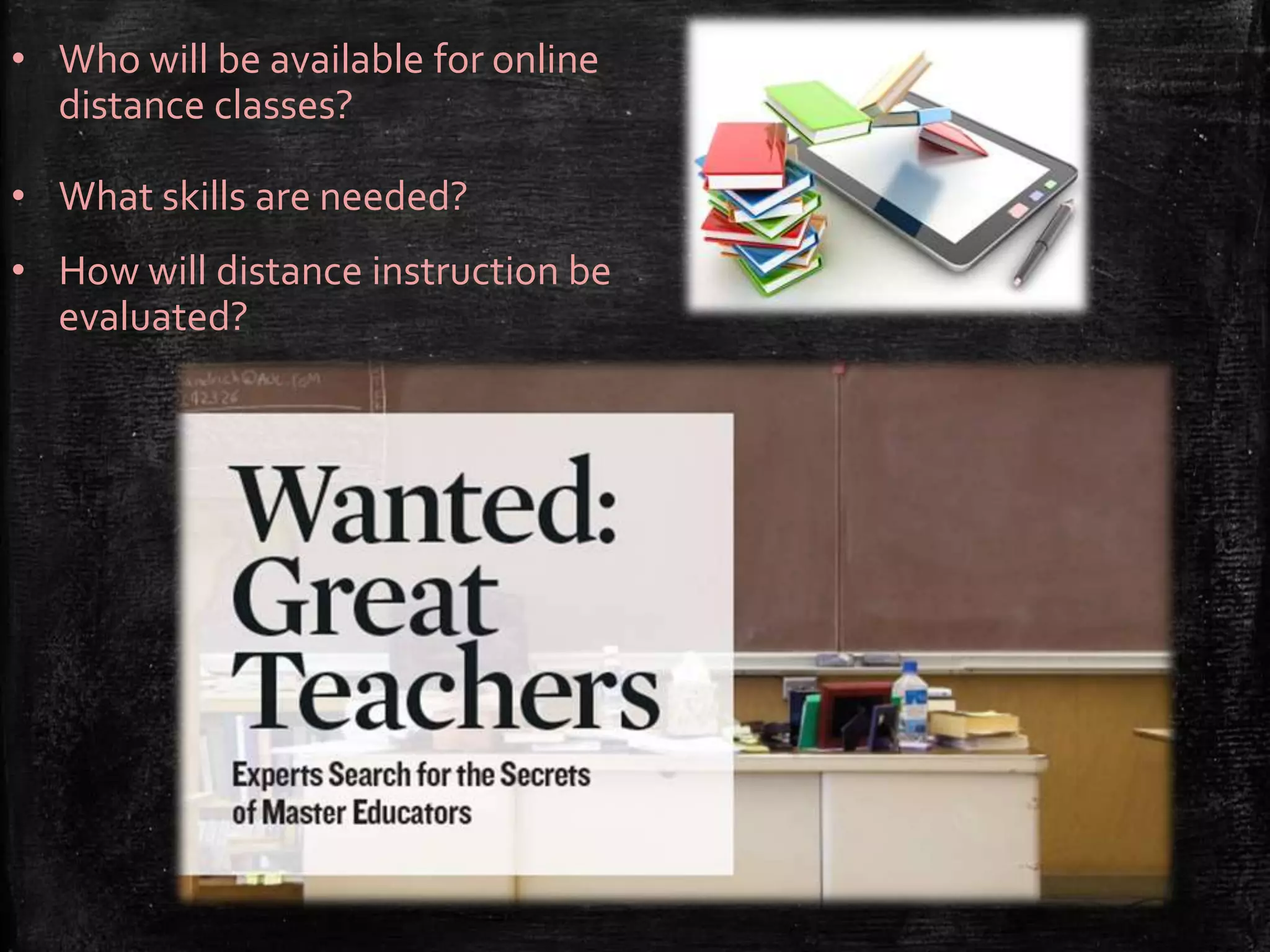
• Who will be available for online
distance classes?
• What skills are needed?
• How will distance instruction be
evaluated?
Needed skills for instructors
Knowledge about: pedagogy + technology
+learner needs
Skills with curriculum, materials activities and
tests.
Skills in building community.
Challenges for TESOL
• Students all over the world demanding
instructional delivery models using innovations
in technology.
• Instructors and administrators: How to meet the
needs of a highly diverse student market.
• Predicting the needs and presenting material in
ways that address the need of very diverse
student groups. (see Garton and Edge for more
information)
To what extend are
teacher educators
prepared to meet
the challenge of
teaching in online
distance TESOL?
go to my first webquest
Go to my first prezi
My first google site
my slideshare
My first educational youtube
video
conclusion
 I believe there is a huge future for online
distance English learning as well as for
online distanceTESOL courses.
 There is a lot being done in English learning
in order to be ahead of new technologies.
 Traditional teachers have the need to
explore new technologies and be prepared
for theTESOL future.
Bibliography
England, L. and R. Hall, D. (2012). Online
language teacher education.TESOL
perspectives. NewYork: Routledge, pp.187-
199.

The future of online TESOL

  • 1.
    The future of onlineTESOL Presentation by Beatriz Rodríguez Rivera rodriguezriverabeatriz@gmail.com
  • 2.
  • 3.
    English learning aroundthe world • Over 1 billion people are currently learning English worldwide • 750 million English as a foreign language speakers. • 375 million English as a second language speakers According to the British Council in the year 2000
  • 4.
    ESL or EFL? ESL: Speakers use English on a daily basis.  EFL: Speakers use the English language ocassionally.
  • 5.
    How many EFLor ESL students will study online? Greater number of online students = Greater need for teachers
  • 6.
    Advantages of onlinedistance programs  Flexibility  High quality  Easy access  Available even in areas which there may be limitedTESOL preparation courses.
  • 7.
    How will onlinedistance TESOL instructors be prepared in the future?
  • 8.
    Criticism about online distanceTESOL  “For those of us who love technology and gadgets it can be tempting to integrate such options into our courses just because they´re there…or because their neat and we have became enamored with them” Henry and Meadow (2008)
  • 9.
    Number of TESOLprograms online
  • 10.
  • 11.
  • 12.
    Issues for thefuture of Learning Online at a distance Who will enroll inTESOL courses and programs online? Where will they teach? How many students will seek online distance courses? What will their goals be for professional education?
  • 13.
    Who will enrollin TESOL courses and programs online?  There is no reliable statistics on the number of online distanceTESOL programs.  From more than 2500 colleges in the USA it was learned that approximately 5.6 million students were enrolled in at least one online course by 2009. hackschooling makes me happy video
  • 15.
  • 16.
  • 17.
  • 18.
    To what extendcan we identify contexts, goals, ages and proficiency for those English language learners who seek online distance courses and programs of study?
  • 19.
    • Who willbe available for online distance classes? • What skills are needed? • How will distance instruction be evaluated?
  • 20.
    Needed skills forinstructors Knowledge about: pedagogy + technology +learner needs Skills with curriculum, materials activities and tests. Skills in building community.
  • 21.
    Challenges for TESOL •Students all over the world demanding instructional delivery models using innovations in technology. • Instructors and administrators: How to meet the needs of a highly diverse student market. • Predicting the needs and presenting material in ways that address the need of very diverse student groups. (see Garton and Edge for more information)
  • 22.
    To what extendare teacher educators prepared to meet the challenge of teaching in online distance TESOL?
  • 23.
    go to myfirst webquest Go to my first prezi My first google site my slideshare My first educational youtube video
  • 24.
    conclusion  I believethere is a huge future for online distance English learning as well as for online distanceTESOL courses.  There is a lot being done in English learning in order to be ahead of new technologies.  Traditional teachers have the need to explore new technologies and be prepared for theTESOL future.
  • 25.
    Bibliography England, L. andR. Hall, D. (2012). Online language teacher education.TESOL perspectives. NewYork: Routledge, pp.187- 199.