MOOCS AND YOUR ORGANISATION
ONLINE & ELEARNING CONFERENCE 2015
MARY-ANN FIFE
MAY 2015
Overview
 The MOOC Phenomenon
 MOOCs at UCT
 MOOCs and your organisation
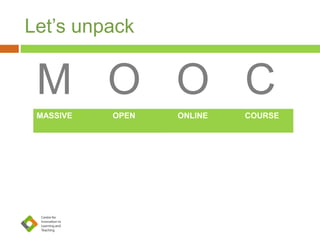
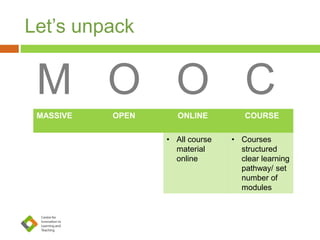
Let’s unpack
M O O C
MASSIVE OPEN ONLINE COURSE
• Many
thousand
participants /
learners
• Open
enrollment
and free
access to
course
content
• All course
material
online
• Courses
structured
clear learning
pathway/ set
number of
modules
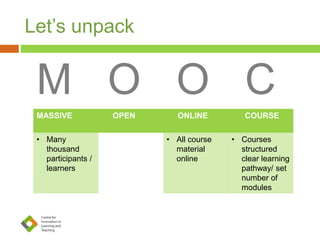
Let’s unpack
M O O C
MASSIVE OPEN ONLINE COURSE
• Many
thousand
participants /
learners
• Open
enrollment
and free
access to
course
content
• All course
material
online
• Courses
structured
clear learning
pathway/ set
number of
modules
Let’s unpack
M O O C
MASSIVE OPEN ONLINE COURSE
• Many
thousand
participants /
learners
• Open
enrollment
and free
access to
course
content
• All course
material
online
• Courses
structured
clear learning
pathway/ set
number of
modules
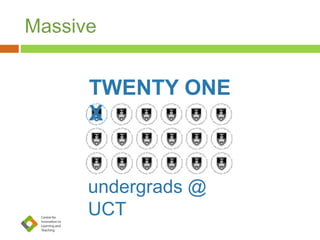
Massive
TWENTY ONE
X
undergrads @
UCT
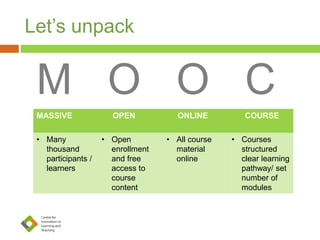
Let’s unpack
M O O C
MASSIVE OPEN ONLINE COURSE
• Many
thousand
participants /
learners
• Open
enrollment
and free
access to
course
content
• All course
material
online
• Courses
structured
clear learning
pathway/ set
number of
modules
Kontizas Dimitrios
Ask the audience
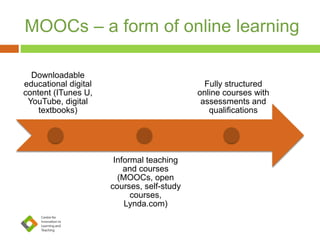
MOOCs – a form of online learning
Downloadable
educational digital
content (ITunes U,
YouTube, digital
textbooks)
Informal teaching
and courses
(MOOCs, open
courses, self-study
courses,
Lynda.com)
Fully structured
online courses with
assessments and
qualifications
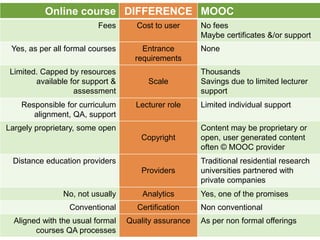
Online course DIFFERENCE MOOC
Fees Cost to user No fees
Maybe certificates &/or support
Yes, as per all formal courses Entrance
requirements
None
Limited. Capped by resources
available for support &
assessment
Scale
Thousands
Savings due to limited lecturer
support
Responsible for curriculum
alignment, QA, support
Lecturer role Limited individual support
Largely proprietary, some open
Copyright
Content may be proprietary or
open, user generated content
often © MOOC provider
Distance education providers
Providers
Traditional residential research
universities partnered with
private companies
No, not usually Analytics Yes, one of the promises
Conventional Certification Non conventional
Aligned with the usual formal
courses QA processes
Quality assurance As per non formal offerings
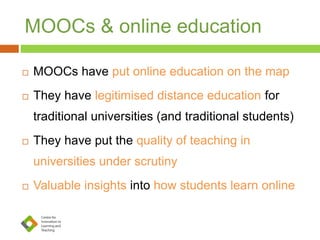
MOOCs & online education
 MOOCs have put online education on the map
 They have legitimised distance education for
traditional universities (and traditional students)
 They have put the quality of teaching in
universities under scrutiny
 Valuable insights into how students learn online
David Blackwell
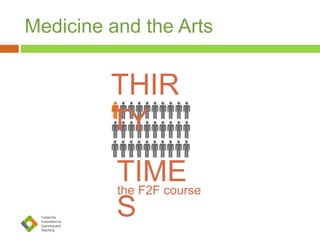
Medicine and the Arts
THIR
TY
TIME
S
the F2F course
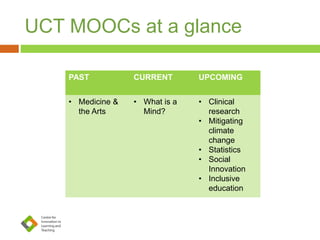
UCT MOOCs at a glance
PAST CURRENT UPCOMING
• Medicine &
the Arts
• What is a
Mind?
• Clinical
research
• Mitigating
climate
change
• Statistics
• Social
Innovation
• Inclusive
education
Prof Sandra Klopper – DVC Teaching and Learning
 UCT to offer MOOCs – full version (Prof.
Klopper speaks at 00:49)
https://www.youtube.com/watch?v=rGL9nmXZf8
s
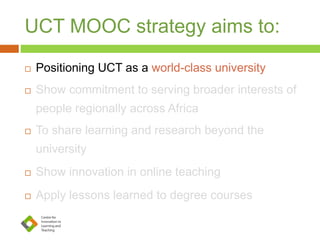
UCT MOOC strategy aims to:
 Positioning UCT as a world-class university
 Show commitment to serving broader interests of
people regionally across Africa
 To share learning and research beyond the
university
 Show innovation in online teaching
 Apply lessons learned to degree courses
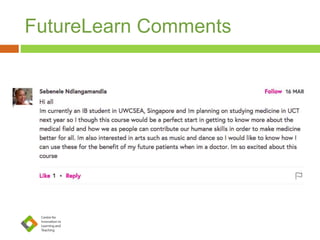
FutureLearn Comments
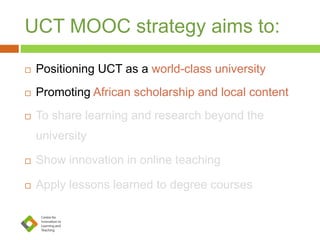
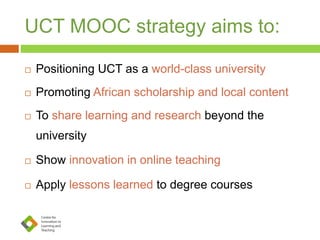
UCT MOOC strategy aims to:
 Positioning UCT as a world-class university
 Promoting African scholarship and local content
 To share learning and research beyond the
university
 Show innovation in online teaching
 Apply lessons learned to degree courses
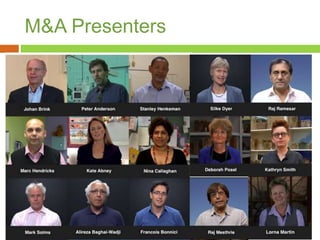
M&A Presenters
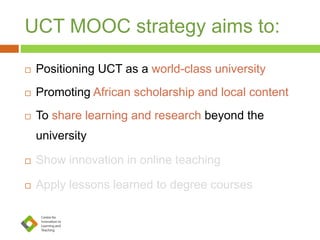
UCT MOOC strategy aims to:
 Positioning UCT as a world-class university
 Promoting African scholarship and local content
 To share learning and research beyond the
university
 Show innovation in online teaching
 Apply lessons learned to degree courses
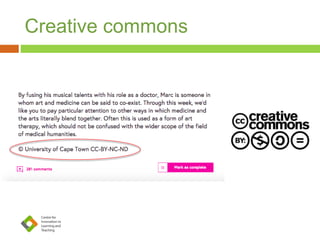
Creative commons
UCT MOOC strategy aims to:
 Positioning UCT as a world-class university
 Promoting African scholarship and local content
 To share learning and research beyond the
university
 Show innovation in online teaching
 Apply lessons learned to degree courses
Dr. Cheryl Brown – Senior lecturer and CCD team lead
 UCT to offer MOOCs – full version (Dr. Brown
speaks at 02:24)
https://www.youtube.com/watch?v=rGL9nmXZf8
s
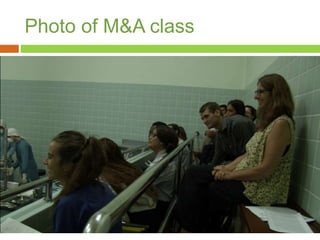
Photo of M&A class
What is a Mind? Trailer
 Link to trailer video for Mark Solms’ Course:
What is a Mind?
https://www.futurelearn.com/courses/what-is-a-
mind
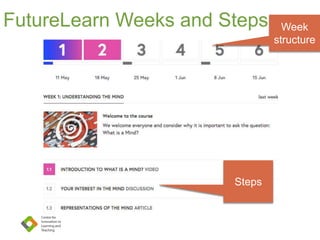
FutureLearn Weeks and Steps Week
structure
Steps
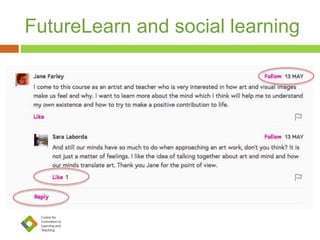
FutureLearn and social learning
Some key challenges:
 Low rates of uncapped broadband internet
access in South Africa and many other African
countries
 Resource Constraints
 Financial sustainability
Some key challenges:
 Low rates of uncapped broadband internet
access in South Africa and many other African
countries
 Resource Constraints
 Financial sustainability
Some key challenges:
 Low rates of uncapped broadband internet
access in South Africa and many other African
countries
 Resource Constraints
 Financial sustainability
2014 – The year of the corporate MOOC
Corporate
MOOCs
Are you reading this carefully?
If you are, I may as well
entertain you with a joke.
Jokes? Wait, I don’t know very
many jokes. Hipster Ipsum will
have to do.
Gluten-free hashtag squid
lomo, 90's retro flannel
taxidermy. Asymmetrical
quinoa four dollar toast,
biodiesel bicycle rights plaid
Williamsburg. Jean shorts
Godard retro ugh. Intelligentsia
XOXO Marfa mixtape pickled
banjo Brooklyn, narwhal put a
bird on it leggings Neutra
biodiesel keffiyeh crucifix.
Brooklyn readymade
meditation swag. Brooklyn
Pitchfork Portland photo booth,
VHS XOXO Echo Park
readymade post-ironic you
probably haven't heard of them.
Lomo Carles Godard PBR
XOXO.
Gluten-free hashtag squid
lomo, 90's retro flannel.
Yesterday’s News
DON’T BELIEVE EVERYTHING YOU READ - Since 1802
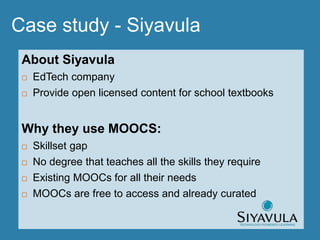
About Siyavula
 EdTech company
 Provide open licensed content for school textbooks
Why they use MOOCS:
 Skillset gap
 No degree that teaches all the skills they require
 Existing MOOCs for all their needs
 MOOCs are free to access and already curated
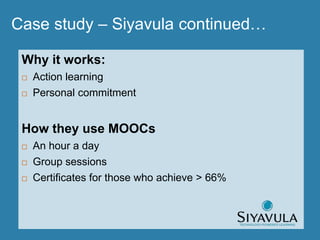
Case study - Siyavula
Why it works:
 Action learning
 Personal commitment
How they use MOOCs
 An hour a day
 Group sessions
 Certificates for those who achieve > 66%
Case study – Siyavula continued…
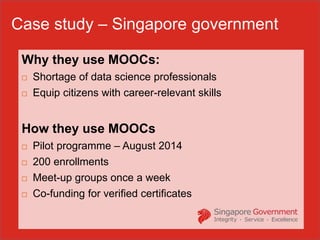
Why they use MOOCs:
 Shortage of data science professionals
 Equip citizens with career-relevant skills
How they use MOOCs
 Pilot programme – August 2014
 200 enrollments
 Meet-up groups once a week
 Co-funding for verified certificates
Case study – Singapore government
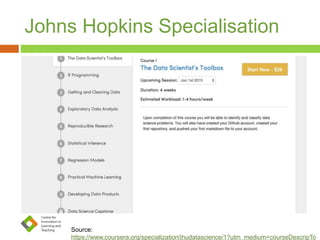
Johns Hopkins Specialisation
Source:
https://www.coursera.org/specialization/jhudatascience/1?utm_medium=courseDescripTo
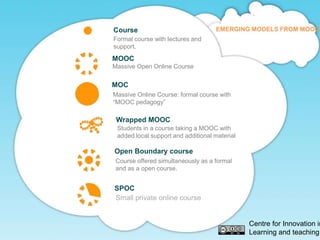
EMERGING MODELS FROM MOOCS
Open Boundary course
Course offered simultaneously as a formal
and as a open course.
SPOC
Small private online course
MOC
Massive Online Course: formal course with
“MOOC pedagogy”
Wrapped MOOC
Students in a course taking a MOOC with
added local support and additional material
MOOC
Massive Open Online Course
Course
Formal course with lectures and
support.
Centre for Innovation in
Learning and teaching
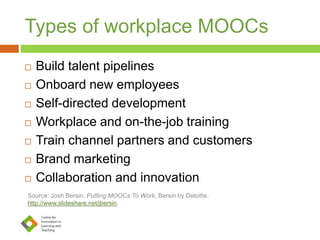
Types of workplace MOOCs
 Build talent pipelines
 Onboard new employees
 Self-directed development
 Workplace and on-the-job training
 Train channel partners and customers
 Brand marketing
 Collaboration and innovation
Source: Josh Bersin, Putting MOOCs To Work, Bersin by Deloitte.
http://www.slideshare.net/jbersin.
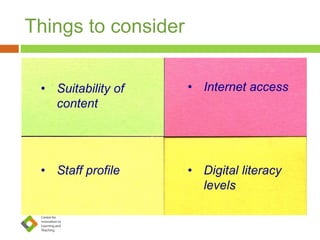
Things to consider
• Digital literacy
levels
• Internet access• Suitability of
content
• Staff profile
Test the waters
Ayacop
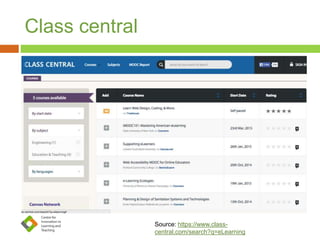
Class central
Source: https://www.class-
central.com/search?q=eLearning
Pastern
Acknowledgements
 Andrew Deacon
 Janet Small
 Sukaina Walji
CILT
This work is licensed under the Creative Commons Share Alike 2.5 South
Africa License. To view a copy of this license, visit http://creative
commons.org/licenses/by-sa/2.5/za/ or send a letter to Creative Commons,
171 Second Street, Suite 300, San Francisco, Califirnia, 94105, USA
www.cilt.uct.ac.za mary-ann.fife@uct.ac.za

2015 05 20 e learning presentation for sharing

  • 1.
    MOOCS AND YOURORGANISATION ONLINE & ELEARNING CONFERENCE 2015 MARY-ANN FIFE MAY 2015
  • 2.
    Overview  The MOOCPhenomenon  MOOCs at UCT  MOOCs and your organisation
  • 3.
    Let’s unpack M OO C MASSIVE OPEN ONLINE COURSE • Many thousand participants / learners • Open enrollment and free access to course content • All course material online • Courses structured clear learning pathway/ set number of modules
  • 4.
    Let’s unpack M OO C MASSIVE OPEN ONLINE COURSE • Many thousand participants / learners • Open enrollment and free access to course content • All course material online • Courses structured clear learning pathway/ set number of modules
  • 5.
    Let’s unpack M OO C MASSIVE OPEN ONLINE COURSE • Many thousand participants / learners • Open enrollment and free access to course content • All course material online • Courses structured clear learning pathway/ set number of modules
  • 6.
  • 7.
    Let’s unpack M OO C MASSIVE OPEN ONLINE COURSE • Many thousand participants / learners • Open enrollment and free access to course content • All course material online • Courses structured clear learning pathway/ set number of modules
  • 8.
  • 9.
  • 11.
    MOOCs – aform of online learning Downloadable educational digital content (ITunes U, YouTube, digital textbooks) Informal teaching and courses (MOOCs, open courses, self-study courses, Lynda.com) Fully structured online courses with assessments and qualifications
  • 12.
    Online course DIFFERENCEMOOC Fees Cost to user No fees Maybe certificates &/or support Yes, as per all formal courses Entrance requirements None Limited. Capped by resources available for support & assessment Scale Thousands Savings due to limited lecturer support Responsible for curriculum alignment, QA, support Lecturer role Limited individual support Largely proprietary, some open Copyright Content may be proprietary or open, user generated content often © MOOC provider Distance education providers Providers Traditional residential research universities partnered with private companies No, not usually Analytics Yes, one of the promises Conventional Certification Non conventional Aligned with the usual formal courses QA processes Quality assurance As per non formal offerings
  • 13.
    MOOCs & onlineeducation  MOOCs have put online education on the map  They have legitimised distance education for traditional universities (and traditional students)  They have put the quality of teaching in universities under scrutiny  Valuable insights into how students learn online
  • 14.
  • 15.
    Medicine and theArts THIR TY TIME S the F2F course
  • 16.
    UCT MOOCs ata glance PAST CURRENT UPCOMING • Medicine & the Arts • What is a Mind? • Clinical research • Mitigating climate change • Statistics • Social Innovation • Inclusive education
  • 17.
    Prof Sandra Klopper– DVC Teaching and Learning  UCT to offer MOOCs – full version (Prof. Klopper speaks at 00:49) https://www.youtube.com/watch?v=rGL9nmXZf8 s
  • 18.
    UCT MOOC strategyaims to:  Positioning UCT as a world-class university  Show commitment to serving broader interests of people regionally across Africa  To share learning and research beyond the university  Show innovation in online teaching  Apply lessons learned to degree courses
  • 19.
  • 20.
    UCT MOOC strategyaims to:  Positioning UCT as a world-class university  Promoting African scholarship and local content  To share learning and research beyond the university  Show innovation in online teaching  Apply lessons learned to degree courses
  • 21.
  • 22.
    UCT MOOC strategyaims to:  Positioning UCT as a world-class university  Promoting African scholarship and local content  To share learning and research beyond the university  Show innovation in online teaching  Apply lessons learned to degree courses
  • 23.
  • 24.
    UCT MOOC strategyaims to:  Positioning UCT as a world-class university  Promoting African scholarship and local content  To share learning and research beyond the university  Show innovation in online teaching  Apply lessons learned to degree courses
  • 25.
    Dr. Cheryl Brown– Senior lecturer and CCD team lead  UCT to offer MOOCs – full version (Dr. Brown speaks at 02:24) https://www.youtube.com/watch?v=rGL9nmXZf8 s
  • 26.
  • 27.
    What is aMind? Trailer  Link to trailer video for Mark Solms’ Course: What is a Mind? https://www.futurelearn.com/courses/what-is-a- mind
  • 28.
    FutureLearn Weeks andSteps Week structure Steps
  • 29.
  • 30.
    Some key challenges: Low rates of uncapped broadband internet access in South Africa and many other African countries  Resource Constraints  Financial sustainability
  • 31.
    Some key challenges: Low rates of uncapped broadband internet access in South Africa and many other African countries  Resource Constraints  Financial sustainability
  • 32.
    Some key challenges: Low rates of uncapped broadband internet access in South Africa and many other African countries  Resource Constraints  Financial sustainability
  • 33.
    2014 – Theyear of the corporate MOOC Corporate MOOCs Are you reading this carefully? If you are, I may as well entertain you with a joke. Jokes? Wait, I don’t know very many jokes. Hipster Ipsum will have to do. Gluten-free hashtag squid lomo, 90's retro flannel taxidermy. Asymmetrical quinoa four dollar toast, biodiesel bicycle rights plaid Williamsburg. Jean shorts Godard retro ugh. Intelligentsia XOXO Marfa mixtape pickled banjo Brooklyn, narwhal put a bird on it leggings Neutra biodiesel keffiyeh crucifix. Brooklyn readymade meditation swag. Brooklyn Pitchfork Portland photo booth, VHS XOXO Echo Park readymade post-ironic you probably haven't heard of them. Lomo Carles Godard PBR XOXO. Gluten-free hashtag squid lomo, 90's retro flannel. Yesterday’s News DON’T BELIEVE EVERYTHING YOU READ - Since 1802
  • 34.
    About Siyavula  EdTechcompany  Provide open licensed content for school textbooks Why they use MOOCS:  Skillset gap  No degree that teaches all the skills they require  Existing MOOCs for all their needs  MOOCs are free to access and already curated Case study - Siyavula
  • 35.
    Why it works: Action learning  Personal commitment How they use MOOCs  An hour a day  Group sessions  Certificates for those who achieve > 66% Case study – Siyavula continued…
  • 36.
    Why they useMOOCs:  Shortage of data science professionals  Equip citizens with career-relevant skills How they use MOOCs  Pilot programme – August 2014  200 enrollments  Meet-up groups once a week  Co-funding for verified certificates Case study – Singapore government
  • 37.
  • 38.
    EMERGING MODELS FROMMOOCS Open Boundary course Course offered simultaneously as a formal and as a open course. SPOC Small private online course MOC Massive Online Course: formal course with “MOOC pedagogy” Wrapped MOOC Students in a course taking a MOOC with added local support and additional material MOOC Massive Open Online Course Course Formal course with lectures and support. Centre for Innovation in Learning and teaching
  • 39.
    Types of workplaceMOOCs  Build talent pipelines  Onboard new employees  Self-directed development  Workplace and on-the-job training  Train channel partners and customers  Brand marketing  Collaboration and innovation Source: Josh Bersin, Putting MOOCs To Work, Bersin by Deloitte. http://www.slideshare.net/jbersin.
  • 40.
    Things to consider •Digital literacy levels • Internet access• Suitability of content • Staff profile
  • 41.
  • 42.
  • 43.
  • 44.
    Acknowledgements  Andrew Deacon Janet Small  Sukaina Walji CILT This work is licensed under the Creative Commons Share Alike 2.5 South Africa License. To view a copy of this license, visit http://creative commons.org/licenses/by-sa/2.5/za/ or send a letter to Creative Commons, 171 Second Street, Suite 300, San Francisco, Califirnia, 94105, USA www.cilt.uct.ac.za mary-ann.fife@uct.ac.za