






Connectivity 
everywhere
50 billion 
connected 
devices 
by 2020 
Source: Cisco, The Internet of Things
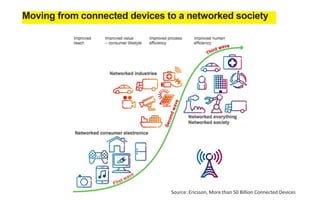
Moving from connected devices to a networked society 
Source: Ericsson, More than 50 Billion Connected Devices
The pay off 
Improved access to information and 
services 
Reduced cost and improved efficiency 
= 
Increased choice and improved lifestyle for 
individuals 
Increased opportunities for business
Four areas of 
impact
1. Connected You
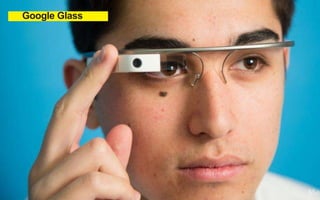
Google Glass
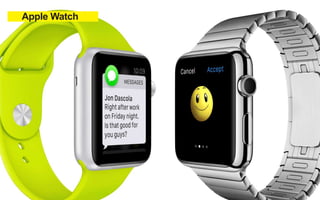
Apple Watch
2. Connected Home
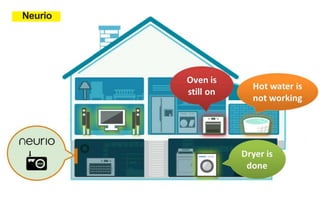
Neurio
Alfred
3. Connected Travel
WeCycle
Google Driverless Car
4. Connected Health
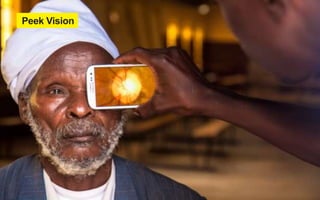
Peek Vision
Enable Talk
3 challenges 
to tackle
Loss of privacy
Loss of control
Social etiquette
Opportunities 
for content
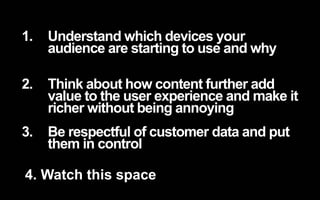
1. Understand which devices your 
audience are starting to use and why 
2. Think about how content further add 
value to the user experience and make it 
richer without being annoying 
3. Be respectful of customer data and put 
them in control 
4. Watch this space
Thank you. 
Like what you see? 
Tweet us @SevenEC1or email 
Robin.Bonn@seven.co.uk

The Future of Connectivity – Connectivity Everywhere

Editor's Notes

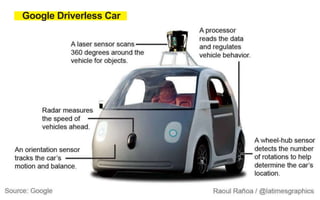
  • #16 Of course if we are talking about pushing the boundaries, as usual, we need to talk about Google and their driverless car which is already gathering fame.
  • #17  From May this year, they announced this new prototype, which they built from scratch, which has no steering wheel or brake or accelerator pedals, but an override system. Google’s aim – beyond getting into new markets and making huge amounts of money - is to improve road safety by overcoming the most dangerous part of driving – drivers - as human error is responsible for over 90% of accidents. In the states, more people under 35 die from deaths on the road than cancer. Using sensors around the car to see 360 degrees around – no more blind spots and seeing 2 football fields away, the data delivered along with 3D mapping, tells the car how to deal with different obstacles and situations- be it cyclists or road blocks. It also uses mapping technology to get you to your destination.
  • #18 Health is an exciting area of development for internet of things and is expected to have a lot of positive outcomes, not just in monitoring health but eventually in helping diagnose and treat it.
  • #19  Peek vision is one such device which attaches to the back of a smartphone and helps tackle blindness in remote parts of the world. 40m people worldwide are blind – usually in the world’s poorest countries - and 80% is avoidable. This portable eye examination kit gives comprehensive eye examinations that are able to look into the eye itself and then diagnose conditions like cataracts that can cause blindness and are treatable. All at the fraction of the price of the expensive equipment eye clinics would use and can be used by local health workers .
  • #20 Another example of a piece of connected technology which is really enabling is Enable Talk. This project, which won 1st prize in the Microsoft Imagine competitions by some Ukrainian students, who had observed the difficulties that deaf people in their class had with communication. The gloves have sensors in them that recognise movement and the positions of the hands and can translate those signs to speech, enabling them to communicate and connect to those around.
  • #21 So it all sounds very poisitve and exciting but there are 3 challenges or barriers to tackle with this move to become a more connected society
  • #22 There is a worry with the huge amount of data that will be gathered, who will control it and how do we know it won’t be used for bad purposes. At the worst extreme you come out at George Orwell’s 1984. There is already a lot of paranoia about the extent to which companies like Facebook and Google know a lot about it. The law isn’t keeping up with the fast developments in technology. And it’s not just governments and corporations we need to worry about, there is concern too that we may be more open to hacking with all the additional data being created.
  • #23  Linked to this is loss of control. By machines becoming smarter, will we stop being able to make decisions? “Positive things may be tempered by a growing reliance on outsourcing to technologies that make decisions not based on human concerns but instead on algorithms (however influenced by our past choices). We may begin to lose sight of our own desires or our own wills… What will happen to our own sense of intuition, let alone our capacity to venture into the unknown, learn new things, and our ability to be still and quiet without being in constant relationship to one device or other.” Aaron Black, author of the Psychodynamics of social networking
  • #24 And on a lighter note, there’s social etiquiette. You may have heard the term Google Glasshole which the Urban Dictionary defines as a person who constantly talks to their Google Glass, ignoring the outside world. Google is so keen to ensure that there arent’ societal barriers to their technology adoption that they have published a manual for those wearing Glass with the first instruction - Don’t Be creepy or rude (aka, a “Glasshole”). Currently some restaurants in the states are banning Glass wearers for freaking out other dinners. Doc Searls, from the Harvard Berkman Center for Internet and Society expects it will take 5 years for manners friendly systems and the protocols that go with them to be be developed
  • #25 So what does all this mean for content? At the moment it’s early days. But what we can be sure of is more devices = more opportunities to connect and engage with our audiences. This will be the future so it is important that we start getting in on this early and understanding the user and user experience.
  • #26 For a more connected society, content needs to ensure it is even more razor focused on understanding and delivering on user needs in the different occasions Understand the needs and occasions those devices are delivering against This is important as these devices will be used to make life simpler and more efficient – content if it is wrongly judged, could do the opposite. As usual, this comes down to user insight. Don’t be creepy at the expense of being clever. It’s about trying things and testing and watching the market