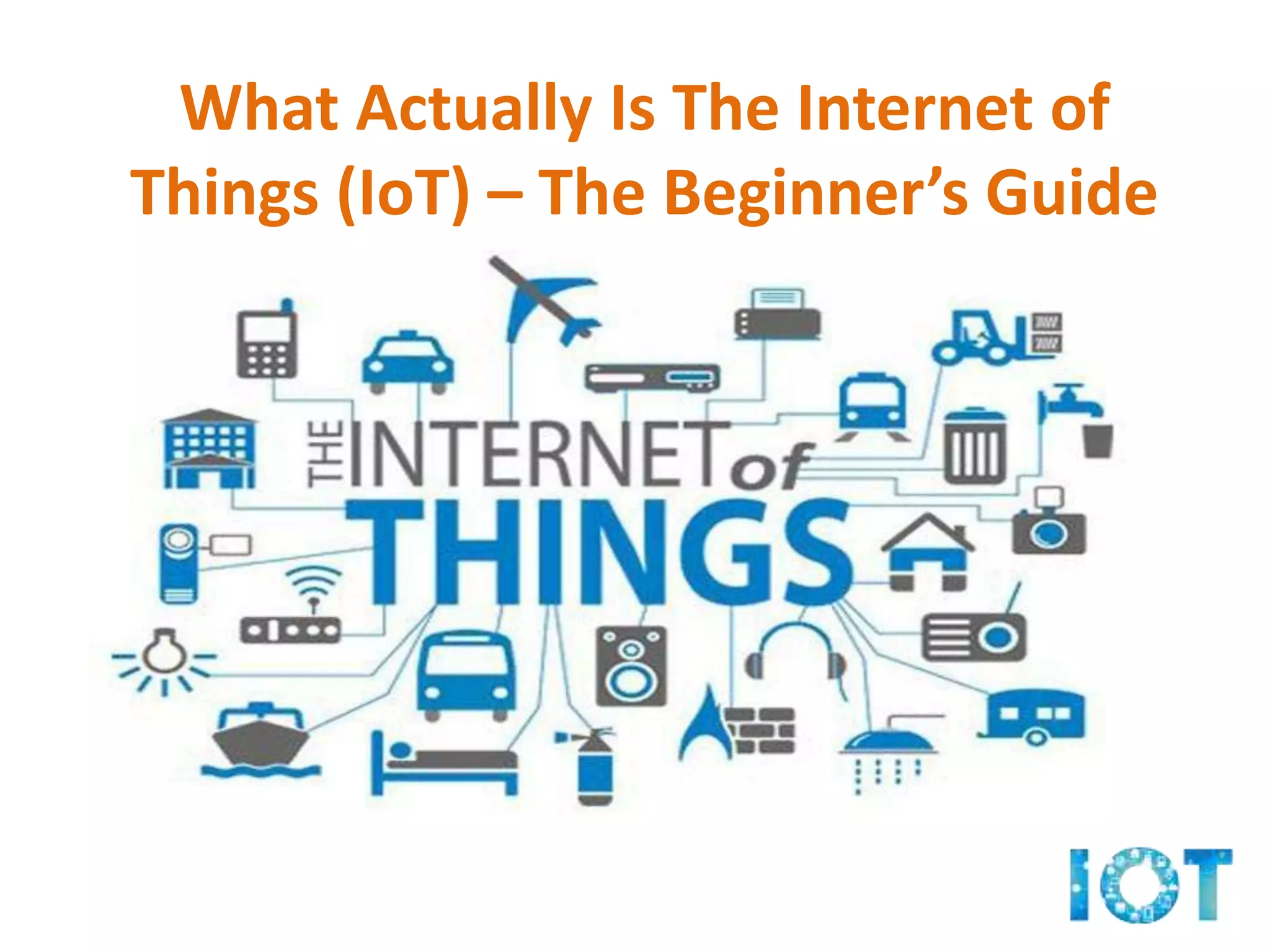
What Actually Is The Internet of
Things (IoT) – The Beginner’s Guide
Introduction
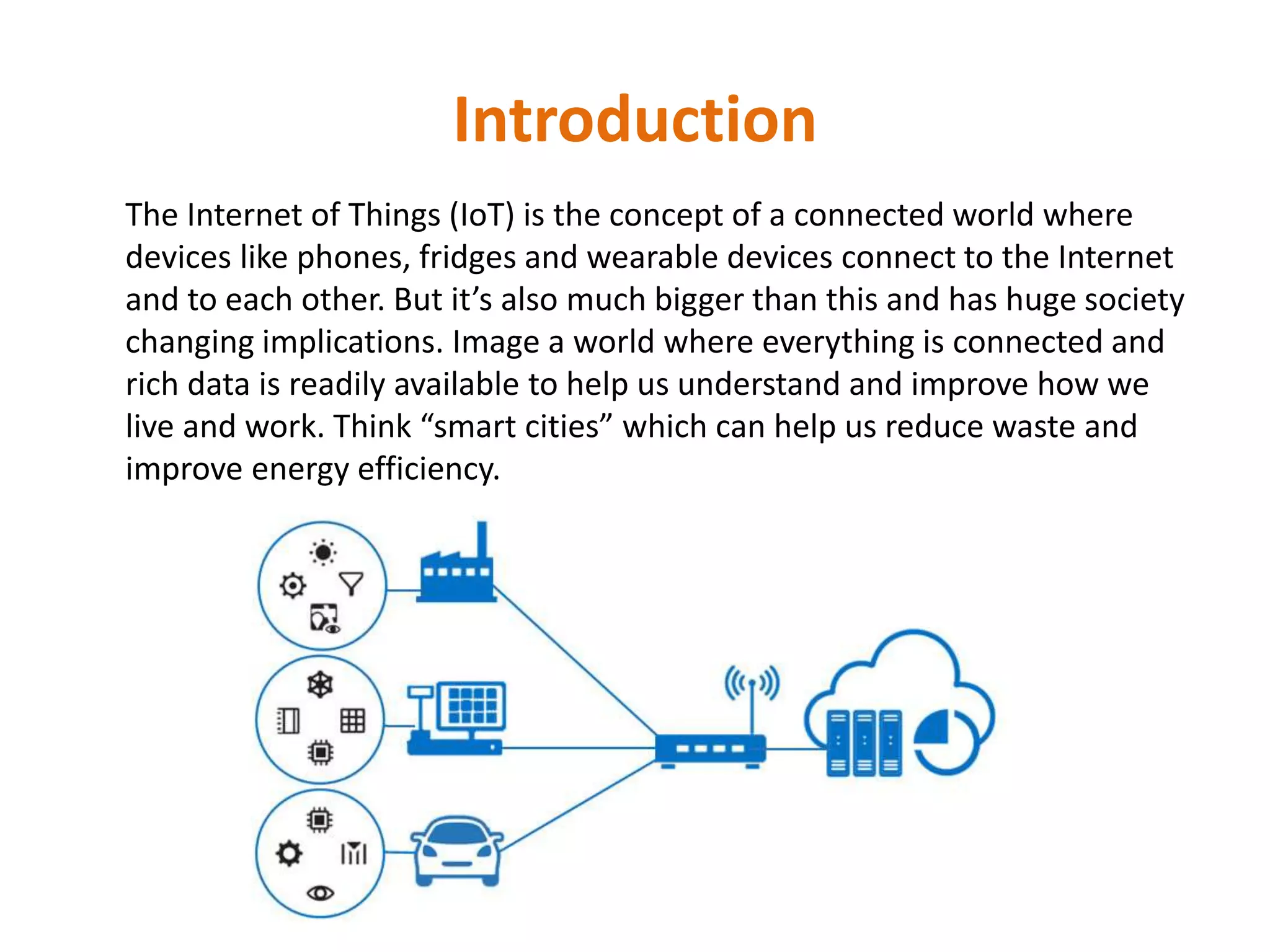
The Internet of Things (IoT) is the concept of a connected world where
devices like phones, fridges and wearable devices connect to the Internet
and to each other. But it’s also much bigger than this and has huge society
changing implications. Image a world where everything is connected and
rich data is readily available to help us understand and improve how we
live and work. Think “smart cities” which can help us reduce waste and
improve energy efficiency.
What’s the premise behind the IoT?
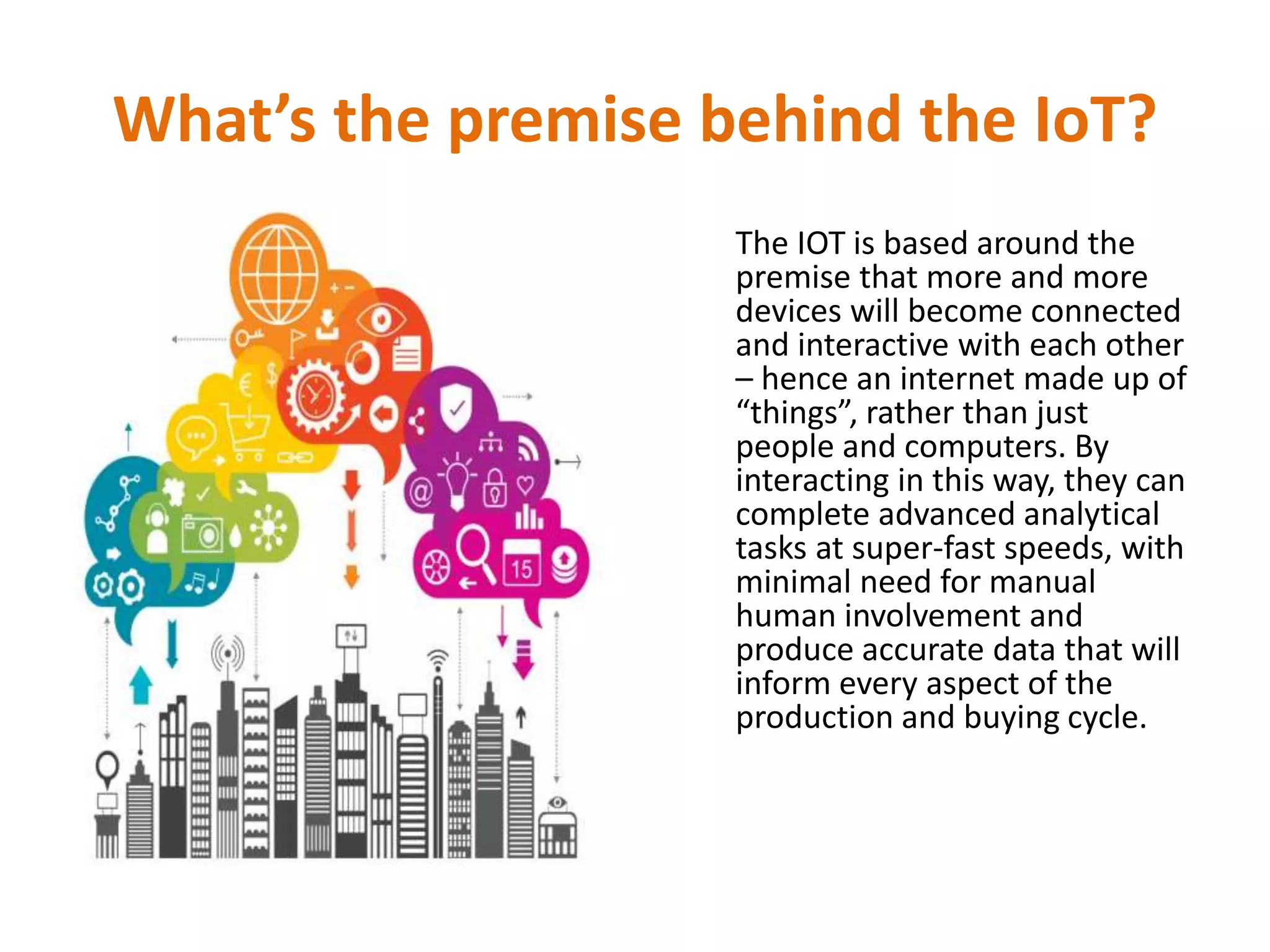
The IOT is based around the
premise that more and more
devices will become connected
and interactive with each other
– hence an internet made up of
“things”, rather than just
people and computers. By
interacting in this way, they can
complete advanced analytical
tasks at super-fast speeds, with
minimal need for manual
human involvement and
produce accurate data that will
inform every aspect of the
production and buying cycle.
Current state of the Internet of
Things?
• The Internet of Things is already affecting human lives. It has multitudes of
uses which are being exploited by both security experts as well as the
black hats.
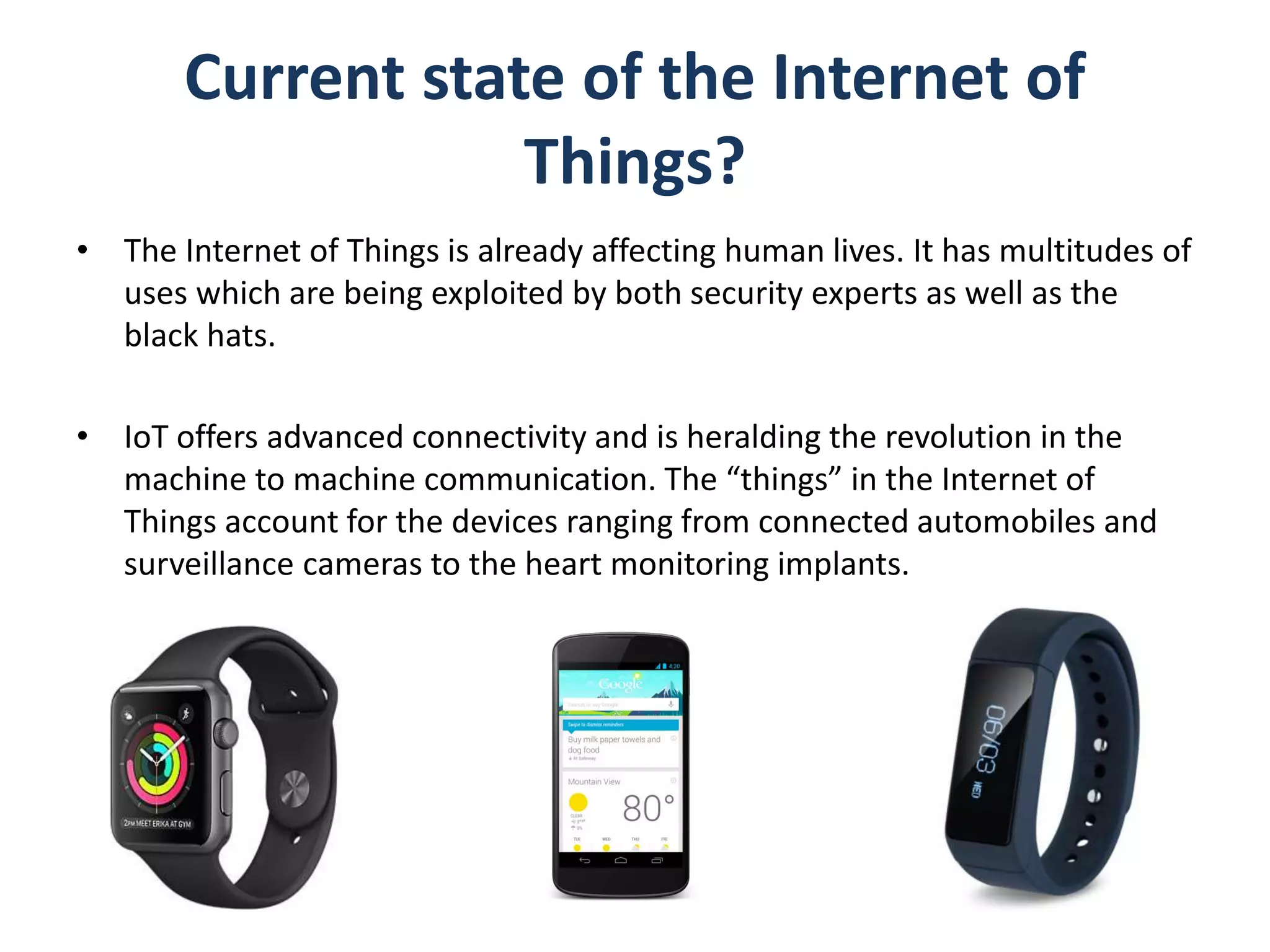
• IoT offers advanced connectivity and is heralding the revolution in the
machine to machine communication. The “things” in the Internet of
Things account for the devices ranging from connected automobiles and
surveillance cameras to the heart monitoring implants.
Examples of the Internet of Things
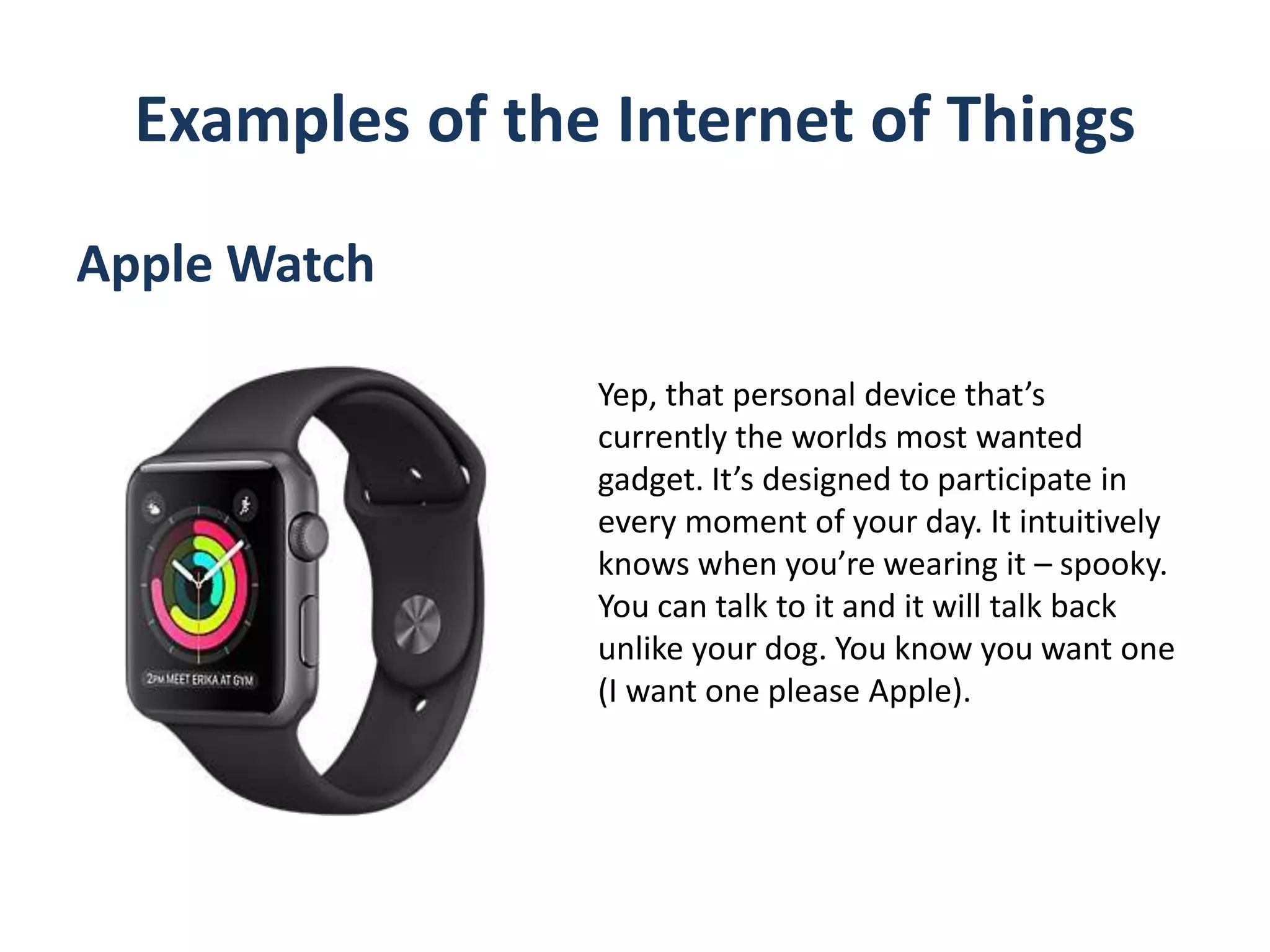
Apple Watch
Yep, that personal device that’s
currently the worlds most wanted
gadget. It’s designed to participate in
every moment of your day. It intuitively
knows when you’re wearing it – spooky.
You can talk to it and it will talk back
unlike your dog. You know you want one
(I want one please Apple).
Examples of the Internet of Things
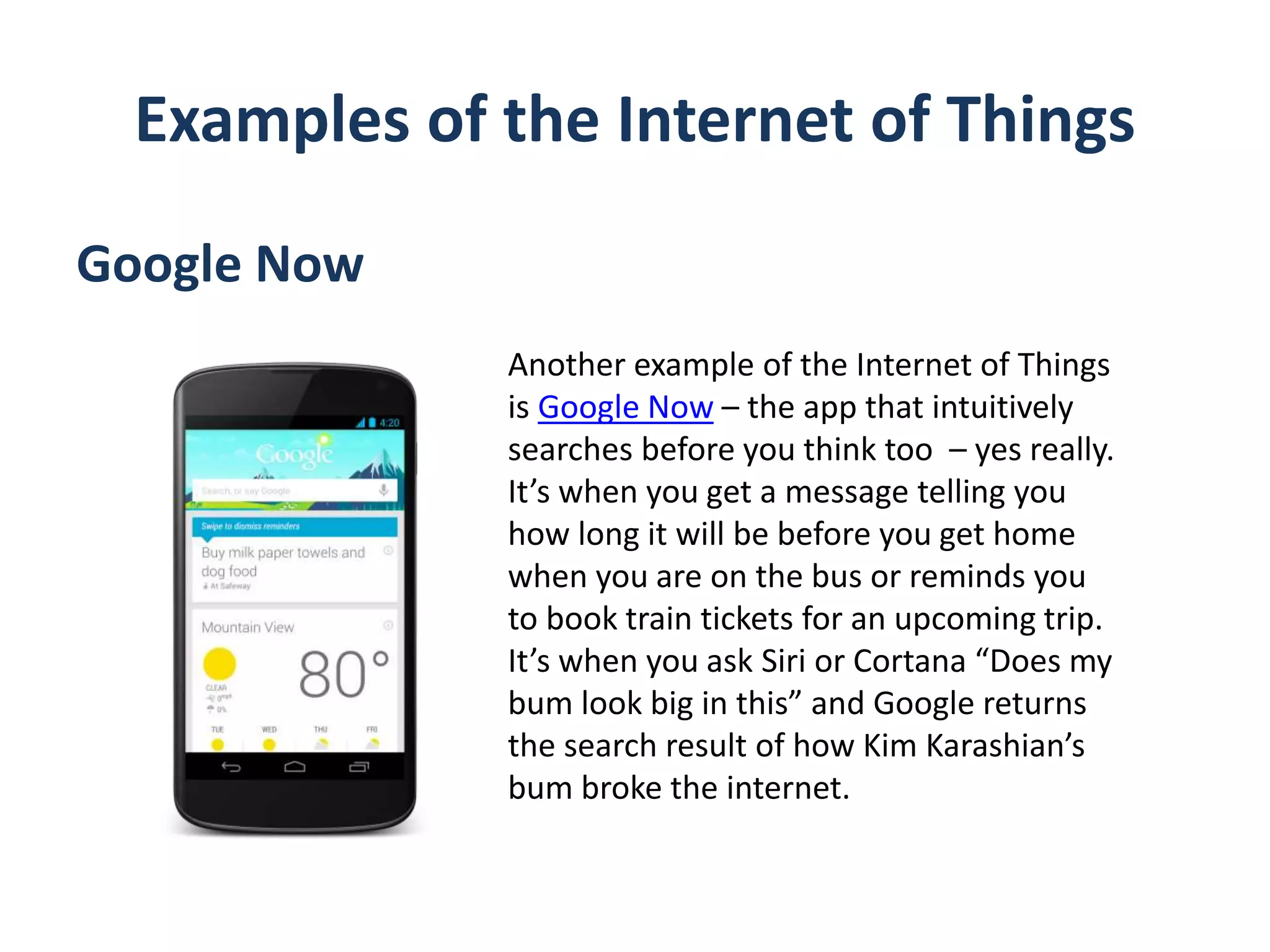
Google Now
Another example of the Internet of Things
is Google Now – the app that intuitively
searches before you think too – yes really.
It’s when you get a message telling you
how long it will be before you get home
when you are on the bus or reminds you
to book train tickets for an upcoming trip.
It’s when you ask Siri or Cortana “Does my
bum look big in this” and Google returns
the search result of how Kim Karashian’s
bum broke the internet.
Examples of the Internet of Things
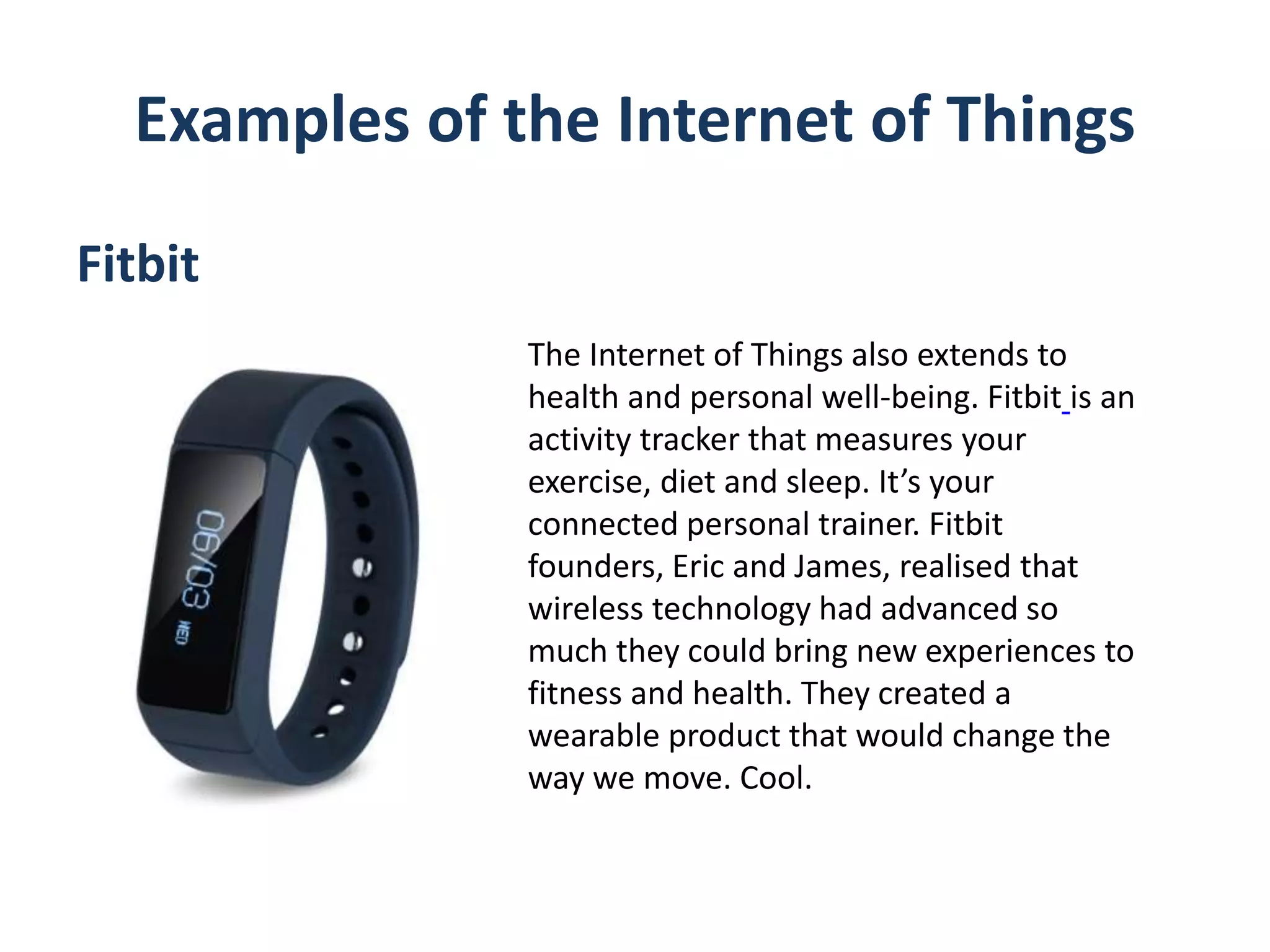
Fitbit
The Internet of Things also extends to
health and personal well-being. Fitbit is an
activity tracker that measures your
exercise, diet and sleep. It’s your
connected personal trainer. Fitbit
founders, Eric and James, realised that
wireless technology had advanced so
much they could bring new experiences to
fitness and health. They created a
wearable product that would change the
way we move. Cool.
IoT Predictions, Trends, and Market
• BI Intelligence, Business Insider's premium research service, expects there
will be more than 24 billion IoT devices on Earth by 2020. That's
approximately four devices for every human being on the planet.
• And as we approach that point, $6 billion will flow into IoT solutions,
including application development, device hardware, system integration,
data storage, security, and connectivity. But that will be money well spent,
as those investments will generate $13 trillion by 2025.
• Who will reap these benefits? There are three major entities that will use
IoT ecosystems: consumers, governments, and businesses. For more
detail, see the Industries section below.
Future of the Internet of Things?
In near future, majority of our electronic devices will be connected to the
Internet via unique IP address (IPv6, since IPv4 will soon be filled up) and
thus could be controlled by the owner from any place at any time.
Developing countries such as India envisaging the flagship projects of
Smart Cities will pin their hopes to smart infrastructure combined with the
huge influx of IoT technology. As for individuals, wearable connected
devices and smart homes would be a key to a smart and sustainable
future.
The IoTs will also help the governments and big enterprises in monitoring,
collecting, analyzing and then providing solutions for any situation in a
short time.
“Big Data” IoT analytics will generate
“Big Revenue”
“As IoT gains momentum, the volume of data generated will be
stratospheric. Not only will there be more data, but there will be different
types of data, and data from sources that have yet to be considered. Big
Data analytics will evolve into a distributed analytics model, which will
help with the monetization of IoT data. We will see more devices capable
of analyzing1 data locally, processing and capturing the most important
data for more real-time IoT services.”
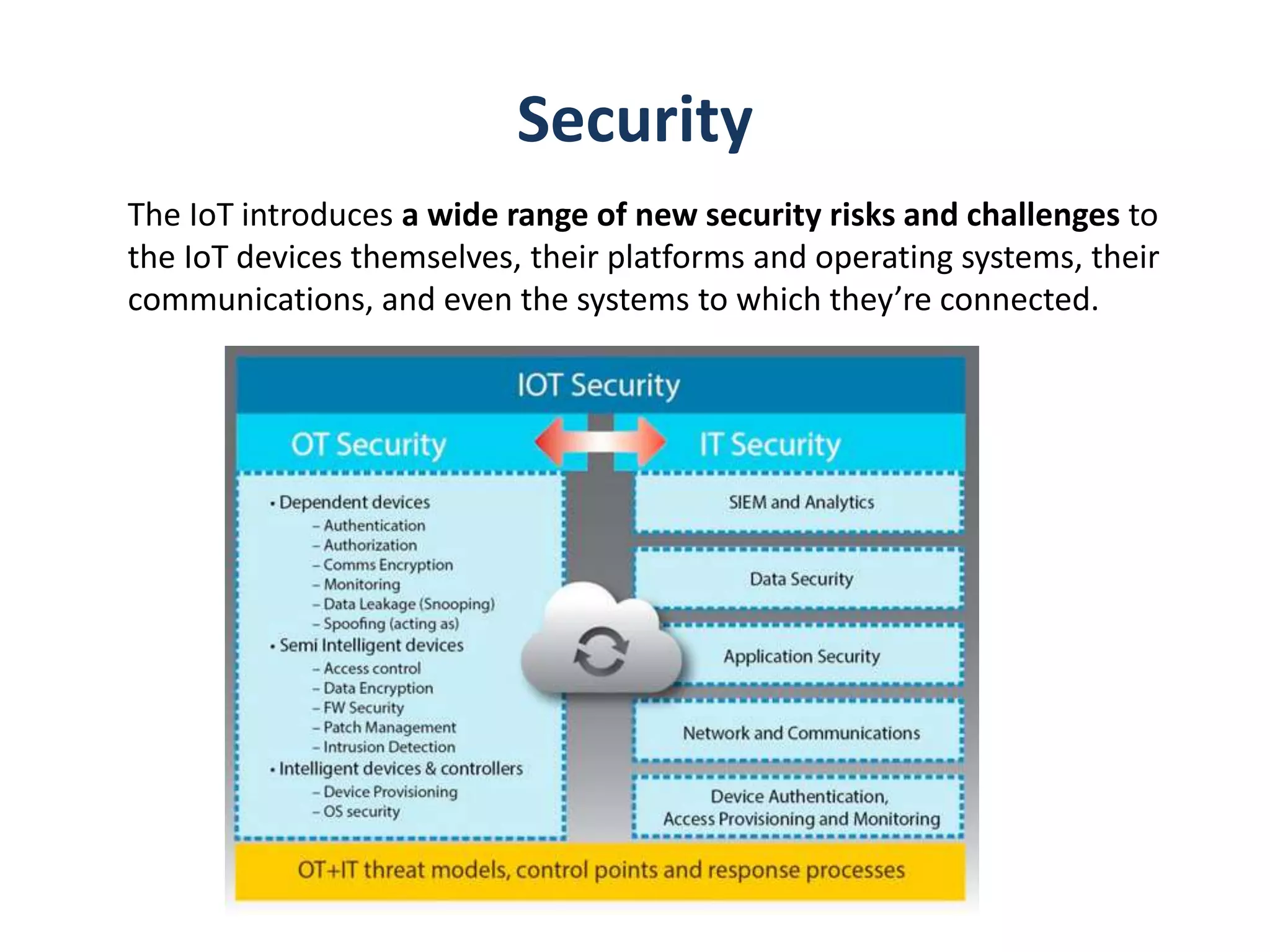
Security
The IoT introduces a wide range of new security risks and challenges to
the IoT devices themselves, their platforms and operating systems, their
communications, and even the systems to which they’re connected.
IoT gets accountable
• “The focus will be on the operationalization of IoT – how to
monitor, manage and secure the IoT infrastructure.2
• Pilots and concepts have to be operationalized. By the end of the
year, vendors will be under pressure to show profitable revenue
streams. It is time to move from talk to action.
• Mainstream IT will be forced to get involved with IoT programs to
provide assurance and scalability. CIOs will have to either learn
about operational technology (manufacturing execution systems,
SCADA, building management systems, Robotics, etc.) or hire
leaders with hands-on domain knowledge.3
• Boards, and especially audit committees, will ask about safety and
security as it relates to IoT.
• New business models based on Things-as-a-Service will evolve.”
Contact Us
ADDRESS
Jigsaw Academy
No. 308, First Floor, 100ft Main Road,
Indiranagar, 1st Stage, Bangalore-560038
Landmark: Above Domino’s Pizza
Phone No: +91 90193-17000
URL: https://www.jigsawacademy.com/iot/iot-courses

The Internet of Things (IoT for Beginners Guide)

  • 1.
    What Actually IsThe Internet of Things (IoT) – The Beginner’s Guide
  • 2.
    Introduction The Internet ofThings (IoT) is the concept of a connected world where devices like phones, fridges and wearable devices connect to the Internet and to each other. But it’s also much bigger than this and has huge society changing implications. Image a world where everything is connected and rich data is readily available to help us understand and improve how we live and work. Think “smart cities” which can help us reduce waste and improve energy efficiency.
  • 3.
    What’s the premisebehind the IoT? The IOT is based around the premise that more and more devices will become connected and interactive with each other – hence an internet made up of “things”, rather than just people and computers. By interacting in this way, they can complete advanced analytical tasks at super-fast speeds, with minimal need for manual human involvement and produce accurate data that will inform every aspect of the production and buying cycle.
  • 4.
    Current state ofthe Internet of Things? • The Internet of Things is already affecting human lives. It has multitudes of uses which are being exploited by both security experts as well as the black hats. • IoT offers advanced connectivity and is heralding the revolution in the machine to machine communication. The “things” in the Internet of Things account for the devices ranging from connected automobiles and surveillance cameras to the heart monitoring implants.
  • 5.
    Examples of theInternet of Things Apple Watch Yep, that personal device that’s currently the worlds most wanted gadget. It’s designed to participate in every moment of your day. It intuitively knows when you’re wearing it – spooky. You can talk to it and it will talk back unlike your dog. You know you want one (I want one please Apple).
  • 6.
    Examples of theInternet of Things Google Now Another example of the Internet of Things is Google Now – the app that intuitively searches before you think too – yes really. It’s when you get a message telling you how long it will be before you get home when you are on the bus or reminds you to book train tickets for an upcoming trip. It’s when you ask Siri or Cortana “Does my bum look big in this” and Google returns the search result of how Kim Karashian’s bum broke the internet.
  • 7.
    Examples of theInternet of Things Fitbit The Internet of Things also extends to health and personal well-being. Fitbit is an activity tracker that measures your exercise, diet and sleep. It’s your connected personal trainer. Fitbit founders, Eric and James, realised that wireless technology had advanced so much they could bring new experiences to fitness and health. They created a wearable product that would change the way we move. Cool.
  • 8.
    IoT Predictions, Trends,and Market • BI Intelligence, Business Insider's premium research service, expects there will be more than 24 billion IoT devices on Earth by 2020. That's approximately four devices for every human being on the planet. • And as we approach that point, $6 billion will flow into IoT solutions, including application development, device hardware, system integration, data storage, security, and connectivity. But that will be money well spent, as those investments will generate $13 trillion by 2025. • Who will reap these benefits? There are three major entities that will use IoT ecosystems: consumers, governments, and businesses. For more detail, see the Industries section below.
  • 9.
    Future of theInternet of Things? In near future, majority of our electronic devices will be connected to the Internet via unique IP address (IPv6, since IPv4 will soon be filled up) and thus could be controlled by the owner from any place at any time. Developing countries such as India envisaging the flagship projects of Smart Cities will pin their hopes to smart infrastructure combined with the huge influx of IoT technology. As for individuals, wearable connected devices and smart homes would be a key to a smart and sustainable future. The IoTs will also help the governments and big enterprises in monitoring, collecting, analyzing and then providing solutions for any situation in a short time.
  • 10.
    “Big Data” IoTanalytics will generate “Big Revenue” “As IoT gains momentum, the volume of data generated will be stratospheric. Not only will there be more data, but there will be different types of data, and data from sources that have yet to be considered. Big Data analytics will evolve into a distributed analytics model, which will help with the monetization of IoT data. We will see more devices capable of analyzing1 data locally, processing and capturing the most important data for more real-time IoT services.”
  • 11.
    Security The IoT introducesa wide range of new security risks and challenges to the IoT devices themselves, their platforms and operating systems, their communications, and even the systems to which they’re connected.
  • 12.
    IoT gets accountable •“The focus will be on the operationalization of IoT – how to monitor, manage and secure the IoT infrastructure.2 • Pilots and concepts have to be operationalized. By the end of the year, vendors will be under pressure to show profitable revenue streams. It is time to move from talk to action. • Mainstream IT will be forced to get involved with IoT programs to provide assurance and scalability. CIOs will have to either learn about operational technology (manufacturing execution systems, SCADA, building management systems, Robotics, etc.) or hire leaders with hands-on domain knowledge.3 • Boards, and especially audit committees, will ask about safety and security as it relates to IoT. • New business models based on Things-as-a-Service will evolve.”
  • 13.
    Contact Us ADDRESS Jigsaw Academy No.308, First Floor, 100ft Main Road, Indiranagar, 1st Stage, Bangalore-560038 Landmark: Above Domino’s Pizza Phone No: +91 90193-17000 URL: https://www.jigsawacademy.com/iot/iot-courses