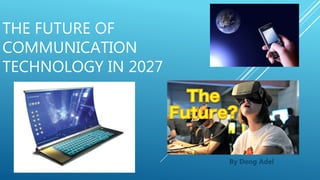
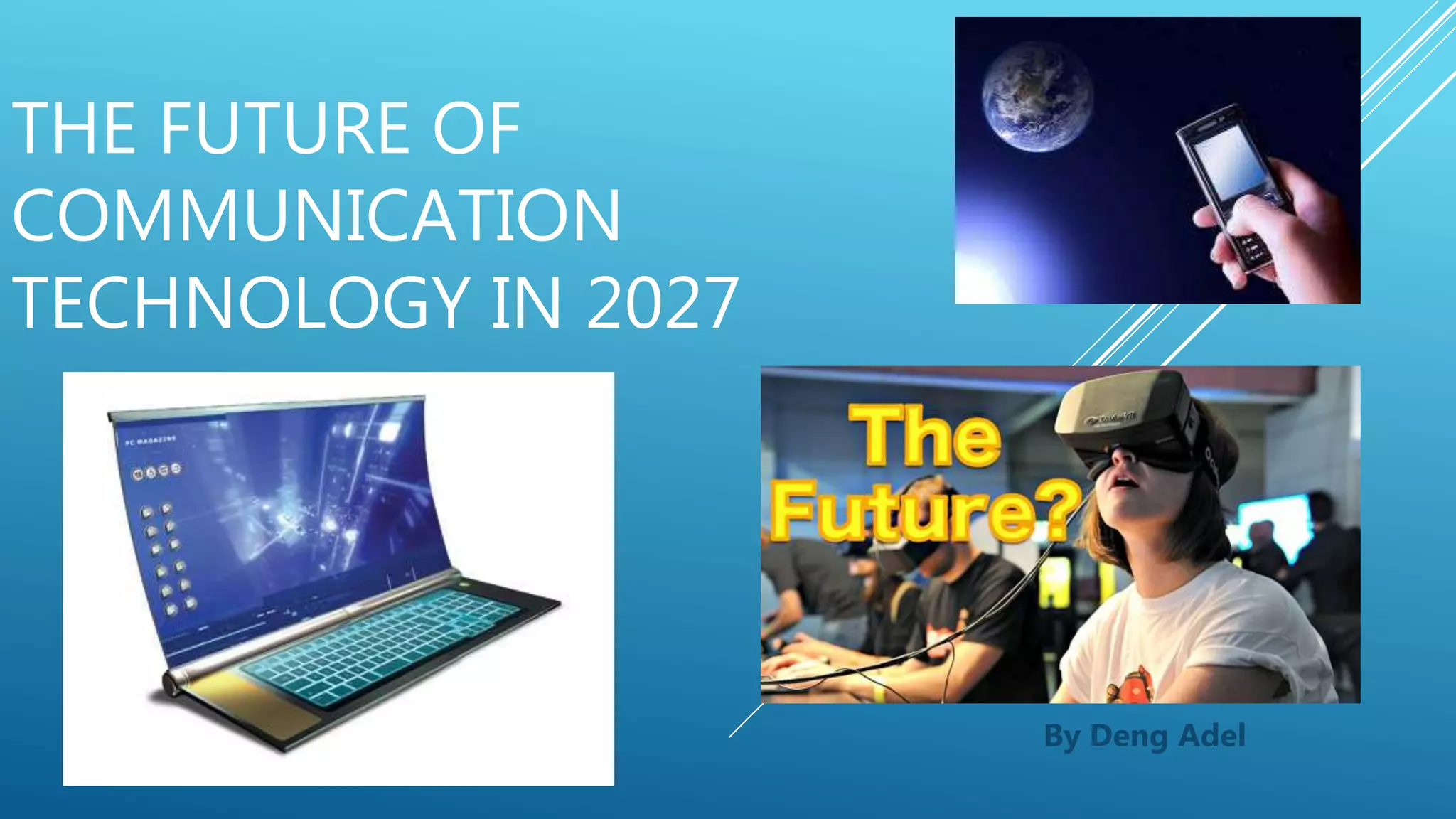
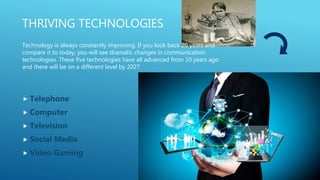
THE FUTURE OF
COMMUNICATION
TECHNOLOGY IN 2027
By Deng Adel
THRIVING TECHNOLOGIES
 Telephone
 Computer
 Television
 Social Media
 Video Gaming
Technology is always constantly improving. If you look back 20 years and
compare it to today, you will see dramatic changes in communication
technologies. These five technologies have all advanced from 10 years ago
and there will be on a different level by 2027
THE TELEPHONE
 The telephone was invented in 1876 by a Scottish-born scientist named Alexander
Graham Bell
 Alexander wanted a way to communicate with people without having to write
letters
 In 1900 the first coin operated telephone was installed in Hartford, Connecticut.
 In 1962 the first international communication satellite was launched (Telstar)
 Great advancements have occurred since the invention of the telephone
 Touch screen mobile phones with Bluetooth and Wi-Fi
 IPhone, Samsung, Nokia, Motorola
 Smartphones such as Apple and Android
The History
Current
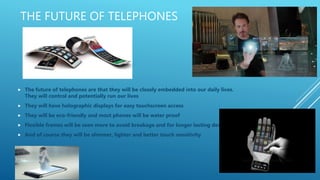
THE FUTURE OF TELEPHONES
 The future of telephones are that they will be closely embedded into our daily lives.
They will control and potentially run our lives
 They will have holographic displays for easy touchscreen access
 They will be eco-friendly and most phones will be water proof
 Flexible frames will be seen more to avoid breakage and for longer lasting devices
 And of course they will be slimmer, lighter and better touch sensitivity
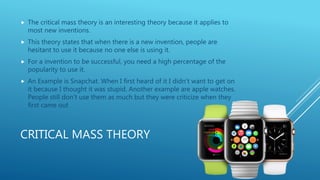
CRITICAL MASS THEORY
 The critical mass theory is an interesting theory because it applies to
most new inventions.
 This theory states that when there is a new invention, people are
hesitant to use it because no one else is using it.
 For a invention to be successful, you need a high percentage of the
popularity to use it.
 An Example is Snapchat. When I first heard of it I didn’t want to get on
it because I thought it was stupid. Another example are apple watches.
People still don’t use them as much but they were criticize when they
first came out
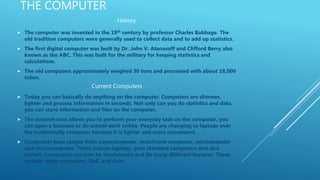
THE COMPUTER
 The computer was invented in the 19th century by professor Charles Babbage. The
old tradition computers were generally used to collect data and to add up statistics.
 The first digital computer was built by Dr. John V. Atanasoff and Clifford Berry also
known as the ABC. This was built for the military for keeping statistics and
calculations.
 The old computers approximately weighed 30 tons and processed with about 18,000
tubes.
 Today you can basically do anything on the computer. Computers are slimmer,
lighter and process information in seconds. Not only can you do statistics and data,
you can store information and files on the computer.
 The internet now allows you to perform your everyday task on the computer, you
can open a business or do school work online. People are changing to laptops over
the traditionally computer because it is lighter and more convenient.
 Computers have ranges from supercomputer, mainframe computer, minicomputer
and microcomputer. These include laptops, your standard computers and also
tablets. Computers can now be touchscreen and do many different features. These
include apple computers, Dell, and Acer.
Current Computers
History
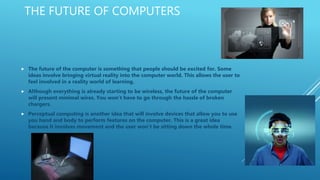
THE FUTURE OF COMPUTERS
 The future of the computer is something that people should be excited for. Some
ideas involve bringing virtual reality into the computer world. This allows the user to
feel involved in a reality world of learning.
 Although everything is already starting to be wireless, the future of the computer
will present minimal wires. You won’t have to go through the hassle of broken
chargers.
 Perceptual computing is another idea that will involve devices that allow you to use
you hand and body to perform features on the computer. This is a great idea
because it involves movement and the user won’t be sitting down the whole time.
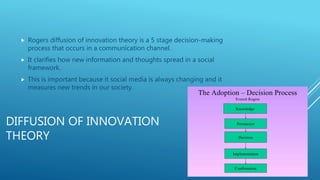
DIFFUSION OF INNOVATION
THEORY
 Rogers diffusion of innovation theory is a 5 stage decision-making
process that occurs in a communication channel.
 It clarifies how new information and thoughts spread in a social
framework.
 This is important because it social media is always changing and it
measures new trends in our society.
TELEVISION
 The television was invented in the early 1990’s with the involvement of different
scientist and inventors.
 John Logie Baird is regarded as one of the first people to transmit moving pictures.
 Paul Nipkow, a 23-year old German university student proposed the first
electromechanical television system in 1884.
 Mechanical televisions worked by using a rotational disk of images.
 Currently, we do not use mechanical televisions anymore because electronic
televisions are much better.
 Televisions of today weigh less, have bigger flat screens, have color and high
definition quality.
 Televisions are cheaper now and you can access many more channels.
History
Current
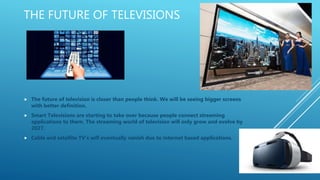
THE FUTURE OF TELEVISIONS
 The future of television is closer than people think. We will be seeing bigger screens
with better definition.
 Smart Televisions are starting to take over because people connect streaming
applications to them. The streaming world of television will only grow and evolve by
2027.
 Cable and satellite TV’s will eventually vanish due to internet based applications.
SOCIAL MEDIA
 Social media is relatively new because it could only develop with the
invention of the internet.
 In the 1960s emailing and communicating through virtual newspapers
was common.
 The first recognized social media site called “six degrees” was created
by Andrew Weinreich in 1997. Blogging websites were also formed
around that same time.
 Social media grew dramatically in the 2000s, Myspace and LinkedIn
were very popular in the early 2000s.
 Now the popular social media sites are Facebook, Instagram, Twitter,
Snapchat and a couple of others. All these sites allow you to connect
with others and also share your personal information.
History
Current
THE FUTURE OF SOCIAL MEDIA
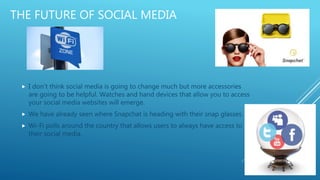
 I don’t think social media is going to change much but more accessories
are going to be helpful. Watches and hand devices that allow you to access
your social media websites will emerge.
 We have already seen where Snapchat is heading with their snap glasses.
 Wi-Fi polls around the country that allows users to always have access to
their social media.
MEDIA DEPENDENCY THEORY
 This theory explains that there are people who rely on social media to
fulfil their needs. They lack real life experience and turn to social media
to make their decisions.
 This theory is relatable to our youth because everyone is always on
their phone communicating with others. This could have a negative
affect in the future because the younger generation is going to lack life
skills and experience.
FUTURE OF VIDEO GAMING
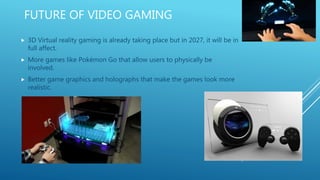
 3D Virtual reality gaming is already taking place but in 2027, it will be in
full affect.
 More games like Pokémon Go that allow users to physically be
involved.
 Better game graphics and holographs that make the games look more
realistic.
REFERENCES
 Paul, I. (2015, October 09). 10 enthralling visions for the future
of computing. Retrieved April 24, 2017, from
http://www.pcworld.com/article/2988179/computers/10-
enthralling-visions-for-the-future-of-computing.html
 Hendricks, D. (2013, May 06). Complete History of Social
Media: Then And Now. Retrieved April 24, 2017, from
https://smallbiztrends.com/2013/05/the-complete-history-of-
social-media-infographic.html
 What is social media? - Definition from WhatIs.com. (n.d.).
Retrieved April 24, 2017, from
http://whatis.techtarget.com/definition/social-media
 Anpipt01 Follow. (2011, December 13). The Future of
Communication Technology. Retrieved April 24, 2017, from
https://www.slideshare.net/anpipt01/the-future-of-
communication-technology

The future of communication technologies

  • 1.
  • 2.
    THRIVING TECHNOLOGIES  Telephone Computer  Television  Social Media  Video Gaming Technology is always constantly improving. If you look back 20 years and compare it to today, you will see dramatic changes in communication technologies. These five technologies have all advanced from 10 years ago and there will be on a different level by 2027
  • 3.
    THE TELEPHONE  Thetelephone was invented in 1876 by a Scottish-born scientist named Alexander Graham Bell  Alexander wanted a way to communicate with people without having to write letters  In 1900 the first coin operated telephone was installed in Hartford, Connecticut.  In 1962 the first international communication satellite was launched (Telstar)  Great advancements have occurred since the invention of the telephone  Touch screen mobile phones with Bluetooth and Wi-Fi  IPhone, Samsung, Nokia, Motorola  Smartphones such as Apple and Android The History Current
  • 4.
    THE FUTURE OFTELEPHONES  The future of telephones are that they will be closely embedded into our daily lives. They will control and potentially run our lives  They will have holographic displays for easy touchscreen access  They will be eco-friendly and most phones will be water proof  Flexible frames will be seen more to avoid breakage and for longer lasting devices  And of course they will be slimmer, lighter and better touch sensitivity
  • 5.
    CRITICAL MASS THEORY The critical mass theory is an interesting theory because it applies to most new inventions.  This theory states that when there is a new invention, people are hesitant to use it because no one else is using it.  For a invention to be successful, you need a high percentage of the popularity to use it.  An Example is Snapchat. When I first heard of it I didn’t want to get on it because I thought it was stupid. Another example are apple watches. People still don’t use them as much but they were criticize when they first came out
  • 6.
    THE COMPUTER  Thecomputer was invented in the 19th century by professor Charles Babbage. The old tradition computers were generally used to collect data and to add up statistics.  The first digital computer was built by Dr. John V. Atanasoff and Clifford Berry also known as the ABC. This was built for the military for keeping statistics and calculations.  The old computers approximately weighed 30 tons and processed with about 18,000 tubes.  Today you can basically do anything on the computer. Computers are slimmer, lighter and process information in seconds. Not only can you do statistics and data, you can store information and files on the computer.  The internet now allows you to perform your everyday task on the computer, you can open a business or do school work online. People are changing to laptops over the traditionally computer because it is lighter and more convenient.  Computers have ranges from supercomputer, mainframe computer, minicomputer and microcomputer. These include laptops, your standard computers and also tablets. Computers can now be touchscreen and do many different features. These include apple computers, Dell, and Acer. Current Computers History
  • 7.
    THE FUTURE OFCOMPUTERS  The future of the computer is something that people should be excited for. Some ideas involve bringing virtual reality into the computer world. This allows the user to feel involved in a reality world of learning.  Although everything is already starting to be wireless, the future of the computer will present minimal wires. You won’t have to go through the hassle of broken chargers.  Perceptual computing is another idea that will involve devices that allow you to use you hand and body to perform features on the computer. This is a great idea because it involves movement and the user won’t be sitting down the whole time.
  • 8.
    DIFFUSION OF INNOVATION THEORY Rogers diffusion of innovation theory is a 5 stage decision-making process that occurs in a communication channel.  It clarifies how new information and thoughts spread in a social framework.  This is important because it social media is always changing and it measures new trends in our society.
  • 9.
    TELEVISION  The televisionwas invented in the early 1990’s with the involvement of different scientist and inventors.  John Logie Baird is regarded as one of the first people to transmit moving pictures.  Paul Nipkow, a 23-year old German university student proposed the first electromechanical television system in 1884.  Mechanical televisions worked by using a rotational disk of images.  Currently, we do not use mechanical televisions anymore because electronic televisions are much better.  Televisions of today weigh less, have bigger flat screens, have color and high definition quality.  Televisions are cheaper now and you can access many more channels. History Current
  • 10.
    THE FUTURE OFTELEVISIONS  The future of television is closer than people think. We will be seeing bigger screens with better definition.  Smart Televisions are starting to take over because people connect streaming applications to them. The streaming world of television will only grow and evolve by 2027.  Cable and satellite TV’s will eventually vanish due to internet based applications.
  • 11.
    SOCIAL MEDIA  Socialmedia is relatively new because it could only develop with the invention of the internet.  In the 1960s emailing and communicating through virtual newspapers was common.  The first recognized social media site called “six degrees” was created by Andrew Weinreich in 1997. Blogging websites were also formed around that same time.  Social media grew dramatically in the 2000s, Myspace and LinkedIn were very popular in the early 2000s.  Now the popular social media sites are Facebook, Instagram, Twitter, Snapchat and a couple of others. All these sites allow you to connect with others and also share your personal information. History Current
  • 12.
    THE FUTURE OFSOCIAL MEDIA  I don’t think social media is going to change much but more accessories are going to be helpful. Watches and hand devices that allow you to access your social media websites will emerge.  We have already seen where Snapchat is heading with their snap glasses.  Wi-Fi polls around the country that allows users to always have access to their social media.
  • 13.
    MEDIA DEPENDENCY THEORY This theory explains that there are people who rely on social media to fulfil their needs. They lack real life experience and turn to social media to make their decisions.  This theory is relatable to our youth because everyone is always on their phone communicating with others. This could have a negative affect in the future because the younger generation is going to lack life skills and experience.
  • 14.
    FUTURE OF VIDEOGAMING  3D Virtual reality gaming is already taking place but in 2027, it will be in full affect.  More games like Pokémon Go that allow users to physically be involved.  Better game graphics and holographs that make the games look more realistic.
  • 15.
    REFERENCES  Paul, I.(2015, October 09). 10 enthralling visions for the future of computing. Retrieved April 24, 2017, from http://www.pcworld.com/article/2988179/computers/10- enthralling-visions-for-the-future-of-computing.html  Hendricks, D. (2013, May 06). Complete History of Social Media: Then And Now. Retrieved April 24, 2017, from https://smallbiztrends.com/2013/05/the-complete-history-of- social-media-infographic.html  What is social media? - Definition from WhatIs.com. (n.d.). Retrieved April 24, 2017, from http://whatis.techtarget.com/definition/social-media  Anpipt01 Follow. (2011, December 13). The Future of Communication Technology. Retrieved April 24, 2017, from https://www.slideshare.net/anpipt01/the-future-of- communication-technology