The document discusses the Internet of Things (IoT). It defines IoT as the network of physical objects embedded with electronics, software, and sensors that enables the collection and exchange of data. Key components that drive IoT include sensors that detect information, connectivity that allows communication over the internet, and people and processes that analyze and take action based on the data. Some advantages of IoT are more efficient resource utilization, minimized human effort through automation, and time savings. The document outlines current and potential future applications of IoT but also notes there are challenges to widespread adoption.
INTERNET OF THINGS
TheInternet of Things (IoT) is the network
of physical objects or “things” embedded with
electronics, software, sensors, and network
connectivity, which enables these objects to
collect and exchange data.
4.
HISTORY OF IoT
1999
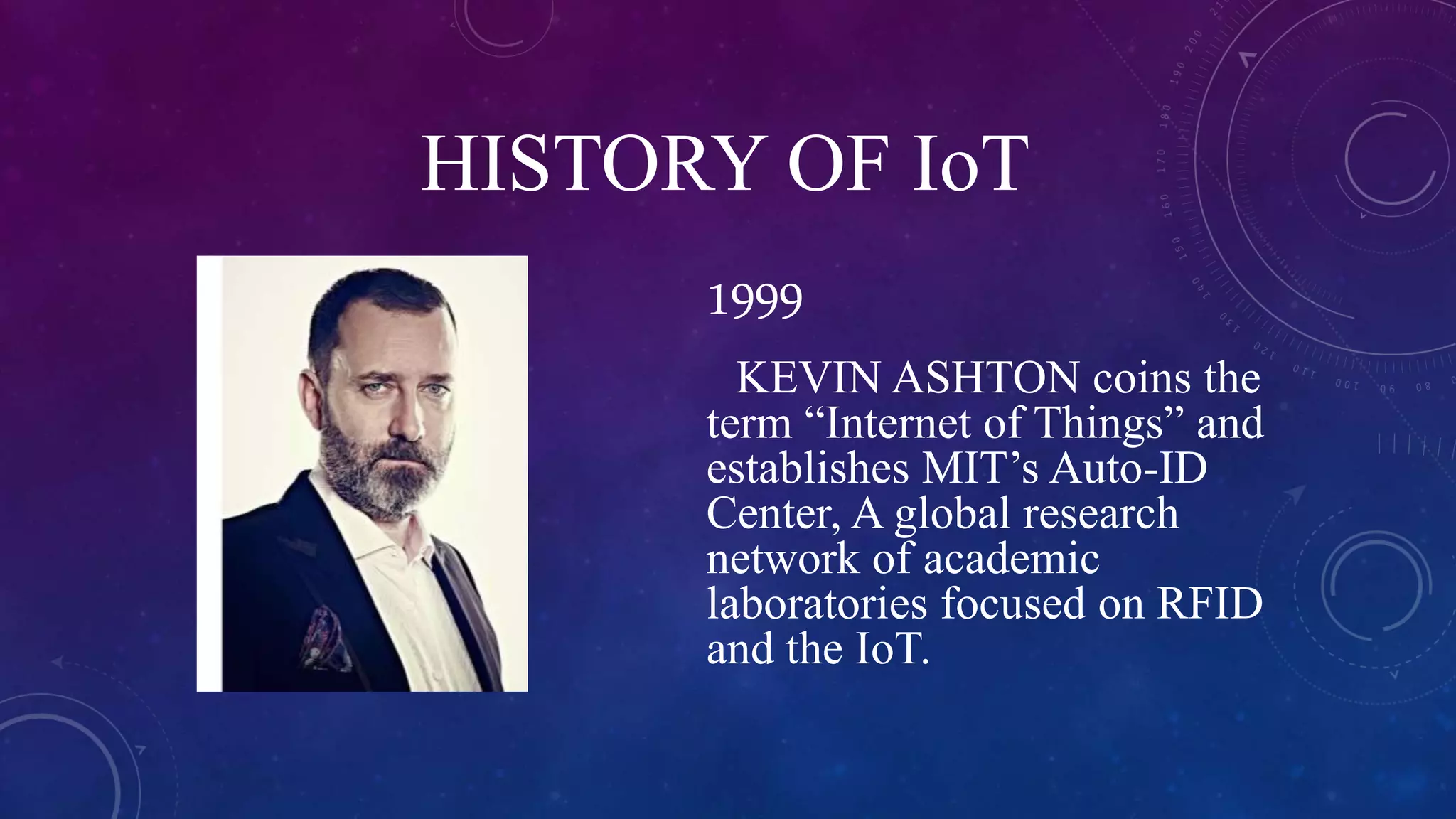
KEVINASHTON coins the
term “Internet of Things” and
establishes MIT’s Auto-ID
Center, A global research
network of academic
laboratories focused on RFID
and the IoT.
5.
COMPONENTS OF IoT
•Smart Systems and Internet
of Things are driven by a
combination of:
1) Sensors
2) Connectivity
3) People & Processes
CONNECTIVITY
SSENSORS
PEOPLE
AND
PROCESS
IoT
6.
SENSORS:
Sensors detect andmeasure information on all sorts of things like temperature,
humidity, and pressure. And they communicate that data in some form, such as a
numerical value or electrical signal.
CONNECTIVITY:
The Internet of Things (IoT)—the network of connected “smart” devices that
communicate seamlessly over the Internet—is transforming how we live and work.
PEOPLE & PROCESSES:
Connecting more people in more relevant, valuable ways.
Delivering the data right information to the right person (or machine) at the right time.
7.
WHY IoT?
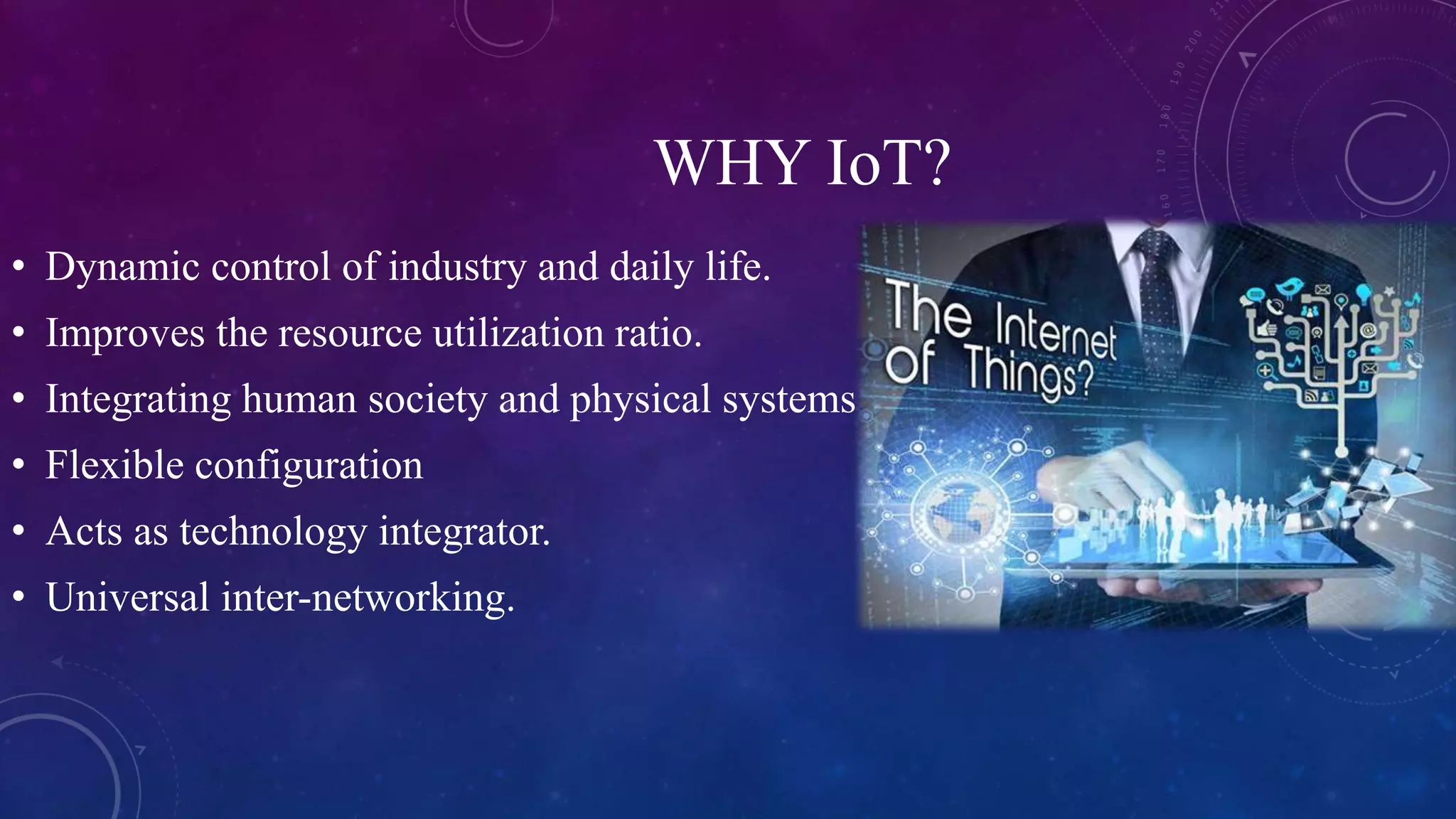
• Dynamiccontrol of industry and daily life.
• Improves the resource utilization ratio.
• Integrating human society and physical systems
• Flexible configuration
• Acts as technology integrator.
• Universal inter-networking.
8.
THE INTERNET OFTHINGS LIFECYCLE
COLLECT COMMUNICATE ANALYZE ACT
ACTION
Taking ACTION basedon the information and data
Communicate with another machine [M2M]
Send a Notification[sms, email, text]
Talk to another system
13.
THE STRUCTURE OFIoT
Tagging Things : Real-time item traceability and addressability by
RFID’s.
Feeling Things: SENSORS act as primary devices to collect data from the
Environment.
Shrinking Things: Miniaturization and NANOTECHNOLOGY has provoked the
ability of smaller things to interact and connect within the “things” or “smart devices”.
Thinking Things: EMBEDDED INTELLIGENCE in devices through sensors
has formed the network connection to the Internet. It can make the “things” realizing the
Intelligent control
14.
ADVANTAGES OF IoT
Efficientresource utilization : If we know the functionality and the way that
how each device work we definitely increase the efficient resource utilization as
well as monitor natural resources.
Minimize human effort: As the devices of IoT interact and communicate with
each other and do lot of task for us, then they minimize the human effort.
Save time: As it reduces the human effort then it definitely saves out time. Time is
the primary factor which can save through IoT platform.
CONCLUSION
The potential economicimpact of IoT
is huge, but the journey to IoT adoption
is not a seamless one. There are many
challenges that face companies looking
to implement IoT solutions. However,
the risks and disadvantages associated
With IoT can be overcome.




![ANALYSIS
Creating INFORMATION from the data
Visualising the data
Building reports
Filtering data [paring it down]](https://image.slidesharecdn.com/iotppt-191012135515/75/IoT-ppt-11-2048.jpg)
![ACTION
Taking ACTION based on the information and data
Communicate with another machine [M2M]
Send a Notification[sms, email, text]
Talk to another system](https://image.slidesharecdn.com/iotppt-191012135515/75/IoT-ppt-12-2048.jpg)



![Vibe Coding vs. Spec-Driven Development [Free Meetup]](https://cdn.slidesharecdn.com/ss_thumbnails/vibecodingvsspecdrivendevelopment-251209105622-43f455e7-thumbnail.jpg?width=640&height=640&fit=bounds)


