Serve food and beverage
PREPARED BY:
MS. RICA L. GABRES
Table Service Procedures and
Techniques
Principles of Table Service
A well planned and attractive
table contributes to the success
of a party. The application of
creative skills can be judged
according to how the dining table
is presented.
The following are some principles to
follow in table service:
1. Place only the
essential tableware
depending on the style
of meal service when
setting the party table
to avoid too much
clutter.
2. Keep in mind the comfort of
the diner when setting the table.
Table appointments should be
placed logically and neatly
where they are to be used. For
example, forks are placed at the
left side of the plate since it is
generally used with the left
hand.
3. Have an artistic mind when
setting the table. There should be
balance and simplicity in the table
setting. Balance can be achieved
through the size of serving platters
and the type and color of table
appointments used. Make sure that
table appointments fit the occasion
and style of service.
4. Make sure that the table
appointments are appropriate
for the dishes to be served. For
example, teaspoons should be
laid out when serving ice
cream. However, forks should
be laid out when serving cake
since they are the more
appropriate to use.
5. The party table may or may
not be covered depending on its
appearance. Use a tablecloth to
completely cover the surface if
it is unattractive. Be sure the
tablecloth is well- pressed and
creaseless except for the
centerfold.
6. When laying flatware, the fork is
placed with tines facing up at the left side
of the plate while the spoon is laid with
bowls up at the right. Knives are placed
with the cutting edge toward the plate at
the right side. When the knives and
spoons are set, the knife is placed
nearer the plate. When teaspoons are
necessary, these are placed at the right
of the spoon or above the cover, with
bowls up.
7. Serving flatware is
generally at the right of the dish.
When two pieces are
necessary, they may be placed
at either side of the dish. It is
improper to have the serving
flatware stuck into the food at
the start of the meal.
8. Dinner plates are placed
turned up at the center of the
cover. Soup bowls are placed
on the dinner plate. Cups and
saucers are placed at the top
right or right side of the cover. If
a salad plate is necessary, it is
placed at the top left.
9. Drinking glasses are placed at
the tip of the knife or spoon at the
right side of the cover. If wine or
juice glasses are needed in a meal,
these are placed below the drinking
glass in a diagonal fashion.
Coasters should be set when cold
beverages are served in ordinary
drinking glasses or unstemmed
beverage ware.
10. Serving dishes are
placed at the middle of the
table in a manner that will
not make the table look
cluttered. Make sure that
serving flatware for each
dish is provided and placed
near the dishes.
There are several styles
of table service. Some
ways are formal and
elaborate, others are
casual and relaxed.
Generally, these styles
can be classified as
formal, informal, and
compromise.
Below are the lists of table service procedures and its techniques
Lists of table service procedures and its
techniques:
American
Service or Blue
Plate Service
All food cooked and plated (portion or
arranged) in kitchen. The food server picks up
the plate and delivers this to the guest. Table
setting, individual cover are laid, except
dinnerware. Serve from left , result of limited
staff.
Advantages
• casual dining, portion control, less service
skill needed
Disadvantages
• less personal, guests can not choose
portion
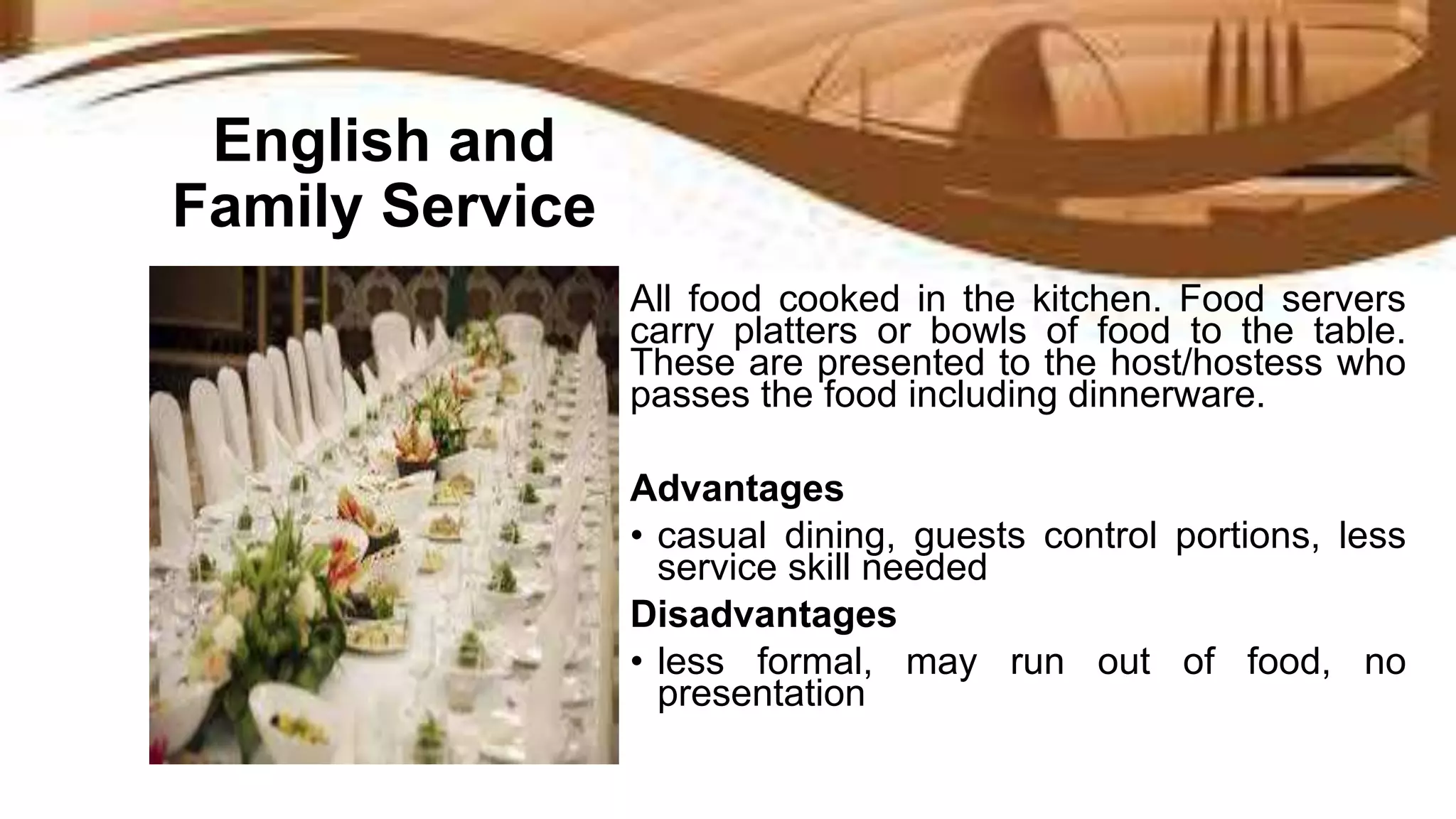
English and
Family Service
All food cooked in the kitchen. Food servers
carry platters or bowls of food to the table.
These are presented to the host/hostess who
passes the food including dinnerware.
Advantages
• casual dining, guests control portions, less
service skill needed
Disadvantages
• less formal, may run out of food, no
presentation
French Style
Service
Advantages
•elegant, showcases food,
high check average
Disadvantages
•need highly -trained staff,
high labor costs, capital
investment in cart, fewer
turns of tables, fewer tables
in dining room
Russian
Service
Is the most popular style used in restaurant. The cover
is arranged the same as French Service but the food is
arranged on platters by the chef in the kitchen. The
platters are served from the guest‘s left side. The
server holds the platter with the left hand, holding the
serving spoon and fork with the right hand, apportions
the food from the platter and places on the plate of the
guest.
Advantages
• casual dining, server controls portions, less service
skill needed
Disadvantages
• formal, no choice portion, no presentation
Buffet Service
(Smorgarbord
Service)
Guest goes to the food which is displayed.
Three (3) possible dining arrangements:
1. At the dining table : tables are fully set with all
appointments for dining except the dinner plate.
2. Lacking room for table : the guest maybe provided with
a tray that holds plate and beverages and the guest
places on his or her lap.
3. At times ; the only arrangement made for dining Is to
have plenty space on which guest can place a
beverage while they sit wherever they can and eat
from the plate held in the hand.
Advantages
• Display food, speed, economy, less service skill needed
Disadvantages
• food safety, capital investment
A person who sets a table must possess
the following qualities:
1.Common Sense – to easily identify the convenient position of
the table appointments and prepare only that which is
needed.
2.Concern for the comfort of those at the table – thinking about
the diners will facilitate preparation of everything they may
need when dining.
3.Courtesy – that all the tools essential for refined eating be
provided and that they be conveniently place.
4.Artistic – to present a balanced appearance of the cover and
of the table.
Tasks involved in setting the table
1. Prepare the dinnerware, beverage ware, flatware and
hollowware.
a) Availability of table appointments needed are checked or
requested based on setting capacity plus 50% standby.
b) The table appointments are inspected for cleanliness. Thus,
to spotless, dry, with no chips and clear when seen through light.
c) The required table appointments are then stocked
according to standard layout, based on seating capacity
plus 50% standby.
Tasks involved in setting the table
2. Prepare the condiments and food accompaniments.
a)Condiments and food accompaniments which may
include the following; salt & pepper shakers, toothpick,
paper napkins, condiments, sauces, flower vase,
ashtray) are replenished or refilled.
b)These are inspected for cleanliness. Smudges and
smears at the neck of the bottles are cleaned. Spoiled
condiments and sauces are discarded. Salt & pepper
condiments are free from clog and caking.
c)These are then stocked or loaded on trays ready for
distribution.
Tasks involved in setting the table
3. Set the covers.
a) Tables and chairs are checked for functionality and
cleanliness. These should be well-polished and should not
be wobbly and do not have rough surfaces. Tables and
chairs have to be positioned according to the standard lay-
out.
b) Tablecloth is then spread on the table, equal on all sides.
Check also that the shapes of the tablecloth conforms the
shape of the table. The tablecloth should have no holes, is
well- ironed with no stain when set.
c) Table appointments are positioned following standard
procedures. These have to be done within the standard
length of time.
Tasks involved in setting the table
4. Check and prepare the function and order
arrangement.
a) The server confers with the headwaiters about
diners with special needs. Reservation books are
there for this purpose.
b) Proper arrangements for special request are
prepared; table preference, number of diners,
etc.
Rules to Observe in Table
Service
Order of Service
There are some dining places that are not
particular about the order of service.
Establishments like these only aim to get the
food on the table. A good food server
however, does his/her work professionally;
thus, he/she observes the following
guidelines on the order of service based on
generally accepted procedures:
1. In banquets and formal
gatherings, serve the
host/hostess or the guest of
honor first, following a
counterclockwise direction.
2. In informal groups, serve
the hostess first if she is
known. If the hostess is not
identified, start with the most
senior female in the group.
3. In small, intimate groups,
serve the female first, then
the males. Serve following
a counterclockwise
direction.
4. The service of lunch or dinner
follows this order:
a. As soon as the guest is seated, fill
the water glass three-fourths full
with ice water. Keep the water glass
refilled continuously during the
meal.
b. Serve chilled butter on a
bread and butter plate and
the appetizer at the center
of the cover, if these are
included in the menu.
c. When the guest is
through, remove the
appetizer dish.
d. Serve the soup
at the center of
the cover.
e. Remove the soup
plate or soup bowl after
the guest is finished with
the course.
f. Serve the main
dish or entrée at the
center of the cover
in front of the guest.
g. When the guest is through, remove
main dishes and used flatware. Leave the
water glass, which is constantly
replenished throughout the meal. Leave
the dessert implements, either teaspoon
or dessert fork, if they are set on the
table.
h. If morsels of food or
crumbs are on the
table, clear the table
with the use of a
napkin.
i. Set the dessert
implements, if they
have not yet been
set.
j. Serve the dessert
at the center of the
cover.
k. Serve the beverage, if
the diner prefers that it be
served with the dessert.
Otherwise, beverage may
be served after the dessert.
5. For breakfast, the order of
service begins with the fruit
or fruit juice. This is
equivalent to soup and
appetizer for lunch and
dinner.
Loading of Trays
Part of being a good server is being
systematic with one‘s work. Trays are
used to facilitate service. Knowing
how to load trays contributes to
prompt, smooth, and efficient
service and helps reduce accidents
and unnecessary work strain.
The following should be
remembered when loading trays:
Place heaviest plates at the
center of the tray. Distribute the
other dishes evenly on the sides
of the tray, while maintaining
proper balance.
Glasses, cups, teapots,
and coffeepots must not
be placed near the sides or
edges of the tray where
they are likely to fall off.
During service, arrange cups and
saucers on the tray separately, instead of
having each cup on top of a saucer. This
will occupy much space and will lessen
the load of the tray. As the guests are
served, place each cup over a saucer
one at a time, until all the guests have
been served.
In stacking soiled dishes,
place the heaviest plates at
the center of the tray so that
one arm can support them.
Its weight can help stabilize
the tray.
Place tall objects, such as
glasses and bottles, as close
together as possible to prevent
them from falling. This way they
will support each other and will
have less chances of falling.
Be sure trays are always
clean, dry, and free from any
spillages or food particles. All
throughout the service, keep
the tray clean and dry.

3.-Serve-food-and-beverage.pptx

  • 1.
    Serve food andbeverage PREPARED BY: MS. RICA L. GABRES
  • 2.
  • 3.
    Principles of TableService A well planned and attractive table contributes to the success of a party. The application of creative skills can be judged according to how the dining table is presented.
  • 4.
    The following aresome principles to follow in table service:
  • 5.
    1. Place onlythe essential tableware depending on the style of meal service when setting the party table to avoid too much clutter.
  • 6.
    2. Keep inmind the comfort of the diner when setting the table. Table appointments should be placed logically and neatly where they are to be used. For example, forks are placed at the left side of the plate since it is generally used with the left hand.
  • 7.
    3. Have anartistic mind when setting the table. There should be balance and simplicity in the table setting. Balance can be achieved through the size of serving platters and the type and color of table appointments used. Make sure that table appointments fit the occasion and style of service.
  • 8.
    4. Make surethat the table appointments are appropriate for the dishes to be served. For example, teaspoons should be laid out when serving ice cream. However, forks should be laid out when serving cake since they are the more appropriate to use.
  • 9.
    5. The partytable may or may not be covered depending on its appearance. Use a tablecloth to completely cover the surface if it is unattractive. Be sure the tablecloth is well- pressed and creaseless except for the centerfold.
  • 10.
    6. When layingflatware, the fork is placed with tines facing up at the left side of the plate while the spoon is laid with bowls up at the right. Knives are placed with the cutting edge toward the plate at the right side. When the knives and spoons are set, the knife is placed nearer the plate. When teaspoons are necessary, these are placed at the right of the spoon or above the cover, with bowls up.
  • 11.
    7. Serving flatwareis generally at the right of the dish. When two pieces are necessary, they may be placed at either side of the dish. It is improper to have the serving flatware stuck into the food at the start of the meal.
  • 12.
    8. Dinner platesare placed turned up at the center of the cover. Soup bowls are placed on the dinner plate. Cups and saucers are placed at the top right or right side of the cover. If a salad plate is necessary, it is placed at the top left.
  • 13.
    9. Drinking glassesare placed at the tip of the knife or spoon at the right side of the cover. If wine or juice glasses are needed in a meal, these are placed below the drinking glass in a diagonal fashion. Coasters should be set when cold beverages are served in ordinary drinking glasses or unstemmed beverage ware.
  • 14.
    10. Serving dishesare placed at the middle of the table in a manner that will not make the table look cluttered. Make sure that serving flatware for each dish is provided and placed near the dishes.
  • 15.
    There are severalstyles of table service. Some ways are formal and elaborate, others are casual and relaxed. Generally, these styles can be classified as formal, informal, and compromise.
  • 16.
    Below are thelists of table service procedures and its techniques Lists of table service procedures and its techniques:
  • 17.
    American Service or Blue PlateService All food cooked and plated (portion or arranged) in kitchen. The food server picks up the plate and delivers this to the guest. Table setting, individual cover are laid, except dinnerware. Serve from left , result of limited staff. Advantages • casual dining, portion control, less service skill needed Disadvantages • less personal, guests can not choose portion
  • 18.
    English and Family Service Allfood cooked in the kitchen. Food servers carry platters or bowls of food to the table. These are presented to the host/hostess who passes the food including dinnerware. Advantages • casual dining, guests control portions, less service skill needed Disadvantages • less formal, may run out of food, no presentation
  • 19.
    French Style Service Advantages •elegant, showcasesfood, high check average Disadvantages •need highly -trained staff, high labor costs, capital investment in cart, fewer turns of tables, fewer tables in dining room
  • 20.
    Russian Service Is the mostpopular style used in restaurant. The cover is arranged the same as French Service but the food is arranged on platters by the chef in the kitchen. The platters are served from the guest‘s left side. The server holds the platter with the left hand, holding the serving spoon and fork with the right hand, apportions the food from the platter and places on the plate of the guest. Advantages • casual dining, server controls portions, less service skill needed Disadvantages • formal, no choice portion, no presentation
  • 21.
    Buffet Service (Smorgarbord Service) Guest goesto the food which is displayed. Three (3) possible dining arrangements: 1. At the dining table : tables are fully set with all appointments for dining except the dinner plate. 2. Lacking room for table : the guest maybe provided with a tray that holds plate and beverages and the guest places on his or her lap. 3. At times ; the only arrangement made for dining Is to have plenty space on which guest can place a beverage while they sit wherever they can and eat from the plate held in the hand. Advantages • Display food, speed, economy, less service skill needed Disadvantages • food safety, capital investment
  • 22.
    A person whosets a table must possess the following qualities: 1.Common Sense – to easily identify the convenient position of the table appointments and prepare only that which is needed. 2.Concern for the comfort of those at the table – thinking about the diners will facilitate preparation of everything they may need when dining. 3.Courtesy – that all the tools essential for refined eating be provided and that they be conveniently place. 4.Artistic – to present a balanced appearance of the cover and of the table.
  • 23.
    Tasks involved insetting the table 1. Prepare the dinnerware, beverage ware, flatware and hollowware. a) Availability of table appointments needed are checked or requested based on setting capacity plus 50% standby. b) The table appointments are inspected for cleanliness. Thus, to spotless, dry, with no chips and clear when seen through light. c) The required table appointments are then stocked according to standard layout, based on seating capacity plus 50% standby.
  • 24.
    Tasks involved insetting the table 2. Prepare the condiments and food accompaniments. a)Condiments and food accompaniments which may include the following; salt & pepper shakers, toothpick, paper napkins, condiments, sauces, flower vase, ashtray) are replenished or refilled. b)These are inspected for cleanliness. Smudges and smears at the neck of the bottles are cleaned. Spoiled condiments and sauces are discarded. Salt & pepper condiments are free from clog and caking. c)These are then stocked or loaded on trays ready for distribution.
  • 25.
    Tasks involved insetting the table 3. Set the covers. a) Tables and chairs are checked for functionality and cleanliness. These should be well-polished and should not be wobbly and do not have rough surfaces. Tables and chairs have to be positioned according to the standard lay- out. b) Tablecloth is then spread on the table, equal on all sides. Check also that the shapes of the tablecloth conforms the shape of the table. The tablecloth should have no holes, is well- ironed with no stain when set. c) Table appointments are positioned following standard procedures. These have to be done within the standard length of time.
  • 26.
    Tasks involved insetting the table 4. Check and prepare the function and order arrangement. a) The server confers with the headwaiters about diners with special needs. Reservation books are there for this purpose. b) Proper arrangements for special request are prepared; table preference, number of diners, etc.
  • 27.
    Rules to Observein Table Service
  • 28.
  • 29.
    There are somedining places that are not particular about the order of service. Establishments like these only aim to get the food on the table. A good food server however, does his/her work professionally; thus, he/she observes the following guidelines on the order of service based on generally accepted procedures:
  • 30.
    1. In banquetsand formal gatherings, serve the host/hostess or the guest of honor first, following a counterclockwise direction.
  • 31.
    2. In informalgroups, serve the hostess first if she is known. If the hostess is not identified, start with the most senior female in the group.
  • 32.
    3. In small,intimate groups, serve the female first, then the males. Serve following a counterclockwise direction.
  • 33.
    4. The serviceof lunch or dinner follows this order: a. As soon as the guest is seated, fill the water glass three-fourths full with ice water. Keep the water glass refilled continuously during the meal.
  • 34.
    b. Serve chilledbutter on a bread and butter plate and the appetizer at the center of the cover, if these are included in the menu.
  • 35.
    c. When theguest is through, remove the appetizer dish.
  • 36.
    d. Serve thesoup at the center of the cover.
  • 37.
    e. Remove thesoup plate or soup bowl after the guest is finished with the course.
  • 38.
    f. Serve themain dish or entrée at the center of the cover in front of the guest.
  • 39.
    g. When theguest is through, remove main dishes and used flatware. Leave the water glass, which is constantly replenished throughout the meal. Leave the dessert implements, either teaspoon or dessert fork, if they are set on the table.
  • 40.
    h. If morselsof food or crumbs are on the table, clear the table with the use of a napkin.
  • 41.
    i. Set thedessert implements, if they have not yet been set.
  • 42.
    j. Serve thedessert at the center of the cover.
  • 43.
    k. Serve thebeverage, if the diner prefers that it be served with the dessert. Otherwise, beverage may be served after the dessert.
  • 44.
    5. For breakfast,the order of service begins with the fruit or fruit juice. This is equivalent to soup and appetizer for lunch and dinner.
  • 45.
  • 46.
    Part of beinga good server is being systematic with one‘s work. Trays are used to facilitate service. Knowing how to load trays contributes to prompt, smooth, and efficient service and helps reduce accidents and unnecessary work strain.
  • 47.
    The following shouldbe remembered when loading trays: Place heaviest plates at the center of the tray. Distribute the other dishes evenly on the sides of the tray, while maintaining proper balance.
  • 48.
    Glasses, cups, teapots, andcoffeepots must not be placed near the sides or edges of the tray where they are likely to fall off.
  • 49.
    During service, arrangecups and saucers on the tray separately, instead of having each cup on top of a saucer. This will occupy much space and will lessen the load of the tray. As the guests are served, place each cup over a saucer one at a time, until all the guests have been served.
  • 50.
    In stacking soileddishes, place the heaviest plates at the center of the tray so that one arm can support them. Its weight can help stabilize the tray.
  • 51.
    Place tall objects,such as glasses and bottles, as close together as possible to prevent them from falling. This way they will support each other and will have less chances of falling.
  • 52.
    Be sure traysare always clean, dry, and free from any spillages or food particles. All throughout the service, keep the tray clean and dry.