Still Standards after All These Years


                  Karen Luond Fowdy
                  and Lisa Hendrickson
                  http://WorkshopsforWorldLanguageInstruction.com
                  http://fowdyhendrickson.wikispaces.com/
INTRODUCTION

   Who are you?
   Why did you become a world language
    teacher?


       Karen Fowdy and Lisa Hendrickson   http://WorkshopsforWorldLanguageInstruction.com
OVERVIEW

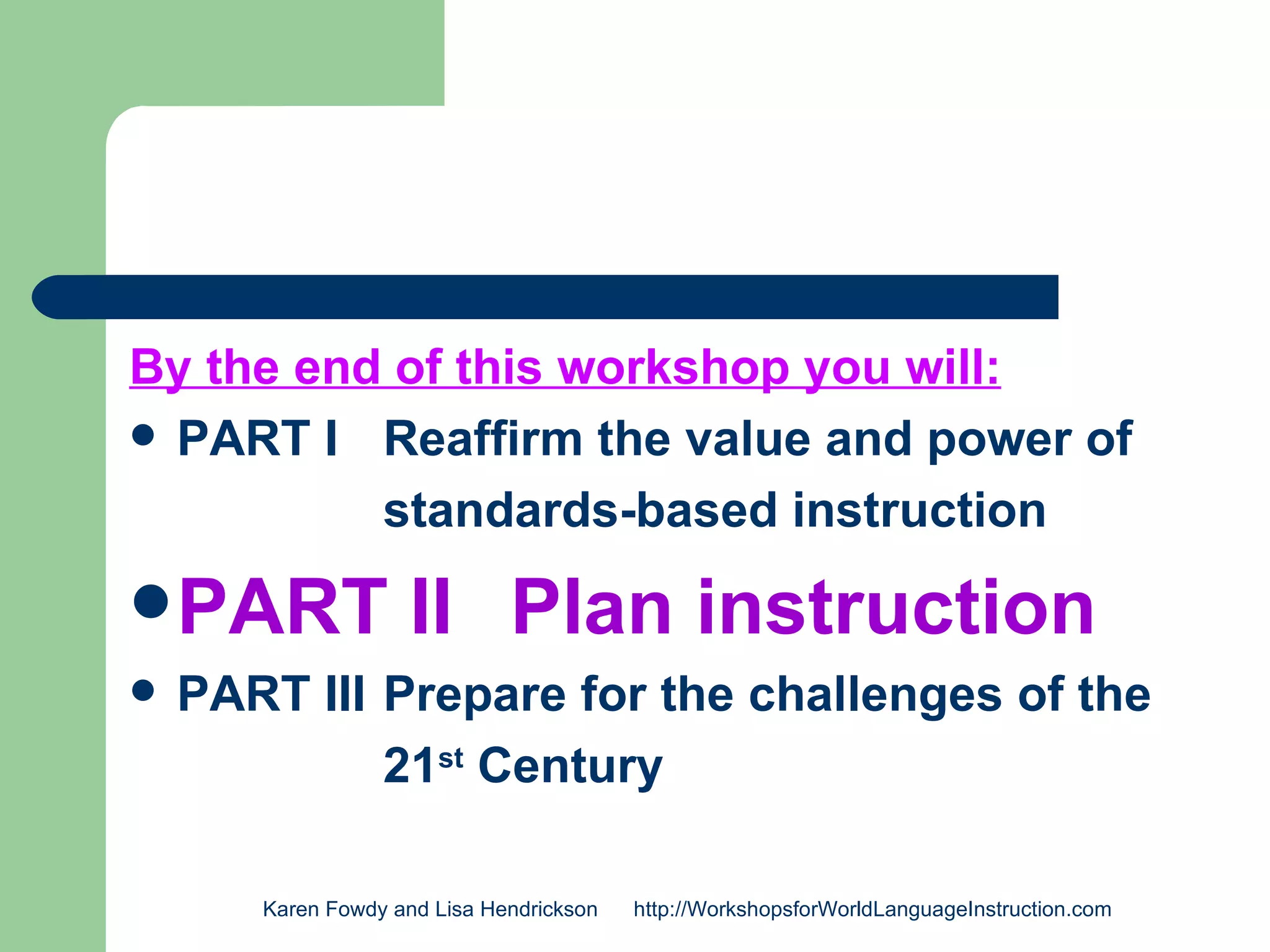
By the end of this workshop you will:
 PART I Reaffirm the value and power of

           standards-based instruction
 PART II Plan instruction
 PART III Prepare for the challenges of the

           21st Century


     Karen Fowdy and Lisa Hendrickson   http://WorkshopsforWorldLanguageInstruction.com
OVERVIEW

By the end of this workshop you will:
 PART    I Reaffirm the value
    and power of standards-
    based instruction
   PART II Plan instruction
   PART III Prepare for the challenges of the
             21st Century
       Karen Fowdy and Lisa Hendrickson   http://WorkshopsforWorldLanguageInstruction.com
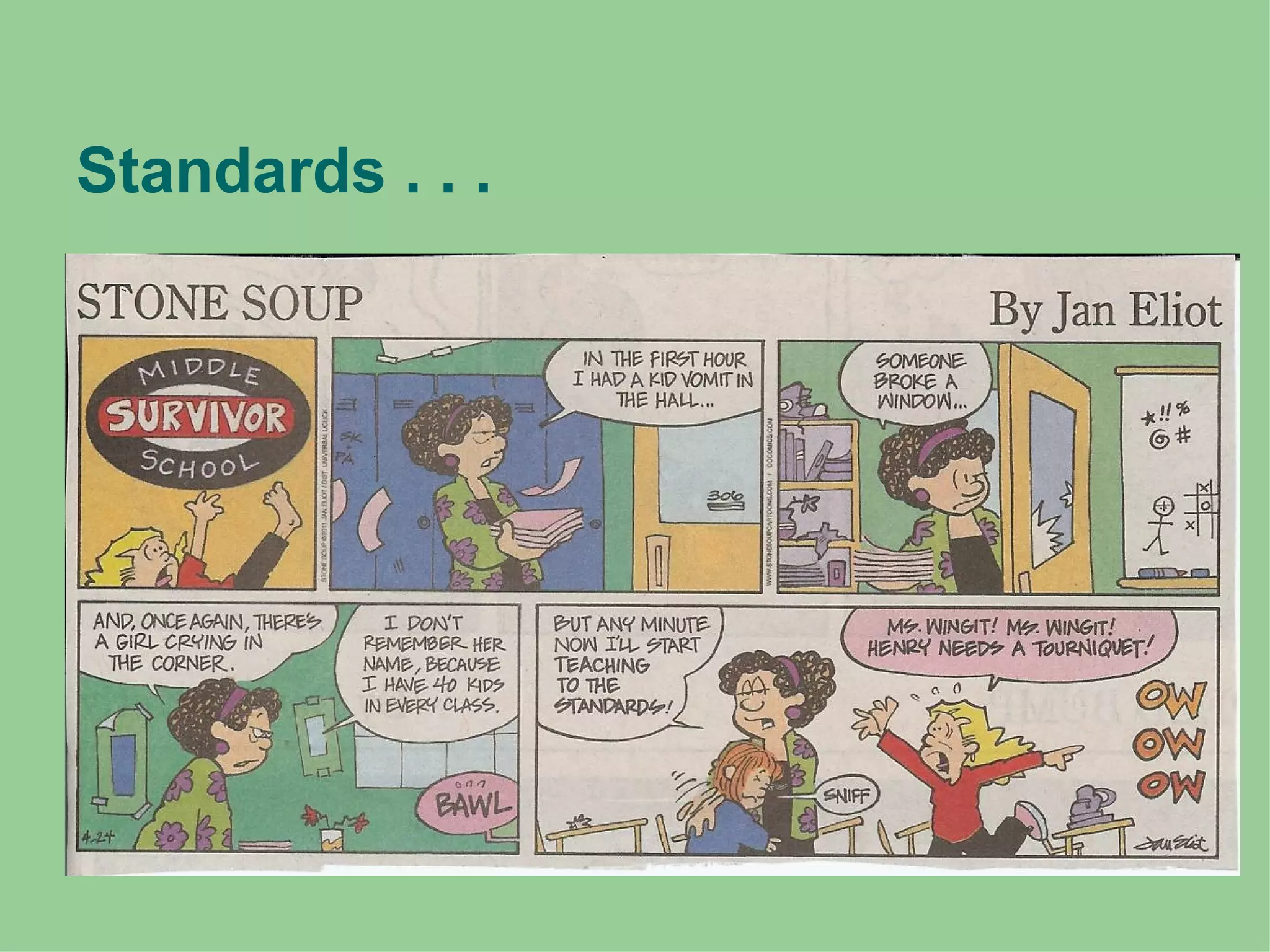
Standards . . .
Standards . . .

 “The 5 Cs . . . The Standards . . . The National
 Standards . . . The Standards for Learning
 Languages . . . The National Foreign Language
 Standards . . . The Standards for Foreign Language
 Learning in the 21st Century . . . whatever you call
 them, you know them—or you should know them—
 as the visionary goals guiding foreign language
 education and reflecting best instructional practices
 in the United States today and for the past 15+
 years.” Cutshall, Sandy. “More Than a Decade of Standards: A Look at
 how Far We’ve Come.” The Language Educator. January 2012, pg. 42


       Karen Fowdy and Lisa Hendrickson   http://WorkshopsforWorldLanguageInstruction.com
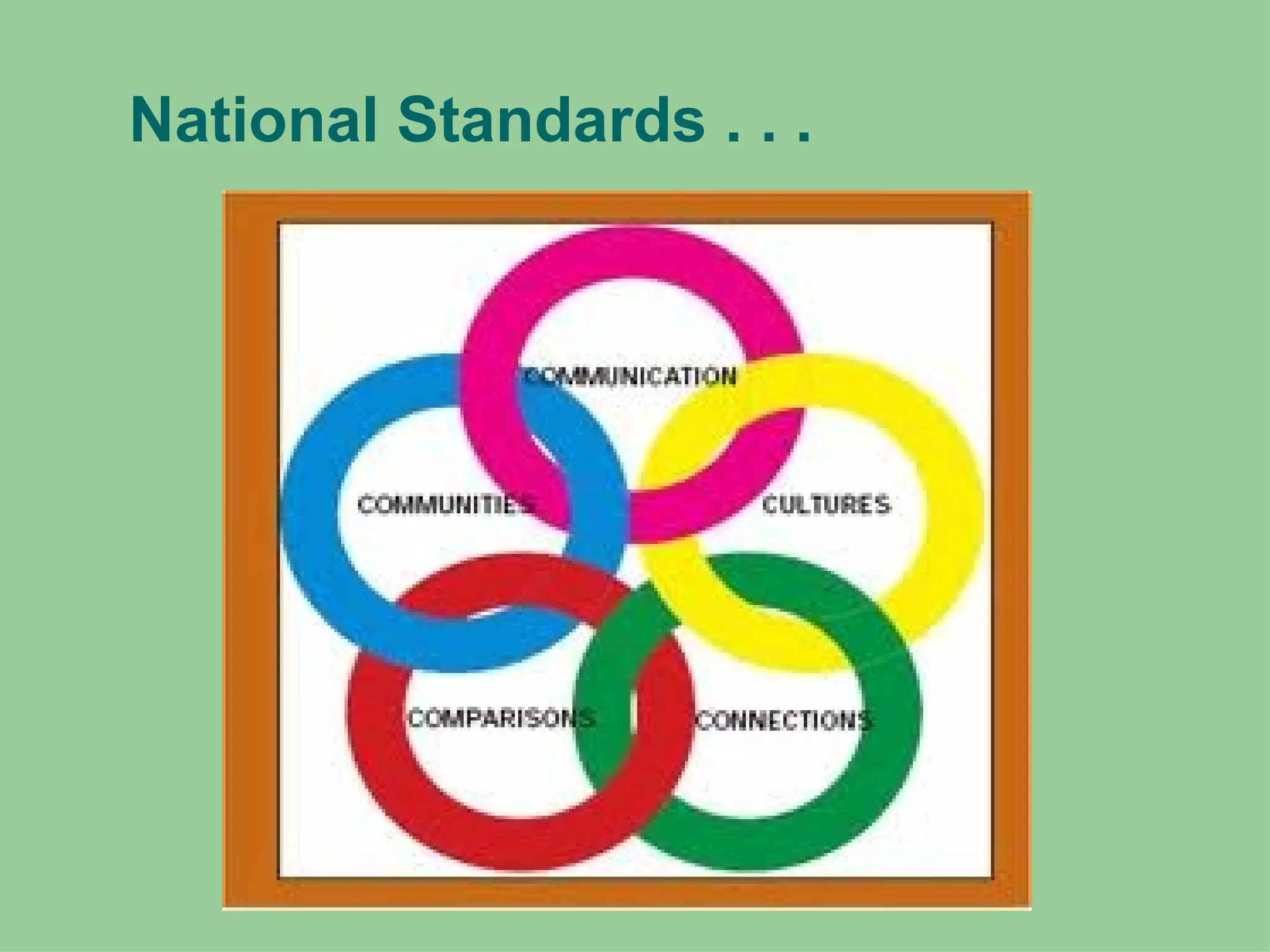
National Standards . . .
POP QUIZ

How well do you know the National Standards
 for Foreign Language Learning?
POP QUIZ
1.   D                                            1.     D (All seven of these are identified
2.   B                                                   as essential curricular elements)
3.   B (Option C describes what a                 2.     A
     student needs to do within the               3.     D
     modes of communication)                      4.     C
4.   A (Option D describes how                    5.     D
     culture used to be categorized:
     Big C for arts, literature; Little C         6.     C (Arabic, Chinese, Classical
     for daily routines, celebrations;                   Languages, French, German,
     and sometimes as Middle C for                       Italian, Japanese, Portuguese,
     systems such as economics of                        Russian, and Spanish); however,
     politics)                                           standards in American Sign
                                                         Language (ASL), Hindi, Korean,
                                                         Modern Greek, Scandinavian
                                                         languages, Swahili, Urdu, Yoruba,
                                                         and Zulu are underway.)


     Cutshall, S., More Than a Decade of Standards: A Look at How Far We’ve Come. (January 2012)
     The Language Educator 7, 46-47
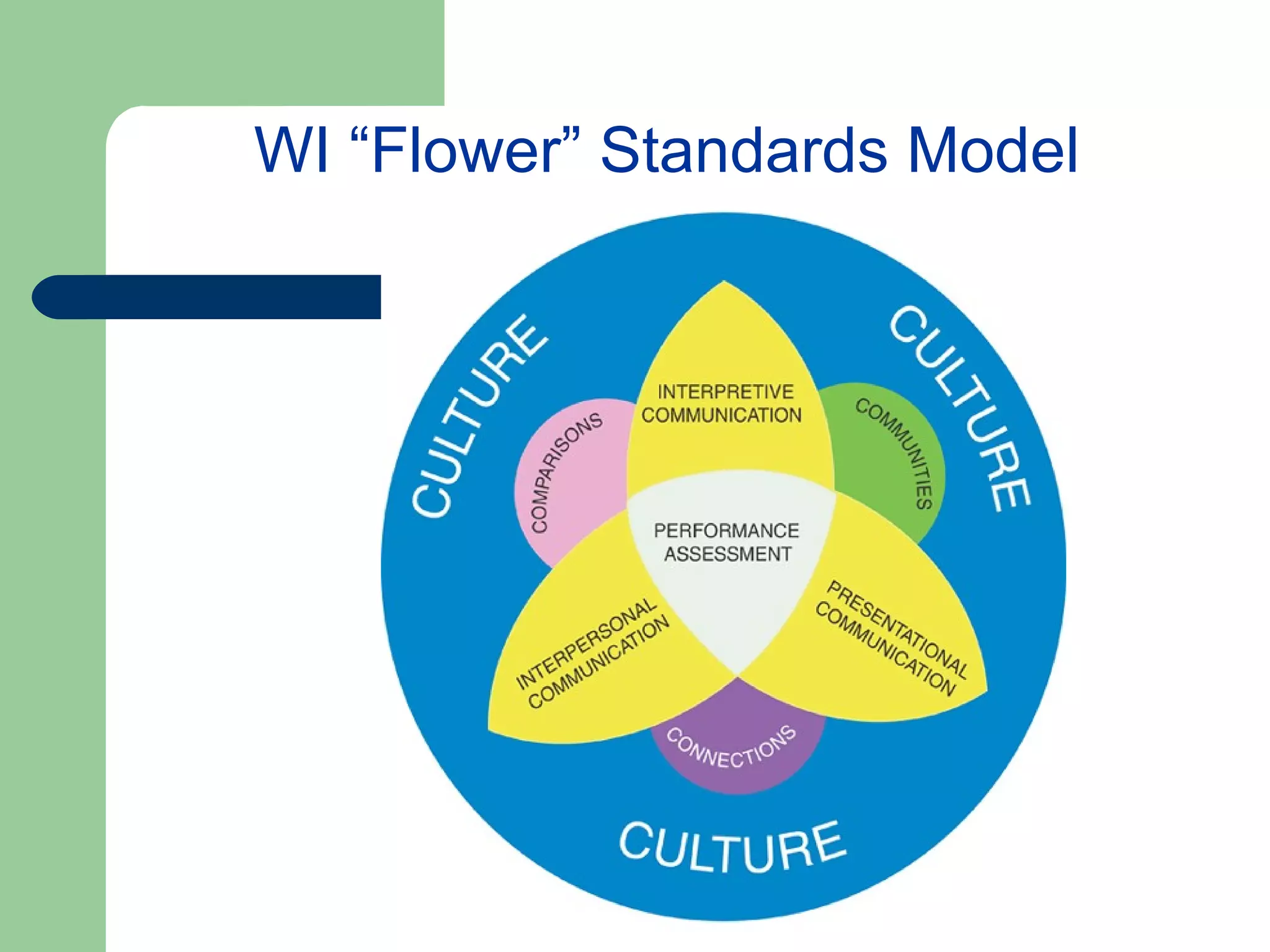
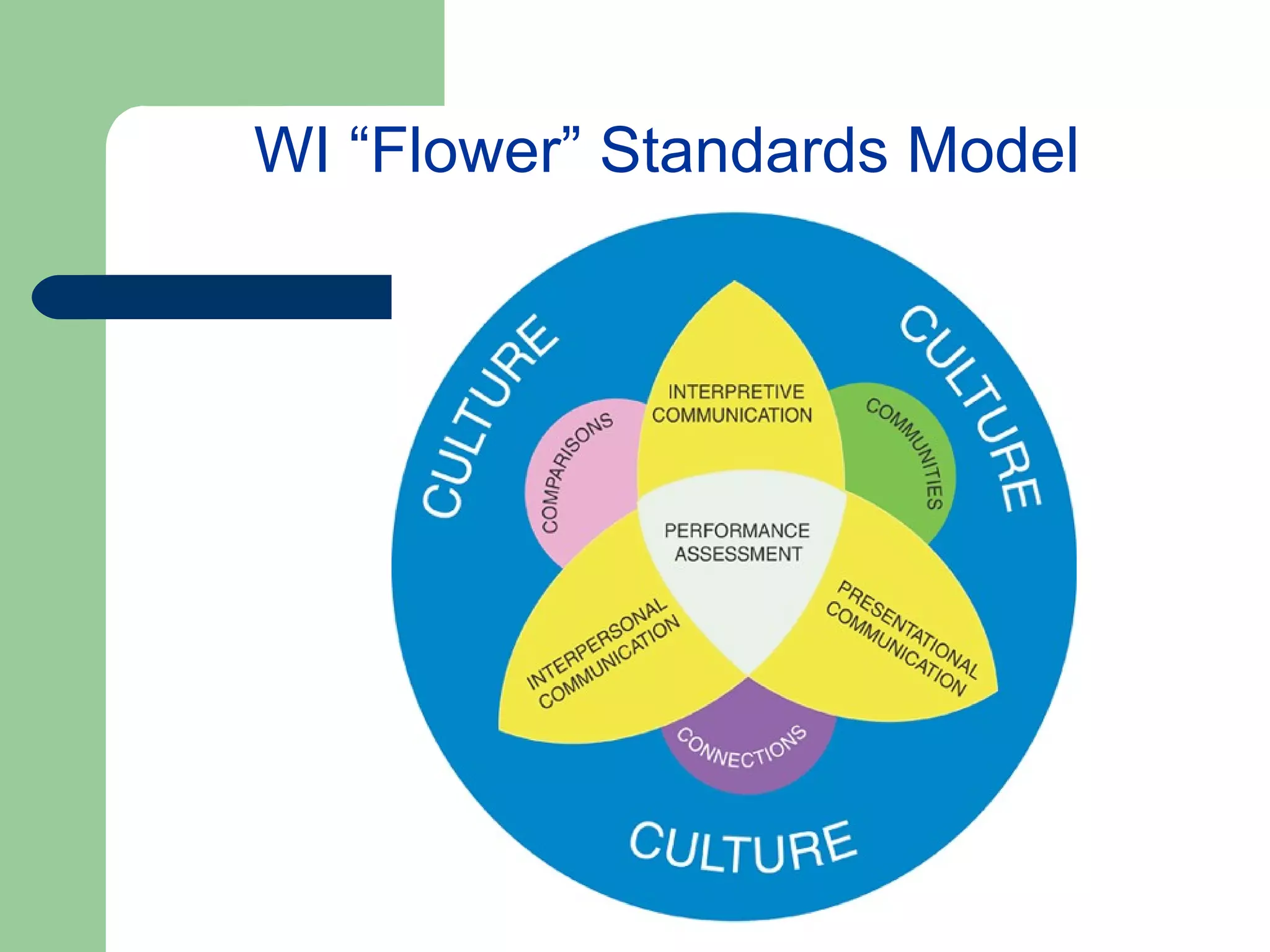
WI “Flower” Standards Model
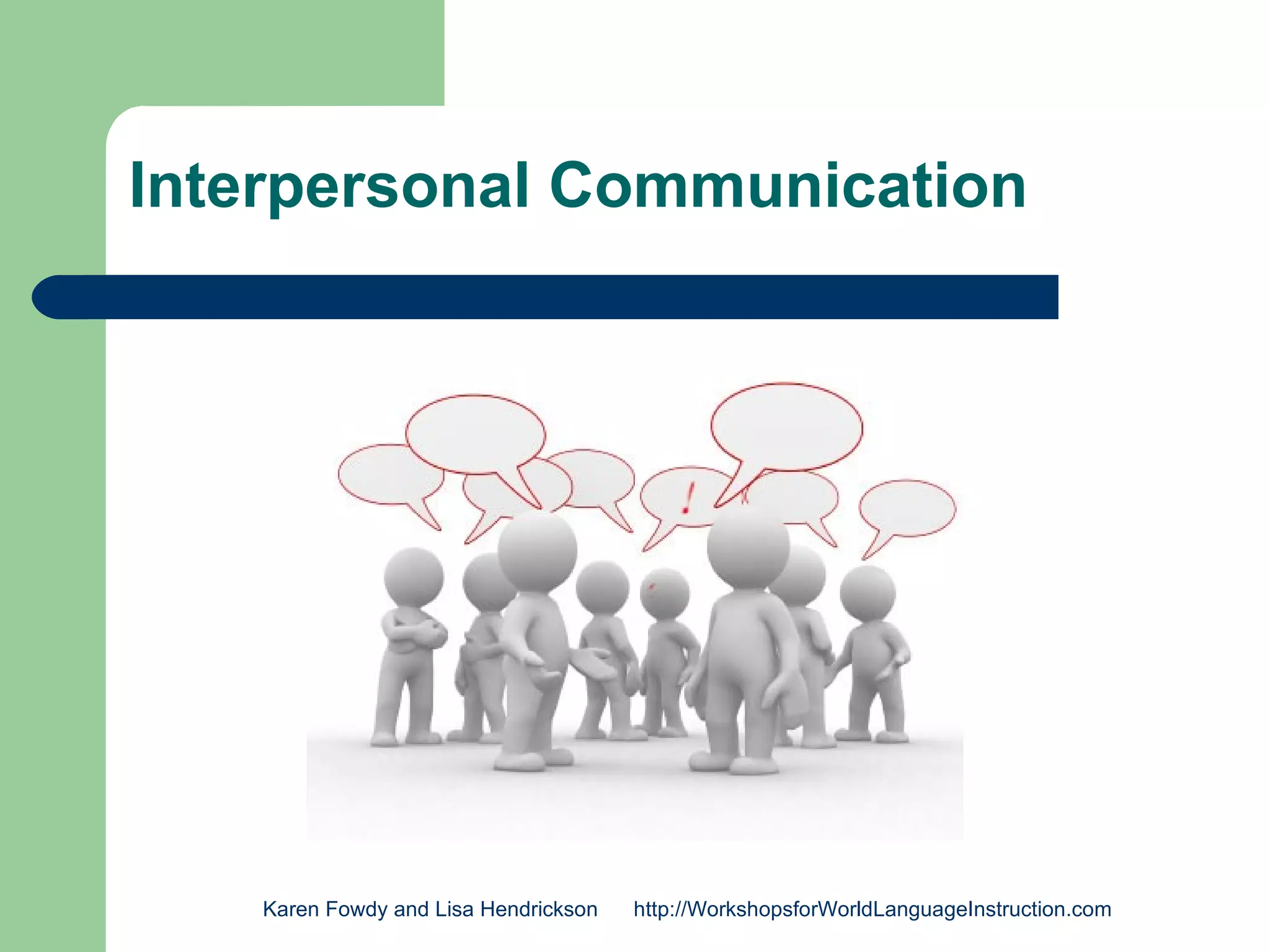
Interpersonal Communication


    Karen Fowdy and Lisa Hendrickson   http://WorkshopsforWorldLanguageInstruction.com
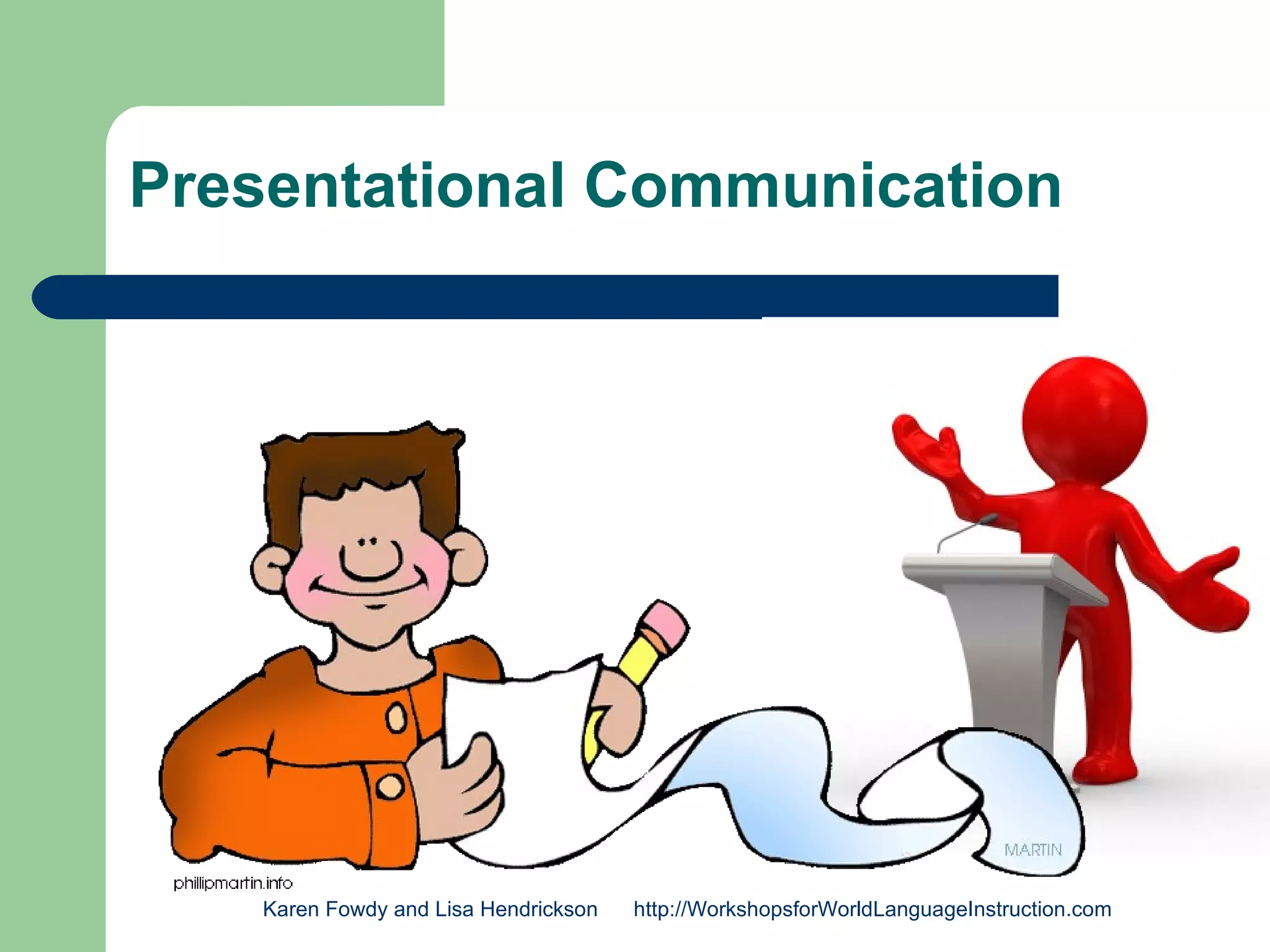
Presentational Communication


    Karen Fowdy and Lisa Hendrickson   http://WorkshopsforWorldLanguageInstruction.com
Interpretive Communication


    Karen Fowdy and Lisa Hendrickson   http://WorkshopsforWorldLanguageInstruction.com
Standards . . .

       “(Keith) Cothrun sees a major impact of the Standards
 movement as helping to unite the profession across languages
 and levels. He continues, “It has also gotten teachers—the
 classroom practitioners—to think about what really is important
 in the study and acquisition of language. And it’s not
 necessarily learning things in isolation; it’s not about being able
 to recite the rules. It’s actually about application. That has
 served us in providing students satisfaction in what they are
 learning in the classroom. Students in Standards-based
 programs are walking away with proficiency in the language—
 and that’s what they come to our classrooms for, to use the
 language in a very practical fashion and to communicate.”

   Cutshall, S., More Than a Decade of Standards: A Look at How Far We’ve Come. (January 2012)
   The Language Educator 7, 44-45
WI “Flower” Standards Model
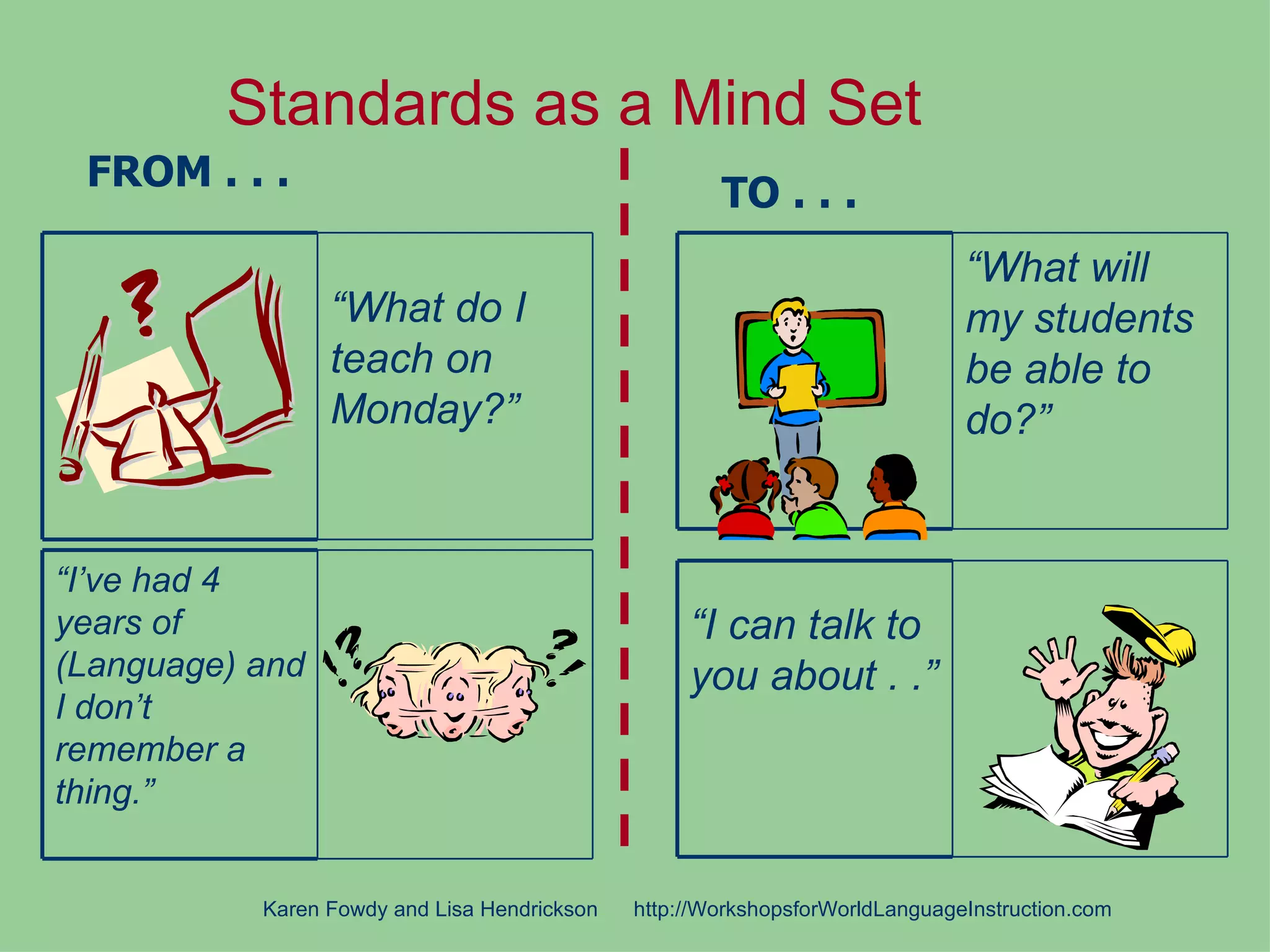
Standards as a Mind Set
 FROM . . .                                           TO . . .
                                                                              “What will
                 “What do I                                                   my students
                 teach on                                                     be able to
                 Monday?”                                                     do?”


“I’ve had 4
years of                                           “I can talk to
(Language) and                                     you about . .”
I don’t
remember a
thing.”


           Karen Fowdy and Lisa Hendrickson   http://WorkshopsforWorldLanguageInstruction.com
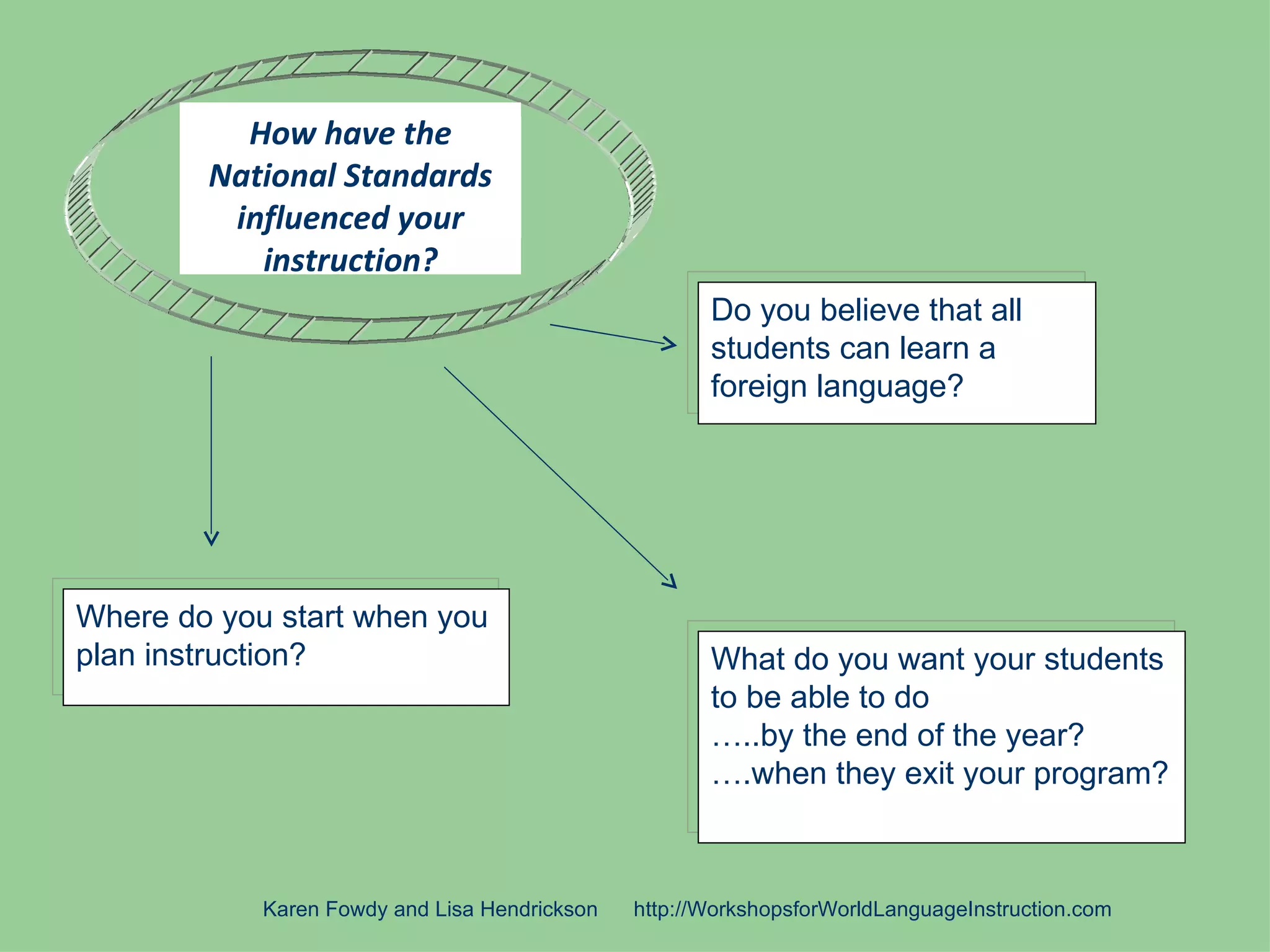
How Howthe National
             have have the
         National Standards
       Standards influenced your
       instruction?
           influenced your
            instruction?
                                                      Do you believe that all
                                                      students can learn a
                                                      foreign language?


Where do you start when you
plan instruction?                                     What do you want your students
                                                      to be able to do
                                                      …..by the end of the year?
                                                      ….when they exit your program?


            Karen Fowdy and Lisa Hendrickson   http://WorkshopsforWorldLanguageInstruction.com
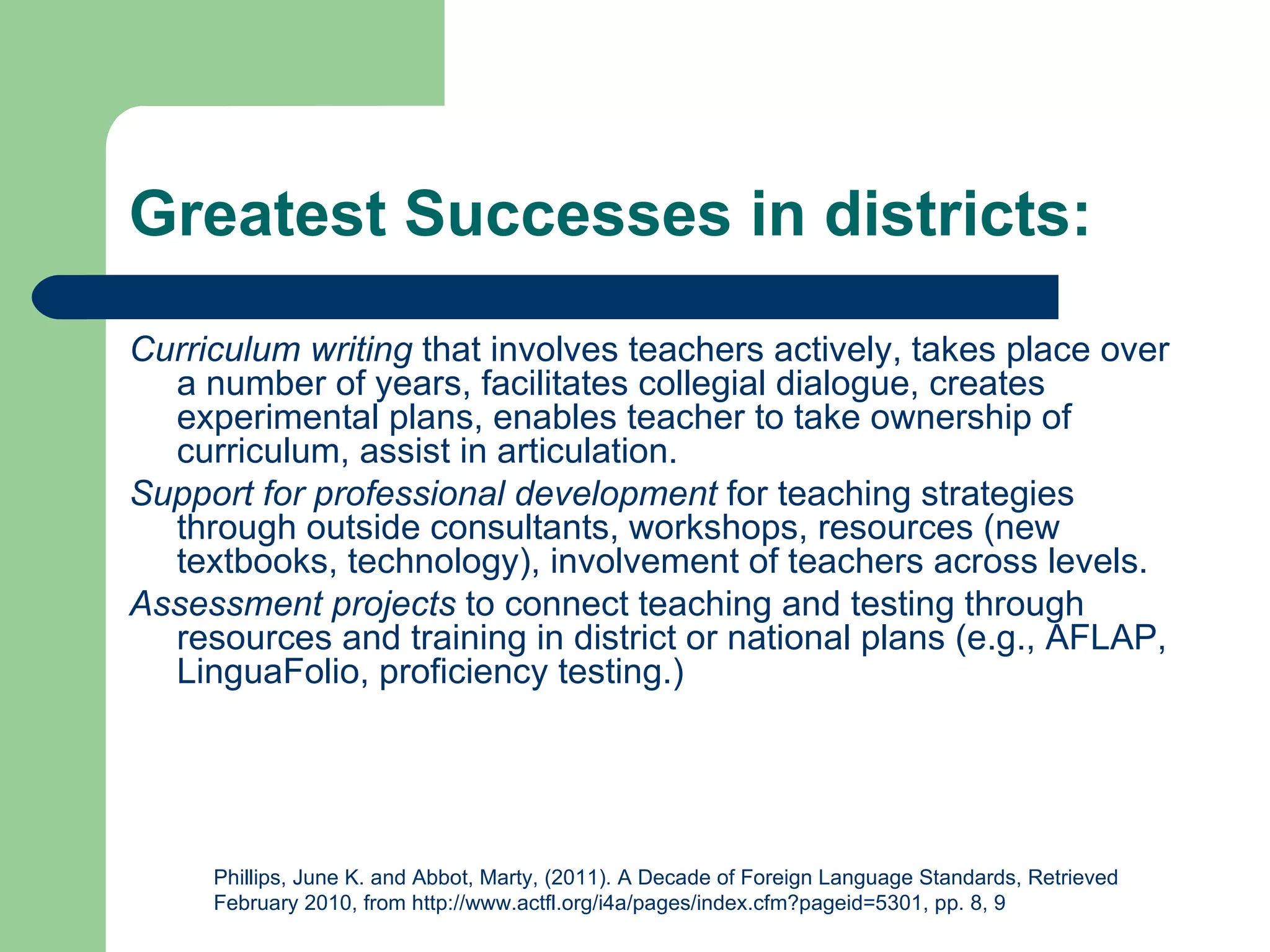
Greatest Successes in districts:
Curriculum writing that involves teachers actively, takes place over
  a number of years, facilitates collegial dialogue, creates
  experimental plans, enables teacher to take ownership of
  curriculum, assist in articulation.
Support for professional development for teaching strategies
  through outside consultants, workshops, resources (new
  textbooks, technology), involvement of teachers across levels.
Assessment projects to connect teaching and testing through
  resources and training in district or national plans (e.g., AFLAP,
  LinguaFolio, proficiency testing.)


     Phillips, June K. and Abbot, Marty, (2011). A Decade of Foreign Language Standards, Retrieved
     February 2010, from http://www.actfl.org/i4a/pages/index.cfm?pageid=5301, pp. 8, 9
Roadblocks?
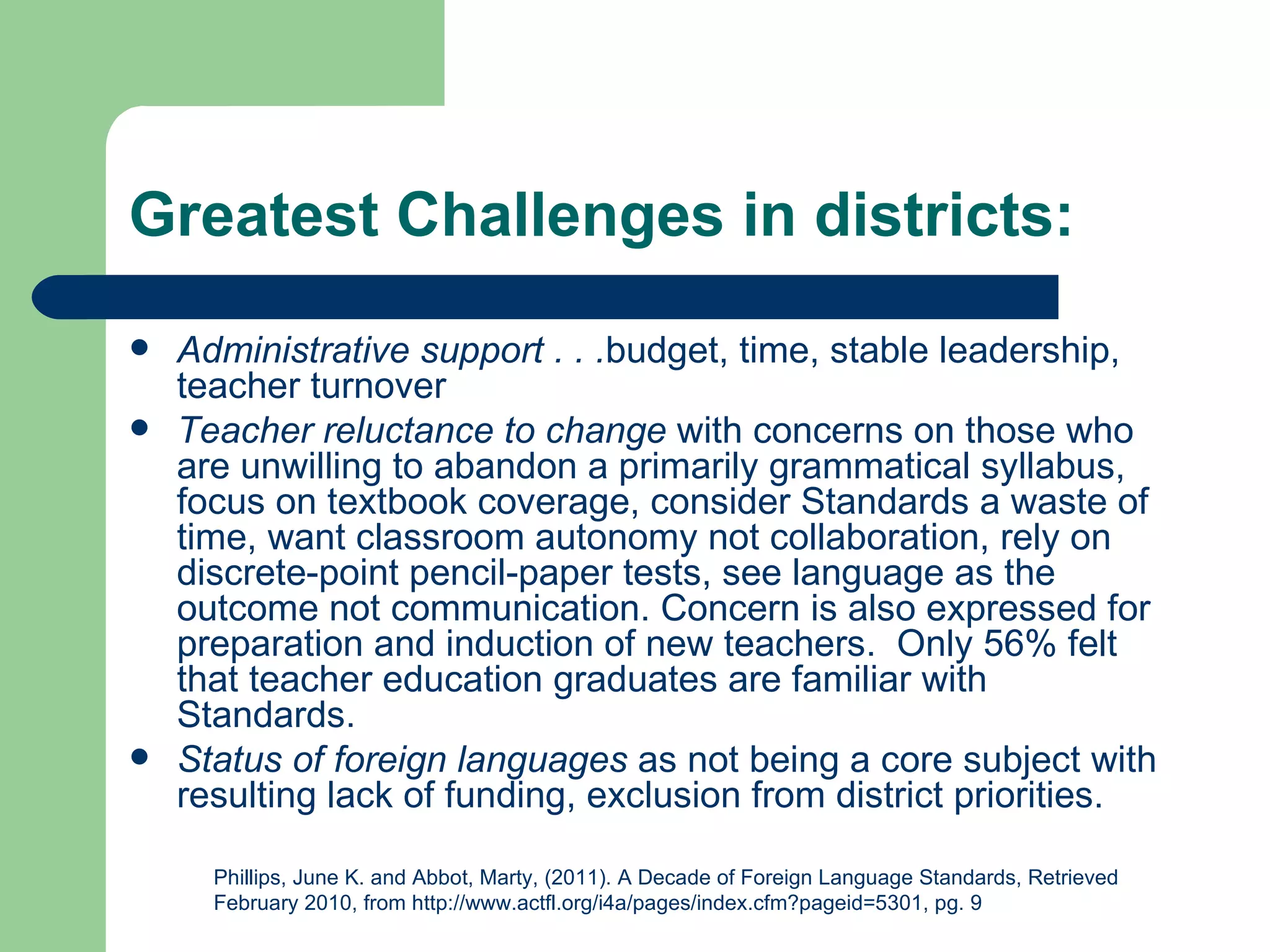
Greatest Challenges in districts:
   Administrative support . . .budget, time, stable leadership,
    teacher turnover
   Teacher reluctance to change with concerns on those who
    are unwilling to abandon a primarily grammatical syllabus,
    focus on textbook coverage, consider Standards a waste of
    time, want classroom autonomy not collaboration, rely on
    discrete-point pencil-paper tests, see language as the
    outcome not communication. Concern is also expressed for
    preparation and induction of new teachers. Only 56% felt
    that teacher education graduates are familiar with
    Standards.
   Status of foreign languages as not being a core subject with
    resulting lack of funding, exclusion from district priorities.

      Phillips, June K. and Abbot, Marty, (2011). A Decade of Foreign Language Standards, Retrieved
      February 2010, from http://www.actfl.org/i4a/pages/index.cfm?pageid=5301, pg. 9
By the end of this workshop you will:
 PART I Reaffirm the value and power of

          standards-based instruction
 PART               II Plan instruction
   PART III Prepare for the challenges of the
             21st Century

       Karen Fowdy and Lisa Hendrickson   http://WorkshopsforWorldLanguageInstruction.com
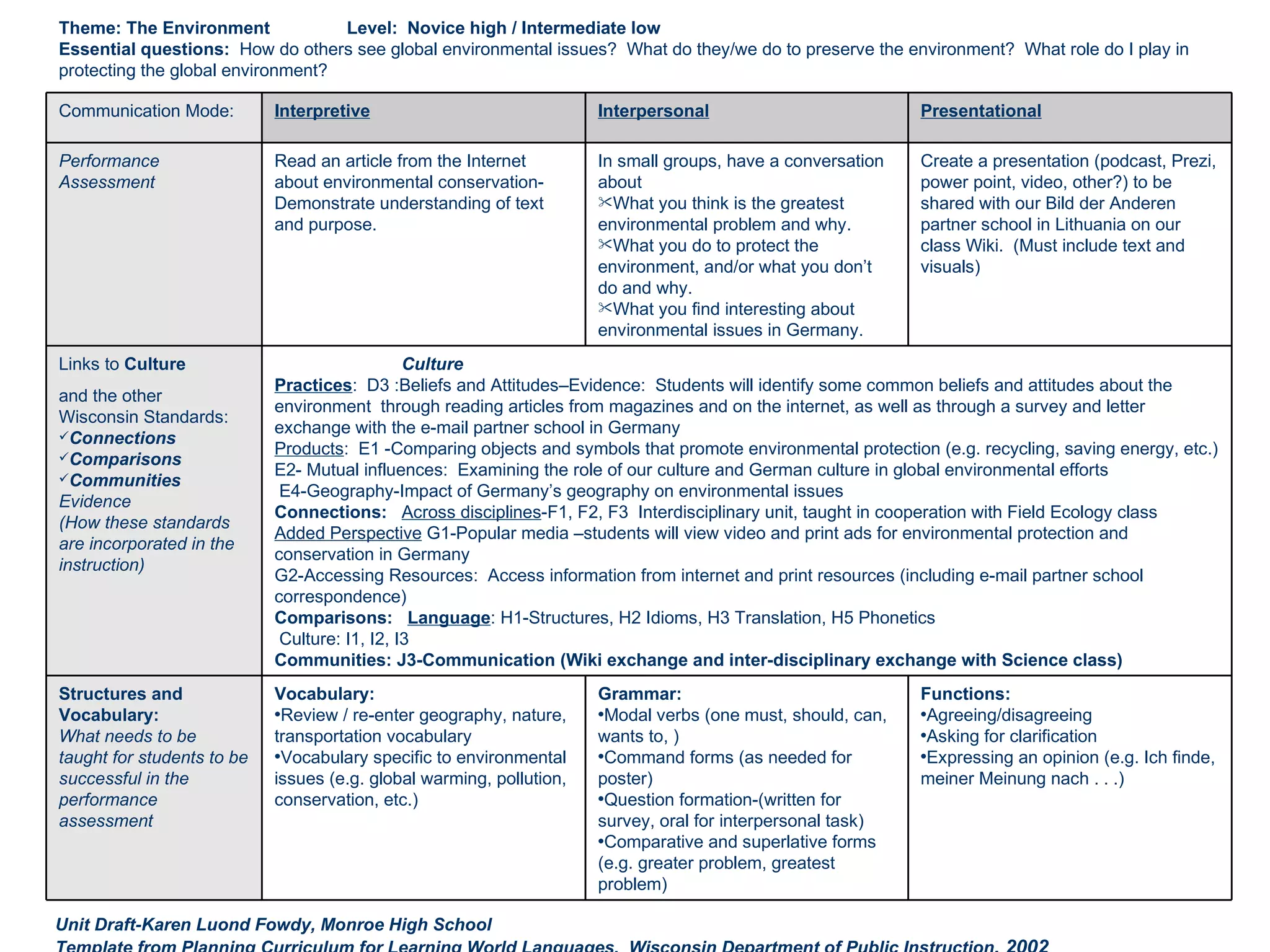
Theme: The Environment             Level: Novice high / Intermediate low
Essential questions: How do others see global environmental issues? What do they/we do to preserve the environment? What role do I play in
protecting the global environment?

Communication Mode:         Interpretive                              Interpersonal                          Presentational

Performance                 Read an article from the Internet         In small groups, have a conversation   Create a presentation (podcast, Prezi,
Assessment                  about environmental conservation-         about                                  power point, video, other?) to be
                            Demonstrate understanding of text         What you think is the greatest        shared with our Bild der Anderen
                            and purpose.                              environmental problem and why.         partner school in Lithuania on our
                                                                      What you do to protect the            class Wiki. (Must include text and
                                                                      environment, and/or what you don’t     visuals)
                                                                      do and why.
                                                                      What you find interesting about
                                                                      environmental issues in Germany.
Links to Culture                               Culture
                            Practices: D3 :Beliefs and Attitudes–Evidence: Students will identify some common beliefs and attitudes about the
and the other
                            environment through reading articles from magazines and on the internet, as well as through a survey and letter
Wisconsin Standards:
Connections
                            exchange with the e-mail partner school in Germany
Comparisons
                            Products: E1 -Comparing objects and symbols that promote environmental protection (e.g. recycling, saving energy, etc.)
Communities
                            E2- Mutual influences: Examining the role of our culture and German culture in global environmental efforts
                             E4-Geography-Impact of Germany’s geography on environmental issues
Evidence
                            Connections: Across disciplines-F1, F2, F3 Interdisciplinary unit, taught in cooperation with Field Ecology class
(How these standards
                            Added Perspective G1-Popular media –students will view video and print ads for environmental protection and
are incorporated in the
                            conservation in Germany
instruction)
                            G2-Accessing Resources: Access information from internet and print resources (including e-mail partner school
                            correspondence)
                            Comparisons: Language: H1-Structures, H2 Idioms, H3 Translation, H5 Phonetics
                             Culture: I1, I2, I3
                            Communities: J3-Communication (Wiki exchange and inter-disciplinary exchange with Science class)
Structures and              Vocabulary:                               Grammar:                               Functions:
Vocabulary:                 •Review / re-enter geography, nature,     •Modal verbs (one must, should, can,   •Agreeing/disagreeing
What needs to be            transportation vocabulary                 wants to, )                            •Asking for clarification
taught for students to be   •Vocabulary specific to environmental     •Command forms (as needed for          •Expressing an opinion (e.g. Ich finde,
successful in the           issues (e.g. global warming, pollution,   poster)                                meiner Meinung nach . . .)
performance                 conservation, etc.)                       •Question formation-(written for
assessment                                                            survey, oral for interpersonal task)
                                                                      •Comparative and superlative forms
                                                                      (e.g. greater problem, greatest
                                                                      problem)

Unit Draft-Karen Luond Fowdy, Monroe High School
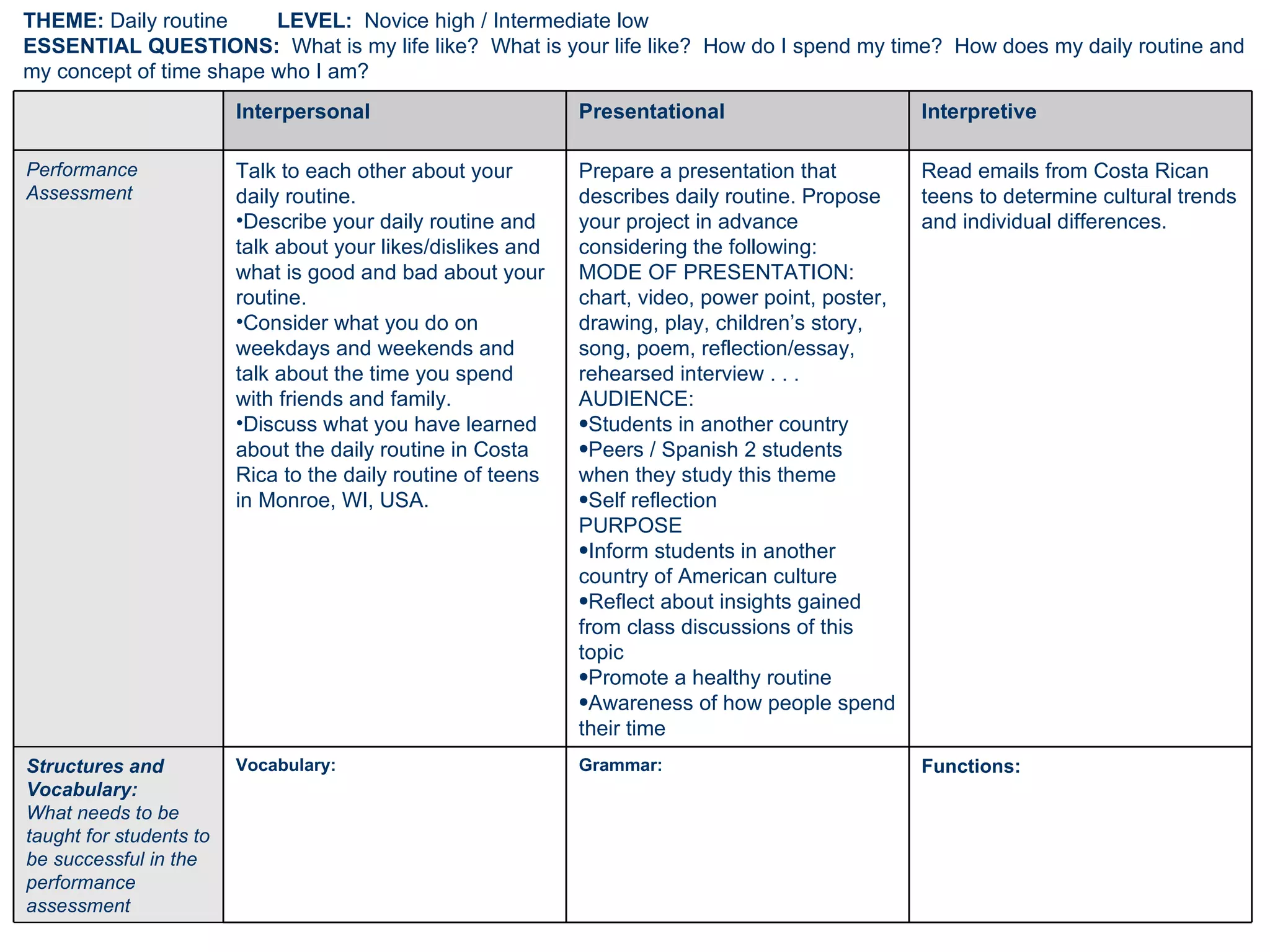
THEME: Daily routine     LEVEL: Novice high / Intermediate low
ESSENTIAL QUESTIONS: What is my life like? What is your life like? How do I spend my time? How does my daily routine and
my concept of time shape who I am?
                         Interpersonal                        Presentational                       Interpretive

Performance              Talk to each other about your        Prepare a presentation that          Read emails from Costa Rican
Assessment               daily routine.                       describes daily routine. Propose     teens to determine cultural trends
                         •Describe your daily routine and     your project in advance              and individual differences.
                         talk about your likes/dislikes and   considering the following:
                         what is good and bad about your      MODE OF PRESENTATION:
                         routine.                             chart, video, power point, poster,
                         •Consider what you do on             drawing, play, children’s story,
                         weekdays and weekends and            song, poem, reflection/essay,
                         talk about the time you spend        rehearsed interview . . .
                         with friends and family.             AUDIENCE:
                         •Discuss what you have learned       •Students in another country
                         about the daily routine in Costa     •Peers / Spanish 2 students
                         Rica to the daily routine of teens   when they study this theme
                         in Monroe, WI, USA.                  •Self reflection
                                                              PURPOSE
                                                              •Inform students in another
                                                              country of American culture
                                                              •Reflect about insights gained
                                                              from class discussions of this
                                                              topic
                                                              •Promote a healthy routine
                                                              •Awareness of how people spend
                                                              their time
Structures and           Vocabulary:                          Grammar:                             Functions:
Vocabulary:
What needs to be
taught for students to
be successful in the
performance
assessment
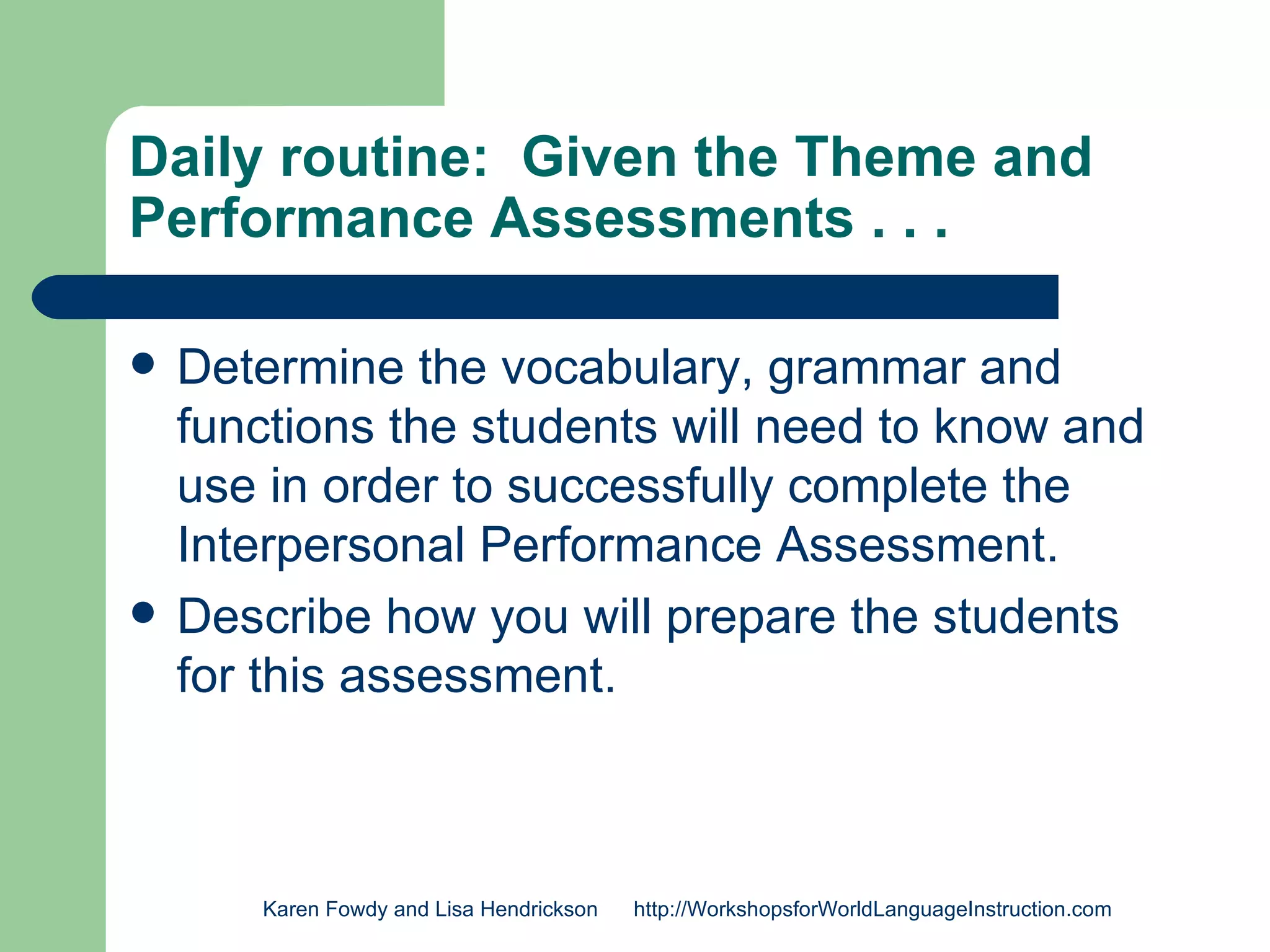
Daily routine: Given the Theme and
Performance Assessments . . .

   Determine the vocabulary, grammar and
    functions the students will need to know and
    use in order to successfully complete the
    Interpersonal Performance Assessment.
   Describe how you will prepare the students
    for this assessment.


       Karen Fowdy and Lisa Hendrickson   http://WorkshopsforWorldLanguageInstruction.com
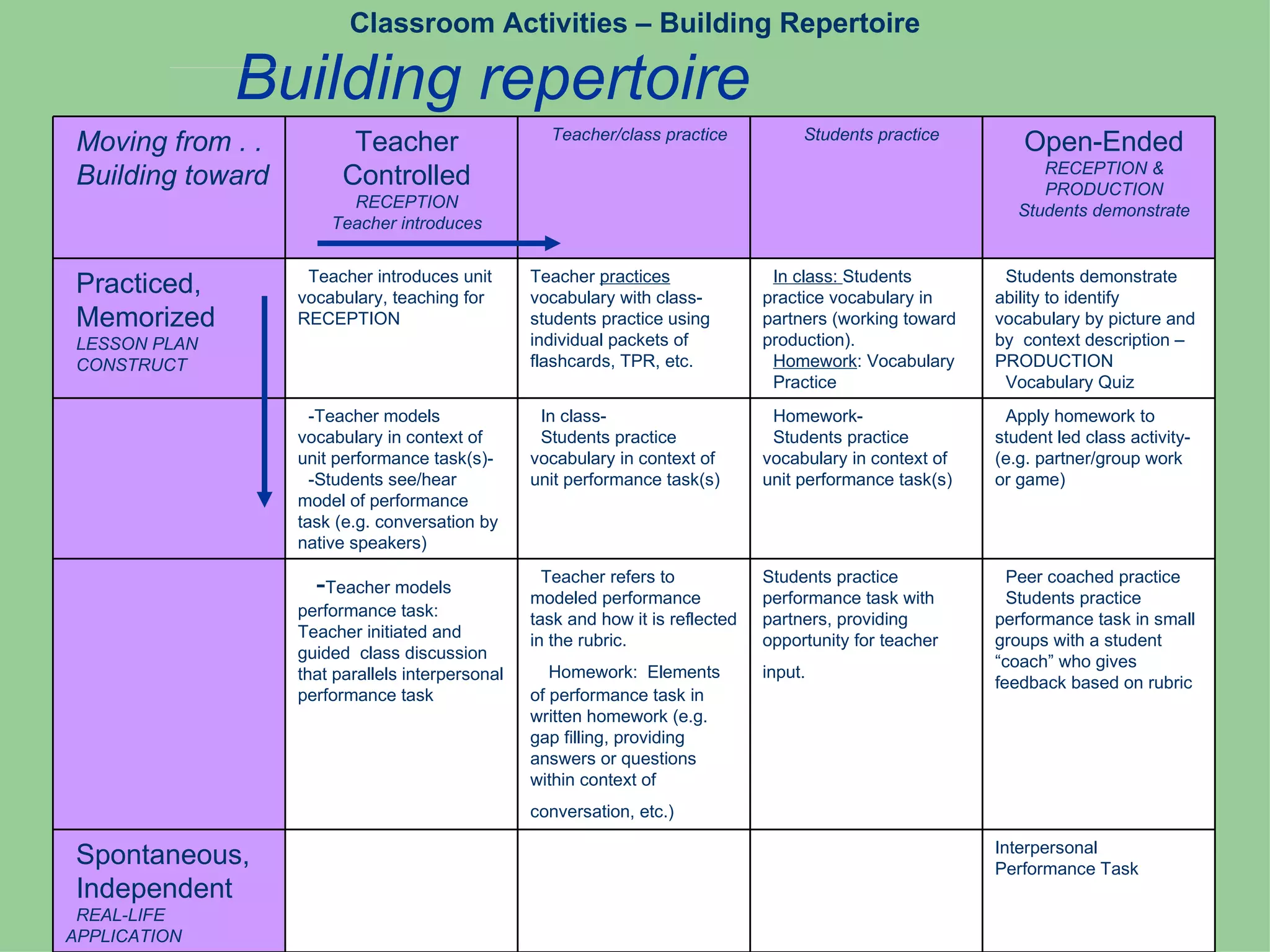
Classroom Activities – Building Repertoire

               Building repertoire
                                                    Teacher/class practice            Students practice
 Moving from . .          Teacher                                                                               Open-Ended
                                                                                                                  RECEPTION &
 Building toward         Controlled                                                                               PRODUCTION
                         RECEPTION                                                                             Students demonstrate
                       Teacher introduces


                    Teacher introduces unit       Teacher practices               In class: Students         Students demonstrate
 Practiced,        vocabulary, teaching for       vocabulary with class-         practice vocabulary in     ability to identify
 Memorized         RECEPTION                      students practice using        partners (working toward   vocabulary by picture and
 LESSON PLAN                                      individual packets of          production).               by context description –
 CONSTRUCT                                        flashcards, TPR, etc.           Homework: Vocabulary      PRODUCTION
                                                                                  Practice                   Vocabulary Quiz
                     -Teacher models               In class-                      Homework-                  Apply homework to
                   vocabulary in context of        Students practice              Students practice         student led class activity-
                   unit performance task(s)-      vocabulary in context of       vocabulary in context of   (e.g. partner/group work
                     -Students see/hear           unit performance task(s)       unit performance task(s)   or game)
                   model of performance
                   task (e.g. conversation by
                   native speakers)
                                                    Teacher refers to            Students practice            Peer coached practice
                     -Teacher models              modeled performance            performance task with        Students practice
                   performance task:              task and how it is reflected   partners, providing        performance task in small
                   Teacher initiated and          in the rubric.                 opportunity for teacher    groups with a student
                   guided class discussion                                                                  “coach” who gives
                   that parallels interpersonal      Homework: Elements          input.
                                                                                                            feedback based on rubric
                   performance task               of performance task in
                                                  written homework (e.g.
                                                  gap filling, providing
                                                  answers or questions
                                                  within context of
                                                  conversation, etc.)

                                                                                                            Interpersonal
 Spontaneous,                                                                                               Performance Task
 Independent
 REAL-LIFE
APPLICATION
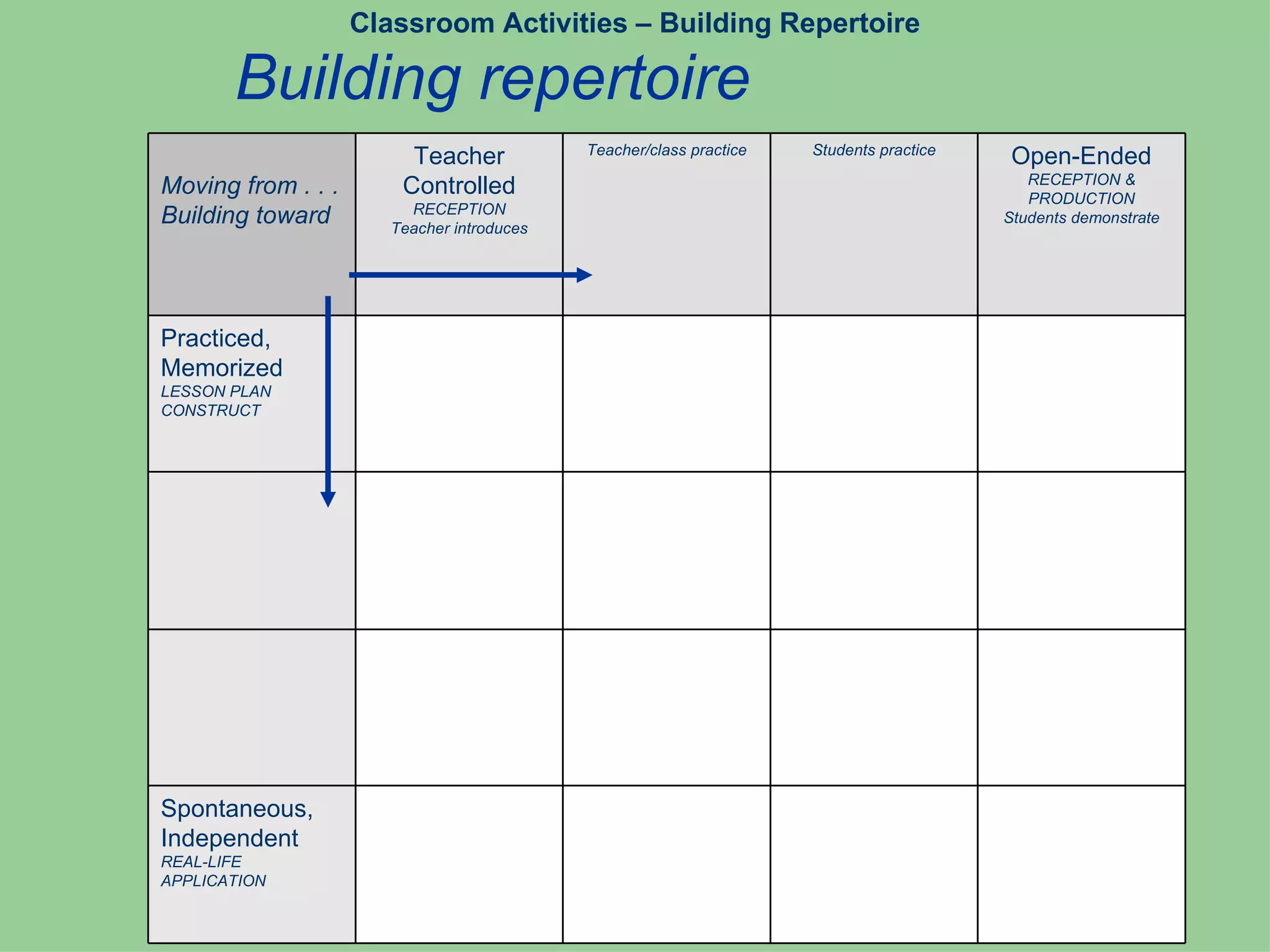
Classroom Activities – Building Repertoire

       Building repertoire
                                            Teacher/class practice   Students practice
                         Teacher                                                          Open-Ended
                                                                                            RECEPTION &
Moving from . . .       Controlled                                                          PRODUCTION
                         RECEPTION
Building toward        Teacher introduces
                                                                                         Students demonstrate


Practiced,
Memorized
LESSON PLAN
CONSTRUCT


Spontaneous,
Independent
REAL-LIFE
APPLICATION
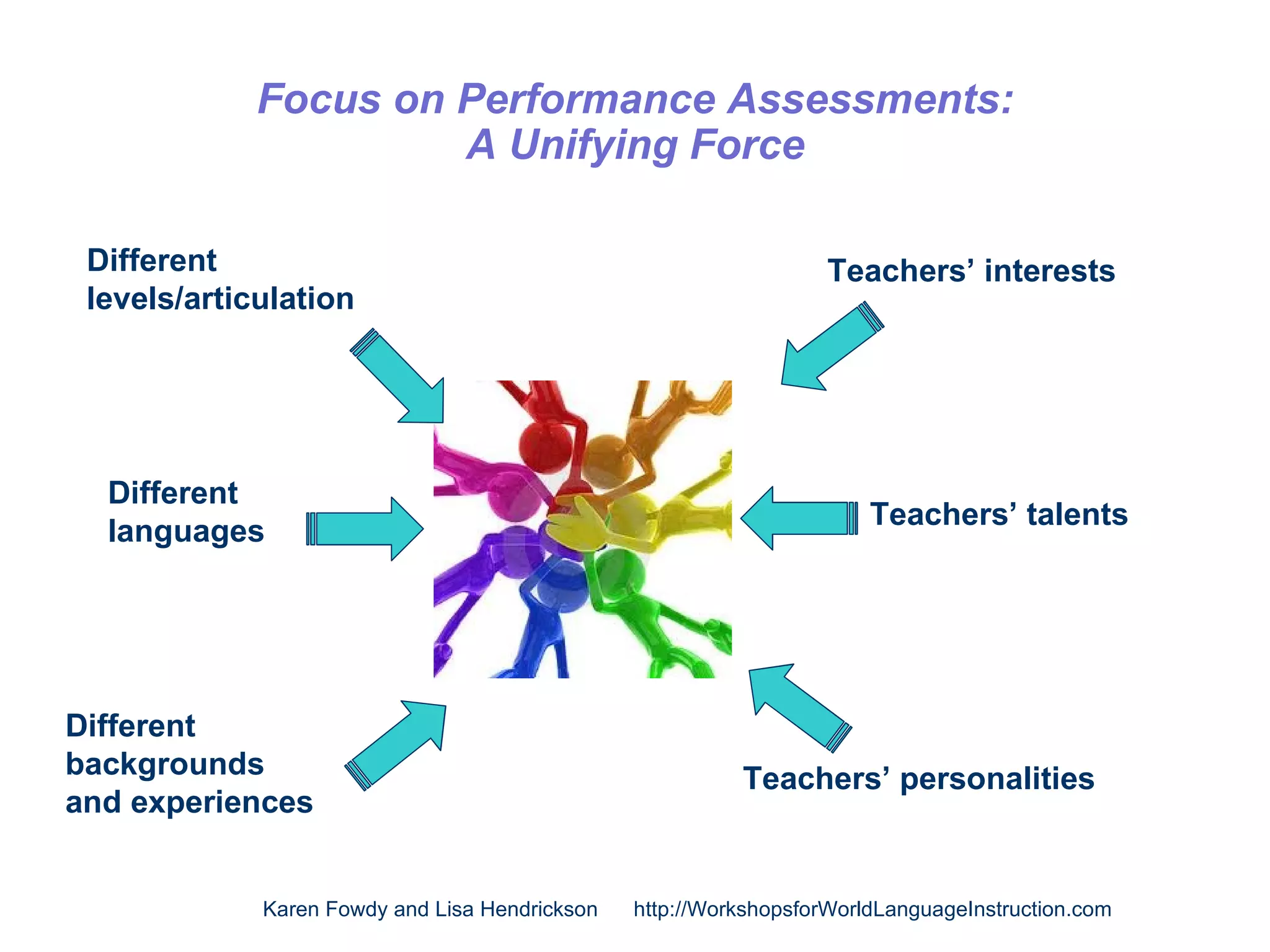
Focus on Performance Assessments:
                      A Unifying Force

 Different                                                         Teachers’ interests
 levels/articulation


  Different
                                                                       Teachers’ talents
  languages


Different
backgrounds                                               Teachers’ personalities
and experiences


             Karen Fowdy and Lisa Hendrickson   http://WorkshopsforWorldLanguageInstruction.com
By the end of this workshop you will:
 PART I    Reaffirm the value and power of
            standards-based instruction
 PART II   Plan instruction

 PART  III Prepare for the
  challenges of the 21st Century

      Karen Fowdy and Lisa Hendrickson   http://WorkshopsforWorldLanguageInstruction.com
Part III – 21st Century

   Global Education and International Initiatives
   Alignment with Common Core State
    Standards. http://www.actfl.org/commoncore
   A Decade of Foreign Language Standards
    Impact, Influence, and Future Directions
    http://www.actfl.org


        Karen Fowdy and Lisa Hendrickson   http://WorkshopsforWorldLanguageInstruction.com
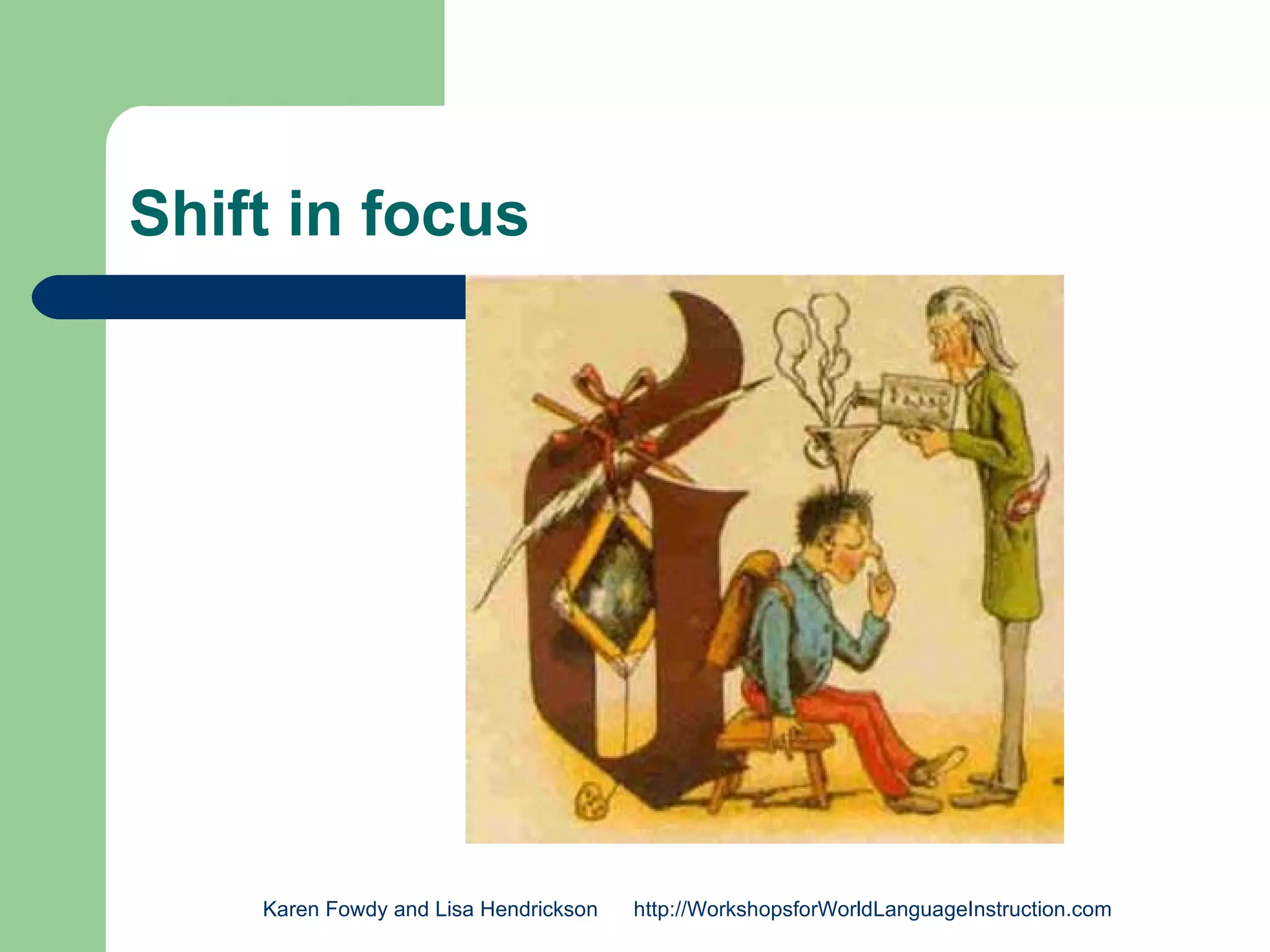
Shift in focus


    Karen Fowdy and Lisa Hendrickson   http://WorkshopsforWorldLanguageInstruction.com
REVIEW

By the end of this workshop you will:
 PART I Reaffirm the value and power of

           standards-based instruction
 PART II Plan instruction
 PART III Prepare for the challenges of the

           21st Century


     Karen Fowdy and Lisa Hendrickson   http://WorkshopsforWorldLanguageInstruction.com
REFLECTION

   Why did you become a world language
    teacher?
   Why do your students want to learn a new
    language?


       Karen Fowdy and Lisa Hendrickson   http://WorkshopsforWorldLanguageInstruction.com

Csc power point 2012 mar 4 for wiki

  • 1.
    Still Standards afterAll These Years Karen Luond Fowdy and Lisa Hendrickson http://WorkshopsforWorldLanguageInstruction.com http://fowdyhendrickson.wikispaces.com/
  • 2.
    INTRODUCTION  Who are you?  Why did you become a world language teacher? Karen Fowdy and Lisa Hendrickson http://WorkshopsforWorldLanguageInstruction.com
  • 3.
    OVERVIEW By the endof this workshop you will:  PART I Reaffirm the value and power of standards-based instruction  PART II Plan instruction  PART III Prepare for the challenges of the 21st Century Karen Fowdy and Lisa Hendrickson http://WorkshopsforWorldLanguageInstruction.com
  • 4.
    OVERVIEW By the endof this workshop you will:  PART I Reaffirm the value and power of standards- based instruction  PART II Plan instruction  PART III Prepare for the challenges of the 21st Century Karen Fowdy and Lisa Hendrickson http://WorkshopsforWorldLanguageInstruction.com
  • 5.
  • 6.
    Standards . .. “The 5 Cs . . . The Standards . . . The National Standards . . . The Standards for Learning Languages . . . The National Foreign Language Standards . . . The Standards for Foreign Language Learning in the 21st Century . . . whatever you call them, you know them—or you should know them— as the visionary goals guiding foreign language education and reflecting best instructional practices in the United States today and for the past 15+ years.” Cutshall, Sandy. “More Than a Decade of Standards: A Look at how Far We’ve Come.” The Language Educator. January 2012, pg. 42 Karen Fowdy and Lisa Hendrickson http://WorkshopsforWorldLanguageInstruction.com
  • 7.
  • 8.
    POP QUIZ How welldo you know the National Standards for Foreign Language Learning?
  • 9.
    POP QUIZ 1. D 1. D (All seven of these are identified 2. B as essential curricular elements) 3. B (Option C describes what a 2. A student needs to do within the 3. D modes of communication) 4. C 4. A (Option D describes how 5. D culture used to be categorized: Big C for arts, literature; Little C 6. C (Arabic, Chinese, Classical for daily routines, celebrations; Languages, French, German, and sometimes as Middle C for Italian, Japanese, Portuguese, systems such as economics of Russian, and Spanish); however, politics) standards in American Sign Language (ASL), Hindi, Korean, Modern Greek, Scandinavian languages, Swahili, Urdu, Yoruba, and Zulu are underway.) Cutshall, S., More Than a Decade of Standards: A Look at How Far We’ve Come. (January 2012) The Language Educator 7, 46-47
  • 10.
  • 11.
    Interpersonal Communication Karen Fowdy and Lisa Hendrickson http://WorkshopsforWorldLanguageInstruction.com
  • 12.
    Presentational Communication Karen Fowdy and Lisa Hendrickson http://WorkshopsforWorldLanguageInstruction.com
  • 13.
    Interpretive Communication Karen Fowdy and Lisa Hendrickson http://WorkshopsforWorldLanguageInstruction.com
  • 14.
    Standards . .. “(Keith) Cothrun sees a major impact of the Standards movement as helping to unite the profession across languages and levels. He continues, “It has also gotten teachers—the classroom practitioners—to think about what really is important in the study and acquisition of language. And it’s not necessarily learning things in isolation; it’s not about being able to recite the rules. It’s actually about application. That has served us in providing students satisfaction in what they are learning in the classroom. Students in Standards-based programs are walking away with proficiency in the language— and that’s what they come to our classrooms for, to use the language in a very practical fashion and to communicate.” Cutshall, S., More Than a Decade of Standards: A Look at How Far We’ve Come. (January 2012) The Language Educator 7, 44-45
  • 15.
  • 16.
    Standards as aMind Set FROM . . . TO . . . “What will “What do I my students teach on be able to Monday?” do?” “I’ve had 4 years of “I can talk to (Language) and you about . .” I don’t remember a thing.” Karen Fowdy and Lisa Hendrickson http://WorkshopsforWorldLanguageInstruction.com
  • 17.
    How Howthe National have have the National Standards Standards influenced your instruction? influenced your instruction? Do you believe that all students can learn a foreign language? Where do you start when you plan instruction? What do you want your students to be able to do …..by the end of the year? ….when they exit your program? Karen Fowdy and Lisa Hendrickson http://WorkshopsforWorldLanguageInstruction.com
  • 18.
    Greatest Successes indistricts: Curriculum writing that involves teachers actively, takes place over a number of years, facilitates collegial dialogue, creates experimental plans, enables teacher to take ownership of curriculum, assist in articulation. Support for professional development for teaching strategies through outside consultants, workshops, resources (new textbooks, technology), involvement of teachers across levels. Assessment projects to connect teaching and testing through resources and training in district or national plans (e.g., AFLAP, LinguaFolio, proficiency testing.) Phillips, June K. and Abbot, Marty, (2011). A Decade of Foreign Language Standards, Retrieved February 2010, from http://www.actfl.org/i4a/pages/index.cfm?pageid=5301, pp. 8, 9
  • 19.
  • 20.
    Greatest Challenges indistricts:  Administrative support . . .budget, time, stable leadership, teacher turnover  Teacher reluctance to change with concerns on those who are unwilling to abandon a primarily grammatical syllabus, focus on textbook coverage, consider Standards a waste of time, want classroom autonomy not collaboration, rely on discrete-point pencil-paper tests, see language as the outcome not communication. Concern is also expressed for preparation and induction of new teachers. Only 56% felt that teacher education graduates are familiar with Standards.  Status of foreign languages as not being a core subject with resulting lack of funding, exclusion from district priorities. Phillips, June K. and Abbot, Marty, (2011). A Decade of Foreign Language Standards, Retrieved February 2010, from http://www.actfl.org/i4a/pages/index.cfm?pageid=5301, pg. 9
  • 21.
    By the endof this workshop you will:  PART I Reaffirm the value and power of standards-based instruction  PART II Plan instruction  PART III Prepare for the challenges of the 21st Century Karen Fowdy and Lisa Hendrickson http://WorkshopsforWorldLanguageInstruction.com
  • 22.
    Theme: The Environment Level: Novice high / Intermediate low Essential questions: How do others see global environmental issues? What do they/we do to preserve the environment? What role do I play in protecting the global environment? Communication Mode: Interpretive Interpersonal Presentational Performance Read an article from the Internet In small groups, have a conversation Create a presentation (podcast, Prezi, Assessment about environmental conservation- about power point, video, other?) to be Demonstrate understanding of text What you think is the greatest shared with our Bild der Anderen and purpose. environmental problem and why. partner school in Lithuania on our What you do to protect the class Wiki. (Must include text and environment, and/or what you don’t visuals) do and why. What you find interesting about environmental issues in Germany. Links to Culture Culture Practices: D3 :Beliefs and Attitudes–Evidence: Students will identify some common beliefs and attitudes about the and the other environment through reading articles from magazines and on the internet, as well as through a survey and letter Wisconsin Standards: Connections exchange with the e-mail partner school in Germany Comparisons Products: E1 -Comparing objects and symbols that promote environmental protection (e.g. recycling, saving energy, etc.) Communities E2- Mutual influences: Examining the role of our culture and German culture in global environmental efforts E4-Geography-Impact of Germany’s geography on environmental issues Evidence Connections: Across disciplines-F1, F2, F3 Interdisciplinary unit, taught in cooperation with Field Ecology class (How these standards Added Perspective G1-Popular media –students will view video and print ads for environmental protection and are incorporated in the conservation in Germany instruction) G2-Accessing Resources: Access information from internet and print resources (including e-mail partner school correspondence) Comparisons: Language: H1-Structures, H2 Idioms, H3 Translation, H5 Phonetics Culture: I1, I2, I3 Communities: J3-Communication (Wiki exchange and inter-disciplinary exchange with Science class) Structures and Vocabulary: Grammar: Functions: Vocabulary: •Review / re-enter geography, nature, •Modal verbs (one must, should, can, •Agreeing/disagreeing What needs to be transportation vocabulary wants to, ) •Asking for clarification taught for students to be •Vocabulary specific to environmental •Command forms (as needed for •Expressing an opinion (e.g. Ich finde, successful in the issues (e.g. global warming, pollution, poster) meiner Meinung nach . . .) performance conservation, etc.) •Question formation-(written for assessment survey, oral for interpersonal task) •Comparative and superlative forms (e.g. greater problem, greatest problem) Unit Draft-Karen Luond Fowdy, Monroe High School
  • 23.
    THEME: Daily routine LEVEL: Novice high / Intermediate low ESSENTIAL QUESTIONS: What is my life like? What is your life like? How do I spend my time? How does my daily routine and my concept of time shape who I am? Interpersonal Presentational Interpretive Performance Talk to each other about your Prepare a presentation that Read emails from Costa Rican Assessment daily routine. describes daily routine. Propose teens to determine cultural trends •Describe your daily routine and your project in advance and individual differences. talk about your likes/dislikes and considering the following: what is good and bad about your MODE OF PRESENTATION: routine. chart, video, power point, poster, •Consider what you do on drawing, play, children’s story, weekdays and weekends and song, poem, reflection/essay, talk about the time you spend rehearsed interview . . . with friends and family. AUDIENCE: •Discuss what you have learned •Students in another country about the daily routine in Costa •Peers / Spanish 2 students Rica to the daily routine of teens when they study this theme in Monroe, WI, USA. •Self reflection PURPOSE •Inform students in another country of American culture •Reflect about insights gained from class discussions of this topic •Promote a healthy routine •Awareness of how people spend their time Structures and Vocabulary: Grammar: Functions: Vocabulary: What needs to be taught for students to be successful in the performance assessment
  • 24.
    Daily routine: Giventhe Theme and Performance Assessments . . .  Determine the vocabulary, grammar and functions the students will need to know and use in order to successfully complete the Interpersonal Performance Assessment.  Describe how you will prepare the students for this assessment. Karen Fowdy and Lisa Hendrickson http://WorkshopsforWorldLanguageInstruction.com
  • 25.
    Classroom Activities –Building Repertoire Building repertoire Teacher/class practice Students practice Moving from . . Teacher Open-Ended RECEPTION & Building toward Controlled PRODUCTION RECEPTION Students demonstrate Teacher introduces Teacher introduces unit Teacher practices In class: Students Students demonstrate Practiced, vocabulary, teaching for vocabulary with class- practice vocabulary in ability to identify Memorized RECEPTION students practice using partners (working toward vocabulary by picture and LESSON PLAN individual packets of production). by context description – CONSTRUCT flashcards, TPR, etc. Homework: Vocabulary PRODUCTION Practice Vocabulary Quiz -Teacher models In class- Homework- Apply homework to vocabulary in context of Students practice Students practice student led class activity- unit performance task(s)- vocabulary in context of vocabulary in context of (e.g. partner/group work -Students see/hear unit performance task(s) unit performance task(s) or game) model of performance task (e.g. conversation by native speakers) Teacher refers to Students practice Peer coached practice -Teacher models modeled performance performance task with Students practice performance task: task and how it is reflected partners, providing performance task in small Teacher initiated and in the rubric. opportunity for teacher groups with a student guided class discussion “coach” who gives that parallels interpersonal Homework: Elements input. feedback based on rubric performance task of performance task in written homework (e.g. gap filling, providing answers or questions within context of conversation, etc.) Interpersonal Spontaneous, Performance Task Independent REAL-LIFE APPLICATION
  • 26.
    Classroom Activities –Building Repertoire Building repertoire Teacher/class practice Students practice Teacher Open-Ended RECEPTION & Moving from . . . Controlled PRODUCTION RECEPTION Building toward Teacher introduces Students demonstrate Practiced, Memorized LESSON PLAN CONSTRUCT Spontaneous, Independent REAL-LIFE APPLICATION
  • 27.
    Focus on PerformanceAssessments: A Unifying Force Different Teachers’ interests levels/articulation Different Teachers’ talents languages Different backgrounds Teachers’ personalities and experiences Karen Fowdy and Lisa Hendrickson http://WorkshopsforWorldLanguageInstruction.com
  • 28.
    By the endof this workshop you will:  PART I Reaffirm the value and power of standards-based instruction  PART II Plan instruction  PART III Prepare for the challenges of the 21st Century Karen Fowdy and Lisa Hendrickson http://WorkshopsforWorldLanguageInstruction.com
  • 29.
    Part III –21st Century  Global Education and International Initiatives  Alignment with Common Core State Standards. http://www.actfl.org/commoncore  A Decade of Foreign Language Standards Impact, Influence, and Future Directions http://www.actfl.org Karen Fowdy and Lisa Hendrickson http://WorkshopsforWorldLanguageInstruction.com
  • 30.
    Shift in focus Karen Fowdy and Lisa Hendrickson http://WorkshopsforWorldLanguageInstruction.com
  • 31.
    REVIEW By the endof this workshop you will:  PART I Reaffirm the value and power of standards-based instruction  PART II Plan instruction  PART III Prepare for the challenges of the 21st Century Karen Fowdy and Lisa Hendrickson http://WorkshopsforWorldLanguageInstruction.com
  • 32.
    REFLECTION  Why did you become a world language teacher?  Why do your students want to learn a new language? Karen Fowdy and Lisa Hendrickson http://WorkshopsforWorldLanguageInstruction.com