Topic: Organizational Culture and Ethics
Presented By:-
Tribhuwan Singh
Rajpurohit
Ph.D Ext. Edu.
1) Introduction & Elements of Organizational Culture
2) How Employees Learn Culture/How it is
“reinforced”.
3) Functions of Organizational Culture
4) Types of Organizational Culture.
5) Values and its types
6) Organizational Ethics
Content of the presentation
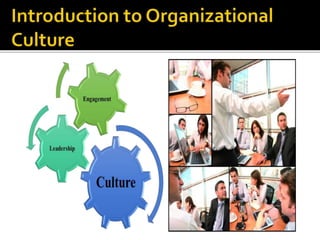
 Culture is the unique dominant pattern of
shared beliefs, assumptions, values, and
norms that shape the socialization, symbols,
language and practices of a group of people.
 The attitudes and approaches that typify the
way staff carry out their tasks.
 Culture is developed and transmitted by
people, consciously and unconsciously, to
subsequent generations.
Organizational culture includes an organization’s
expectations, experiences, philosophy, as well as
the values that guide member behavior, and is
expressed in member self-image, inner workings,
interactions with the outside world, and future
expectations.
16–
18
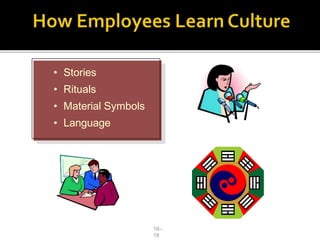
• Stories
• Rituals
• Material Symbols
• Language
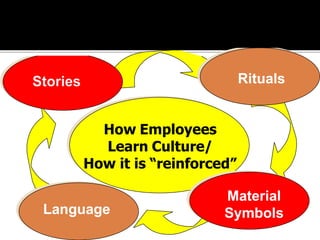
How Employees
Learn Culture/
How it is “reinforced”
Material
Symbols
Language
Rituals
 Social prescriptions of desired (undesired)
behavior
 Provides a realistic human side to
expectations
 Most effective stories and legends:
Describe real people
Assumed to be true
Known throughout the organization
Are prescriptive
 Rituals
programmed routines
(eg., how visitors are greeted)
 Ceremonies
planned activities for an audience
(eg., award ceremonies)
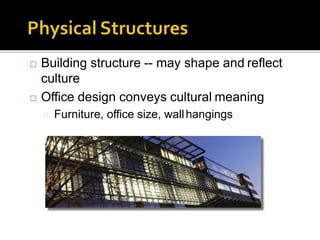
 Building structure -- may shape and reflect
culture
 Office design conveys cultural meaning
Furniture, office size, wallhangings
 Artifacts are the physical things that are found
that have particular symbolism for culture
 The purpose of Artifacts are as remindersand
triggers
 EX.- Button, Jewelry, clothing
 Language is a shared system of vocal sounds,
written signs, and/or gestures used to convey
meaning among members of a culture.
The Nike swoosh was inspired by the
Greek goddess Nike, the winged goddess
of victory. The swoosh symbolizes her
flight. It conveys the meaning of a brand of
sports shoes
 Innovation and Risk Taking
 Attention to Detail- Ability to efficiently
allocate
 Outcome and Results
 Team Orientation- extent to which an
individual enjoying working with others
 Aggressiveness- Competitiveness
 Stability
 Culture provides a sense of identity to
members and increases their commitment to
the organization
 Culture is a sense-making device
for organization members
 Culture reinforces the values
of the organization
 Culture serves as a control
mechanism for shaping
behavior
• Defines the boundary between one
organization and others
• Facilitates the generation of
commitment to something
larger than self-interest
• Enhances the stability of the social
system
• Serves as a control mechanism
for fitting employees in the
organization
Continued
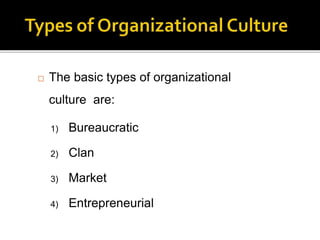
 The basic types of organizational
culture are:
1) Bureaucratic
2) Clan
3) Market
4) Entrepreneurial
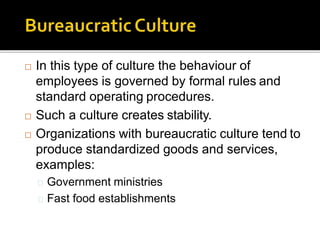
 In this type of culture the behaviour of
employees is governed by formal rules and
standard operating procedures.
 Such a culture creates stability.
 Organizations with bureaucratic culture tend to
produce standardized goods and services,
examples:
Government ministries
Fast food establishments
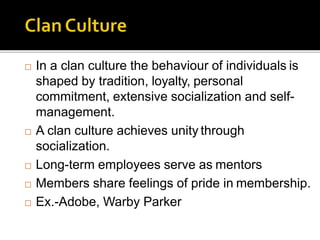
 In a clan culture the behaviour of individuals is
shaped by tradition, loyalty, personal
commitment, extensive socialization and self-
management.
 A clan culture achieves unity through
socialization.
 Long-term employees serve as mentors
 Members share feelings of pride in membership.
 Ex.-Adobe, Warby Parker
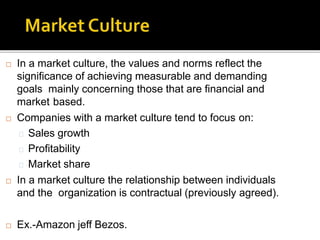
 In a market culture, the values and norms reflect the
significance of achieving measurable and demanding
goals mainly concerning those that are financial and
market based.
 Companies with a market culture tend to focus on:
Sales growth
Profitability
Market share
 In a market culture the relationship between individuals
and the organization is contractual (previously agreed).
 Ex.-Amazon jeff Bezos.
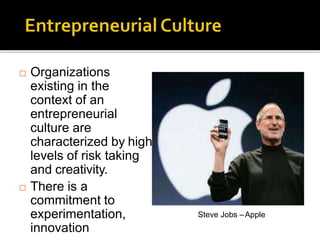
 Organizations
existing in the
context of an
entrepreneurial
culture are
characterized by high
levels of risk taking
and creativity.
 There is a
commitment to
experimentation,
innovation
Steve Jobs –Apple
21
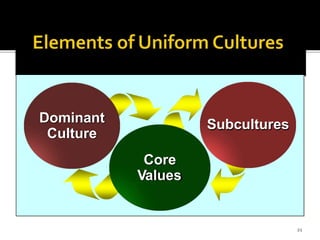
Core
Values
Subcultures
Dominant
Culture
22
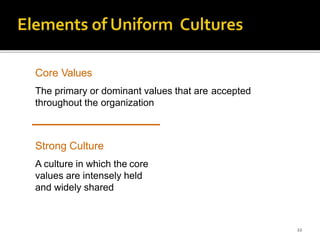
Core Values
The primary or dominant values that are accepted
throughout the organization
Strong Culture
A culture in which the core
values are intensely held
and widely shared
23
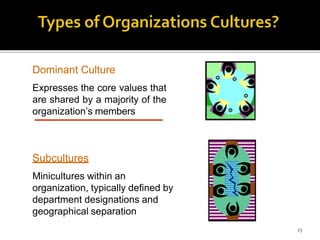
Dominant Culture
Expresses the core values that
are shared by a majority of the
organization’s members
Subcultures
Minicultures within an
organization, typically defined by
department designations and
geographical separation
24
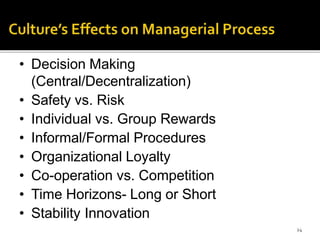
• Decision Making
(Central/Decentralization)
• Safety vs. Risk
• Individual vs. Group Rewards
• Informal/Formal Procedures
• Organizational Loyalty
• Co-operation vs. Competition
• Time Horizons- Long or Short
• Stability Innovation
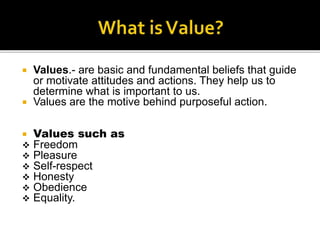
 Values.- are basic and fundamental beliefs that guide
or motivate attitudes and actions. They help us to
determine what is important to us.
 Values are the motive behind purposeful action.
 Values such as
 Freedom
 Pleasure
 Self-respect
 Honesty
 Obedience
 Equality.
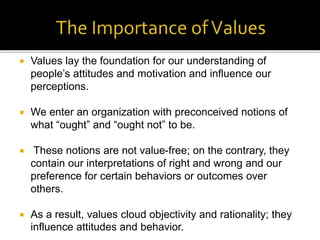
 Values lay the foundation for our understanding of
people’s attitudes and motivation and influence our
perceptions.
 We enter an organization with preconceived notions of
what “ought” and “ought not” to be.
 These notions are not value-free; on the contrary, they
contain our interpretations of right and wrong and our
preference for certain behaviors or outcomes over
others.
 As a result, values cloud objectivity and rationality; they
influence attitudes and behavior.
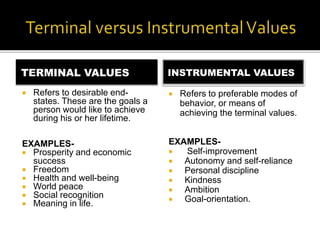
TERMINAL VALUES
 Refers to desirable end-
states. These are the goals a
person would like to achieve
during his or her lifetime.
EXAMPLES-
 Prosperity and economic
success
 Freedom
 Health and well-being
 World peace
 Social recognition
 Meaning in life.
INSTRUMENTAL VALUES
 Refers to preferable modes of
behavior, or means of
achieving the terminal values.
EXAMPLES-
 Self-improvement
 Autonomy and self-reliance
 Personal discipline
 Kindness
 Ambition
 Goal-orientation.
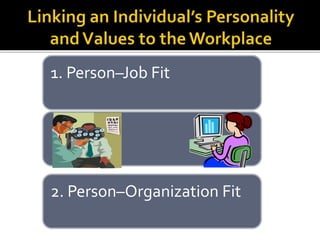
1. Person–Job Fit
2. Person–Organization Fit
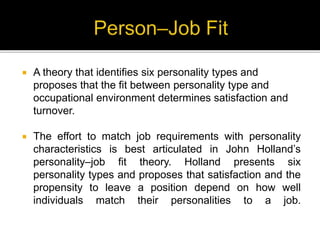
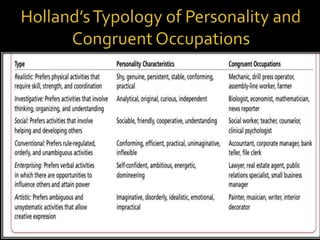
 A theory that identifies six personality types and
proposes that the fit between personality type and
occupational environment determines satisfaction and
turnover.
 The effort to match job requirements with personality
characteristics is best articulated in John Holland’s
personality–job fit theory. Holland presents six
personality types and proposes that satisfaction and the
propensity to leave a position depend on how well
individuals match their personalities to a job.
 If an organization faces a dynamic and changing
environment and requires employees able to readily
change tasks and move easily between teams, it’s
more important that employees’ personalities fit with
the overall organization’s culture than with the
characteristics of any specific job.
 The person–organization fit essentially argues that
people are attracted to and selected by organizations
that match their values, and they leave organizations
that are not compatible with their personalities.
 One of the most widely referenced
approaches for analyzing variations among
cultures was done in the late 1970s by Geert
Hofstede.
 He surveyed more than 116,000 IBM
employees in 40 countries about their work-
related values and found that managers and
employees vary on five value dimensions of
national culture:
 Power distance
 Individualism versus collectivism
 Masculinity versus femininity
 Uncertainty avoidance
 Long-term versus short-term orientation.
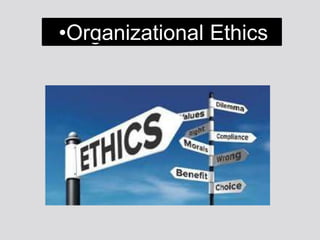
•Organizational Ethics
• Ethics is knowing the difference between what you
have a right to do and what is right to do.
• Ethical behavior depends on the person’s frame of
reference.
• Many employees feel pressured to cut corners,
break rules, and engage in other questionable
practices.
• Increasingly they face ethical dilemmas and
ethical choices, in which they are required to
identify right and wrong conduct.
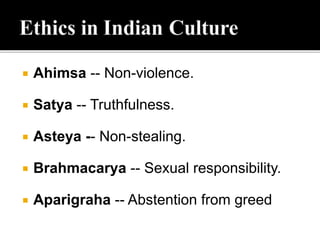
 Ahimsa -- Non-violence.
 Satya -- Truthfulness.
 Asteya -- Non-stealing.
 Brahmacarya -- Sexual responsibility.
 Aparigraha -- Abstention from greed
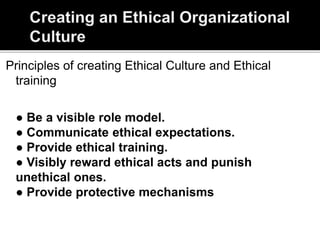
Principles of creating Ethical Culture and Ethical
training
● Be a visible role model.
● Communicate ethical expectations.
● Provide ethical training.
● Visibly reward ethical acts and punish
unethical ones.
● Provide protective mechanisms
14–
40
• Ethical considerations should be an
important criterion in all organizational
decision making.
• 2 ways to frame decisions ethically:
1. Utilitarianism
2. Deonance
14–
41
• Utilitarianism: A system in which decisions are
made to provide the greatest good for the
greatest number
• It proposes making decisions solely on the basis
of their outcomes.
• This view dominates business decision making.
It is consistent with goals such as efficiency,
productivity, and high profits.
• Example- Footbridge incident
 Utilitarianism has been accused of looking
only at the results of actions, and
disregarding the desires or intentions that
motivate them.
14–
43
• Deonance- A perspective in which ethical decisions
are made because you ‘ought to’ in order to be
consistent with moral norms, principle, standards,
rules and laws.
• This criterion is to impose and enforce rules fairly and
impartially to ensure justice or an equitable
distribution of benefits and costs.
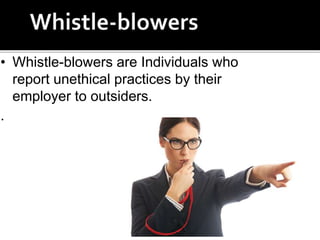
• Whistle-blowers are Individuals who
report unethical practices by their
employer to outsiders.
.
 Lying is deadly for decision making.
 Lying demotivate individuals
 Change environment of workplace
 Starting of unethical behaviour.
 Raises stress and conflicts
• “Ethical leaders speak to us about our identity, what we are
and what we can become, how we live and how we could live
better.”
• Ethical Leadership is to believe that we are not in the
business of surviving but in being good, and to admit to
ourselves that we are good in order to survive
 Ethical leadership is knowing your core
values and having the courage to live
them in all parts of your life in service of
the common good.
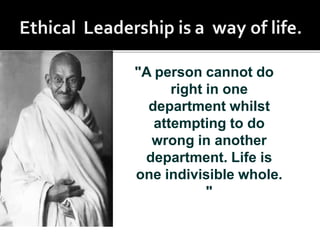
"A person cannot do
right in one
department whilst
attempting to do
wrong in another
department. Life is
one indivisible whole.
"
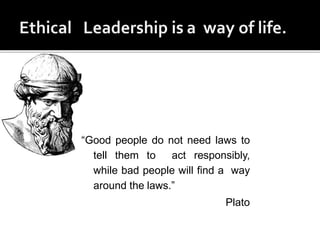
“Good people do not need laws to
tell them to act responsibly,
while bad people will find a way
around the laws.”
Plato
Thank You

Organization Culture and Ethics

  • 1.
    Topic: Organizational Cultureand Ethics Presented By:- Tribhuwan Singh Rajpurohit Ph.D Ext. Edu.
  • 2.
    1) Introduction &Elements of Organizational Culture 2) How Employees Learn Culture/How it is “reinforced”. 3) Functions of Organizational Culture 4) Types of Organizational Culture. 5) Values and its types 6) Organizational Ethics Content of the presentation
  • 4.
     Culture isthe unique dominant pattern of shared beliefs, assumptions, values, and norms that shape the socialization, symbols, language and practices of a group of people.  The attitudes and approaches that typify the way staff carry out their tasks.  Culture is developed and transmitted by people, consciously and unconsciously, to subsequent generations.
  • 5.
    Organizational culture includesan organization’s expectations, experiences, philosophy, as well as the values that guide member behavior, and is expressed in member self-image, inner workings, interactions with the outside world, and future expectations.
  • 6.
    16– 18 • Stories • Rituals •Material Symbols • Language
  • 7.
    How Employees Learn Culture/ Howit is “reinforced” Material Symbols Language Rituals
  • 8.
     Social prescriptionsof desired (undesired) behavior  Provides a realistic human side to expectations  Most effective stories and legends: Describe real people Assumed to be true Known throughout the organization Are prescriptive
  • 9.
     Rituals programmed routines (eg.,how visitors are greeted)  Ceremonies planned activities for an audience (eg., award ceremonies)
  • 10.
     Building structure-- may shape and reflect culture  Office design conveys cultural meaning Furniture, office size, wallhangings
  • 11.
     Artifacts arethe physical things that are found that have particular symbolism for culture  The purpose of Artifacts are as remindersand triggers  EX.- Button, Jewelry, clothing
  • 12.
     Language isa shared system of vocal sounds, written signs, and/or gestures used to convey meaning among members of a culture. The Nike swoosh was inspired by the Greek goddess Nike, the winged goddess of victory. The swoosh symbolizes her flight. It conveys the meaning of a brand of sports shoes
  • 13.
     Innovation andRisk Taking  Attention to Detail- Ability to efficiently allocate  Outcome and Results  Team Orientation- extent to which an individual enjoying working with others  Aggressiveness- Competitiveness  Stability
  • 14.
     Culture providesa sense of identity to members and increases their commitment to the organization  Culture is a sense-making device for organization members  Culture reinforces the values of the organization  Culture serves as a control mechanism for shaping behavior
  • 15.
    • Defines theboundary between one organization and others • Facilitates the generation of commitment to something larger than self-interest • Enhances the stability of the social system • Serves as a control mechanism for fitting employees in the organization Continued
  • 16.
     The basictypes of organizational culture are: 1) Bureaucratic 2) Clan 3) Market 4) Entrepreneurial
  • 17.
     In thistype of culture the behaviour of employees is governed by formal rules and standard operating procedures.  Such a culture creates stability.  Organizations with bureaucratic culture tend to produce standardized goods and services, examples: Government ministries Fast food establishments
  • 18.
     In aclan culture the behaviour of individuals is shaped by tradition, loyalty, personal commitment, extensive socialization and self- management.  A clan culture achieves unity through socialization.  Long-term employees serve as mentors  Members share feelings of pride in membership.  Ex.-Adobe, Warby Parker
  • 19.
     In amarket culture, the values and norms reflect the significance of achieving measurable and demanding goals mainly concerning those that are financial and market based.  Companies with a market culture tend to focus on: Sales growth Profitability Market share  In a market culture the relationship between individuals and the organization is contractual (previously agreed).  Ex.-Amazon jeff Bezos.
  • 20.
     Organizations existing inthe context of an entrepreneurial culture are characterized by high levels of risk taking and creativity.  There is a commitment to experimentation, innovation Steve Jobs –Apple
  • 21.
  • 22.
    22 Core Values The primaryor dominant values that are accepted throughout the organization Strong Culture A culture in which the core values are intensely held and widely shared
  • 23.
    23 Dominant Culture Expresses thecore values that are shared by a majority of the organization’s members Subcultures Minicultures within an organization, typically defined by department designations and geographical separation
  • 24.
    24 • Decision Making (Central/Decentralization) •Safety vs. Risk • Individual vs. Group Rewards • Informal/Formal Procedures • Organizational Loyalty • Co-operation vs. Competition • Time Horizons- Long or Short • Stability Innovation
  • 26.
     Values.- arebasic and fundamental beliefs that guide or motivate attitudes and actions. They help us to determine what is important to us.  Values are the motive behind purposeful action.  Values such as  Freedom  Pleasure  Self-respect  Honesty  Obedience  Equality.
  • 27.
     Values laythe foundation for our understanding of people’s attitudes and motivation and influence our perceptions.  We enter an organization with preconceived notions of what “ought” and “ought not” to be.  These notions are not value-free; on the contrary, they contain our interpretations of right and wrong and our preference for certain behaviors or outcomes over others.  As a result, values cloud objectivity and rationality; they influence attitudes and behavior.
  • 28.
    TERMINAL VALUES  Refersto desirable end- states. These are the goals a person would like to achieve during his or her lifetime. EXAMPLES-  Prosperity and economic success  Freedom  Health and well-being  World peace  Social recognition  Meaning in life. INSTRUMENTAL VALUES  Refers to preferable modes of behavior, or means of achieving the terminal values. EXAMPLES-  Self-improvement  Autonomy and self-reliance  Personal discipline  Kindness  Ambition  Goal-orientation.
  • 30.
    1. Person–Job Fit 2.Person–Organization Fit
  • 31.
     A theorythat identifies six personality types and proposes that the fit between personality type and occupational environment determines satisfaction and turnover.  The effort to match job requirements with personality characteristics is best articulated in John Holland’s personality–job fit theory. Holland presents six personality types and proposes that satisfaction and the propensity to leave a position depend on how well individuals match their personalities to a job.
  • 33.
     If anorganization faces a dynamic and changing environment and requires employees able to readily change tasks and move easily between teams, it’s more important that employees’ personalities fit with the overall organization’s culture than with the characteristics of any specific job.  The person–organization fit essentially argues that people are attracted to and selected by organizations that match their values, and they leave organizations that are not compatible with their personalities.
  • 34.
     One ofthe most widely referenced approaches for analyzing variations among cultures was done in the late 1970s by Geert Hofstede.  He surveyed more than 116,000 IBM employees in 40 countries about their work- related values and found that managers and employees vary on five value dimensions of national culture:
  • 35.
     Power distance Individualism versus collectivism  Masculinity versus femininity  Uncertainty avoidance  Long-term versus short-term orientation.
  • 36.
  • 37.
    • Ethics isknowing the difference between what you have a right to do and what is right to do. • Ethical behavior depends on the person’s frame of reference. • Many employees feel pressured to cut corners, break rules, and engage in other questionable practices. • Increasingly they face ethical dilemmas and ethical choices, in which they are required to identify right and wrong conduct.
  • 38.
     Ahimsa --Non-violence.  Satya -- Truthfulness.  Asteya -- Non-stealing.  Brahmacarya -- Sexual responsibility.  Aparigraha -- Abstention from greed
  • 39.
    Principles of creatingEthical Culture and Ethical training ● Be a visible role model. ● Communicate ethical expectations. ● Provide ethical training. ● Visibly reward ethical acts and punish unethical ones. ● Provide protective mechanisms
  • 40.
    14– 40 • Ethical considerationsshould be an important criterion in all organizational decision making. • 2 ways to frame decisions ethically: 1. Utilitarianism 2. Deonance
  • 41.
    14– 41 • Utilitarianism: Asystem in which decisions are made to provide the greatest good for the greatest number • It proposes making decisions solely on the basis of their outcomes. • This view dominates business decision making. It is consistent with goals such as efficiency, productivity, and high profits. • Example- Footbridge incident
  • 42.
     Utilitarianism hasbeen accused of looking only at the results of actions, and disregarding the desires or intentions that motivate them.
  • 43.
    14– 43 • Deonance- Aperspective in which ethical decisions are made because you ‘ought to’ in order to be consistent with moral norms, principle, standards, rules and laws. • This criterion is to impose and enforce rules fairly and impartially to ensure justice or an equitable distribution of benefits and costs.
  • 44.
    • Whistle-blowers areIndividuals who report unethical practices by their employer to outsiders. .
  • 46.
     Lying isdeadly for decision making.  Lying demotivate individuals  Change environment of workplace  Starting of unethical behaviour.  Raises stress and conflicts
  • 47.
    • “Ethical leadersspeak to us about our identity, what we are and what we can become, how we live and how we could live better.” • Ethical Leadership is to believe that we are not in the business of surviving but in being good, and to admit to ourselves that we are good in order to survive
  • 48.
     Ethical leadershipis knowing your core values and having the courage to live them in all parts of your life in service of the common good.
  • 49.
    "A person cannotdo right in one department whilst attempting to do wrong in another department. Life is one indivisible whole. "
  • 50.
    “Good people donot need laws to tell them to act responsibly, while bad people will find a way around the laws.” Plato
  • 51.