edsa-project.eu
Bridging the Data Science Skills Gap with Open
Courseware
Dr. Alexander Mikroyannidis
The Open University, UK
edsa-project.eu
Digital/Big Data Skills Gap (UK)
• 750,000 tech vacancies by 2017, according to a recent prediction by O2.
• The UK is already losing a potential £2 billion per year from unfilled roles
requiring digital skills.
• Only 1/3 of ICT teachers have the relevant qualifications.
• Tenfold increase in Big Data staff demand over last 5 years:
– 41% increase in the past year
– 77% of Big Data roles were “hard-to-fill”
– 160% increase in demand for Big Data specialists 2013-2020 to
346,000 new jobs
edsa-project.eu
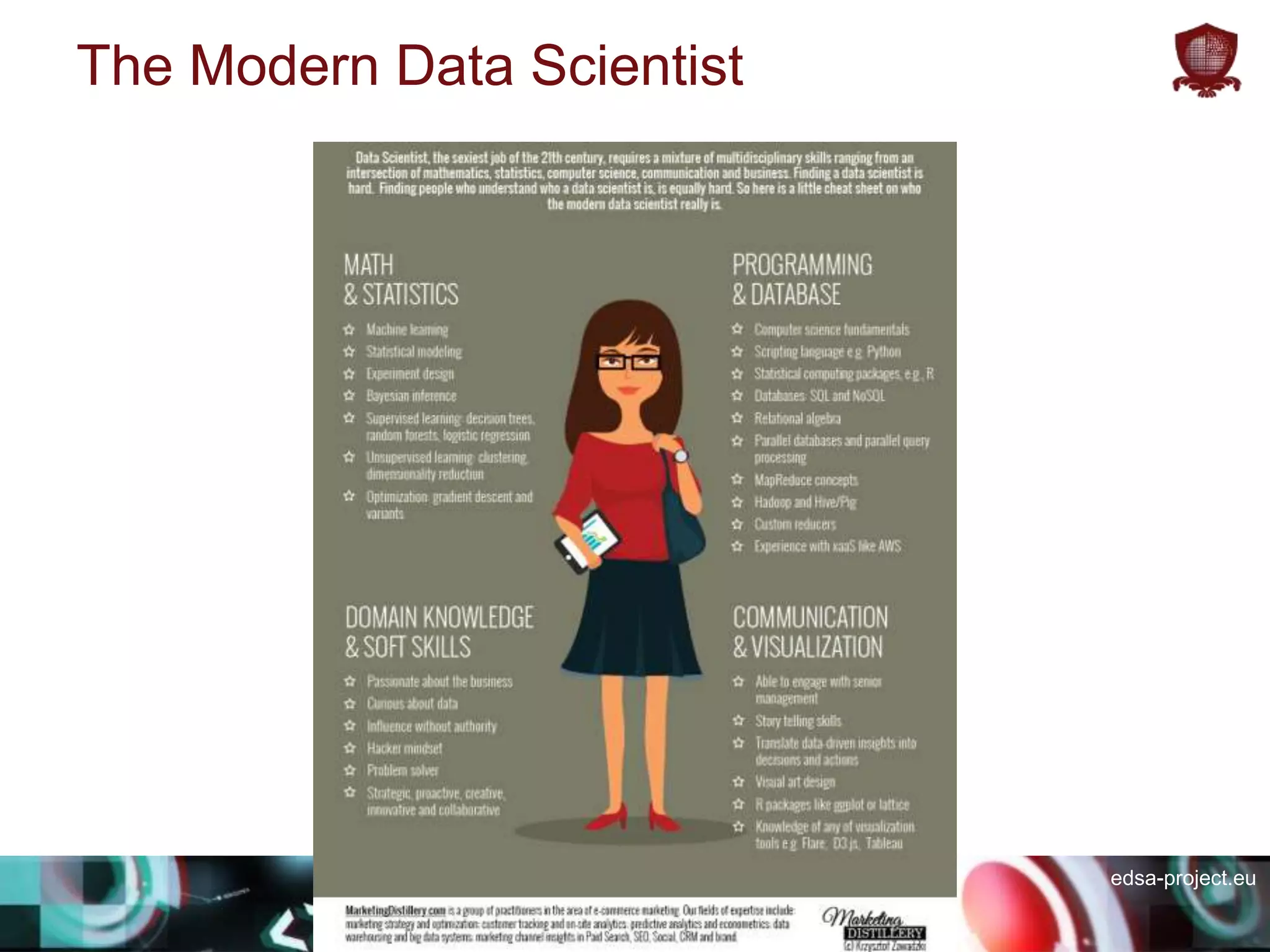
The Modern Data Scientist
edsa-project.eu
What is the EDSA about?
ESTABLISH A EUROPEAN COMMUNITY OF
EDUCATORS, LEARNERS, PRACTITIONERS,
AND POLICY MAKERS ON DATA SCIENCE
edsa-project.eu
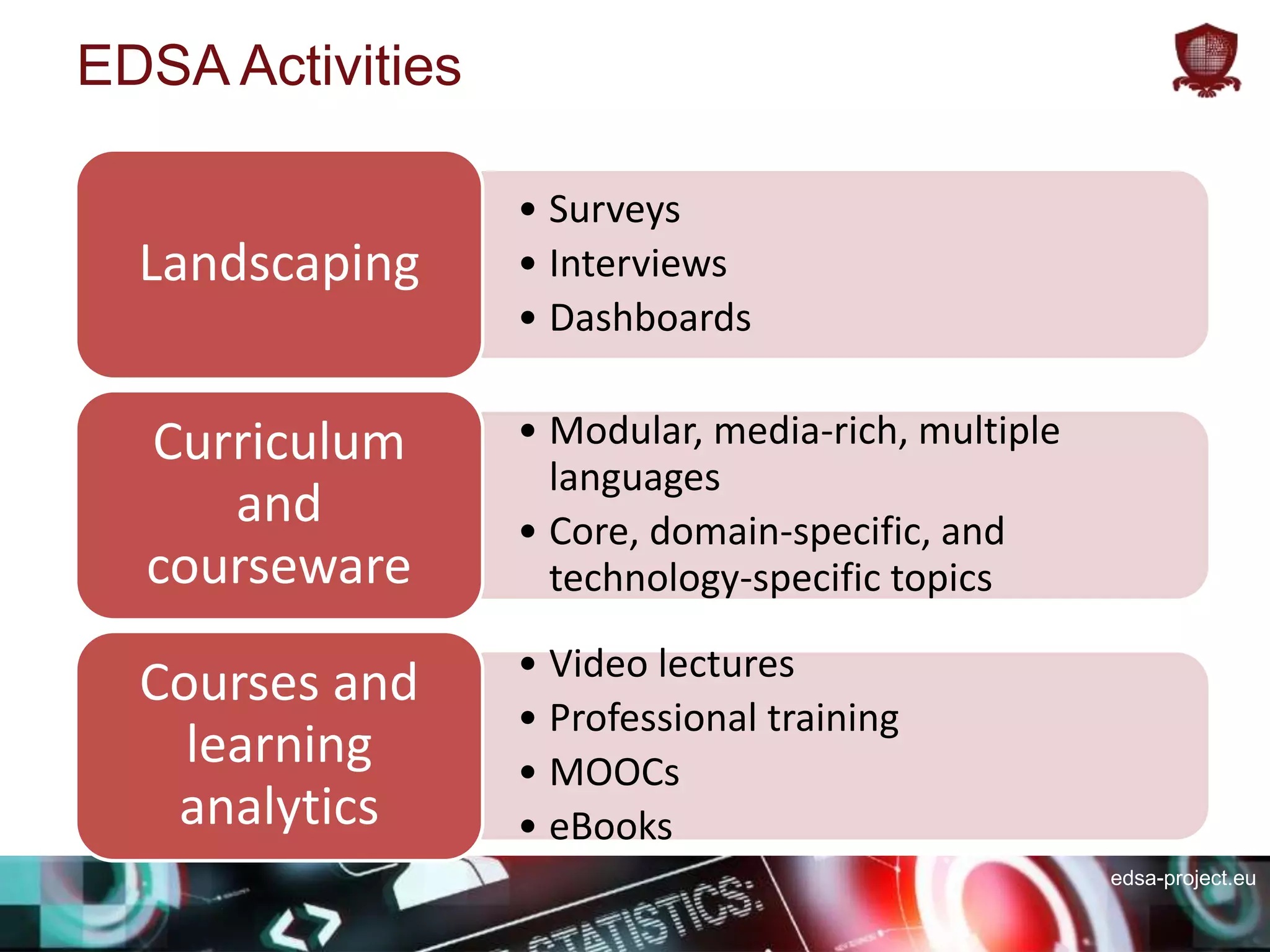
EDSA Activities
• Surveys
• Interviews
• Dashboards
Landscaping
• Modular, media-rich, multiple
languages
• Core, domain-specific, and
technology-specific topics
Curriculum
and
courseware
• Video lectures
• Professional training
• MOOCs
• eBooks
Courses and
learning
analytics
edsa-project.eu
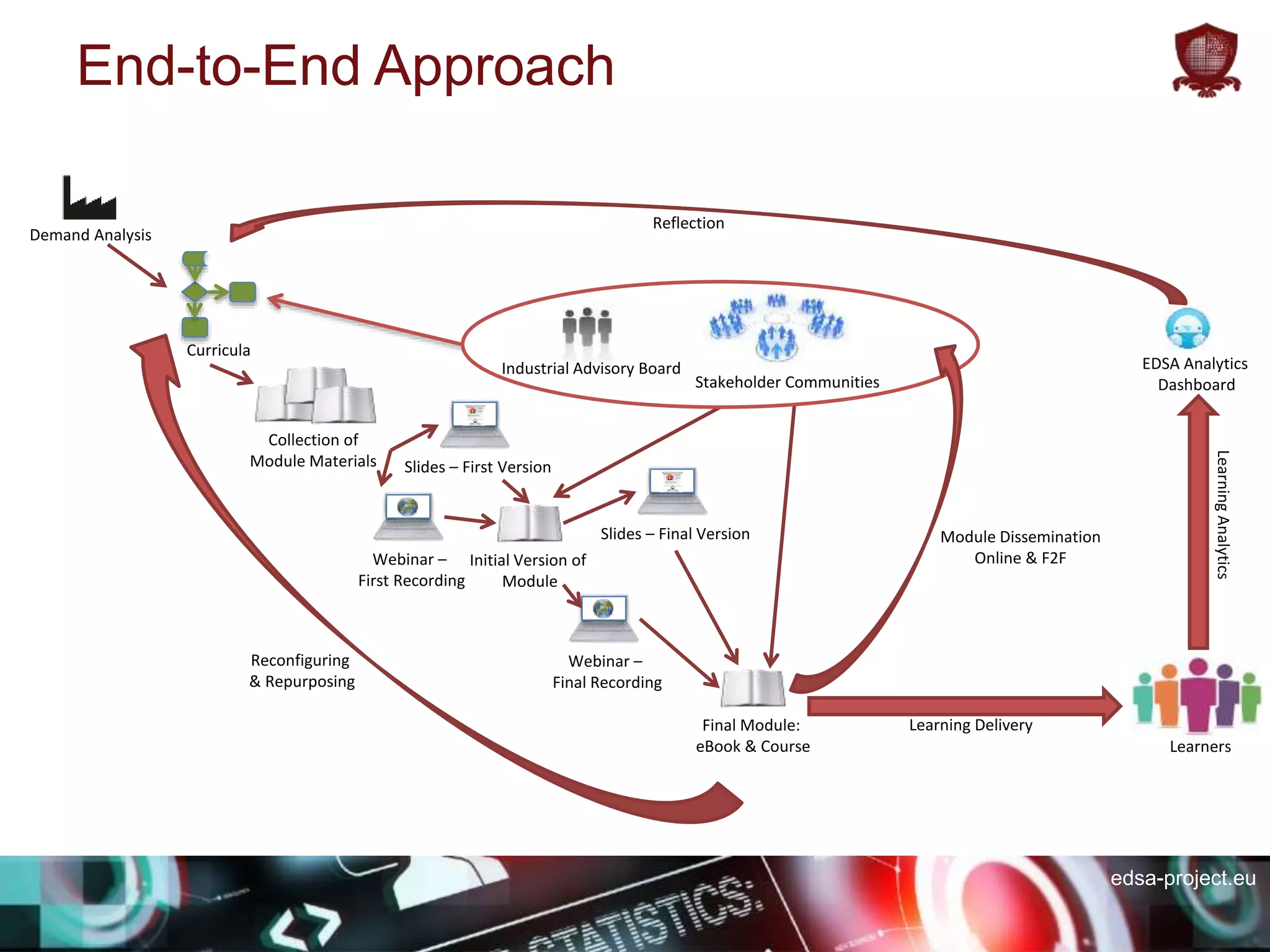
Initial Version of
Module
Final Module:
eBook & Course
Webinar –
Final Recording
Webinar –
First Recording
Collection of
Module Materials Slides – First Version
Slides – Final Version
Stakeholder Communities
Industrial Advisory Board
Demand Analysis
Reflection
Module Dissemination
Online & F2F
LearningAnalytics
Curricula
EDSA Analytics
Dashboard
Reconfiguring
& Repurposing
Learners
Learning Delivery
End-to-End Approach
edsa-project.eu
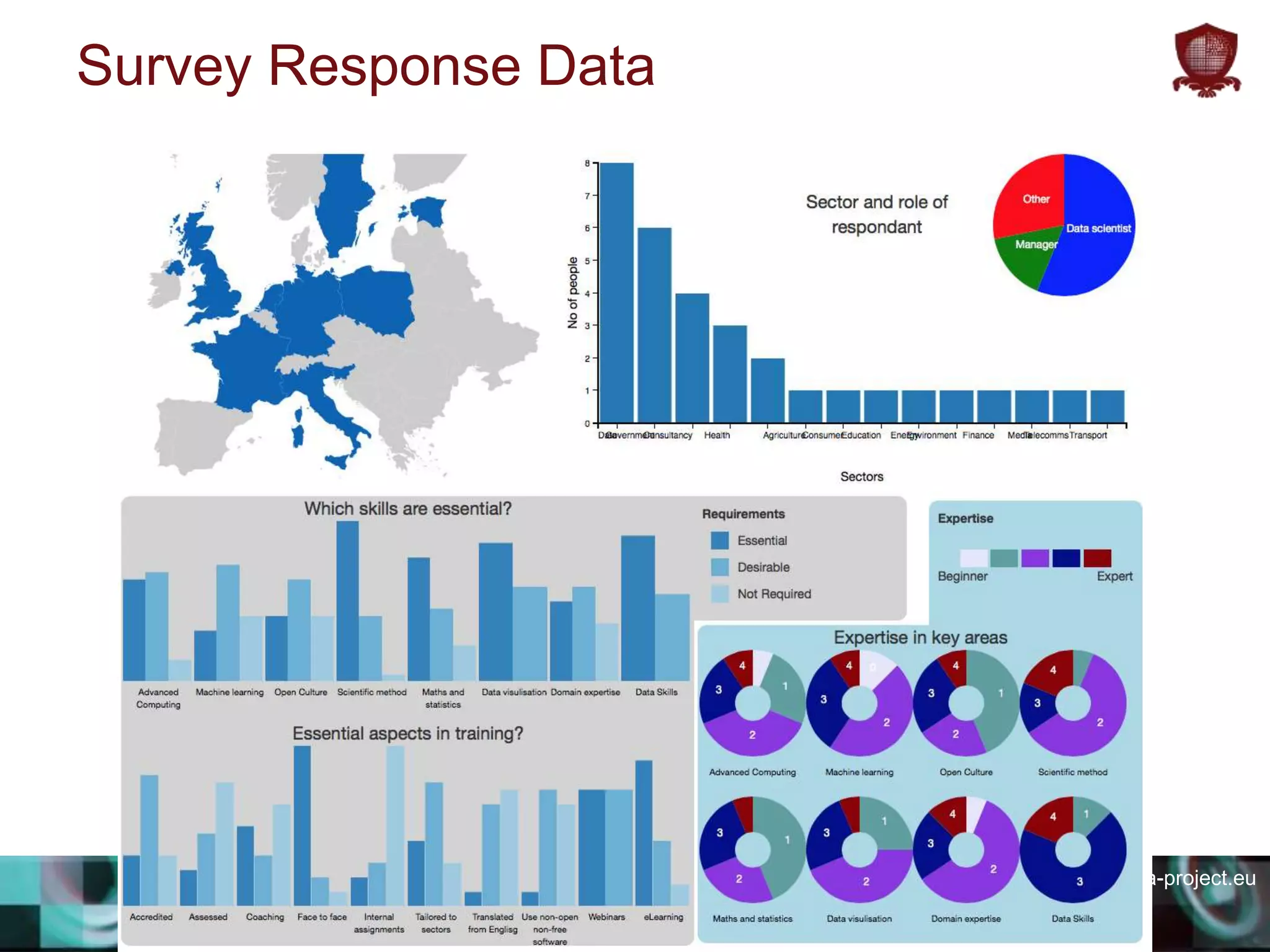
Survey Response Data
edsa-project.eu
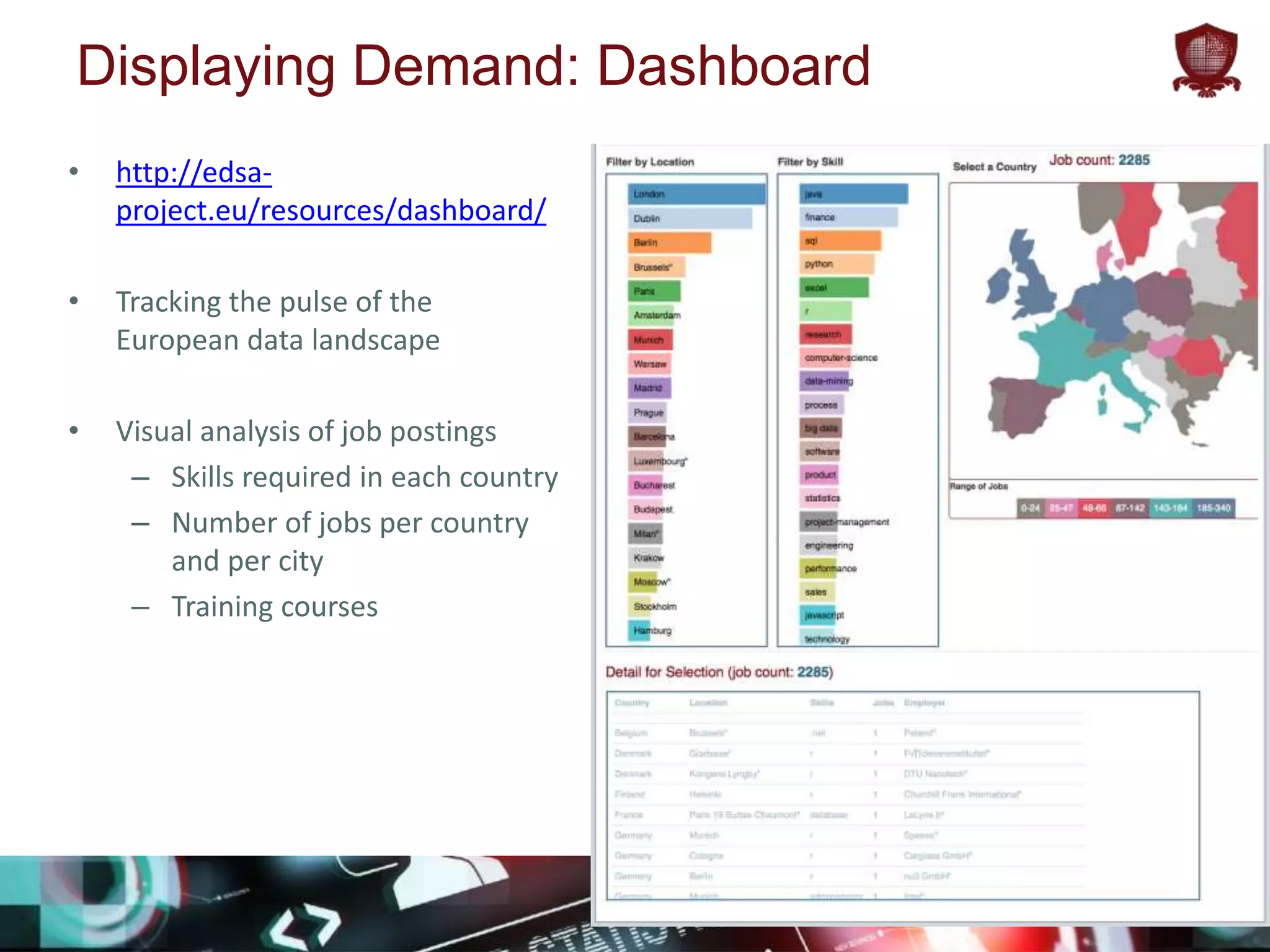
Displaying Demand: Dashboard
• http://edsa-
project.eu/resources/dashboard/
• Tracking the pulse of the
European data landscape
• Visual analysis of job postings
– Skills required in each country
– Number of jobs per country
and per city
– Training courses
edsa-project.eu
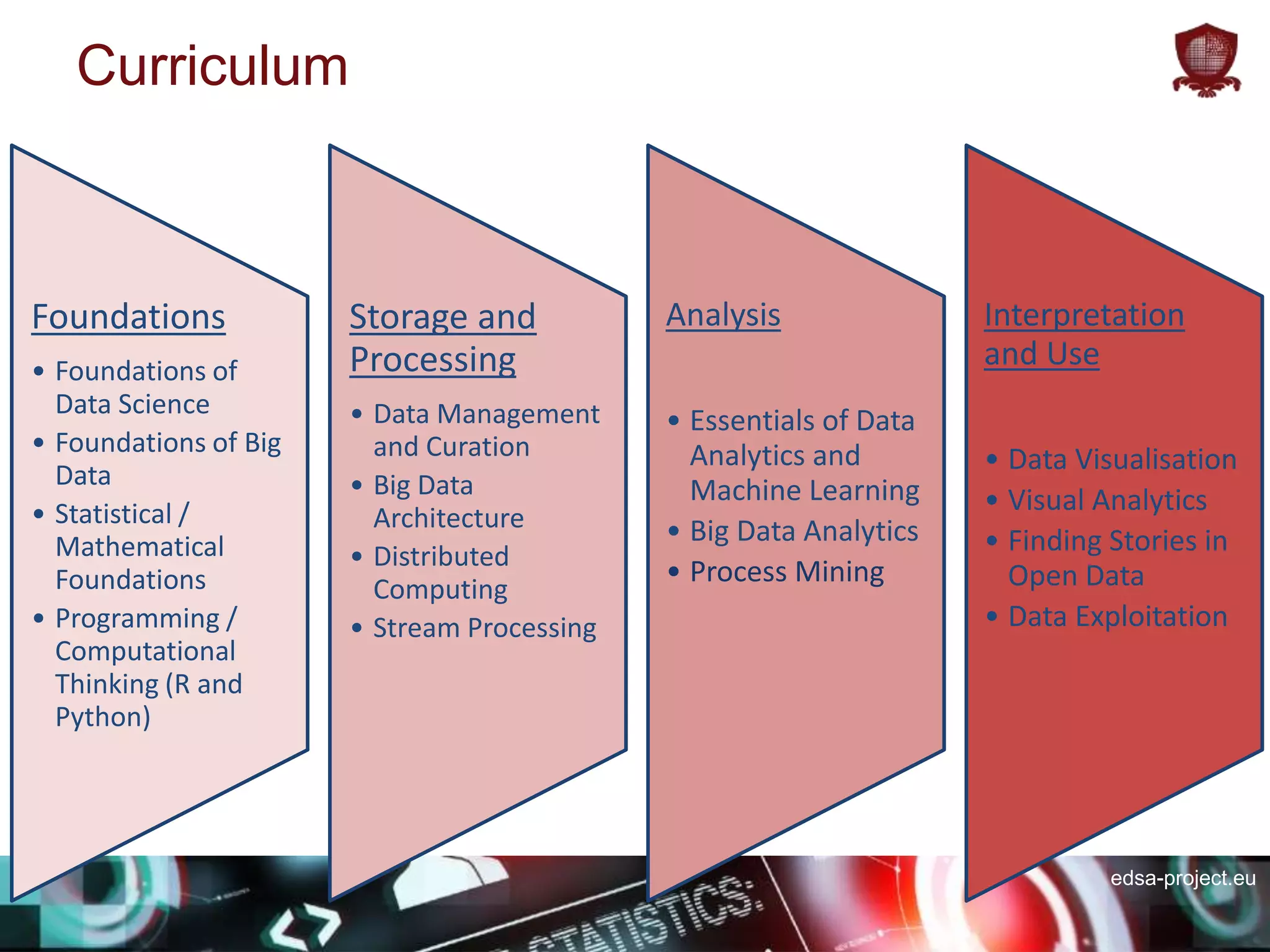
Curriculum
Foundations
• Foundations of
Data Science
• Foundations of Big
Data
• Statistical /
Mathematical
Foundations
• Programming /
Computational
Thinking (R and
Python)
Storage and
Processing
• Data Management
and Curation
• Big Data
Architecture
• Distributed
Computing
• Stream Processing
Analysis
• Essentials of Data
Analytics and
Machine Learning
• Big Data Analytics
• Process Mining
Interpretation
and Use
• Data Visualisation
• Visual Analytics
• Finding Stories in
Open Data
• Data Exploitation
edsa-project.eu
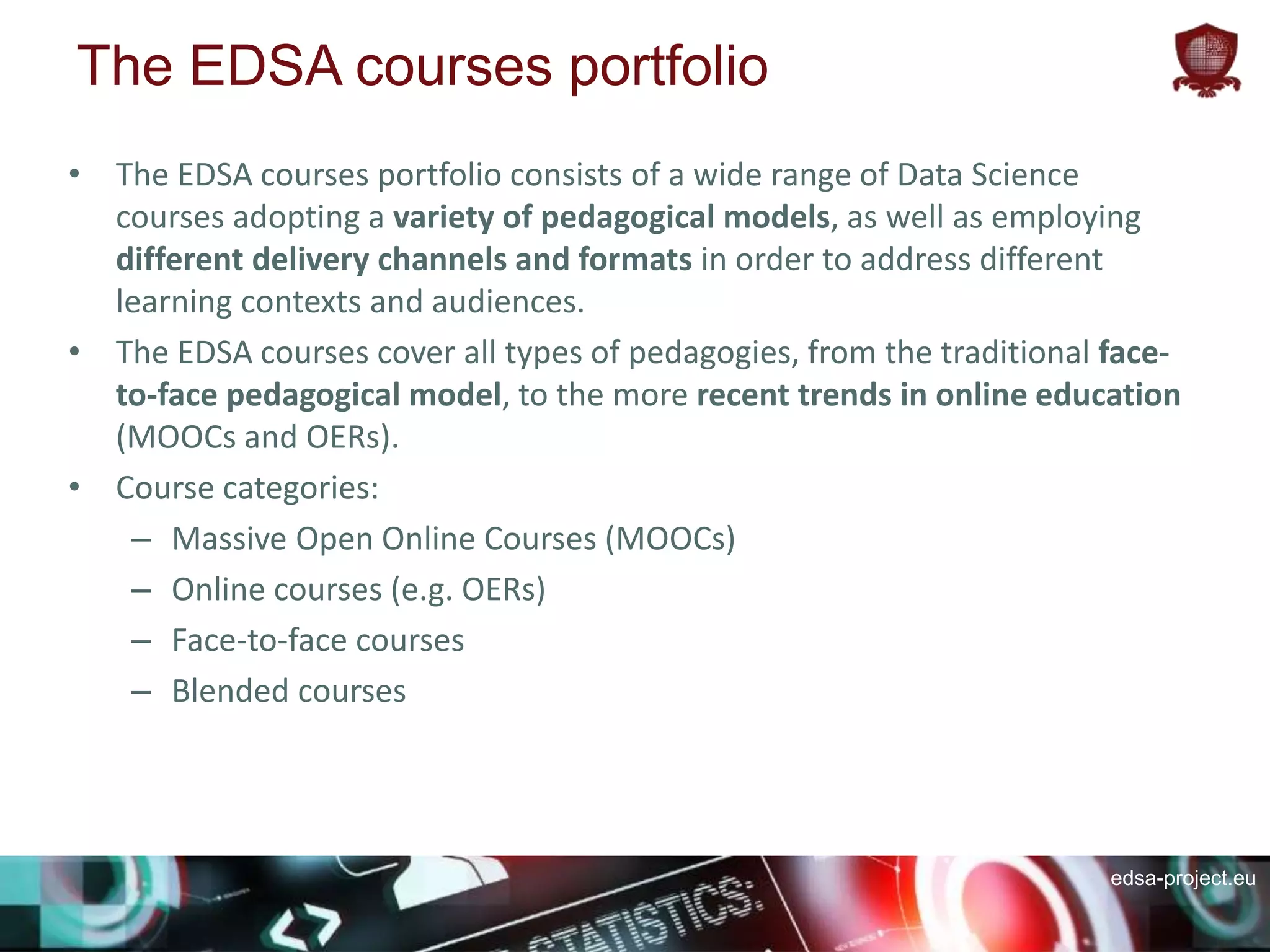
The EDSA courses portfolio
• The EDSA courses portfolio consists of a wide range of Data Science
courses adopting a variety of pedagogical models, as well as employing
different delivery channels and formats in order to address different
learning contexts and audiences.
• The EDSA courses cover all types of pedagogies, from the traditional face-
to-face pedagogical model, to the more recent trends in online education
(MOOCs and OERs).
• Course categories:
– Massive Open Online Courses (MOOCs)
– Online courses (e.g. OERs)
– Face-to-face courses
– Blended courses
edsa-project.eu
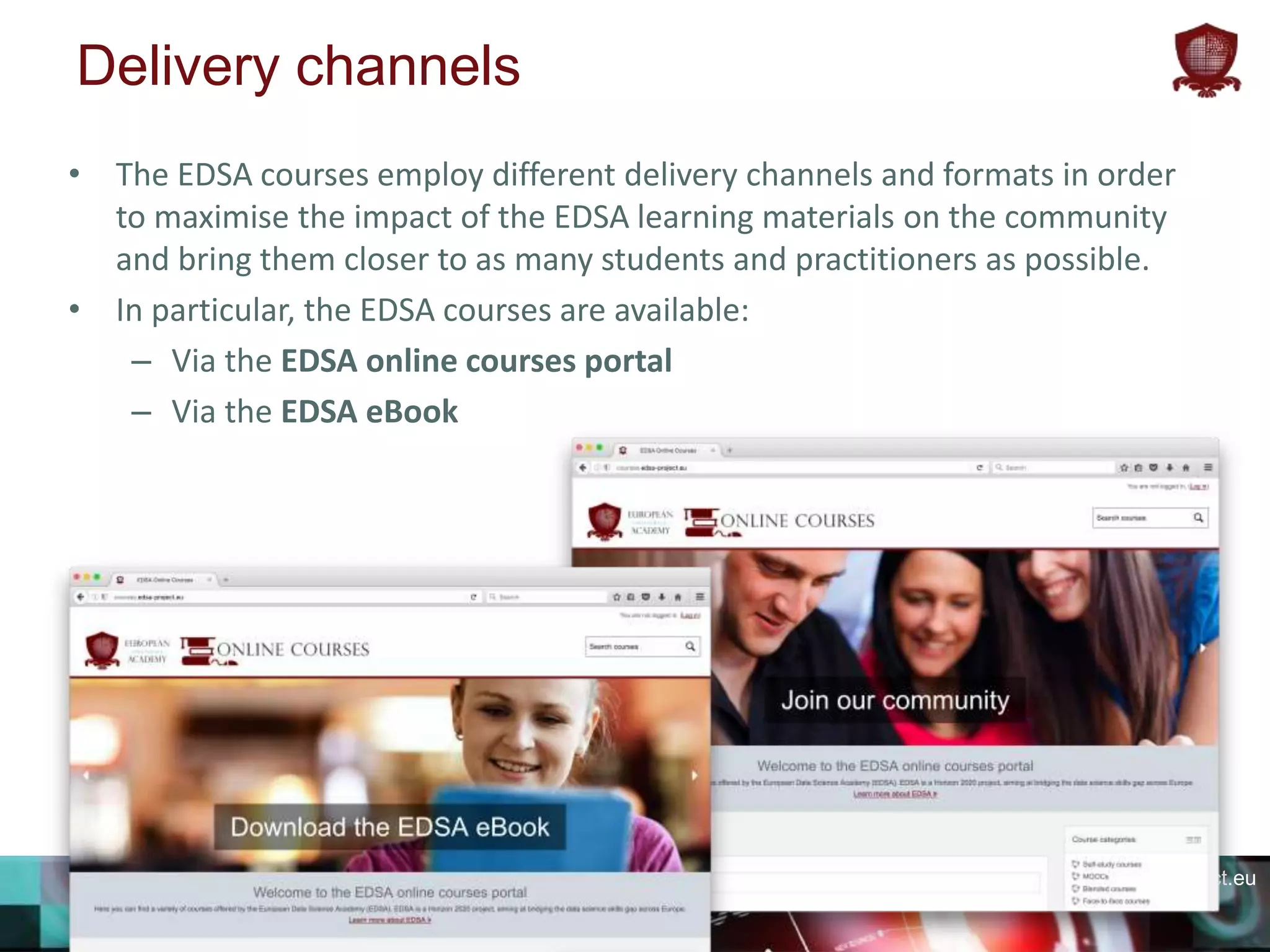
Delivery channels
• The EDSA courses employ different delivery channels and formats in order
to maximise the impact of the EDSA learning materials on the community
and bring them closer to as many students and practitioners as possible.
• In particular, the EDSA courses are available:
– Via the EDSA online courses portal
– Via the EDSA eBook
edsa-project.eu
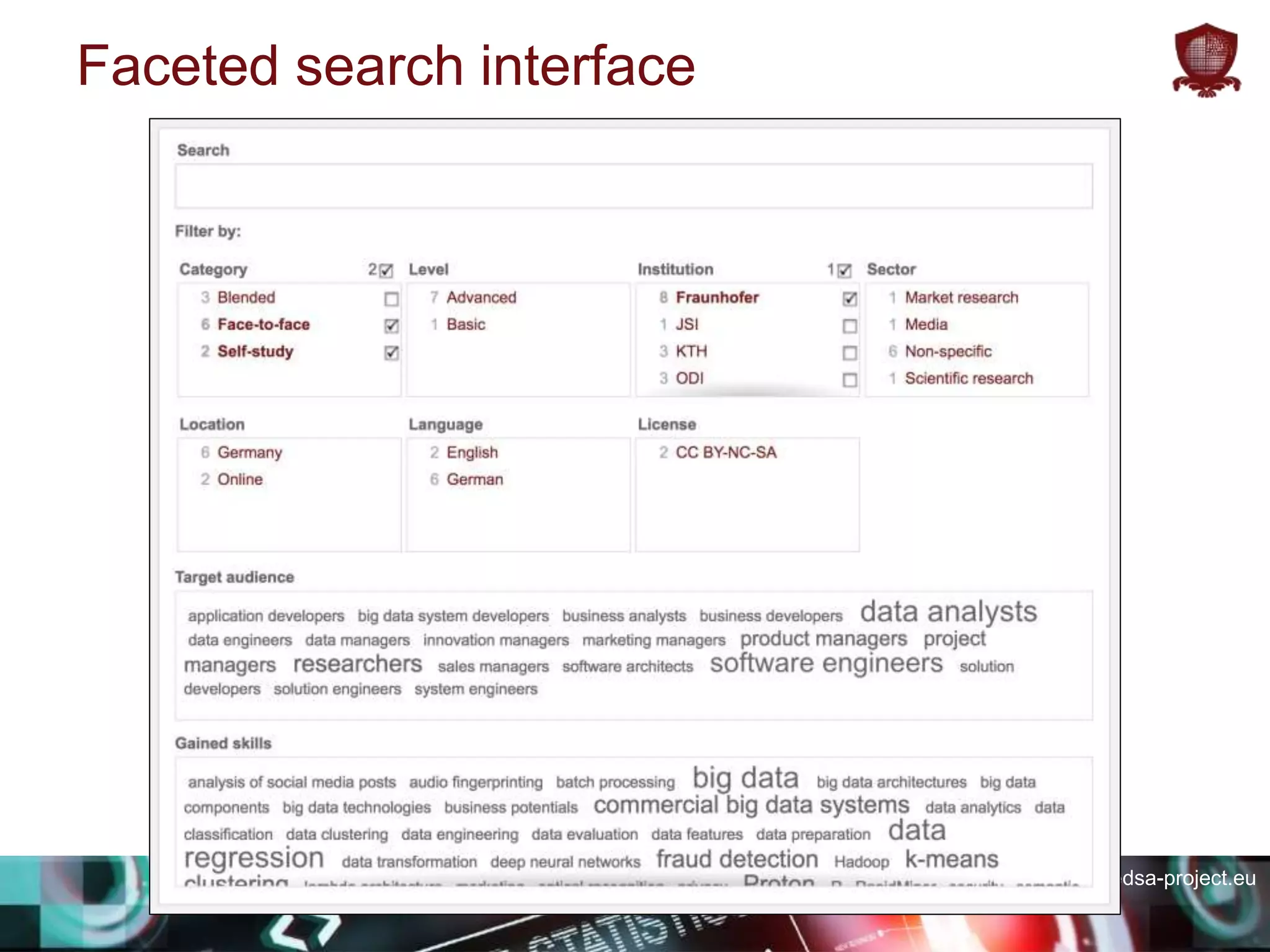
Faceted search interface
edsa-project.eu
Course metadata
The following metadata are recorded for all EDSA courses and used for finding
courses via faceted search:
– Category (e.g. blended, face-to-face, etc.)
– Level (i.e. basic, intermediate, advanced)
– Institution offering the course
– Target sector
– Target audience
– Gained skills
– Location
– Language
– License (Creative Commons)
edsa-project.eu
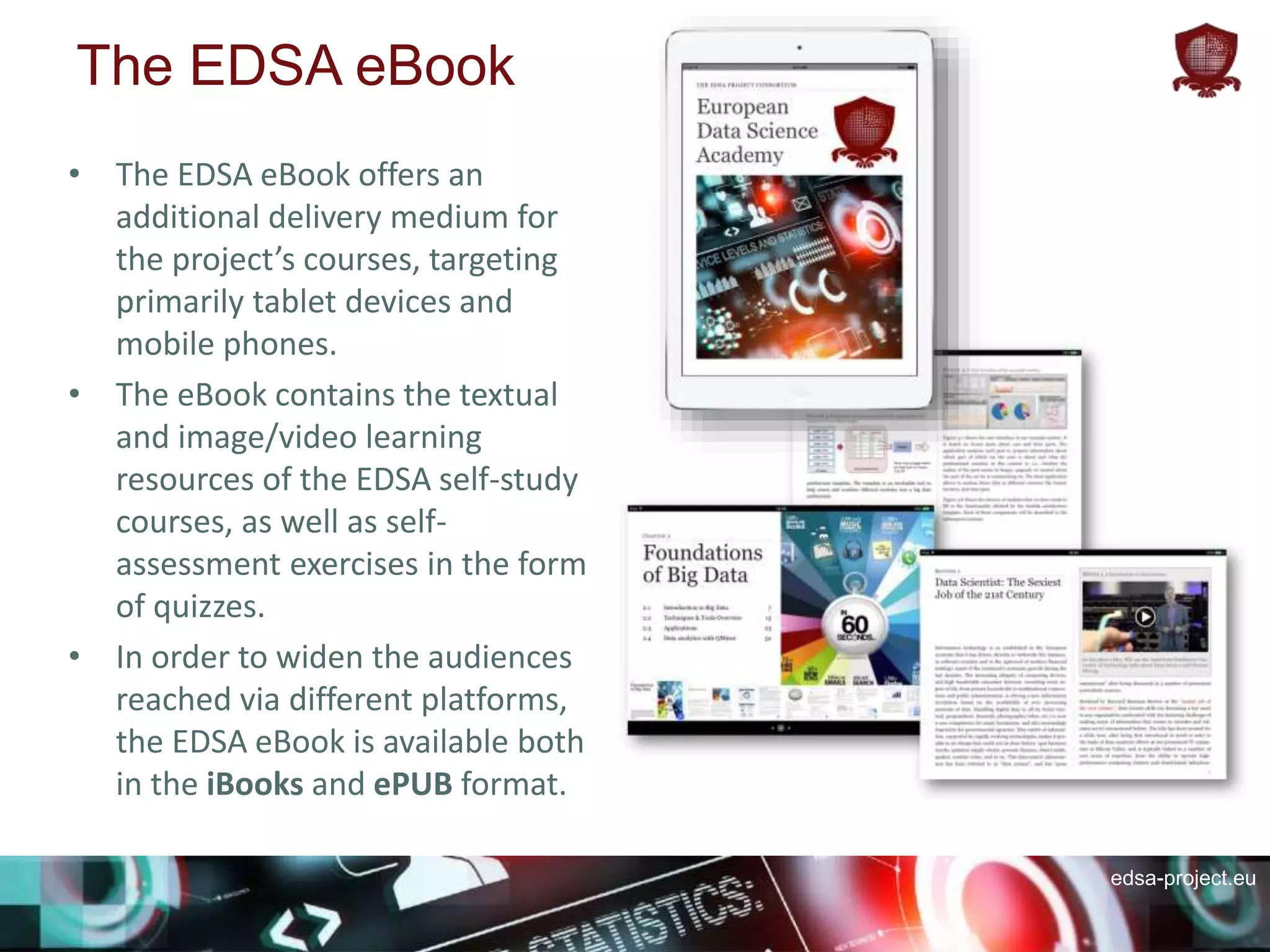
The EDSA eBook
• The EDSA eBook offers an
additional delivery medium for
the project’s courses, targeting
primarily tablet devices and
mobile phones.
• The eBook contains the textual
and image/video learning
resources of the EDSA self-study
courses, as well as self-
assessment exercises in the form
of quizzes.
• In order to widen the audiences
reached via different platforms,
the EDSA eBook is available both
in the iBooks and ePUB format.
edsa-project.eu
Feedback
Qualitative and quantitative feedback is collected about the EDSA courses via:
• Learning Analytics
User interactions with the EDSA learning materials are recorded as xAPI
statements and stored in the Learning Locker LRS (Learning Record
Store).
• Questionnaires
Measuring the ease of use and learning effectiveness of the EDSA
learning materials. Mainly comprised of a set of statements to which the
learner is requested to record their level of agreement via a 5-Likert scale
ranging from 1 (strongly disagree) to 5 (strongly agree). Open-ended
questions ask about the things that the learner has enjoyed most about
the EDSA learning materials, possible improvements, as well as any
additional comments.
edsa-project.eu
Next steps
• Designing a curriculum that covers
data science is an inherently difficult
task that faces a number of
challenges, most notably the speed at
which this field is changing.
• We will carry out revisions to the
curriculum and the associated
learning resources throughout the
duration of the project, in order to
reflect the most up-to-date needs of
the community and the latest cutting-
edge techniques for making sense of
data.
edsa-project.eu
Join us
• Help shape an evolving data science curriculum endorsed by the
European Commission through its Horizon 2020 programme.
• Improve the quality of data science training available across the EU by
reusing EDSA learning materials.
• Help create the next generation of world-leading data scientists by
delivering co-branded training.
• Develop the community around data science training and education
together with other EDSA members.
More info: http://edsa-project.eu

The European Data Science Academy: Bridging the Data Science Skills Gap with Open Courseware

  • 1.
    edsa-project.eu Bridging the DataScience Skills Gap with Open Courseware Dr. Alexander Mikroyannidis The Open University, UK
  • 2.
    edsa-project.eu Digital/Big Data SkillsGap (UK) • 750,000 tech vacancies by 2017, according to a recent prediction by O2. • The UK is already losing a potential £2 billion per year from unfilled roles requiring digital skills. • Only 1/3 of ICT teachers have the relevant qualifications. • Tenfold increase in Big Data staff demand over last 5 years: – 41% increase in the past year – 77% of Big Data roles were “hard-to-fill” – 160% increase in demand for Big Data specialists 2013-2020 to 346,000 new jobs
  • 3.
  • 4.
    edsa-project.eu What is theEDSA about? ESTABLISH A EUROPEAN COMMUNITY OF EDUCATORS, LEARNERS, PRACTITIONERS, AND POLICY MAKERS ON DATA SCIENCE
  • 5.
    edsa-project.eu EDSA Activities • Surveys •Interviews • Dashboards Landscaping • Modular, media-rich, multiple languages • Core, domain-specific, and technology-specific topics Curriculum and courseware • Video lectures • Professional training • MOOCs • eBooks Courses and learning analytics
  • 6.
    edsa-project.eu Initial Version of Module FinalModule: eBook & Course Webinar – Final Recording Webinar – First Recording Collection of Module Materials Slides – First Version Slides – Final Version Stakeholder Communities Industrial Advisory Board Demand Analysis Reflection Module Dissemination Online & F2F LearningAnalytics Curricula EDSA Analytics Dashboard Reconfiguring & Repurposing Learners Learning Delivery End-to-End Approach
  • 7.
  • 8.
    edsa-project.eu Displaying Demand: Dashboard •http://edsa- project.eu/resources/dashboard/ • Tracking the pulse of the European data landscape • Visual analysis of job postings – Skills required in each country – Number of jobs per country and per city – Training courses
  • 9.
    edsa-project.eu Curriculum Foundations • Foundations of DataScience • Foundations of Big Data • Statistical / Mathematical Foundations • Programming / Computational Thinking (R and Python) Storage and Processing • Data Management and Curation • Big Data Architecture • Distributed Computing • Stream Processing Analysis • Essentials of Data Analytics and Machine Learning • Big Data Analytics • Process Mining Interpretation and Use • Data Visualisation • Visual Analytics • Finding Stories in Open Data • Data Exploitation
  • 10.
    edsa-project.eu The EDSA coursesportfolio • The EDSA courses portfolio consists of a wide range of Data Science courses adopting a variety of pedagogical models, as well as employing different delivery channels and formats in order to address different learning contexts and audiences. • The EDSA courses cover all types of pedagogies, from the traditional face- to-face pedagogical model, to the more recent trends in online education (MOOCs and OERs). • Course categories: – Massive Open Online Courses (MOOCs) – Online courses (e.g. OERs) – Face-to-face courses – Blended courses
  • 11.
    edsa-project.eu Delivery channels • TheEDSA courses employ different delivery channels and formats in order to maximise the impact of the EDSA learning materials on the community and bring them closer to as many students and practitioners as possible. • In particular, the EDSA courses are available: – Via the EDSA online courses portal – Via the EDSA eBook
  • 12.
  • 13.
    edsa-project.eu Course metadata The followingmetadata are recorded for all EDSA courses and used for finding courses via faceted search: – Category (e.g. blended, face-to-face, etc.) – Level (i.e. basic, intermediate, advanced) – Institution offering the course – Target sector – Target audience – Gained skills – Location – Language – License (Creative Commons)
  • 14.
    edsa-project.eu The EDSA eBook •The EDSA eBook offers an additional delivery medium for the project’s courses, targeting primarily tablet devices and mobile phones. • The eBook contains the textual and image/video learning resources of the EDSA self-study courses, as well as self- assessment exercises in the form of quizzes. • In order to widen the audiences reached via different platforms, the EDSA eBook is available both in the iBooks and ePUB format.
  • 15.
    edsa-project.eu Feedback Qualitative and quantitativefeedback is collected about the EDSA courses via: • Learning Analytics User interactions with the EDSA learning materials are recorded as xAPI statements and stored in the Learning Locker LRS (Learning Record Store). • Questionnaires Measuring the ease of use and learning effectiveness of the EDSA learning materials. Mainly comprised of a set of statements to which the learner is requested to record their level of agreement via a 5-Likert scale ranging from 1 (strongly disagree) to 5 (strongly agree). Open-ended questions ask about the things that the learner has enjoyed most about the EDSA learning materials, possible improvements, as well as any additional comments.
  • 16.
    edsa-project.eu Next steps • Designinga curriculum that covers data science is an inherently difficult task that faces a number of challenges, most notably the speed at which this field is changing. • We will carry out revisions to the curriculum and the associated learning resources throughout the duration of the project, in order to reflect the most up-to-date needs of the community and the latest cutting- edge techniques for making sense of data.
  • 17.
    edsa-project.eu Join us • Helpshape an evolving data science curriculum endorsed by the European Commission through its Horizon 2020 programme. • Improve the quality of data science training available across the EU by reusing EDSA learning materials. • Help create the next generation of world-leading data scientists by delivering co-branded training. • Develop the community around data science training and education together with other EDSA members. More info: http://edsa-project.eu

Editor's Notes

  • #10 15 topics. Detailed curricula for