TELECO
TELECO
ESSENTIAL RETAIL
SALES CYCLE
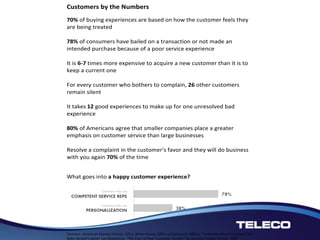
Customers by the Numbers
70% of buying experiences are based on how the customer feels they
are being treated
78% of consumers have bailed on a transaction or not made an
intended purchase because of a poor service experience
It is 6-7 times more expensive to acquire a new customer than it is to
keep a current one
For every customer who bothers to complain, 26 other customers
remain silent
It takes 12 good experiences to make up for one unresolved bad
experience
80% of Americans agree that smaller companies place a greater
emphasis on customer service than large businesses
Resolve a complaint in the customer's favor and they will do business
with you again 70% of the time
What goes into a happy customer experience?
Sources: American Express Survey, 2011; White House Office of Consumer Affairs; “Understanding Customers” by
Ruby Newell-Legner; Lee Resources; “The Cost of Poor Customer Service” by Genesys Global Survey, 2009.
CONSUMER SALES PROCESS
6-STAGE SYSTEM
To ensure you deliver the best customer
experience possible, it is necessary to
understand how the sales process works.
Each product and service has their own
unique sales process whether it is B2C or B2B.
Each stage has its own functions that must be
performed successfully to complete the sale.
This leads to a sustainable business through
retention and growth.
CONSUMER SALES PROCESS
6-STAGE SYSTEM
1. ESTABLISH RAPPORT
2. NEEDS ASSESSMENT
3. VALUE PROPOSITION
4. CLOSING
5. PROCESSING
6. POST-SALES
1. ESTABLISH RAPPORT
Establishing rapport is the first and most critical
stage in the sales process.
By establishing rapport with a customer, you
lay the foundation of your relationship with
them.
It is this relationship that allows the customer
to want to get to know you, trust you and be
influenced by you. Without trust, they will not
consider your recommendations and they will
not commit to the sale.
1. ESTABLISH RAPPORT
There are 4 areas we focus on when establishing
rapport during the sales process. They all lead to
the customer wanting to do business with you.
First Impression
Showing You Care
Active Listening
Being A Trusted Advisor
1. ESTABLISH RAPPORT
1. Stand, smile, make eye contact and greet.
2. Introduce yourself.
3. Use their name – it always makes people feel
good hearing their name and it helps you to
remember it.
4. Ask qualifying questions and be open to where
the customer takes the sales interaction.
5. Build on what the customer says.
6. Look for ‘things in common’ to talk about.
7. Keep your comments positive and opinions
neutral.
2. NEEDS ASSESSMENT
You will continue to build rapport with your
customer by properly discovering the nature of
the opportunity.
It is your job to have the customer tell you
everything you need to know to help make
them happy with their purchase, keep them
coming back and referring their family and
friends to you.
2. NEEDS ASSESSMENT
The Needs Assessment can be broken down into
2 categories:
Buying Motivators
Qualifying Questions
2. NEEDS ASSESSMENT
Buying Motivators
• Price
• Value
• Quality
• Selection
• Customer Service
2. NEEDS ASSESSMENT
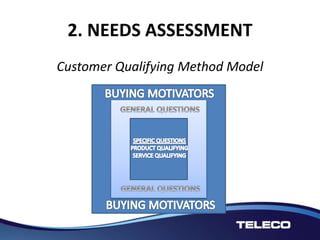
There are 3 Categories of Qualifying Questions:
1. Assess the Opportunity (General Questions)
2. Product Qualifying (Specific Questions)
3. Service Qualifying (Specific Questions)
2. NEEDS ASSESSMENT
Customer Qualifying Method Model
3. VALUE PROPOSITION
Once you’ve built rapport and fully assessed the
customer’s needs, you will make a
recommendation to them in the form of a sales
presentation.
The merit behind your recommendation will
need to be clear to the customer.
A well-polished presentation will highlight the
product/service as well as value added
features and benefits.
3. VALUE PROPOSITION
What are the 3 main questions the value
proposition should answer to the customer?
What need does the product address?
How do the features of the product/service
benefit me?
Why should I buy from you and not elsewhere?
3. VALUE PROPOSITION
The Value Proposition can be applied in a logical
sequence with 3 parts:
• Know Your Customer
• Know Your Product
• Know Your Competition
3. VALUE PROPOSITION
Know Your Customer
Treat each customer as the unique individual
that they are and recognize that different
features and benefits in your product are of
different value to different people.
3. VALUE PROPOSITION
Know Your Product
• Device
• Plan
• Extended Service Plan
• Accessories
• Complimentary Products
3. VALUE PROPOSITION
Know Your Competition
Knowledge of the alternatives is the key to
being able to proactively demonstrate value in
your product/service to your customer.
You can eliminate any perceived doubt they
may have in your ability to fulfill their needs
by demonstrating your thorough knowledge
of the market for the product/service you sell.
3. VALUE PROPOSITION
Why you need to be able to articulate your value
proposition to your customer for short and long
term implications:
• Increase your referral activity
• Gain market share over competitors
• Enhance your sales presentation
4. CLOSING
Closing the sale is a two step process that
involves the customer committing to the sale
and the actual processing of the sale.
 Commitment is achieved when the customer
verbally agrees to the sale.
Processing is the signed contract and
exchange of money. This is a separate stage.
4. CLOSING
Commitment
In order for the customer to commit to the
sale you must ask for the sale. This can take
many forms.
You must also overcome the objection a
customer may have for any of your
products/services.
4. CLOSING
Asking For the Sale
The following are the main techniques used to
ask for the sale:
• Direct Close
• Indirect Close
• Comparative Close
4. CLOSING
Overcoming the Objection
The following are the main reasons why a
customer may object:
• Lack of funds
• Lack of need
• Lack of priority
• Lack of authority
5. PROCESSING
Once the customer has committed to a sale you
need to process the transaction.
The processing is the finalization of the contract,
the exchange of funds for the product and the
establishment of the service level agreement
(SLA).
At this point, an important stage of the overall
sales process comes back into play.
What stage is it and why is it important?
ESTABLISHING RAPPORT
6. POST-SALES
The final stage of the sales process is the post-
sales service.
When a certain level of service is expected
you always want to exceed expectations in
order to win repeat business.
Post-sales service can be divided into two
categories: reactive and proactive.
6. POST-SALES
Reactive
This type of post-sales service would include
any occurrences where a customer would
need to return to the point of distribution or
call for technical support.
This could include warranty processing,
troubleshooting, product learning and
account maintenance.
6. POST-SALES
Proactive
This type of post-sales service would be any
way in which you continue your relationship
with your customer.
This should include, at a minimum, a follow-
up call, and can also include but not limited to
emails on product news/information and
social media efforts.
CONSUMER SALES PROCESS
6-STAGE SYSTEM
1. ESTABLISH RAPPORT
2. NEEDS ASSESSMENT
3. VALUE PROPOSITION
4. CLOSING
5. PROCESSING
6. POST-SALES

The Essential Retail Sales Cycle

  • 1.
  • 2.
    Customers by theNumbers 70% of buying experiences are based on how the customer feels they are being treated 78% of consumers have bailed on a transaction or not made an intended purchase because of a poor service experience It is 6-7 times more expensive to acquire a new customer than it is to keep a current one For every customer who bothers to complain, 26 other customers remain silent It takes 12 good experiences to make up for one unresolved bad experience 80% of Americans agree that smaller companies place a greater emphasis on customer service than large businesses Resolve a complaint in the customer's favor and they will do business with you again 70% of the time What goes into a happy customer experience? Sources: American Express Survey, 2011; White House Office of Consumer Affairs; “Understanding Customers” by Ruby Newell-Legner; Lee Resources; “The Cost of Poor Customer Service” by Genesys Global Survey, 2009.
  • 3.
    CONSUMER SALES PROCESS 6-STAGESYSTEM To ensure you deliver the best customer experience possible, it is necessary to understand how the sales process works. Each product and service has their own unique sales process whether it is B2C or B2B. Each stage has its own functions that must be performed successfully to complete the sale. This leads to a sustainable business through retention and growth.
  • 4.
    CONSUMER SALES PROCESS 6-STAGESYSTEM 1. ESTABLISH RAPPORT 2. NEEDS ASSESSMENT 3. VALUE PROPOSITION 4. CLOSING 5. PROCESSING 6. POST-SALES
  • 5.
    1. ESTABLISH RAPPORT Establishingrapport is the first and most critical stage in the sales process. By establishing rapport with a customer, you lay the foundation of your relationship with them. It is this relationship that allows the customer to want to get to know you, trust you and be influenced by you. Without trust, they will not consider your recommendations and they will not commit to the sale.
  • 6.
    1. ESTABLISH RAPPORT Thereare 4 areas we focus on when establishing rapport during the sales process. They all lead to the customer wanting to do business with you. First Impression Showing You Care Active Listening Being A Trusted Advisor
  • 7.
    1. ESTABLISH RAPPORT 1.Stand, smile, make eye contact and greet. 2. Introduce yourself. 3. Use their name – it always makes people feel good hearing their name and it helps you to remember it. 4. Ask qualifying questions and be open to where the customer takes the sales interaction. 5. Build on what the customer says. 6. Look for ‘things in common’ to talk about. 7. Keep your comments positive and opinions neutral.
  • 8.
    2. NEEDS ASSESSMENT Youwill continue to build rapport with your customer by properly discovering the nature of the opportunity. It is your job to have the customer tell you everything you need to know to help make them happy with their purchase, keep them coming back and referring their family and friends to you.
  • 9.
    2. NEEDS ASSESSMENT TheNeeds Assessment can be broken down into 2 categories: Buying Motivators Qualifying Questions
  • 10.
    2. NEEDS ASSESSMENT BuyingMotivators • Price • Value • Quality • Selection • Customer Service
  • 11.
    2. NEEDS ASSESSMENT Thereare 3 Categories of Qualifying Questions: 1. Assess the Opportunity (General Questions) 2. Product Qualifying (Specific Questions) 3. Service Qualifying (Specific Questions)
  • 12.
    2. NEEDS ASSESSMENT CustomerQualifying Method Model
  • 13.
    3. VALUE PROPOSITION Onceyou’ve built rapport and fully assessed the customer’s needs, you will make a recommendation to them in the form of a sales presentation. The merit behind your recommendation will need to be clear to the customer. A well-polished presentation will highlight the product/service as well as value added features and benefits.
  • 14.
    3. VALUE PROPOSITION Whatare the 3 main questions the value proposition should answer to the customer? What need does the product address? How do the features of the product/service benefit me? Why should I buy from you and not elsewhere?
  • 15.
    3. VALUE PROPOSITION TheValue Proposition can be applied in a logical sequence with 3 parts: • Know Your Customer • Know Your Product • Know Your Competition
  • 16.
    3. VALUE PROPOSITION KnowYour Customer Treat each customer as the unique individual that they are and recognize that different features and benefits in your product are of different value to different people.
  • 17.
    3. VALUE PROPOSITION KnowYour Product • Device • Plan • Extended Service Plan • Accessories • Complimentary Products
  • 18.
    3. VALUE PROPOSITION KnowYour Competition Knowledge of the alternatives is the key to being able to proactively demonstrate value in your product/service to your customer. You can eliminate any perceived doubt they may have in your ability to fulfill their needs by demonstrating your thorough knowledge of the market for the product/service you sell.
  • 19.
    3. VALUE PROPOSITION Whyyou need to be able to articulate your value proposition to your customer for short and long term implications: • Increase your referral activity • Gain market share over competitors • Enhance your sales presentation
  • 20.
    4. CLOSING Closing thesale is a two step process that involves the customer committing to the sale and the actual processing of the sale.  Commitment is achieved when the customer verbally agrees to the sale. Processing is the signed contract and exchange of money. This is a separate stage.
  • 21.
    4. CLOSING Commitment In orderfor the customer to commit to the sale you must ask for the sale. This can take many forms. You must also overcome the objection a customer may have for any of your products/services.
  • 22.
    4. CLOSING Asking Forthe Sale The following are the main techniques used to ask for the sale: • Direct Close • Indirect Close • Comparative Close
  • 23.
    4. CLOSING Overcoming theObjection The following are the main reasons why a customer may object: • Lack of funds • Lack of need • Lack of priority • Lack of authority
  • 24.
    5. PROCESSING Once thecustomer has committed to a sale you need to process the transaction. The processing is the finalization of the contract, the exchange of funds for the product and the establishment of the service level agreement (SLA). At this point, an important stage of the overall sales process comes back into play. What stage is it and why is it important? ESTABLISHING RAPPORT
  • 25.
    6. POST-SALES The finalstage of the sales process is the post- sales service. When a certain level of service is expected you always want to exceed expectations in order to win repeat business. Post-sales service can be divided into two categories: reactive and proactive.
  • 26.
    6. POST-SALES Reactive This typeof post-sales service would include any occurrences where a customer would need to return to the point of distribution or call for technical support. This could include warranty processing, troubleshooting, product learning and account maintenance.
  • 27.
    6. POST-SALES Proactive This typeof post-sales service would be any way in which you continue your relationship with your customer. This should include, at a minimum, a follow- up call, and can also include but not limited to emails on product news/information and social media efforts.
  • 28.
    CONSUMER SALES PROCESS 6-STAGESYSTEM 1. ESTABLISH RAPPORT 2. NEEDS ASSESSMENT 3. VALUE PROPOSITION 4. CLOSING 5. PROCESSING 6. POST-SALES