Presentation on personal
selling process
Submitted by :
Laxmi
B.com(h)
Personal selling
•Personalsellingisalsoknownasfacetofacesellingin
whichonepersonwhoissalesmantryingtoconvince
thecustomerinbuyingaproduct.
•Itisapromotionalmethod inwhichsalesmanusing
his/herskillsandabilitiesinanattempttomakea
sale.
Personal selling process
• The selling process is a
set of activities
undertaken to
successfully obtain an
order and building a
long term customer
relations. The activities
apply to all forms of
selling and can be
adapted to most Selling
situations .
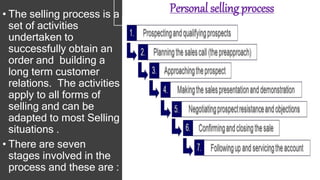
• There are seven
stages involved in the
process and these are :
1. Prospecting and evaluating
• It is the initial stage of personal selling
process involves identifying potential
customers.
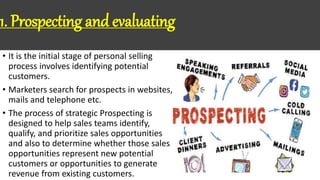
• Marketers search for prospects in websites,
mails and telephone etc.
• The process of strategic Prospecting is
designed to help sales teams identify,
qualify, and prioritize sales opportunities
and also to determine whether those sales
opportunities represent new potential
customers or opportunities to generate
revenue from existing customers.
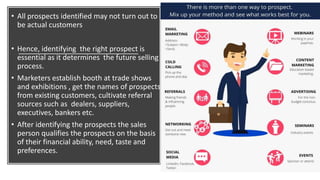
• All prospects identified may not turn out to
be actual customers
• Hence, identifying the right prospect is
essential as it determines the future selling
process.
• Marketers establish booth at trade shows
and exhibitions , get the names of prospects
from existing customers, cultivate referral
sources such as dealers, suppliers,
executives, bankers etc.
• After identifying the prospects the sales
person qualifies the prospects on the basis
of their financial ability, need, taste and
preferences.
2. Pre –approach
• At this stage, the salesperson
needs to decide as to how to
approach the prospective
customers.
• The salesperson may make a
personal visit, a phone call or
send a letter , based on the
convenience of the prospects.
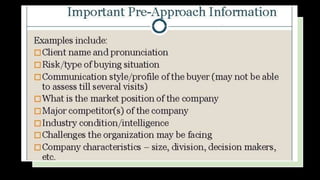
• Steps to follow in pre approach
planning
1. Analyze prospecting
information
2. Plan specifically for each sales
call
3. Approach
•At this stage,the salesperson should
properly approach the prospects. He
should properly greet the buyer and
give a good start to the conversation.
•The salesperson attitude, appearance,
way of speaking matters most at this
stage.
•This usually involves introductions,
framing some small talk ,asking a few
warm up questions, and generally
explaining who you are and whom
you represent. This is called
approach.
4. Presentation and
demonstration
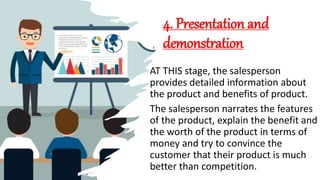
AT THIS stage, the salesperson
provides detailed information about
the product and benefits of product.
The salesperson narrates the features
of the product, explain the benefit and
the worth of the product in terms of
money and try to convince the
customer that their product is much
better than competition.
• It explains benefits that should
address specific needs mentioned
by the buyer.
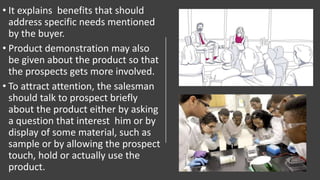
• Product demonstration may also
be given about the product so that
the prospects gets more involved.
• To attract attention, the salesman
should talk to prospect briefly
about the product either by asking
a question that interest him or by
display of some material, such as
sample or by allowing the prospect
touch, hold or actually use the
product.
5. Meeting objections
• After presentation and demonstration, when customers
are asked to place order, they are reluctant to buy and
raise objections.
• The sales resistance usually takes the form of objections
an outward expression of prospect’s doubt or negative
feelings.
• Customers may raise objections with regard to
price,delivery schedule , product or company
characteristics etc.
• Type of objections
1. Price/value objections
2. Product/ service objections
3. Procrastinating objections
4. Hidden objections
Methods of
handling
objections
. Direct denial method : under this the salesman
should never contradict the buyers observation.
• Salesman should kept in mind these guidelines
1. He should not be offensive,rather he should
smile.
2. The type of customer must be kept in mind, so
that their feelings doesn’t hurt.
3. It shouldn’t be used if the objection has any
ego involvement .
Indirect denial mthod: in this method the
salesman agrees with the prospect only to differ
subsequently looking at the position from different
angle. This method is also sometimes described as
the “ yes”, ”but” method .
• 3. Reverse position method: the objects of this method is that very often the customer
whilst explaining his objections would explain it away and realise its flimsiness.
• Effectiveness in this method depends on the sincerity with which the salesman makes his
statement and also the eagerness he shows to learn reasons behind the prospects
statement.
4.Boomberg method: it consistes throwing back to prospects his objections in the form of
reason why he should buy the article.
Eg: when a prospect raises an objections, the reply may be “ that is exactly the reason why I
believe you need this article “
5. Superior point : this method is similar to the indirect method explained above except that
here the salesman admits the validity of the objectify but offsets the objections by a superior
point of greater advantage.
6.Interrogation method: this method consists in asking the customer a question or questions
tactfully so that the objections may be answered away by the prospect himself.
7. Pass up method : some salesman tries to pass off most objections. Although this is
objectionable as previously mentioned,if the prospect has made a flimsy objection this
method can be justifiably used.
Selecting an
appropriate method for
overcoming objection
•As discussed earlier, there are 7
methods of meeting objections raised
by the prospects. However,there is no
such method which can be used
successfully in overcoming each and
every objection.
•Sometimes , two or more methods are
combined according to the situation to
overcome customer objections.
•Eg; the the question or interrogation
method and boomerang methods can
be combined to meet objections of the
customers.
6.The close
• After handling objections and
convincing customers to buy the
product the salesperson requests
the customer to place order.
• And if, your customer is convinced
your product will meet her needs ,
you close by aggreeing on the
terms on the sale and finishing up
the transaction.
Three closing techniques are used when a salesperson believes that
buyers is about to ready to make a purchase
1. Trial close: it involves asking the prospect to make a Decision on some aspect
of the purchase; like
• “ would you prefer the gray or red model?”
2. Assumptive close: it entails asking the prospects to make choices concerning
delivering, warranty or financial terms under the assumption that a sale has been
finalized.
3. Urgency close: it is used to commit the prospect quickly by making reference
to the timeliness of the purchase; like
• “ The low interest financing ends next week”,or
• “That is the last model we have in stock”.
# when a prospect is clearly ready to buy ,the final close is used and a
salesperson asks for the order.
Importance of sales
closing
• The foremost importance of sales closing is that deal
is done, and the sales is closed. A sales is completed
only when the payment is realized by the company.
• Sales closing will ensure that all the processes are
followed,and the sales is realized, and the money is
earned by the company.
• From the organizational pt of view, the closing of sale
would mean acquiring a customer , which would be
important to track and for future references.
• For the salesperson, the target is given on closing the
sales deals , which is why it is important that he
closes the deals.
• For the customer prespective sales,closing would
mean that all the commitments that are given from
the salesperson to be honoured .
Reasons for unsuccessful
close
•Salesperson didn’t create/ build value
•Not selling to correct person
•Lack of urgency
•No compelling reasons to buy
•Lack of posturing
•Salesman lacks opportunities so they
continue to the work to the lousy ones
too
Requirements for successful sale
• 1.Believe in your product/ service and negate your fear by getting into action.
• 2.Commit to the sale,devote your energy and do everything make to seal the
deal.
• 3.A true professional is impervious To any negatively because he is a pro and
He is operating a level a far beyond the average player of game.
• 4.You need to have confidence in the product and Show it can solve their
problem. You must believe that what you are offering is the right thing for the
prospect.
• 5.Have a written offer always have a presentation and prices in writing for the
buyer so they can see it with their own eyes. Closing Is getting the buyer to
take action and agree To exchange something value, for what it is it you offer
so that is close on your offer and solutions.
7.Followup
• The follow up is an important part of
assuring customer satisfaction, retaining
customers and prospecting for new
customers.
• The follow up stage includes making certain
the customer’s purchase has been properly
delivered and installed and difficulties
experienced with the use of the item are
addressed.
• The salesperson can ensure customer
satisfaction by properly attending matters
which are important to the customers. Thus,
follow up is necessary if salesperson wants to
ensure repeat purchase.
Questions
for
discussions
• Ask your original question again , slightly differently;
don’t be afraid to ask the same question twice.if I am
interviewing someone and the person either defects my
first question or doesn’t give a real response, I will often
say “ let me ask you this another way…”
1. It is highly effective method of extracting a real
response that will actually be predictive of behavior
• Connect their answer to each other ; to understand
people better is to link their responses to something they
said earlier.
1. Ask something like :” oh, that’s like the time you…,” or,
“is it what you meant earlier when you said….”
• Ask about the implications of their answers; when
people answer a question without being particularly
revealing, or by giving a safe ans what to do ? They you
might asked about the implications of that like, “ what
are the consequences of your detail orientation?” And
keep asking questions , until you are satisfied what you
need to know about the person.
PPT ON Personal selling process

PPT ON Personal selling process

  • 1.
    Presentation on personal sellingprocess Submitted by : Laxmi B.com(h)
  • 2.
  • 3.
    Personal selling process •The selling process is a set of activities undertaken to successfully obtain an order and building a long term customer relations. The activities apply to all forms of selling and can be adapted to most Selling situations . • There are seven stages involved in the process and these are :
  • 4.
    1. Prospecting andevaluating • It is the initial stage of personal selling process involves identifying potential customers. • Marketers search for prospects in websites, mails and telephone etc. • The process of strategic Prospecting is designed to help sales teams identify, qualify, and prioritize sales opportunities and also to determine whether those sales opportunities represent new potential customers or opportunities to generate revenue from existing customers.
  • 5.
    • All prospectsidentified may not turn out to be actual customers • Hence, identifying the right prospect is essential as it determines the future selling process. • Marketers establish booth at trade shows and exhibitions , get the names of prospects from existing customers, cultivate referral sources such as dealers, suppliers, executives, bankers etc. • After identifying the prospects the sales person qualifies the prospects on the basis of their financial ability, need, taste and preferences.
  • 6.
    2. Pre –approach •At this stage, the salesperson needs to decide as to how to approach the prospective customers. • The salesperson may make a personal visit, a phone call or send a letter , based on the convenience of the prospects. • Steps to follow in pre approach planning 1. Analyze prospecting information 2. Plan specifically for each sales call
  • 8.
    3. Approach •At thisstage,the salesperson should properly approach the prospects. He should properly greet the buyer and give a good start to the conversation. •The salesperson attitude, appearance, way of speaking matters most at this stage. •This usually involves introductions, framing some small talk ,asking a few warm up questions, and generally explaining who you are and whom you represent. This is called approach.
  • 9.
    4. Presentation and demonstration ATTHIS stage, the salesperson provides detailed information about the product and benefits of product. The salesperson narrates the features of the product, explain the benefit and the worth of the product in terms of money and try to convince the customer that their product is much better than competition.
  • 10.
    • It explainsbenefits that should address specific needs mentioned by the buyer. • Product demonstration may also be given about the product so that the prospects gets more involved. • To attract attention, the salesman should talk to prospect briefly about the product either by asking a question that interest him or by display of some material, such as sample or by allowing the prospect touch, hold or actually use the product.
  • 11.
    5. Meeting objections •After presentation and demonstration, when customers are asked to place order, they are reluctant to buy and raise objections. • The sales resistance usually takes the form of objections an outward expression of prospect’s doubt or negative feelings. • Customers may raise objections with regard to price,delivery schedule , product or company characteristics etc. • Type of objections 1. Price/value objections 2. Product/ service objections 3. Procrastinating objections 4. Hidden objections
  • 12.
    Methods of handling objections . Directdenial method : under this the salesman should never contradict the buyers observation. • Salesman should kept in mind these guidelines 1. He should not be offensive,rather he should smile. 2. The type of customer must be kept in mind, so that their feelings doesn’t hurt. 3. It shouldn’t be used if the objection has any ego involvement . Indirect denial mthod: in this method the salesman agrees with the prospect only to differ subsequently looking at the position from different angle. This method is also sometimes described as the “ yes”, ”but” method .
  • 13.
    • 3. Reverseposition method: the objects of this method is that very often the customer whilst explaining his objections would explain it away and realise its flimsiness. • Effectiveness in this method depends on the sincerity with which the salesman makes his statement and also the eagerness he shows to learn reasons behind the prospects statement. 4.Boomberg method: it consistes throwing back to prospects his objections in the form of reason why he should buy the article. Eg: when a prospect raises an objections, the reply may be “ that is exactly the reason why I believe you need this article “ 5. Superior point : this method is similar to the indirect method explained above except that here the salesman admits the validity of the objectify but offsets the objections by a superior point of greater advantage. 6.Interrogation method: this method consists in asking the customer a question or questions tactfully so that the objections may be answered away by the prospect himself. 7. Pass up method : some salesman tries to pass off most objections. Although this is objectionable as previously mentioned,if the prospect has made a flimsy objection this method can be justifiably used.
  • 14.
    Selecting an appropriate methodfor overcoming objection •As discussed earlier, there are 7 methods of meeting objections raised by the prospects. However,there is no such method which can be used successfully in overcoming each and every objection. •Sometimes , two or more methods are combined according to the situation to overcome customer objections. •Eg; the the question or interrogation method and boomerang methods can be combined to meet objections of the customers.
  • 15.
    6.The close • Afterhandling objections and convincing customers to buy the product the salesperson requests the customer to place order. • And if, your customer is convinced your product will meet her needs , you close by aggreeing on the terms on the sale and finishing up the transaction.
  • 16.
    Three closing techniquesare used when a salesperson believes that buyers is about to ready to make a purchase 1. Trial close: it involves asking the prospect to make a Decision on some aspect of the purchase; like • “ would you prefer the gray or red model?” 2. Assumptive close: it entails asking the prospects to make choices concerning delivering, warranty or financial terms under the assumption that a sale has been finalized. 3. Urgency close: it is used to commit the prospect quickly by making reference to the timeliness of the purchase; like • “ The low interest financing ends next week”,or • “That is the last model we have in stock”. # when a prospect is clearly ready to buy ,the final close is used and a salesperson asks for the order.
  • 17.
    Importance of sales closing •The foremost importance of sales closing is that deal is done, and the sales is closed. A sales is completed only when the payment is realized by the company. • Sales closing will ensure that all the processes are followed,and the sales is realized, and the money is earned by the company. • From the organizational pt of view, the closing of sale would mean acquiring a customer , which would be important to track and for future references. • For the salesperson, the target is given on closing the sales deals , which is why it is important that he closes the deals. • For the customer prespective sales,closing would mean that all the commitments that are given from the salesperson to be honoured .
  • 18.
    Reasons for unsuccessful close •Salespersondidn’t create/ build value •Not selling to correct person •Lack of urgency •No compelling reasons to buy •Lack of posturing •Salesman lacks opportunities so they continue to the work to the lousy ones too
  • 19.
    Requirements for successfulsale • 1.Believe in your product/ service and negate your fear by getting into action. • 2.Commit to the sale,devote your energy and do everything make to seal the deal. • 3.A true professional is impervious To any negatively because he is a pro and He is operating a level a far beyond the average player of game. • 4.You need to have confidence in the product and Show it can solve their problem. You must believe that what you are offering is the right thing for the prospect. • 5.Have a written offer always have a presentation and prices in writing for the buyer so they can see it with their own eyes. Closing Is getting the buyer to take action and agree To exchange something value, for what it is it you offer so that is close on your offer and solutions.
  • 20.
    7.Followup • The followup is an important part of assuring customer satisfaction, retaining customers and prospecting for new customers. • The follow up stage includes making certain the customer’s purchase has been properly delivered and installed and difficulties experienced with the use of the item are addressed. • The salesperson can ensure customer satisfaction by properly attending matters which are important to the customers. Thus, follow up is necessary if salesperson wants to ensure repeat purchase.
  • 21.
    Questions for discussions • Ask youroriginal question again , slightly differently; don’t be afraid to ask the same question twice.if I am interviewing someone and the person either defects my first question or doesn’t give a real response, I will often say “ let me ask you this another way…” 1. It is highly effective method of extracting a real response that will actually be predictive of behavior • Connect their answer to each other ; to understand people better is to link their responses to something they said earlier. 1. Ask something like :” oh, that’s like the time you…,” or, “is it what you meant earlier when you said….” • Ask about the implications of their answers; when people answer a question without being particularly revealing, or by giving a safe ans what to do ? They you might asked about the implications of that like, “ what are the consequences of your detail orientation?” And keep asking questions , until you are satisfied what you need to know about the person.