SALES AND MARKETING STRATEGIES
WHAT IS SALES    The act of selling; specially: the transfer of ownership of a title or property from one person to another for a price.
WHAT IS MARKETING    Marketing is the activity, set of instructions, and processes for creating, communicating, delivering, and exchanging that have value for customers, clients, partners, and society at large
DIFFERENCE BETWEEN MARKETING AND SALESSales is one activity of the entire marketing process.
Sales is the act of persuading or influencing a customer, marketing activity support sales effort.
Marketing is everything you do to open avenues for sale, sales is every thing you do to close a sale.
Sales is focused on short term, marketing is long term concern.VENDOR MANAGEMENT         WHAT IS VENDORA vendor (pronounced VEHN-duhr, from frenchvendre, meaning to sell) is any person or company that sells goods or services to someone else in the economic production chain
VENDOR MANAGEMENT  Vendor management is the discipline of establishing service, quality, cost and satisfaction goals and selecting and managing third party companies to consistently meet these goals.
   These things to come under vendor   management: Establishing goals.
 Selecting vendors.
 Managing vendors.
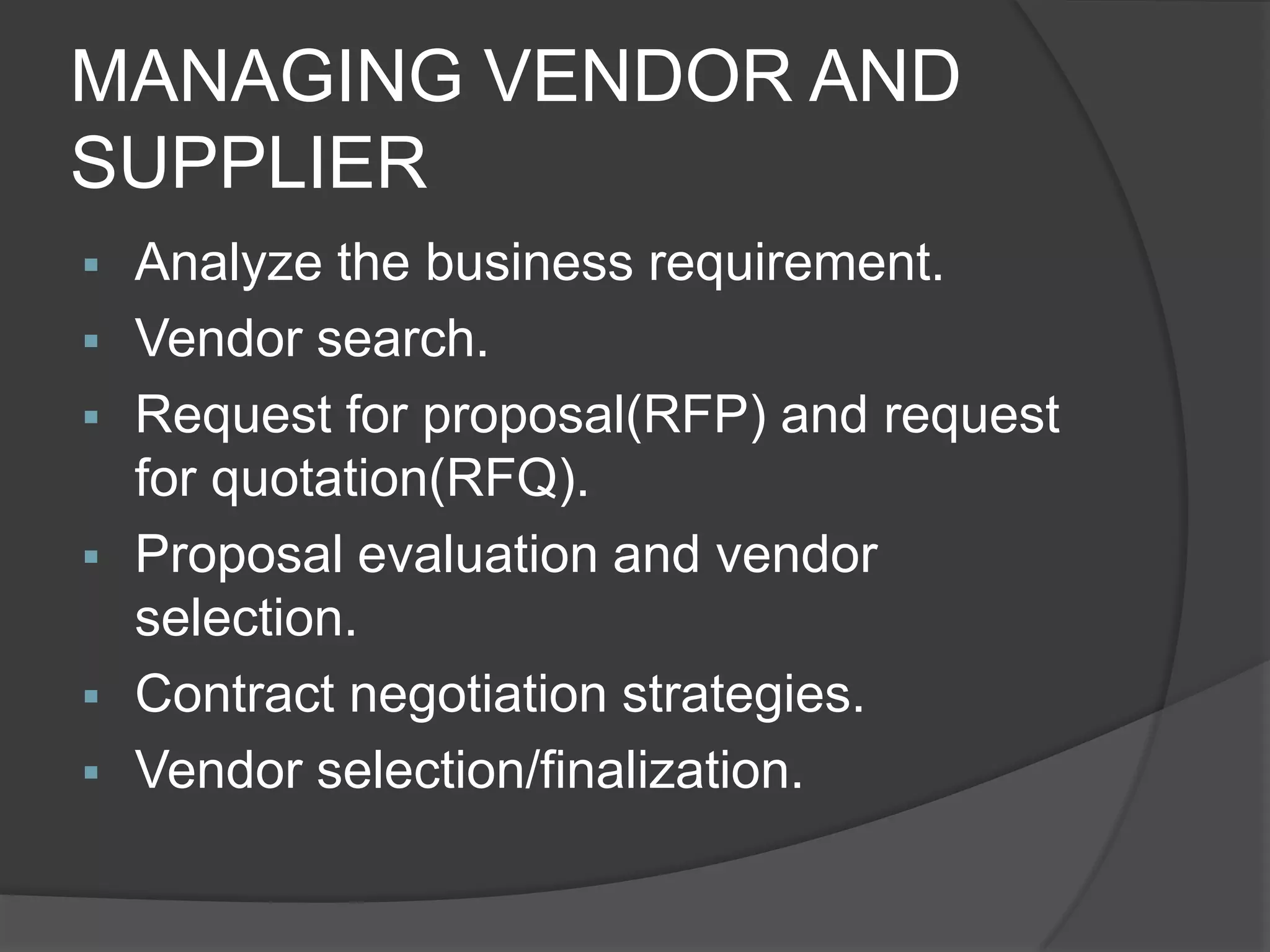
 Consistently meet goalsMANAGING VENDOR AND SUPPLIERAnalyze the business requirement.
Vendor search.
Request for proposal(RFP) and request for quotation(RFQ).
Proposal evaluation and vendor selection.
Contract negotiation strategies.
Vendor selection/finalization.ANALYZE THE BUSINESS REQUIREMENT Assemble an evaluation team.
Define the product, material or service.
Define the technical business requirement.
Define the vendor requirement.
Publish a requirements document for approval.VENDOR SEARCHCompile a list of possible vendors.
Select vendor to request more information form.
Write a request for information.
Evaluate responses and create a short list of vendors.REQUEST FOR PROPOSAL AND REQUEST FOR QUOTATIONSubmission details.
Introduction and executive summary.
Business overview and background.
Detailed specifications.
Assumptions and constraints.
Terms and Conditions.
Selection criteriaPROPOSAL EVALUATION AND VENDOR SELECTIONPreliminary review of all vendor proposal.
Record business and vendor requirement.
Assign value for each requirement.
Assign a performance value.
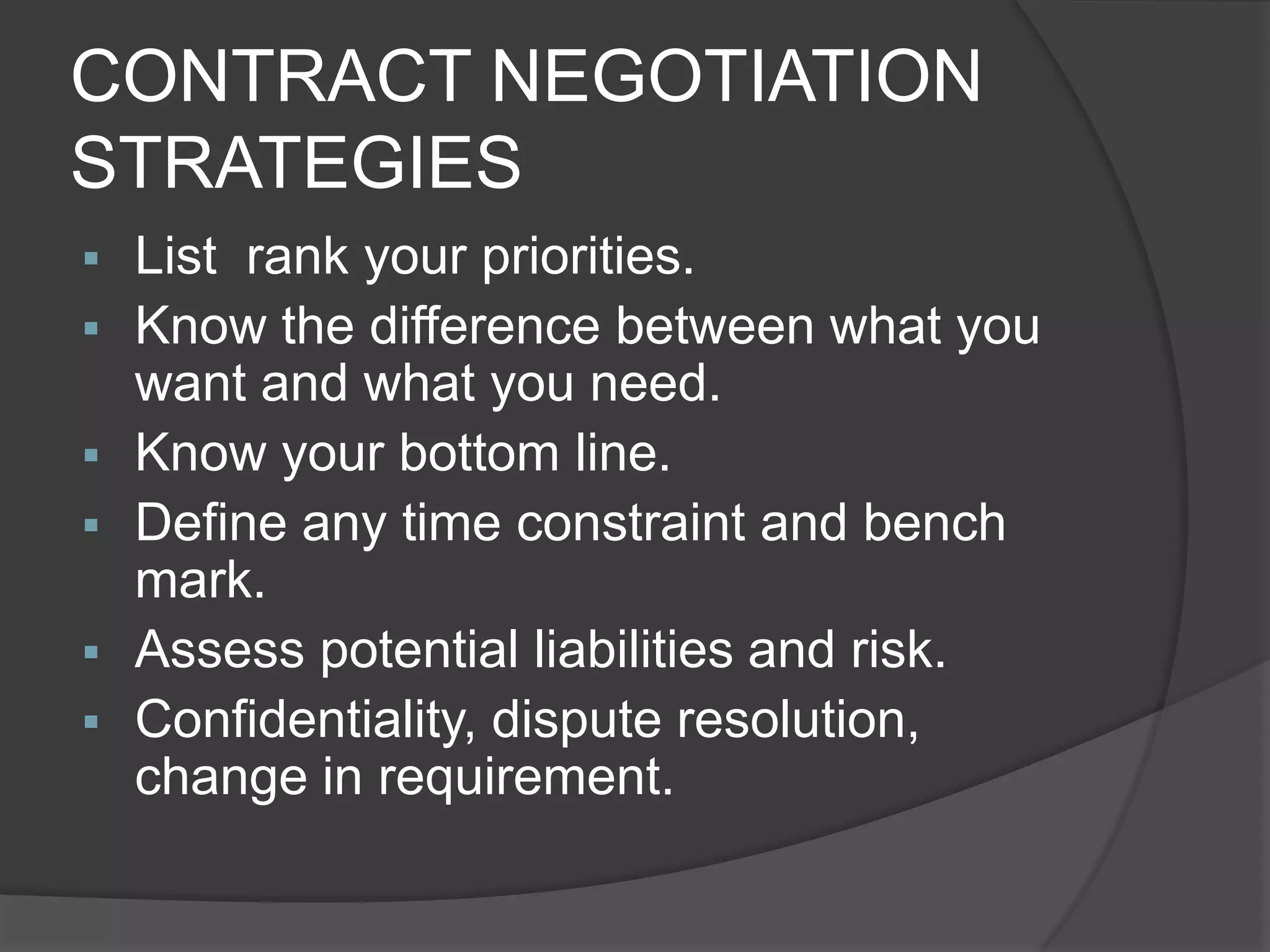
Calculate a total performanceCONTRACT NEGOTIATION STRATEGIESList  rank your priorities.
Know the difference between what you want and what you need.
Know your bottom line.

Sales and marketing strategies

  • 1.
  • 2.
    WHAT IS SALES The act of selling; specially: the transfer of ownership of a title or property from one person to another for a price.
  • 3.
    WHAT IS MARKETING Marketing is the activity, set of instructions, and processes for creating, communicating, delivering, and exchanging that have value for customers, clients, partners, and society at large
  • 4.
    DIFFERENCE BETWEEN MARKETINGAND SALESSales is one activity of the entire marketing process.
  • 5.
    Sales is theact of persuading or influencing a customer, marketing activity support sales effort.
  • 6.
    Marketing is everythingyou do to open avenues for sale, sales is every thing you do to close a sale.
  • 7.
    Sales is focusedon short term, marketing is long term concern.VENDOR MANAGEMENT WHAT IS VENDORA vendor (pronounced VEHN-duhr, from frenchvendre, meaning to sell) is any person or company that sells goods or services to someone else in the economic production chain
  • 8.
    VENDOR MANAGEMENT Vendor management is the discipline of establishing service, quality, cost and satisfaction goals and selecting and managing third party companies to consistently meet these goals.
  • 9.
    These things to come under vendor management: Establishing goals.
  • 10.
  • 11.
  • 12.
    Consistently meetgoalsMANAGING VENDOR AND SUPPLIERAnalyze the business requirement.
  • 13.
  • 14.
    Request for proposal(RFP)and request for quotation(RFQ).
  • 15.
    Proposal evaluation andvendor selection.
  • 16.
  • 17.
    Vendor selection/finalization.ANALYZE THEBUSINESS REQUIREMENT Assemble an evaluation team.
  • 18.
    Define the product,material or service.
  • 19.
    Define the technicalbusiness requirement.
  • 20.
    Define the vendorrequirement.
  • 21.
    Publish a requirementsdocument for approval.VENDOR SEARCHCompile a list of possible vendors.
  • 22.
    Select vendor torequest more information form.
  • 23.
    Write a requestfor information.
  • 24.
    Evaluate responses andcreate a short list of vendors.REQUEST FOR PROPOSAL AND REQUEST FOR QUOTATIONSubmission details.
  • 25.
  • 26.
  • 27.
  • 28.
  • 29.
  • 30.
    Selection criteriaPROPOSAL EVALUATIONAND VENDOR SELECTIONPreliminary review of all vendor proposal.
  • 31.
    Record business andvendor requirement.
  • 32.
    Assign value foreach requirement.
  • 33.
  • 34.
    Calculate a totalperformanceCONTRACT NEGOTIATION STRATEGIESList rank your priorities.
  • 35.
    Know the differencebetween what you want and what you need.
  • 36.
  • 37.
    Define any timeconstraint and bench mark.
  • 38.
  • 39.
    Confidentiality, dispute resolution,change in requirement. VENDOR FINALIZATION Finalization of the vendor is done in this stage and all the documents will be duly signed by the concerned authorities of both the parties
  • 40.
    CHANNEL MANAGEMENTSUPPLY CHAIN A supply chain is the organization, people, technology, activities, information and resources involved in moving a product or service from supplier to customers.
  • 41.
    BUILDING RELATIONSHIP WITHTHE CUSTOMER Success in sales depends directly on your ability to make yourself likeable, and create a positive experience for your customers.
  • 42.
    STEPS TO BUILDA PROFITABLE CUSTOMER RELATIONSHIPLove what you sell, the company you work for and the customers you serve.Be empathetic and compassionate.Add value and give first.Express your true intent. Don't go for the big decision all at once.Use friendly, warm words.Ask the right questions. 
  • 43.
    Love what yousell, the company you work for and the customers you serve. If you are truly passionate about these three things, your willingness to help your customers solve their problems will shine through. Customers will believe your sincerity and be captivated by your excitement. In short - you will be fun to work with.
  • 44.
    Be empathetic andcompassionate. Truly care about your customers, and remember that no matter how good an actor you are, faking it simply won't work.
  • 45.
    Add value andgive first. Share your network of contacts with your customers, and don't expect them to give you their business without you giving them something first.
  • 46.
    Express your trueintent. Tell customers upfront: "I don't know if there's a fit between what you need and what I have right now, but I'm hoping we can explore that in more detail during this meeting."
  • 47.
    Don't go forthe big decision all at once. In our personal lives, we don't propose to someone on a first date (at least, not usually!). The same is true in our business relationships. So get approval from the customer to move ahead in increasing increments.
  • 48.
    Use friendly, warmwords. When you use simple language instead of formal "business speak," people respond better and trust you more. And don't try to impress prospects with your extensive vocabulary, or you may end up just sounding fake.
  • 49.
    Ask the rightquestions.  Successfully building agreement with your prospects depends on your ability to ask the right questions. What are the right questions? Those that move the prospect from an intellectual position of knowing they have a problem that needs to be solved, to an emotional state of trusting you to solve that problem in a way that will satisfy them. 
  • 50.
    IDENTIFYING CUSTOMER NEEDS You will only gain a competitive edge if you have correctly identified your customer needs. In order to identify customer needs and make use of this information you will need to do three things:
  • 51.
    Communicate withyour customers and find out how you can satisfy their needs better. Establish ways to record and interpret customer feedback. Use this information when making important decisions about marketing, buying, merchandising and selling.
  • 52.
    The resultant competitiveedge should: Attract more customers than your competitors. Increase the amount that your customers spend. Persuade your customers to shop with you more regularly.
  • 53.
    CUSTOMER NEEDS Customershave six basic buying needs pertaining to the product: Safety.Performance.Appearance.Comfort.Economy.Durability.
  • 54.
    IDENTIFY DECISION MAKER Decision maker is the major prospect for the seller to sell the product ,goods or services.
  • 55.
    CUSTOMIZE THE SALES No two customers are alike in the need, so you have to find the different need of the different people differently that’s how you can customize your sales.
  • 56.
    IDENTIFY THE CUSTOMERBUDGETRecognize the needProvide the Right Product/Service.How much he is willing to pay.What product is good for him.
  • 57.
    ABILITY TO CONVINCEThink in terms of what your customer receive.How is the product or service that you sell is unique in terms of customer benefits.Identify a “ pain point ” in your industry.Be specific and make sure you can back up proposition when asked for proof.
  • 58.
    PRESALES APPROACH Pre- approach is an important stage in the sales process that means gathering and analyzing all important information about prospect before engaging him or her in the selling process.
  • 59.
    CLOSING THE DEAL The final delivery of the product or the service to the customer and receiving the price of it and providing the tangible proof of the price received and filling the warranty form if any.
  • 60.
  • 61.