The  Escalation of  Wireless  Internet By  Ryan Woods Follow me @rtwoods13 Image: cestaimee ~ Flickr
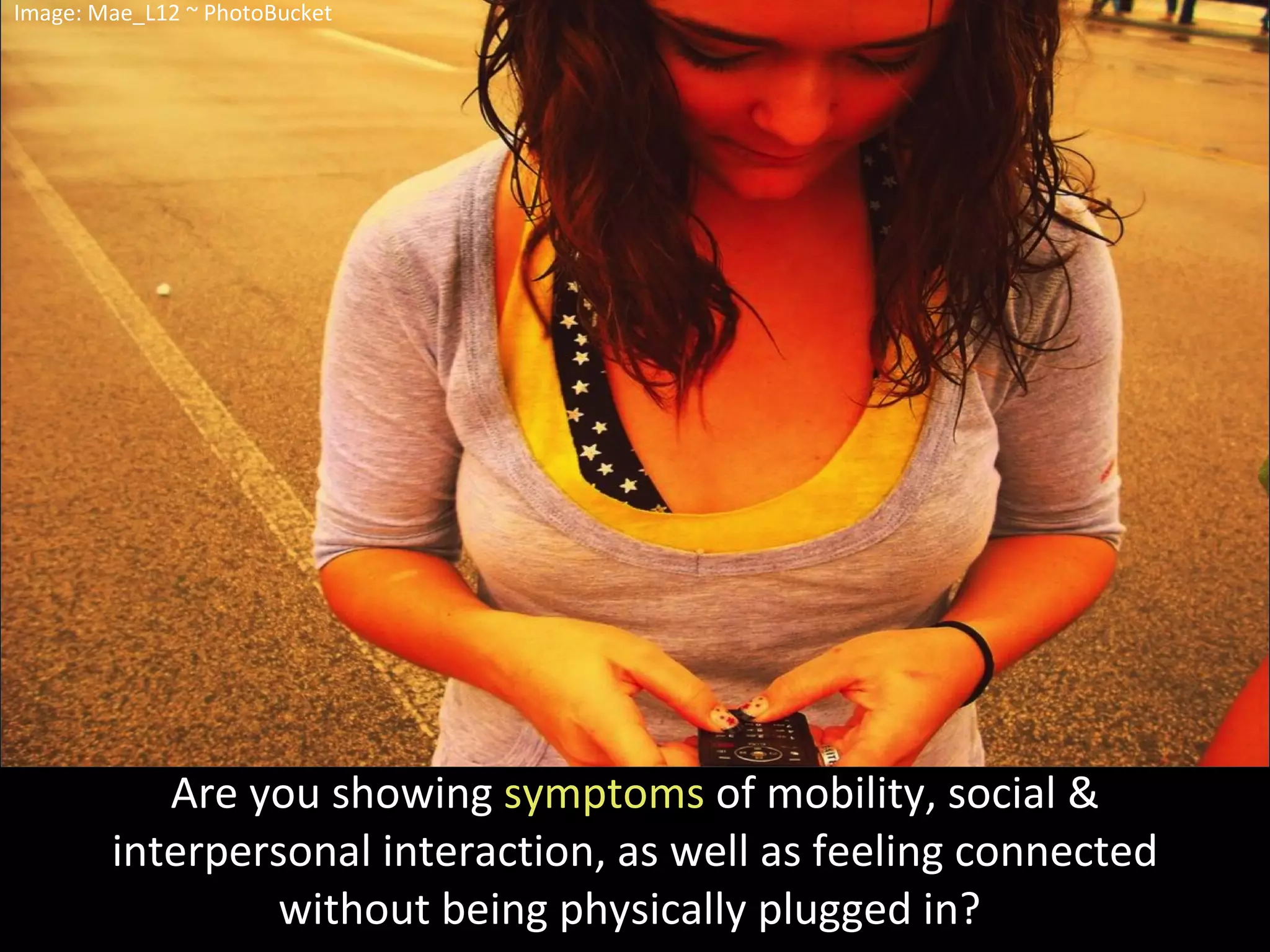
Are you showing  symptoms  of mobility, social & interpersonal interaction, as well as feeling connected without being physically plugged in?  Image: Mae_L12 ~ PhotoBucket
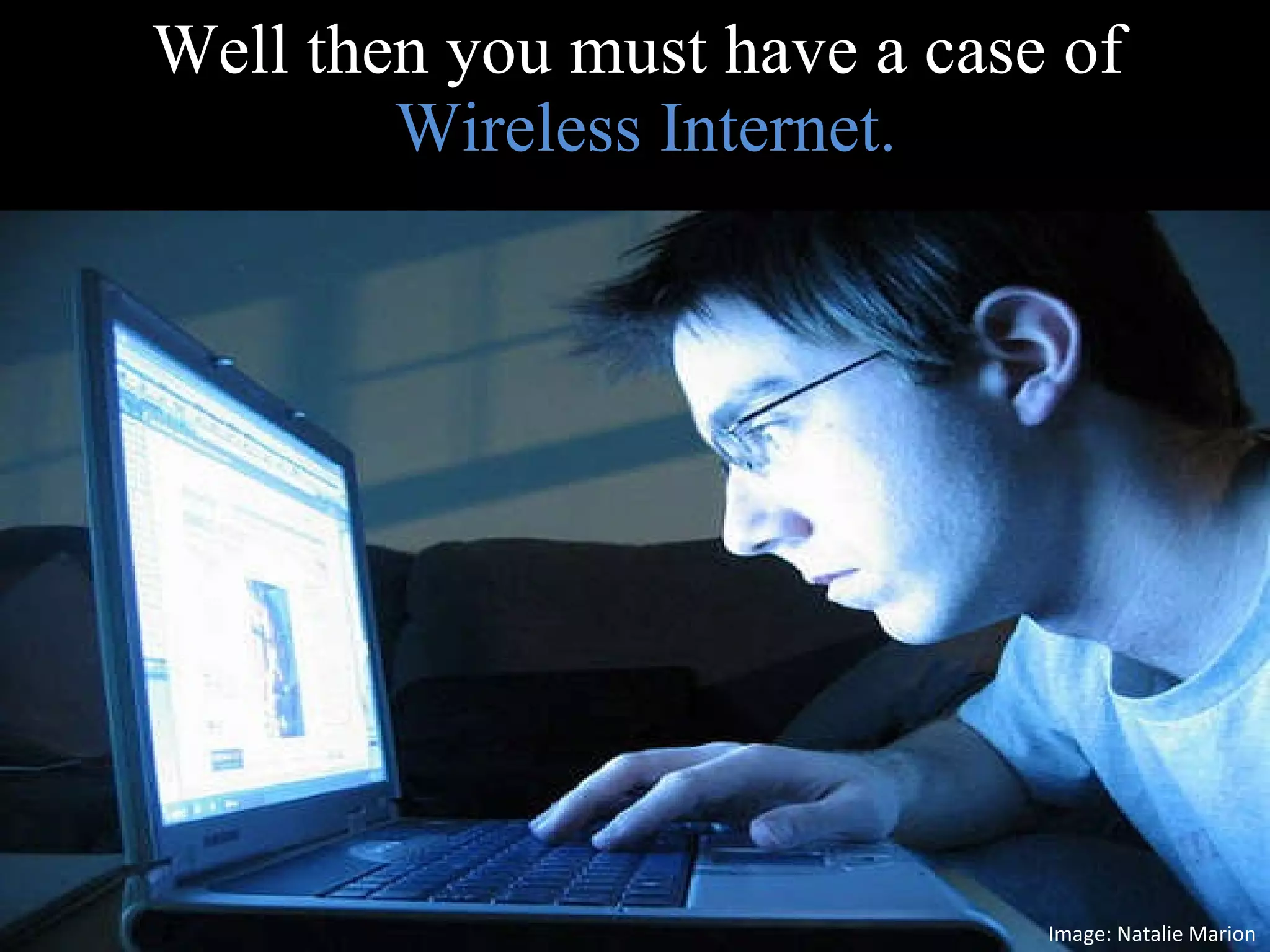
Well then you must have a case of  Wireless Internet. Image: Natalie Marion
What  is  Wireless  Internet? Image Source: Alegriphotos
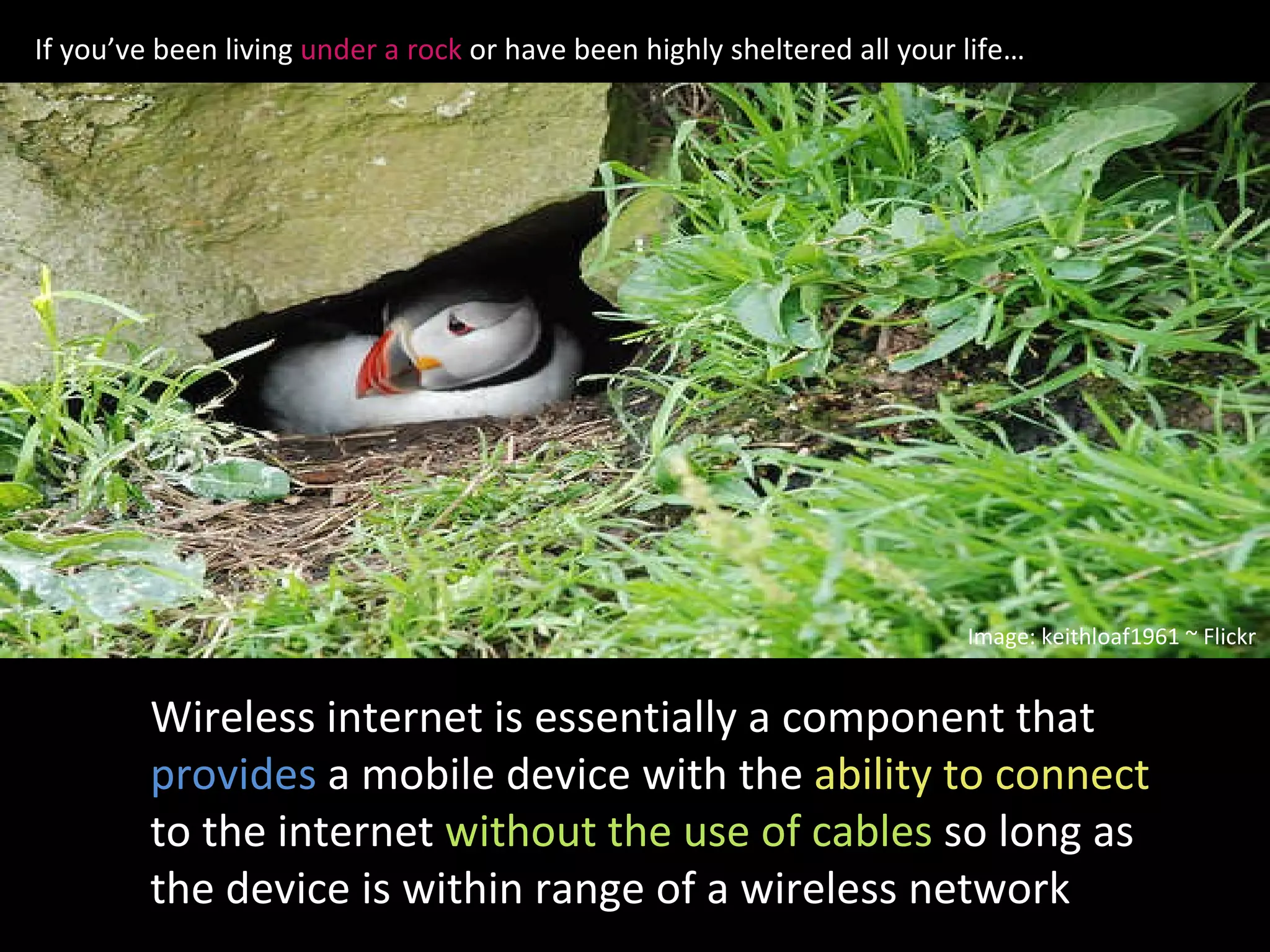
If you’ve been living  under a rock  or have been highly sheltered all your life… Wireless internet is essentially a component that  provides  a mobile device with the  ability to connect  to the internet  without the use of cables   so long as the device is within range of a wireless network Image: keithloaf1961 ~ Flickr
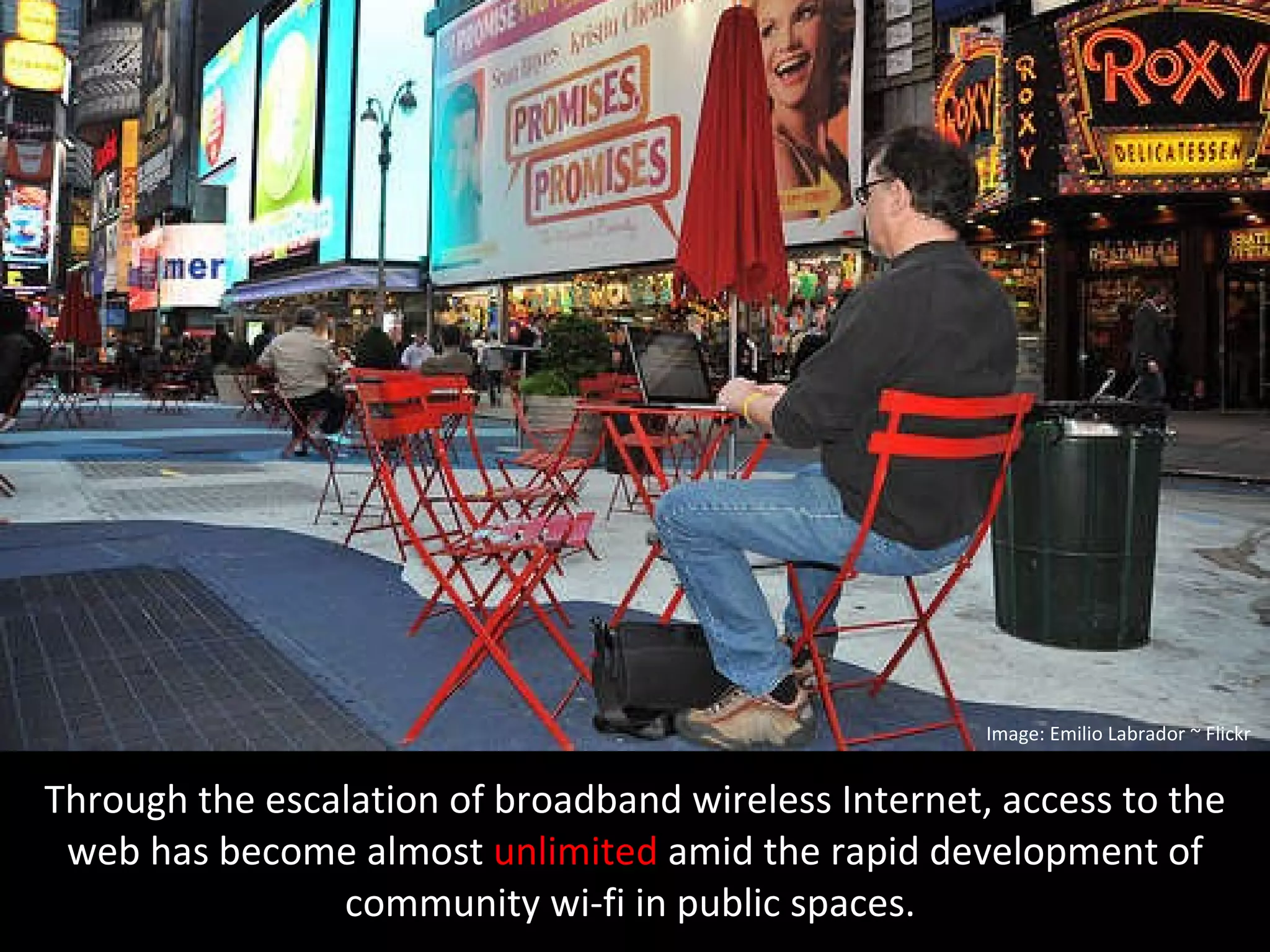
Through the escalation of broadband wireless Internet, access to the web has become almost  unlimited  amid the rapid development of community wi-fi in public spaces.  Crop top off. Insert quote on grey bottom Image: Emilio Labrador ~ Flickr
The accessibility      is boundless… Image: Adnan Islam ~ Flickr
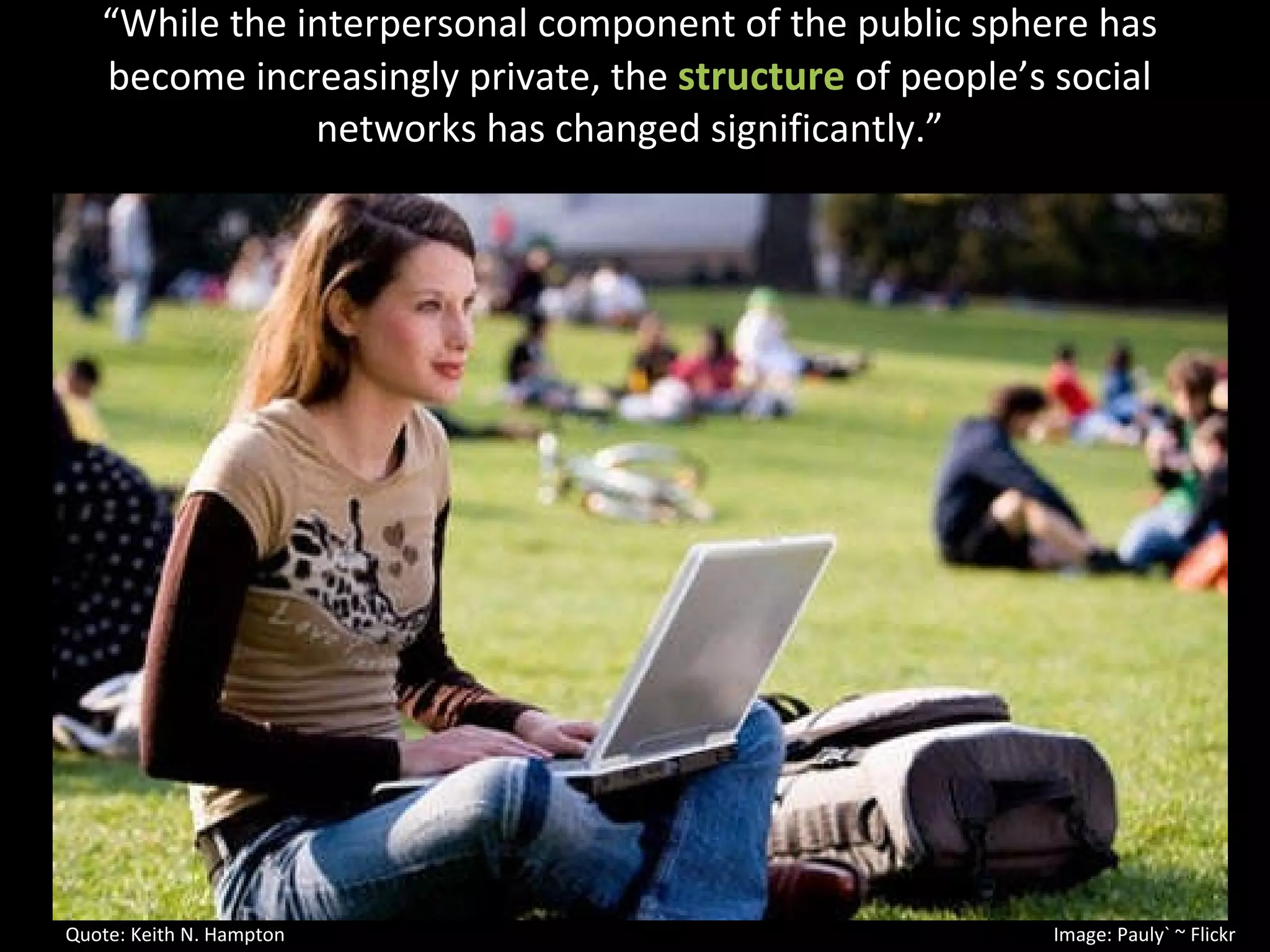
“ While the interpersonal component of the public sphere has become increasingly private, the  structure   of people’s social networks has changed significantly.” Quote: Keith N. Hampton  Image: Pauly` ~ Flickr
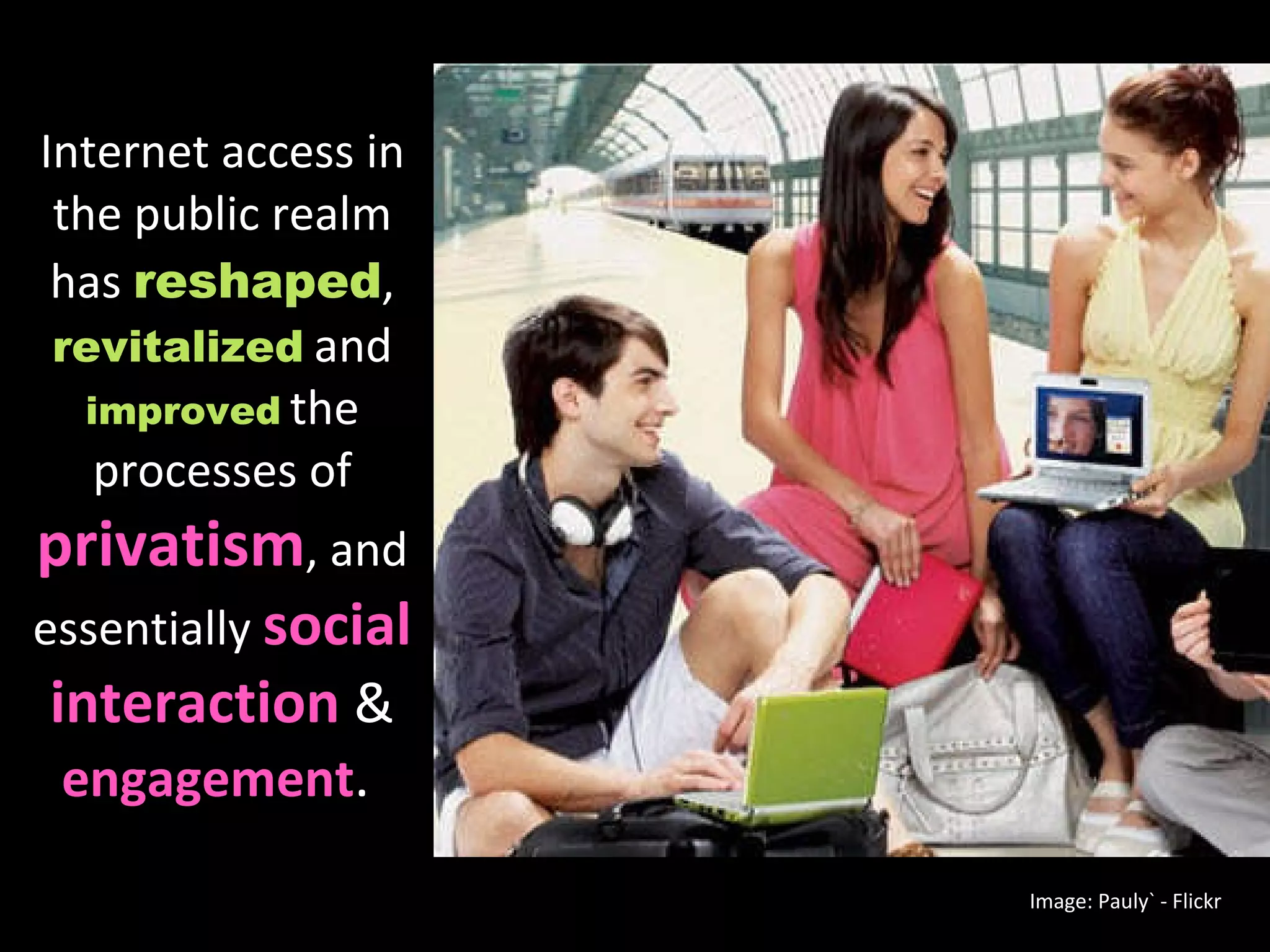
Internet access in the public realm has  reshaped ,  revitalized   and  improved   the processes of  privatism , and essentially  social interaction  &  engagement .  Image: Pauly` - Flickr
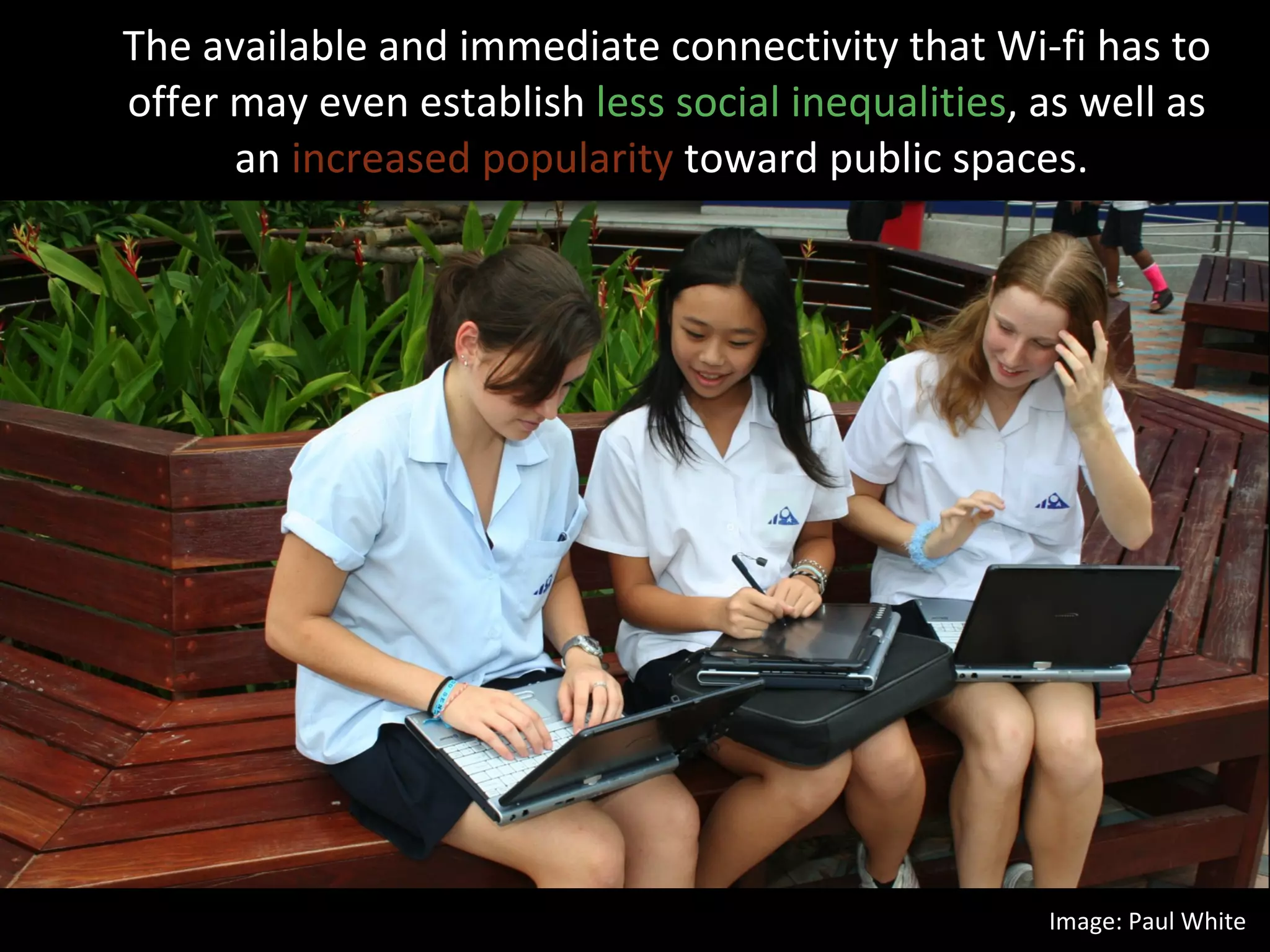
The available and immediate connectivity that Wi-fi has to offer may even establish  less social inequalities , as well as an  increased popularity  toward public spaces.  Image: Paul White
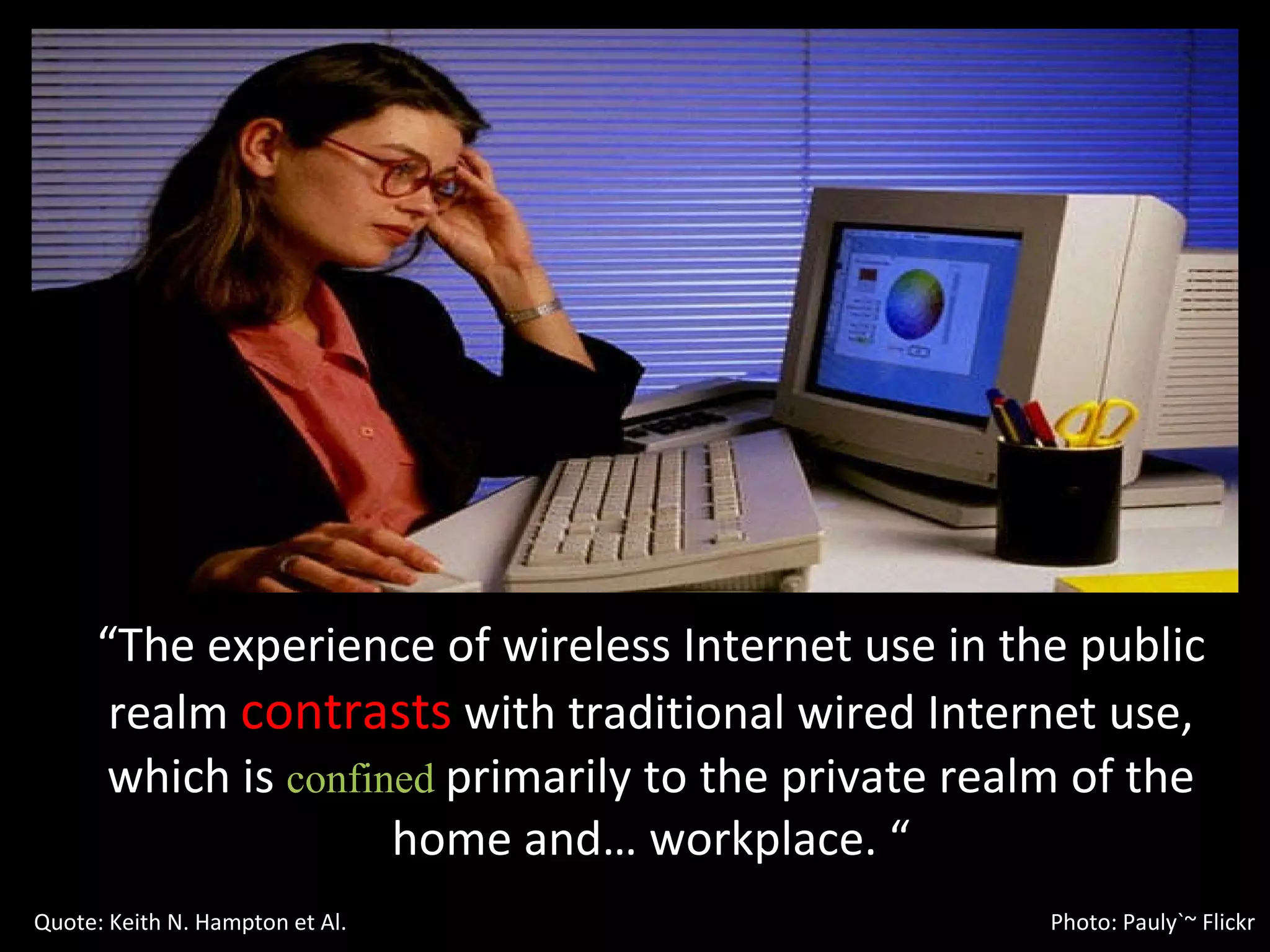
“ The experience of wireless Internet use in the public realm  contrasts  with traditional wired Internet use, which is  confined  primarily to the private realm of the home and… workplace. “ Quote: Keith N. Hampton et Al.  Photo: Pauly`~ Flickr
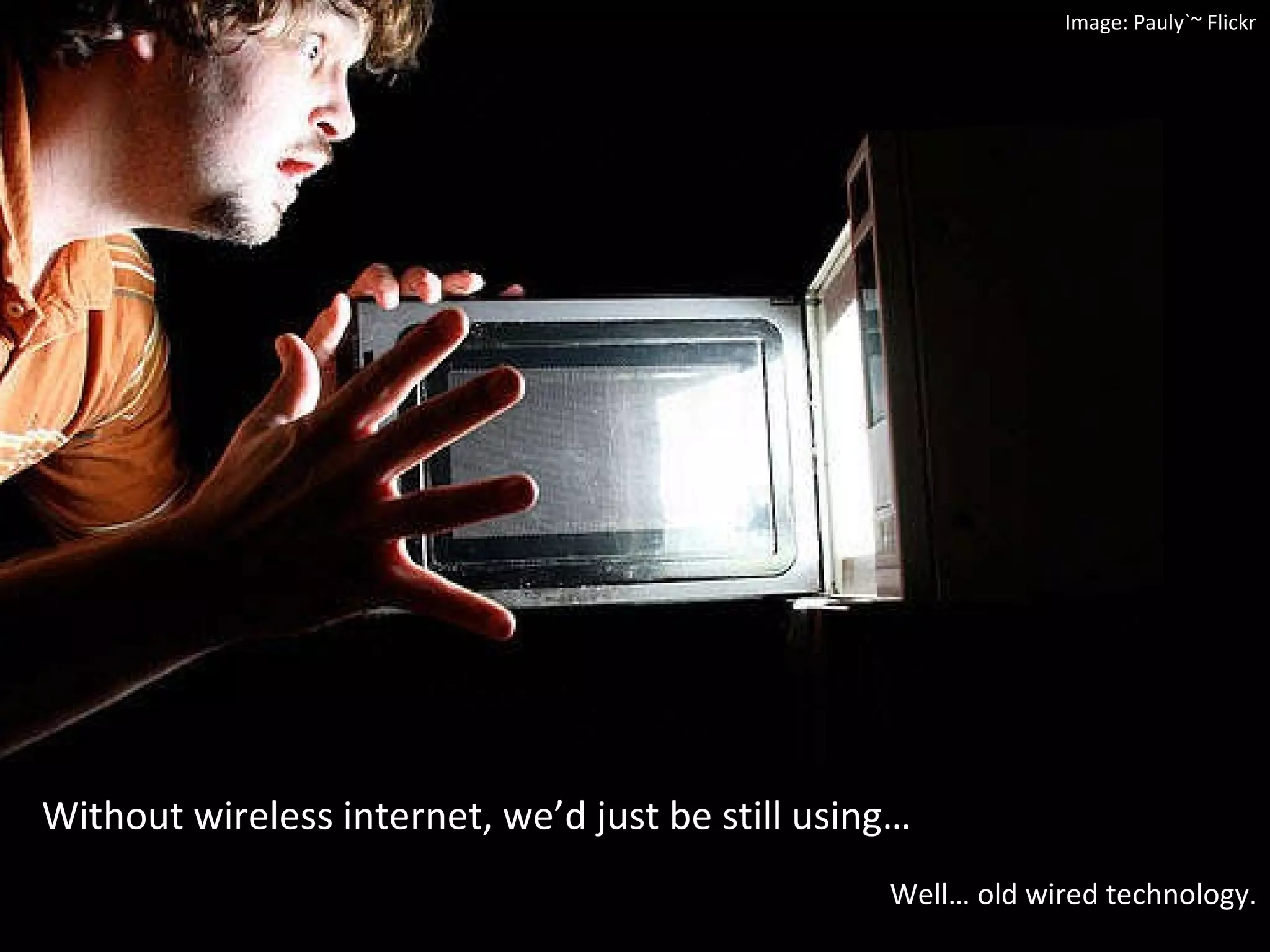
Without wireless internet, we’d just be still using… Well… old wired technology. Image: Pauly`~ Flickr
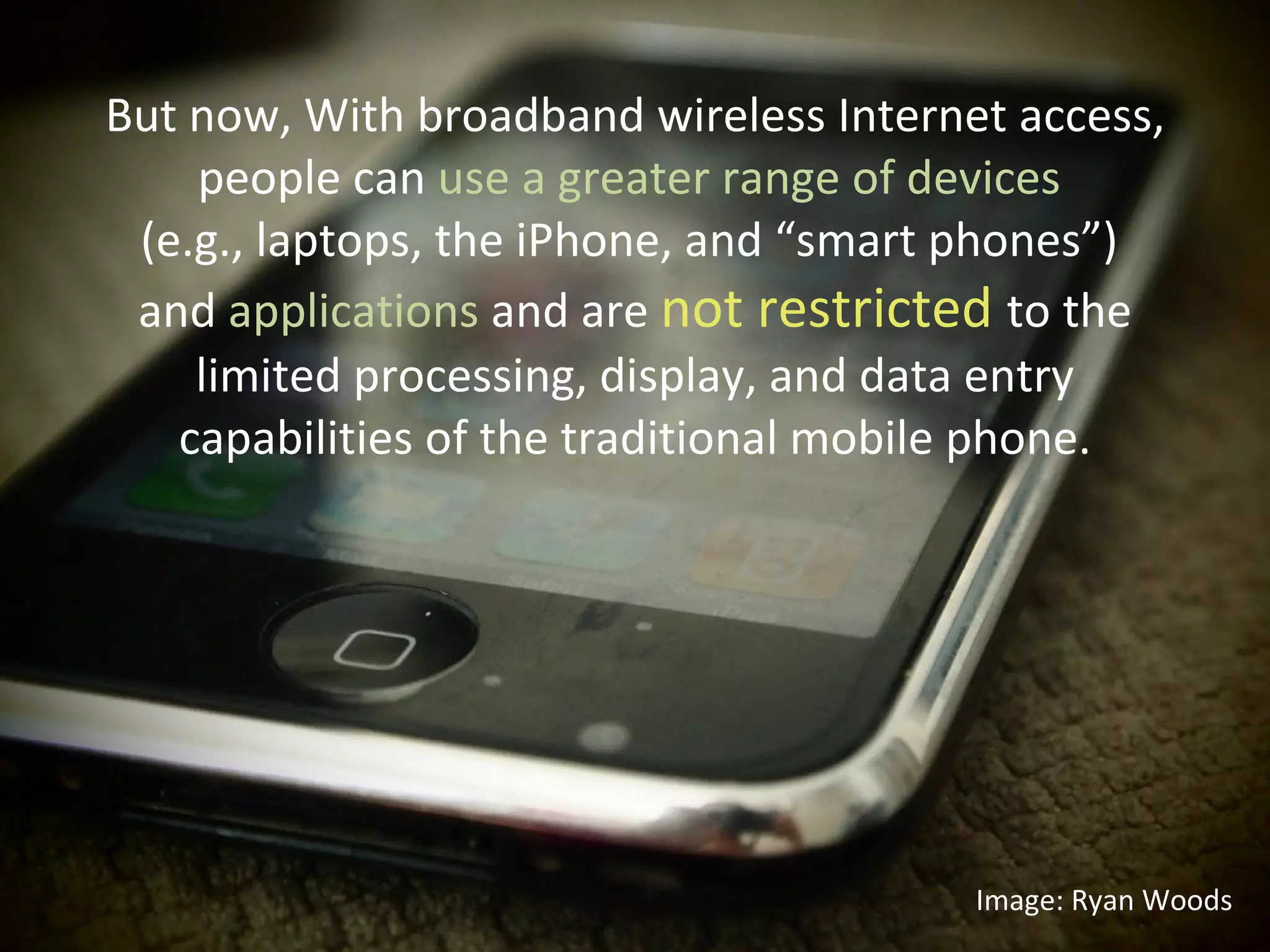
But now, With broadband wireless Internet access, people can  use a greater range of devices  (e.g., laptops, the iPhone, and “smart phones”)  and  applications  and are  not restricted  to the limited processing, display, and data entry capabilities of the traditional mobile phone. Image: Ryan Woods
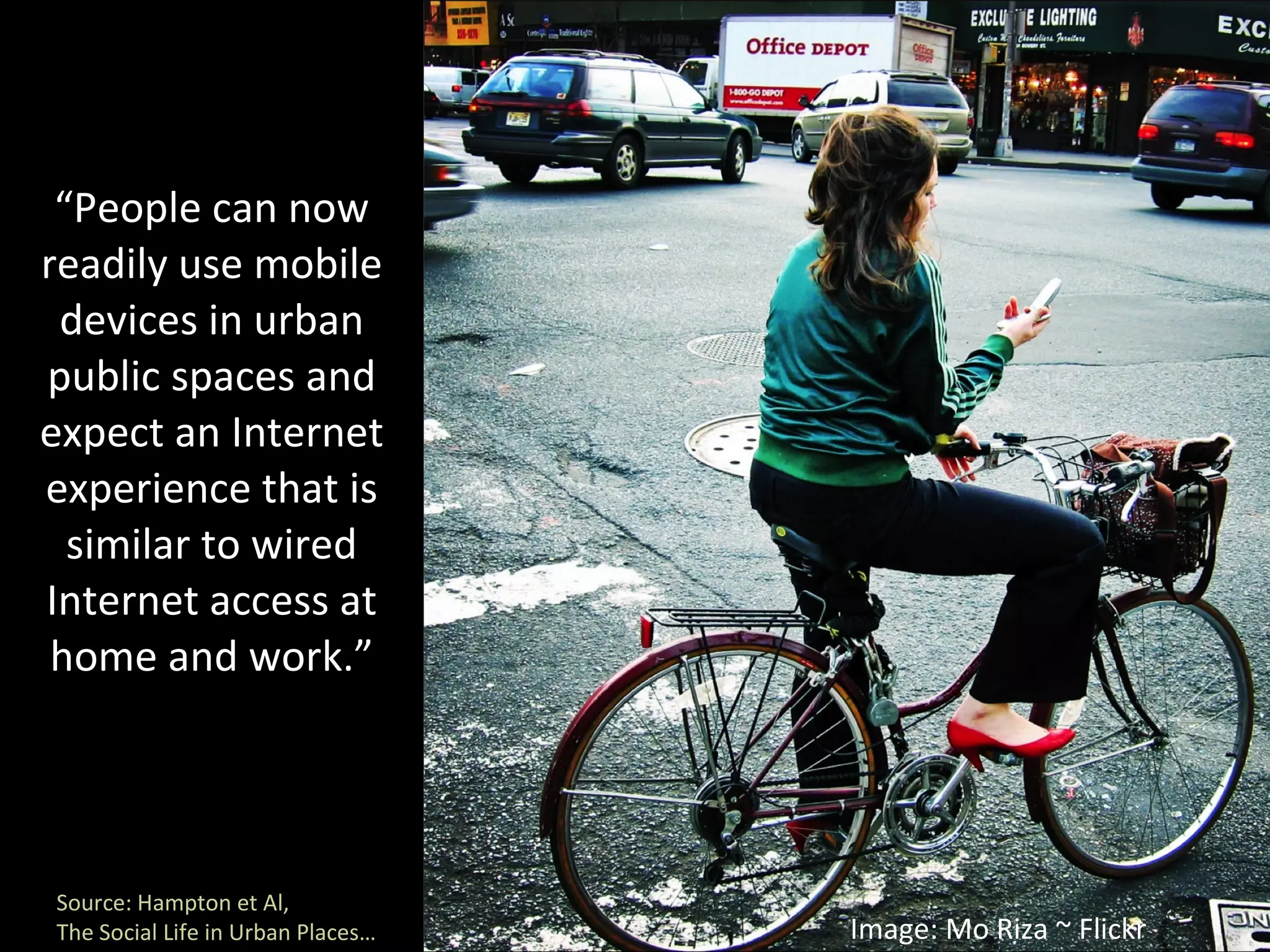
“ People can now readily use mobile devices in urban public spaces and expect an Internet experience that is similar to wired Internet access at home and work.” Source: Hampton et Al,  The Social Life in Urban Places…  Image: Mo Riza ~ Flickr
Mobile phone networks  are only one example of wireless communications that are capable of providing broadband Internet access to phones, laptops, and other mobile devices.  Wi-fi networks are an additional   opportunity for  wireless connectivity .   Image: Alegriphotos
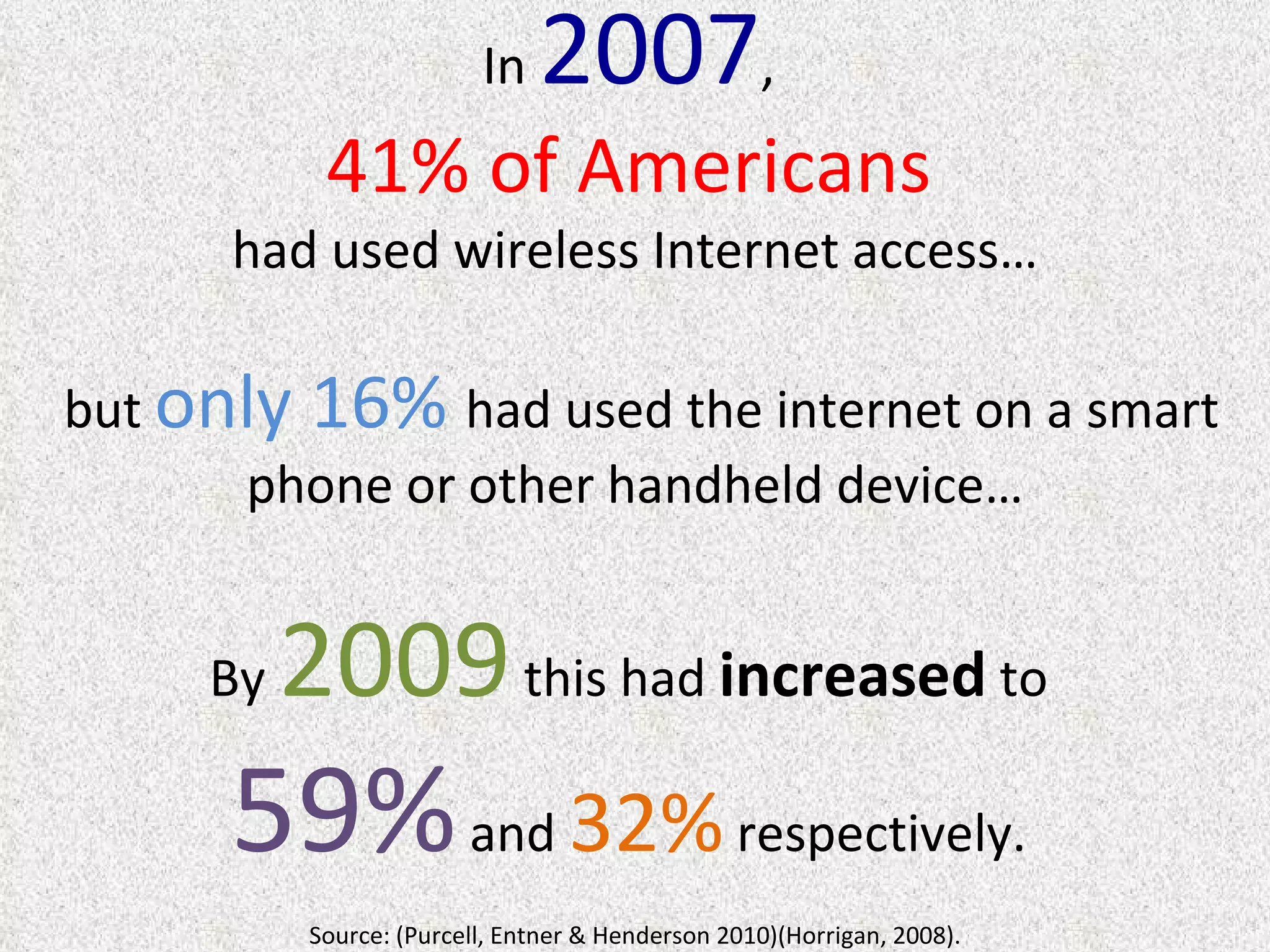
In  2007 ,  41% of Americans   had used wireless Internet access…  but  only 16%  had used the internet on a smart phone or other handheld device… By  2009  this had  increased  to  59%  and  32%  respectively.  Source: (Purcell, Entner & Henderson 2010)(Horrigan, 2008).
“ Wi-fi networks [can] range from the formal to the accidental and from corporate to counter-culture.” Source: Hampton et Al,  The Social Life in Urban Places…    Image: Cordey ~ Flickr
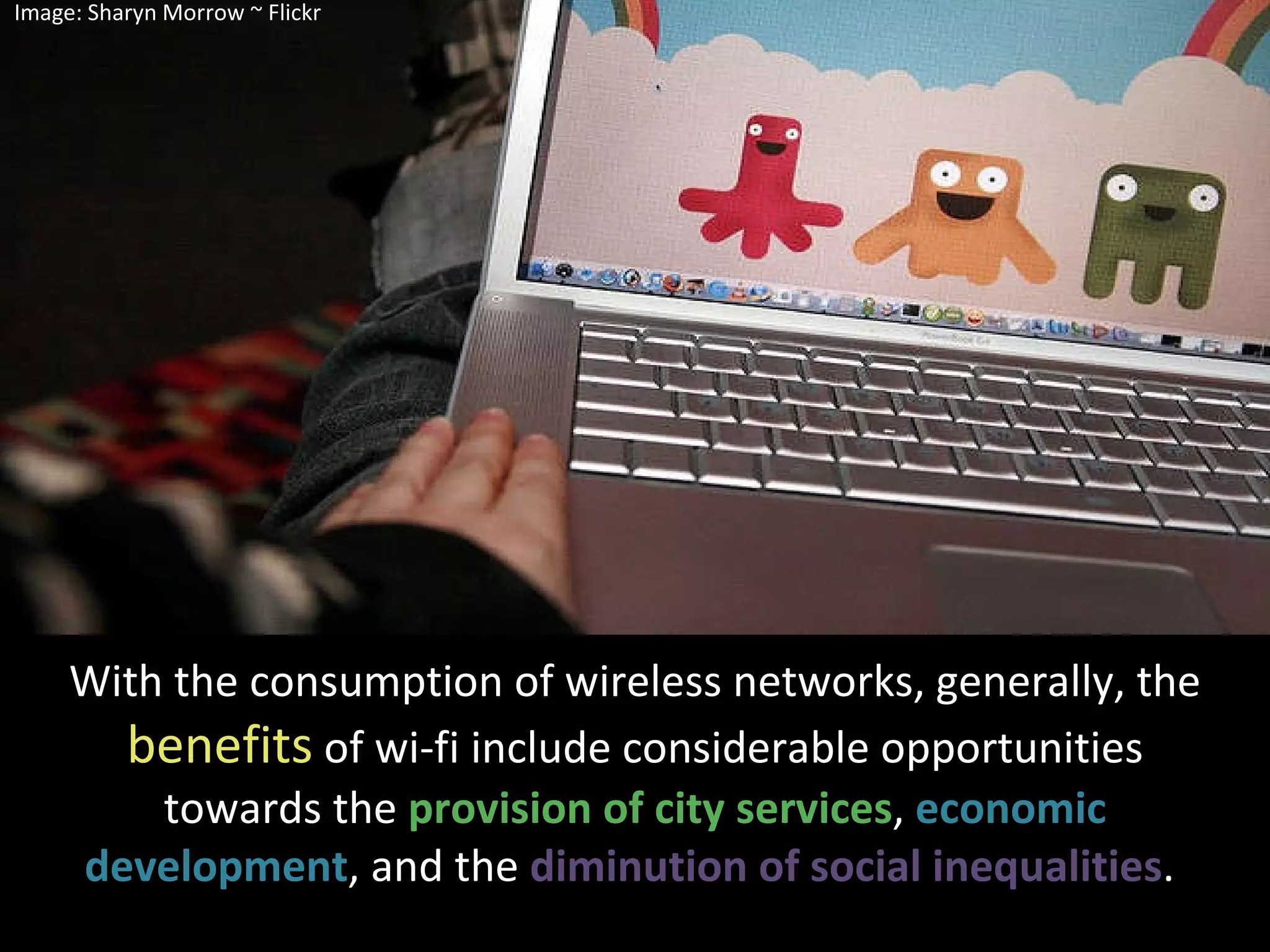
With the consumption of wireless networks, generally, the  benefits  of wi-fi include considerable opportunities towards the  provision of city services ,  economic development , and the  diminution of social inequalities .  Image: Sharyn Morrow ~ Flickr
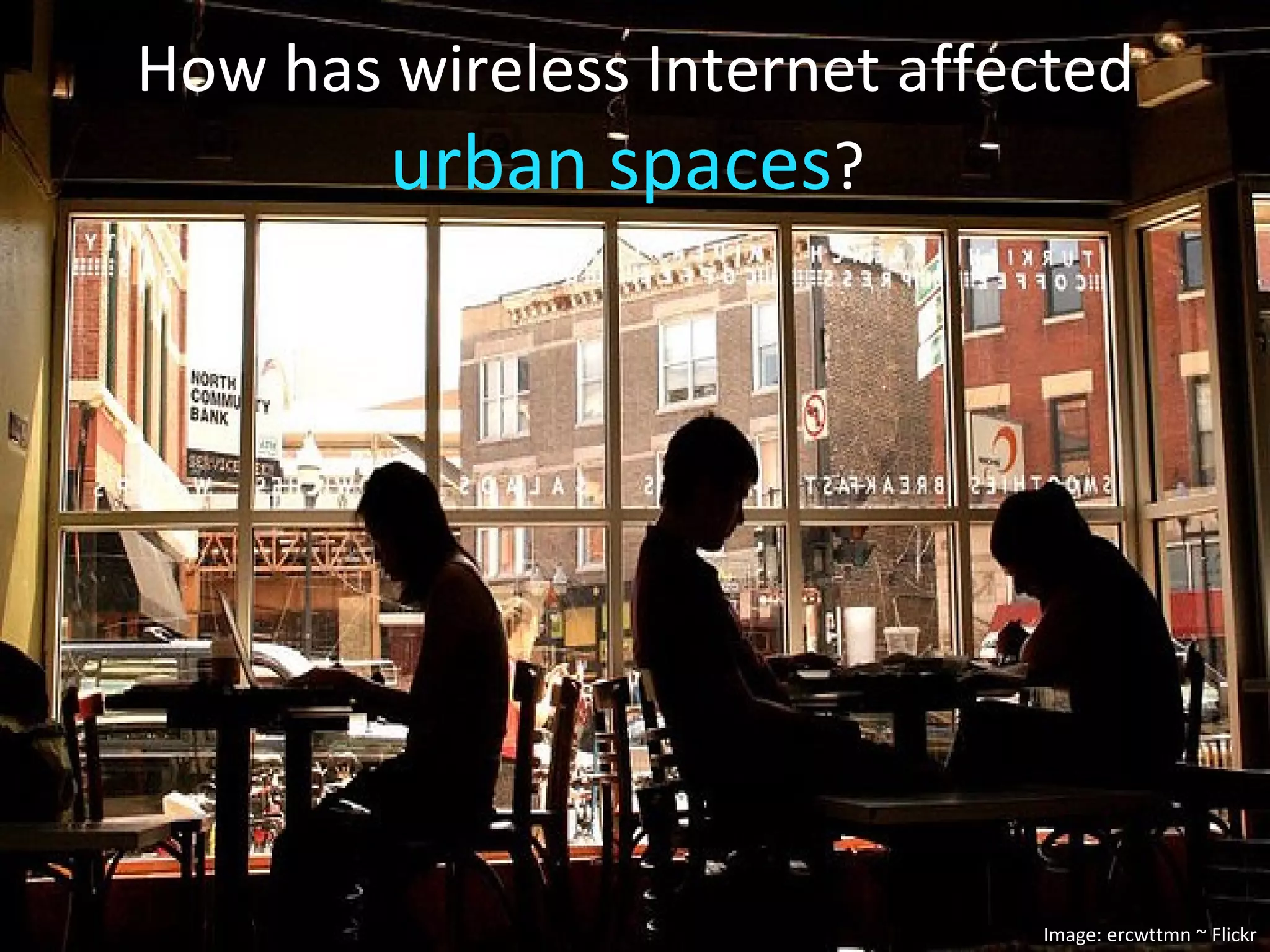
How has wireless Internet affected  urban spaces ?  Image: ercwttmn ~ Flickr
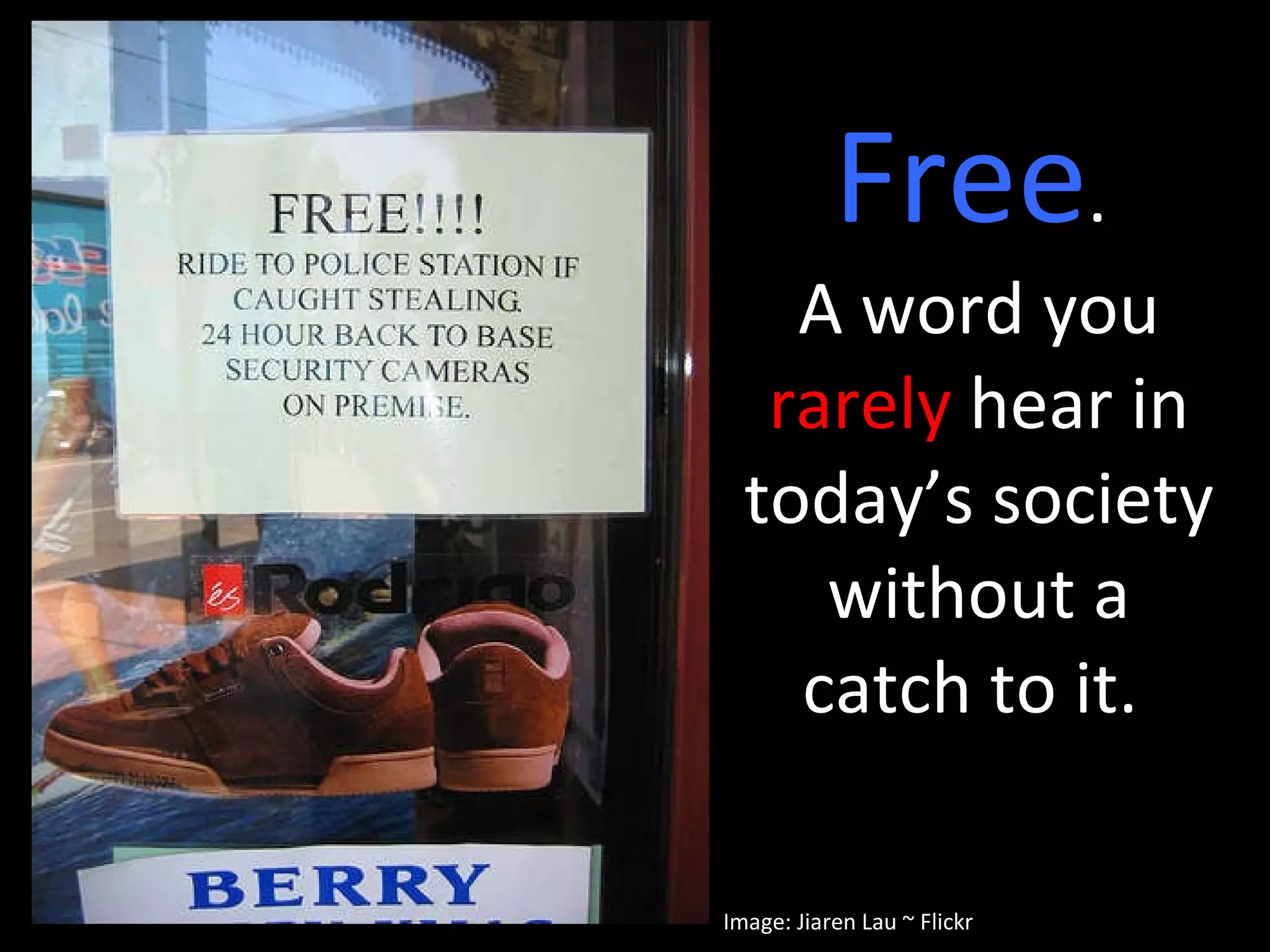
Free .  A word you  rarely  hear in today’s society without a catch to it.  Image: Jiaren Lau ~ Flickr
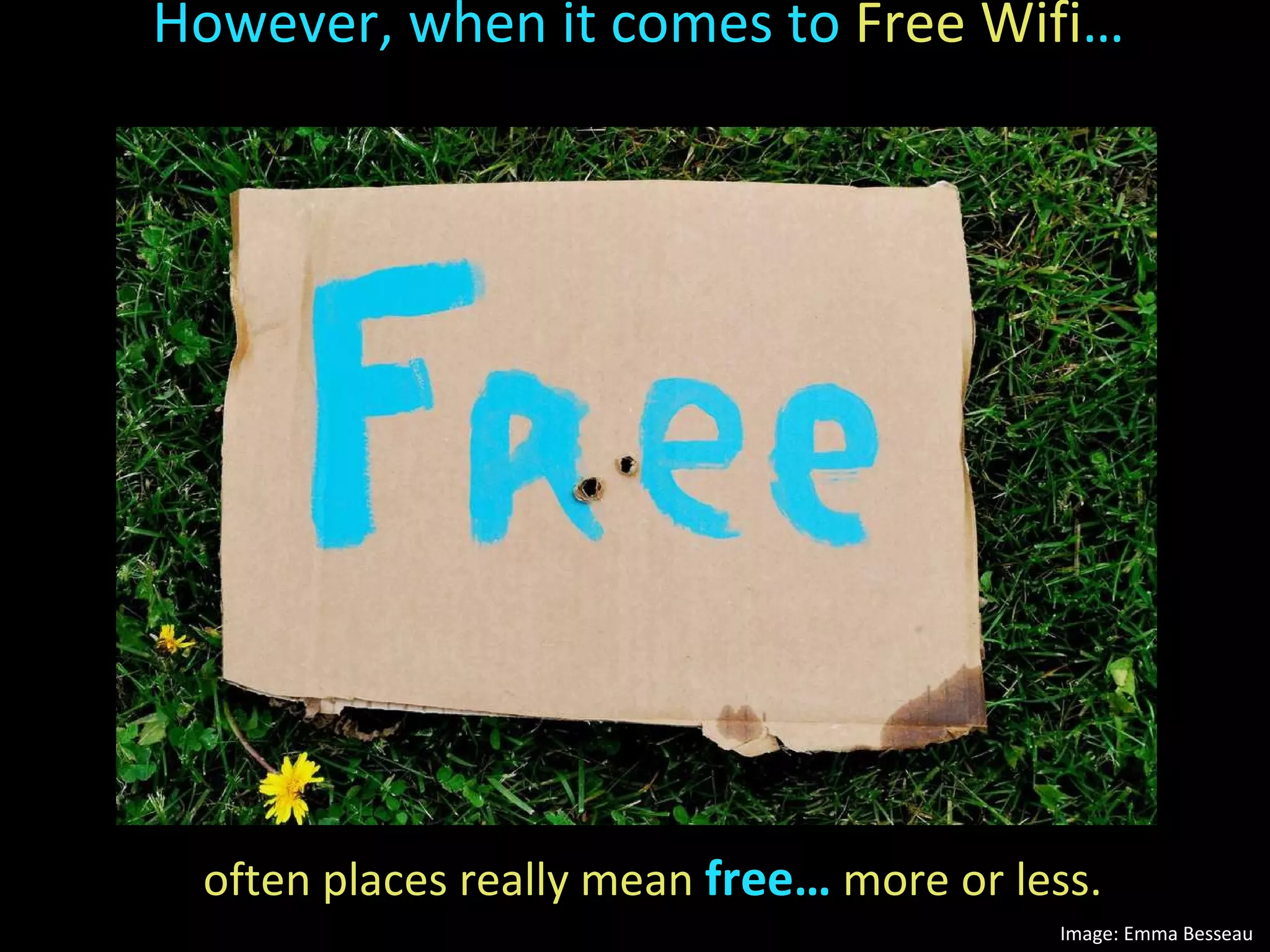
However, when it comes to  Free Wifi …  often places really mean  free…  more or less.  Image: Emma Besseau
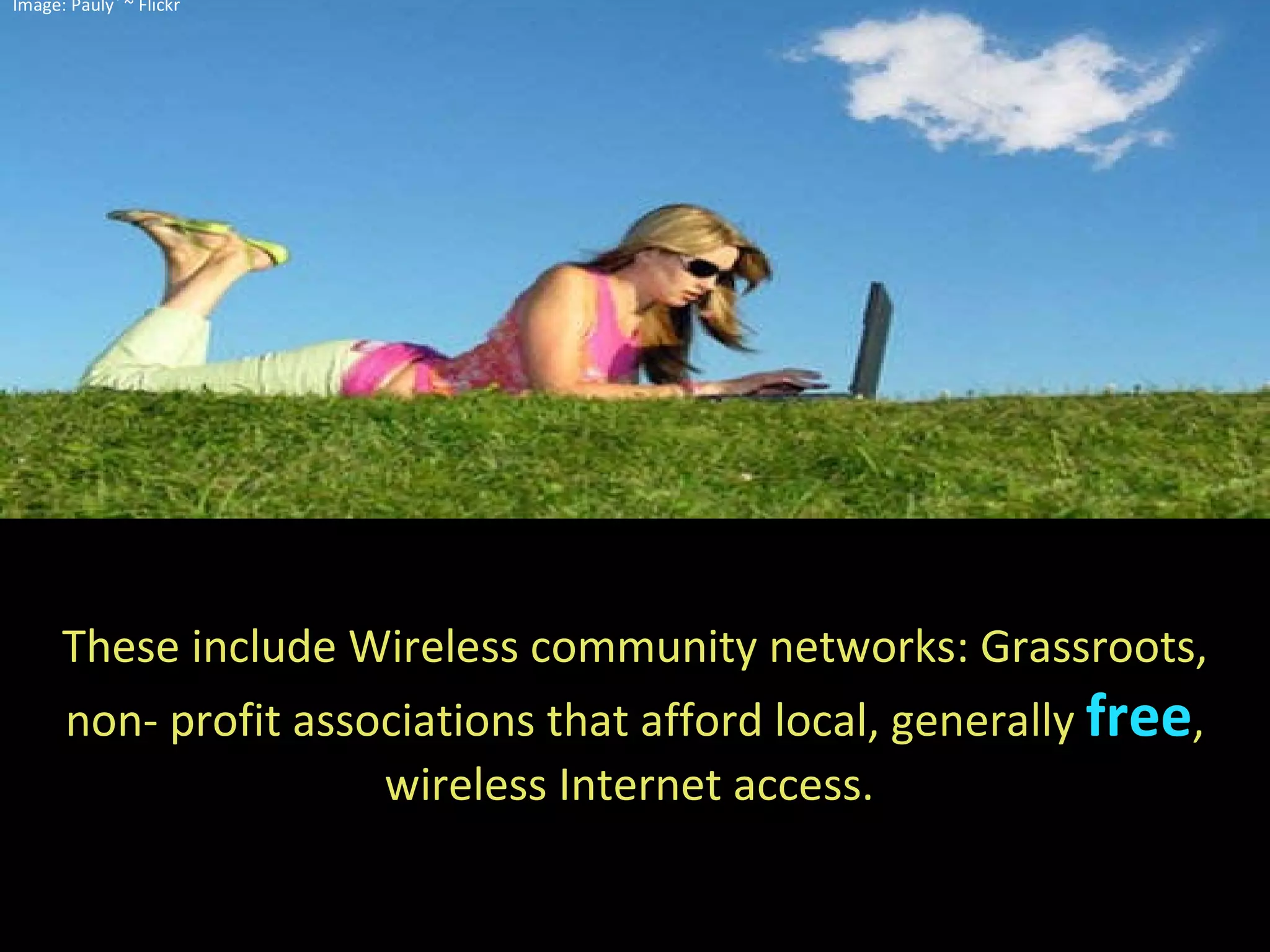
These include Wireless community networks: Grassroots, non- profit associations that afford local, generally  free , wireless Internet access.  Image: Pauly` ~ Flickr
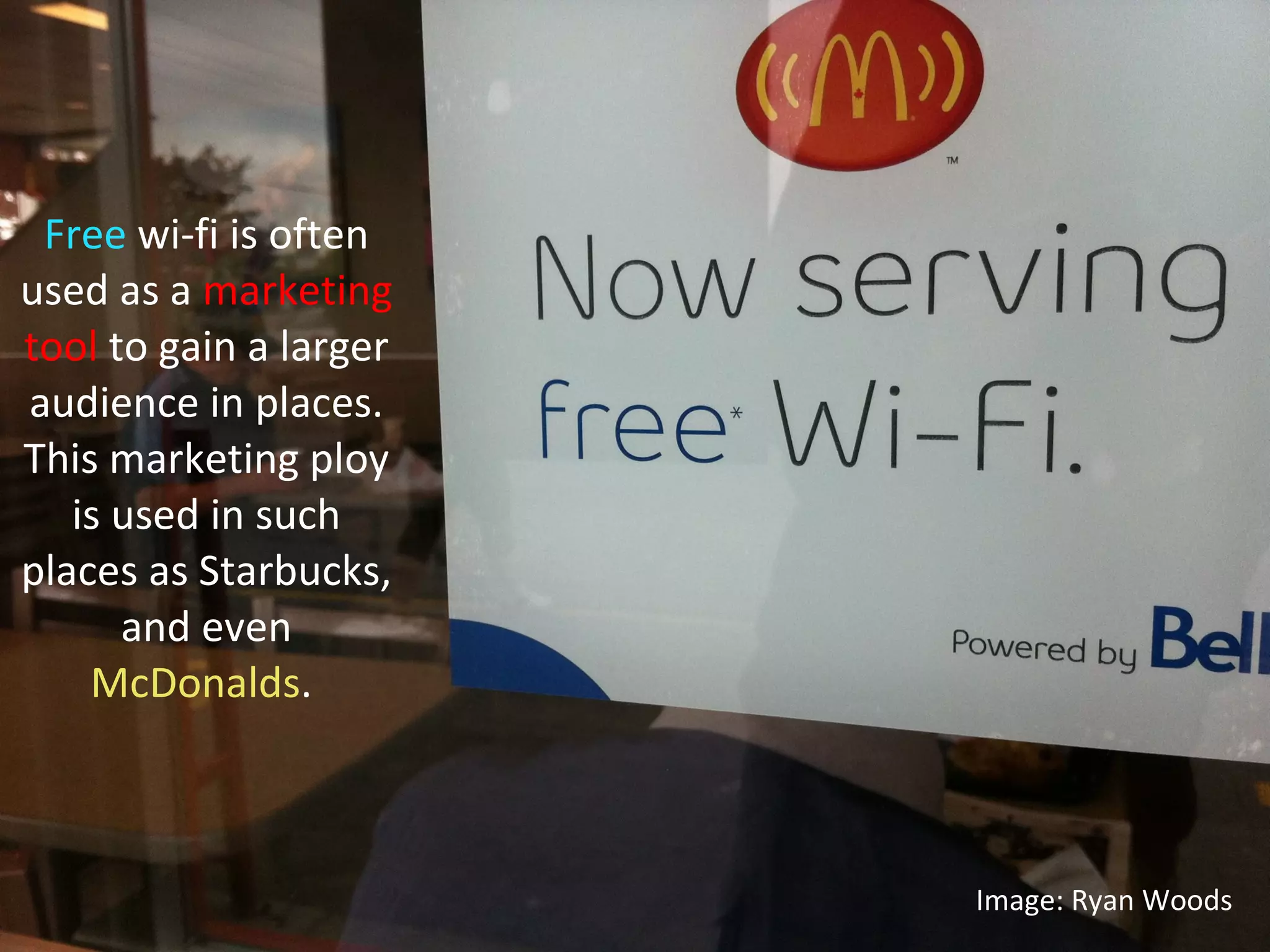
Free  wi-fi is often used as a  marketing tool  to gain a larger audience in places. This marketing ploy is used in such places as Starbucks, and even  McDonalds .  Image: Ryan Woods
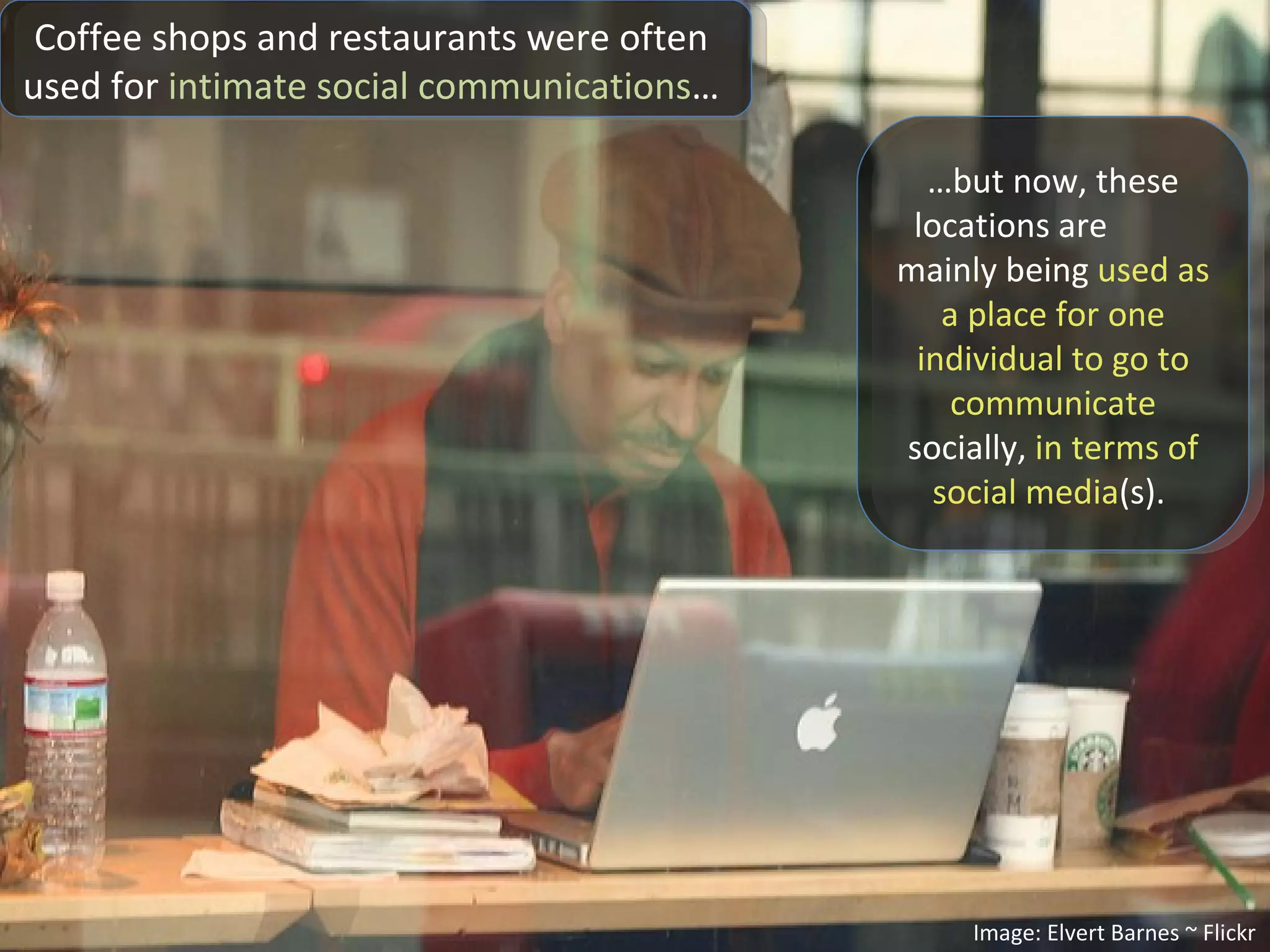
Image: Elvert Barnes ~ Flickr Coffee shops and restaurants were often  used for  intimate social communications …  … but now, these locations are  mainly being  used as a place for one individual to go to communicate  socially,  in terms of social media (s).
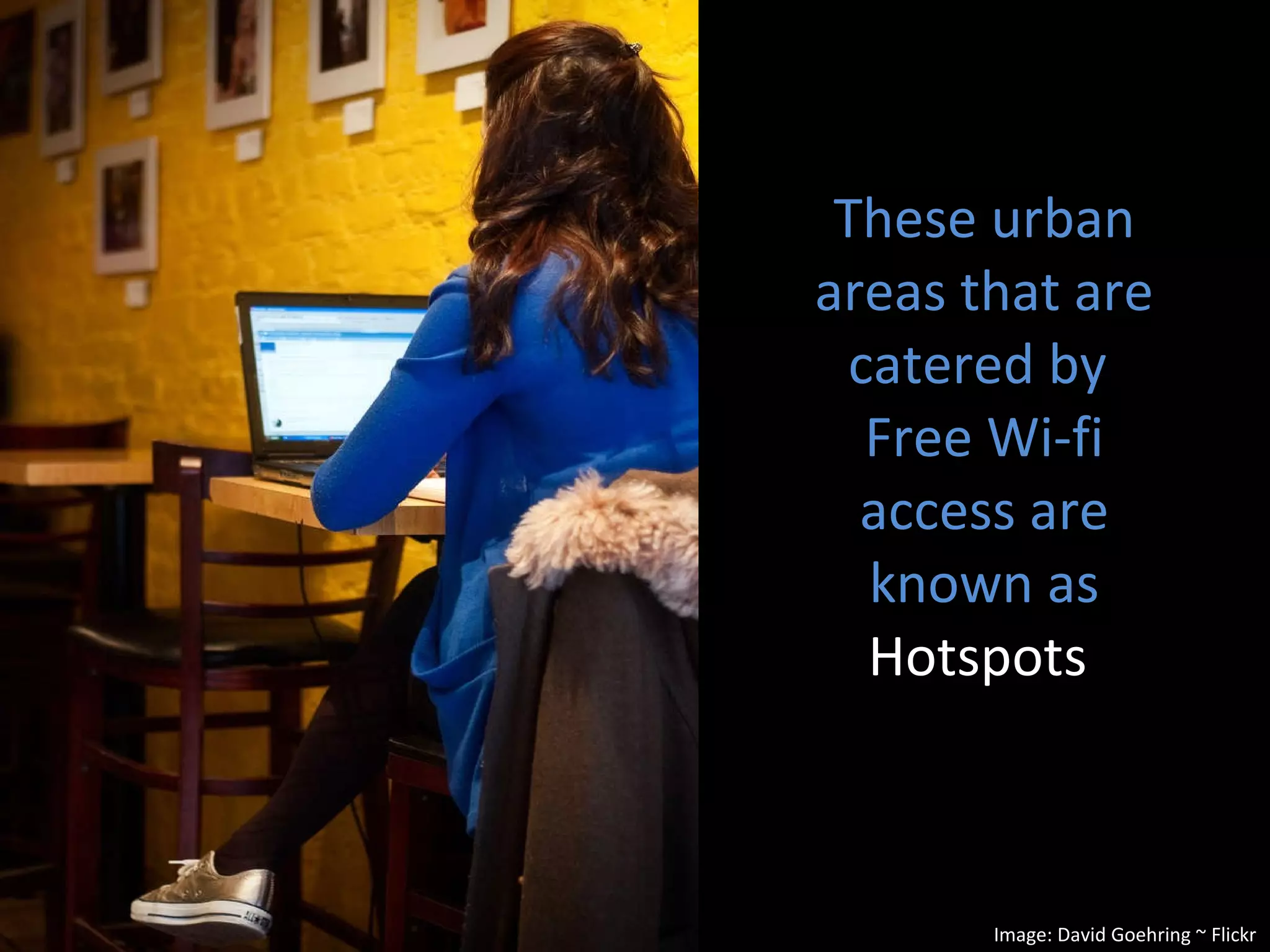
These urban areas that are catered by  Free Wi-fi access are known as  Hotspots   Image: David Goehring ~ Flickr
Hotspots  are limited locations where Wireless internet access, such as a  coffee shop , bookstore, or airport lounge. Access is typically associated with pay-per-use or the  purchase of a product  (e.g. a cup of coffee).  Image: N i c o l a ~ Flickr
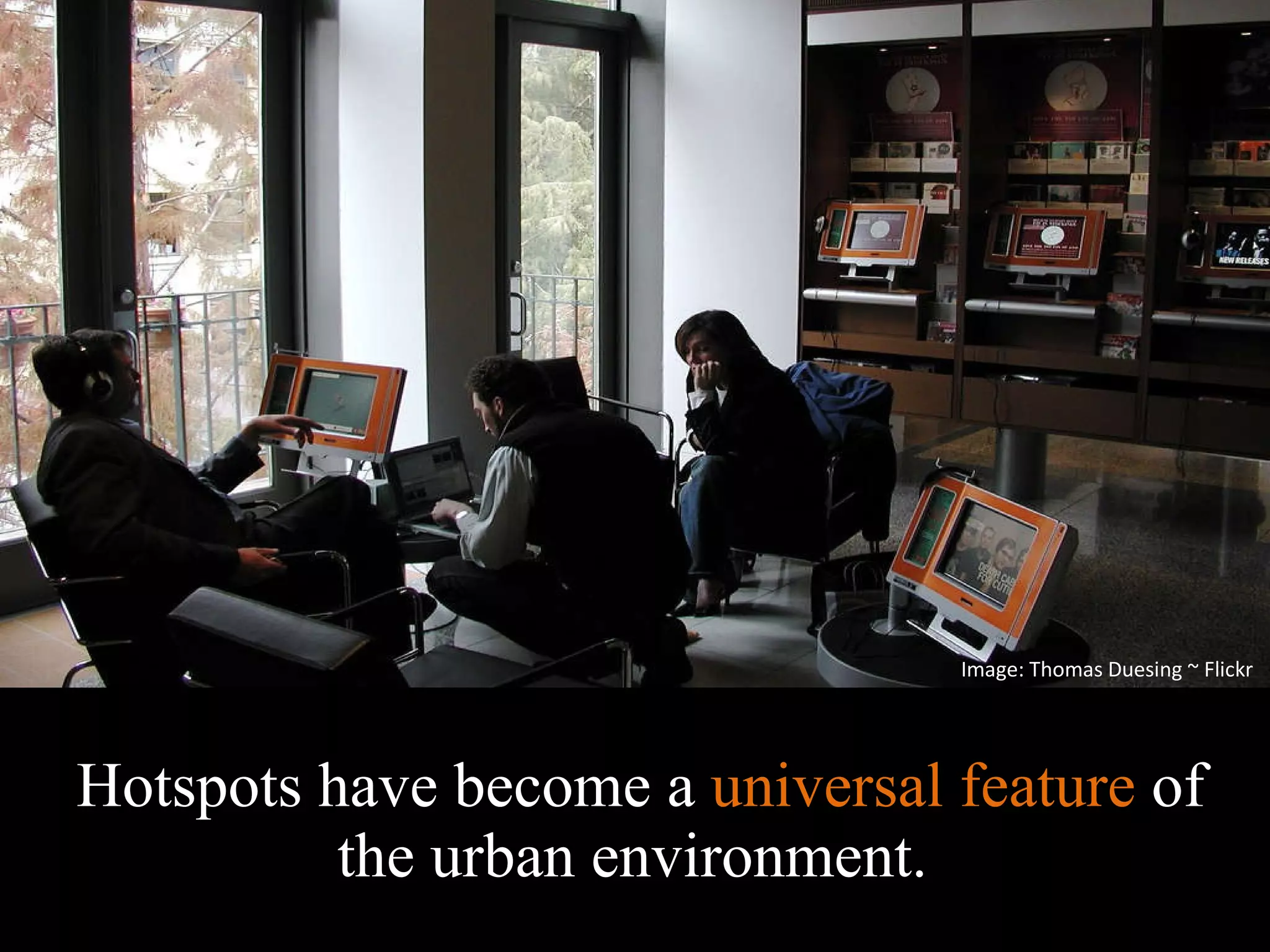
Hotspots have become a  universal feature  of the urban environment.  Image: Thomas Duesing ~ Flickr
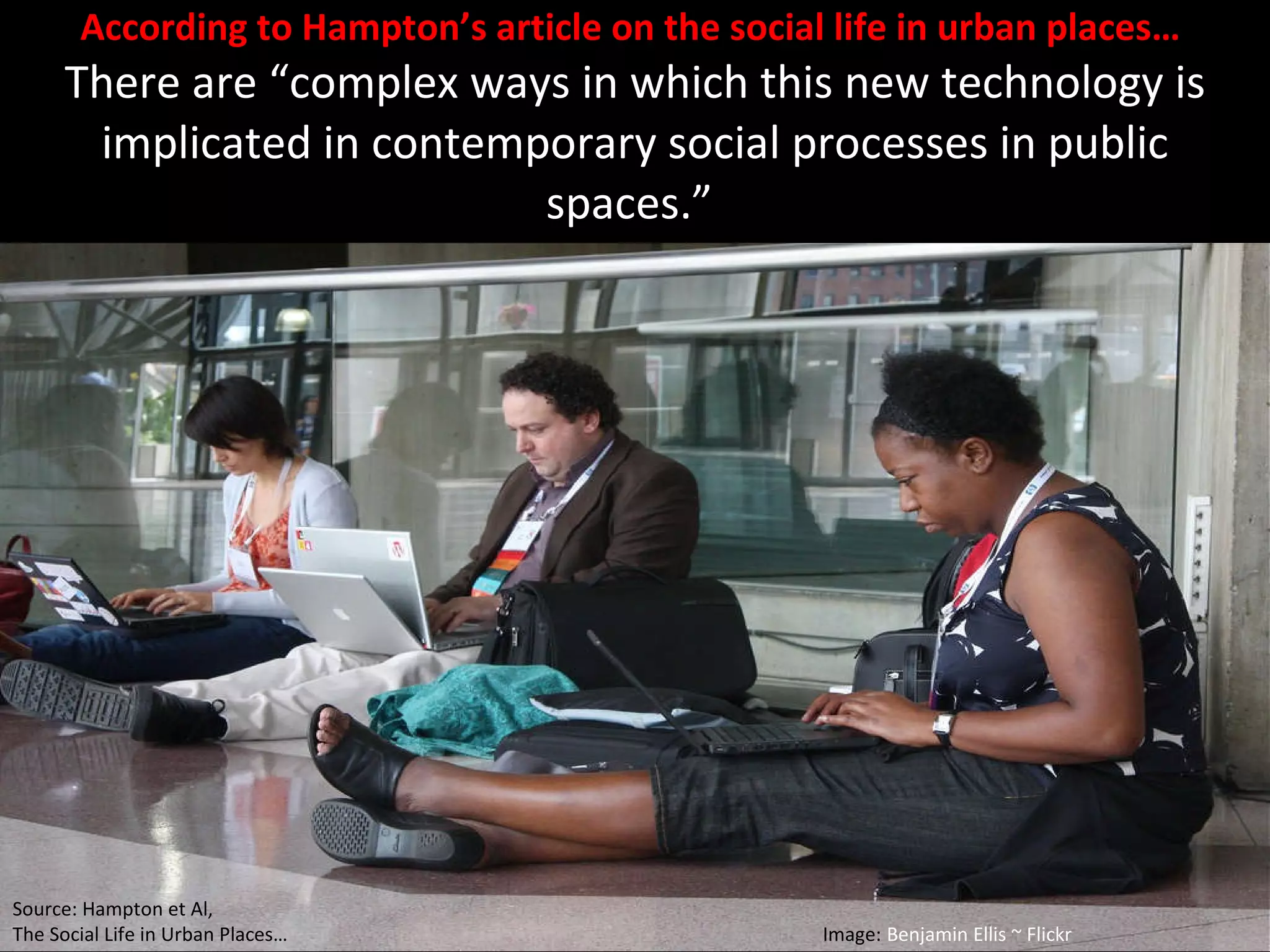
According to Hampton’s article on the social life in urban places…  There are “complex ways in which this new technology is implicated in contemporary social processes in public spaces.”  Source: Hampton et Al,  The Social Life in Urban Places…  Image:  Benjamin Ellis ~ Flickr
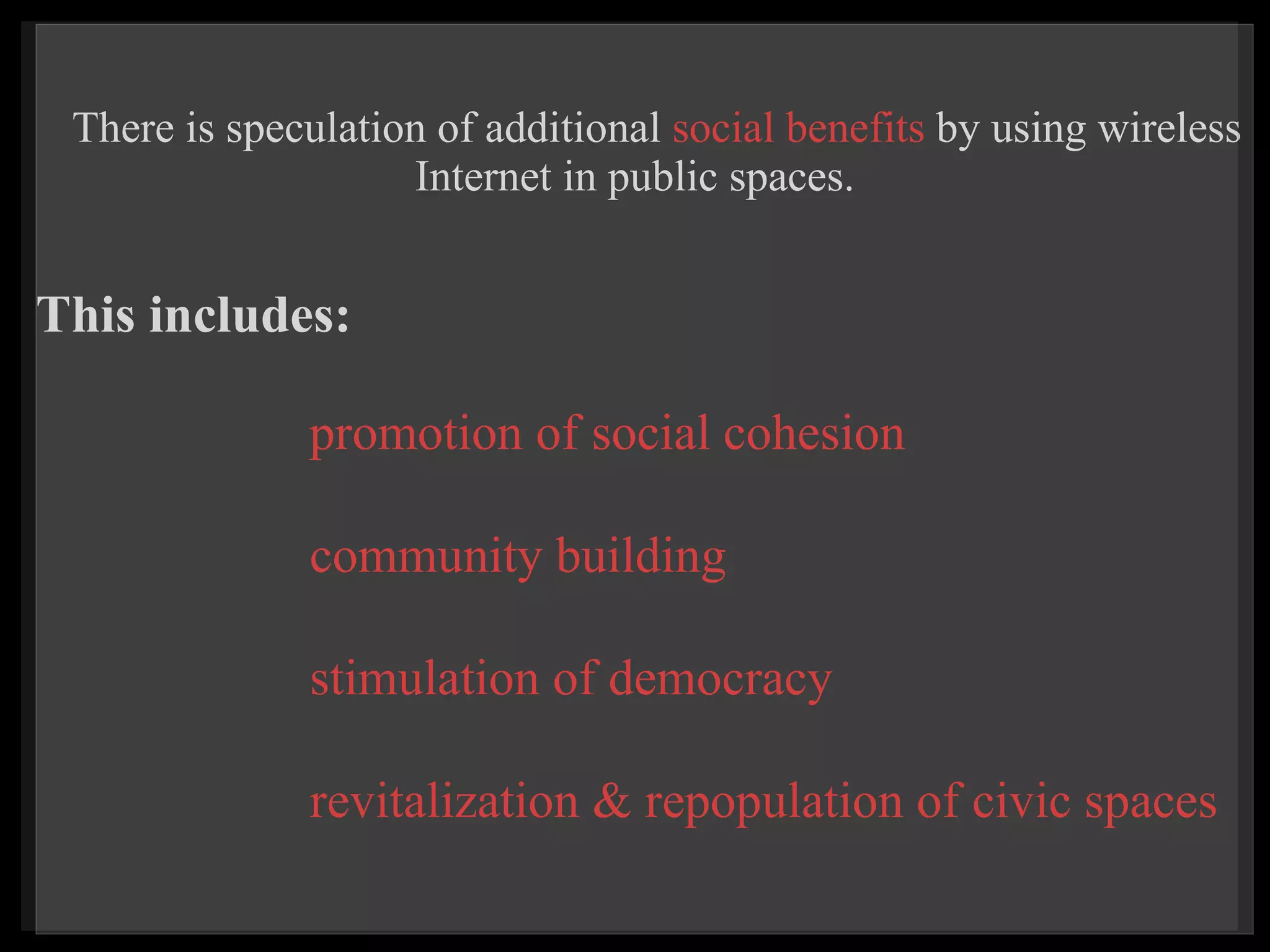
There is speculation of additional  social benefits  by using wireless Internet in public spaces.    promotion of social cohesion     community building     stimulation of democracy   revitalization & repopulation of civic spaces  This includes:
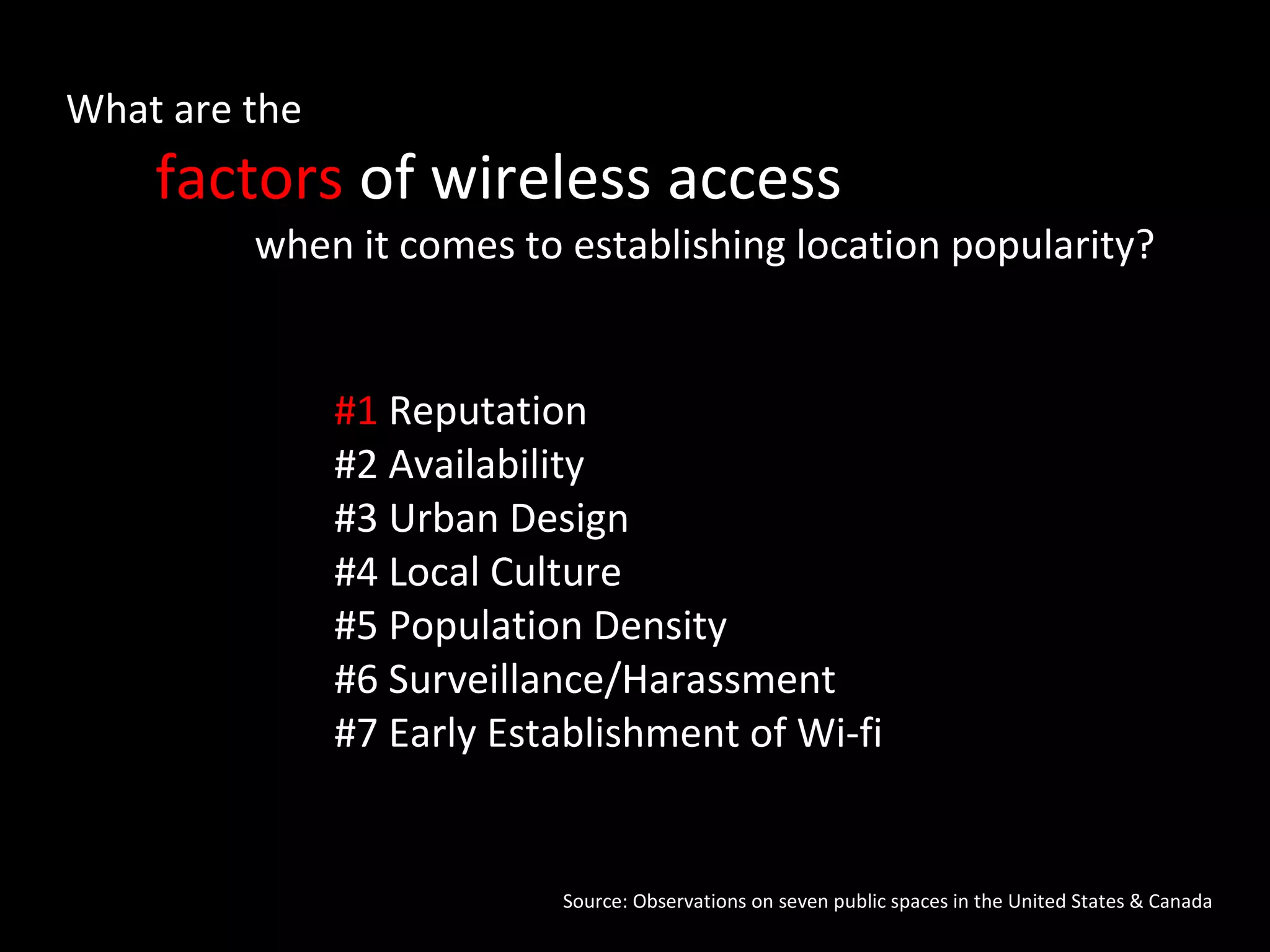
What are the    factors  of wireless access    when it comes to establishing location popularity?     #1  Reputation   #2 Availability   #3 Urban Design   #4 Local Culture   #5 Population Density   #6 Surveillance/Harassment   #7 Early Establishment of Wi-fi   Source: Observations on seven public spaces in the United States & Canada
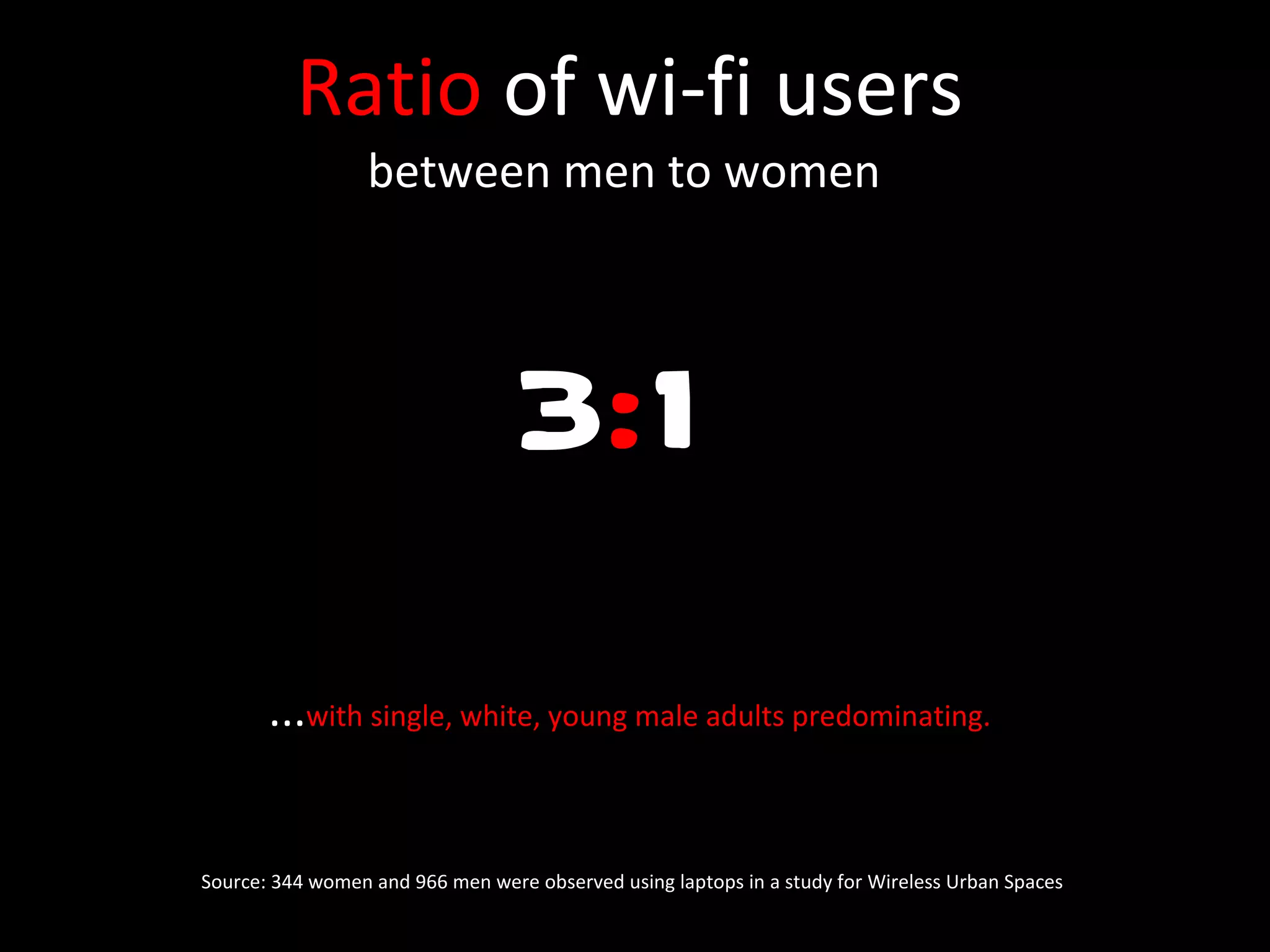
Ratio  of wi-fi users between men to women    3 : 1 ... with single, white, young male adults predominating.     Source: 344 women and 966 men were observed using laptops in a study for Wireless Urban Spaces
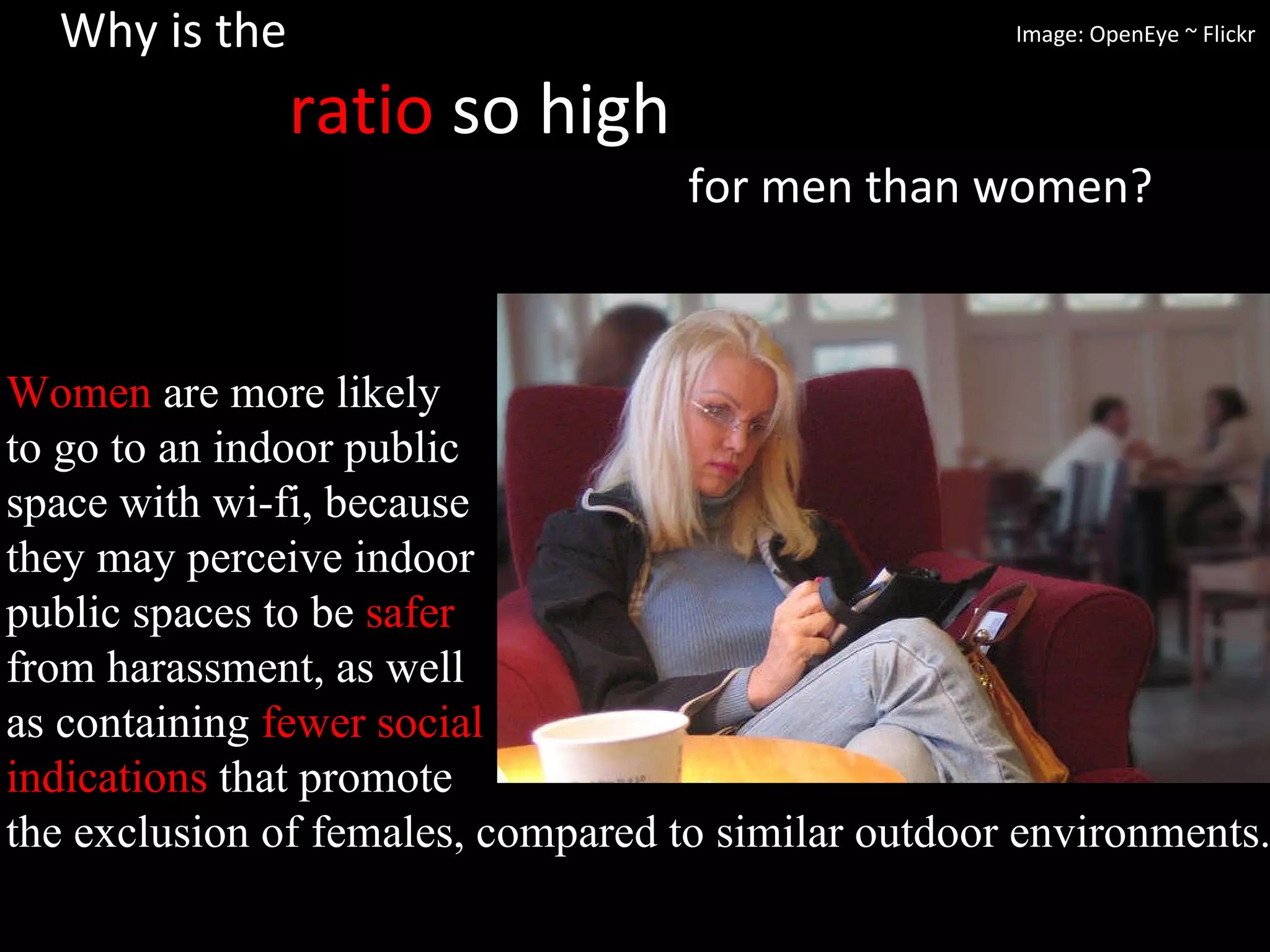
Why is the    ratio  so high    for men than women? Women  are more likely  to go to an indoor public  space with wi-fi, because  they may perceive indoor  public spaces to be  safer   from harassment, as well  as containing  fewer social  indications  that promote  the exclusion of females, compared to similar outdoor environments.  Image: OpenEye ~ Flickr
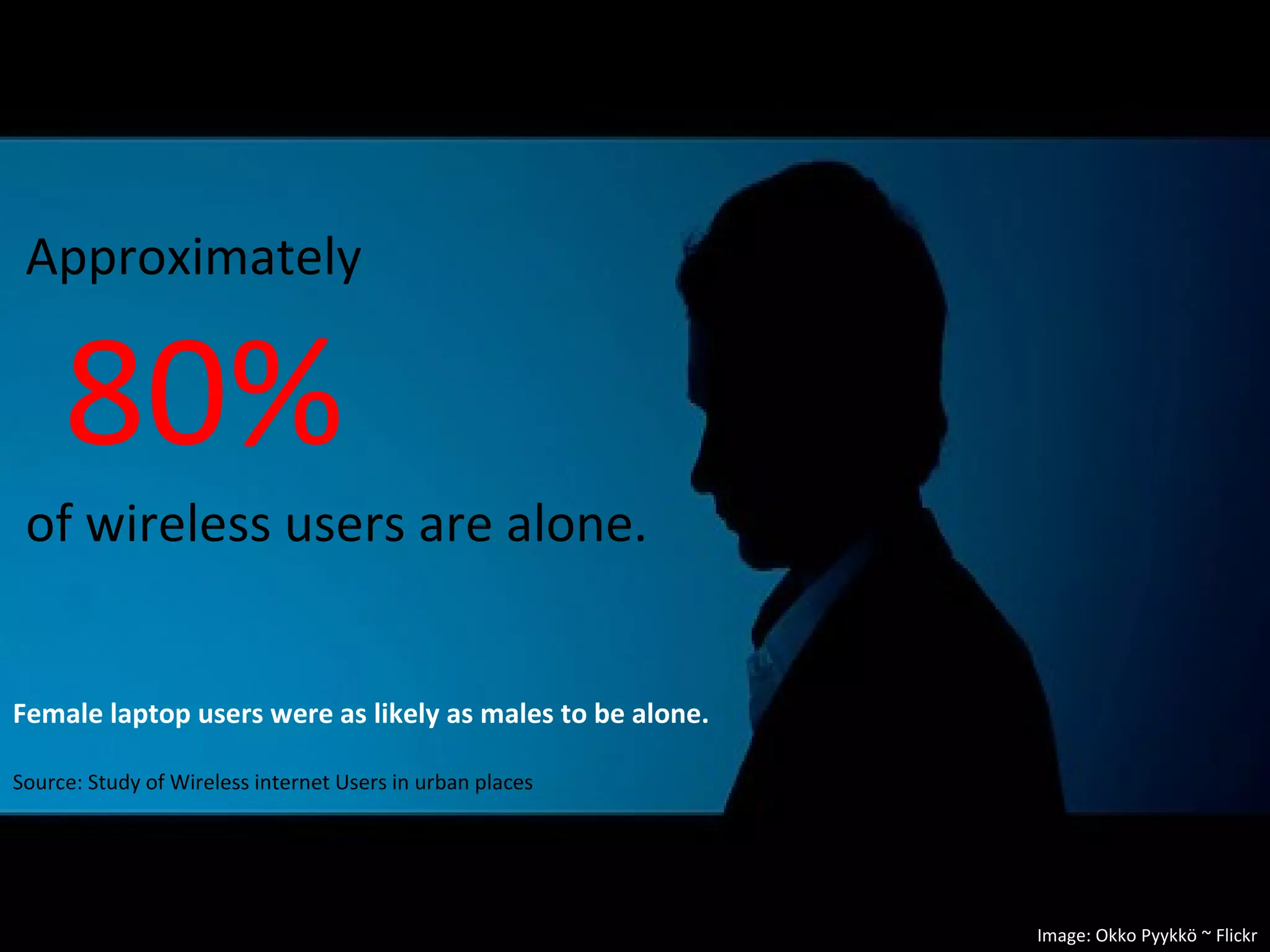
Approximately     80%     of wireless users are alone.   Female laptop users were as likely as males to be alone. Source: Study of Wireless internet Users in urban places  Image: Okko Pyykkö ~ Flickr
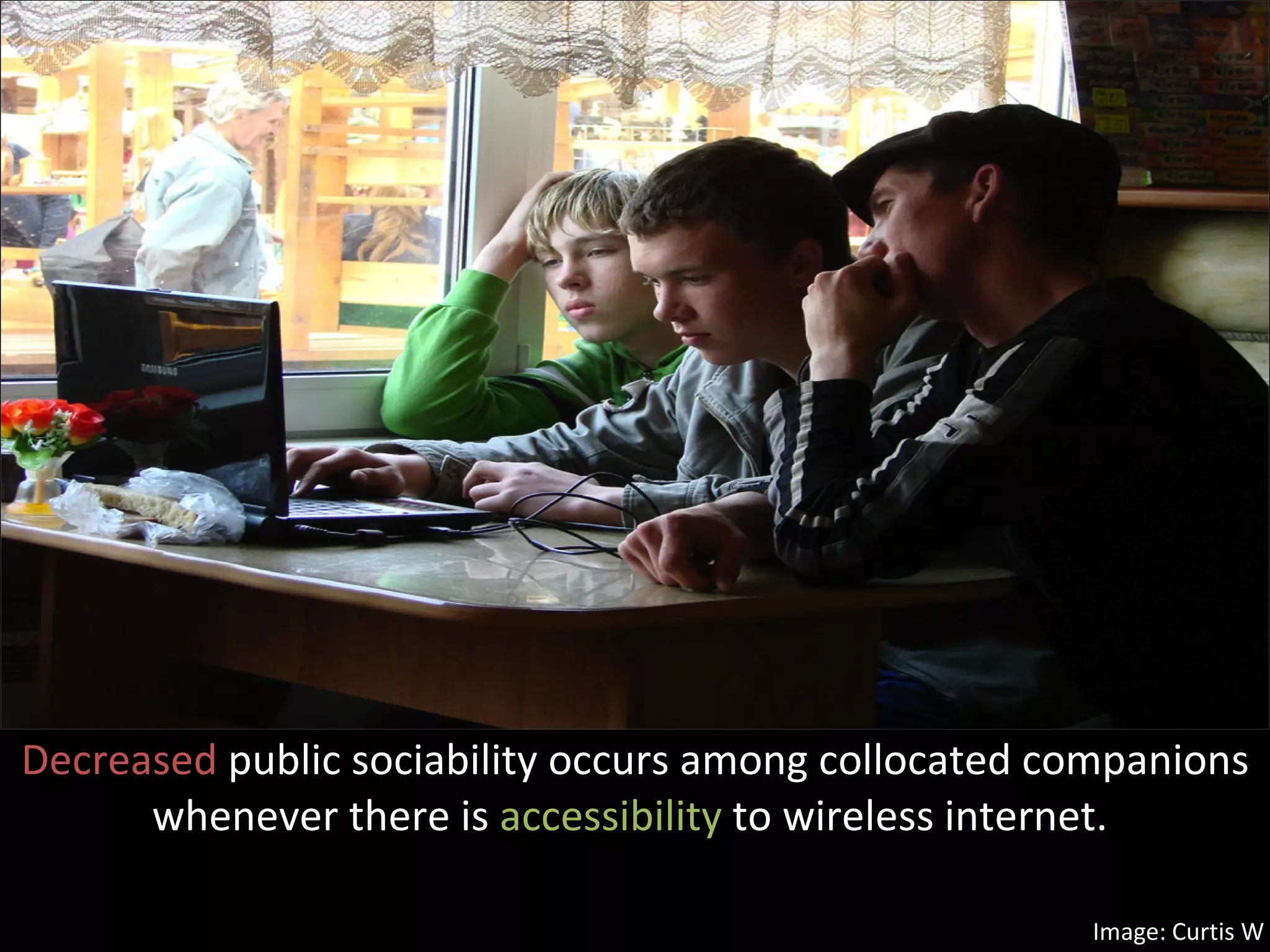
Decreased  public sociability occurs among collocated companions whenever there is  accessibility  to wireless internet.  Image: Curtis W
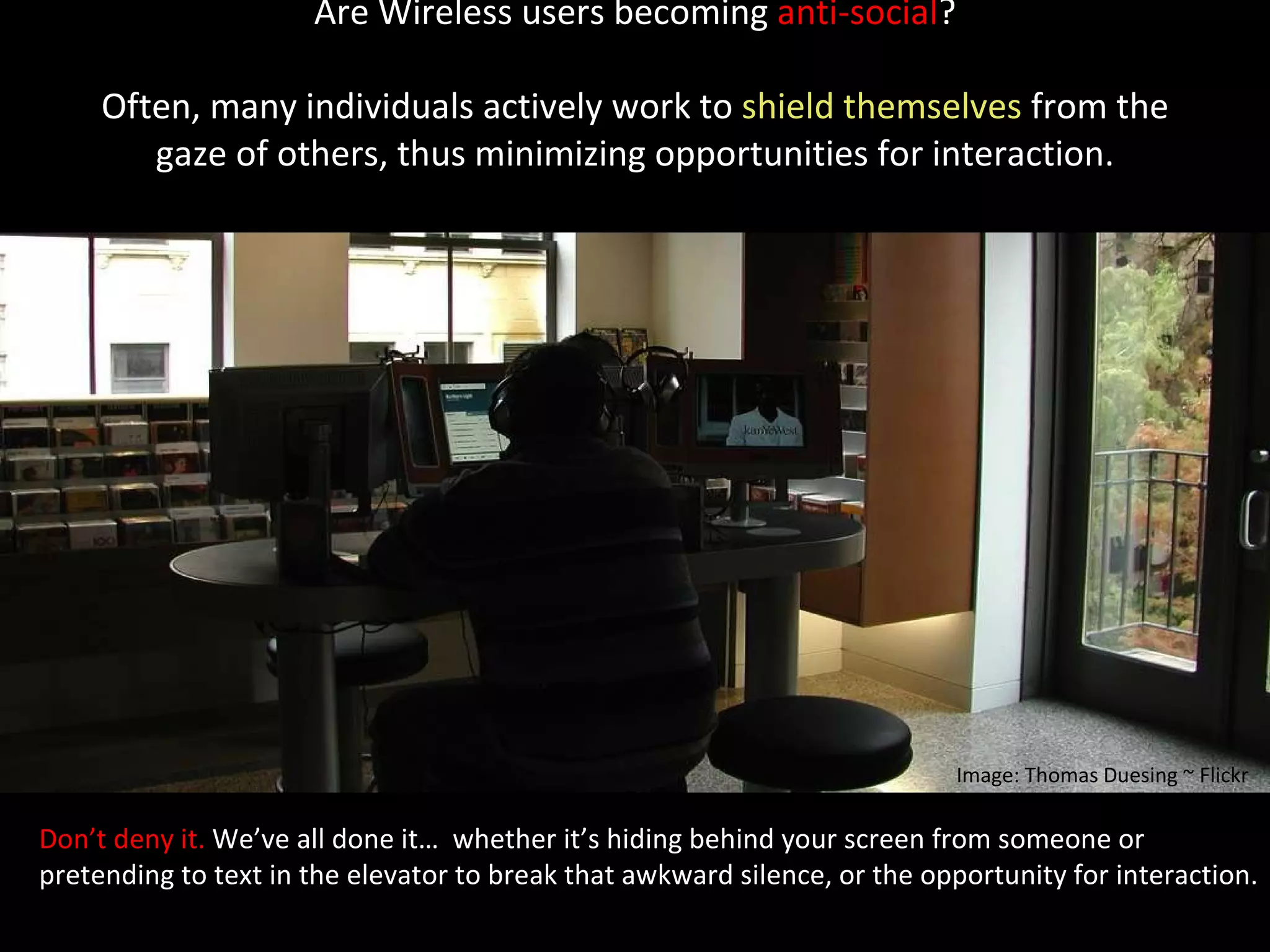
Are Wireless users becoming  anti-social ? Often, many individuals actively work to  shield themselves  from the gaze of others, thus minimizing opportunities for interaction.   Don’t deny it.  We’ve all done it…  whether it’s hiding behind your screen from someone or  pretending to text in the elevator to break that awkward silence, or the opportunity for interaction. Image: Thomas Duesing ~ Flickr
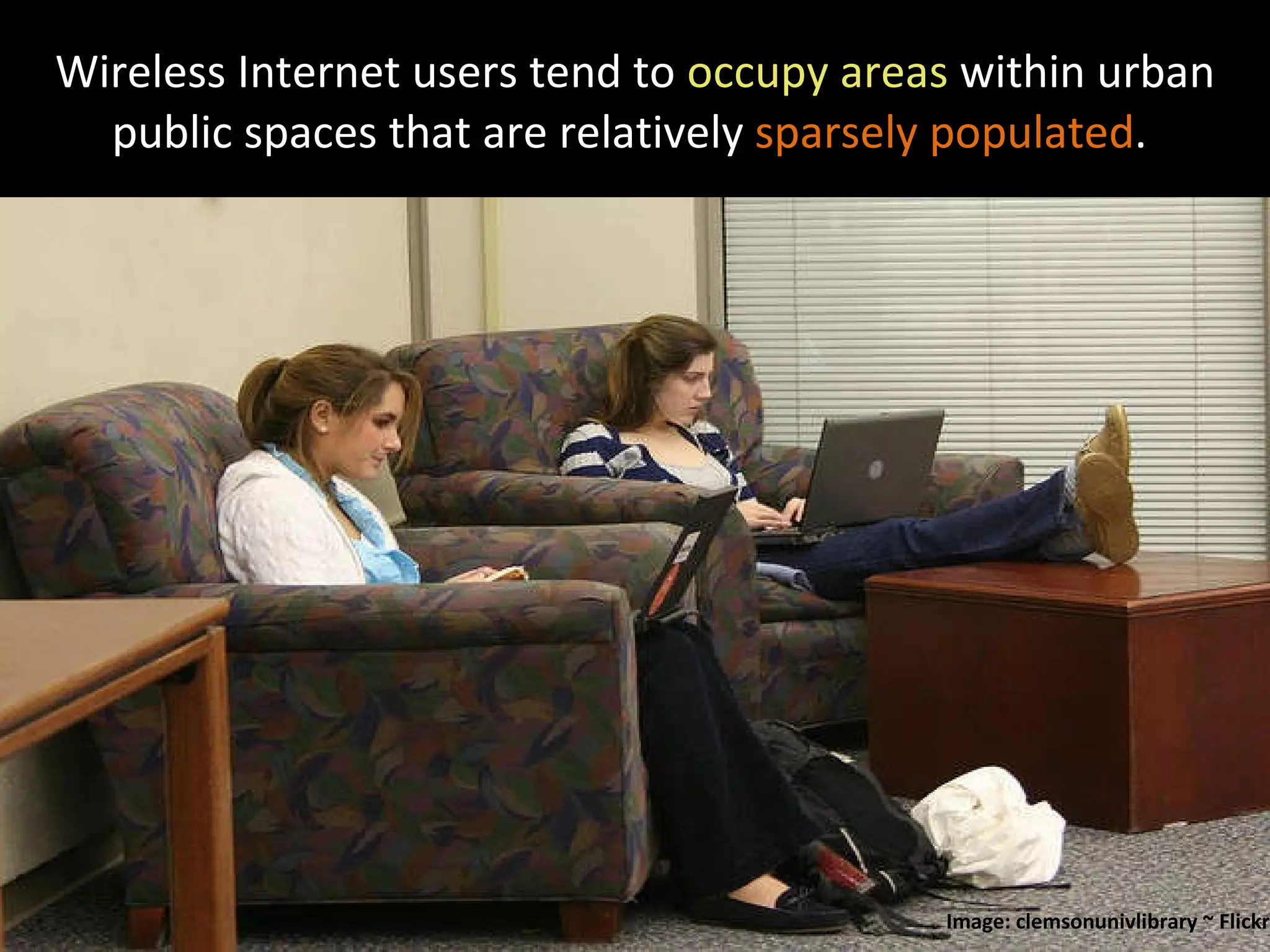
Wireless Internet users tend to  occupy areas  within urban public spaces that are relatively  sparsely populated .  Image: clemsonunivlibrary ~ Flickr
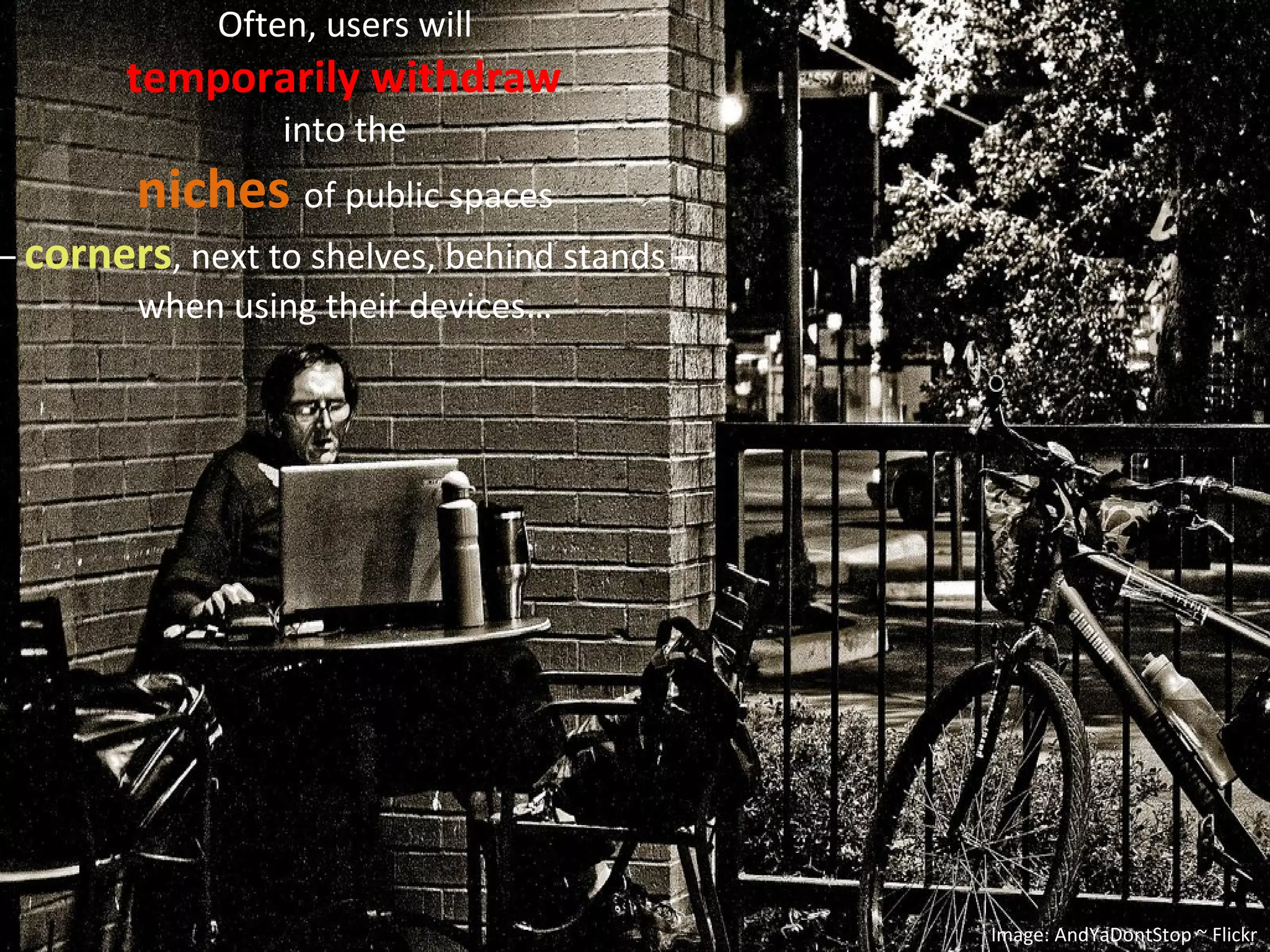
Often, users will  temporarily withdraw  into the  niches   of public spaces  –  corners , next to shelves, behind stands –  when using their devices…  Image: AndYaDontStop ~ Flickr
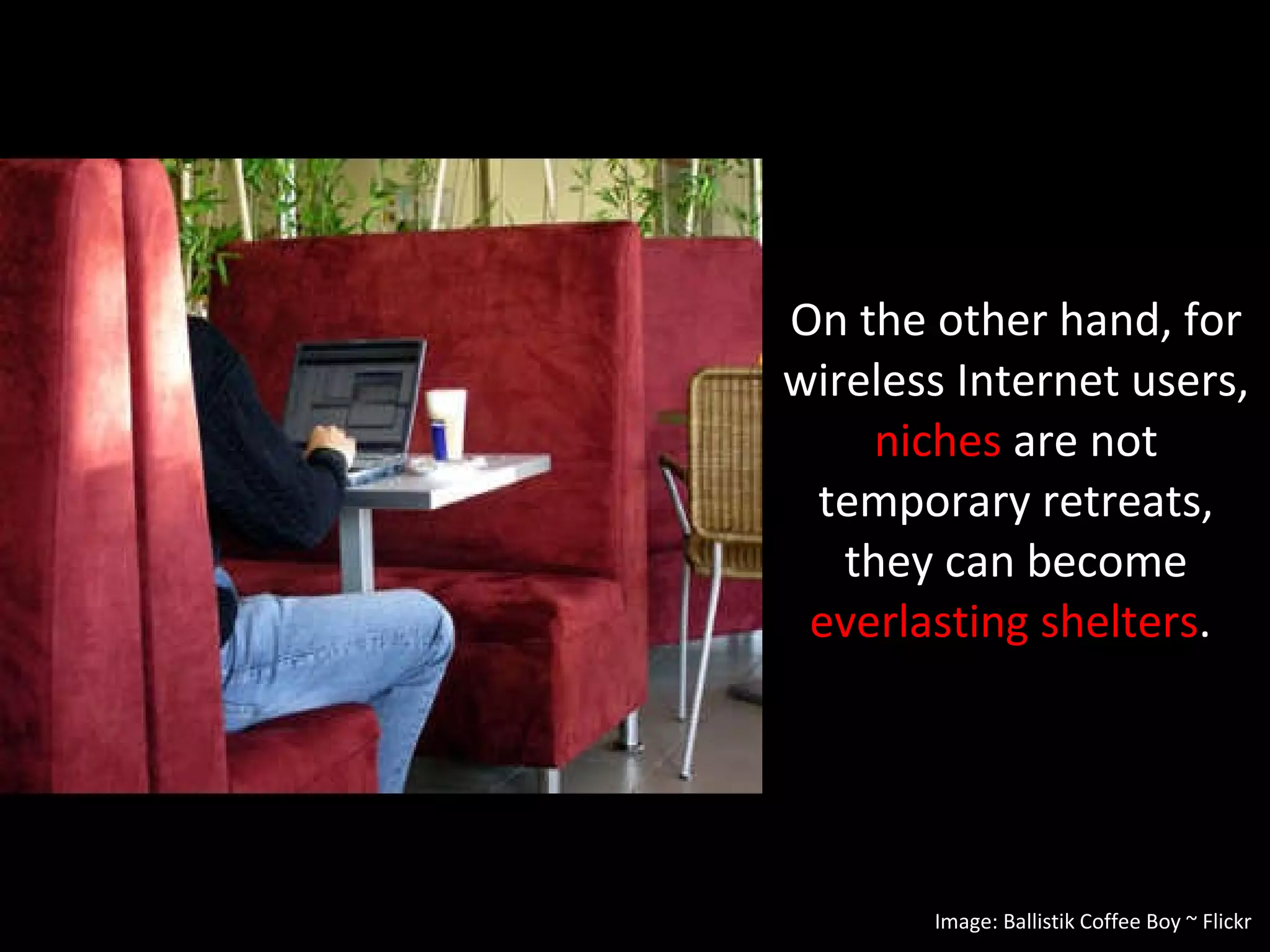
On the other hand, for wireless Internet users,  niches  are not temporary retreats, they can become  everlasting shelters .  Need image Image: Ballistik Coffee Boy ~ Flickr
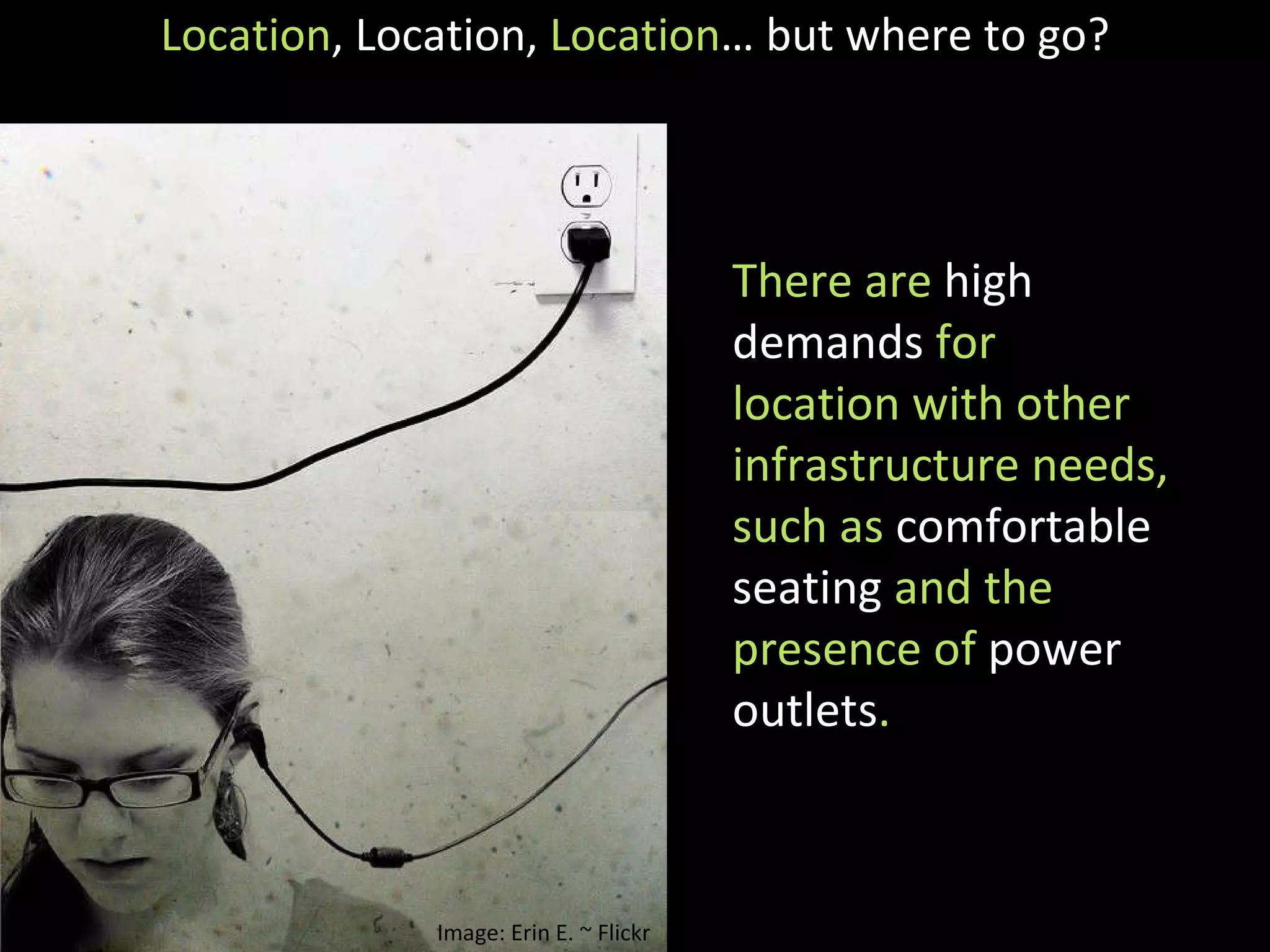
Location , Location,  Location … but where to go? There are  high demands  for location with other infrastructure needs, such as  comfortable seating  and the presence of  power outlets .  Image: Erin E. ~ Flickr
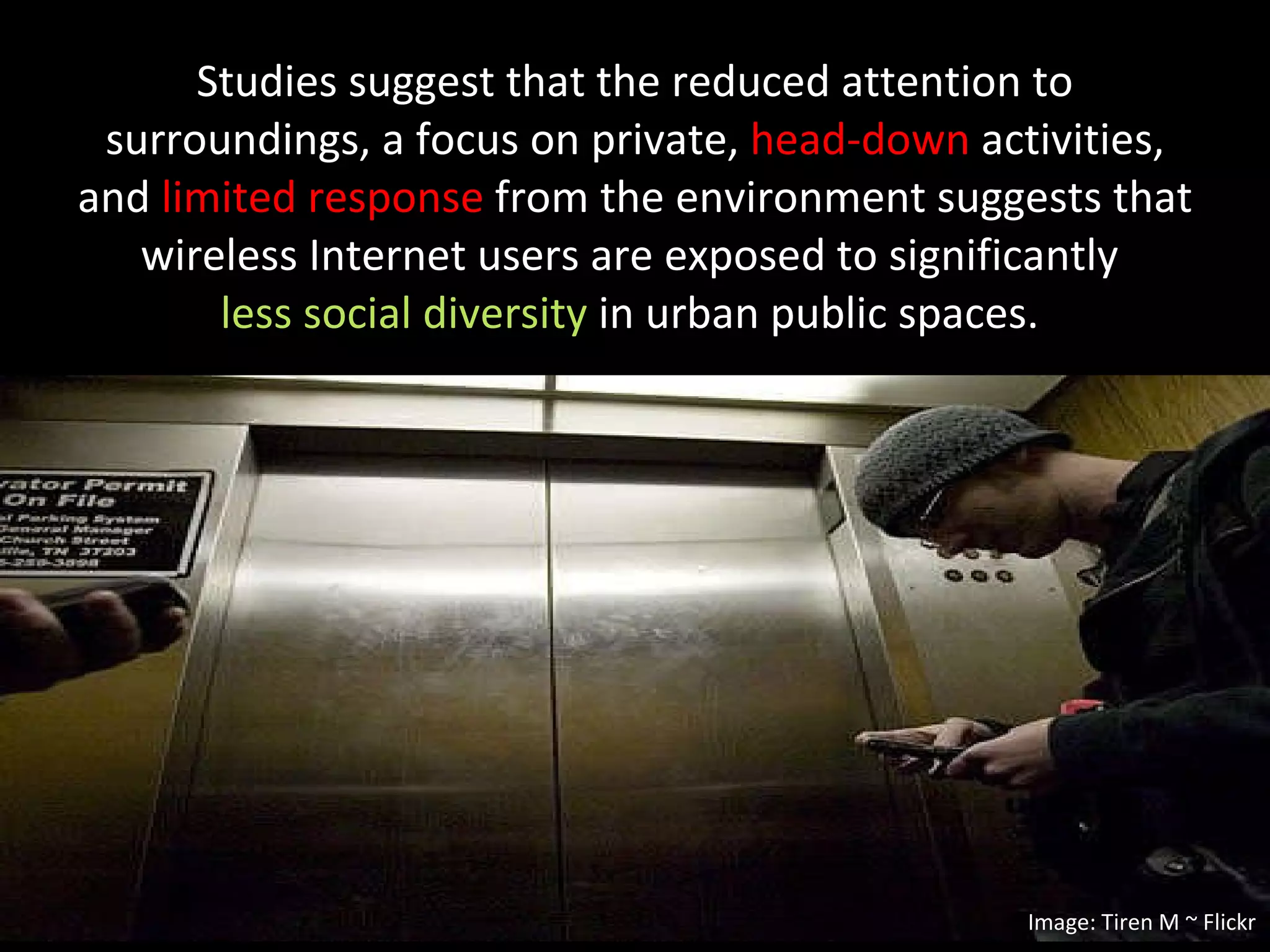
Studies suggest that the reduced attention to surroundings, a focus on private,  head-down  activities, and  limited response  from the environment suggests that wireless Internet users are exposed to significantly  less social diversity  in urban public spaces.  Image: Tiren M ~ Flickr
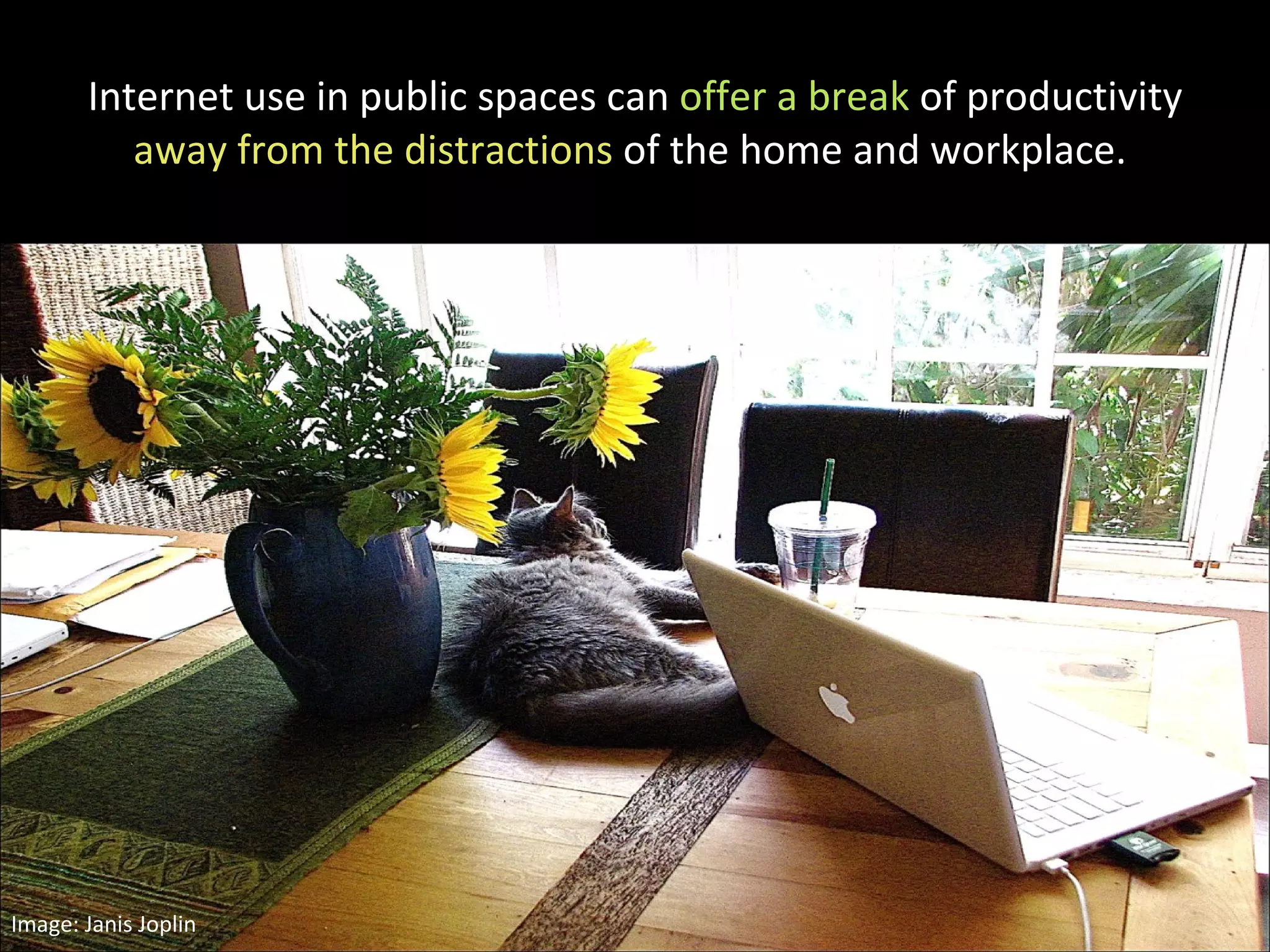
Internet use in public spaces can  offer a break  of productivity  away from the distractions  of the home and workplace.  Image: Janis Joplin
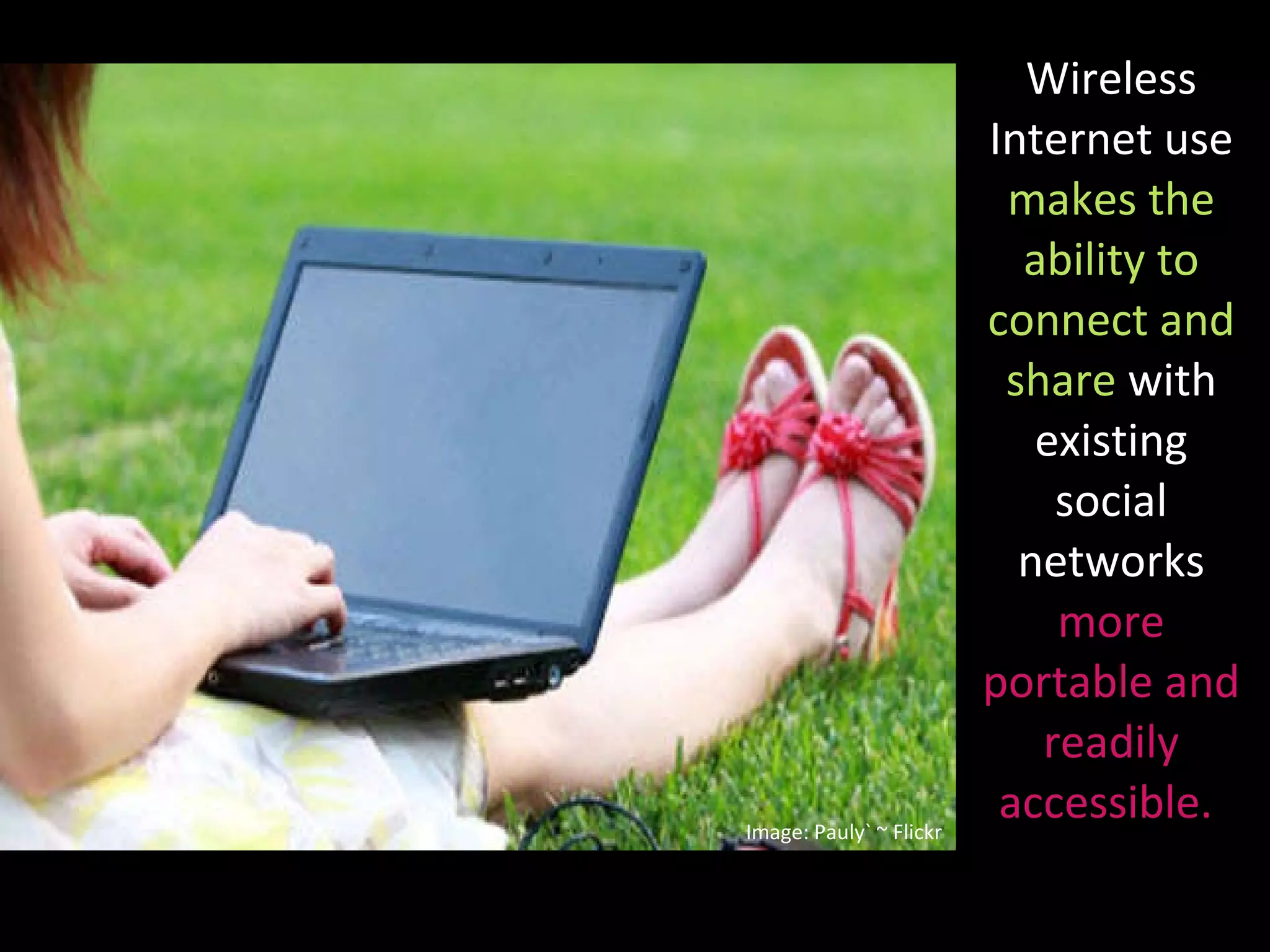
Wireless Internet use  makes the ability to connect and share  with existing social networks  more portable and readily accessible.  Image: Pauly` ~ Flickr
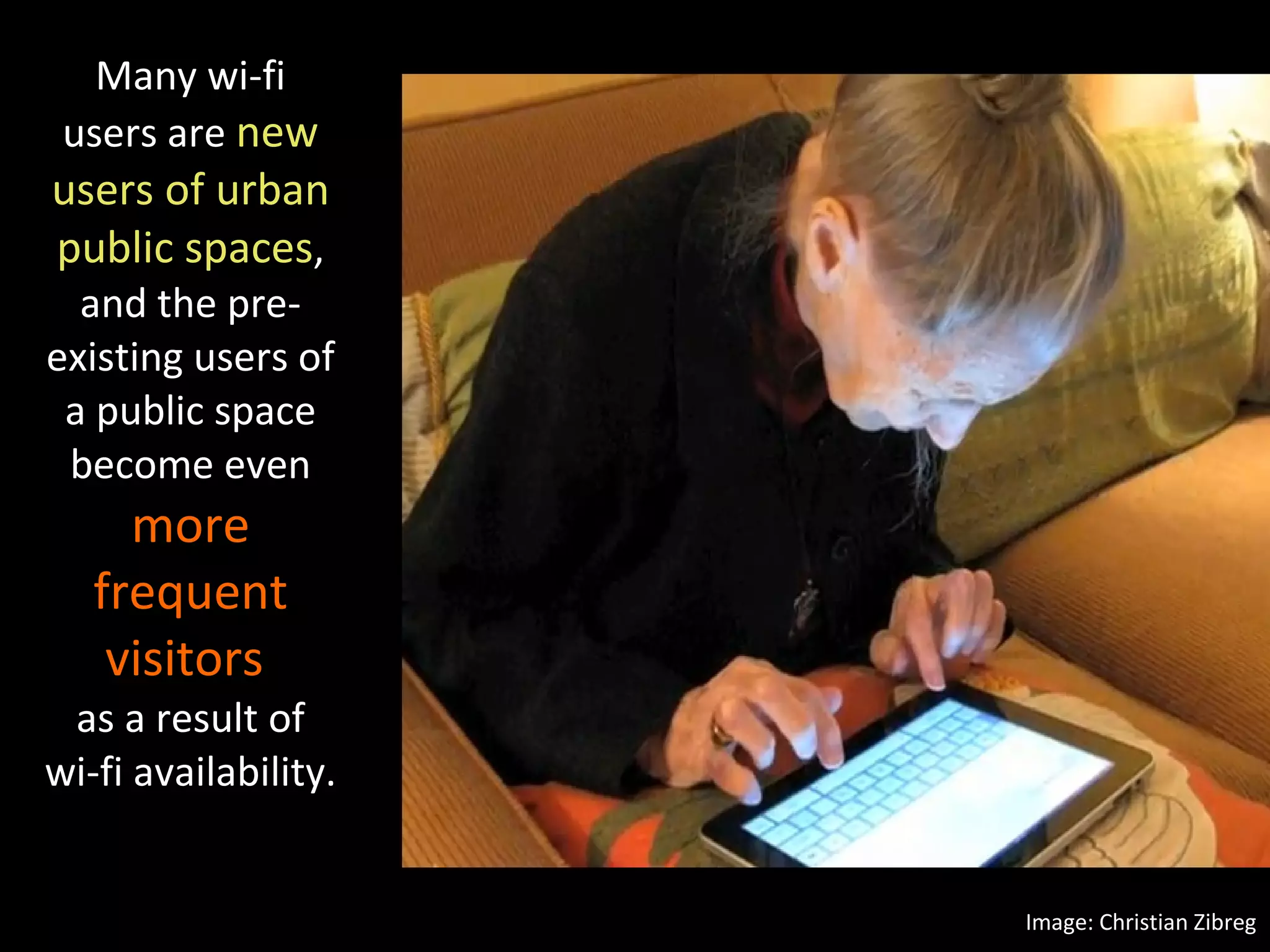
Many wi-fi users are  new users of urban public spaces , and the pre-existing users of a public space become even  more frequent visitors   as a result of wi-fi availability.    Image: Christian Zibreg
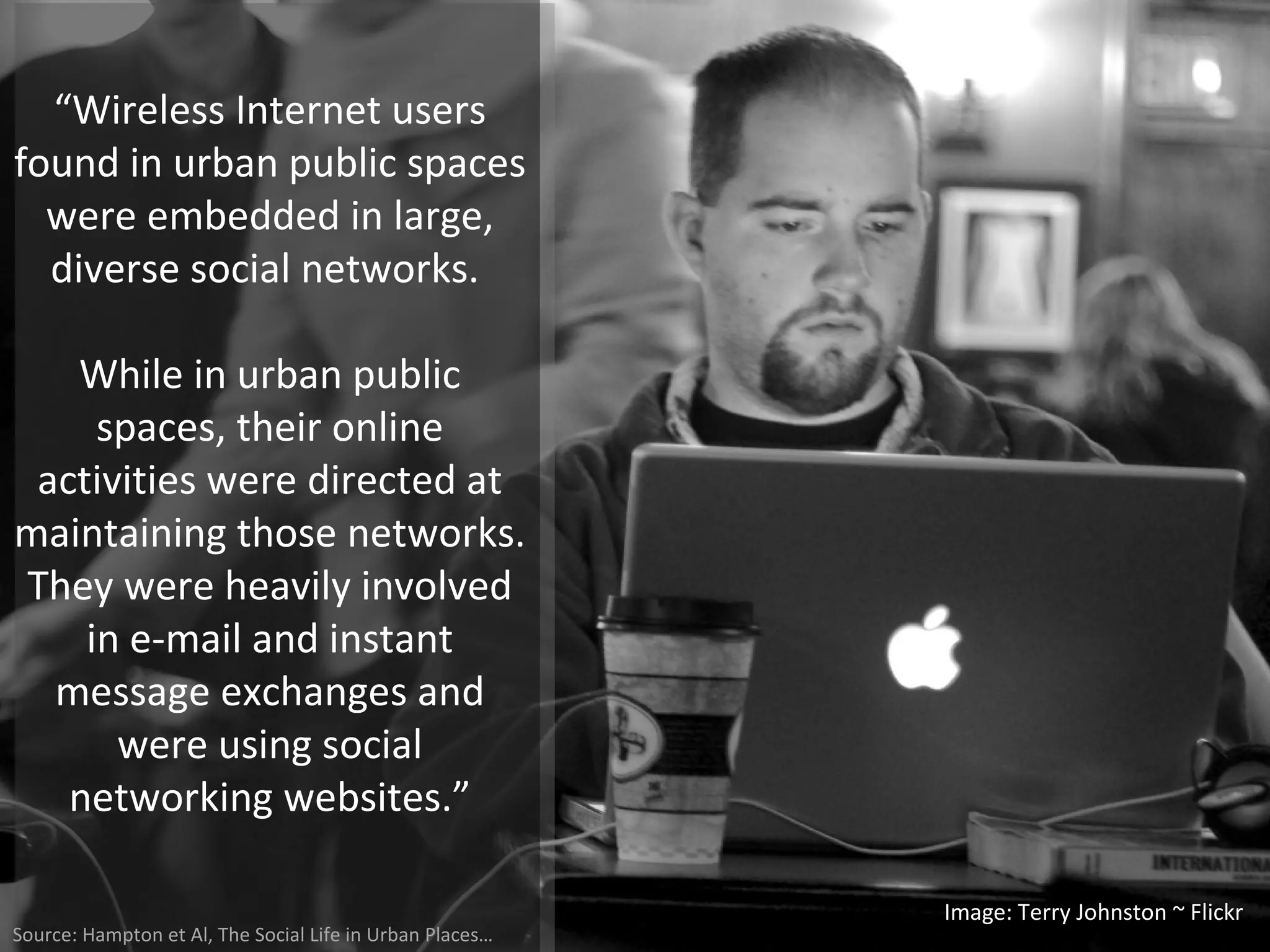
“ Wireless Internet users found in urban public spaces were embedded in large, diverse social networks.  While in urban public spaces, their online activities were directed at maintaining those networks. They were heavily involved in e-mail and instant message exchanges and were using social networking websites.” Image: Terry Johnston ~ Flickr Source: Hampton et Al, The Social Life in Urban Places…
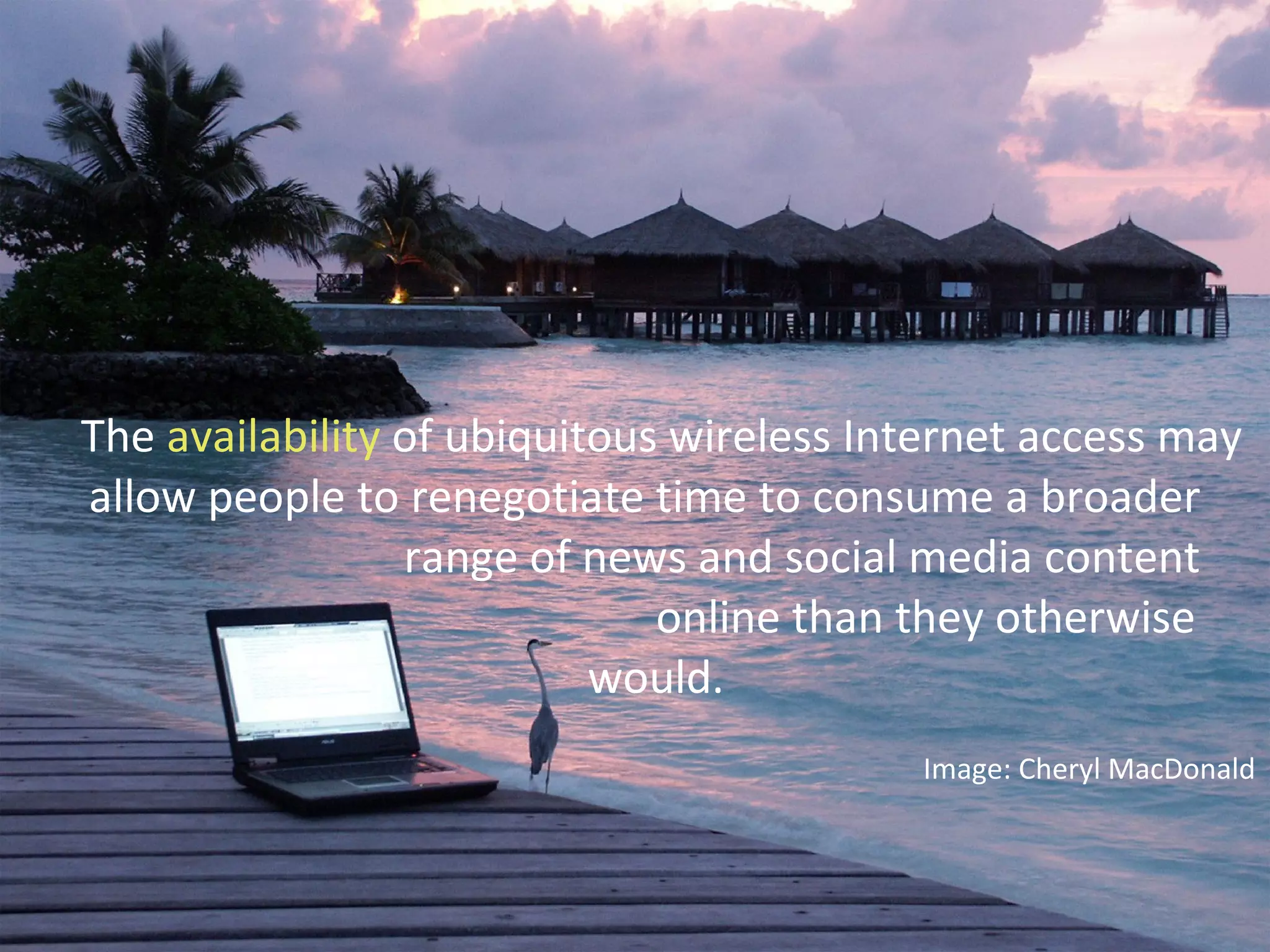
The  availability  of ubiquitous wireless Internet access may allow people to renegotiate time to consume a broader    range of news and social media content    online than they otherwise would.  Image: Cheryl MacDonald
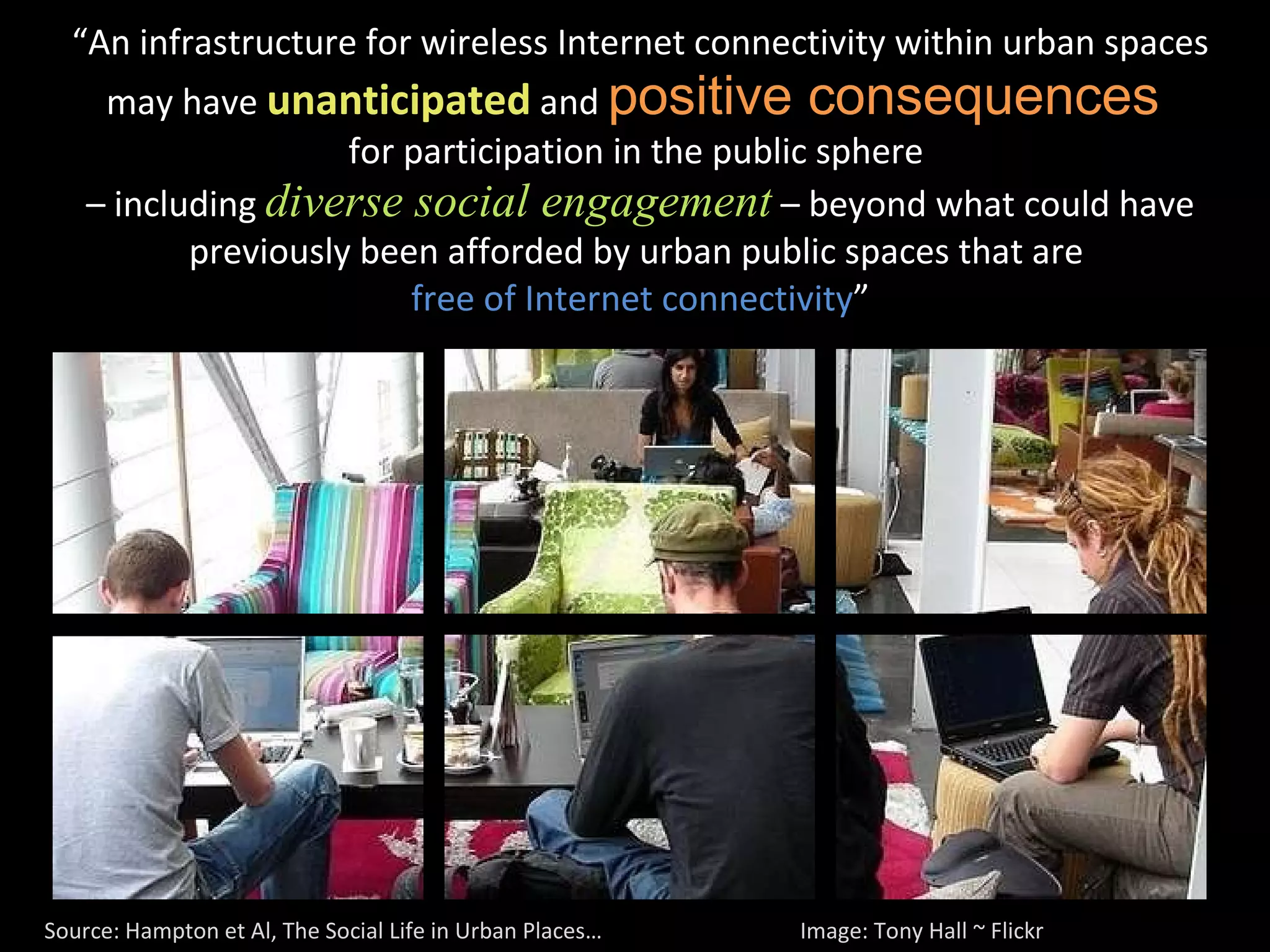
“ An infrastructure for wireless Internet connectivity within urban spaces may have  unanticipated   and  positive consequences  for participation in the public sphere  – including  diverse social engagement   – beyond what could have previously been afforded by urban public spaces that are  free of Internet connectivity ” Source: Hampton et Al, The Social Life in Urban Places…  Image: Tony Hall ~ Flickr
Wireless Internet has been nothing short of revolutionary in how people connect with other users, anytime, anywhere.  thanks for coming. Image:  koffeeben ~DeviantArt

The Escalation of Wireless Internet

  • 1.
    The Escalationof Wireless Internet By Ryan Woods Follow me @rtwoods13 Image: cestaimee ~ Flickr
  • 2.
    Are you showing symptoms of mobility, social & interpersonal interaction, as well as feeling connected without being physically plugged in? Image: Mae_L12 ~ PhotoBucket
  • 3.
    Well then youmust have a case of Wireless Internet. Image: Natalie Marion
  • 4.
    What is Wireless Internet? Image Source: Alegriphotos
  • 5.
    If you’ve beenliving under a rock or have been highly sheltered all your life… Wireless internet is essentially a component that provides a mobile device with the ability to connect to the internet without the use of cables so long as the device is within range of a wireless network Image: keithloaf1961 ~ Flickr
  • 6.
    Through the escalationof broadband wireless Internet, access to the web has become almost unlimited amid the rapid development of community wi-fi in public spaces. Crop top off. Insert quote on grey bottom Image: Emilio Labrador ~ Flickr
  • 7.
    The accessibility is boundless… Image: Adnan Islam ~ Flickr
  • 8.
    “ While theinterpersonal component of the public sphere has become increasingly private, the structure of people’s social networks has changed significantly.” Quote: Keith N. Hampton Image: Pauly` ~ Flickr
  • 9.
    Internet access inthe public realm has reshaped , revitalized and improved the processes of privatism , and essentially social interaction & engagement . Image: Pauly` - Flickr
  • 10.
    The available andimmediate connectivity that Wi-fi has to offer may even establish less social inequalities , as well as an increased popularity toward public spaces. Image: Paul White
  • 11.
    “ The experienceof wireless Internet use in the public realm contrasts with traditional wired Internet use, which is confined primarily to the private realm of the home and… workplace. “ Quote: Keith N. Hampton et Al. Photo: Pauly`~ Flickr
  • 12.
    Without wireless internet,we’d just be still using… Well… old wired technology. Image: Pauly`~ Flickr
  • 13.
    But now, Withbroadband wireless Internet access, people can use a greater range of devices (e.g., laptops, the iPhone, and “smart phones”) and applications and are not restricted to the limited processing, display, and data entry capabilities of the traditional mobile phone. Image: Ryan Woods
  • 14.
    “ People cannow readily use mobile devices in urban public spaces and expect an Internet experience that is similar to wired Internet access at home and work.” Source: Hampton et Al, The Social Life in Urban Places… Image: Mo Riza ~ Flickr
  • 15.
    Mobile phone networks are only one example of wireless communications that are capable of providing broadband Internet access to phones, laptops, and other mobile devices. Wi-fi networks are an additional opportunity for wireless connectivity . Image: Alegriphotos
  • 16.
    In 2007, 41% of Americans had used wireless Internet access… but only 16% had used the internet on a smart phone or other handheld device… By 2009 this had increased to 59% and 32% respectively. Source: (Purcell, Entner & Henderson 2010)(Horrigan, 2008).
  • 17.
    “ Wi-fi networks[can] range from the formal to the accidental and from corporate to counter-culture.” Source: Hampton et Al, The Social Life in Urban Places… Image: Cordey ~ Flickr
  • 18.
    With the consumptionof wireless networks, generally, the benefits of wi-fi include considerable opportunities towards the provision of city services , economic development , and the diminution of social inequalities . Image: Sharyn Morrow ~ Flickr
  • 19.
    How has wirelessInternet affected urban spaces ? Image: ercwttmn ~ Flickr
  • 20.
    Free . A word you rarely hear in today’s society without a catch to it. Image: Jiaren Lau ~ Flickr
  • 21.
    However, when itcomes to Free Wifi … often places really mean free… more or less. Image: Emma Besseau
  • 22.
    These include Wirelesscommunity networks: Grassroots, non- profit associations that afford local, generally free , wireless Internet access. Image: Pauly` ~ Flickr
  • 23.
    Free wi-fiis often used as a marketing tool to gain a larger audience in places. This marketing ploy is used in such places as Starbucks, and even McDonalds . Image: Ryan Woods
  • 24.
    Image: Elvert Barnes~ Flickr Coffee shops and restaurants were often used for intimate social communications … … but now, these locations are mainly being used as a place for one individual to go to communicate socially, in terms of social media (s).
  • 25.
    These urban areasthat are catered by Free Wi-fi access are known as Hotspots Image: David Goehring ~ Flickr
  • 26.
    Hotspots arelimited locations where Wireless internet access, such as a coffee shop , bookstore, or airport lounge. Access is typically associated with pay-per-use or the purchase of a product (e.g. a cup of coffee). Image: N i c o l a ~ Flickr
  • 27.
    Hotspots have becomea universal feature of the urban environment. Image: Thomas Duesing ~ Flickr
  • 28.
    According to Hampton’sarticle on the social life in urban places… There are “complex ways in which this new technology is implicated in contemporary social processes in public spaces.” Source: Hampton et Al, The Social Life in Urban Places… Image: Benjamin Ellis ~ Flickr
  • 29.
    There is speculationof additional social benefits by using wireless Internet in public spaces. promotion of social cohesion community building stimulation of democracy revitalization & repopulation of civic spaces This includes:
  • 30.
    What are the factors of wireless access when it comes to establishing location popularity? #1 Reputation #2 Availability #3 Urban Design #4 Local Culture #5 Population Density #6 Surveillance/Harassment #7 Early Establishment of Wi-fi Source: Observations on seven public spaces in the United States & Canada
  • 31.
    Ratio ofwi-fi users between men to women 3 : 1 ... with single, white, young male adults predominating. Source: 344 women and 966 men were observed using laptops in a study for Wireless Urban Spaces
  • 32.
    Why is the ratio so high for men than women? Women are more likely to go to an indoor public space with wi-fi, because they may perceive indoor public spaces to be safer from harassment, as well as containing fewer social indications that promote the exclusion of females, compared to similar outdoor environments. Image: OpenEye ~ Flickr
  • 33.
    Approximately 80% of wireless users are alone. Female laptop users were as likely as males to be alone. Source: Study of Wireless internet Users in urban places Image: Okko Pyykkö ~ Flickr
  • 34.
    Decreased publicsociability occurs among collocated companions whenever there is accessibility to wireless internet. Image: Curtis W
  • 35.
    Are Wireless usersbecoming anti-social ? Often, many individuals actively work to shield themselves from the gaze of others, thus minimizing opportunities for interaction. Don’t deny it. We’ve all done it… whether it’s hiding behind your screen from someone or pretending to text in the elevator to break that awkward silence, or the opportunity for interaction. Image: Thomas Duesing ~ Flickr
  • 36.
    Wireless Internet userstend to occupy areas within urban public spaces that are relatively sparsely populated . Image: clemsonunivlibrary ~ Flickr
  • 37.
    Often, users will temporarily withdraw into the niches of public spaces – corners , next to shelves, behind stands – when using their devices… Image: AndYaDontStop ~ Flickr
  • 38.
    On the otherhand, for wireless Internet users, niches are not temporary retreats, they can become everlasting shelters . Need image Image: Ballistik Coffee Boy ~ Flickr
  • 39.
    Location , Location, Location … but where to go? There are high demands for location with other infrastructure needs, such as comfortable seating and the presence of power outlets . Image: Erin E. ~ Flickr
  • 40.
    Studies suggest thatthe reduced attention to surroundings, a focus on private, head-down activities, and limited response from the environment suggests that wireless Internet users are exposed to significantly less social diversity in urban public spaces. Image: Tiren M ~ Flickr
  • 41.
    Internet use inpublic spaces can offer a break of productivity away from the distractions of the home and workplace. Image: Janis Joplin
  • 42.
    Wireless Internet use makes the ability to connect and share with existing social networks more portable and readily accessible. Image: Pauly` ~ Flickr
  • 43.
    Many wi-fi usersare new users of urban public spaces , and the pre-existing users of a public space become even more frequent visitors as a result of wi-fi availability. Image: Christian Zibreg
  • 44.
    “ Wireless Internetusers found in urban public spaces were embedded in large, diverse social networks. While in urban public spaces, their online activities were directed at maintaining those networks. They were heavily involved in e-mail and instant message exchanges and were using social networking websites.” Image: Terry Johnston ~ Flickr Source: Hampton et Al, The Social Life in Urban Places…
  • 45.
    The availability of ubiquitous wireless Internet access may allow people to renegotiate time to consume a broader range of news and social media content online than they otherwise would. Image: Cheryl MacDonald
  • 46.
    “ An infrastructurefor wireless Internet connectivity within urban spaces may have unanticipated and positive consequences for participation in the public sphere – including diverse social engagement – beyond what could have previously been afforded by urban public spaces that are free of Internet connectivity ” Source: Hampton et Al, The Social Life in Urban Places… Image: Tony Hall ~ Flickr
  • 47.
    Wireless Internet hasbeen nothing short of revolutionary in how people connect with other users, anytime, anywhere. thanks for coming. Image: koffeeben ~DeviantArt