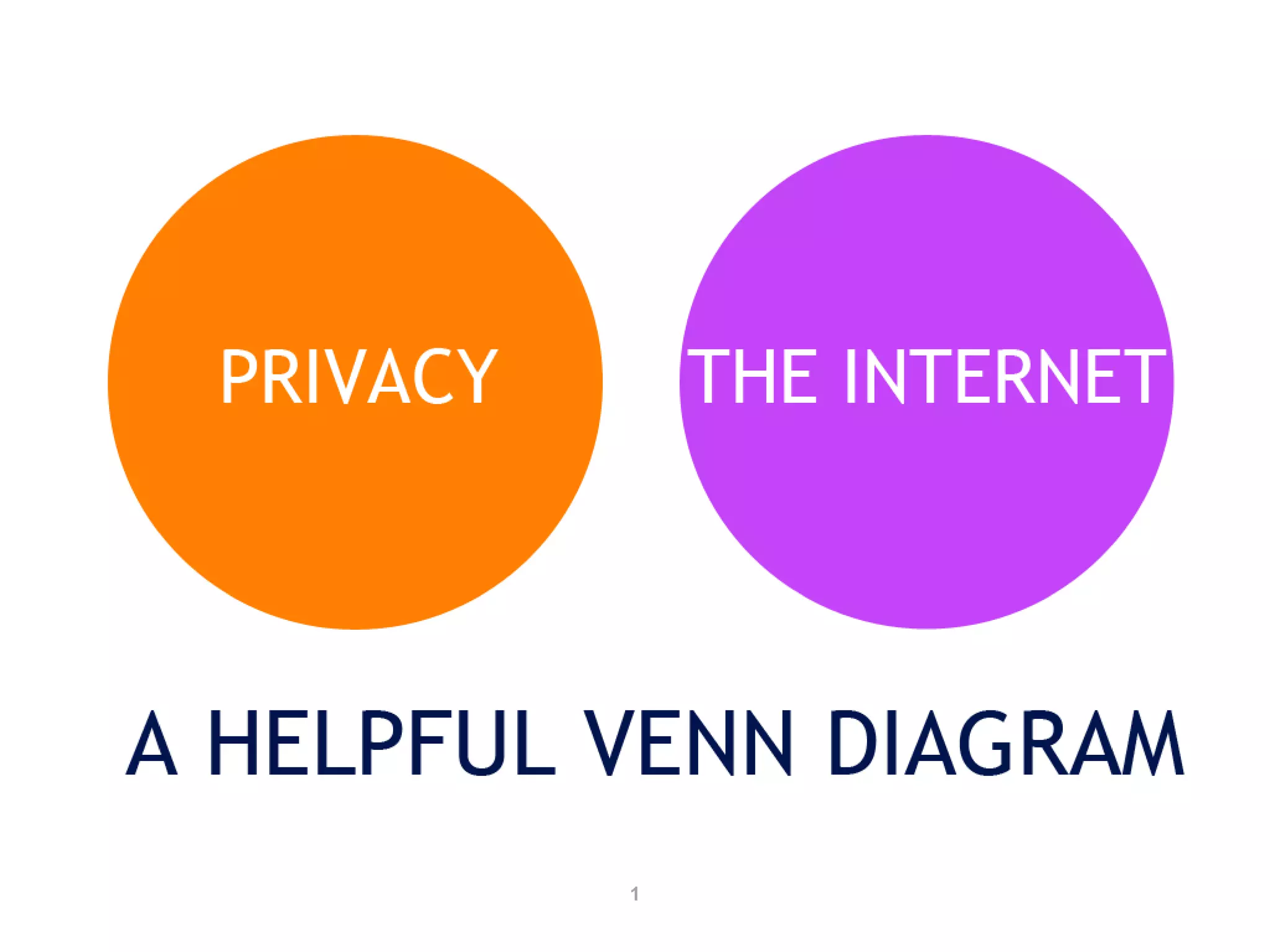
The case for privacy in a digitally networked era MAC309 [email_address]
Overview Commodification of publicness Lifecasting The new publicness Reputation Facebook and privacy
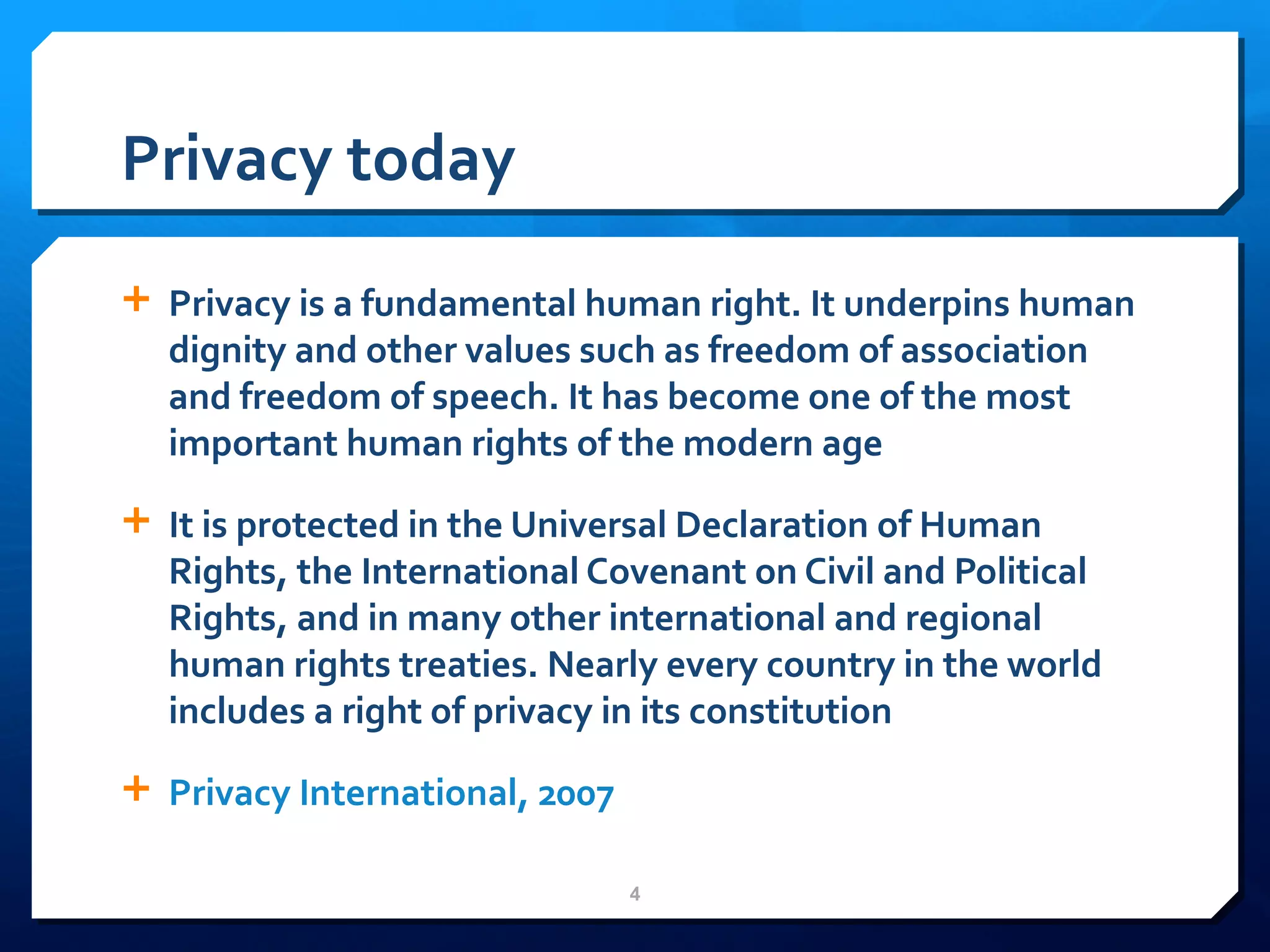
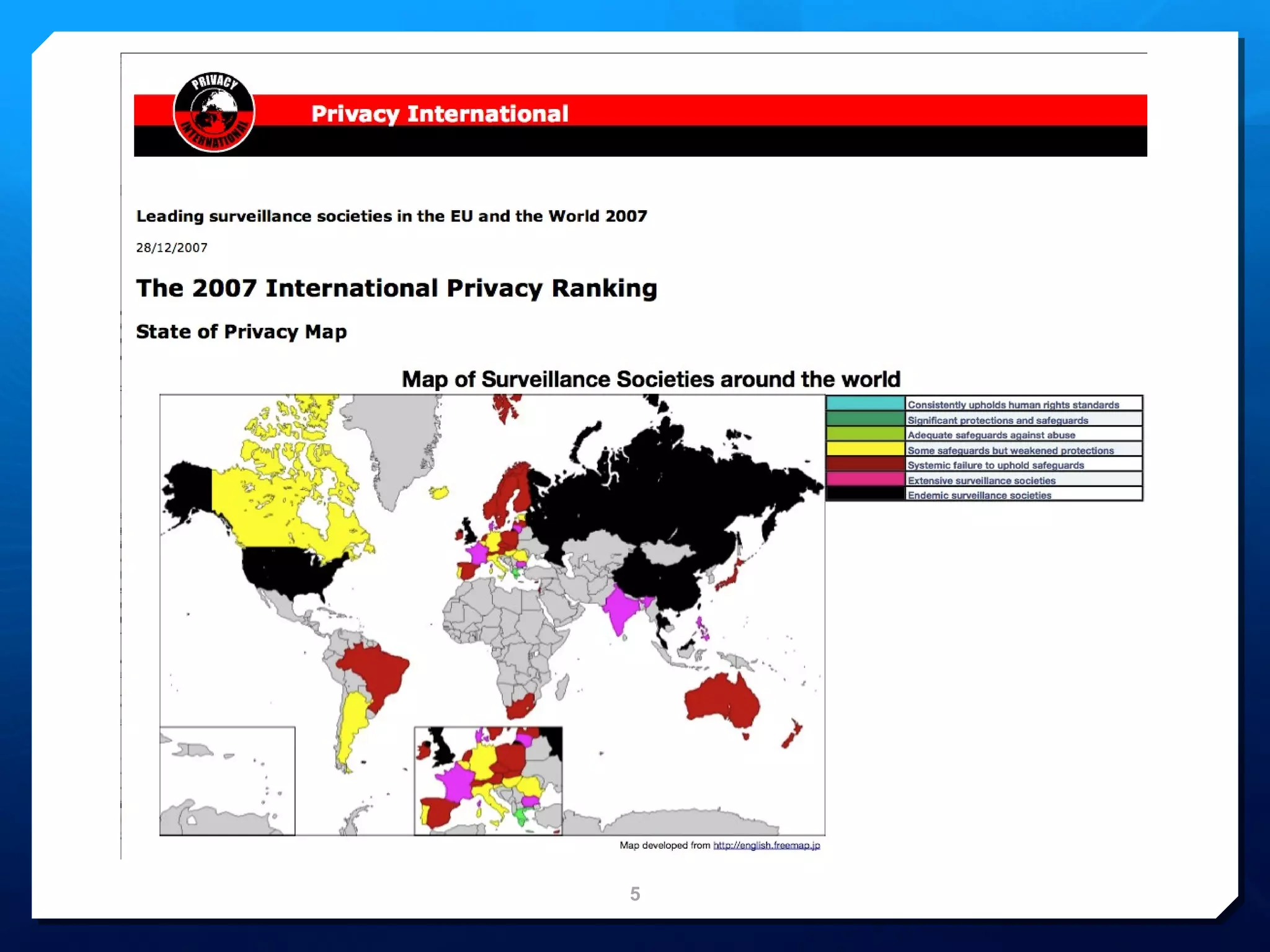
Privacy today Privacy is a fundamental human right. It underpins human dignity and other values such as freedom of association and freedom of speech. It has become one of the most important human rights of the modern age It is protected in the Universal Declaration of Human Rights, the International Covenant on Civil and Political Rights, and in many other international and regional human rights treaties. Nearly every country in the world includes a right of privacy in its constitution Privacy International, 2007
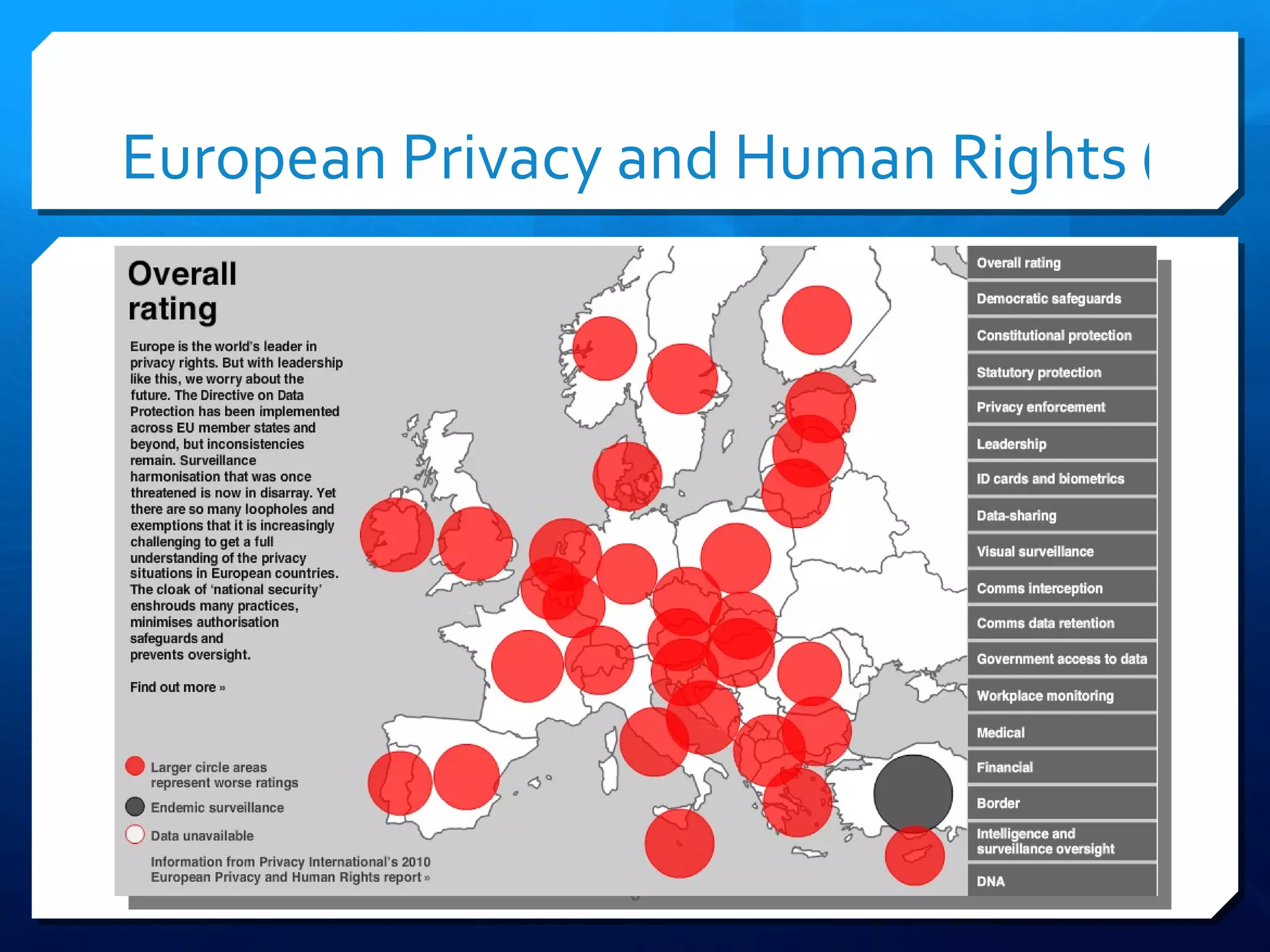
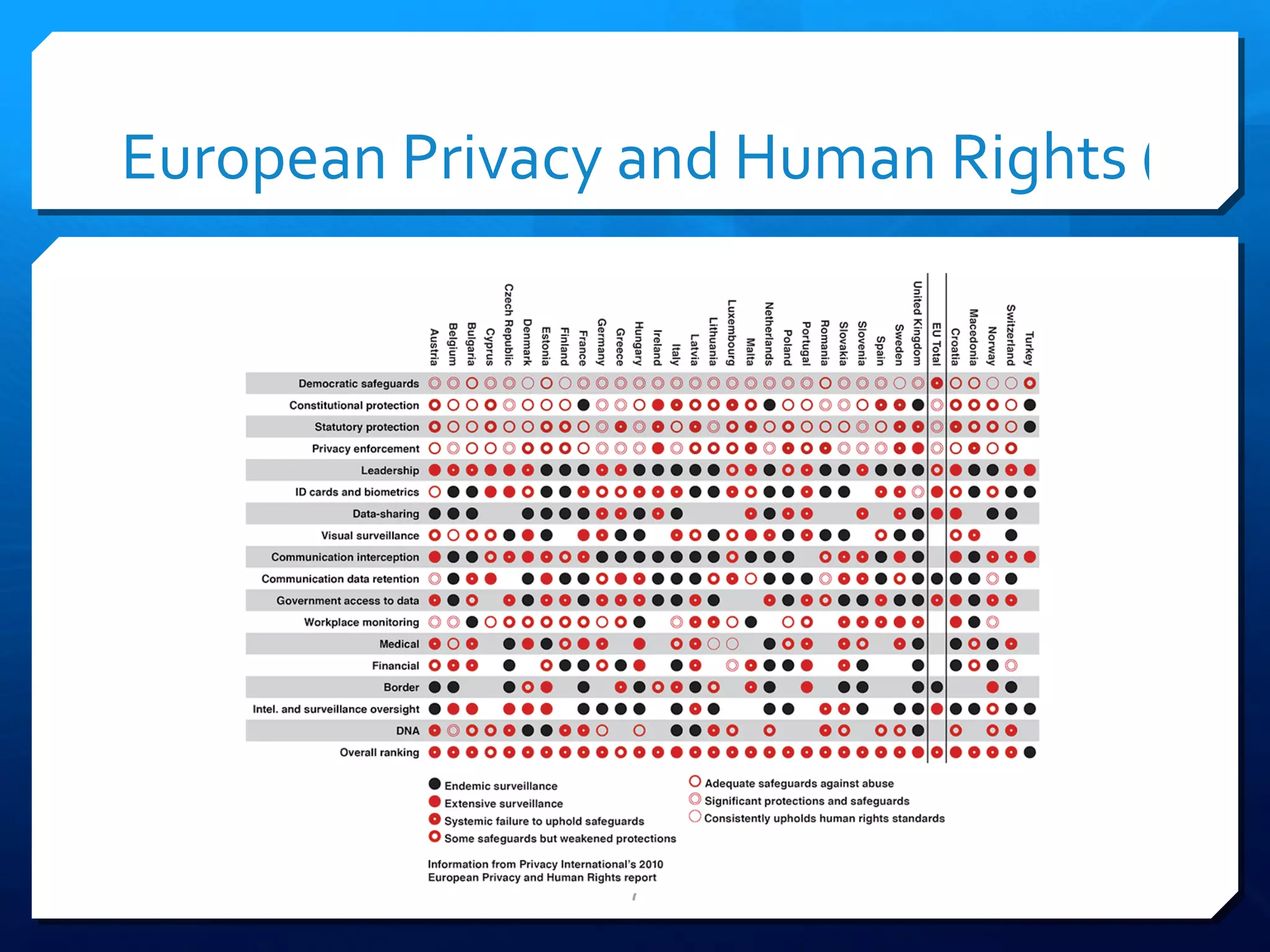
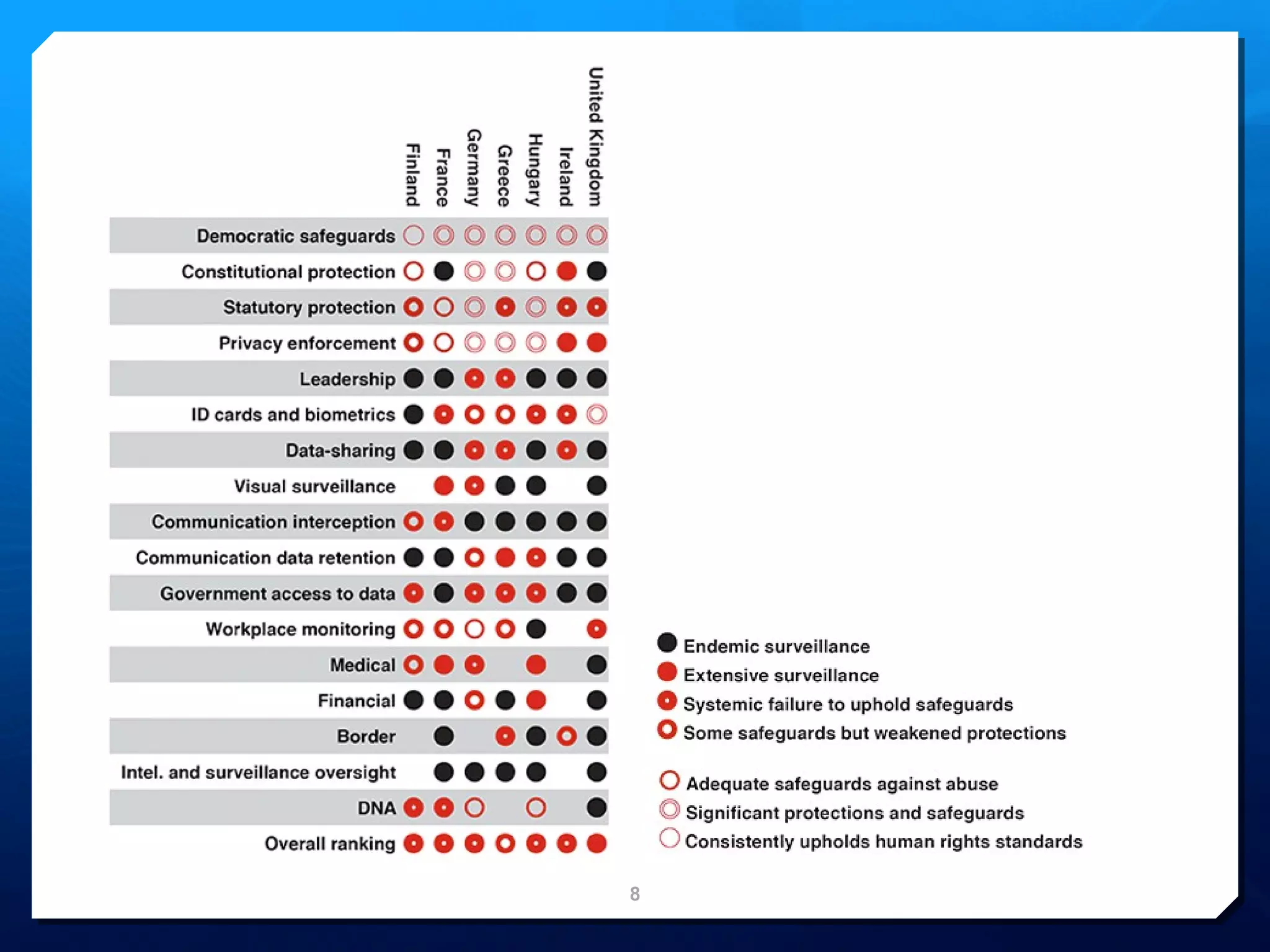
European Privacy and Human Rights (EPHR) 2010
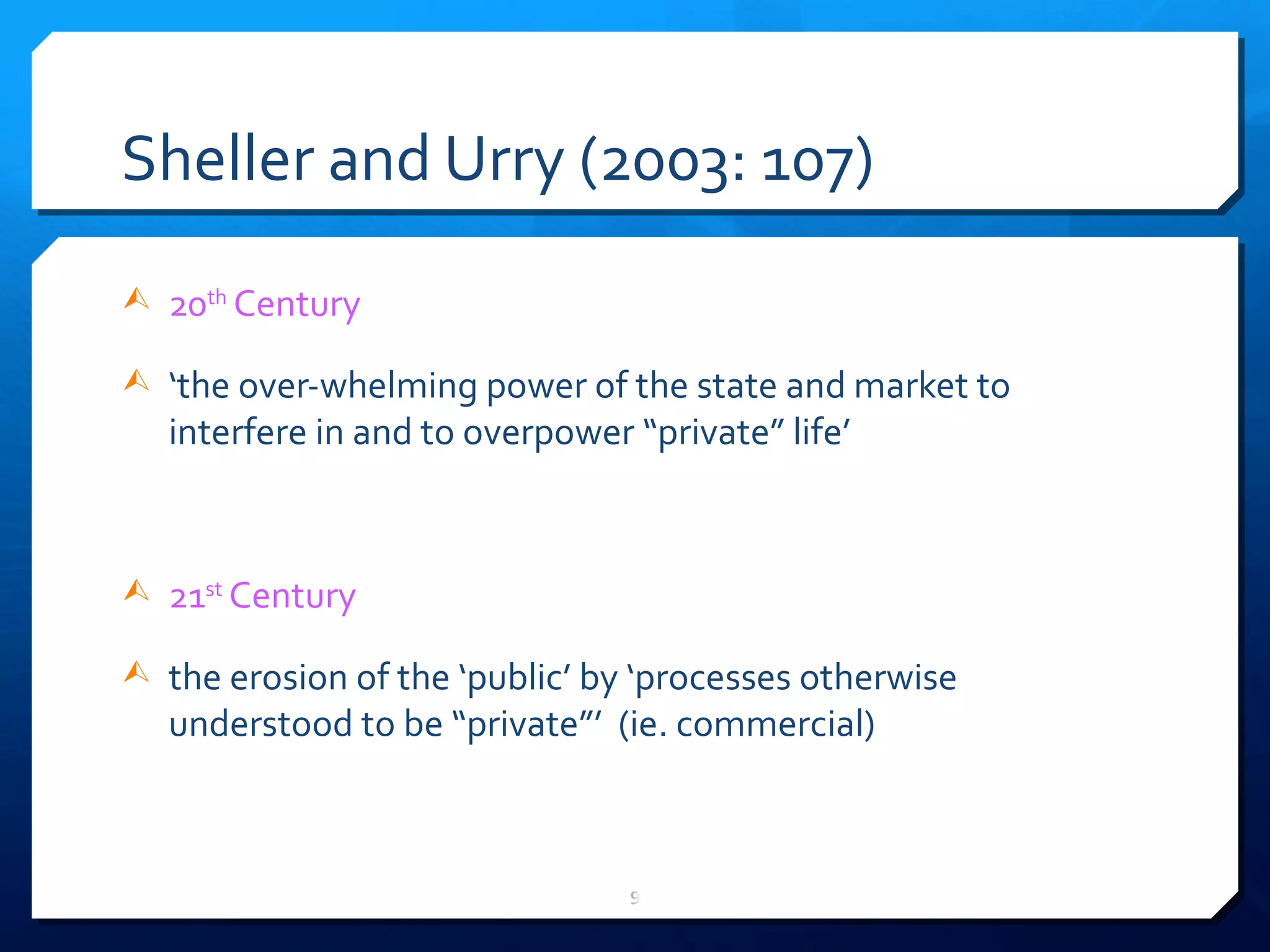
Sheller and Urry (2003: 107) 20 th  Century ‘ the over-whelming power of the state and market to interfere in and to overpower  “ private ”  life ’ 21 st  Century the erosion of the  ‘ public ’  by  ‘ processes otherwise understood to be  “ private ”’   (ie. commercial)
Sheller and Urry (2003: 107) Private corporations have taken over once public institutions of schools, hospitals, prisons, transportation systems, postal services and the state itself, leading to a loss of democratic control, ...  while, ... a politics of confessional intimacy and shaming has invaded the once public arena of political debate and arbitration of collective interests.  On every front, it seems, the  ‘ public ’  is being privatized, the private is becoming oversized, and this undermines democratic life.
Sensitive data? UK census data [2011] gathered by US arms manufacturer  Lockheed Martin
Privacy versus sociability Tension between the right to privacy and the sacrifices we make in order to communicate online Personal autonomy Private information commoditized
Privacy versus sociability Tension between the right to privacy and the sacrifices we make in order to communicate online Personal autonomy Private information commoditized  “ We have had developers tell us that they don't want their platform screwed up by too much privacy management … There's all sorts of hoodwinking and linguistic devices that they use to persuade you to hand over your data.” Simon Davies, director-general of Privacy International
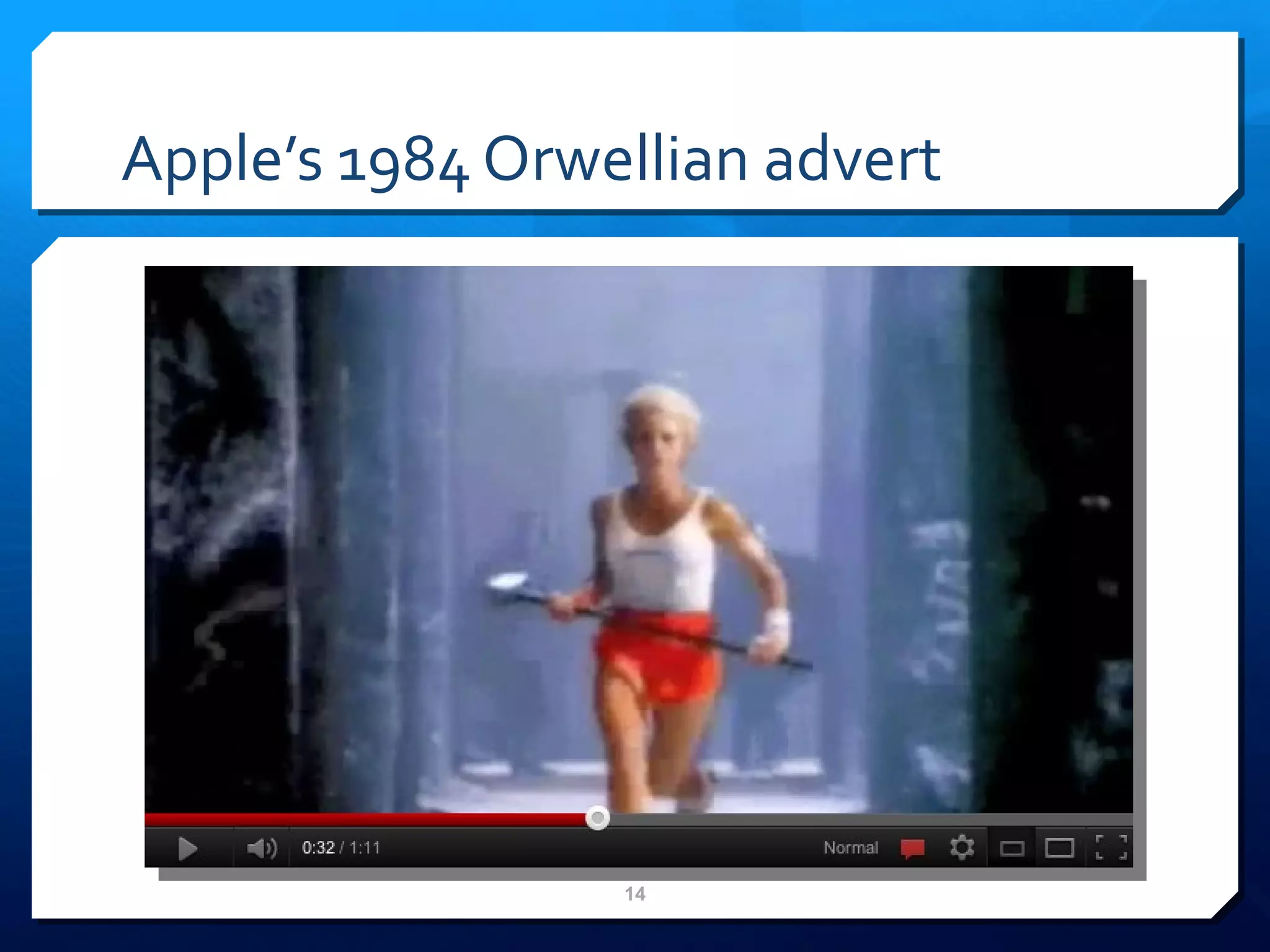
Apple’s 1984 Orwellian advert
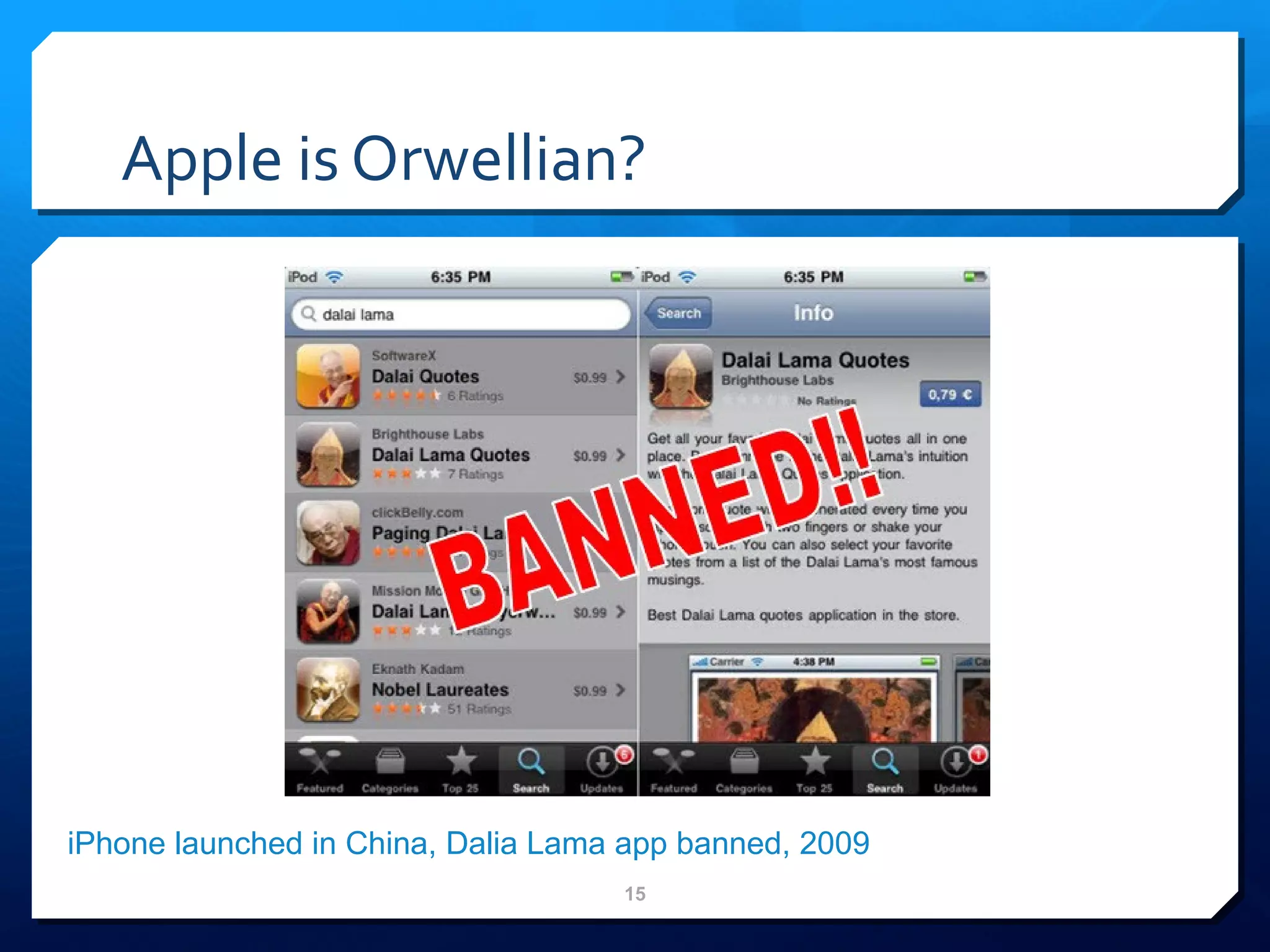
Apple is Orwellian? iPhone launched in China, Dalia Lama app banned, 2009
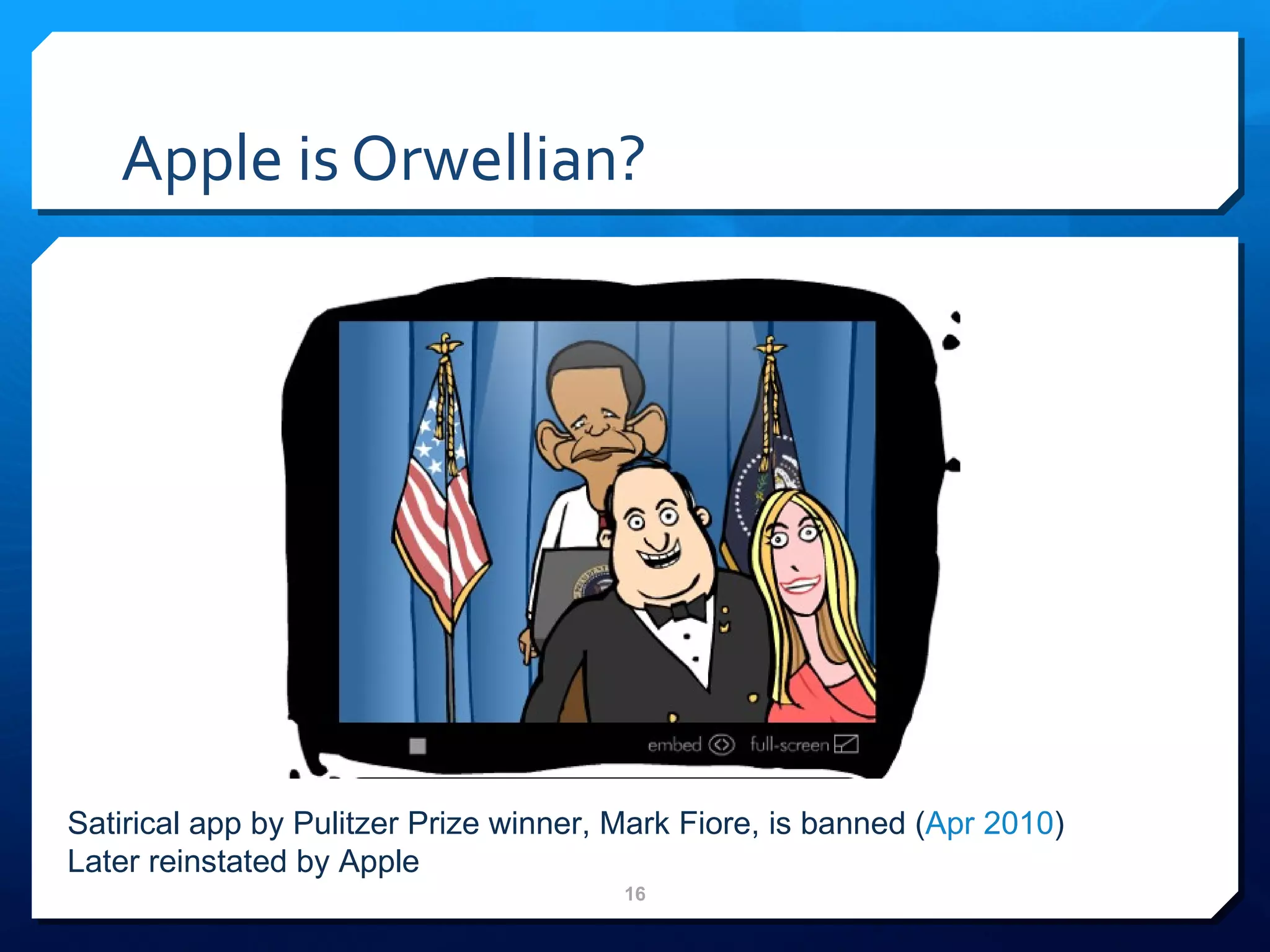
Apple is Orwellian? Satirical app by Pulitzer Prize winner, Mark Fiore, is banned ( Apr 2010 ) Later reinstated by Apple
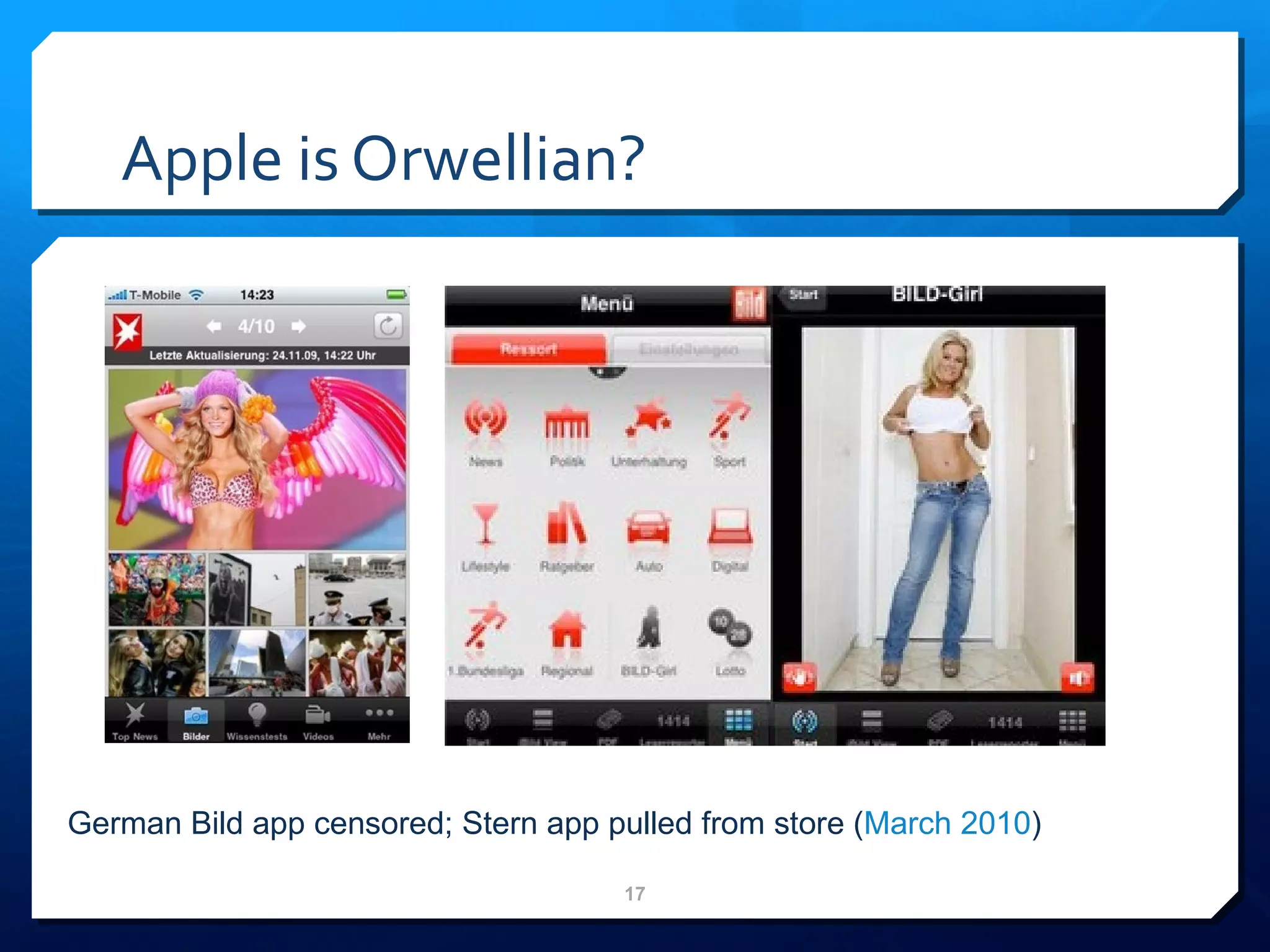
Apple is Orwellian? German Bild app censored; Stern app pulled from store ( March 2010 )
The private leaks into the public “ The proliferation of screens, from the miniature ones displaying text messages on handheld devices to the large ones in public spaces is allowing for new kinds of informational mobilities that use public spaces for  ‘ private ’  purposes  … .  Private conversations are increasingly occurring in various `free spaces ’   that have been appropriated from the `semipublic ’ realm of streets, trains, stairwells, hallways, and stations.  New degrees and kinds of personal communication or `keeping in touch’ are now possible from shifting public locations.” (Mimi Sheller, 2004,  ‘Mobile publics: beyond the network perspective’,  Environment and Palnning D: Society and Space , vol 22 p39-52
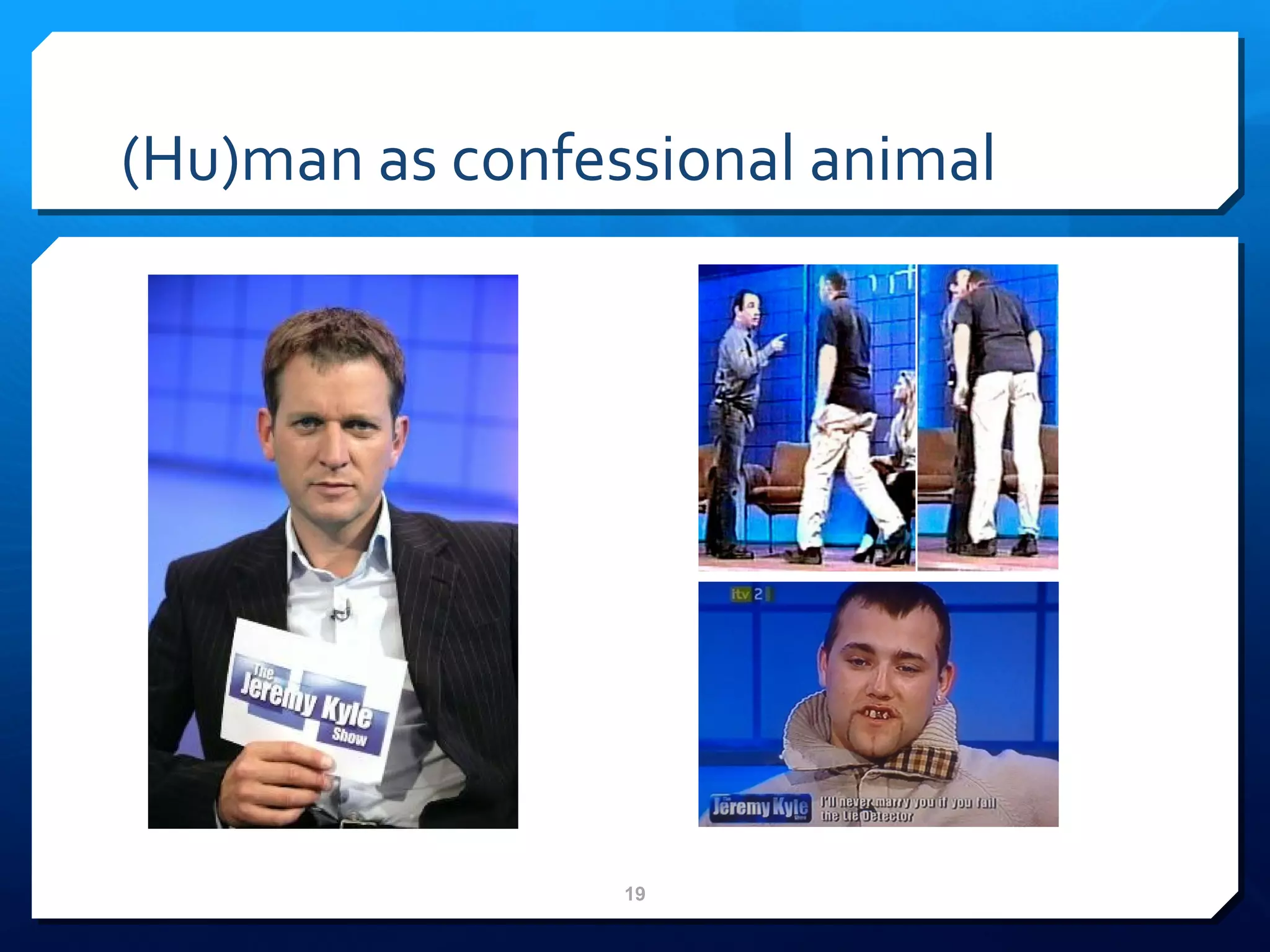
(Hu)man as confessional animal
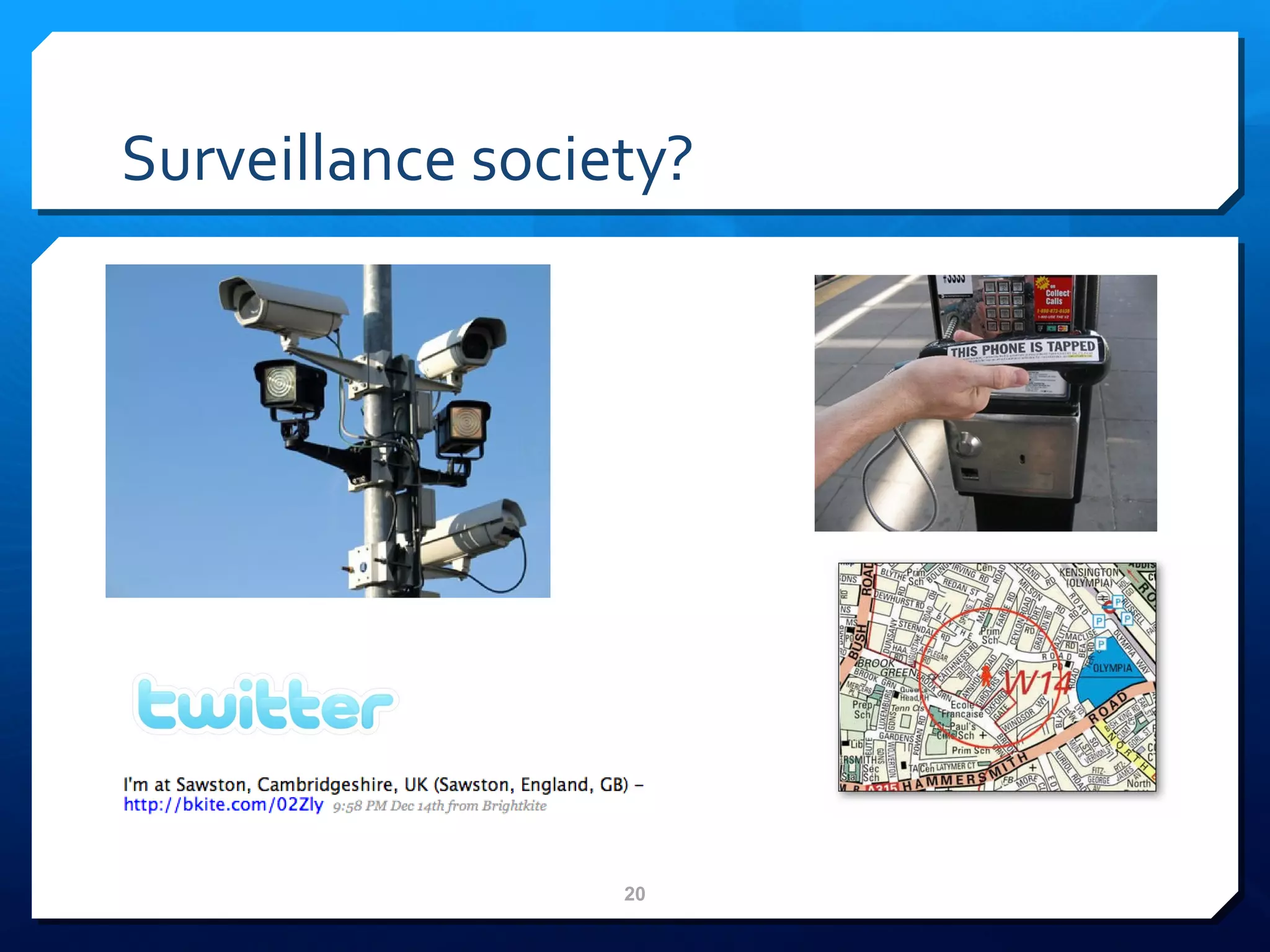
Surveillance society?
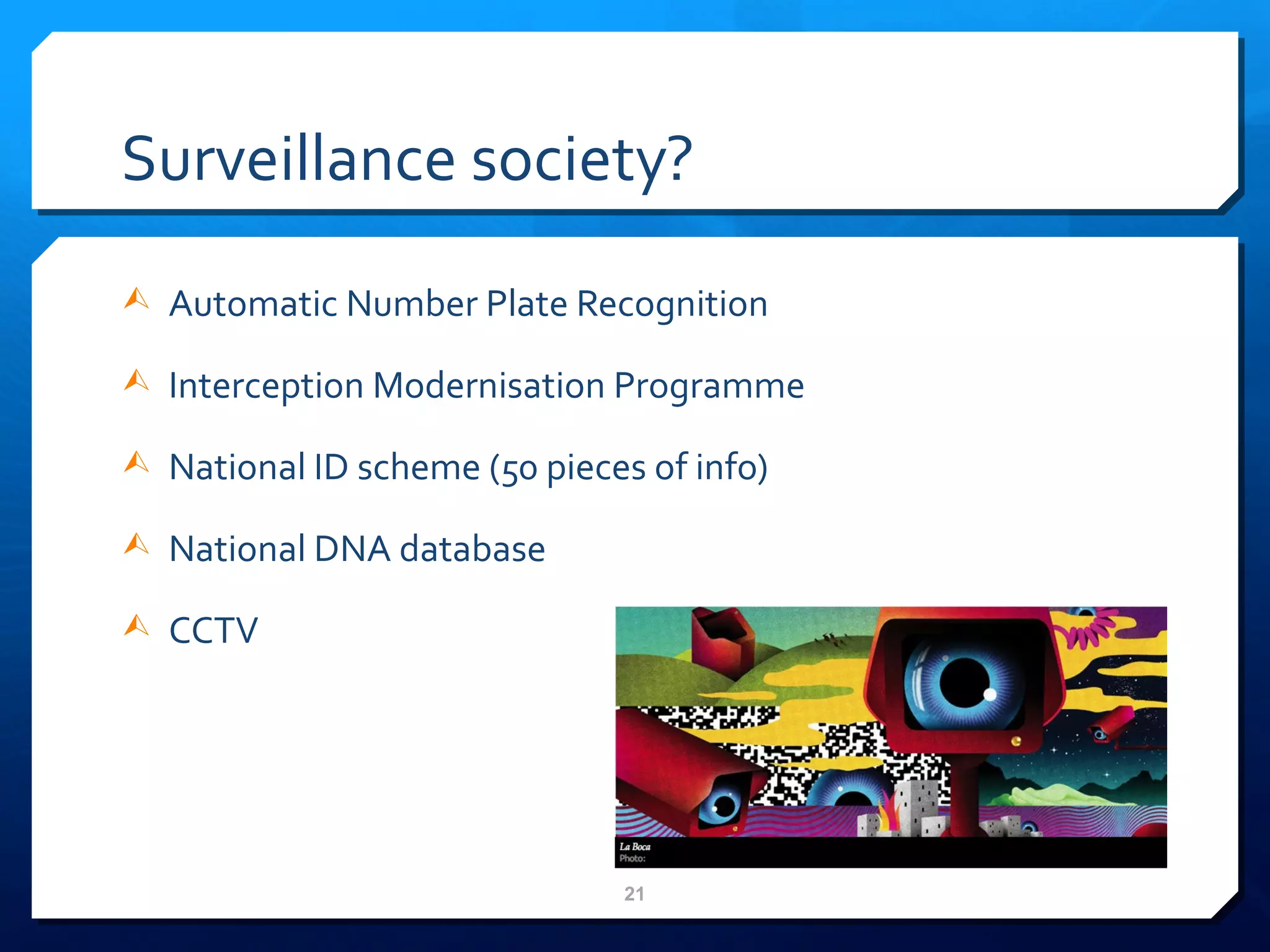
Surveillance society? Automatic Number Plate Recognition Interception Modernisation Programme National ID scheme (50 pieces of info) National DNA database CCTV
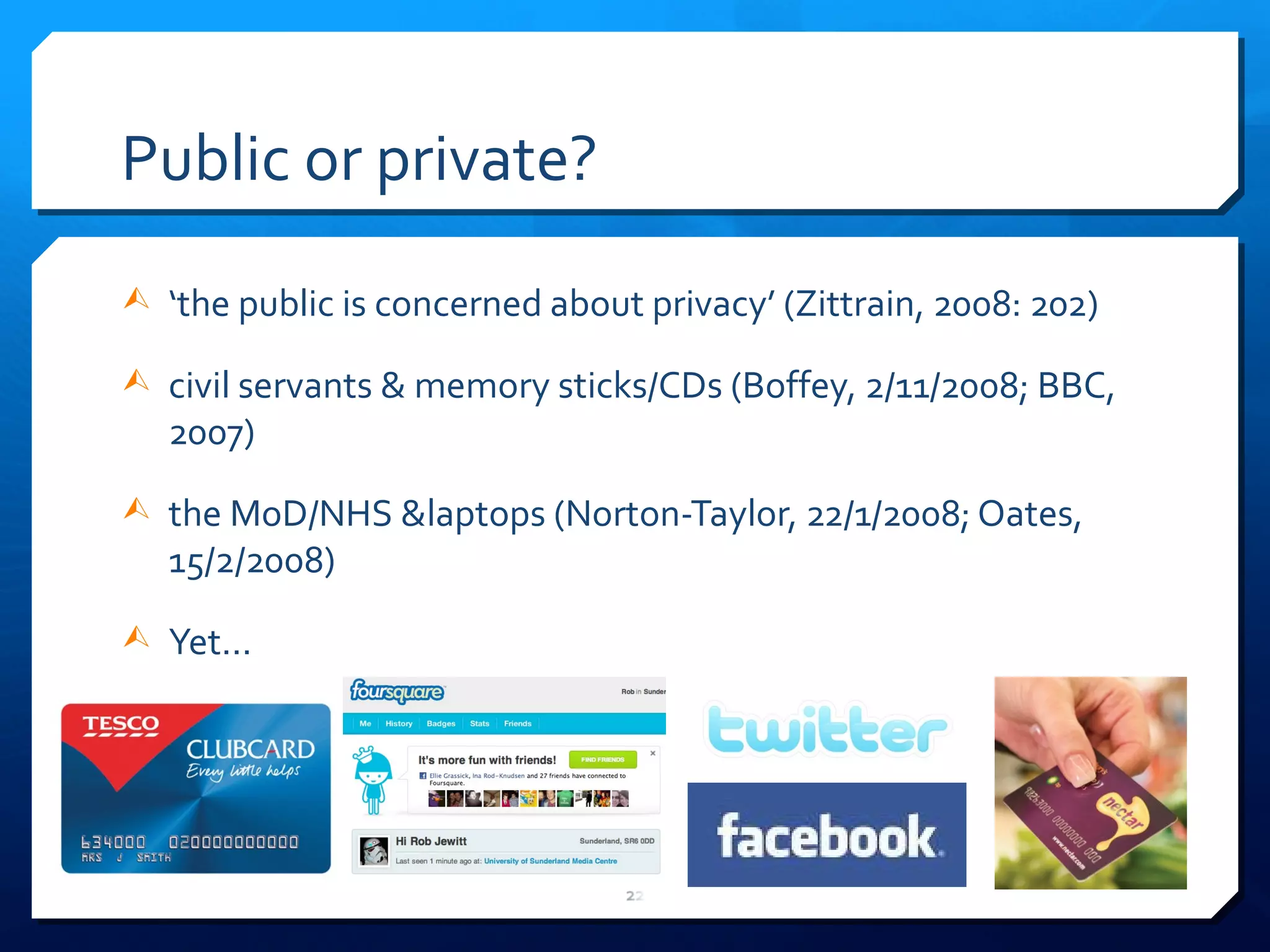
Public or private? ‘ the public is concerned about privacy ’  (Zittrain, 2008: 202) civil servants & memory sticks/CDs (Boffey, 2/11/2008; BBC, 2007) the MoD/NHS &laptops (Norton-Taylor, 22/1/2008; Oates, 15/2/2008) Yet...
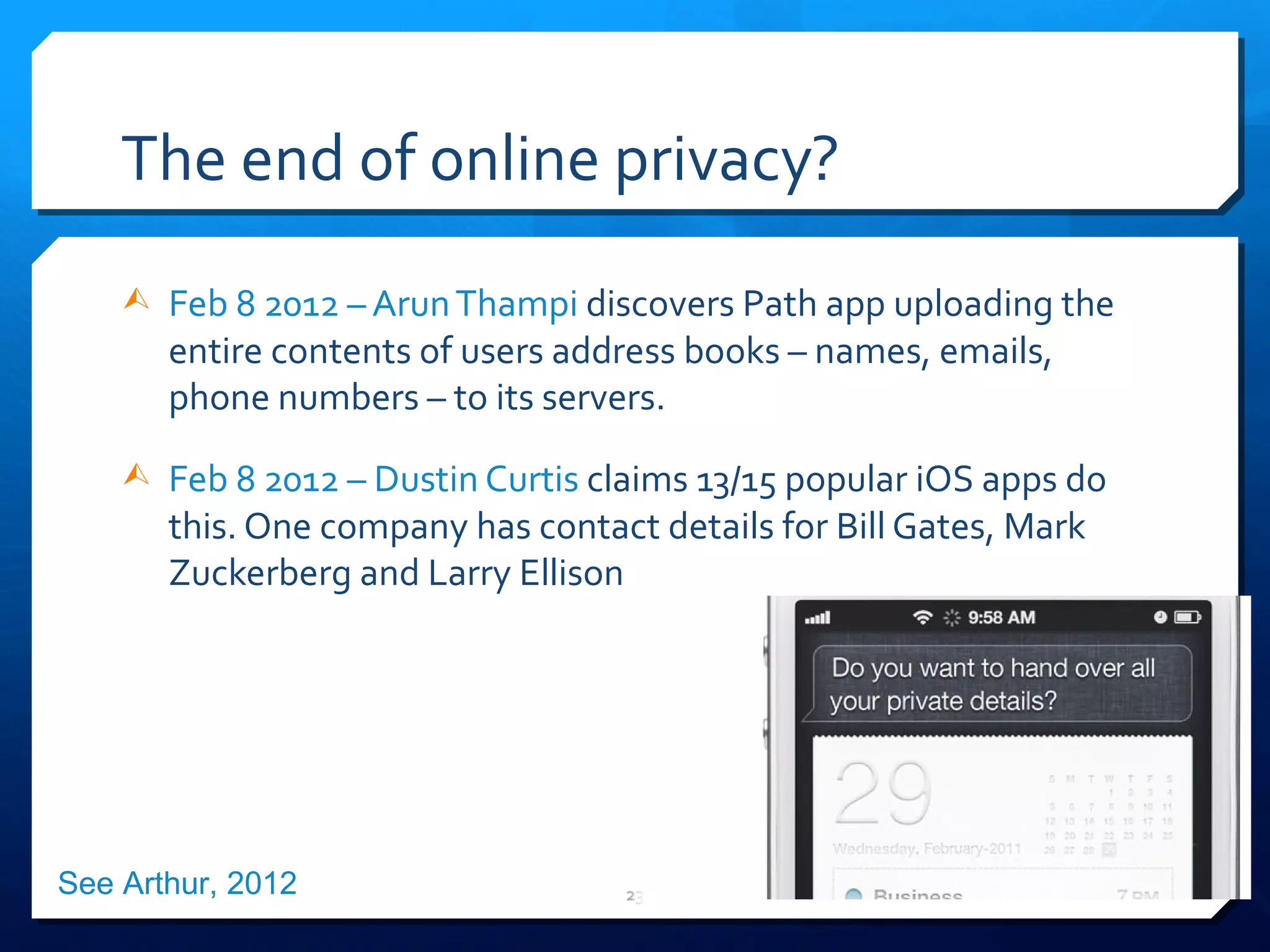
The end of online privacy? Feb 8 2012 – Arun Thampi  discovers Path app  uploading the entire contents of users address books – names, emails, phone numbers – to its servers. Feb 8 2012 – Dustin Curtis  claims 13/15 popular iOS apps do this. One company has contact details for Bill Gates, Mark Zuckerberg and Larry Ellison See Arthur, 2012
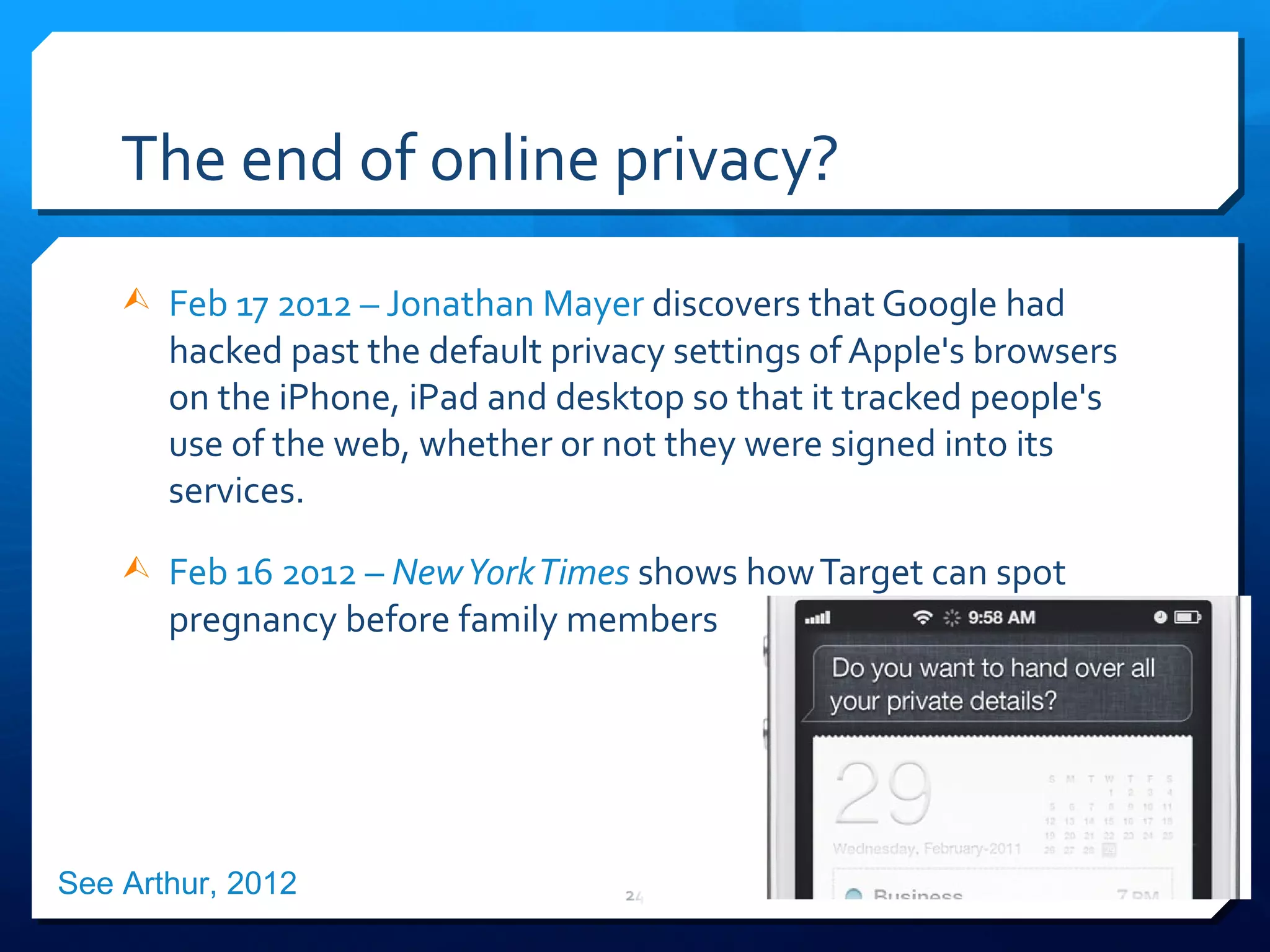
The end of online privacy? Feb 17 2012 – Jonathan Mayer  discovers t hat Google had hacked past the default privacy settings of Apple's browsers on the iPhone, iPad and desktop so that it tracked people's use of the web, whether or not they were signed into its services. Feb 16 2012 –  New York Times   shows how Target can spot pregnancy before family members See Arthur, 2012
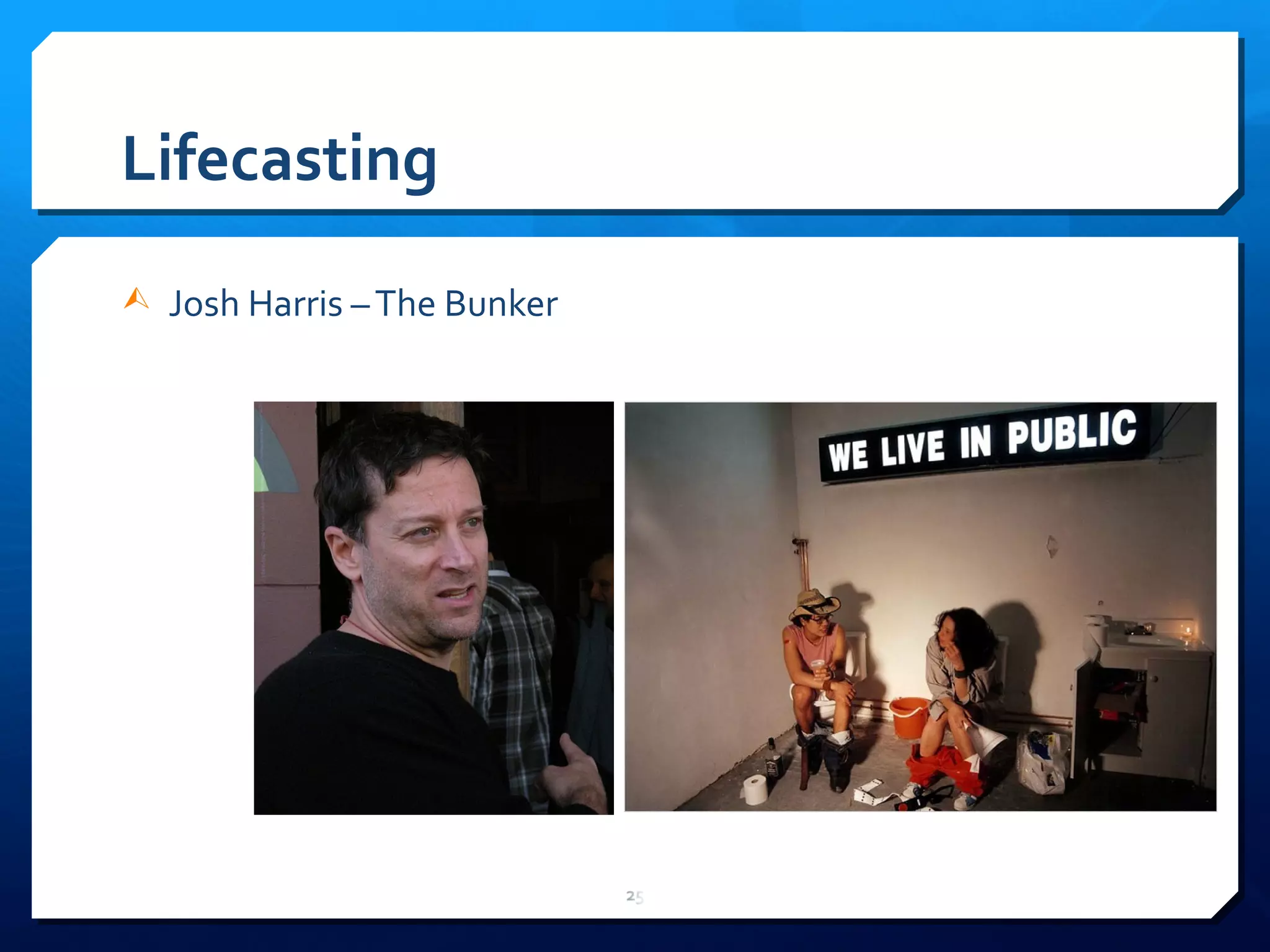
Lifecasting Josh Harris – The Bunker
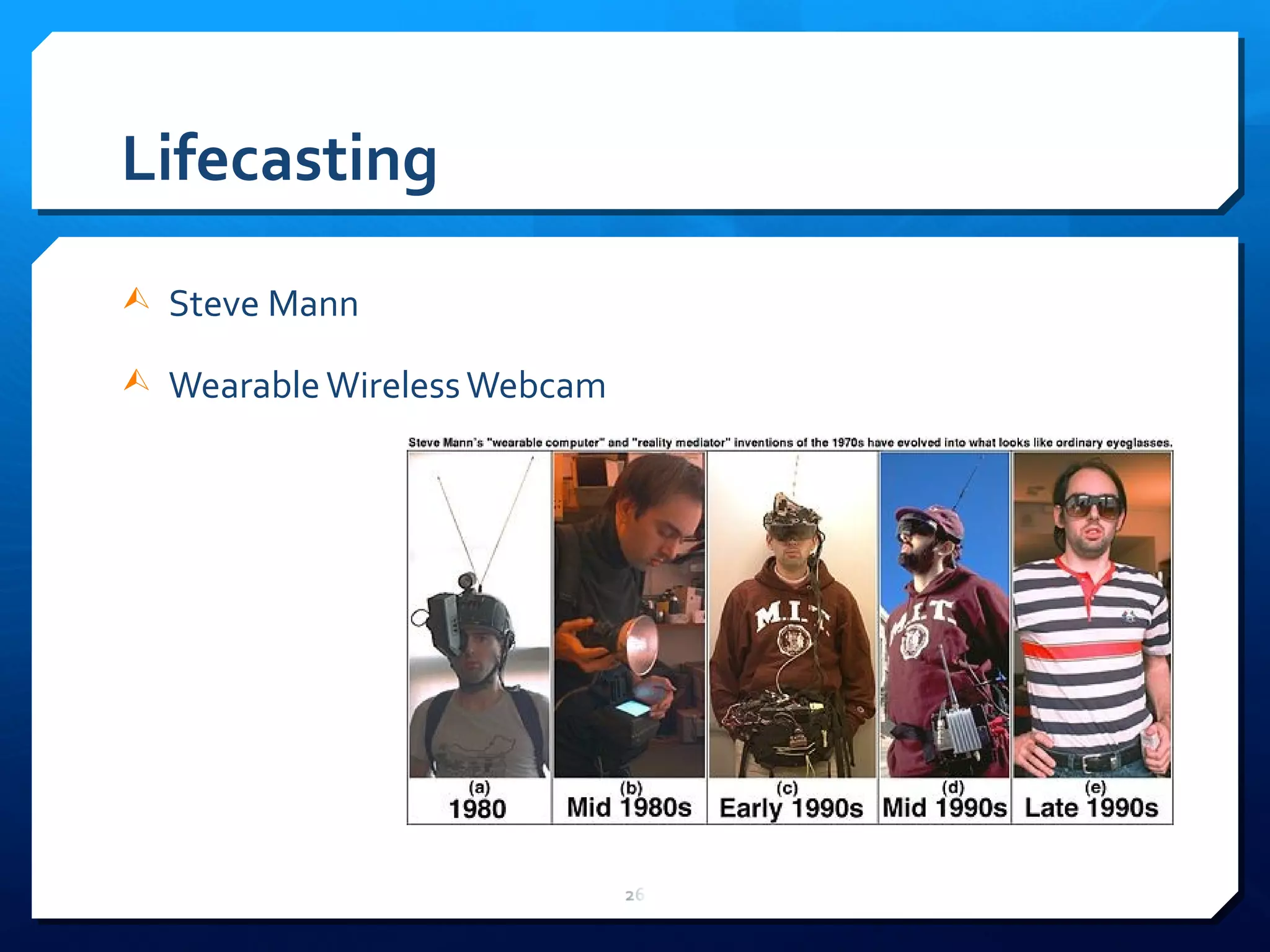
Lifecasting Steve Mann Wearable Wireless Webcam
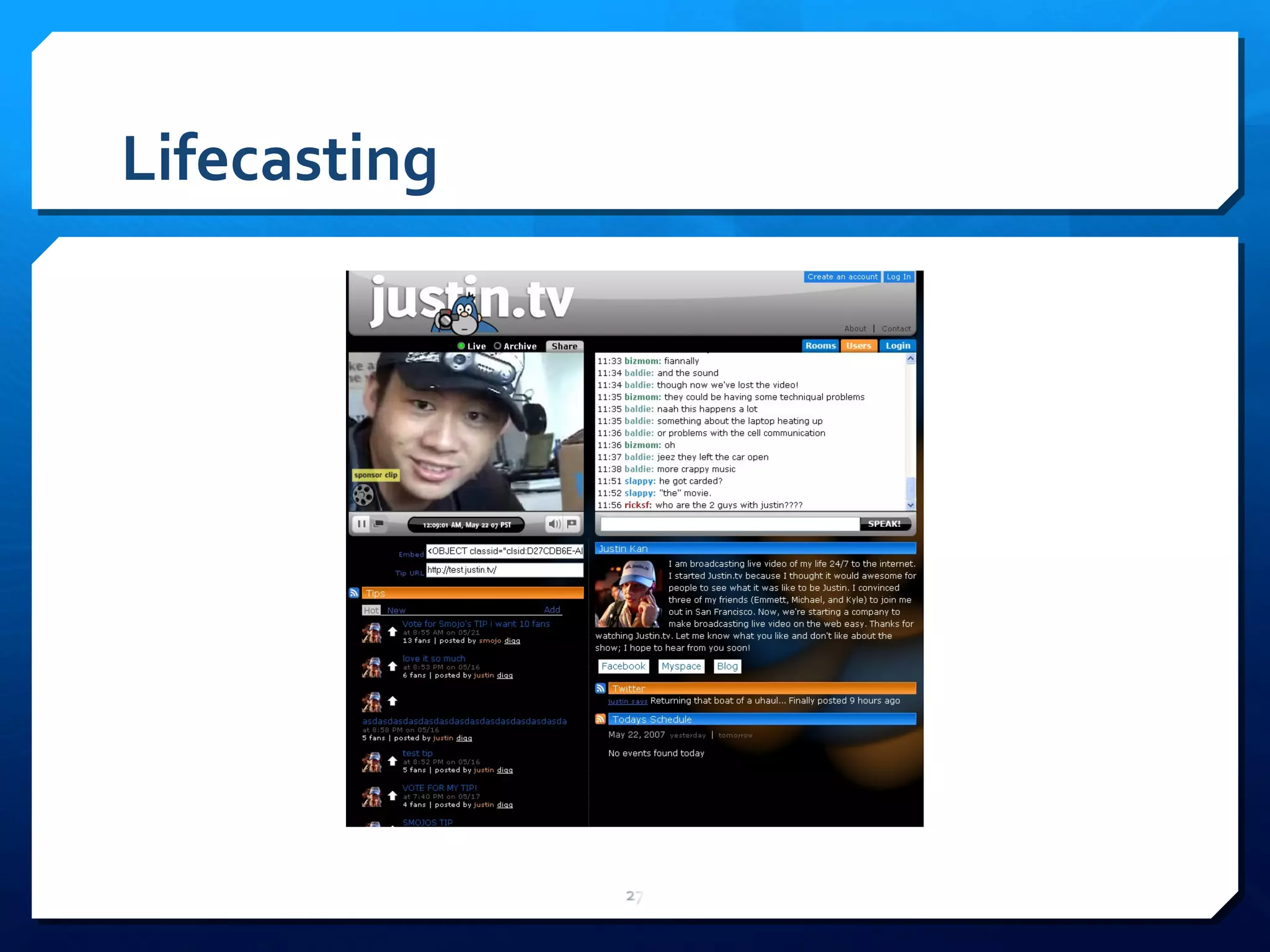
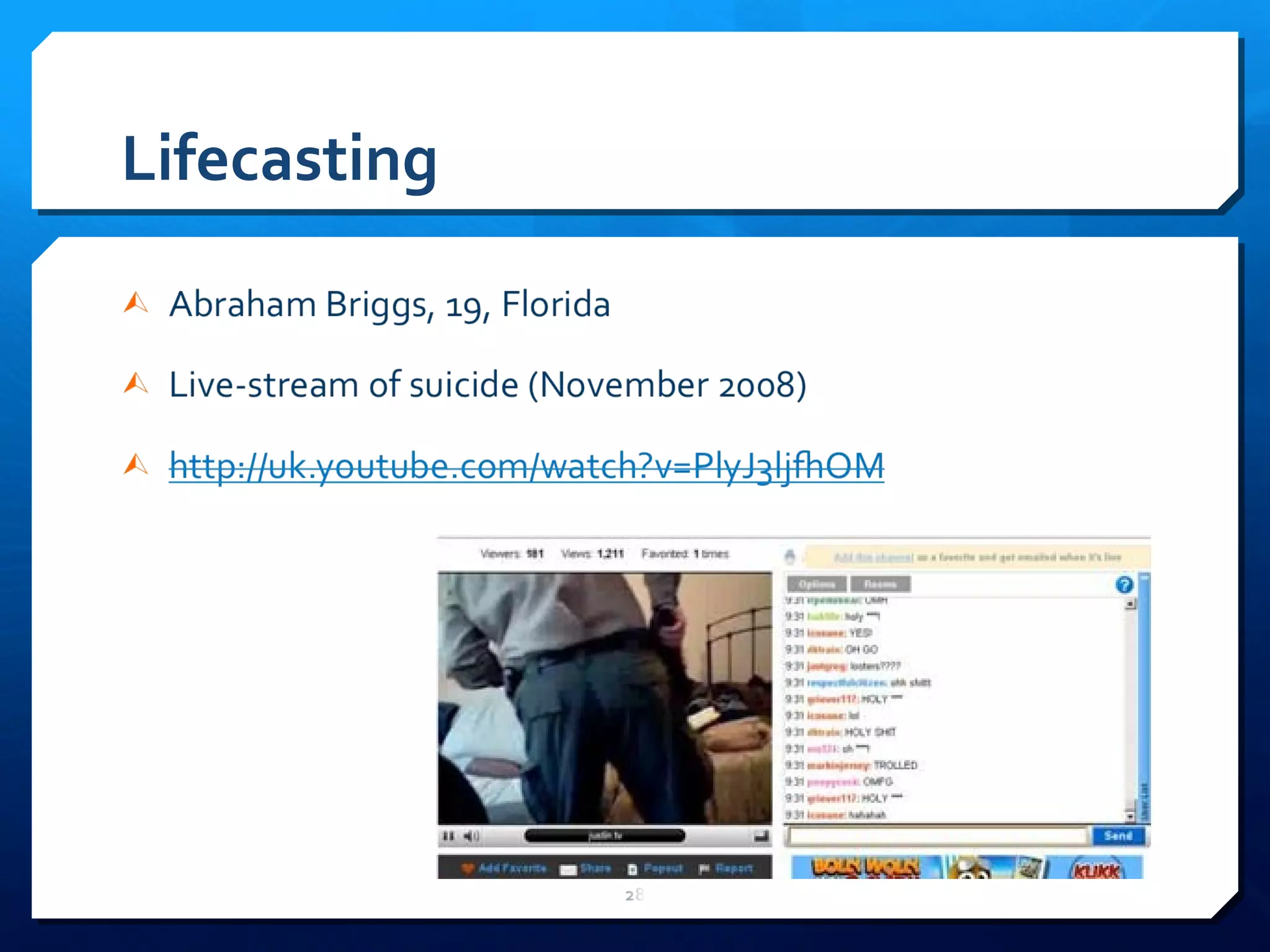
Lifecasting
Lifecasting
The new publicness? ‘ any activity is subject to recording and broadcast ’  (Zittrain, 2008: 210) The Sherrif ’ s Office of Anderson County, Tennesse  Jailcam fiasco
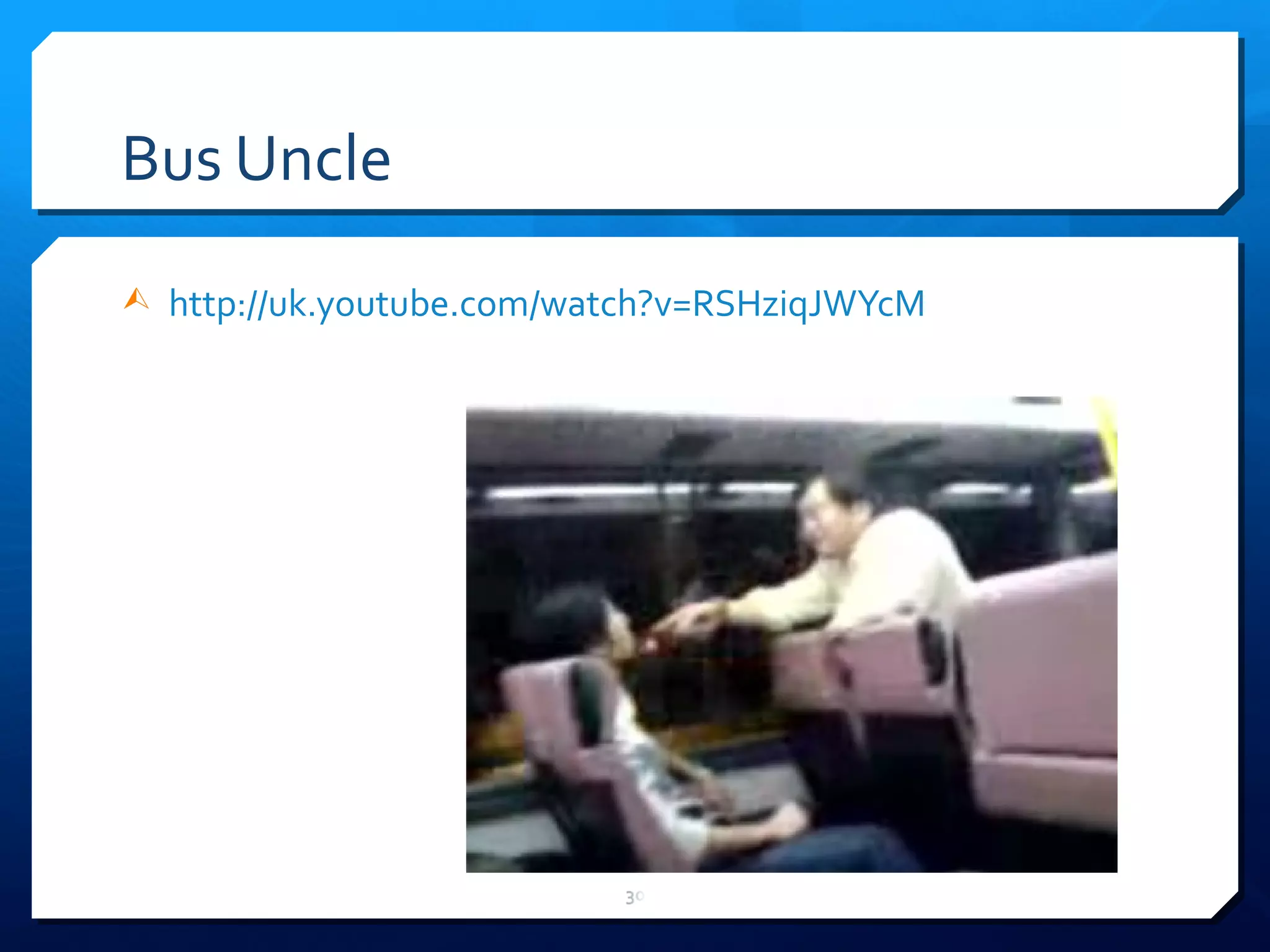
Bus Uncle http://uk.youtube.com/watch?v=RSHziqJWYcM
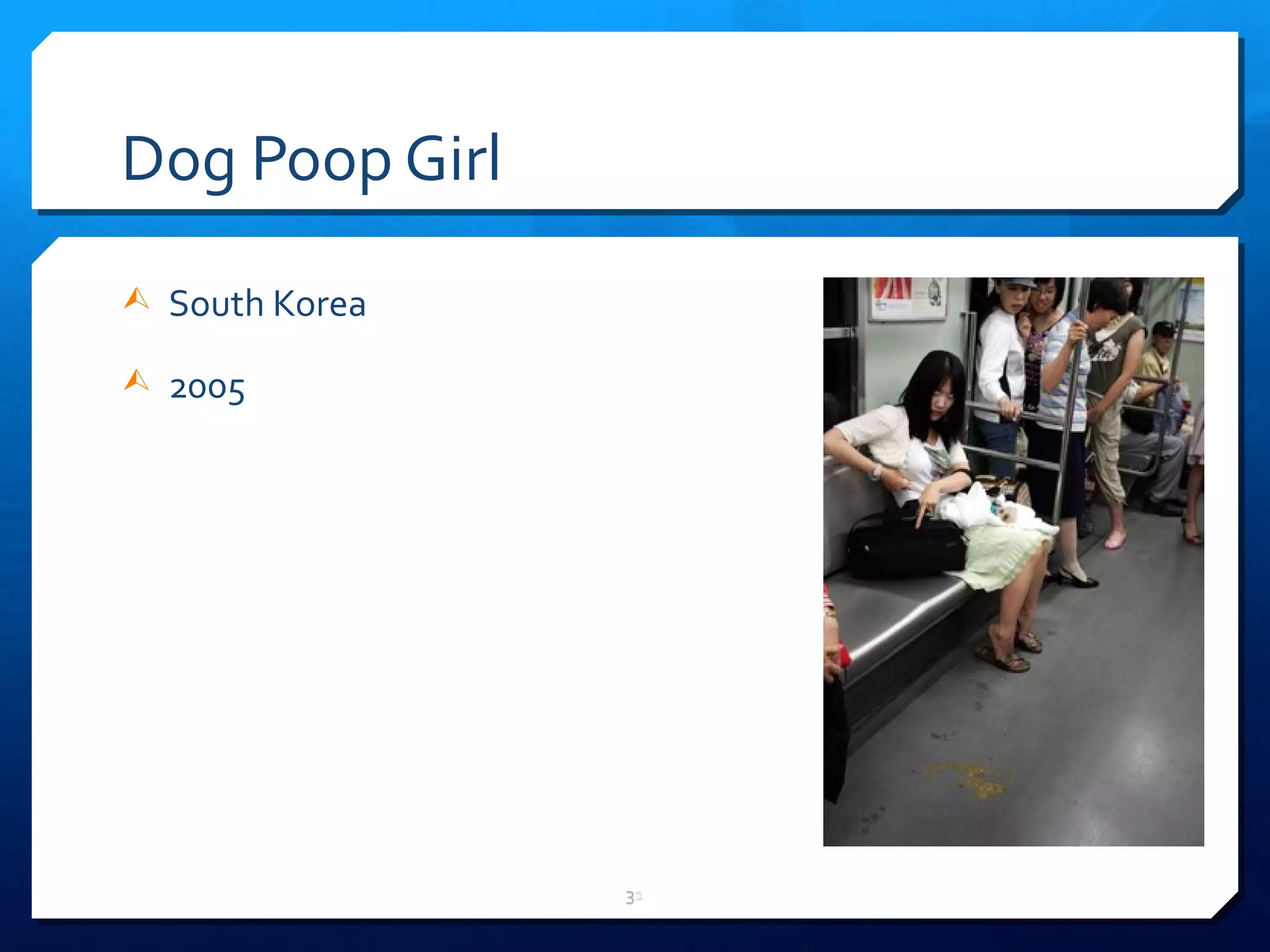
Dog Poop Girl South Korea 2005
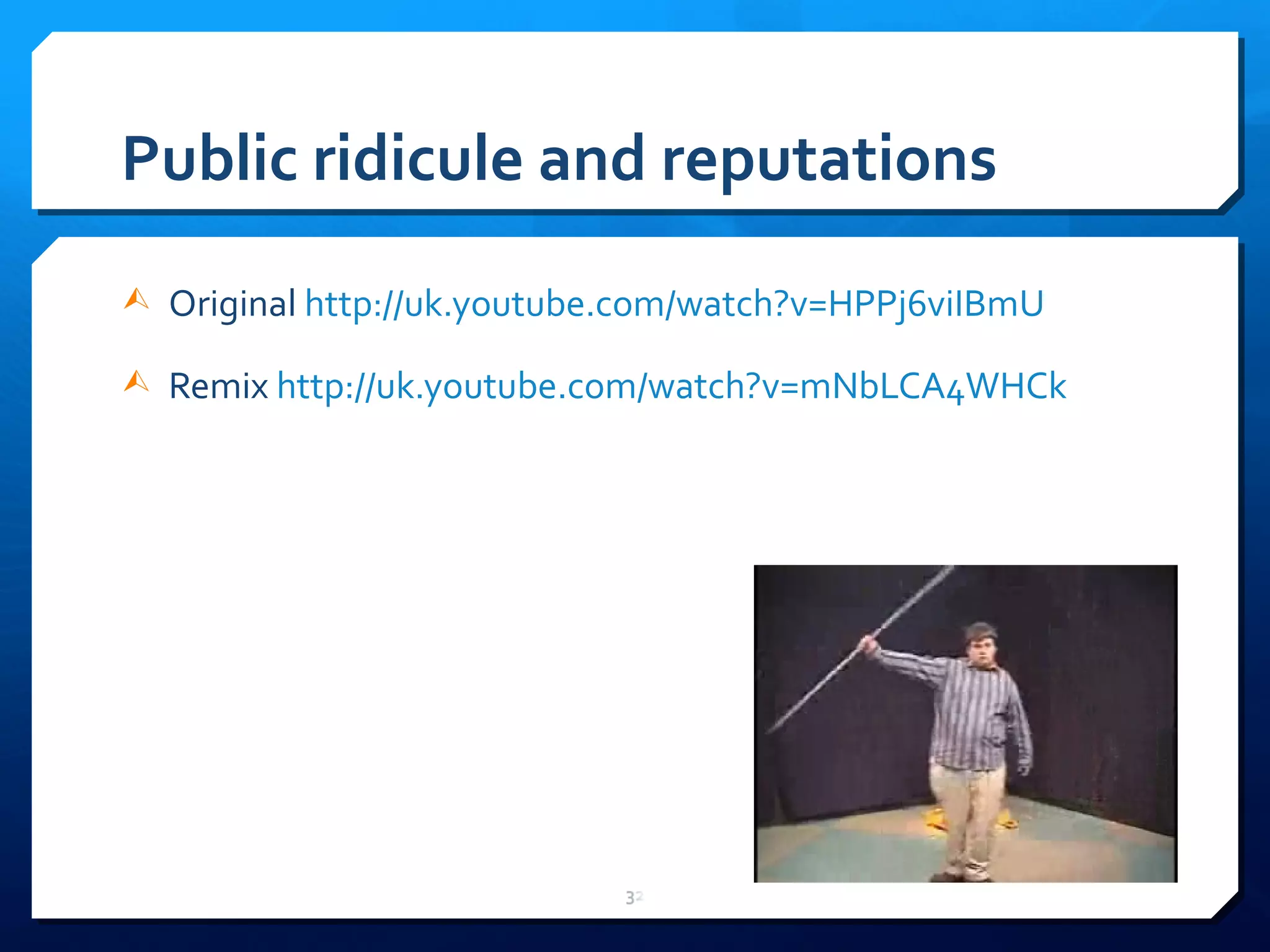
Public ridicule and reputations Original  http://uk.youtube.com/watch?v=HPPj6viIBmU   Remix  http://uk.youtube.com/watch?v=mNbLCA4WHCk
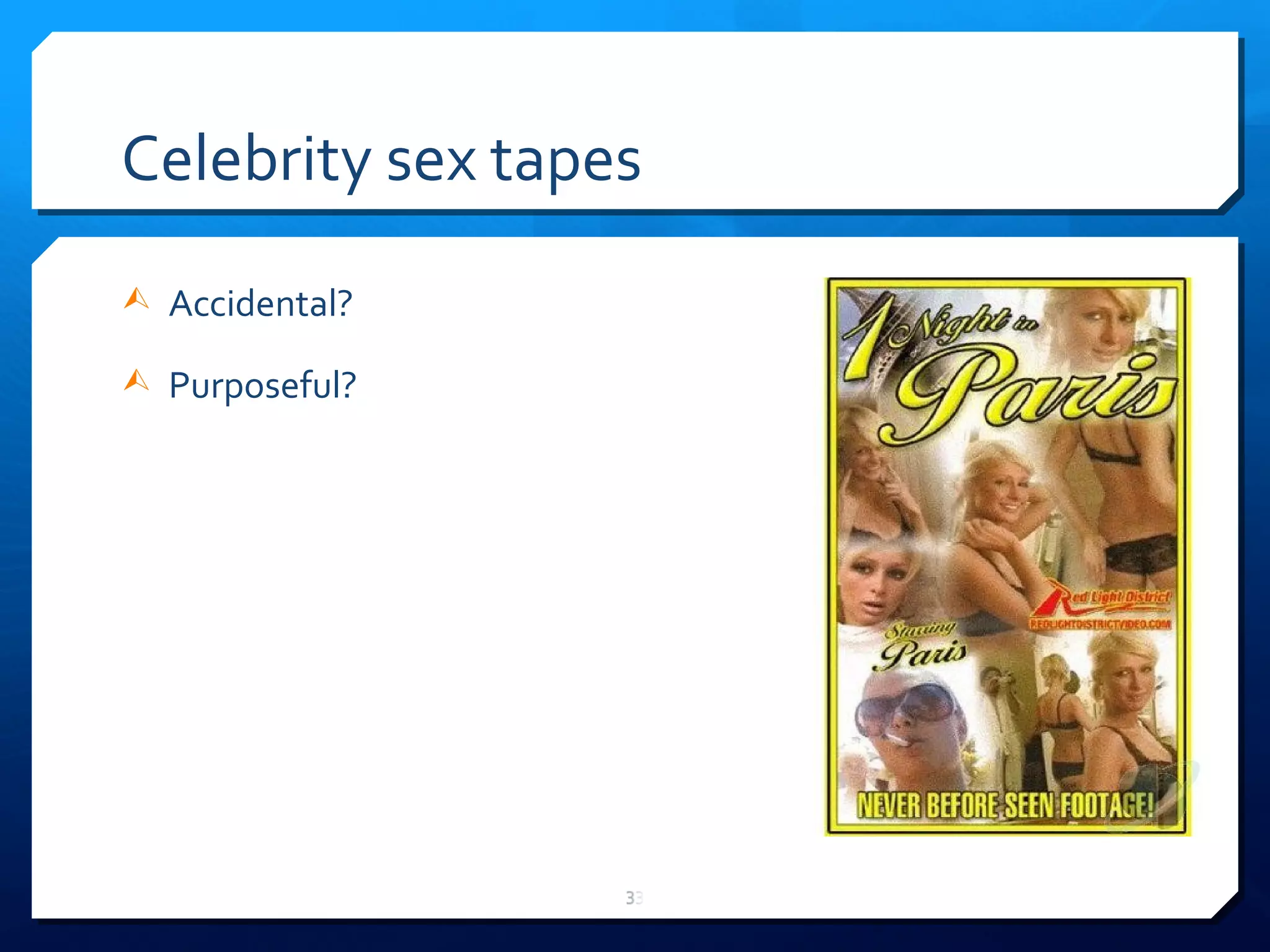
Celebrity sex tapes Accidental? Purposeful?
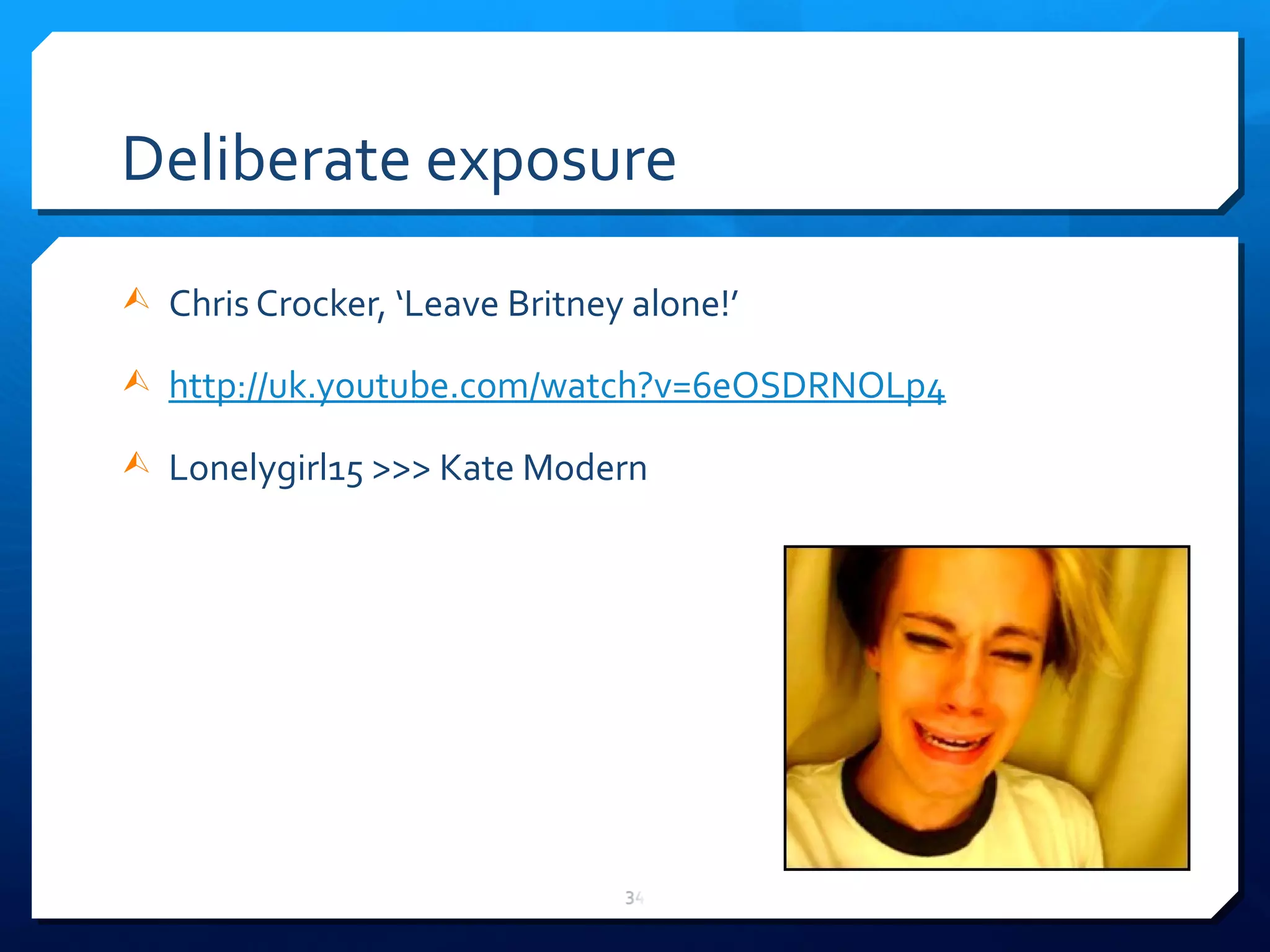
Deliberate exposure Chris Crocker,  ‘ Leave Britney alone! ’ http://uk.youtube.com/watch?v=6eOSDRNOLp4 Lonelygirl15 >>> Kate Modern
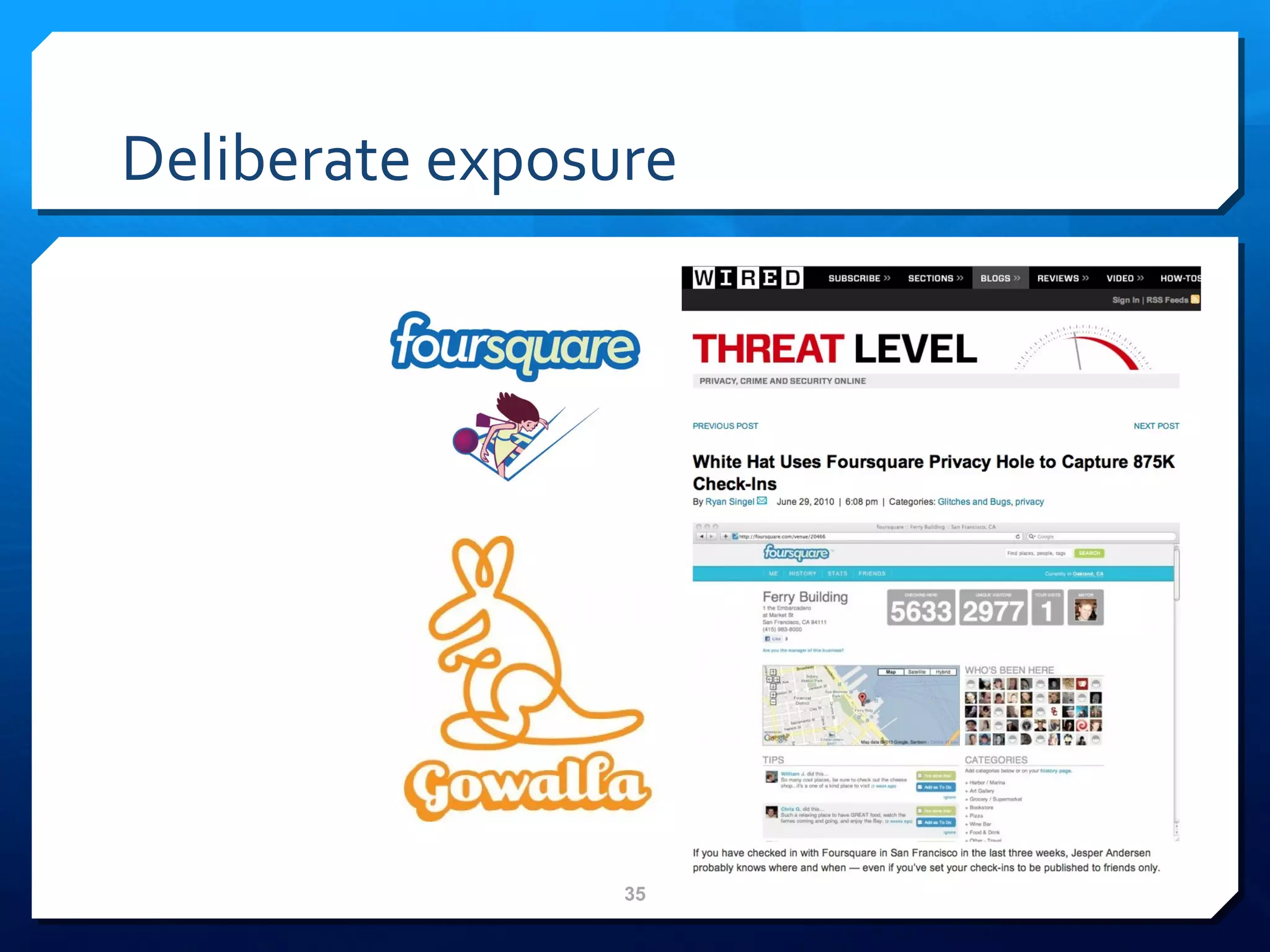
Deliberate exposure
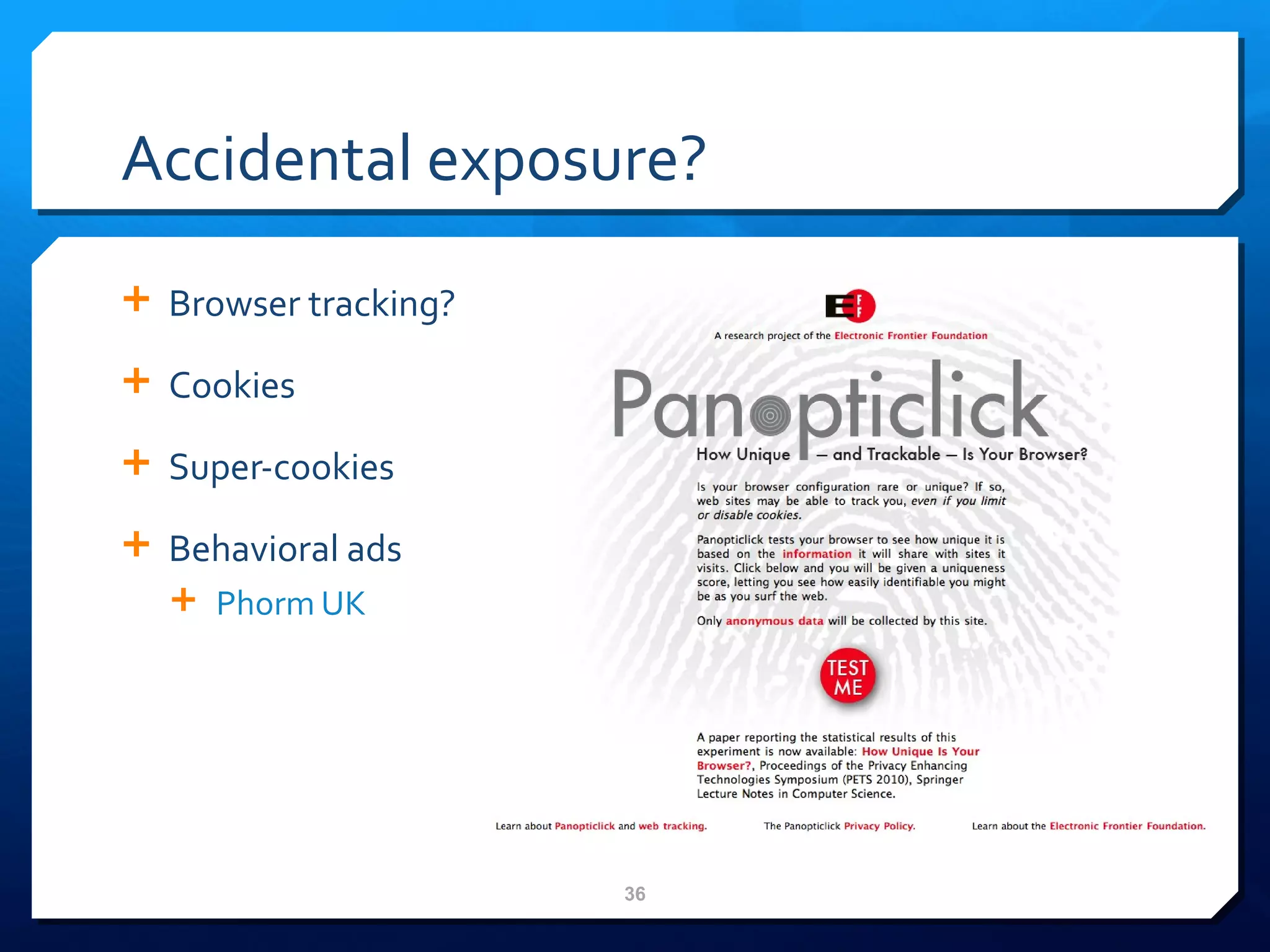
Accidental exposure? Browser tracking? Cookies Super-cookies Behavioral ads Phorm UK
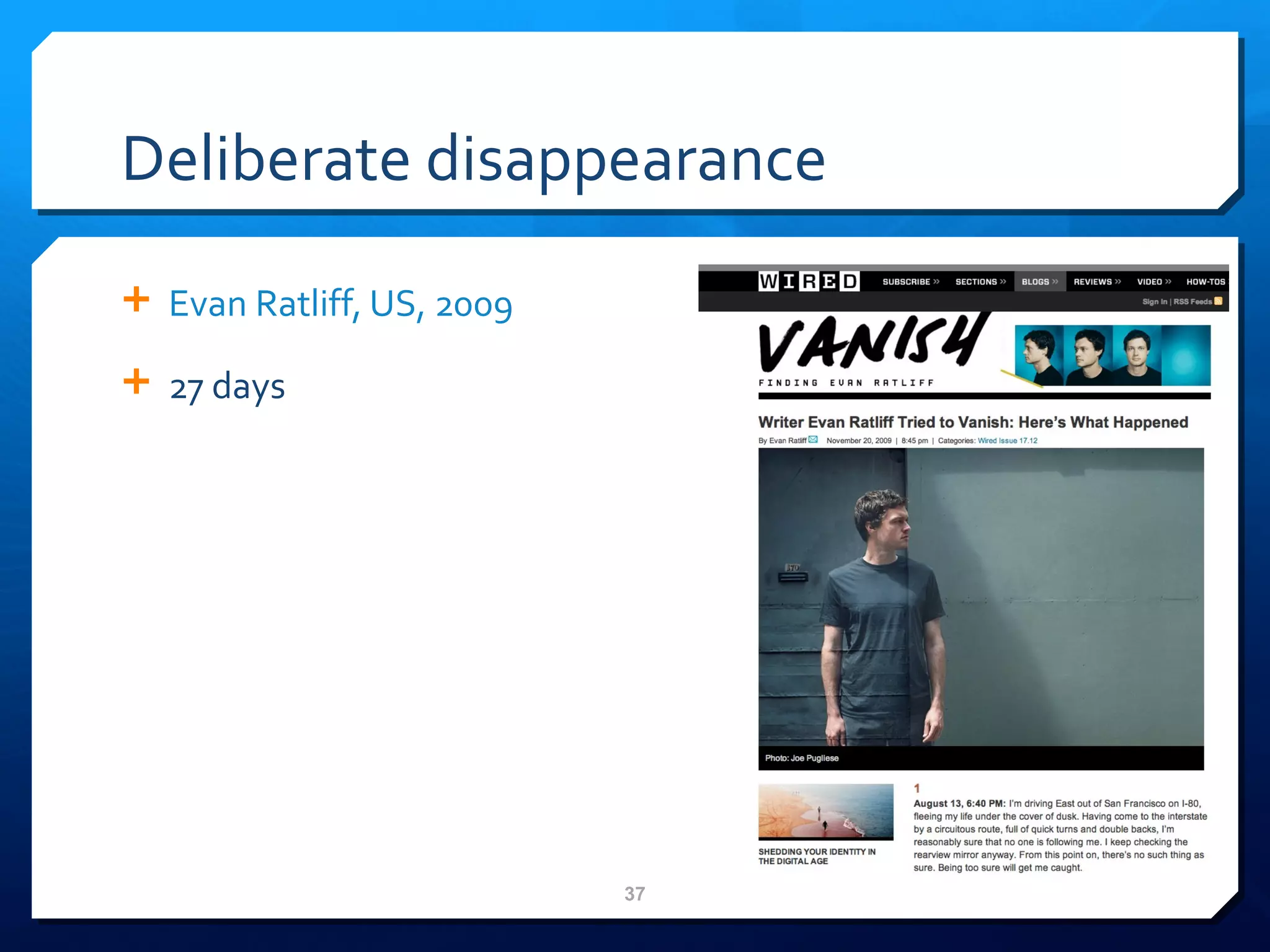
Deliberate disappearance  Evan Ratliff, US, 2009 27 days
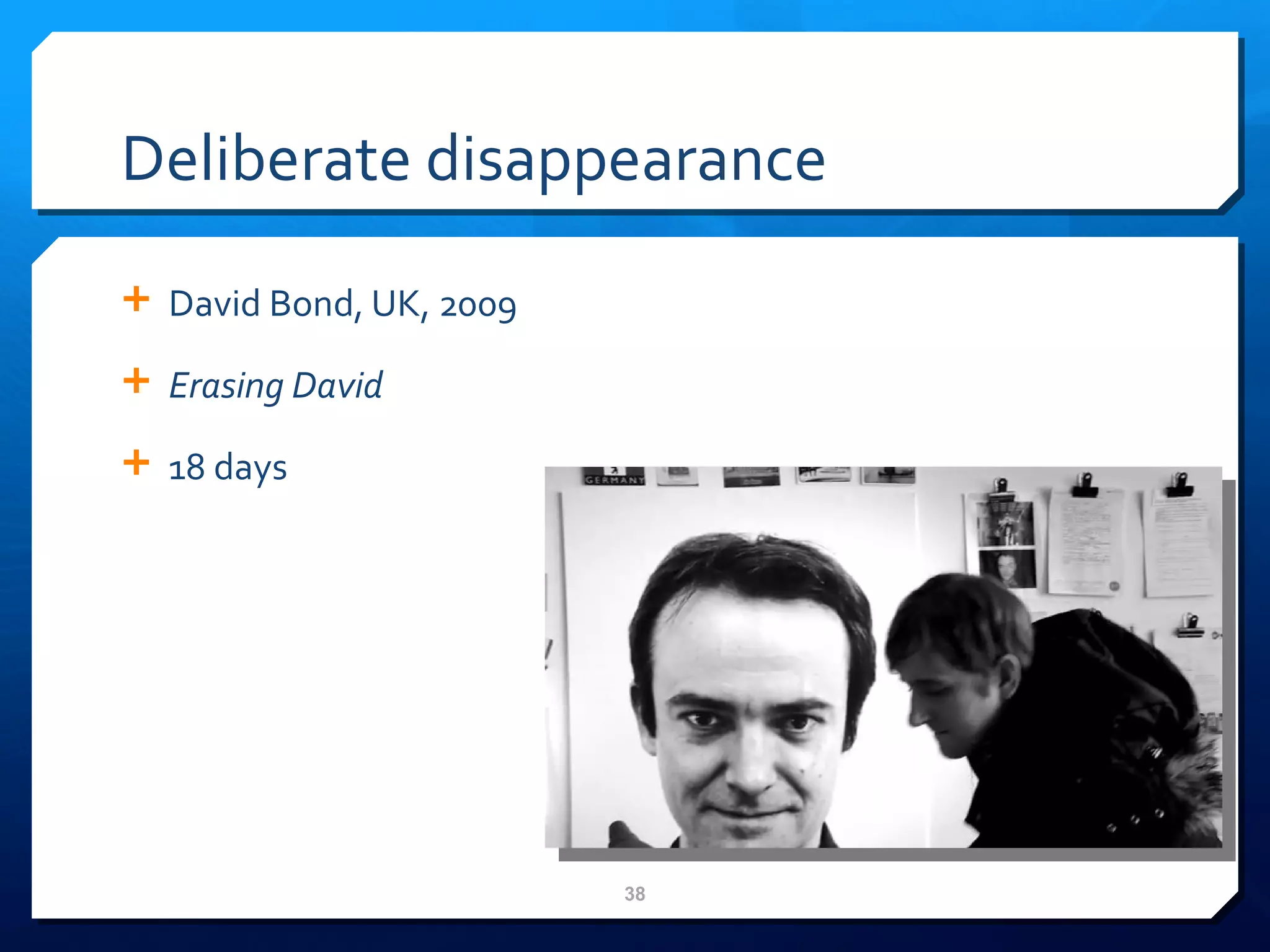
Deliberate disappearance  David Bond, UK, 2009 Erasing David  18 days
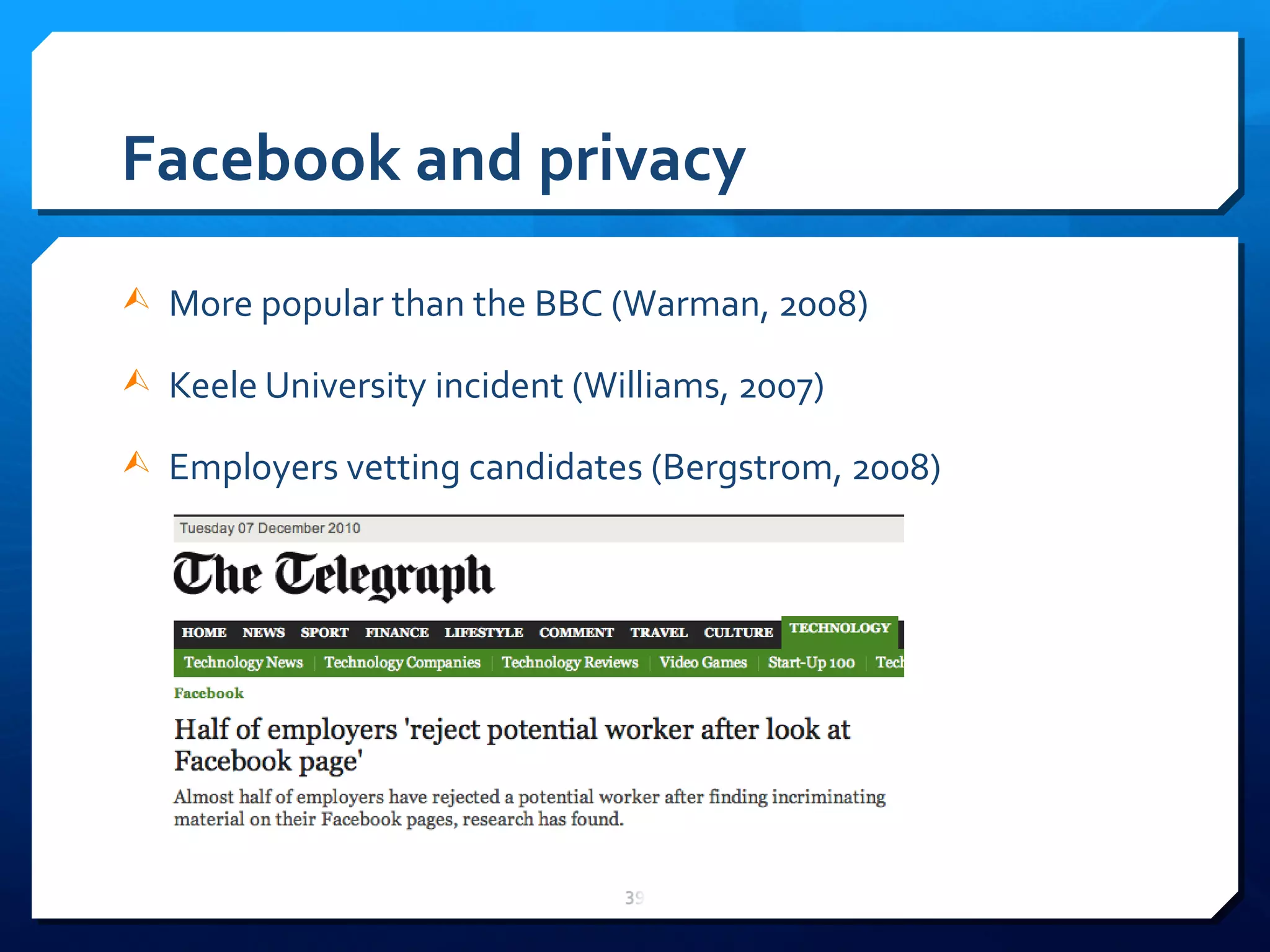
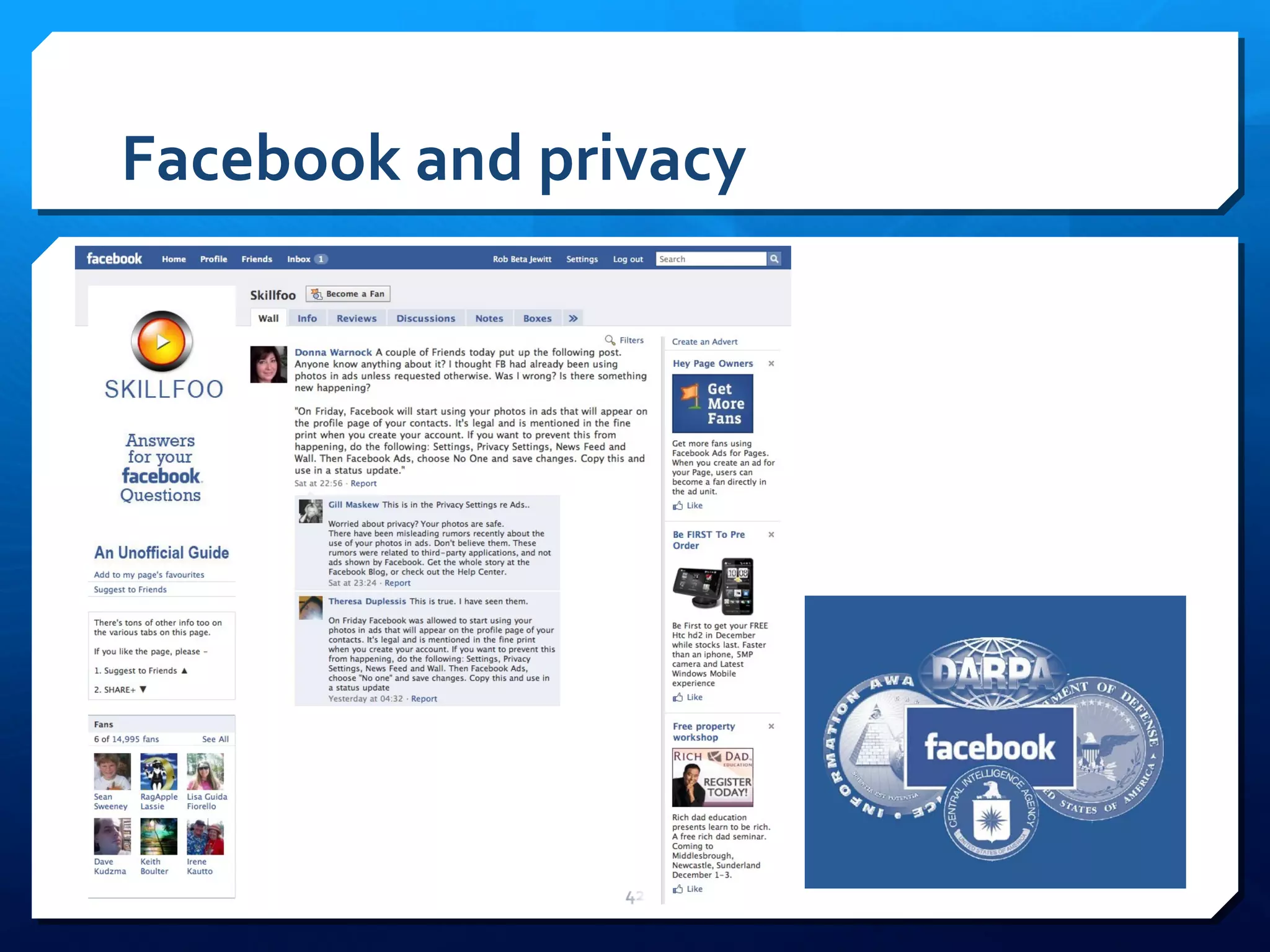
Facebook and privacy More popular than the BBC (Warman, 2008) Keele University incident (Williams, 2007) Employers vetting candidates (Bergstrom, 2008)
You are what you post? “ You have one identity. […] The days of you having a different image for your co-workers and for the other people you know are probably coming to an end pretty quickly. […] Having two identities for yourself is an example of a lack of integrity.” Mark Zuckerberg, Facebook (in  Kiss, 2010 )
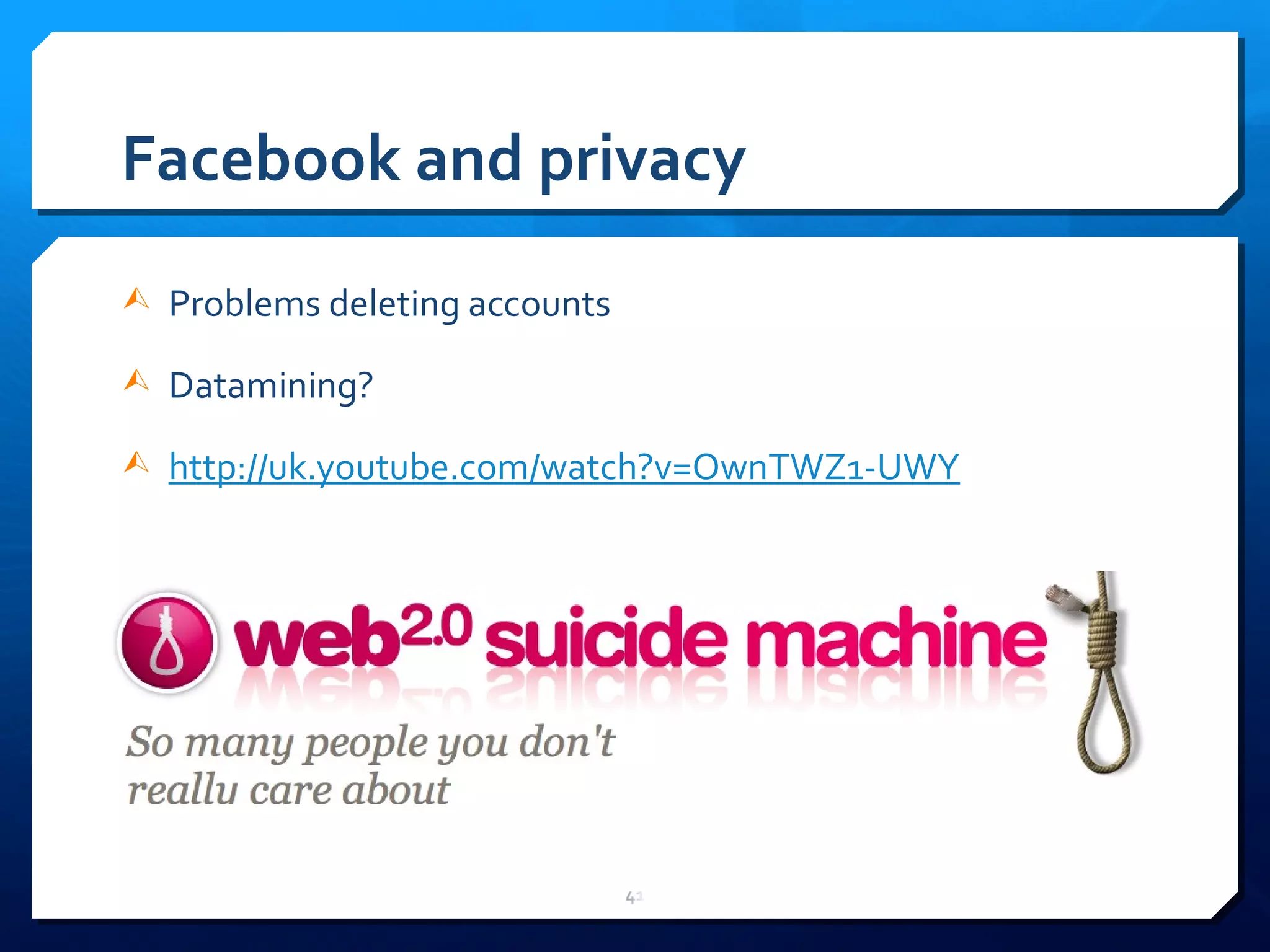
Facebook and privacy Problems deleting accounts Datamining? http://uk.youtube.com/watch?v=OwnTWZ1-UWY
Facebook and privacy
Facebook and privacy ‘ online risks may arise from their very confidence that they can know, judge and trust the people with whom they are intimate ...  teenagers ’  limited internet literacy combined with confusing or poorly designed site settings, [leaves] them unclear regarding their control over  who can see what about them ’ Livingstone, 2008: 406
Facebook ’ s  “ News Feed ” “ The tech world has a tendency to view the concept of  ‘ private ’  as a single bit that is either 0 or 1. Data are either exposed or not. When companies make a decision to make data visible in a more  ‘ efficient ’  manner,  it is often startling, prompting users to speak of a disruption of  ‘ privacy ’ ” boyd, 2008: 14
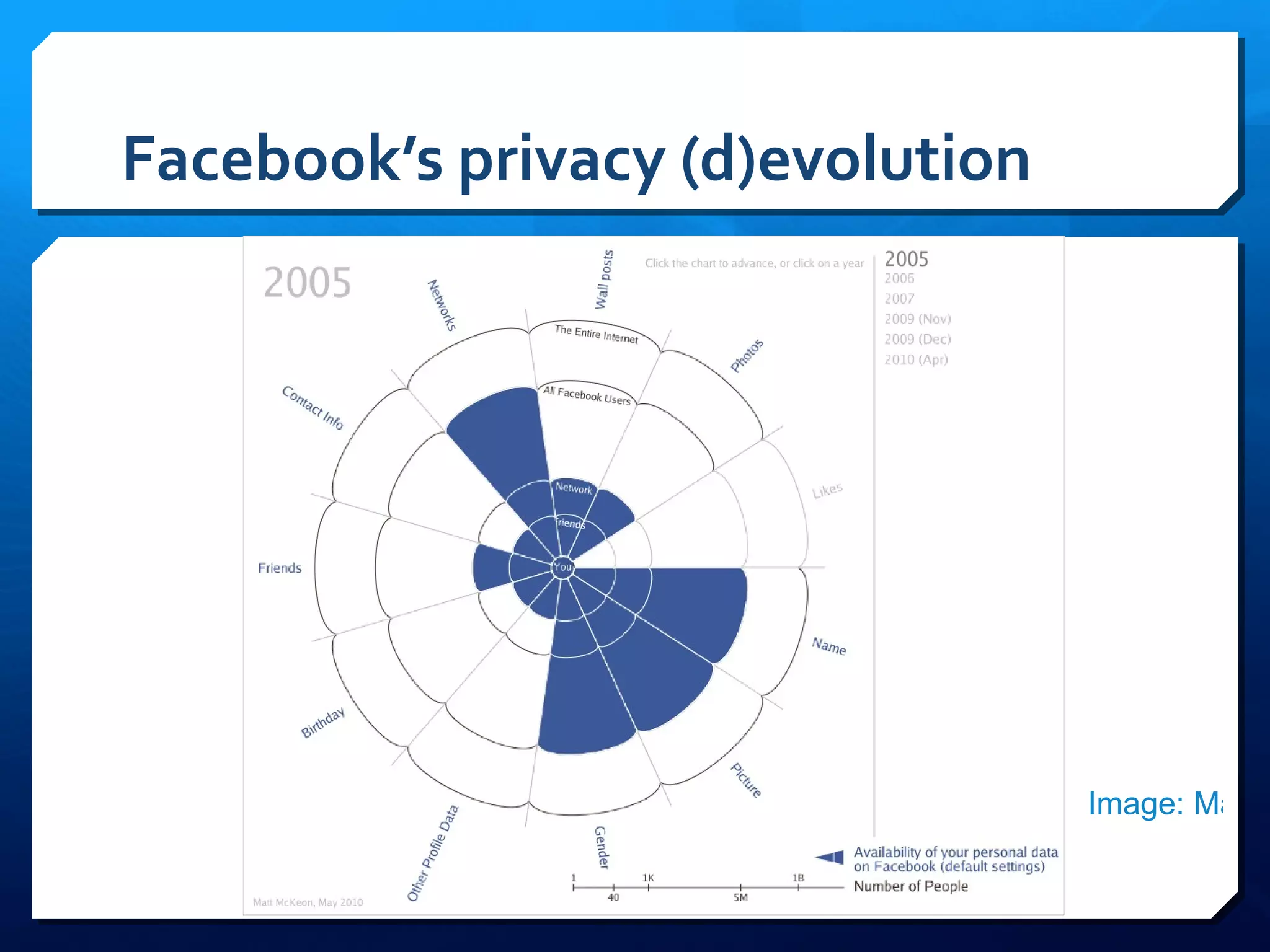
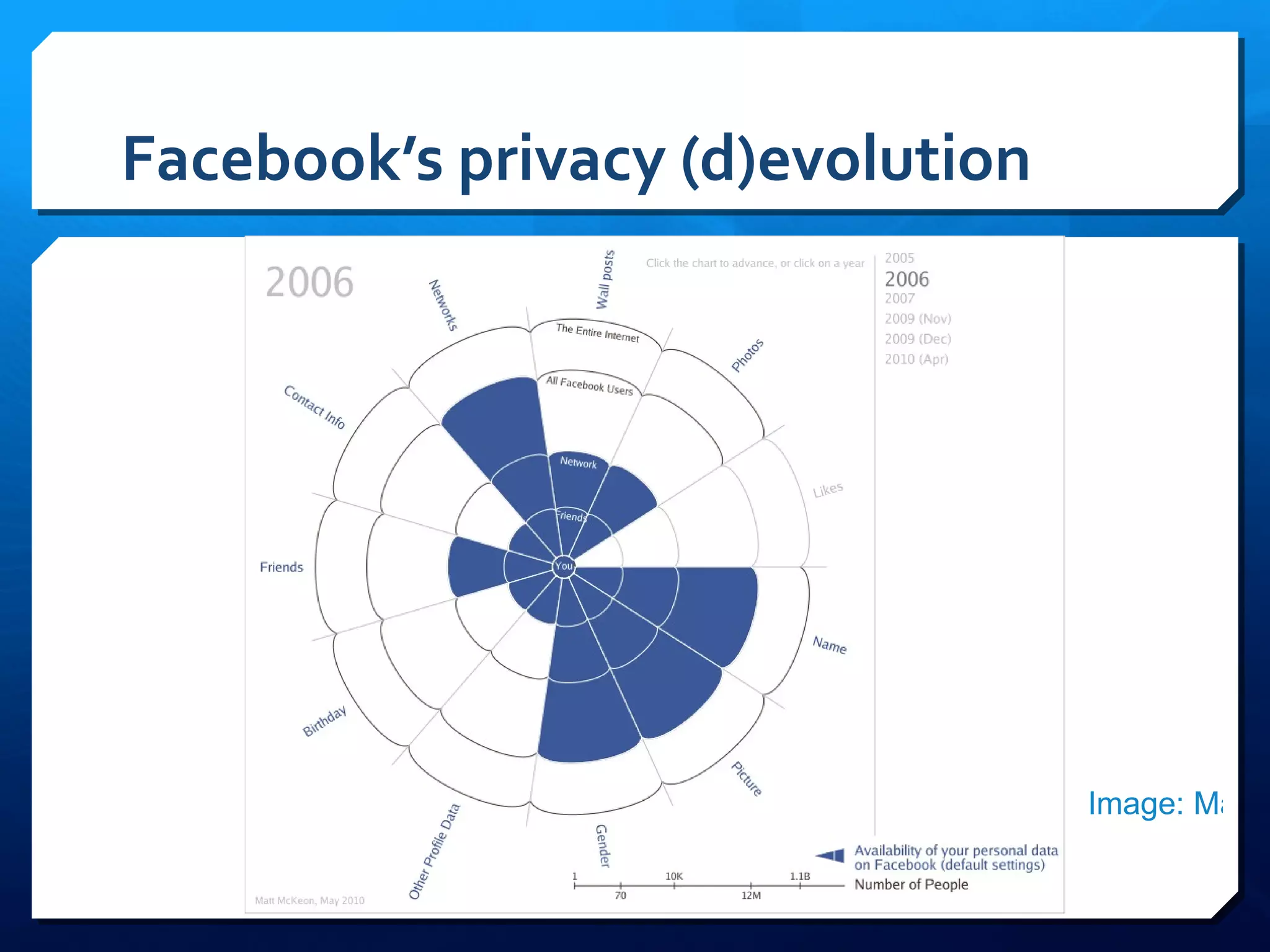
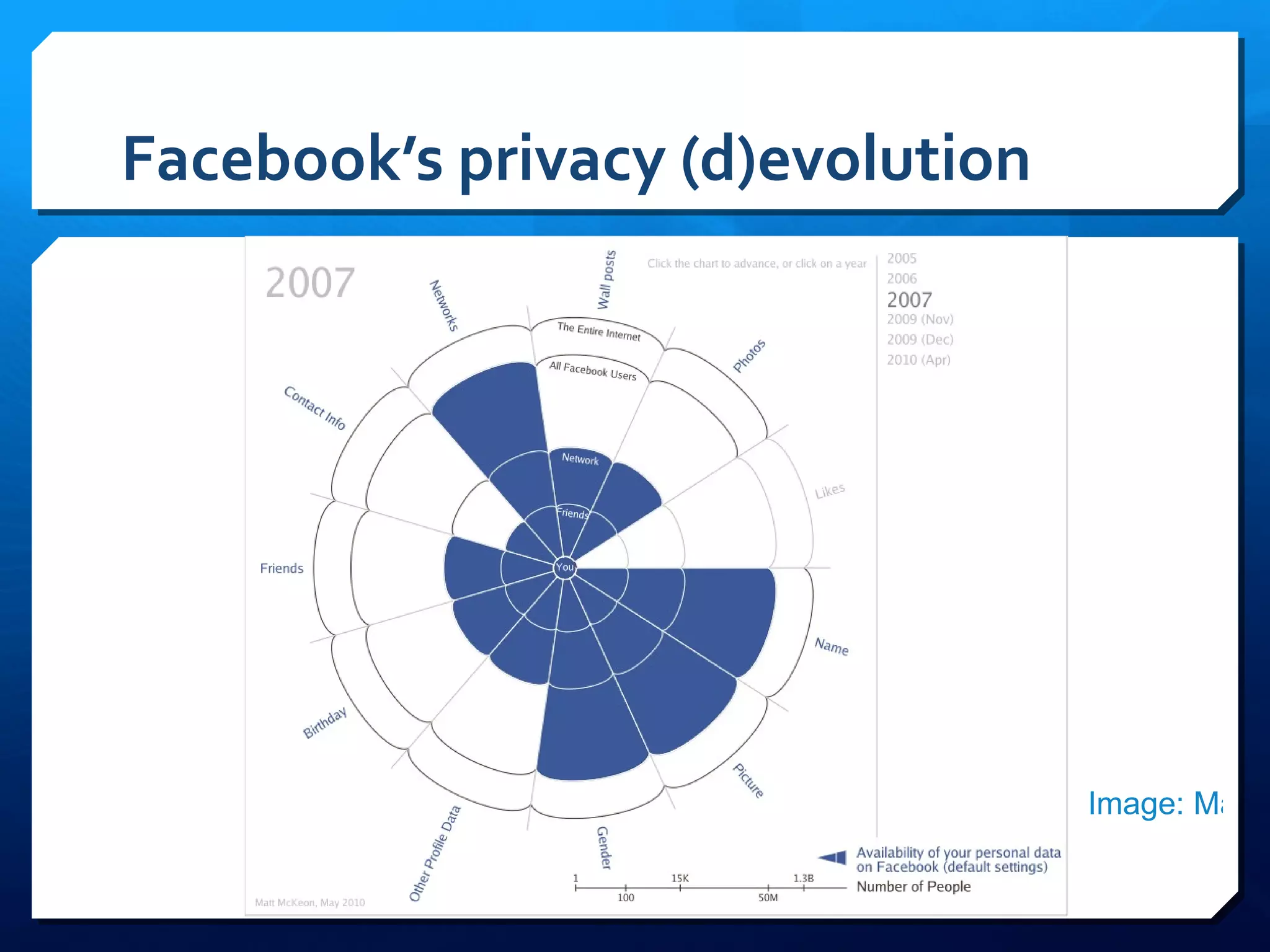
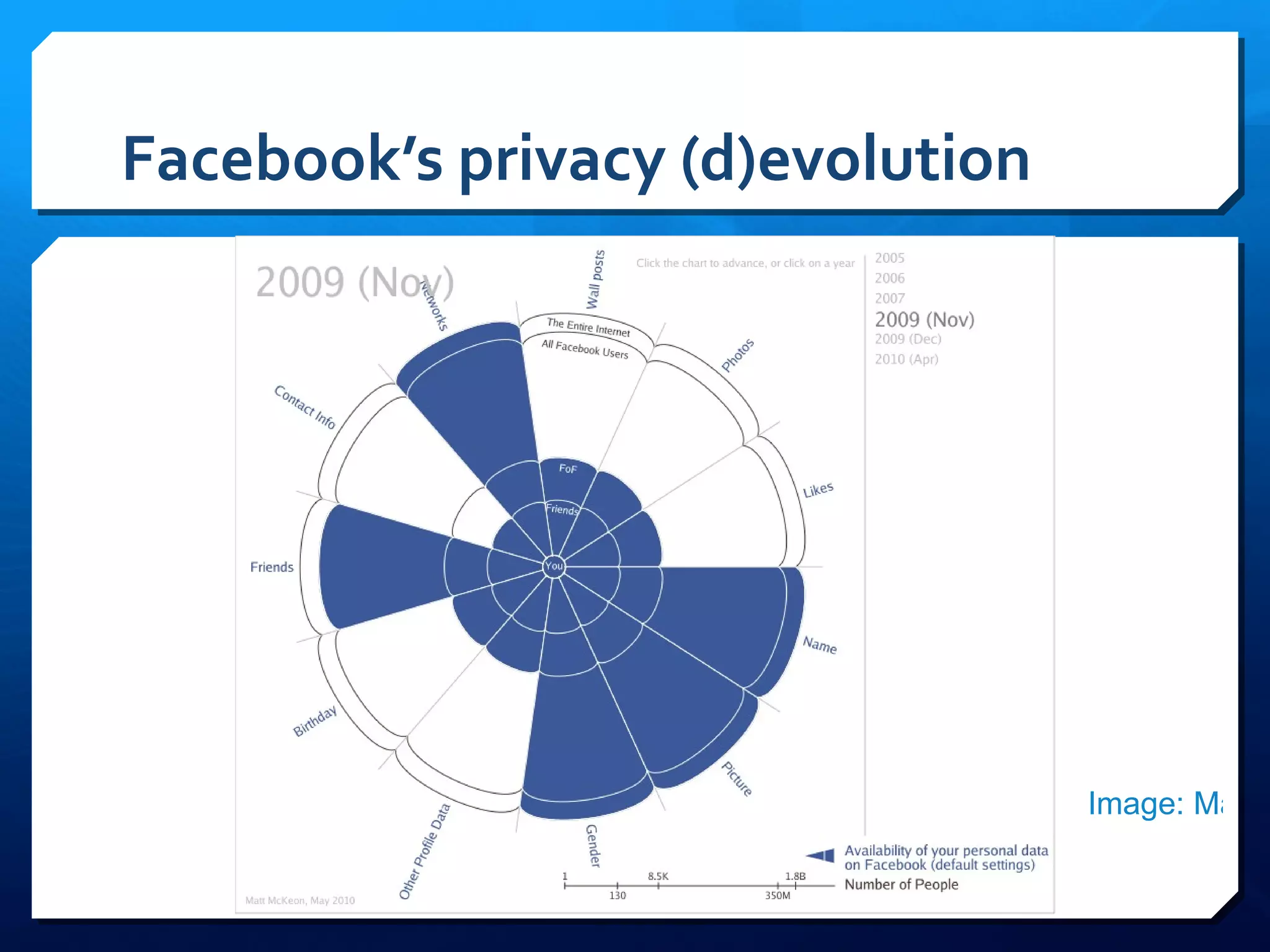
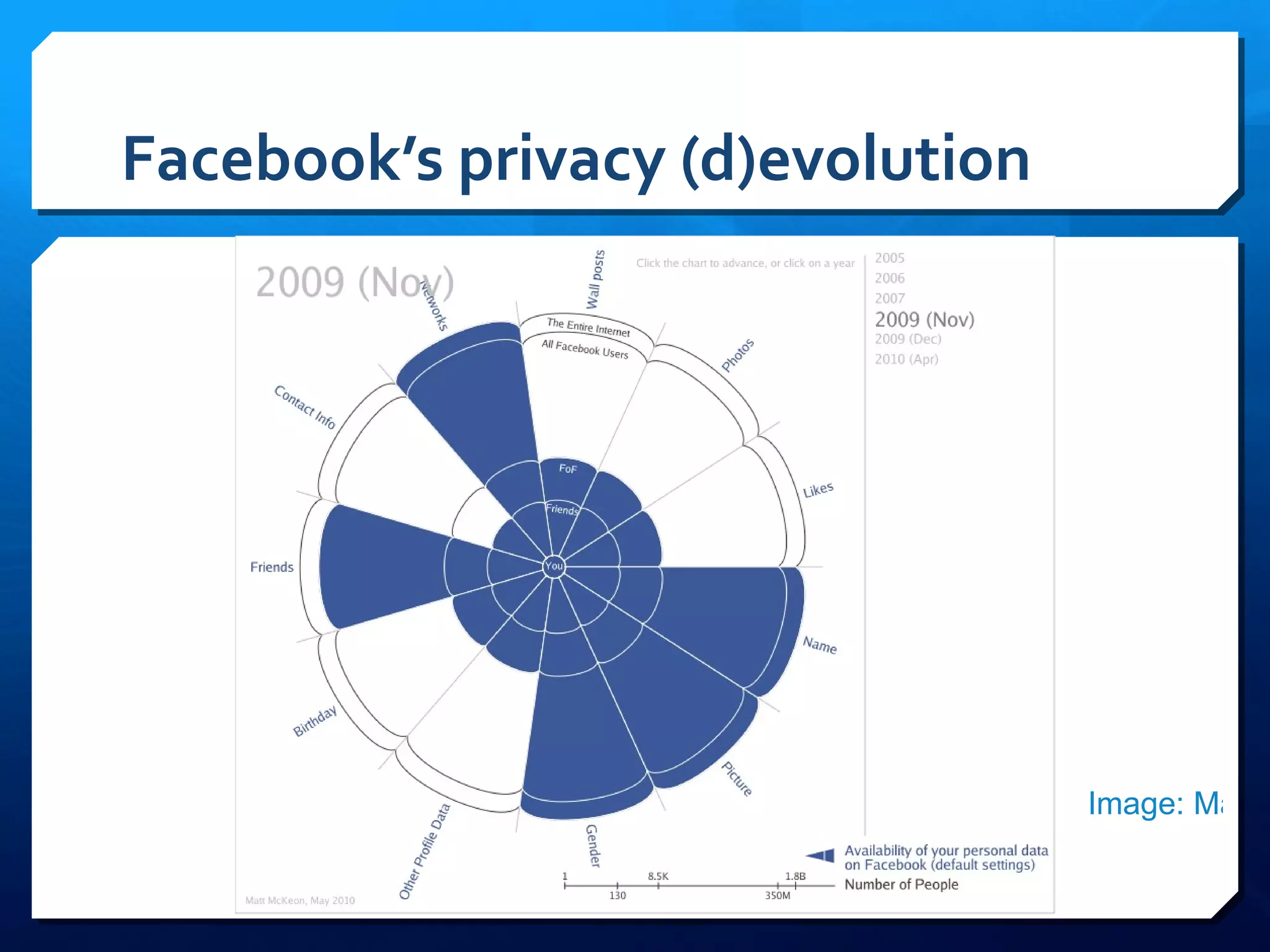
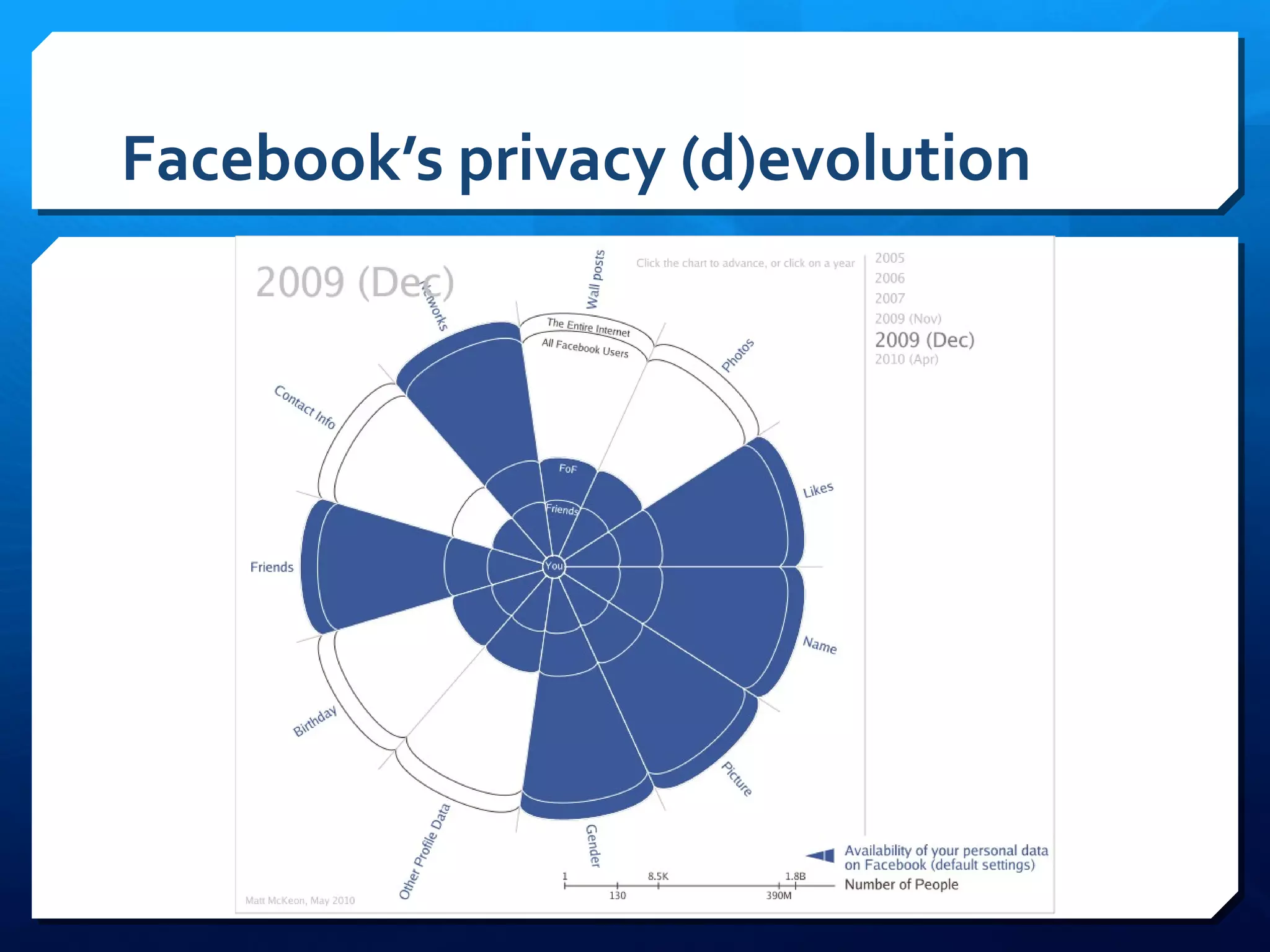
Facebook’s privacy (d)evolution Image: Matt Mckeon
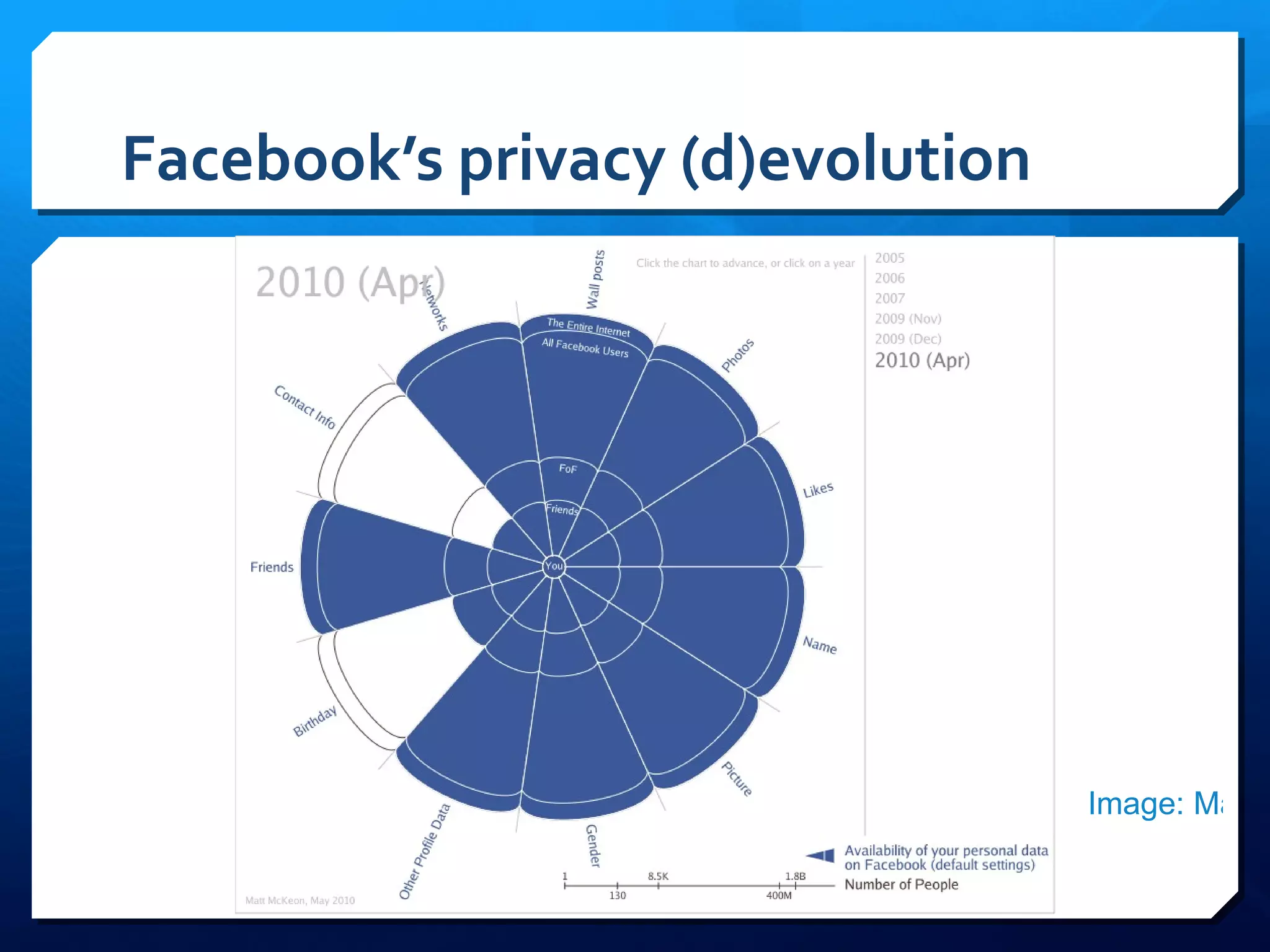
Facebook’s privacy (d)evolution
Facebook’s privacy (d)evolution Image: Matt Mckeon
Privacy is a luxury? “ what renders  privacy a luxury commodity  is that obtaining it implies a level of  computer literacy  that is inaccessible to most, and typically associated with higher income and education levels, and certain ethnic groups, in ways that mirror dominant socio–demographic inequalities” Zizi   Papacharissi , 2010
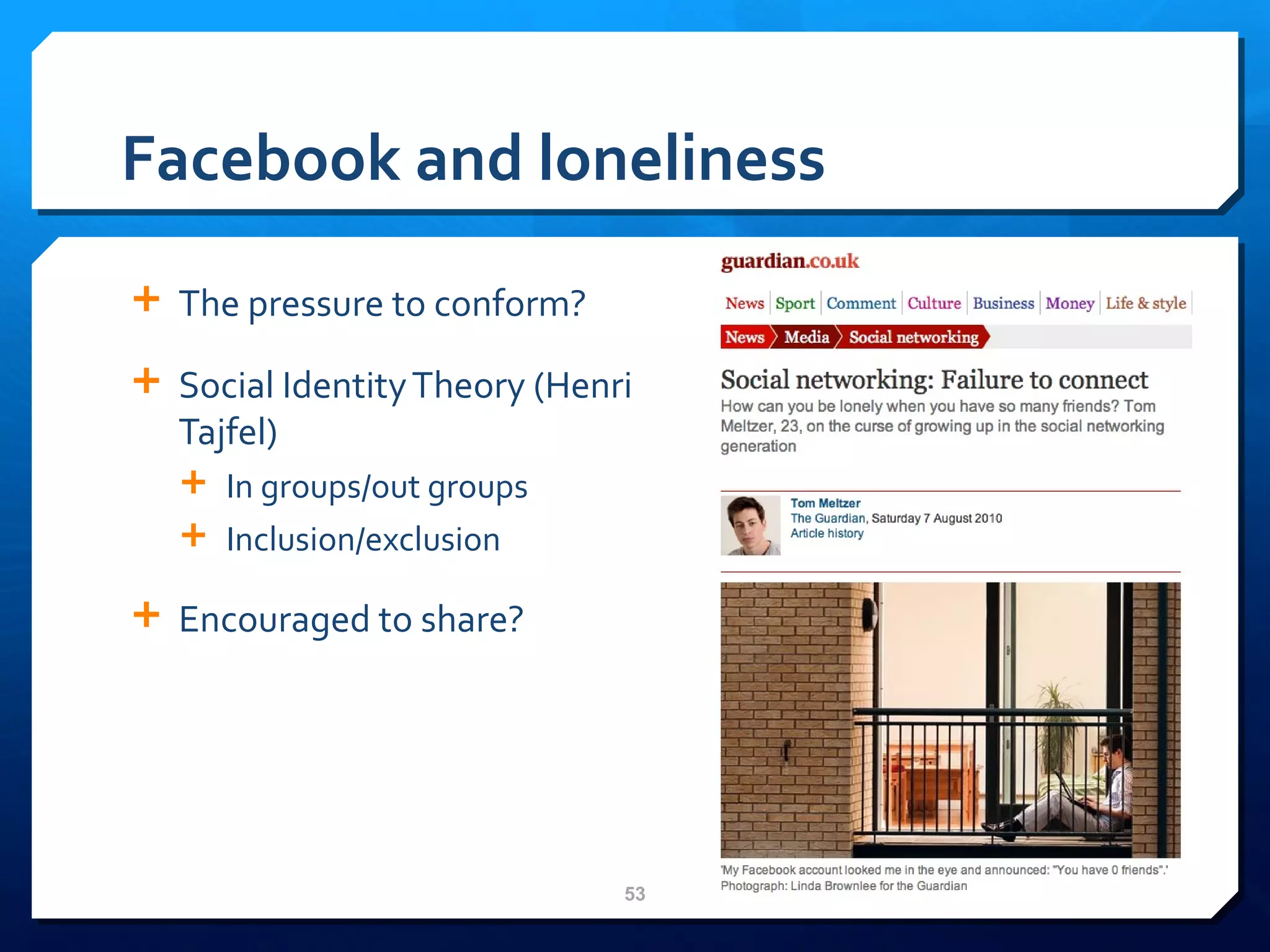
Facebook and loneliness  The pressure to conform? Social Identity Theory (Henri Tajfel) In groups/out groups Inclusion/exclusion Encouraged to share?
Summary Increasing desire for personalization of experience Increasing desire for socialization via Internet Privacy is a basic human right but we may be living through a period of ‘filter bubbles’ ( Pariser, 2011 )  whereby what is public or hidden from us is difficult to ascertain To what extent are we complicit/ignorant of the implications?
Summary New media = new risks? Reputation and commerce - Amazon, eBay, etc (Zittrain, 2008: 218) Applicable to social contexts (Youtube?) Surveillance brings new benefits?
Questions to consider: To what extent do we willingly reveal private information about ourselves in public forums, and how risky is this behaviour? How commonplace is  ‘ lifecasting ’  in its various forms and what are the potential implications of spending an increasing amount of time broadcasting our lives? To what extent can we trust companies to respect our privacy or our private infomration? To what extent do social media tools reconfigure traditional boundaries of public and private?
Sources Guy Adams (2008),  ‘ Couple sue McDonald's over nude photos ’ ,  The Independent ,  http://www.independent.co.uk/news/world/americas/couple-sue-mcdonalds-over-nude-photos-1032211.html   BBC (2007),  ‘ UK's families put on fraud alert ’ ,  http://news.bbc.co.uk/1/hi/uk_politics/7103566.stm   Ida Bergstrom (2008),  ‘ Facebook can ruin your life. And so can MySpace, Bebo... ’ ,  The Independent ,  http://www.independent.co.uk/life-style/gadgets-and-tech/news/facebook-can-ruin-your-life-and-so-can-myspace-bebo-780521.html   Daniel Boffey (2008),  ‘ Tax website shut down as memory stick with secret personal data of 12million is found in a pub car park ’ ,  Mail Online ,  http://www.dailymail.co.uk/news/article-1082402/Tax-website-shut-memory-stick-secret-personal-data-12million-pub-car-park.html   danah boyd (2008),  ‘ Facebook's Privacy Trainwreck: Exposure, Invasion, and Social Convergence ’ ,  Convergence , Vol 14 Iss 1. Mike Harvey (2008),  ‘ Horror as teenager commits suicide live ’ ,  TimesOnline ,  online  http://www.timesonline.co.uk/tol/news/world/us_and_americas/article5203176.ece   Jonathan Krim, 2005,  ‘ Subway Fracas Escalates Into Test Of the Internet's Power to Shame ’ ,  The Washington Post ,  http://www.washingtonpost.com/wp-dyn/content/article/2005/07/06/AR2005070601953.html   Sonia Livingstone (2008),  ‘ Taking risky opportunities in youthful content creation: teenagers' use of social networking sites for intimacy, privacy and self-expression ’ ,  New Media & Society , Vol 10 Iss 3. Richard Norton-Taylor (2008),  ‘ MoD admits inquiry into 69 lost laptops ’ ,  Guardian.co.uk ,  http://www.guardian.co.uk/uk/2008/jan/22/politics.military   John Oates (2008),  ‘ 5,000 NHS records vanish with latest lost laptop ’ ,  The Register ,  http://www.theregister.co.uk/2008/02/15/more_nhs_data_losses/   Mimi Sheller and John Urry (2003),  ‘ Mobile Transformations of  “ Public ”  and  “ Private ”  Life ’ ,  Theory, Culture and Society , Vol 20 Iss 3, 107-125 Mimi Sheller, 2004,  ‘Mobile publics: beyond the network perspective’,  Environment and Palnning D: Society and Space , vol 22 p39-52 Evan Ratliff, 2009,  ‘Writer Evan Ratliff Tried to Vanish: Here’s What Happened’ in  Wired   http://www.wired.com/vanish/2009/11/ff_vanish2/   Mark Warman (2008),  ‘ How Facebook toppled the BBC ’ ,  Telegraph ,  http://www.telegraph.co.uk/scienceandtechnology/technology/3394840/How-Facebook-toppled-the-BBC.html   Chris Williams (2007),  ‘ University moves to hush Facebook criticism ’ ,  The Register ,  http://www.theregister.co.uk/2007/05/22/keele_facebook/

The case for privacy (2012)

  • 2.
    The case forprivacy in a digitally networked era MAC309 [email_address]
  • 3.
    Overview Commodification ofpublicness Lifecasting The new publicness Reputation Facebook and privacy
  • 4.
    Privacy today Privacyis a fundamental human right. It underpins human dignity and other values such as freedom of association and freedom of speech. It has become one of the most important human rights of the modern age It is protected in the Universal Declaration of Human Rights, the International Covenant on Civil and Political Rights, and in many other international and regional human rights treaties. Nearly every country in the world includes a right of privacy in its constitution Privacy International, 2007
  • 6.
    European Privacy andHuman Rights (EPHR) 2010
  • 7.
    European Privacy andHuman Rights (EPHR) 2010
  • 9.
    Sheller and Urry(2003: 107) 20 th Century ‘ the over-whelming power of the state and market to interfere in and to overpower “ private ” life ’ 21 st Century the erosion of the ‘ public ’ by ‘ processes otherwise understood to be “ private ”’ (ie. commercial)
  • 10.
    Sheller and Urry(2003: 107) Private corporations have taken over once public institutions of schools, hospitals, prisons, transportation systems, postal services and the state itself, leading to a loss of democratic control, ... while, ... a politics of confessional intimacy and shaming has invaded the once public arena of political debate and arbitration of collective interests. On every front, it seems, the ‘ public ’ is being privatized, the private is becoming oversized, and this undermines democratic life.
  • 11.
    Sensitive data? UKcensus data [2011] gathered by US arms manufacturer Lockheed Martin
  • 12.
    Privacy versus sociabilityTension between the right to privacy and the sacrifices we make in order to communicate online Personal autonomy Private information commoditized
  • 13.
    Privacy versus sociabilityTension between the right to privacy and the sacrifices we make in order to communicate online Personal autonomy Private information commoditized “ We have had developers tell us that they don't want their platform screwed up by too much privacy management … There's all sorts of hoodwinking and linguistic devices that they use to persuade you to hand over your data.” Simon Davies, director-general of Privacy International
  • 14.
  • 15.
    Apple is Orwellian?iPhone launched in China, Dalia Lama app banned, 2009
  • 16.
    Apple is Orwellian?Satirical app by Pulitzer Prize winner, Mark Fiore, is banned ( Apr 2010 ) Later reinstated by Apple
  • 17.
    Apple is Orwellian?German Bild app censored; Stern app pulled from store ( March 2010 )
  • 18.
    The private leaksinto the public “ The proliferation of screens, from the miniature ones displaying text messages on handheld devices to the large ones in public spaces is allowing for new kinds of informational mobilities that use public spaces for ‘ private ’ purposes … . Private conversations are increasingly occurring in various `free spaces ’ that have been appropriated from the `semipublic ’ realm of streets, trains, stairwells, hallways, and stations. New degrees and kinds of personal communication or `keeping in touch’ are now possible from shifting public locations.” (Mimi Sheller, 2004, ‘Mobile publics: beyond the network perspective’, Environment and Palnning D: Society and Space , vol 22 p39-52
  • 19.
  • 20.
  • 21.
    Surveillance society? AutomaticNumber Plate Recognition Interception Modernisation Programme National ID scheme (50 pieces of info) National DNA database CCTV
  • 22.
    Public or private?‘ the public is concerned about privacy ’ (Zittrain, 2008: 202) civil servants & memory sticks/CDs (Boffey, 2/11/2008; BBC, 2007) the MoD/NHS &laptops (Norton-Taylor, 22/1/2008; Oates, 15/2/2008) Yet...
  • 23.
    The end ofonline privacy? Feb 8 2012 – Arun Thampi discovers Path app uploading the entire contents of users address books – names, emails, phone numbers – to its servers. Feb 8 2012 – Dustin Curtis claims 13/15 popular iOS apps do this. One company has contact details for Bill Gates, Mark Zuckerberg and Larry Ellison See Arthur, 2012
  • 24.
    The end ofonline privacy? Feb 17 2012 – Jonathan Mayer discovers t hat Google had hacked past the default privacy settings of Apple's browsers on the iPhone, iPad and desktop so that it tracked people's use of the web, whether or not they were signed into its services. Feb 16 2012 – New York Times shows how Target can spot pregnancy before family members See Arthur, 2012
  • 25.
  • 26.
    Lifecasting Steve MannWearable Wireless Webcam
  • 27.
  • 28.
  • 29.
    The new publicness?‘ any activity is subject to recording and broadcast ’ (Zittrain, 2008: 210) The Sherrif ’ s Office of Anderson County, Tennesse Jailcam fiasco
  • 30.
  • 31.
    Dog Poop GirlSouth Korea 2005
  • 32.
    Public ridicule andreputations Original http://uk.youtube.com/watch?v=HPPj6viIBmU Remix http://uk.youtube.com/watch?v=mNbLCA4WHCk
  • 33.
    Celebrity sex tapesAccidental? Purposeful?
  • 34.
    Deliberate exposure ChrisCrocker, ‘ Leave Britney alone! ’ http://uk.youtube.com/watch?v=6eOSDRNOLp4 Lonelygirl15 >>> Kate Modern
  • 35.
  • 36.
    Accidental exposure? Browsertracking? Cookies Super-cookies Behavioral ads Phorm UK
  • 37.
    Deliberate disappearance Evan Ratliff, US, 2009 27 days
  • 38.
    Deliberate disappearance David Bond, UK, 2009 Erasing David 18 days
  • 39.
    Facebook and privacyMore popular than the BBC (Warman, 2008) Keele University incident (Williams, 2007) Employers vetting candidates (Bergstrom, 2008)
  • 40.
    You are whatyou post? “ You have one identity. […] The days of you having a different image for your co-workers and for the other people you know are probably coming to an end pretty quickly. […] Having two identities for yourself is an example of a lack of integrity.” Mark Zuckerberg, Facebook (in Kiss, 2010 )
  • 41.
    Facebook and privacyProblems deleting accounts Datamining? http://uk.youtube.com/watch?v=OwnTWZ1-UWY
  • 42.
  • 43.
    Facebook and privacy‘ online risks may arise from their very confidence that they can know, judge and trust the people with whom they are intimate ... teenagers ’ limited internet literacy combined with confusing or poorly designed site settings, [leaves] them unclear regarding their control over who can see what about them ’ Livingstone, 2008: 406
  • 44.
    Facebook ’ s “ News Feed ” “ The tech world has a tendency to view the concept of ‘ private ’ as a single bit that is either 0 or 1. Data are either exposed or not. When companies make a decision to make data visible in a more ‘ efficient ’ manner, it is often startling, prompting users to speak of a disruption of ‘ privacy ’ ” boyd, 2008: 14
  • 45.
  • 46.
  • 47.
  • 48.
  • 49.
  • 50.
  • 51.
  • 52.
    Privacy is aluxury? “ what renders privacy a luxury commodity is that obtaining it implies a level of computer literacy that is inaccessible to most, and typically associated with higher income and education levels, and certain ethnic groups, in ways that mirror dominant socio–demographic inequalities” Zizi Papacharissi , 2010
  • 53.
    Facebook and loneliness The pressure to conform? Social Identity Theory (Henri Tajfel) In groups/out groups Inclusion/exclusion Encouraged to share?
  • 54.
    Summary Increasing desirefor personalization of experience Increasing desire for socialization via Internet Privacy is a basic human right but we may be living through a period of ‘filter bubbles’ ( Pariser, 2011 ) whereby what is public or hidden from us is difficult to ascertain To what extent are we complicit/ignorant of the implications?
  • 55.
    Summary New media= new risks? Reputation and commerce - Amazon, eBay, etc (Zittrain, 2008: 218) Applicable to social contexts (Youtube?) Surveillance brings new benefits?
  • 56.
    Questions to consider:To what extent do we willingly reveal private information about ourselves in public forums, and how risky is this behaviour? How commonplace is ‘ lifecasting ’ in its various forms and what are the potential implications of spending an increasing amount of time broadcasting our lives? To what extent can we trust companies to respect our privacy or our private infomration? To what extent do social media tools reconfigure traditional boundaries of public and private?
  • 57.
    Sources Guy Adams(2008), ‘ Couple sue McDonald's over nude photos ’ , The Independent , http://www.independent.co.uk/news/world/americas/couple-sue-mcdonalds-over-nude-photos-1032211.html BBC (2007), ‘ UK's families put on fraud alert ’ , http://news.bbc.co.uk/1/hi/uk_politics/7103566.stm Ida Bergstrom (2008), ‘ Facebook can ruin your life. And so can MySpace, Bebo... ’ , The Independent , http://www.independent.co.uk/life-style/gadgets-and-tech/news/facebook-can-ruin-your-life-and-so-can-myspace-bebo-780521.html Daniel Boffey (2008), ‘ Tax website shut down as memory stick with secret personal data of 12million is found in a pub car park ’ , Mail Online , http://www.dailymail.co.uk/news/article-1082402/Tax-website-shut-memory-stick-secret-personal-data-12million-pub-car-park.html danah boyd (2008), ‘ Facebook's Privacy Trainwreck: Exposure, Invasion, and Social Convergence ’ , Convergence , Vol 14 Iss 1. Mike Harvey (2008), ‘ Horror as teenager commits suicide live ’ , TimesOnline , online http://www.timesonline.co.uk/tol/news/world/us_and_americas/article5203176.ece Jonathan Krim, 2005, ‘ Subway Fracas Escalates Into Test Of the Internet's Power to Shame ’ , The Washington Post , http://www.washingtonpost.com/wp-dyn/content/article/2005/07/06/AR2005070601953.html Sonia Livingstone (2008), ‘ Taking risky opportunities in youthful content creation: teenagers' use of social networking sites for intimacy, privacy and self-expression ’ , New Media & Society , Vol 10 Iss 3. Richard Norton-Taylor (2008), ‘ MoD admits inquiry into 69 lost laptops ’ , Guardian.co.uk , http://www.guardian.co.uk/uk/2008/jan/22/politics.military John Oates (2008), ‘ 5,000 NHS records vanish with latest lost laptop ’ , The Register , http://www.theregister.co.uk/2008/02/15/more_nhs_data_losses/ Mimi Sheller and John Urry (2003), ‘ Mobile Transformations of “ Public ” and “ Private ” Life ’ , Theory, Culture and Society , Vol 20 Iss 3, 107-125 Mimi Sheller, 2004, ‘Mobile publics: beyond the network perspective’, Environment and Palnning D: Society and Space , vol 22 p39-52 Evan Ratliff, 2009, ‘Writer Evan Ratliff Tried to Vanish: Here’s What Happened’ in Wired http://www.wired.com/vanish/2009/11/ff_vanish2/ Mark Warman (2008), ‘ How Facebook toppled the BBC ’ , Telegraph , http://www.telegraph.co.uk/scienceandtechnology/technology/3394840/How-Facebook-toppled-the-BBC.html Chris Williams (2007), ‘ University moves to hush Facebook criticism ’ , The Register , http://www.theregister.co.uk/2007/05/22/keele_facebook/