The picture of Dorian Grey
  Made by : Iordan Natalia 1LM2,
  103 group
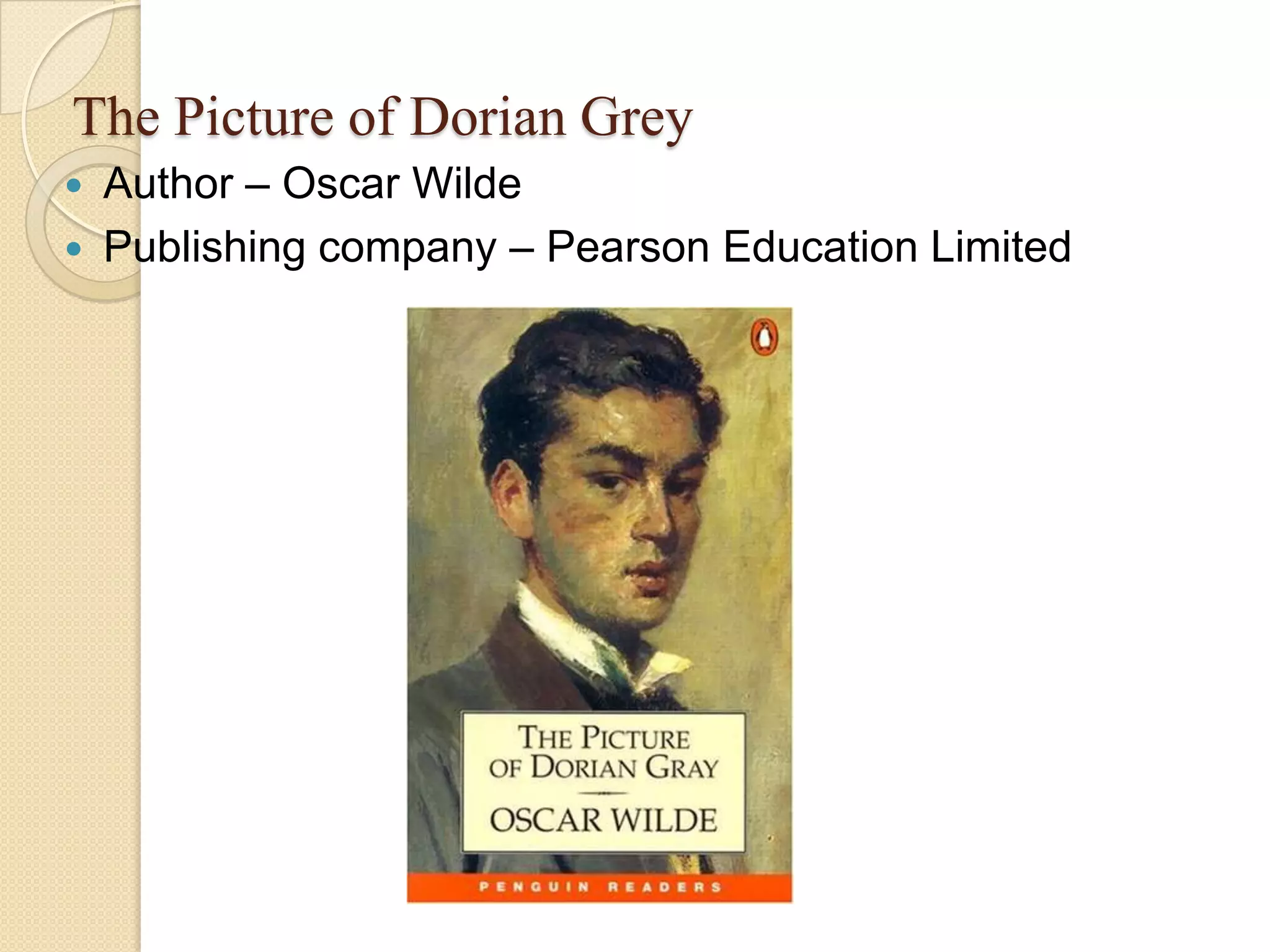
The Picture of Dorian Grey
 Author – Oscar Wilde
 Publishing company – Pearson Education Limited
Main character - Dorian Grey
    A radiantly handsome, impressionable, and wealthy
    young gentleman, whose portrait the artist Basil
    Hallward paints. Under the influence of Lord Henry
    Wotton, Dorian becomes extremely concerned with
    the transience of his beauty and begins to pursue his
    own pleasure above all else. He devotes himself to
    having as many experiences as possible, whether
    moral or immoral, elegant or sordid.
Setting of the story
   The story takes place around 100 years ago, in
    London, England. The main characters are Dorian
    Grey, Basil Hallward, Lord Henry Wotton. Painter
    Basil Hallward is impressed by the beauty of Dorian
    Grey and paints his portrait.
The Plot
   The famous London artist Basil Hallward shows his
    dear friend Lord Henry Wotton his new painting: a
    portrait of a young and noble man, named Dorian
    Grey. Basil is really attracted by Dorian’s charm and
    beauty, and considers the youth an inspirational
    gift for his art. Lord Henry asks the painter to meet
    Dorian and Basil; after some hesitation, he agrees.
    The young man becomes enthralled by Lord Henry’s
    eloquence and his worldly view. As a new kind of
    hedonism, according to Lord Henry, the only aims in
    life are to pursue beauty and to satisfy one’s own
    senses. He persuades Dorian not to waste his beauty,
    but to make use of it, and to indulge in any
    pleasurable experience.
   In fact, when Dorian realises that one day his beauty
    will disappear, he wishes that the portrait painted by
    Basil would age instead of him. His wish comes true,
    indeed he finds that the portrait’s expression changes
    and ages for every sin he commits. For eighteen years
    he experiments with every kind of vice, and step by
    step Dorian loses his innocence, behaving in a sinful
    way. In fact, he causes the death of a young and
    talented actress, who had fallen in love with him; he
    ruins and corrupts a lot of friends and young noble
    men;
   he even kills his friend Basil, but his outward
    appearances remains unchanged. Instead, the
    portrait, now old and ugly, is a sort of mirror
    of the effect of each sin upon his soul. At the end,
    he decides to be really good and to forget the past.
    He decides to destroy the portrait, and does so, in
    a fit of range, by stabbing it. The servants hear his
    cry, and call the police, who find the corpse of
    Dorian suddenly aged, and the portrait in its
    original form. They identify the corpse through
    the rings on his hand.
Conclusion
   I was deeply impressed by this book, it is a
    psychological one that puts the readers to think about
    human being, about life itself. I gave the highest rate
    to it. I would recommend it to you, because it is useful
    for our souls, it guides us to think about the
    consequences of our actions and that self-worship
    leads to self-distruction.

The picture of Dorian Grey

  • 1.
    The picture ofDorian Grey Made by : Iordan Natalia 1LM2, 103 group
  • 2.
    The Picture ofDorian Grey  Author – Oscar Wilde  Publishing company – Pearson Education Limited
  • 3.
    Main character -Dorian Grey  A radiantly handsome, impressionable, and wealthy young gentleman, whose portrait the artist Basil Hallward paints. Under the influence of Lord Henry Wotton, Dorian becomes extremely concerned with the transience of his beauty and begins to pursue his own pleasure above all else. He devotes himself to having as many experiences as possible, whether moral or immoral, elegant or sordid.
  • 4.
    Setting of thestory  The story takes place around 100 years ago, in London, England. The main characters are Dorian Grey, Basil Hallward, Lord Henry Wotton. Painter Basil Hallward is impressed by the beauty of Dorian Grey and paints his portrait.
  • 5.
    The Plot  The famous London artist Basil Hallward shows his dear friend Lord Henry Wotton his new painting: a portrait of a young and noble man, named Dorian Grey. Basil is really attracted by Dorian’s charm and beauty, and considers the youth an inspirational gift for his art. Lord Henry asks the painter to meet Dorian and Basil; after some hesitation, he agrees. The young man becomes enthralled by Lord Henry’s eloquence and his worldly view. As a new kind of hedonism, according to Lord Henry, the only aims in life are to pursue beauty and to satisfy one’s own senses. He persuades Dorian not to waste his beauty, but to make use of it, and to indulge in any pleasurable experience.
  • 6.
    In fact, when Dorian realises that one day his beauty will disappear, he wishes that the portrait painted by Basil would age instead of him. His wish comes true, indeed he finds that the portrait’s expression changes and ages for every sin he commits. For eighteen years he experiments with every kind of vice, and step by step Dorian loses his innocence, behaving in a sinful way. In fact, he causes the death of a young and talented actress, who had fallen in love with him; he ruins and corrupts a lot of friends and young noble men;
  • 7.
    he even kills his friend Basil, but his outward appearances remains unchanged. Instead, the portrait, now old and ugly, is a sort of mirror of the effect of each sin upon his soul. At the end, he decides to be really good and to forget the past. He decides to destroy the portrait, and does so, in a fit of range, by stabbing it. The servants hear his cry, and call the police, who find the corpse of Dorian suddenly aged, and the portrait in its original form. They identify the corpse through the rings on his hand.
  • 8.
    Conclusion  I was deeply impressed by this book, it is a psychological one that puts the readers to think about human being, about life itself. I gave the highest rate to it. I would recommend it to you, because it is useful for our souls, it guides us to think about the consequences of our actions and that self-worship leads to self-distruction.