
Human Resources: Past and Present
Scientific Management – this technique was the
first radical change in what most owners and
managers of the early 1900s generally considered
the most effective means of managing employees
– constant supervision and threats of the loss of
their jobs.
Before the advent of scientific management, all employees
were considered equally productive, and if their
productivity did not measure up, they deserved to be
quickly terminated which is different to scientific
management.
Frederick Taylor, the Father of Scientific Management,
Frank and Lilian Gilbreth, and Henry Gantt believed that
managers should take a scientific and objective approach
in studying how work can be most efficiently designed.
Human Relations– during the 1930s and 1940s,
with impetus provided by the classic Hawthorne
studies, management’s attention shifted to Human
Relations.
The Hawthorne studies demonstrated that
employee productivity was affected not only by the
way the job was designed and the manner in which
employees were rewarded economically but also by
certain social and psychological factors.
Hawthorne researchers, Elton Mayo and F.J.
Roethlisberger discovered that employees’
feelings, emotions, and sentiments were strongly
affected by such work conditions as group
relationships, leadership styles, and support from
management.
And those feelings could, in turn, have a significant
impact on productivity.
The Mayo-Roethlisberger research led to the
widespread implementation of behavioral science
techniques in industry, including supervisory
training programs that emphasized support and
concern for the workers.
The shift to human relations was also influenced by the growing
strength of unions during the period. The rise of unionism was
largely the result of passage of the Wagner Act of 1935, which gave
workers the legal right to organize and to bargain collectively with
employers in disputes about wages, job security, benefits, and many
other work conditions.
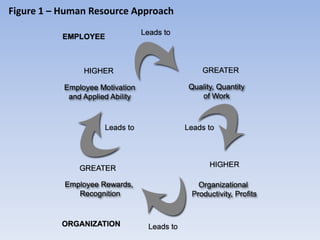
Human Resources – the emerging trend in human
resource (HR) management is clearly toward the
adoption of the human resource approach,
through which organizations benefit in two
significant ways: an increase in organizational
effectiveness and the satisfaction of each
employee’s needs.
Figure 1 – Human Resource Approach
Strategic Human Resource Management
In a fast-paced global economy, change is the
norm. Environmental, social, and technological
change, the increased internationalization of
business, and the increased scarcity and cost of HR,
can only mean that long-term planning is risky but
absolutely essential.
How do organizations make decisions about their future
in this complex, rapidly changing world?
The process is called STRATEGIC MANAGEMENT. It
involves making those decisions that define the overall
mission and objectives of the organization, determining
the most effective utilization of its resources, and crafting
and executing the strategy in ways that produce the
intended results.
Business strategy is management’s game plan.
Without one, management would have no road map
to follow and no action plan to produce desired
results. Strategic human resource management
activities address a wide variety of people issues
relevant to business strategy.
HR management crosses all the functional areas and is
fully integrated with all the significant parts of the
organization: operations, marketing, finance, and so
on.
Human Resource Functions
Because the human resource function within each
organization is unique to that organization, the
activities included in the HR department will vary
from organization to organization.
Among the activities that are most likely to be
assigned exclusively to the HR department are:
1. Compensation and benefits issues, such as
insurance administration, wage and salary
administration, unemployment compensation,
pension plans, vacation/leave processing, and
flexible benefits accounts.
2. Employee services such as outplacement
services, employee assistance plans, health and
wellness programs, savings plans, and
relocation services.
3. Affirmative Action and Equal Employment
Opportunity.
4. Job analysis programs
5. Preemployment testing, including drug testing
6. Attitude surveys.
In addition, the HR department is likely to carry out some
activities jointly with other departments in the organization,
including interviewing, productivity/motivation programs,
training and development, career planning, disciplinary
procedures, and performance appraisals.
Job Analysis and Design
For an employee to perform satisfactorily, his or
her skills, abilities, and motives to perform the job
must match the job’s requirements. A mismatch
may lead to poor performance, absenteeism,
turnover, and other problems.
Through a process called job analysis, the skills and
abilities to perform a specific job are determined.
Recruitment and Selection
Recruitment of human resources is a critical HR
function. Recruiting and selecting a qualified labor
force involves a variety of HR activities, including
analysis of the labor market, long-term planning,
interviewing, and testing.
To a great degree, the effectiveness of an organization
depends on the effectiveness of its employees.
Appraisal, Training and Development
The growth of an organization is closely related to
the development of its human resources. When
employees fail to grow and develop in their work, a
stagnant organization most likely will result.
A strong employee development program does not
guarantee organizational success, but such a program is
generally found in successful, expanding organizations.
• One important developmental function is the
appraisal of employee performance. During an
appraisal process, employees become aware of any
performance deficiencies they may have and are
informed of what they must do to improve their
performance and thus become promotable.
• The heart of the development process is composed
of on-the-job and off-the-job activities that teach
employees new skills and abilities.
• Training and development offer many rewards
but also pose many problems for training
personnel:
Who should be trained and why?
What training techniques should be used?
Is training cost-effective?
Compensation and Health
The issue of compensation has long posed
problems for the HR manager: How should jobs be
evaluated to determine their worth? Are wage and
salary levels competitive? Are they fair? Is it
possible to create an incentive compensation
system tied to performance?
An increasingly important part of compensation is
employee benefits. Because the cost of benefits
for many organizations now averages as much as
40 percent of total payroll costs, employers are
trying to control benefit costs without seriously
affecting the overall compensation program.
Labor Relations
Labor unions exert a powerful influence on employers
and help shape the HR policies and programs for union
employees. Because union participation in personnel
decision making may have great impact on the
economic condition of the firm, managers must
understand a union’s philosophies and goals and
explore ways in which a cooperative rather than an
adversarial relationship may be achieved.
HR Department Roles
The primary task of the HR department is to ensure
that the organization’s HR are utilized and managed as
effectively as possible. HR administrators help design
and implement policies and programs that enhance
human abilities and improve the organization’s overall
effectiveness.
HR Policies
HR policies are guides to management’s thinking,
and they help management achieve the
organization’s HR objectives. Policies also help
define acceptable and unacceptable behavior and
establish the organization’s position on an issue.
Critical Policy Issues
1. Employee Influence
2. Personnel Flow
3. Reward System
4. Work System
Communication
• All business organizations depend on
communication. Communication is the glue that
binds various elements, coordinates activities,
allows people to work together, and produces
results.
• Often it is the HR staff who plays a pivotal role in
the design and maintenance of good companywide
communication flows to and from all employees.
• Downward communication methods, from
management to employees, include orientation
sessions, bulletin boards, newsletters, and
employee handbooks.
• Upward communication methods usually
include suggestion programs, complaint
procedures, electronic mail, attitude surveys,
and open-door meetings.
1. New Employee Orientation
2. Bulletin Boards
3. Communication Meetings
4. Newsletters
5. Employee Handbooks
6. Suggestion Programs
7. Complaint Procedures
8. Electronic Mail
9. Surveys
10.Open-door Meetings
Advice and Services
To cope with complex issues, managers often turn
to staff experts for advice and counsel.
• How do I deal with an employee who I suspect is on
drugs?
• How do I meet my equal employment goals without
raising cries of “reverse discrimination”?
• How do I tell a high-achieving employee that the
budget will not allow a merit increase this year?
• How do I counsel a manager who is suffering a
midcareer crisis?
• How do I deal with an employee who has been with
the company for twenty-five years but not can no
longer perform effectively?
• How can I increase employee morale?
The environment for human resources

The environment for human resources

  • 2.
    Human Resources: Pastand Present Scientific Management – this technique was the first radical change in what most owners and managers of the early 1900s generally considered the most effective means of managing employees – constant supervision and threats of the loss of their jobs.
  • 3.
    Before the adventof scientific management, all employees were considered equally productive, and if their productivity did not measure up, they deserved to be quickly terminated which is different to scientific management. Frederick Taylor, the Father of Scientific Management, Frank and Lilian Gilbreth, and Henry Gantt believed that managers should take a scientific and objective approach in studying how work can be most efficiently designed.
  • 4.
    Human Relations– duringthe 1930s and 1940s, with impetus provided by the classic Hawthorne studies, management’s attention shifted to Human Relations. The Hawthorne studies demonstrated that employee productivity was affected not only by the way the job was designed and the manner in which employees were rewarded economically but also by certain social and psychological factors.
  • 5.
    Hawthorne researchers, EltonMayo and F.J. Roethlisberger discovered that employees’ feelings, emotions, and sentiments were strongly affected by such work conditions as group relationships, leadership styles, and support from management. And those feelings could, in turn, have a significant impact on productivity.
  • 6.
    The Mayo-Roethlisberger researchled to the widespread implementation of behavioral science techniques in industry, including supervisory training programs that emphasized support and concern for the workers. The shift to human relations was also influenced by the growing strength of unions during the period. The rise of unionism was largely the result of passage of the Wagner Act of 1935, which gave workers the legal right to organize and to bargain collectively with employers in disputes about wages, job security, benefits, and many other work conditions.
  • 7.
    Human Resources –the emerging trend in human resource (HR) management is clearly toward the adoption of the human resource approach, through which organizations benefit in two significant ways: an increase in organizational effectiveness and the satisfaction of each employee’s needs.
  • 8.
    Figure 1 –Human Resource Approach
  • 9.
    Strategic Human ResourceManagement In a fast-paced global economy, change is the norm. Environmental, social, and technological change, the increased internationalization of business, and the increased scarcity and cost of HR, can only mean that long-term planning is risky but absolutely essential.
  • 10.
    How do organizationsmake decisions about their future in this complex, rapidly changing world? The process is called STRATEGIC MANAGEMENT. It involves making those decisions that define the overall mission and objectives of the organization, determining the most effective utilization of its resources, and crafting and executing the strategy in ways that produce the intended results.
  • 11.
    Business strategy ismanagement’s game plan. Without one, management would have no road map to follow and no action plan to produce desired results. Strategic human resource management activities address a wide variety of people issues relevant to business strategy. HR management crosses all the functional areas and is fully integrated with all the significant parts of the organization: operations, marketing, finance, and so on.
  • 12.
    Human Resource Functions Becausethe human resource function within each organization is unique to that organization, the activities included in the HR department will vary from organization to organization. Among the activities that are most likely to be assigned exclusively to the HR department are:
  • 13.
    1. Compensation andbenefits issues, such as insurance administration, wage and salary administration, unemployment compensation, pension plans, vacation/leave processing, and flexible benefits accounts. 2. Employee services such as outplacement services, employee assistance plans, health and wellness programs, savings plans, and relocation services.
  • 14.
    3. Affirmative Actionand Equal Employment Opportunity. 4. Job analysis programs 5. Preemployment testing, including drug testing 6. Attitude surveys. In addition, the HR department is likely to carry out some activities jointly with other departments in the organization, including interviewing, productivity/motivation programs, training and development, career planning, disciplinary procedures, and performance appraisals.
  • 15.
    Job Analysis andDesign For an employee to perform satisfactorily, his or her skills, abilities, and motives to perform the job must match the job’s requirements. A mismatch may lead to poor performance, absenteeism, turnover, and other problems. Through a process called job analysis, the skills and abilities to perform a specific job are determined.
  • 16.
    Recruitment and Selection Recruitmentof human resources is a critical HR function. Recruiting and selecting a qualified labor force involves a variety of HR activities, including analysis of the labor market, long-term planning, interviewing, and testing. To a great degree, the effectiveness of an organization depends on the effectiveness of its employees.
  • 17.
    Appraisal, Training andDevelopment The growth of an organization is closely related to the development of its human resources. When employees fail to grow and develop in their work, a stagnant organization most likely will result. A strong employee development program does not guarantee organizational success, but such a program is generally found in successful, expanding organizations.
  • 18.
    • One importantdevelopmental function is the appraisal of employee performance. During an appraisal process, employees become aware of any performance deficiencies they may have and are informed of what they must do to improve their performance and thus become promotable. • The heart of the development process is composed of on-the-job and off-the-job activities that teach employees new skills and abilities.
  • 19.
    • Training anddevelopment offer many rewards but also pose many problems for training personnel: Who should be trained and why? What training techniques should be used? Is training cost-effective?
  • 20.
    Compensation and Health Theissue of compensation has long posed problems for the HR manager: How should jobs be evaluated to determine their worth? Are wage and salary levels competitive? Are they fair? Is it possible to create an incentive compensation system tied to performance?
  • 21.
    An increasingly importantpart of compensation is employee benefits. Because the cost of benefits for many organizations now averages as much as 40 percent of total payroll costs, employers are trying to control benefit costs without seriously affecting the overall compensation program.
  • 22.
    Labor Relations Labor unionsexert a powerful influence on employers and help shape the HR policies and programs for union employees. Because union participation in personnel decision making may have great impact on the economic condition of the firm, managers must understand a union’s philosophies and goals and explore ways in which a cooperative rather than an adversarial relationship may be achieved.
  • 23.
    HR Department Roles Theprimary task of the HR department is to ensure that the organization’s HR are utilized and managed as effectively as possible. HR administrators help design and implement policies and programs that enhance human abilities and improve the organization’s overall effectiveness.
  • 24.
    HR Policies HR policiesare guides to management’s thinking, and they help management achieve the organization’s HR objectives. Policies also help define acceptable and unacceptable behavior and establish the organization’s position on an issue.
  • 25.
    Critical Policy Issues 1.Employee Influence 2. Personnel Flow 3. Reward System 4. Work System
  • 26.
    Communication • All businessorganizations depend on communication. Communication is the glue that binds various elements, coordinates activities, allows people to work together, and produces results. • Often it is the HR staff who plays a pivotal role in the design and maintenance of good companywide communication flows to and from all employees.
  • 27.
    • Downward communicationmethods, from management to employees, include orientation sessions, bulletin boards, newsletters, and employee handbooks. • Upward communication methods usually include suggestion programs, complaint procedures, electronic mail, attitude surveys, and open-door meetings.
  • 28.
    1. New EmployeeOrientation 2. Bulletin Boards 3. Communication Meetings 4. Newsletters 5. Employee Handbooks 6. Suggestion Programs 7. Complaint Procedures 8. Electronic Mail 9. Surveys 10.Open-door Meetings
  • 29.
    Advice and Services Tocope with complex issues, managers often turn to staff experts for advice and counsel. • How do I deal with an employee who I suspect is on drugs? • How do I meet my equal employment goals without raising cries of “reverse discrimination”?
  • 30.
    • How doI tell a high-achieving employee that the budget will not allow a merit increase this year? • How do I counsel a manager who is suffering a midcareer crisis? • How do I deal with an employee who has been with the company for twenty-five years but not can no longer perform effectively? • How can I increase employee morale?