CHAPTER 3 THE FOUNDATIONS OF ISLAMIC ECONOMIC SYSTEM Mohd Fauzwadi Mat Ali/FPP
OBJECTIVES OF THIS CHAPTER To identify the types of economic systems  To compare the types of economic systems  To describe the philosophy and principles of Islamic economy Mohd Fauzwadi Mat Ali/FPP
INTRODUCTION There are many terms that are used to describe the types of economies that exist in the world  In reality there are no pure capitalism economies, nor are there any pure central planning economies  For example, even in the United States, where free enterprise reigns, the government plays a major role in the economy. Minimum wages, social security, and regulatory policies are examples of government involvement.  Mohd Fauzwadi Mat Ali/FPP
Cont’ In China, for example, some private ownership of businesses is allowed, however the government still maintains tight control over the factors of production and prices.  While we could say that both the United States and China are mixed economies because they contain both capitalism and central planning economic features, to do so would be misleading because the role that the respective governments play in the economy are quite different.  Mohd Fauzwadi Mat Ali/FPP
Cont’ It’s can be say that a differences countries have differences of economic systems The economic system of a country determines how things are produced, distributed and sold Mohd Fauzwadi Mat Ali/FPP
DEFINITION OF ECONOMICS Economics is the study of how people choose to use their scarce resources (land, labor, capital, entrepreneur) in an attempt to satisfy unlimited wants Mohd Fauzwadi Mat Ali/FPP
DEFINITION OF ECONOMICS SYSTEM An economic system is a set of mechanisms and institutions that resolve the what, how and for whom questions Economic systems determine how people produce and consume goods and how wealth is distributed and evolves Mohd Fauzwadi Mat Ali/FPP
Cont’ An economic system is a mechanism (social institution) which deals with the production, distribution and consumption of goods and services in a particular society Mohd Fauzwadi Mat Ali/FPP
TYPES OF ECONOMIC SYSTEM Traditional economy Capitalism economy Central planning economy Mixed economy Islamic economy  Mohd Fauzwadi Mat Ali/FPP
CAPITALISM ECONOMY Capitalism economy is an economic system in which individuals own and operate the factors of production It’s a private ownership of resources and the use of prices to coordinate economic activity  It’s also known as market economy  Mohd Fauzwadi Mat Ali/FPP
Cont’ Based on the free trade and market  A limited control by government Mohd Fauzwadi Mat Ali/FPP
PRINCIPLES OF CAPITALISM ECONOMY High competitiveness Individual have a their own properties Profitability incentive Free trade economy Consumer power Limited control by government Mohd Fauzwadi Mat Ali/FPP
PROBLEMS OF CAPITALISM ECONOMY  Rational  Socio-economy are not stable High competitiveness Monopoly The prices in the marketplace reflect consumer preferences  The distribution of property and income could be very unequal  Mohd Fauzwadi Mat Ali/FPP
CENTRAL PLANNING ECONOMY Central planning economy is a economic system in which the government owns and operates the factors of production It’s a centralized economic planning and public ownership of resources Example in practice of this system are Cuba, China & Laos  Mohd Fauzwadi Mat Ali/FPP
PRINCIPLES OF CENTRAL PLANNING ECONOMY The government own all wealth or properties The stability of socio economy Controlled by government Mohd Fauzwadi Mat Ali/FPP
PROBLEMS OF CENTRAL PLANNING ECONOMY Rational A limited of individual freedom  Contrast with the human character Stereotype Lack of moral education and religious Increase a racism or group among societies  Mohd Fauzwadi Mat Ali/FPP
Cont’ In this system, the government makes decisions about how products and services are distributed It’s also same with the socialism economy and communism economy   Mohd Fauzwadi Mat Ali/FPP
SOCIALISM ECONOMY Socialism is a political system that denies the validity of property rights. It claims that all property is communally owned Instead of being a variant of property rights, this is an invalidation of those rights. It destroys the concept of rights by invalidating their base in human life.  Mohd Fauzwadi Mat Ali/FPP
COMMUNISM ECONOMY Communism is a form of government where almost all factors of production are owned by the government, which also makes all decisions.  Mohd Fauzwadi Mat Ali/FPP
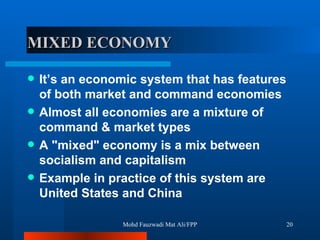
MIXED ECONOMY It’s an economic system that has features of both market and command economies Almost all economies are a mixture of command & market types  A "mixed" economy is a mix between socialism and capitalism  Example in practice of this system are United States and China  Mohd Fauzwadi Mat Ali/FPP
Cont’ In a mixed economy, there is a sharing of power between individuals and the government  Individuals own businesses but there is more government regulation in order to protect consumers and workers from unfair practices. The government associated with such economies may call itself democratic or socialist, or a combination of the two  Example in practice of this system are United States, Great Britain, Japan etc. Mohd Fauzwadi Mat Ali/FPP
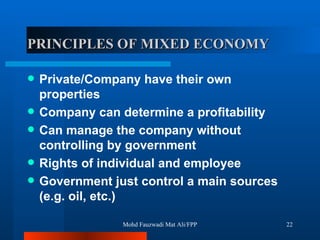
PRINCIPLES OF MIXED ECONOMY   Private/Company have their own properties  Company can determine a profitability Can manage the company without controlling by government Rights of individual and employee Government just control a main sources (e.g. oil, etc.) Mohd Fauzwadi Mat Ali/FPP
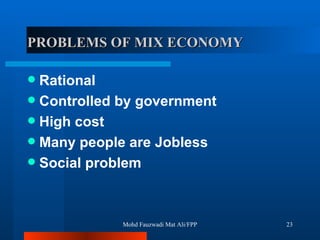
PROBLEMS OF MIX ECONOMY Rational Controlled by government High cost Many people are Jobless Social problem  Mohd Fauzwadi Mat Ali/FPP
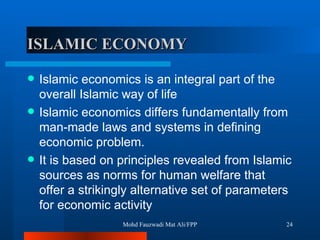
ISLAMIC ECONOMY   Islamic economics is an integral part of the overall Islamic way of life  Islamic economics differs fundamentally from man-made laws and systems in defining economic problem.  It is based on principles revealed from Islamic sources as norms for human welfare that offer a strikingly alternative set of parameters for economic activity  Mohd Fauzwadi Mat Ali/FPP
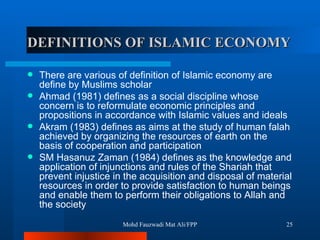
DEFINITIONS OF ISLAMIC ECONOMY There are various of definition of Islamic economy are define by Muslims scholar Ahmad (1981) defines as a social discipline whose concern is to reformulate economic principles and propositions in accordance with Islamic values and ideals  Akram (1983) defines as aims at the study of human falah achieved by organizing the resources of earth on the basis of cooperation and participation  SM Hasanuz Zaman (1984) defines as the knowledge and application of injunctions and rules of the Shariah that prevent injustice in the acquisition and disposal of material resources in order to provide satisfaction to human beings and enable them to perform their obligations to Allah and the society Mohd Fauzwadi Mat Ali/FPP
Cont.. Mannan (1986) defines as studies of a social science in the economic problems of people to fill with the values of Islam  Hailani (1991) defines as all activities for using and managing the natural sources by individual or society to perform their obligations to Allah Khurshid Ahmad (1992) defines as a systematic effort to try to understand the economic problem and human's behavior from an Islamic perspective  Mohd Fauzwadi Mat Ali/FPP
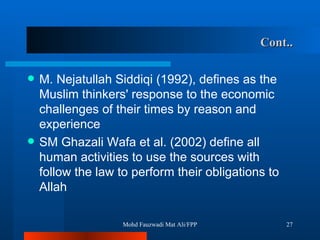
Cont.. M. Nejatullah Siddiqi (1992), defines as the Muslim thinkers' response to the economic challenges of their times by reason and experience SM Ghazali Wafa et al. (2002) define all human activities to use the sources with follow the law to perform their obligations to Allah Mohd Fauzwadi Mat Ali/FPP
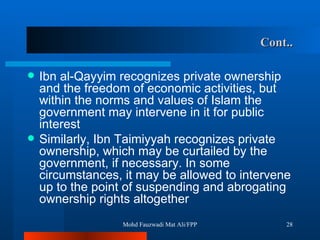
Cont.. Ibn al-Qayyim recognizes private ownership and the freedom of economic activities, but within the norms and values of Islam the government may intervene in it for public interest Similarly, Ibn Taimiyyah recognizes private ownership, which may be curtailed by the government, if necessary. In some circumstances, it may be allowed to intervene up to the point of suspending and abrogating ownership rights altogether  Mohd Fauzwadi Mat Ali/FPP
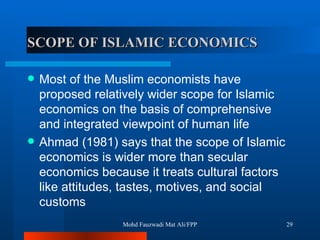
SCOPE OF ISLAMIC ECONOMICS  Most of the Muslim economists have proposed relatively wider scope for Islamic economics on the basis of comprehensive and integrated viewpoint of human life Ahmad (1981) says that the scope of Islamic economics is wider more than secular economics because it treats cultural factors like attitudes, tastes, motives, and social customs  Mohd Fauzwadi Mat Ali/FPP
Cont’ Akram (1983) also says a wider role of Islamic economics because it’s deals with a wide-ranging set of issues, such as: property rights,  the incentives system,  allocation of resources,  types of economic freedom,  the system of economic decision-making  the proper role of government Mohd Fauzwadi Mat Ali/FPP
THE PHILOSOPHY OF ISLAMICS ECONOMY SM Ghazali Wafa et al. (2002) are determine the philosophies of Islamic economy. There are comprise: Unity (Tawhid)  Rubiyyah Tazkiyah End of the day Human as a khalifah (leader) Brotherhood Ownerships Mohd Fauzwadi Mat Ali/FPP
Cont’ Chaudhry (1988) emphasizes on the social aspects of Islamic economics in which individuals interact on the basis of Islamic ethics. He identifies God consciousness (taqwa) and worship (Ibadah) to be the key element influencing the micro-economic behavior of the individuals Mohd Fauzwadi Mat Ali/FPP
Cont’ The  philosophies of Islamic economy are based on several fundamentals tawhid, a comprehensive concept, implying complete submission of oneself to the one and unique being, who is the creator, sustainer, owner of everything, all-knowing, all-wise, and the most powerful.  risalah, an institution of prophethood, which brings the revealed guidance in all dimensions of human life from Allah in the form of the Kitab, and demonstrates its application through practice which is recorded in the form of Sunnah.  akhirah, the hereafter for accountability, and for getting the outcome of all deeds including economic activities economic and non-economic well-being for leading a good life and discharging socio-Islamic obligations in this world and for achieving the home of hereafter.  Mohd Fauzwadi Mat Ali/FPP
THE PURPOSES OF ISLAMIC ECONOMY The main objectives of Islamic economy are made to contribute richly to the achievement of the major socio-economic goals of Islam Others objective are: Broad-based economic well-being with full employment and optimum rate of economic growth Stability in the value of money to enable the medium of exchange to be a reliable and a stable  A return is ensured on investment and development projects Mohd Fauzwadi Mat Ali/FPP
Cont’ Socio-economic justice and equitable distribution of income and wealth to ensure circulation of wealth to make sure that wealth does not concentrate in a few hands   Mohd Fauzwadi Mat Ali/FPP
Cont’ A. Hamid (2006) describes a goals of Islamic economy  to achieve:  Social justice  Distributive a justice  Prevention of income  Redistribution of wealth (charity)  Prohibition of wastefulness  Welfare  Literacy  Human development  Mohd Fauzwadi Mat Ali/FPP
THE BASIC PRINCIPLES OF ISLAMIC ECONOMY According to Afzalur rahman, A basic principles of Islamic economy are: Determine the level of individual liberty  Recognize the right of property Control the economy inequality within natural limits Maintain the equality of social  Increase the social security Prohibition a wider circulation of wealth  Prohibition of anti-social institutions Recognize  of social and individual welfare Mohd Fauzwadi Mat Ali/FPP
Cont’ Abul Kalam (1991) says that the principles of Islamic business are:  Protect the spiritual norms of Islam Produce a lawful (Halal) of supply and demand. It was related with three aspects of life: in edible things, in financial matters, and in the daily business of life Mohd Fauzwadi Mat Ali/FPP
Cont’ Talib Al-Anjari states a principles of Islamic economy is an economy that always puts full employment as the first priority. And, degrades and prohibits unwanted or unnecessary consumption  Mohd Fauzwadi Mat Ali/FPP
PERSPECTIVES OF HUMAN BEHAVIOR IN ISLAMIC ECONOMY It’s consist 6 principles: Rights to create, change, own something Suitable with human characters Ownership Injustice are prohibited Consider a human right among society Mohd Fauzwadi Mat Ali/FPP
BENEFITS OF ISLAMIC ECONOMY Human are borrow the sources by Allah Recognize a human right helpful Use the sources with productive Safety a rights of community  Mohd Fauzwadi Mat Ali/FPP
STRUCTURES OF ISLAMIC ECONOMY According to SM Ghazali Wafa et al. (2002), structure of Islamic economy consist 3 main sectors. It’s: Public – politics, administration, etc Private – business, commerce, etc Volunteer – foundation, social welfare, etc Mohd Fauzwadi Mat Ali/FPP
AN IMPLEMENTATIONS  OF ISLAMIC ECONOMY According to SM Ghazali Wafa et al. (2002), an implementations of Islamic economy should be consider 3 factors: Unity (Tawhid) Vicegerency/Leadership (Khilafah) Justice (‘Adalah) Mohd Fauzwadi Mat Ali/FPP
Cont’ According to Choudhury (2000), Islamic economy instruments are a systemically unified knowledge-induced general equilibrium framework.  The 5 major Islamic economic instruments are:  abolition of interest profit-sharing under economic cooperation between labor and capital joint ventures and equity participation  the institution of charity avoidance of wasteful use of resources Mohd Fauzwadi Mat Ali/FPP
Mohd Fauzwadi Mat Ali/FPP http://wanbk.page.tl

Chapter 3

  • 1.
    CHAPTER 3 THEFOUNDATIONS OF ISLAMIC ECONOMIC SYSTEM Mohd Fauzwadi Mat Ali/FPP
  • 2.
    OBJECTIVES OF THISCHAPTER To identify the types of economic systems To compare the types of economic systems To describe the philosophy and principles of Islamic economy Mohd Fauzwadi Mat Ali/FPP
  • 3.
    INTRODUCTION There aremany terms that are used to describe the types of economies that exist in the world In reality there are no pure capitalism economies, nor are there any pure central planning economies For example, even in the United States, where free enterprise reigns, the government plays a major role in the economy. Minimum wages, social security, and regulatory policies are examples of government involvement. Mohd Fauzwadi Mat Ali/FPP
  • 4.
    Cont’ In China,for example, some private ownership of businesses is allowed, however the government still maintains tight control over the factors of production and prices. While we could say that both the United States and China are mixed economies because they contain both capitalism and central planning economic features, to do so would be misleading because the role that the respective governments play in the economy are quite different. Mohd Fauzwadi Mat Ali/FPP
  • 5.
    Cont’ It’s canbe say that a differences countries have differences of economic systems The economic system of a country determines how things are produced, distributed and sold Mohd Fauzwadi Mat Ali/FPP
  • 6.
    DEFINITION OF ECONOMICSEconomics is the study of how people choose to use their scarce resources (land, labor, capital, entrepreneur) in an attempt to satisfy unlimited wants Mohd Fauzwadi Mat Ali/FPP
  • 7.
    DEFINITION OF ECONOMICSSYSTEM An economic system is a set of mechanisms and institutions that resolve the what, how and for whom questions Economic systems determine how people produce and consume goods and how wealth is distributed and evolves Mohd Fauzwadi Mat Ali/FPP
  • 8.
    Cont’ An economicsystem is a mechanism (social institution) which deals with the production, distribution and consumption of goods and services in a particular society Mohd Fauzwadi Mat Ali/FPP
  • 9.
    TYPES OF ECONOMICSYSTEM Traditional economy Capitalism economy Central planning economy Mixed economy Islamic economy Mohd Fauzwadi Mat Ali/FPP
  • 10.
    CAPITALISM ECONOMY Capitalismeconomy is an economic system in which individuals own and operate the factors of production It’s a private ownership of resources and the use of prices to coordinate economic activity It’s also known as market economy Mohd Fauzwadi Mat Ali/FPP
  • 11.
    Cont’ Based onthe free trade and market A limited control by government Mohd Fauzwadi Mat Ali/FPP
  • 12.
    PRINCIPLES OF CAPITALISMECONOMY High competitiveness Individual have a their own properties Profitability incentive Free trade economy Consumer power Limited control by government Mohd Fauzwadi Mat Ali/FPP
  • 13.
    PROBLEMS OF CAPITALISMECONOMY Rational Socio-economy are not stable High competitiveness Monopoly The prices in the marketplace reflect consumer preferences The distribution of property and income could be very unequal Mohd Fauzwadi Mat Ali/FPP
  • 14.
    CENTRAL PLANNING ECONOMYCentral planning economy is a economic system in which the government owns and operates the factors of production It’s a centralized economic planning and public ownership of resources Example in practice of this system are Cuba, China & Laos Mohd Fauzwadi Mat Ali/FPP
  • 15.
    PRINCIPLES OF CENTRALPLANNING ECONOMY The government own all wealth or properties The stability of socio economy Controlled by government Mohd Fauzwadi Mat Ali/FPP
  • 16.
    PROBLEMS OF CENTRALPLANNING ECONOMY Rational A limited of individual freedom Contrast with the human character Stereotype Lack of moral education and religious Increase a racism or group among societies Mohd Fauzwadi Mat Ali/FPP
  • 17.
    Cont’ In thissystem, the government makes decisions about how products and services are distributed It’s also same with the socialism economy and communism economy Mohd Fauzwadi Mat Ali/FPP
  • 18.
    SOCIALISM ECONOMY Socialismis a political system that denies the validity of property rights. It claims that all property is communally owned Instead of being a variant of property rights, this is an invalidation of those rights. It destroys the concept of rights by invalidating their base in human life. Mohd Fauzwadi Mat Ali/FPP
  • 19.
    COMMUNISM ECONOMY Communismis a form of government where almost all factors of production are owned by the government, which also makes all decisions. Mohd Fauzwadi Mat Ali/FPP
  • 20.
    MIXED ECONOMY It’san economic system that has features of both market and command economies Almost all economies are a mixture of command & market types A "mixed" economy is a mix between socialism and capitalism Example in practice of this system are United States and China Mohd Fauzwadi Mat Ali/FPP
  • 21.
    Cont’ In amixed economy, there is a sharing of power between individuals and the government Individuals own businesses but there is more government regulation in order to protect consumers and workers from unfair practices. The government associated with such economies may call itself democratic or socialist, or a combination of the two Example in practice of this system are United States, Great Britain, Japan etc. Mohd Fauzwadi Mat Ali/FPP
  • 22.
    PRINCIPLES OF MIXEDECONOMY Private/Company have their own properties Company can determine a profitability Can manage the company without controlling by government Rights of individual and employee Government just control a main sources (e.g. oil, etc.) Mohd Fauzwadi Mat Ali/FPP
  • 23.
    PROBLEMS OF MIXECONOMY Rational Controlled by government High cost Many people are Jobless Social problem Mohd Fauzwadi Mat Ali/FPP
  • 24.
    ISLAMIC ECONOMY Islamic economics is an integral part of the overall Islamic way of life Islamic economics differs fundamentally from man-made laws and systems in defining economic problem. It is based on principles revealed from Islamic sources as norms for human welfare that offer a strikingly alternative set of parameters for economic activity Mohd Fauzwadi Mat Ali/FPP
  • 25.
    DEFINITIONS OF ISLAMICECONOMY There are various of definition of Islamic economy are define by Muslims scholar Ahmad (1981) defines as a social discipline whose concern is to reformulate economic principles and propositions in accordance with Islamic values and ideals Akram (1983) defines as aims at the study of human falah achieved by organizing the resources of earth on the basis of cooperation and participation SM Hasanuz Zaman (1984) defines as the knowledge and application of injunctions and rules of the Shariah that prevent injustice in the acquisition and disposal of material resources in order to provide satisfaction to human beings and enable them to perform their obligations to Allah and the society Mohd Fauzwadi Mat Ali/FPP
  • 26.
    Cont.. Mannan (1986)defines as studies of a social science in the economic problems of people to fill with the values of Islam Hailani (1991) defines as all activities for using and managing the natural sources by individual or society to perform their obligations to Allah Khurshid Ahmad (1992) defines as a systematic effort to try to understand the economic problem and human's behavior from an Islamic perspective Mohd Fauzwadi Mat Ali/FPP
  • 27.
    Cont.. M. NejatullahSiddiqi (1992), defines as the Muslim thinkers' response to the economic challenges of their times by reason and experience SM Ghazali Wafa et al. (2002) define all human activities to use the sources with follow the law to perform their obligations to Allah Mohd Fauzwadi Mat Ali/FPP
  • 28.
    Cont.. Ibn al-Qayyimrecognizes private ownership and the freedom of economic activities, but within the norms and values of Islam the government may intervene in it for public interest Similarly, Ibn Taimiyyah recognizes private ownership, which may be curtailed by the government, if necessary. In some circumstances, it may be allowed to intervene up to the point of suspending and abrogating ownership rights altogether Mohd Fauzwadi Mat Ali/FPP
  • 29.
    SCOPE OF ISLAMICECONOMICS Most of the Muslim economists have proposed relatively wider scope for Islamic economics on the basis of comprehensive and integrated viewpoint of human life Ahmad (1981) says that the scope of Islamic economics is wider more than secular economics because it treats cultural factors like attitudes, tastes, motives, and social customs Mohd Fauzwadi Mat Ali/FPP
  • 30.
    Cont’ Akram (1983)also says a wider role of Islamic economics because it’s deals with a wide-ranging set of issues, such as: property rights, the incentives system, allocation of resources, types of economic freedom, the system of economic decision-making the proper role of government Mohd Fauzwadi Mat Ali/FPP
  • 31.
    THE PHILOSOPHY OFISLAMICS ECONOMY SM Ghazali Wafa et al. (2002) are determine the philosophies of Islamic economy. There are comprise: Unity (Tawhid) Rubiyyah Tazkiyah End of the day Human as a khalifah (leader) Brotherhood Ownerships Mohd Fauzwadi Mat Ali/FPP
  • 32.
    Cont’ Chaudhry (1988)emphasizes on the social aspects of Islamic economics in which individuals interact on the basis of Islamic ethics. He identifies God consciousness (taqwa) and worship (Ibadah) to be the key element influencing the micro-economic behavior of the individuals Mohd Fauzwadi Mat Ali/FPP
  • 33.
    Cont’ The philosophies of Islamic economy are based on several fundamentals tawhid, a comprehensive concept, implying complete submission of oneself to the one and unique being, who is the creator, sustainer, owner of everything, all-knowing, all-wise, and the most powerful. risalah, an institution of prophethood, which brings the revealed guidance in all dimensions of human life from Allah in the form of the Kitab, and demonstrates its application through practice which is recorded in the form of Sunnah. akhirah, the hereafter for accountability, and for getting the outcome of all deeds including economic activities economic and non-economic well-being for leading a good life and discharging socio-Islamic obligations in this world and for achieving the home of hereafter. Mohd Fauzwadi Mat Ali/FPP
  • 34.
    THE PURPOSES OFISLAMIC ECONOMY The main objectives of Islamic economy are made to contribute richly to the achievement of the major socio-economic goals of Islam Others objective are: Broad-based economic well-being with full employment and optimum rate of economic growth Stability in the value of money to enable the medium of exchange to be a reliable and a stable A return is ensured on investment and development projects Mohd Fauzwadi Mat Ali/FPP
  • 35.
    Cont’ Socio-economic justiceand equitable distribution of income and wealth to ensure circulation of wealth to make sure that wealth does not concentrate in a few hands Mohd Fauzwadi Mat Ali/FPP
  • 36.
    Cont’ A. Hamid(2006) describes a goals of Islamic economy to achieve: Social justice Distributive a justice Prevention of income Redistribution of wealth (charity) Prohibition of wastefulness Welfare Literacy Human development Mohd Fauzwadi Mat Ali/FPP
  • 37.
    THE BASIC PRINCIPLESOF ISLAMIC ECONOMY According to Afzalur rahman, A basic principles of Islamic economy are: Determine the level of individual liberty Recognize the right of property Control the economy inequality within natural limits Maintain the equality of social Increase the social security Prohibition a wider circulation of wealth Prohibition of anti-social institutions Recognize of social and individual welfare Mohd Fauzwadi Mat Ali/FPP
  • 38.
    Cont’ Abul Kalam(1991) says that the principles of Islamic business are: Protect the spiritual norms of Islam Produce a lawful (Halal) of supply and demand. It was related with three aspects of life: in edible things, in financial matters, and in the daily business of life Mohd Fauzwadi Mat Ali/FPP
  • 39.
    Cont’ Talib Al-Anjaristates a principles of Islamic economy is an economy that always puts full employment as the first priority. And, degrades and prohibits unwanted or unnecessary consumption Mohd Fauzwadi Mat Ali/FPP
  • 40.
    PERSPECTIVES OF HUMANBEHAVIOR IN ISLAMIC ECONOMY It’s consist 6 principles: Rights to create, change, own something Suitable with human characters Ownership Injustice are prohibited Consider a human right among society Mohd Fauzwadi Mat Ali/FPP
  • 41.
    BENEFITS OF ISLAMICECONOMY Human are borrow the sources by Allah Recognize a human right helpful Use the sources with productive Safety a rights of community Mohd Fauzwadi Mat Ali/FPP
  • 42.
    STRUCTURES OF ISLAMICECONOMY According to SM Ghazali Wafa et al. (2002), structure of Islamic economy consist 3 main sectors. It’s: Public – politics, administration, etc Private – business, commerce, etc Volunteer – foundation, social welfare, etc Mohd Fauzwadi Mat Ali/FPP
  • 43.
    AN IMPLEMENTATIONS OF ISLAMIC ECONOMY According to SM Ghazali Wafa et al. (2002), an implementations of Islamic economy should be consider 3 factors: Unity (Tawhid) Vicegerency/Leadership (Khilafah) Justice (‘Adalah) Mohd Fauzwadi Mat Ali/FPP
  • 44.
    Cont’ According toChoudhury (2000), Islamic economy instruments are a systemically unified knowledge-induced general equilibrium framework. The 5 major Islamic economic instruments are: abolition of interest profit-sharing under economic cooperation between labor and capital joint ventures and equity participation the institution of charity avoidance of wasteful use of resources Mohd Fauzwadi Mat Ali/FPP
  • 45.
    Mohd Fauzwadi MatAli/FPP http://wanbk.page.tl