Islamic economics
system
vs
Conventional economics
system
by
Saqib Iqbal (MBA 2.5)
Objectives
 Introduction
 What is Islamic economics system
four principles
 conventional economics system and their view
 basic components of Islamic economy .
Intrduction
 Conventional economy is an economy that already been adopted and applied in
an economic society
 So, when it linked with the economy the conventional system can be considered
as an economic system that has been widely practiced.
 Islamic economic system is based on the proceedings of al- quran and al- sunnah.
 The direction of economic systems is to bring al-falah concept of success in this
world and hereafter.
What is Islamic economics system ?
Islamic economy system define as a collection of general economic principles, which
are derived from Quran and Sunnah and the economic structure that is based on those
principles.
Islamic Economic system is based on four principles
1. All wealth belongs to Almighty Allah
2. Man is the trustee of the wealth
3. Hoarding of wealth is prohibited
4. Wealth must be in circulation at all time
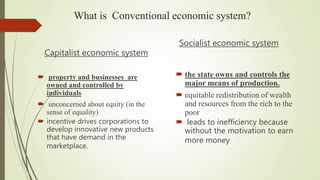
What is Conventional economic system?
Capitalist economic system
 property and businesses are
owned and controlled by
individuals
 unconcerned about equity (in the
sense of equality)
 incentive drives corporations to
develop innovative new products
that have demand in the
marketplace.
Socialist economic system
 the state owns and controls the
major means of production.
 equitable redistribution of wealth
and resources from the rich to the
poor
 leads to inefficiency because
without the motivation to earn
more money
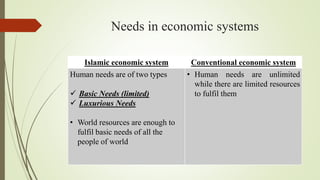
Needs in economic systems
Islamic economic system Conventional economic system
Human needs are of two types
 Basic Needs (limited)
 Luxurious Needs
• World resources are enough to
fulfil basic needs of all the
people of world
• Human needs are unlimited
while there are limited resources
to fulfil them
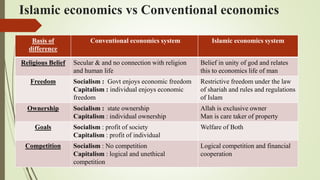
Islamic economics vs Conventional economics
Basis of
difference
Conventional economics system Islamic economics system
Religious Belief Secular & and no connection with religion
and human life
Belief in unity of god and relates
this to economics life of man
Freedom Socialism : Govt enjoys economic freedom
Capitalism : individual enjoys economic
freedom
Restrictive freedom under the law
of shariah and rules and regulations
of Islam
Ownership Socialism : state ownership
Capitalism : individual ownership
Allah is exclusive owner
Man is care taker of property
Goals Socialism : profit of society
Capitalism : profit of individual
Welfare of Both
Competition Socialism : No competition
Capitalism : logical and unethical
competition
Logical competition and financial
cooperation
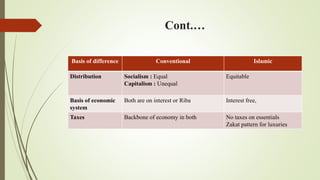
Cont.…
Basis of difference Conventional Islamic
Distribution Socialism : Equal
Capitalism : Unequal
Equitable
Basis of economic
system
Both are on interest or Riba Interest free,
Taxes Backbone of economy in both No taxes on essentials
Zakat pattern for luxuries
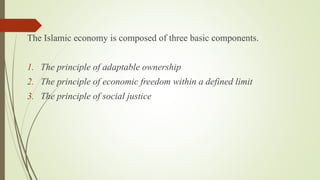
The Islamic economy is composed of three basic components.
1. The principle of adaptable ownership
2. The principle of economic freedom within a defined limit
3. The principle of social justice
1) Ownership
The individual ownership which contains personal House, car etc.
The Public ownership which contains rivers ,oceans , Forests etc.
The State ownership Which contains Government Buildings, Roads etc.
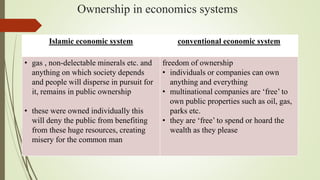
Ownership in economics systems
Islamic economic system conventional economic system
• gas , non-delectable minerals etc. and
anything on which society depends
and people will disperse in pursuit for
it, remains in public ownership
• these were owned individually this
will deny the public from benefiting
from these huge resources, creating
misery for the common man
freedom of ownership
• individuals or companies can own
anything and everything
• multinational companies are ‘free’ to
own public properties such as oil, gas,
parks etc.
• they are ‘free’ to spend or hoard the
wealth as they please
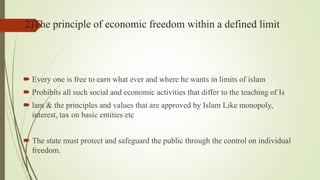
2)The principle of economic freedom within a defined limit
 Every one is free to earn what ever and where he wants in limits of islam
 Prohibits all such social and economic activities that differ to the teaching of Is
 lam & the principles and values that are approved by Islam Like monopoly,
interest, tax on basic entities etc
 The state must protect and safeguard the public through the control on individual
freedom.
3) The principle of social justice
two means for achieving social justice in Islam:
(a) Islamic Social Insurance
The State's duty is not providing the essential requirements of her
citizens only but this is the minimum which should be given, endeavor
for higher standard of living,
(b) Islamic Social Balance
Zakat awakens the individual’s social spirit with the truest practical
expression of brotherhood. When Muslims pay zakat, the society
behaves exactly like a family, the able helping the incapable, one
upholding all.
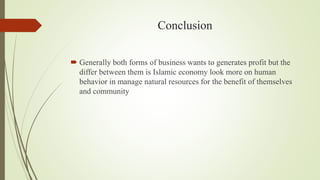
Conclusion
 Generally both forms of business wants to generates profit but the
differ between them is Islamic economy look more on human
behavior in manage natural resources for the benefit of themselves
and community
Islamic ecnomics system vs conventional ecnomic system

Islamic ecnomics system vs conventional ecnomic system

  • 1.
  • 2.
    Objectives  Introduction  Whatis Islamic economics system four principles  conventional economics system and their view  basic components of Islamic economy .
  • 3.
    Intrduction  Conventional economyis an economy that already been adopted and applied in an economic society  So, when it linked with the economy the conventional system can be considered as an economic system that has been widely practiced.  Islamic economic system is based on the proceedings of al- quran and al- sunnah.  The direction of economic systems is to bring al-falah concept of success in this world and hereafter.
  • 4.
    What is Islamiceconomics system ? Islamic economy system define as a collection of general economic principles, which are derived from Quran and Sunnah and the economic structure that is based on those principles. Islamic Economic system is based on four principles 1. All wealth belongs to Almighty Allah 2. Man is the trustee of the wealth 3. Hoarding of wealth is prohibited 4. Wealth must be in circulation at all time
  • 5.
    What is Conventionaleconomic system? Capitalist economic system  property and businesses are owned and controlled by individuals  unconcerned about equity (in the sense of equality)  incentive drives corporations to develop innovative new products that have demand in the marketplace. Socialist economic system  the state owns and controls the major means of production.  equitable redistribution of wealth and resources from the rich to the poor  leads to inefficiency because without the motivation to earn more money
  • 6.
    Needs in economicsystems Islamic economic system Conventional economic system Human needs are of two types  Basic Needs (limited)  Luxurious Needs • World resources are enough to fulfil basic needs of all the people of world • Human needs are unlimited while there are limited resources to fulfil them
  • 7.
    Islamic economics vsConventional economics Basis of difference Conventional economics system Islamic economics system Religious Belief Secular & and no connection with religion and human life Belief in unity of god and relates this to economics life of man Freedom Socialism : Govt enjoys economic freedom Capitalism : individual enjoys economic freedom Restrictive freedom under the law of shariah and rules and regulations of Islam Ownership Socialism : state ownership Capitalism : individual ownership Allah is exclusive owner Man is care taker of property Goals Socialism : profit of society Capitalism : profit of individual Welfare of Both Competition Socialism : No competition Capitalism : logical and unethical competition Logical competition and financial cooperation
  • 8.
    Cont.… Basis of differenceConventional Islamic Distribution Socialism : Equal Capitalism : Unequal Equitable Basis of economic system Both are on interest or Riba Interest free, Taxes Backbone of economy in both No taxes on essentials Zakat pattern for luxuries
  • 9.
    The Islamic economyis composed of three basic components. 1. The principle of adaptable ownership 2. The principle of economic freedom within a defined limit 3. The principle of social justice
  • 10.
    1) Ownership The individualownership which contains personal House, car etc. The Public ownership which contains rivers ,oceans , Forests etc. The State ownership Which contains Government Buildings, Roads etc.
  • 11.
    Ownership in economicssystems Islamic economic system conventional economic system • gas , non-delectable minerals etc. and anything on which society depends and people will disperse in pursuit for it, remains in public ownership • these were owned individually this will deny the public from benefiting from these huge resources, creating misery for the common man freedom of ownership • individuals or companies can own anything and everything • multinational companies are ‘free’ to own public properties such as oil, gas, parks etc. • they are ‘free’ to spend or hoard the wealth as they please
  • 12.
    2)The principle ofeconomic freedom within a defined limit  Every one is free to earn what ever and where he wants in limits of islam  Prohibits all such social and economic activities that differ to the teaching of Is  lam & the principles and values that are approved by Islam Like monopoly, interest, tax on basic entities etc  The state must protect and safeguard the public through the control on individual freedom.
  • 13.
    3) The principleof social justice two means for achieving social justice in Islam: (a) Islamic Social Insurance The State's duty is not providing the essential requirements of her citizens only but this is the minimum which should be given, endeavor for higher standard of living, (b) Islamic Social Balance Zakat awakens the individual’s social spirit with the truest practical expression of brotherhood. When Muslims pay zakat, the society behaves exactly like a family, the able helping the incapable, one upholding all.
  • 14.
    Conclusion  Generally bothforms of business wants to generates profit but the differ between them is Islamic economy look more on human behavior in manage natural resources for the benefit of themselves and community