The DES Algorithm Illustrated                                               3/14/09 7:37PM3/14/09


 [Email Reply]

                         The DES Algorithm Illustrated
                                               by J. Orlin Grabbe

      The DES (Data Encryption Standard) algorithm is the most widely
      used encryption algorithm in the world. For many years, and among
      many people, "secret code making" and DES have been
      synonymous. And despite the recent coup by the Electronic Frontier
      Foundation in creating a $220,000 machine to crack DES-encrypted
      messages, DES will live on in government and banking for years to
      come through a life- extending version called "triple-DES."

      How does DES work? This article explains the various steps
      involved in DES-encryption, illustrating each step by means of a
      simple example. Since the creation of DES, many other algorithms
      (recipes for changing data) have emerged which are based on design
      principles similar to DES. Once you understand the basic
      transformations that take place in DES, you will find it easy to
      follow the steps involved in these more recent algorithms.

      But first a bit of history of how DES came about is appropriate, as
      well as a look toward the future.

         The National Bureau of Standards Coaxes the Genie
                          from the Bottle

      On May 15, 1973, during the reign of Richard Nixon, the National
      Bureau of Standards (NBS) published a notice in the Federal
      Register soliciting proposals for cryptographic algorithms to protect
      data during transmission and storage. The notice explained why

http://www.math.tu-berlin.de/~hess/krypto-ws2006/des.htm                              Page 1 of 24
The DES Algorithm Illustrated                                                  3/14/09 7:37PM3/14/09


      encryption was an important issue.

              Over the last decade, there has been an accelerating
              increase in the accumulations and communication of digital
              data by government, industry and by other organizations in
              the private sector. The contents of these communicated and
              stored data often have very significant value and/or
              sensitivity. It is now common to find data transmissions
              which constitute funds transfers of several million dollars,
              purchase or sale of securities, warrants for arrests or arrest
              and conviction records being communicated between law
              enforcement agencies, airline reservations and ticketing
              representing investment and value both to the airline and
              passengers, and health and patient care records transmitted
              among physicians and treatment centers.

              The increasing volume, value and confidentiality of these
              records regularly transmitted and stored by commercial and
              government agencies has led to heightened recognition and
              concern over their exposures to unauthorized access and
              use. This misuse can be in the form of theft or defalcations
              of data records representing money, malicious modification
              of business inventories or the interception and misuse of
              confidential information about people. The need for
              protection is then apparent and urgent.

              It is recognized that encryption (otherwise known as
              scrambling, enciphering or privacy transformation)
              represents the only means of protecting such data during
              transmission and a useful means of protecting the content
              of data stored on various media, providing encryption of
              adequate strength can be devised and validated and is
              inherently integrable into system architecture. The National
              Bureau of Standards solicits proposed techniques and
http://www.math.tu-berlin.de/~hess/krypto-ws2006/des.htm                                 Page 2 of 24
The DES Algorithm Illustrated                                                   3/14/09 7:37PM3/14/09


              algorithms for computer data encryption. The Bureau also
              solicits recommended techniques for implementing the
              cryptographic function: for generating, evaluating, and
              protecting cryptographic keys; for maintaining files
              encoded under expiring keys; for making partial updates to
              encrypted files; and mixed clear and encrypted data to
              permit labelling, polling, routing, etc. The Bureau in its role
              for establishing standards and aiding government and
              industry in assessing technology, will arrange for the
              evaluation of protection methods in order to prepare
              guidelines.

      NBS waited for the responses to come in. It received none until
      August 6, 1974, three days before Nixon's resignation, when IBM
      submitted a candidate that it had developed internally under the
      name LUCIFER. After evaluating the algorithm with the help of the
      National Security Agency (NSA), the NBS adopted a modification
      of the LUCIFER algorithm as the new Data Encryption Standard
      (DES) on July 15, 1977.

      DES was quickly adopted for non-digital media, such as voice-
      grade public telephone lines. Within a couple of years, for example,
      International Flavors and Fragrances was using DES to protect its
      valuable formulas transmitted over the phone ("With Data
      Encryption, Scents Are Safe at IFF," Computerworld 14, No. 21, 95
      (1980).)

      Meanwhile, the banking industry, which is the largest user of
      encryption outside government, adopted DES as a wholesale
      banking standard. Standards for the wholesale banking industry are
      set by the American National Standards Institute (ANSI). ANSI
      X3.92, adopted in 1980, specified the use of the DES algorithm.


http://www.math.tu-berlin.de/~hess/krypto-ws2006/des.htm                                  Page 3 of 24
The DES Algorithm Illustrated                                             3/14/09 7:37PM3/14/09


                                Some Preliminary Examples of DES

      DES works on bits, or binary numbers--the 0s and 1s common to
      digital computers. Each group of four bits makes up a hexadecimal,
      or base 16, number. Binary "0001" is equal to the hexadecimal
      number "1", binary "1000" is equal to the hexadecimal number "8",
      "1001" is equal to the hexadecimal number "9", "1010" is equal to
      the hexadecimal number "A", and "1111" is equal to the
      hexadecimal number "F".

      DES works by encrypting groups of 64 message bits, which is the
      same as 16 hexadecimal numbers. To do the encryption, DES uses
      "keys" where are also apparently 16 hexadecimal numbers long, or
      apparently 64 bits long. However, every 8th key bit is ignored in
      the DES algorithm, so that the effective key size is 56 bits. But, in
      any case, 64 bits (16 hexadecimal digits) is the round number upon
      which DES is organized.

      For example, if we take the plaintext message
      "8787878787878787", and encrypt it with the DES key
      "0E329232EA6D0D73", we end up with the ciphertext
      "0000000000000000". If the ciphertext is decrypted with the same
      secret DES key "0E329232EA6D0D73", the result is the original
      plaintext "8787878787878787".

      This example is neat and orderly because our plaintext was exactly
      64 bits long. The same would be true if the plaintext happened to be
      a multiple of 64 bits. But most messages will not fall into this
      category. They will not be an exact multiple of 64 bits (that is, an
      exact multiple of 16 hexadecimal numbers).

      For example, take the message "Your lips are smoother than
      vaseline". This plaintext message is 38 bytes (76 hexadecimal
      digits) long. So this message must be padded with some extra bytes
http://www.math.tu-berlin.de/~hess/krypto-ws2006/des.htm                            Page 4 of 24
The DES Algorithm Illustrated                                             3/14/09 7:37PM3/14/09


      at the tail end for the encryption. Once the encrypted message has
      been decrypted, these extra bytes are thrown away. There are, of
      course, different padding schemes--different ways to add extra
      bytes. Here we will just add 0s at the end, so that the total message
      is a multiple of 8 bytes (or 16 hexadecimal digits, or 64 bits).

      The plaintext message "Your lips are smoother than vaseline" is, in
      hexadecimal,

      "596F7572206C6970 732061726520736D 6F6F746865722074
      68616E2076617365 6C696E650D0A".

      (Note here that the first 72 hexadecimal digits represent the English
      message, while "0D" is hexadecimal for Carriage Return, and "0A"
      is hexadecimal for Line Feed, showing that the message file has
      terminated.) We then pad this message with some 0s on the end, to
      get a total of 80 hexadecimal digits:

      "596F7572206C6970 732061726520736D 6F6F746865722074
      68616E2076617365 6C696E650D0A0000".

      If we then encrypt this plaintext message 64 bits (16 hexadecimal
      digits) at a time, using the same DES key "0E329232EA6D0D73"
      as before, we get the ciphertext:

      "C0999FDDE378D7ED 727DA00BCA5A84EE
      47F269A4D6438190 9DD52F78F5358499 828AC9B453E0E653".

      This is the secret code that can be transmitted or stored. Decrypting
      the ciphertext restores the original message "Your lips are smoother
      than vaseline". (Think how much better off Bill Clinton would be
      today, if Monica Lewinsky had used encryption on her Pentagon
      computer!)


http://www.math.tu-berlin.de/~hess/krypto-ws2006/des.htm                            Page 5 of 24
The DES Algorithm Illustrated                                                3/14/09 7:37PM3/14/09


                                      How DES Works in Detail

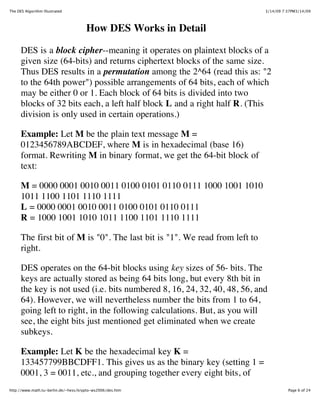
      DES is a block cipher--meaning it operates on plaintext blocks of a
      given size (64-bits) and returns ciphertext blocks of the same size.
      Thus DES results in a permutation among the 2^64 (read this as: "2
      to the 64th power") possible arrangements of 64 bits, each of which
      may be either 0 or 1. Each block of 64 bits is divided into two
      blocks of 32 bits each, a left half block L and a right half R. (This
      division is only used in certain operations.)

      Example: Let M be the plain text message M =
      0123456789ABCDEF, where M is in hexadecimal (base 16)
      format. Rewriting M in binary format, we get the 64-bit block of
      text:

      M = 0000 0001 0010 0011 0100 0101 0110 0111 1000 1001 1010
      1011 1100 1101 1110 1111
      L = 0000 0001 0010 0011 0100 0101 0110 0111
      R = 1000 1001 1010 1011 1100 1101 1110 1111

      The first bit of M is "0". The last bit is "1". We read from left to
      right.

      DES operates on the 64-bit blocks using key sizes of 56- bits. The
      keys are actually stored as being 64 bits long, but every 8th bit in
      the key is not used (i.e. bits numbered 8, 16, 24, 32, 40, 48, 56, and
      64). However, we will nevertheless number the bits from 1 to 64,
      going left to right, in the following calculations. But, as you will
      see, the eight bits just mentioned get eliminated when we create
      subkeys.

      Example: Let K be the hexadecimal key K =
      133457799BBCDFF1. This gives us as the binary key (setting 1 =
      0001, 3 = 0011, etc., and grouping together every eight bits, of
http://www.math.tu-berlin.de/~hess/krypto-ws2006/des.htm                               Page 6 of 24
The DES Algorithm Illustrated                                                         3/14/09 7:37PM3/14/09


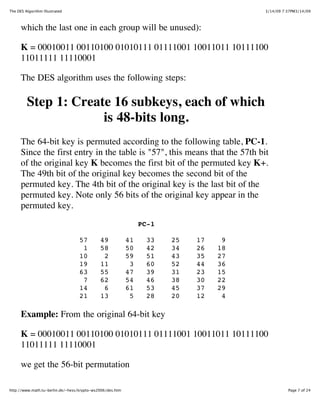
      which the last one in each group will be unused):

      K = 00010011 00110100 01010111 01111001 10011011 10111100
      11011111 11110001

      The DES algorithm uses the following steps:

         Step 1: Create 16 subkeys, each of which
                      is 48-bits long.
      The 64-bit key is permuted according to the following table, PC-1.
      Since the first entry in the table is "57", this means that the 57th bit
      of the original key K becomes the first bit of the permuted key K+.
      The 49th bit of the original key becomes the second bit of the
      permuted key. The 4th bit of the original key is the last bit of the
      permuted key. Note only 56 bits of the original key appear in the
      permuted key.
                                                                PC-1

                                   57        49            41     33   25   17    9
                                    1        58            50     42   34   26   18
                                   10         2            59     51   43   35   27
                                   19        11             3     60   52   44   36
                                   63        55            47     39   31   23   15
                                    7        62            54     46   38   30   22
                                   14         6            61     53   45   37   29
                                   21        13             5     28   20   12    4

      Example: From the original 64-bit key

      K = 00010011 00110100 01010111 01111001 10011011 10111100
      11011111 11110001

      we get the 56-bit permutation

http://www.math.tu-berlin.de/~hess/krypto-ws2006/des.htm                                        Page 7 of 24
The DES Algorithm Illustrated                                                 3/14/09 7:37PM3/14/09


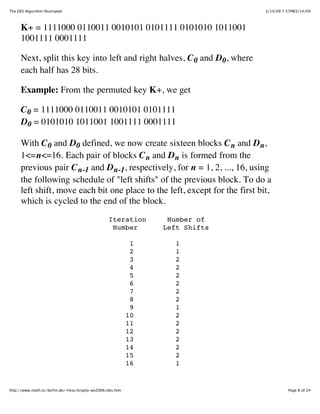
      K+ = 1111000 0110011 0010101 0101111 0101010 1011001
      1001111 0001111

      Next, split this key into left and right halves, C 0 and D0, where
      each half has 28 bits.

      Example: From the permuted key K+, we get

      C 0 = 1111000 0110011 0010101 0101111
      D0 = 0101010 1011001 1001111 0001111

      With C 0 and D0 defined, we now create sixteen blocks C n and Dn ,
      1<=n<=16. Each pair of blocks C n and Dn is formed from the
      previous pair C n-1 and Dn-1, respectively, for n = 1, 2, ..., 16, using
      the following schedule of "left shifts" of the previous block. To do a
      left shift, move each bit one place to the left, except for the first bit,
      which is cycled to the end of the block.
                                                 Iteration       Number of
                                                  Number        Left Shifts

                                                            1      1
                                                            2      1
                                                            3      2
                                                            4      2
                                                            5      2
                                                            6      2
                                                            7      2
                                                            8      2
                                                            9      1
                                                           10      2
                                                           11      2
                                                           12      2
                                                           13      2
                                                           14      2
                                                           15      2
                                                           16      1


http://www.math.tu-berlin.de/~hess/krypto-ws2006/des.htm                                Page 8 of 24
The DES Algorithm Illustrated                                                 3/14/09 7:37PM3/14/09


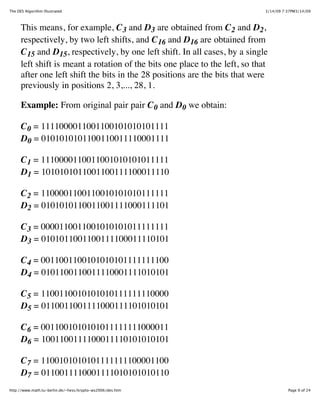
      This means, for example, C 3 and D3 are obtained from C 2 and D2,
      respectively, by two left shifts, and C 16 and D16 are obtained from
      C 15 and D15, respectively, by one left shift. In all cases, by a single
      left shift is meant a rotation of the bits one place to the left, so that
      after one left shift the bits in the 28 positions are the bits that were
      previously in positions 2, 3,..., 28, 1.

      Example: From original pair pair C 0 and D0 we obtain:

      C 0 = 1111000011001100101010101111
      D0 = 0101010101100110011110001111

      C 1 = 1110000110011001010101011111
      D1 = 1010101011001100111100011110

      C 2 = 1100001100110010101010111111
      D2 = 0101010110011001111000111101

      C 3 = 0000110011001010101011111111
      D3 = 0101011001100111100011110101

      C 4 = 0011001100101010101111111100
      D4 = 0101100110011110001111010101

      C 5 = 1100110010101010111111110000
      D5 = 0110011001111000111101010101

      C 6 = 0011001010101011111111000011
      D6 = 1001100111100011110101010101

      C 7 = 1100101010101111111100001100
      D7 = 0110011110001111010101010110
http://www.math.tu-berlin.de/~hess/krypto-ws2006/des.htm                                Page 9 of 24
The DES Algorithm Illustrated                                           3/14/09 7:37PM3/14/09


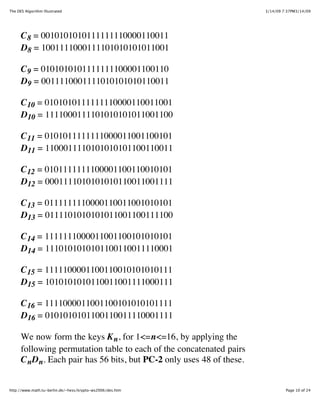
      C 8 = 0010101010111111110000110011
      D8 = 1001111000111101010101011001

      C 9 = 0101010101111111100001100110
      D9 = 0011110001111010101010110011

      C 10 = 0101010111111110000110011001
      D10 = 1111000111101010101011001100

      C 11 = 0101011111111000011001100101
      D11 = 1100011110101010101100110011

      C 12 = 0101111111100001100110010101
      D12 = 0001111010101010110011001111

      C 13 = 0111111110000110011001010101
      D13 = 0111101010101011001100111100

      C 14 = 1111111000011001100101010101
      D14 = 1110101010101100110011110001

      C 15 = 1111100001100110010101010111
      D15 = 1010101010110011001111000111

      C 16 = 1111000011001100101010101111
      D16 = 0101010101100110011110001111

      We now form the keys K n , for 1<=n<=16, by applying the
      following permutation table to each of the concatenated pairs
      C n Dn . Each pair has 56 bits, but PC-2 only uses 48 of these.


http://www.math.tu-berlin.de/~hess/krypto-ws2006/des.htm                         Page 10 of 24
The DES Algorithm Illustrated                                                         3/14/09 7:37PM3/14/09


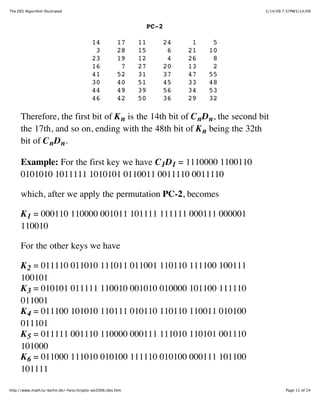
                                                                PC-2

                                         14          17    11          24    1    5
                                          3          28    15           6   21   10
                                         23          19    12           4   26    8
                                         16           7    27          20   13    2
                                         41          52    31          37   47   55
                                         30          40    51          45   33   48
                                         44          49    39          56   34   53
                                         46          42    50          36   29   32

      Therefore, the first bit of K n is the 14th bit of C n Dn , the second bit
      the 17th, and so on, ending with the 48th bit of K n being the 32th
      bit of C n Dn .

      Example: For the first key we have C 1D1 = 1110000 1100110
      0101010 1011111 1010101 0110011 0011110 0011110

      which, after we apply the permutation PC-2, becomes

      K 1 = 000110 110000 001011 101111 111111 000111 000001
      110010

      For the other keys we have

      K 2 = 011110 011010 111011 011001 110110 111100 100111
      100101
      K 3 = 010101 011111 110010 001010 010000 101100 111110
      011001
      K 4 = 011100 101010 110111 010110 110110 110011 010100
      011101
      K 5 = 011111 001110 110000 000111 111010 110101 001110
      101000
      K 6 = 011000 111010 010100 111110 010100 000111 101100
      101111

http://www.math.tu-berlin.de/~hess/krypto-ws2006/des.htm                                       Page 11 of 24
The DES Algorithm Illustrated                                              3/14/09 7:37PM3/14/09


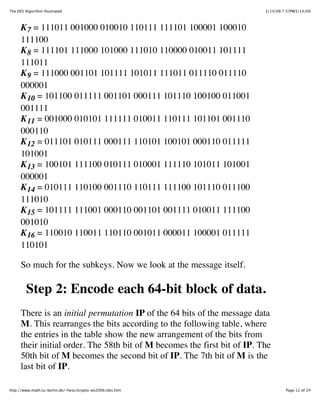
      K 7 = 111011 001000 010010 110111 111101 100001 100010
      111100
      K 8 = 111101 111000 101000 111010 110000 010011 101111
      111011
      K 9 = 111000 001101 101111 101011 111011 011110 011110
      000001
      K 10 = 101100 011111 001101 000111 101110 100100 011001
      001111
      K 11 = 001000 010101 111111 010011 110111 101101 001110
      000110
      K 12 = 011101 010111 000111 110101 100101 000110 011111
      101001
      K 13 = 100101 111100 010111 010001 111110 101011 101001
      000001
      K 14 = 010111 110100 001110 110111 111100 101110 011100
      111010
      K 15 = 101111 111001 000110 001101 001111 010011 111100
      001010
      K 16 = 110010 110011 110110 001011 000011 100001 011111
      110101

      So much for the subkeys. Now we look at the message itself.

         Step 2: Encode each 64-bit block of data.
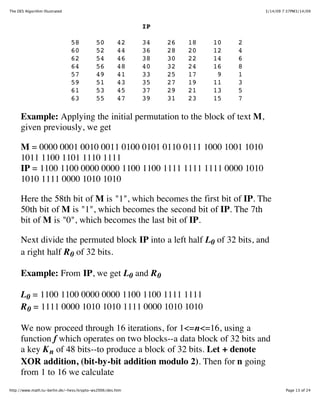
      There is an initial permutation IP of the 64 bits of the message data
      M. This rearranges the bits according to the following table, where
      the entries in the table show the new arrangement of the bits from
      their initial order. The 58th bit of M becomes the first bit of IP. The
      50th bit of M becomes the second bit of IP. The 7th bit of M is the
      last bit of IP.

http://www.math.tu-berlin.de/~hess/krypto-ws2006/des.htm                            Page 12 of 24
The DES Algorithm Illustrated                                                      3/14/09 7:37PM3/14/09


                                                           IP

                                58         50        42    34   26   18   10   2
                                60         52        44    36   28   20   12   4
                                62         54        46    38   30   22   14   6
                                64         56        48    40   32   24   16   8
                                57         49        41    33   25   17    9   1
                                59         51        43    35   27   19   11   3
                                61         53        45    37   29   21   13   5
                                63         55        47    39   31   23   15   7

      Example: Applying the initial permutation to the block of text M,
      given previously, we get

      M = 0000 0001 0010 0011 0100 0101 0110 0111 1000 1001 1010
      1011 1100 1101 1110 1111
      IP = 1100 1100 0000 0000 1100 1100 1111 1111 1111 0000 1010
      1010 1111 0000 1010 1010

      Here the 58th bit of M is "1", which becomes the first bit of IP. The
      50th bit of M is "1", which becomes the second bit of IP. The 7th
      bit of M is "0", which becomes the last bit of IP.

      Next divide the permuted block IP into a left half L0 of 32 bits, and
      a right half R 0 of 32 bits.

      Example: From IP, we get L0 and R 0

      L0 = 1100 1100 0000 0000 1100 1100 1111 1111
      R 0 = 1111 0000 1010 1010 1111 0000 1010 1010

      We now proceed through 16 iterations, for 1<=n<=16, using a
      function f which operates on two blocks--a data block of 32 bits and
      a key K n of 48 bits--to produce a block of 32 bits. Let + denote
      XOR addition, (bit-by-bit addition modulo 2). Then for n going
      from 1 to 16 we calculate
http://www.math.tu-berlin.de/~hess/krypto-ws2006/des.htm                                    Page 13 of 24
The DES Algorithm Illustrated                                                  3/14/09 7:37PM3/14/09


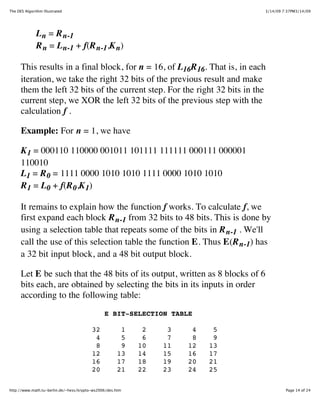
              Ln = R n-1
              R n = Ln-1 + f(R n-1,K n )

      This results in a final block, for n = 16, of L16R 16. That is, in each
      iteration, we take the right 32 bits of the previous result and make
      them the left 32 bits of the current step. For the right 32 bits in the
      current step, we XOR the left 32 bits of the previous step with the
      calculation f .

      Example: For n = 1, we have

      K 1 = 000110 110000 001011 101111 111111 000111 000001
      110010
      L1 = R 0 = 1111 0000 1010 1010 1111 0000 1010 1010
      R 1 = L0 + f(R 0,K 1)

      It remains to explain how the function f works. To calculate f, we
      first expand each block R n-1 from 32 bits to 48 bits. This is done by
      using a selection table that repeats some of the bits in R n-1 . We'll
      call the use of this selection table the function E. Thus E(R n-1) has
      a 32 bit input block, and a 48 bit output block.

      Let E be such that the 48 bits of its output, written as 8 blocks of 6
      bits each, are obtained by selecting the bits in its inputs in order
      according to the following table:
                                               E BIT-SELECTION TABLE

                                         32           1     2    3    4    5
                                          4           5     6    7    8    9
                                          8           9    10   11   12   13
                                         12          13    14   15   16   17
                                         16          17    18   19   20   21
                                         20          21    22   23   24   25

http://www.math.tu-berlin.de/~hess/krypto-ws2006/des.htm                                Page 14 of 24
The DES Algorithm Illustrated                                                      3/14/09 7:37PM3/14/09


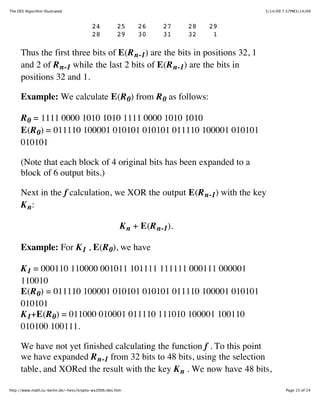
                                         24          25     26     27    28   29
                                         28          29     30     31    32    1

      Thus the first three bits of E(R n-1) are the bits in positions 32, 1
      and 2 of R n-1 while the last 2 bits of E(R n-1) are the bits in
      positions 32 and 1.

      Example: We calculate E(R 0) from R 0 as follows:

      R 0 = 1111 0000 1010 1010 1111 0000 1010 1010
      E(R 0) = 011110 100001 010101 010101 011110 100001 010101
      010101

      (Note that each block of 4 original bits has been expanded to a
      block of 6 output bits.)

      Next in the f calculation, we XOR the output E(R n-1) with the key
      Kn:

                                                       K n + E(R n-1).

      Example: For K 1 , E(R 0), we have

      K 1 = 000110 110000 001011 101111 111111 000111 000001
      110010
      E(R 0) = 011110 100001 010101 010101 011110 100001 010101
      010101
      K 1+E(R 0) = 011000 010001 011110 111010 100001 100110
      010100 100111.

      We have not yet finished calculating the function f . To this point
      we have expanded R n-1 from 32 bits to 48 bits, using the selection
      table, and XORed the result with the key K n . We now have 48 bits,

http://www.math.tu-berlin.de/~hess/krypto-ws2006/des.htm                                    Page 15 of 24
The DES Algorithm Illustrated                                                                            3/14/09 7:37PM3/14/09


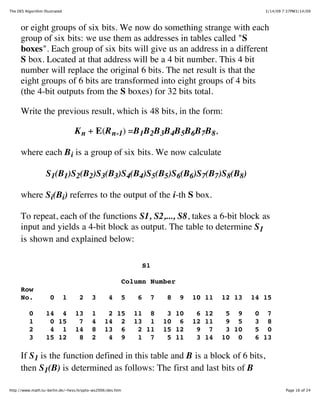
      or eight groups of six bits. We now do something strange with each
      group of six bits: we use them as addresses in tables called "S
      boxes". Each group of six bits will give us an address in a different
      S box. Located at that address will be a 4 bit number. This 4 bit
      number will replace the original 6 bits. The net result is that the
      eight groups of 6 bits are transformed into eight groups of 4 bits
      (the 4-bit outputs from the S boxes) for 32 bits total.

      Write the previous result, which is 48 bits, in the form:

                                    K n + E(R n-1) =B 1B 2B 3B 4B 5B 6B 7B 8,

      where each B i is a group of six bits. We now calculate

                    S1(B1)S2(B2)S3(B3)S4(B4)S5(B5)S6(B6)S7(B7)S8(B8)

      where Si(Bi) referres to the output of the i-th S box.

      To repeat, each of the functions S1, S2,..., S8, takes a 6-bit block as
      input and yields a 4-bit block as output. The table to determine S1
      is shown and explained below:

                                                                    S1

                                                           Column Number
      Row
      No.             0         1    2   3       4         5    6        7    8   9   10 11   12 13   14 15

          0         14 4            13   1      2 15           11 8           3 10     6 12    5 9     0 7
          1          0 15            7   4     14 2            13 1          10 6     12 11    9 5     3 8
          2          4 1            14   8     13 6             2 11         15 12     9 7     3 10    5 0
          3         15 12            8   2      4 9             1 7           5 11     3 14   10 0     6 13

      If S1 is the function defined in this table and B is a block of 6 bits,
      then S1(B) is determined as follows: The first and last bits of B

http://www.math.tu-berlin.de/~hess/krypto-ws2006/des.htm                                                          Page 16 of 24
The DES Algorithm Illustrated                                                                     3/14/09 7:37PM3/14/09


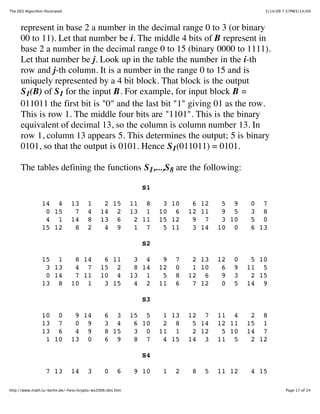
      represent in base 2 a number in the decimal range 0 to 3 (or binary
      00 to 11). Let that number be i. The middle 4 bits of B represent in
      base 2 a number in the decimal range 0 to 15 (binary 0000 to 1111).
      Let that number be j. Look up in the table the number in the i-th
      row and j-th column. It is a number in the range 0 to 15 and is
      uniquely represented by a 4 bit block. That block is the output
      S1(B) of S1 for the input B. For example, for input block B =
      011011 the first bit is "0" and the last bit "1" giving 01 as the row.
      This is row 1. The middle four bits are "1101". This is the binary
      equivalent of decimal 13, so the column is column number 13. In
      row 1, column 13 appears 5. This determines the output; 5 is binary
      0101, so that the output is 0101. Hence S1(011011) = 0101.

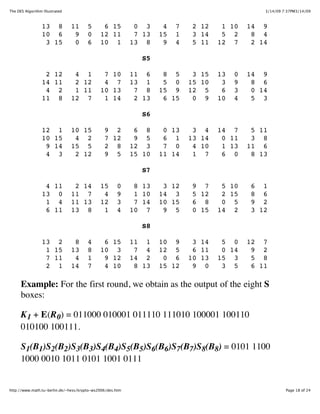
      The tables defining the functions S1,...,S8 are the following:

                                                              S1

                 14 4           13     1      2 15         11 8     3 10     6 12     5 9      0 7
                  0 15           7     4     14 2          13 1    10 6     12 11     9 5      3 8
                  4 1           14     8     13 6           2 11   15 12     9 7      3 10     5 0
                 15 12           8     2      4 9           1 7     5 11     3 14    10 0      6 13

                                                              S2

                 15 1            8 14         6 11          3 4     9   7    2 13    12   0    5 10
                  3 13           4 7         15 2           8 14   12   0    1 10     6   9   11 5
                  0 14           7 11        10 4          13 1     5   8   12 6      9   3    2 15
                 13 8           10 1          3 15          4 2    11   6    7 12     0   5   14 9

                                                              S3

                 10 0            9 14          6 3         15 5     1 13    12 7     11 4      2 8
                 13 7            0 9           3 4          6 10    2 8      5 14    12 11    15 1
                 13 6            4 9           8 15         3 0    11 1      2 12     5 10    14 7
                  1 10          13 0           6 9          8 7     4 15    14 3     11 5      2 12

                                                              S4

                    7 13        14     3       0     6      9 10    1   2    8   5   11 12     4 15

http://www.math.tu-berlin.de/~hess/krypto-ws2006/des.htm                                                   Page 17 of 24
The DES Algorithm Illustrated                                                                    3/14/09 7:37PM3/14/09


                 13 8           11     5      6 15          0 3     4   7    2 12    1 10    14 9
                 10 6            9     0     12 11          7 13   15   1    3 14    5 2      8 4
                  3 15           0     6     10 1          13 8     9   4    5 11   12 7      2 14

                                                              S5

                  2 12           4 1          7 10         11 6     8 5      3 15   13   0   14 9
                 14 11           2 12         4 7          13 1     5 0     15 10    3   9    8 6
                  4 2            1 11        10 13          7 8    15 9     12 5     6   3    0 14
                 11 8           12 7          1 14          2 13    6 15     0 9    10   4    5 3

                                                              S6

                 12 1           10 15          9 2          6 8     0 13     3 4    14 7      5 11
                 10 15           4 2           7 12         9 5     6 1     13 14    0 11     3 8
                  9 14          15 5           2 8         12 3     7 0      4 10    1 13    11 6
                  4 3            2 12          9 5         15 10   11 14     1 7     6 0      8 13

                                                              S7

                  4 11           2 14        15      0      8 13    3 12     9 7     5 10     6 1
                 13 0           11 7          4      9      1 10   14 3      5 12    2 15     8 6
                  1 4           11 13        12      3      7 14   10 15     6 8     0 5      9 2
                  6 11          13 8          1      4     10 7     9 5      0 15   14 2      3 12

                                                              S8

                 13 2            8     4      6 15         11 1    10 9      3 14    5 0     12 7
                  1 15          13     8     10 3           7 4    12 5      6 11    0 14     9 2
                  7 11           4     1      9 12         14 2     0 6     10 13   15 3      5 8
                  2 1           14     7      4 10          8 13   15 12     9 0     3 5      6 11

      Example: For the first round, we obtain as the output of the eight S
      boxes:

      K 1 + E(R 0) = 011000 010001 011110 111010 100001 100110
      010100 100111.

      S1(B1)S2(B2)S3(B3)S4(B4)S5(B5)S6(B6)S7(B7)S8(B8) = 0101 1100
      1000 0010 1011 0101 1001 0111


http://www.math.tu-berlin.de/~hess/krypto-ws2006/des.htm                                                  Page 18 of 24
The DES Algorithm Illustrated                                                      3/14/09 7:37PM3/14/09


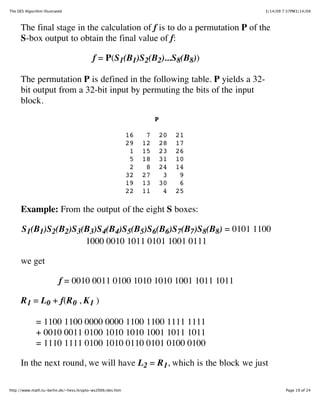
      The final stage in the calculation of f is to do a permutation P of the
      S-box output to obtain the final value of f:

                                         f = P(S1(B1)S2(B2)...S8(B8))

      The permutation P is defined in the following table. P yields a 32-
      bit output from a 32-bit input by permuting the bits of the input
      block.
                                                                     P

                                                           16    7       20   21
                                                           29   12       28   17
                                                            1   15       23   26
                                                            5   18       31   10
                                                            2    8       24   14
                                                           32   27        3    9
                                                           19   13       30    6
                                                           22   11        4   25

      Example: From the output of the eight S boxes:

      S1(B1)S2(B2)S3(B3)S4(B4)S5(B5)S6(B6)S7(B7)S8(B8) = 0101 1100
                     1000 0010 1011 0101 1001 0111

      we get

                           f = 0010 0011 0100 1010 1010 1001 1011 1011

      R 1 = L0 + f(R 0 , K 1 )

              = 1100 1100 0000 0000 1100 1100 1111 1111
              + 0010 0011 0100 1010 1010 1001 1011 1011
              = 1110 1111 0100 1010 0110 0101 0100 0100

      In the next round, we will have L2 = R 1, which is the block we just

http://www.math.tu-berlin.de/~hess/krypto-ws2006/des.htm                                    Page 19 of 24
The DES Algorithm Illustrated                                                            3/14/09 7:37PM3/14/09


      calculated, and then we must calculate R 2 =L1 + f(R1, K 2), and so
      on for 16 rounds. At the end of the sixteenth round we have the
      blocks L16 and R 16. We then reverse the order of the two blocks
      into the 64-bit block

                                                           R 16L16

      and apply a final permutation IP-1 as defined by the following
      table:

                                                             IP-1

                                40           8       48      16      56   24   64   32
                                39           7       47      15      55   23   63   31
                                38           6       46      14      54   22   62   30
                                37           5       45      13      53   21   61   29
                                36           4       44      12      52   20   60   28
                                35           3       43      11      51   19   59   27
                                34           2       42      10      50   18   58   26
                                33           1       41       9      49   17   57   25

      That is, the output of the algorithm has bit 40 of the preoutput block
      as its first bit, bit 8 as its second bit, and so on, until bit 25 of the
      preoutput block is the last bit of the output.

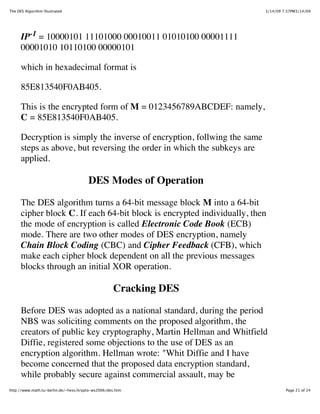
      Example: If we process all 16 blocks using the method defined
      previously, we get, on the 16th round,

      L16 = 0100 0011 0100 0010 0011 0010 0011 0100
      R 16 = 0000 1010 0100 1100 1101 1001 1001 0101

      We reverse the order of these two blocks and apply the final
      permutation to

      R 16L16 = 00001010 01001100 11011001 10010101 01000011
      01000010 00110010 00110100
http://www.math.tu-berlin.de/~hess/krypto-ws2006/des.htm                                          Page 20 of 24
The DES Algorithm Illustrated                                             3/14/09 7:37PM3/14/09


      IP-1 = 10000101 11101000 00010011 01010100 00001111
      00001010 10110100 00000101

      which in hexadecimal format is

      85E813540F0AB405.

      This is the encrypted form of M = 0123456789ABCDEF: namely,
      C = 85E813540F0AB405.

      Decryption is simply the inverse of encryption, follwing the same
      steps as above, but reversing the order in which the subkeys are
      applied.

                                       DES Modes of Operation

      The DES algorithm turns a 64-bit message block M into a 64-bit
      cipher block C. If each 64-bit block is encrypted individually, then
      the mode of encryption is called Electronic Code Book (ECB)
      mode. There are two other modes of DES encryption, namely
      Chain Block Coding (CBC) and Cipher Feedback (CFB), which
      make each cipher block dependent on all the previous messages
      blocks through an initial XOR operation.

                                                    Cracking DES

      Before DES was adopted as a national standard, during the period
      NBS was soliciting comments on the proposed algorithm, the
      creators of public key cryptography, Martin Hellman and Whitfield
      Diffie, registered some objections to the use of DES as an
      encryption algorithm. Hellman wrote: "Whit Diffie and I have
      become concerned that the proposed data encryption standard,
      while probably secure against commercial assault, may be
http://www.math.tu-berlin.de/~hess/krypto-ws2006/des.htm                           Page 21 of 24
The DES Algorithm Illustrated                                           3/14/09 7:37PM3/14/09


      extremely vulnerable to attack by an intelligence organization"
      (letter to NBS, October 22, 1975).

      Diffie and Hellman then outlined a "brute force" attack on DES.
      (By "brute force" is meant that you try as many of the 2^56 possible
      keys as you have to before decrypting the ciphertext into a sensible
      plaintext message.) They proposed a special purpose "parallel
      computer using one million chips to try one million keys each" per
      second, and estimated the cost of such a machine at $20 million.

      Fast forward to 1998. Under the direction of John Gilmore of the
      EFF, a team spent $220,000 and built a machine that can go
      through the entire 56-bit DES key space in an average of 4.5 days.
      On July 17, 1998, they announced they had cracked a 56-bit key in
      56 hours. The computer, called Deep Crack, uses 27 boards each
      containing 64 chips, and is capable of testing 90 billion keys a
      second.

      Despite this, as recently as June 8, 1998, Robert Litt, principal
      associate deputy attorney general at the Department of Justice,
      denied it was possible for the FBI to crack DES: "Let me put the
      technical problem in context: It took 14,000 Pentium computers
      working for four months to decrypt a single message . . . . We are
      not just talking FBI and NSA [needing massive computing power],
      we are talking about every police department."

      Responded cryptograpy expert Bruce Schneier: " . . . the FBI is
      either incompetent or lying, or both." Schneier went on to say: "The
      only solution here is to pick an algorithm with a longer key; there
      isn't enough silicon in the galaxy or enough time before the sun
      burns out to brute- force triple-DES" (Crypto-Gram, Counterpane
      Systems, August 15, 1998).

                                                       Triple-DES
http://www.math.tu-berlin.de/~hess/krypto-ws2006/des.htm                         Page 22 of 24
The DES Algorithm Illustrated                                               3/14/09 7:37PM3/14/09


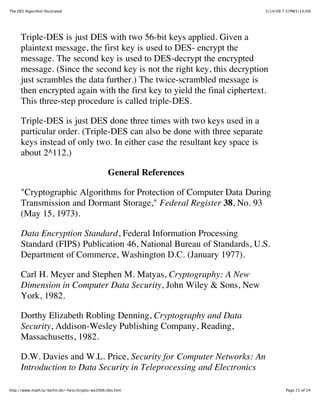
      Triple-DES is just DES with two 56-bit keys applied. Given a
      plaintext message, the first key is used to DES- encrypt the
      message. The second key is used to DES-decrypt the encrypted
      message. (Since the second key is not the right key, this decryption
      just scrambles the data further.) The twice-scrambled message is
      then encrypted again with the first key to yield the final ciphertext.
      This three-step procedure is called triple-DES.

      Triple-DES is just DES done three times with two keys used in a
      particular order. (Triple-DES can also be done with three separate
      keys instead of only two. In either case the resultant key space is
      about 2^112.)

                                                 General References

      "Cryptographic Algorithms for Protection of Computer Data During
      Transmission and Dormant Storage," Federal Register 38, No. 93
      (May 15, 1973).

      Data Encryption Standard, Federal Information Processing
      Standard (FIPS) Publication 46, National Bureau of Standards, U.S.
      Department of Commerce, Washington D.C. (January 1977).

      Carl H. Meyer and Stephen M. Matyas, Cryptography: A New
      Dimension in Computer Data Security, John Wiley & Sons, New
      York, 1982.

      Dorthy Elizabeth Robling Denning, Cryptography and Data
      Security, Addison-Wesley Publishing Company, Reading,
      Massachusetts, 1982.

      D.W. Davies and W.L. Price, Security for Computer Networks: An
      Introduction to Data Security in Teleprocessing and Electronics

http://www.math.tu-berlin.de/~hess/krypto-ws2006/des.htm                             Page 23 of 24
The DES Algorithm Illustrated                                             3/14/09 7:37PM3/14/09


      Funds Transfer, Second Edition, John Wiley & Sons, New York,
      1984, 1989.

      Miles E. Smid and Dennis K. Branstad, "The Data Encryption
      Standard: Past and Future," in Gustavus J. Simmons, ed.,
      Contemporary Cryptography: The Science of Information Integrity,
      IEEE Press, 1992.

      Douglas R. Stinson, Cryptography: Theory and Practice, CRC
      Press, Boca Raton, 1995.

      Bruce Schneier, Applied Cryptography, Second Edition, John Wiley
      & Sons, New York, 1996.

      Alfred J. Menezes, Paul C. van Oorschot, and Scott A. Vanstone,
      Handbook of Applied Cryptography, CRC Press, Boca Raton, 1997.

                                                           -30-

      This article appeared in Laissez Faire City Times, Vol 2, No. 28.

      Homepage: http://orlingrabbe.com/
      Laissez Faire City Times: http://zolatimes.com/


http://www.math.tu-berlin.de/~hess/krypto-ws2006/des.htm                           Page 24 of 24

The des algorithm illustrated

  • 1.
    The DES AlgorithmIllustrated 3/14/09 7:37PM3/14/09 [Email Reply] The DES Algorithm Illustrated by J. Orlin Grabbe The DES (Data Encryption Standard) algorithm is the most widely used encryption algorithm in the world. For many years, and among many people, "secret code making" and DES have been synonymous. And despite the recent coup by the Electronic Frontier Foundation in creating a $220,000 machine to crack DES-encrypted messages, DES will live on in government and banking for years to come through a life- extending version called "triple-DES." How does DES work? This article explains the various steps involved in DES-encryption, illustrating each step by means of a simple example. Since the creation of DES, many other algorithms (recipes for changing data) have emerged which are based on design principles similar to DES. Once you understand the basic transformations that take place in DES, you will find it easy to follow the steps involved in these more recent algorithms. But first a bit of history of how DES came about is appropriate, as well as a look toward the future. The National Bureau of Standards Coaxes the Genie from the Bottle On May 15, 1973, during the reign of Richard Nixon, the National Bureau of Standards (NBS) published a notice in the Federal Register soliciting proposals for cryptographic algorithms to protect data during transmission and storage. The notice explained why http://www.math.tu-berlin.de/~hess/krypto-ws2006/des.htm Page 1 of 24
  • 2.
    The DES AlgorithmIllustrated 3/14/09 7:37PM3/14/09 encryption was an important issue. Over the last decade, there has been an accelerating increase in the accumulations and communication of digital data by government, industry and by other organizations in the private sector. The contents of these communicated and stored data often have very significant value and/or sensitivity. It is now common to find data transmissions which constitute funds transfers of several million dollars, purchase or sale of securities, warrants for arrests or arrest and conviction records being communicated between law enforcement agencies, airline reservations and ticketing representing investment and value both to the airline and passengers, and health and patient care records transmitted among physicians and treatment centers. The increasing volume, value and confidentiality of these records regularly transmitted and stored by commercial and government agencies has led to heightened recognition and concern over their exposures to unauthorized access and use. This misuse can be in the form of theft or defalcations of data records representing money, malicious modification of business inventories or the interception and misuse of confidential information about people. The need for protection is then apparent and urgent. It is recognized that encryption (otherwise known as scrambling, enciphering or privacy transformation) represents the only means of protecting such data during transmission and a useful means of protecting the content of data stored on various media, providing encryption of adequate strength can be devised and validated and is inherently integrable into system architecture. The National Bureau of Standards solicits proposed techniques and http://www.math.tu-berlin.de/~hess/krypto-ws2006/des.htm Page 2 of 24
  • 3.
    The DES AlgorithmIllustrated 3/14/09 7:37PM3/14/09 algorithms for computer data encryption. The Bureau also solicits recommended techniques for implementing the cryptographic function: for generating, evaluating, and protecting cryptographic keys; for maintaining files encoded under expiring keys; for making partial updates to encrypted files; and mixed clear and encrypted data to permit labelling, polling, routing, etc. The Bureau in its role for establishing standards and aiding government and industry in assessing technology, will arrange for the evaluation of protection methods in order to prepare guidelines. NBS waited for the responses to come in. It received none until August 6, 1974, three days before Nixon's resignation, when IBM submitted a candidate that it had developed internally under the name LUCIFER. After evaluating the algorithm with the help of the National Security Agency (NSA), the NBS adopted a modification of the LUCIFER algorithm as the new Data Encryption Standard (DES) on July 15, 1977. DES was quickly adopted for non-digital media, such as voice- grade public telephone lines. Within a couple of years, for example, International Flavors and Fragrances was using DES to protect its valuable formulas transmitted over the phone ("With Data Encryption, Scents Are Safe at IFF," Computerworld 14, No. 21, 95 (1980).) Meanwhile, the banking industry, which is the largest user of encryption outside government, adopted DES as a wholesale banking standard. Standards for the wholesale banking industry are set by the American National Standards Institute (ANSI). ANSI X3.92, adopted in 1980, specified the use of the DES algorithm. http://www.math.tu-berlin.de/~hess/krypto-ws2006/des.htm Page 3 of 24
  • 4.
    The DES AlgorithmIllustrated 3/14/09 7:37PM3/14/09 Some Preliminary Examples of DES DES works on bits, or binary numbers--the 0s and 1s common to digital computers. Each group of four bits makes up a hexadecimal, or base 16, number. Binary "0001" is equal to the hexadecimal number "1", binary "1000" is equal to the hexadecimal number "8", "1001" is equal to the hexadecimal number "9", "1010" is equal to the hexadecimal number "A", and "1111" is equal to the hexadecimal number "F". DES works by encrypting groups of 64 message bits, which is the same as 16 hexadecimal numbers. To do the encryption, DES uses "keys" where are also apparently 16 hexadecimal numbers long, or apparently 64 bits long. However, every 8th key bit is ignored in the DES algorithm, so that the effective key size is 56 bits. But, in any case, 64 bits (16 hexadecimal digits) is the round number upon which DES is organized. For example, if we take the plaintext message "8787878787878787", and encrypt it with the DES key "0E329232EA6D0D73", we end up with the ciphertext "0000000000000000". If the ciphertext is decrypted with the same secret DES key "0E329232EA6D0D73", the result is the original plaintext "8787878787878787". This example is neat and orderly because our plaintext was exactly 64 bits long. The same would be true if the plaintext happened to be a multiple of 64 bits. But most messages will not fall into this category. They will not be an exact multiple of 64 bits (that is, an exact multiple of 16 hexadecimal numbers). For example, take the message "Your lips are smoother than vaseline". This plaintext message is 38 bytes (76 hexadecimal digits) long. So this message must be padded with some extra bytes http://www.math.tu-berlin.de/~hess/krypto-ws2006/des.htm Page 4 of 24
  • 5.
    The DES AlgorithmIllustrated 3/14/09 7:37PM3/14/09 at the tail end for the encryption. Once the encrypted message has been decrypted, these extra bytes are thrown away. There are, of course, different padding schemes--different ways to add extra bytes. Here we will just add 0s at the end, so that the total message is a multiple of 8 bytes (or 16 hexadecimal digits, or 64 bits). The plaintext message "Your lips are smoother than vaseline" is, in hexadecimal, "596F7572206C6970 732061726520736D 6F6F746865722074 68616E2076617365 6C696E650D0A". (Note here that the first 72 hexadecimal digits represent the English message, while "0D" is hexadecimal for Carriage Return, and "0A" is hexadecimal for Line Feed, showing that the message file has terminated.) We then pad this message with some 0s on the end, to get a total of 80 hexadecimal digits: "596F7572206C6970 732061726520736D 6F6F746865722074 68616E2076617365 6C696E650D0A0000". If we then encrypt this plaintext message 64 bits (16 hexadecimal digits) at a time, using the same DES key "0E329232EA6D0D73" as before, we get the ciphertext: "C0999FDDE378D7ED 727DA00BCA5A84EE 47F269A4D6438190 9DD52F78F5358499 828AC9B453E0E653". This is the secret code that can be transmitted or stored. Decrypting the ciphertext restores the original message "Your lips are smoother than vaseline". (Think how much better off Bill Clinton would be today, if Monica Lewinsky had used encryption on her Pentagon computer!) http://www.math.tu-berlin.de/~hess/krypto-ws2006/des.htm Page 5 of 24
  • 6.
    The DES AlgorithmIllustrated 3/14/09 7:37PM3/14/09 How DES Works in Detail DES is a block cipher--meaning it operates on plaintext blocks of a given size (64-bits) and returns ciphertext blocks of the same size. Thus DES results in a permutation among the 2^64 (read this as: "2 to the 64th power") possible arrangements of 64 bits, each of which may be either 0 or 1. Each block of 64 bits is divided into two blocks of 32 bits each, a left half block L and a right half R. (This division is only used in certain operations.) Example: Let M be the plain text message M = 0123456789ABCDEF, where M is in hexadecimal (base 16) format. Rewriting M in binary format, we get the 64-bit block of text: M = 0000 0001 0010 0011 0100 0101 0110 0111 1000 1001 1010 1011 1100 1101 1110 1111 L = 0000 0001 0010 0011 0100 0101 0110 0111 R = 1000 1001 1010 1011 1100 1101 1110 1111 The first bit of M is "0". The last bit is "1". We read from left to right. DES operates on the 64-bit blocks using key sizes of 56- bits. The keys are actually stored as being 64 bits long, but every 8th bit in the key is not used (i.e. bits numbered 8, 16, 24, 32, 40, 48, 56, and 64). However, we will nevertheless number the bits from 1 to 64, going left to right, in the following calculations. But, as you will see, the eight bits just mentioned get eliminated when we create subkeys. Example: Let K be the hexadecimal key K = 133457799BBCDFF1. This gives us as the binary key (setting 1 = 0001, 3 = 0011, etc., and grouping together every eight bits, of http://www.math.tu-berlin.de/~hess/krypto-ws2006/des.htm Page 6 of 24
  • 7.
    The DES AlgorithmIllustrated 3/14/09 7:37PM3/14/09 which the last one in each group will be unused): K = 00010011 00110100 01010111 01111001 10011011 10111100 11011111 11110001 The DES algorithm uses the following steps: Step 1: Create 16 subkeys, each of which is 48-bits long. The 64-bit key is permuted according to the following table, PC-1. Since the first entry in the table is "57", this means that the 57th bit of the original key K becomes the first bit of the permuted key K+. The 49th bit of the original key becomes the second bit of the permuted key. The 4th bit of the original key is the last bit of the permuted key. Note only 56 bits of the original key appear in the permuted key. PC-1 57 49 41 33 25 17 9 1 58 50 42 34 26 18 10 2 59 51 43 35 27 19 11 3 60 52 44 36 63 55 47 39 31 23 15 7 62 54 46 38 30 22 14 6 61 53 45 37 29 21 13 5 28 20 12 4 Example: From the original 64-bit key K = 00010011 00110100 01010111 01111001 10011011 10111100 11011111 11110001 we get the 56-bit permutation http://www.math.tu-berlin.de/~hess/krypto-ws2006/des.htm Page 7 of 24
  • 8.
    The DES AlgorithmIllustrated 3/14/09 7:37PM3/14/09 K+ = 1111000 0110011 0010101 0101111 0101010 1011001 1001111 0001111 Next, split this key into left and right halves, C 0 and D0, where each half has 28 bits. Example: From the permuted key K+, we get C 0 = 1111000 0110011 0010101 0101111 D0 = 0101010 1011001 1001111 0001111 With C 0 and D0 defined, we now create sixteen blocks C n and Dn , 1<=n<=16. Each pair of blocks C n and Dn is formed from the previous pair C n-1 and Dn-1, respectively, for n = 1, 2, ..., 16, using the following schedule of "left shifts" of the previous block. To do a left shift, move each bit one place to the left, except for the first bit, which is cycled to the end of the block. Iteration Number of Number Left Shifts 1 1 2 1 3 2 4 2 5 2 6 2 7 2 8 2 9 1 10 2 11 2 12 2 13 2 14 2 15 2 16 1 http://www.math.tu-berlin.de/~hess/krypto-ws2006/des.htm Page 8 of 24
  • 9.
    The DES AlgorithmIllustrated 3/14/09 7:37PM3/14/09 This means, for example, C 3 and D3 are obtained from C 2 and D2, respectively, by two left shifts, and C 16 and D16 are obtained from C 15 and D15, respectively, by one left shift. In all cases, by a single left shift is meant a rotation of the bits one place to the left, so that after one left shift the bits in the 28 positions are the bits that were previously in positions 2, 3,..., 28, 1. Example: From original pair pair C 0 and D0 we obtain: C 0 = 1111000011001100101010101111 D0 = 0101010101100110011110001111 C 1 = 1110000110011001010101011111 D1 = 1010101011001100111100011110 C 2 = 1100001100110010101010111111 D2 = 0101010110011001111000111101 C 3 = 0000110011001010101011111111 D3 = 0101011001100111100011110101 C 4 = 0011001100101010101111111100 D4 = 0101100110011110001111010101 C 5 = 1100110010101010111111110000 D5 = 0110011001111000111101010101 C 6 = 0011001010101011111111000011 D6 = 1001100111100011110101010101 C 7 = 1100101010101111111100001100 D7 = 0110011110001111010101010110 http://www.math.tu-berlin.de/~hess/krypto-ws2006/des.htm Page 9 of 24
  • 10.
    The DES AlgorithmIllustrated 3/14/09 7:37PM3/14/09 C 8 = 0010101010111111110000110011 D8 = 1001111000111101010101011001 C 9 = 0101010101111111100001100110 D9 = 0011110001111010101010110011 C 10 = 0101010111111110000110011001 D10 = 1111000111101010101011001100 C 11 = 0101011111111000011001100101 D11 = 1100011110101010101100110011 C 12 = 0101111111100001100110010101 D12 = 0001111010101010110011001111 C 13 = 0111111110000110011001010101 D13 = 0111101010101011001100111100 C 14 = 1111111000011001100101010101 D14 = 1110101010101100110011110001 C 15 = 1111100001100110010101010111 D15 = 1010101010110011001111000111 C 16 = 1111000011001100101010101111 D16 = 0101010101100110011110001111 We now form the keys K n , for 1<=n<=16, by applying the following permutation table to each of the concatenated pairs C n Dn . Each pair has 56 bits, but PC-2 only uses 48 of these. http://www.math.tu-berlin.de/~hess/krypto-ws2006/des.htm Page 10 of 24
  • 11.
    The DES AlgorithmIllustrated 3/14/09 7:37PM3/14/09 PC-2 14 17 11 24 1 5 3 28 15 6 21 10 23 19 12 4 26 8 16 7 27 20 13 2 41 52 31 37 47 55 30 40 51 45 33 48 44 49 39 56 34 53 46 42 50 36 29 32 Therefore, the first bit of K n is the 14th bit of C n Dn , the second bit the 17th, and so on, ending with the 48th bit of K n being the 32th bit of C n Dn . Example: For the first key we have C 1D1 = 1110000 1100110 0101010 1011111 1010101 0110011 0011110 0011110 which, after we apply the permutation PC-2, becomes K 1 = 000110 110000 001011 101111 111111 000111 000001 110010 For the other keys we have K 2 = 011110 011010 111011 011001 110110 111100 100111 100101 K 3 = 010101 011111 110010 001010 010000 101100 111110 011001 K 4 = 011100 101010 110111 010110 110110 110011 010100 011101 K 5 = 011111 001110 110000 000111 111010 110101 001110 101000 K 6 = 011000 111010 010100 111110 010100 000111 101100 101111 http://www.math.tu-berlin.de/~hess/krypto-ws2006/des.htm Page 11 of 24
  • 12.
    The DES AlgorithmIllustrated 3/14/09 7:37PM3/14/09 K 7 = 111011 001000 010010 110111 111101 100001 100010 111100 K 8 = 111101 111000 101000 111010 110000 010011 101111 111011 K 9 = 111000 001101 101111 101011 111011 011110 011110 000001 K 10 = 101100 011111 001101 000111 101110 100100 011001 001111 K 11 = 001000 010101 111111 010011 110111 101101 001110 000110 K 12 = 011101 010111 000111 110101 100101 000110 011111 101001 K 13 = 100101 111100 010111 010001 111110 101011 101001 000001 K 14 = 010111 110100 001110 110111 111100 101110 011100 111010 K 15 = 101111 111001 000110 001101 001111 010011 111100 001010 K 16 = 110010 110011 110110 001011 000011 100001 011111 110101 So much for the subkeys. Now we look at the message itself. Step 2: Encode each 64-bit block of data. There is an initial permutation IP of the 64 bits of the message data M. This rearranges the bits according to the following table, where the entries in the table show the new arrangement of the bits from their initial order. The 58th bit of M becomes the first bit of IP. The 50th bit of M becomes the second bit of IP. The 7th bit of M is the last bit of IP. http://www.math.tu-berlin.de/~hess/krypto-ws2006/des.htm Page 12 of 24
  • 13.
    The DES AlgorithmIllustrated 3/14/09 7:37PM3/14/09 IP 58 50 42 34 26 18 10 2 60 52 44 36 28 20 12 4 62 54 46 38 30 22 14 6 64 56 48 40 32 24 16 8 57 49 41 33 25 17 9 1 59 51 43 35 27 19 11 3 61 53 45 37 29 21 13 5 63 55 47 39 31 23 15 7 Example: Applying the initial permutation to the block of text M, given previously, we get M = 0000 0001 0010 0011 0100 0101 0110 0111 1000 1001 1010 1011 1100 1101 1110 1111 IP = 1100 1100 0000 0000 1100 1100 1111 1111 1111 0000 1010 1010 1111 0000 1010 1010 Here the 58th bit of M is "1", which becomes the first bit of IP. The 50th bit of M is "1", which becomes the second bit of IP. The 7th bit of M is "0", which becomes the last bit of IP. Next divide the permuted block IP into a left half L0 of 32 bits, and a right half R 0 of 32 bits. Example: From IP, we get L0 and R 0 L0 = 1100 1100 0000 0000 1100 1100 1111 1111 R 0 = 1111 0000 1010 1010 1111 0000 1010 1010 We now proceed through 16 iterations, for 1<=n<=16, using a function f which operates on two blocks--a data block of 32 bits and a key K n of 48 bits--to produce a block of 32 bits. Let + denote XOR addition, (bit-by-bit addition modulo 2). Then for n going from 1 to 16 we calculate http://www.math.tu-berlin.de/~hess/krypto-ws2006/des.htm Page 13 of 24
  • 14.
    The DES AlgorithmIllustrated 3/14/09 7:37PM3/14/09 Ln = R n-1 R n = Ln-1 + f(R n-1,K n ) This results in a final block, for n = 16, of L16R 16. That is, in each iteration, we take the right 32 bits of the previous result and make them the left 32 bits of the current step. For the right 32 bits in the current step, we XOR the left 32 bits of the previous step with the calculation f . Example: For n = 1, we have K 1 = 000110 110000 001011 101111 111111 000111 000001 110010 L1 = R 0 = 1111 0000 1010 1010 1111 0000 1010 1010 R 1 = L0 + f(R 0,K 1) It remains to explain how the function f works. To calculate f, we first expand each block R n-1 from 32 bits to 48 bits. This is done by using a selection table that repeats some of the bits in R n-1 . We'll call the use of this selection table the function E. Thus E(R n-1) has a 32 bit input block, and a 48 bit output block. Let E be such that the 48 bits of its output, written as 8 blocks of 6 bits each, are obtained by selecting the bits in its inputs in order according to the following table: E BIT-SELECTION TABLE 32 1 2 3 4 5 4 5 6 7 8 9 8 9 10 11 12 13 12 13 14 15 16 17 16 17 18 19 20 21 20 21 22 23 24 25 http://www.math.tu-berlin.de/~hess/krypto-ws2006/des.htm Page 14 of 24
  • 15.
    The DES AlgorithmIllustrated 3/14/09 7:37PM3/14/09 24 25 26 27 28 29 28 29 30 31 32 1 Thus the first three bits of E(R n-1) are the bits in positions 32, 1 and 2 of R n-1 while the last 2 bits of E(R n-1) are the bits in positions 32 and 1. Example: We calculate E(R 0) from R 0 as follows: R 0 = 1111 0000 1010 1010 1111 0000 1010 1010 E(R 0) = 011110 100001 010101 010101 011110 100001 010101 010101 (Note that each block of 4 original bits has been expanded to a block of 6 output bits.) Next in the f calculation, we XOR the output E(R n-1) with the key Kn: K n + E(R n-1). Example: For K 1 , E(R 0), we have K 1 = 000110 110000 001011 101111 111111 000111 000001 110010 E(R 0) = 011110 100001 010101 010101 011110 100001 010101 010101 K 1+E(R 0) = 011000 010001 011110 111010 100001 100110 010100 100111. We have not yet finished calculating the function f . To this point we have expanded R n-1 from 32 bits to 48 bits, using the selection table, and XORed the result with the key K n . We now have 48 bits, http://www.math.tu-berlin.de/~hess/krypto-ws2006/des.htm Page 15 of 24
  • 16.
    The DES AlgorithmIllustrated 3/14/09 7:37PM3/14/09 or eight groups of six bits. We now do something strange with each group of six bits: we use them as addresses in tables called "S boxes". Each group of six bits will give us an address in a different S box. Located at that address will be a 4 bit number. This 4 bit number will replace the original 6 bits. The net result is that the eight groups of 6 bits are transformed into eight groups of 4 bits (the 4-bit outputs from the S boxes) for 32 bits total. Write the previous result, which is 48 bits, in the form: K n + E(R n-1) =B 1B 2B 3B 4B 5B 6B 7B 8, where each B i is a group of six bits. We now calculate S1(B1)S2(B2)S3(B3)S4(B4)S5(B5)S6(B6)S7(B7)S8(B8) where Si(Bi) referres to the output of the i-th S box. To repeat, each of the functions S1, S2,..., S8, takes a 6-bit block as input and yields a 4-bit block as output. The table to determine S1 is shown and explained below: S1 Column Number Row No. 0 1 2 3 4 5 6 7 8 9 10 11 12 13 14 15 0 14 4 13 1 2 15 11 8 3 10 6 12 5 9 0 7 1 0 15 7 4 14 2 13 1 10 6 12 11 9 5 3 8 2 4 1 14 8 13 6 2 11 15 12 9 7 3 10 5 0 3 15 12 8 2 4 9 1 7 5 11 3 14 10 0 6 13 If S1 is the function defined in this table and B is a block of 6 bits, then S1(B) is determined as follows: The first and last bits of B http://www.math.tu-berlin.de/~hess/krypto-ws2006/des.htm Page 16 of 24
  • 17.
    The DES AlgorithmIllustrated 3/14/09 7:37PM3/14/09 represent in base 2 a number in the decimal range 0 to 3 (or binary 00 to 11). Let that number be i. The middle 4 bits of B represent in base 2 a number in the decimal range 0 to 15 (binary 0000 to 1111). Let that number be j. Look up in the table the number in the i-th row and j-th column. It is a number in the range 0 to 15 and is uniquely represented by a 4 bit block. That block is the output S1(B) of S1 for the input B. For example, for input block B = 011011 the first bit is "0" and the last bit "1" giving 01 as the row. This is row 1. The middle four bits are "1101". This is the binary equivalent of decimal 13, so the column is column number 13. In row 1, column 13 appears 5. This determines the output; 5 is binary 0101, so that the output is 0101. Hence S1(011011) = 0101. The tables defining the functions S1,...,S8 are the following: S1 14 4 13 1 2 15 11 8 3 10 6 12 5 9 0 7 0 15 7 4 14 2 13 1 10 6 12 11 9 5 3 8 4 1 14 8 13 6 2 11 15 12 9 7 3 10 5 0 15 12 8 2 4 9 1 7 5 11 3 14 10 0 6 13 S2 15 1 8 14 6 11 3 4 9 7 2 13 12 0 5 10 3 13 4 7 15 2 8 14 12 0 1 10 6 9 11 5 0 14 7 11 10 4 13 1 5 8 12 6 9 3 2 15 13 8 10 1 3 15 4 2 11 6 7 12 0 5 14 9 S3 10 0 9 14 6 3 15 5 1 13 12 7 11 4 2 8 13 7 0 9 3 4 6 10 2 8 5 14 12 11 15 1 13 6 4 9 8 15 3 0 11 1 2 12 5 10 14 7 1 10 13 0 6 9 8 7 4 15 14 3 11 5 2 12 S4 7 13 14 3 0 6 9 10 1 2 8 5 11 12 4 15 http://www.math.tu-berlin.de/~hess/krypto-ws2006/des.htm Page 17 of 24
  • 18.
    The DES AlgorithmIllustrated 3/14/09 7:37PM3/14/09 13 8 11 5 6 15 0 3 4 7 2 12 1 10 14 9 10 6 9 0 12 11 7 13 15 1 3 14 5 2 8 4 3 15 0 6 10 1 13 8 9 4 5 11 12 7 2 14 S5 2 12 4 1 7 10 11 6 8 5 3 15 13 0 14 9 14 11 2 12 4 7 13 1 5 0 15 10 3 9 8 6 4 2 1 11 10 13 7 8 15 9 12 5 6 3 0 14 11 8 12 7 1 14 2 13 6 15 0 9 10 4 5 3 S6 12 1 10 15 9 2 6 8 0 13 3 4 14 7 5 11 10 15 4 2 7 12 9 5 6 1 13 14 0 11 3 8 9 14 15 5 2 8 12 3 7 0 4 10 1 13 11 6 4 3 2 12 9 5 15 10 11 14 1 7 6 0 8 13 S7 4 11 2 14 15 0 8 13 3 12 9 7 5 10 6 1 13 0 11 7 4 9 1 10 14 3 5 12 2 15 8 6 1 4 11 13 12 3 7 14 10 15 6 8 0 5 9 2 6 11 13 8 1 4 10 7 9 5 0 15 14 2 3 12 S8 13 2 8 4 6 15 11 1 10 9 3 14 5 0 12 7 1 15 13 8 10 3 7 4 12 5 6 11 0 14 9 2 7 11 4 1 9 12 14 2 0 6 10 13 15 3 5 8 2 1 14 7 4 10 8 13 15 12 9 0 3 5 6 11 Example: For the first round, we obtain as the output of the eight S boxes: K 1 + E(R 0) = 011000 010001 011110 111010 100001 100110 010100 100111. S1(B1)S2(B2)S3(B3)S4(B4)S5(B5)S6(B6)S7(B7)S8(B8) = 0101 1100 1000 0010 1011 0101 1001 0111 http://www.math.tu-berlin.de/~hess/krypto-ws2006/des.htm Page 18 of 24
  • 19.
    The DES AlgorithmIllustrated 3/14/09 7:37PM3/14/09 The final stage in the calculation of f is to do a permutation P of the S-box output to obtain the final value of f: f = P(S1(B1)S2(B2)...S8(B8)) The permutation P is defined in the following table. P yields a 32- bit output from a 32-bit input by permuting the bits of the input block. P 16 7 20 21 29 12 28 17 1 15 23 26 5 18 31 10 2 8 24 14 32 27 3 9 19 13 30 6 22 11 4 25 Example: From the output of the eight S boxes: S1(B1)S2(B2)S3(B3)S4(B4)S5(B5)S6(B6)S7(B7)S8(B8) = 0101 1100 1000 0010 1011 0101 1001 0111 we get f = 0010 0011 0100 1010 1010 1001 1011 1011 R 1 = L0 + f(R 0 , K 1 ) = 1100 1100 0000 0000 1100 1100 1111 1111 + 0010 0011 0100 1010 1010 1001 1011 1011 = 1110 1111 0100 1010 0110 0101 0100 0100 In the next round, we will have L2 = R 1, which is the block we just http://www.math.tu-berlin.de/~hess/krypto-ws2006/des.htm Page 19 of 24
  • 20.
    The DES AlgorithmIllustrated 3/14/09 7:37PM3/14/09 calculated, and then we must calculate R 2 =L1 + f(R1, K 2), and so on for 16 rounds. At the end of the sixteenth round we have the blocks L16 and R 16. We then reverse the order of the two blocks into the 64-bit block R 16L16 and apply a final permutation IP-1 as defined by the following table: IP-1 40 8 48 16 56 24 64 32 39 7 47 15 55 23 63 31 38 6 46 14 54 22 62 30 37 5 45 13 53 21 61 29 36 4 44 12 52 20 60 28 35 3 43 11 51 19 59 27 34 2 42 10 50 18 58 26 33 1 41 9 49 17 57 25 That is, the output of the algorithm has bit 40 of the preoutput block as its first bit, bit 8 as its second bit, and so on, until bit 25 of the preoutput block is the last bit of the output. Example: If we process all 16 blocks using the method defined previously, we get, on the 16th round, L16 = 0100 0011 0100 0010 0011 0010 0011 0100 R 16 = 0000 1010 0100 1100 1101 1001 1001 0101 We reverse the order of these two blocks and apply the final permutation to R 16L16 = 00001010 01001100 11011001 10010101 01000011 01000010 00110010 00110100 http://www.math.tu-berlin.de/~hess/krypto-ws2006/des.htm Page 20 of 24
  • 21.
    The DES AlgorithmIllustrated 3/14/09 7:37PM3/14/09 IP-1 = 10000101 11101000 00010011 01010100 00001111 00001010 10110100 00000101 which in hexadecimal format is 85E813540F0AB405. This is the encrypted form of M = 0123456789ABCDEF: namely, C = 85E813540F0AB405. Decryption is simply the inverse of encryption, follwing the same steps as above, but reversing the order in which the subkeys are applied. DES Modes of Operation The DES algorithm turns a 64-bit message block M into a 64-bit cipher block C. If each 64-bit block is encrypted individually, then the mode of encryption is called Electronic Code Book (ECB) mode. There are two other modes of DES encryption, namely Chain Block Coding (CBC) and Cipher Feedback (CFB), which make each cipher block dependent on all the previous messages blocks through an initial XOR operation. Cracking DES Before DES was adopted as a national standard, during the period NBS was soliciting comments on the proposed algorithm, the creators of public key cryptography, Martin Hellman and Whitfield Diffie, registered some objections to the use of DES as an encryption algorithm. Hellman wrote: "Whit Diffie and I have become concerned that the proposed data encryption standard, while probably secure against commercial assault, may be http://www.math.tu-berlin.de/~hess/krypto-ws2006/des.htm Page 21 of 24
  • 22.
    The DES AlgorithmIllustrated 3/14/09 7:37PM3/14/09 extremely vulnerable to attack by an intelligence organization" (letter to NBS, October 22, 1975). Diffie and Hellman then outlined a "brute force" attack on DES. (By "brute force" is meant that you try as many of the 2^56 possible keys as you have to before decrypting the ciphertext into a sensible plaintext message.) They proposed a special purpose "parallel computer using one million chips to try one million keys each" per second, and estimated the cost of such a machine at $20 million. Fast forward to 1998. Under the direction of John Gilmore of the EFF, a team spent $220,000 and built a machine that can go through the entire 56-bit DES key space in an average of 4.5 days. On July 17, 1998, they announced they had cracked a 56-bit key in 56 hours. The computer, called Deep Crack, uses 27 boards each containing 64 chips, and is capable of testing 90 billion keys a second. Despite this, as recently as June 8, 1998, Robert Litt, principal associate deputy attorney general at the Department of Justice, denied it was possible for the FBI to crack DES: "Let me put the technical problem in context: It took 14,000 Pentium computers working for four months to decrypt a single message . . . . We are not just talking FBI and NSA [needing massive computing power], we are talking about every police department." Responded cryptograpy expert Bruce Schneier: " . . . the FBI is either incompetent or lying, or both." Schneier went on to say: "The only solution here is to pick an algorithm with a longer key; there isn't enough silicon in the galaxy or enough time before the sun burns out to brute- force triple-DES" (Crypto-Gram, Counterpane Systems, August 15, 1998). Triple-DES http://www.math.tu-berlin.de/~hess/krypto-ws2006/des.htm Page 22 of 24
  • 23.
    The DES AlgorithmIllustrated 3/14/09 7:37PM3/14/09 Triple-DES is just DES with two 56-bit keys applied. Given a plaintext message, the first key is used to DES- encrypt the message. The second key is used to DES-decrypt the encrypted message. (Since the second key is not the right key, this decryption just scrambles the data further.) The twice-scrambled message is then encrypted again with the first key to yield the final ciphertext. This three-step procedure is called triple-DES. Triple-DES is just DES done three times with two keys used in a particular order. (Triple-DES can also be done with three separate keys instead of only two. In either case the resultant key space is about 2^112.) General References "Cryptographic Algorithms for Protection of Computer Data During Transmission and Dormant Storage," Federal Register 38, No. 93 (May 15, 1973). Data Encryption Standard, Federal Information Processing Standard (FIPS) Publication 46, National Bureau of Standards, U.S. Department of Commerce, Washington D.C. (January 1977). Carl H. Meyer and Stephen M. Matyas, Cryptography: A New Dimension in Computer Data Security, John Wiley & Sons, New York, 1982. Dorthy Elizabeth Robling Denning, Cryptography and Data Security, Addison-Wesley Publishing Company, Reading, Massachusetts, 1982. D.W. Davies and W.L. Price, Security for Computer Networks: An Introduction to Data Security in Teleprocessing and Electronics http://www.math.tu-berlin.de/~hess/krypto-ws2006/des.htm Page 23 of 24
  • 24.
    The DES AlgorithmIllustrated 3/14/09 7:37PM3/14/09 Funds Transfer, Second Edition, John Wiley & Sons, New York, 1984, 1989. Miles E. Smid and Dennis K. Branstad, "The Data Encryption Standard: Past and Future," in Gustavus J. Simmons, ed., Contemporary Cryptography: The Science of Information Integrity, IEEE Press, 1992. Douglas R. Stinson, Cryptography: Theory and Practice, CRC Press, Boca Raton, 1995. Bruce Schneier, Applied Cryptography, Second Edition, John Wiley & Sons, New York, 1996. Alfred J. Menezes, Paul C. van Oorschot, and Scott A. Vanstone, Handbook of Applied Cryptography, CRC Press, Boca Raton, 1997. -30- This article appeared in Laissez Faire City Times, Vol 2, No. 28. Homepage: http://orlingrabbe.com/ Laissez Faire City Times: http://zolatimes.com/ http://www.math.tu-berlin.de/~hess/krypto-ws2006/des.htm Page 24 of 24