§
DRIVE
Wed, Oct. 26
Funded by:
Connected Everyday Lab
Elisa Giaccardi
Coordinated by:
TOOLS &
EXPERIMENTS
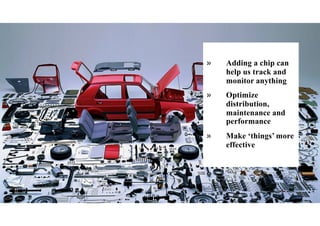
» Adding a chip can
help us track and
monitor anything
» Optimize
distribution,
maintenance and
performance
» Make ‘things’ more
effective
REFRAMING IOT
» Where is the human in the loop?
» What sort of values do we want to design for?
» How do we shift the focus from collecting data to sustaining
value?
» This image
further
elaborates on
the previous
slide
» This image
further
elaborates on
the previous
slide
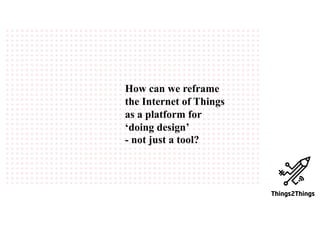
How can we reframe
the Internet of Things
as a platform for
‘doing design’
- not just a tool?
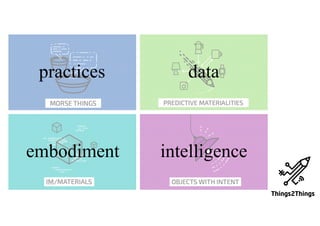
datapractices
embodiment intelligence
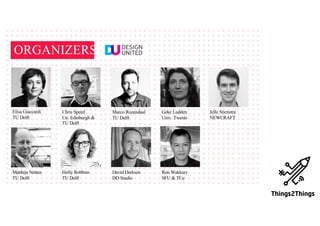
ORGANIZERS
Elisa Giaccardi
TU Delft
Chris Speed
Un. Edinburgh &
TU Delft
Marco Rozendaal
TU Delft
Geke Ludden
Univ. Twente
Jelle Stienstra
NEWCRAFT
Matthijs Netten
TU Delft
Holly Robbins
TU Delft
David Derksen
DD Studio
Ron Wakkary
SFU & TUe
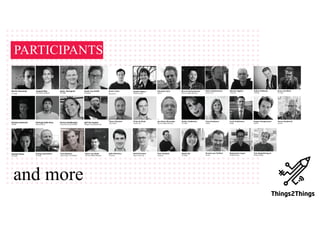
PARTICIPANTS
and more
“For design to contribute
to world-wide challenges,
building communities of
ambitious and curious
people is of utmost
importance.”
- Dan van Eijk, Scientific
Director, Design United
- Bart Ahsmann, Managing
Director, Design United
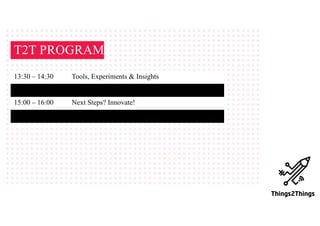
T2T PROGRAM
13:30 – 14:30 Tools, Experiments & Insights
14:30 – 15:00 Break (with performance)
15:00 – 16:00 Next Steps? Innovate!
16:00 Drinks
§
DRIVE
Wed, Oct. 26
Organized by:
Funded by:
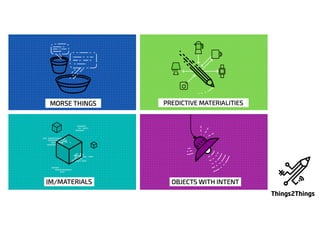
OBJECTS WITH INTENT
Connected Everyday Lab & DesignLab
Dr. Marco Rozendaal & Dr. Wouter Eggink
Breathing life into a
product or environment by
giving it a personality and
acting it out makes for a
quick but powerful way of
understanding the nuances
of good smart product
interaction.
- Pieter Diepenmaat
TOOLS
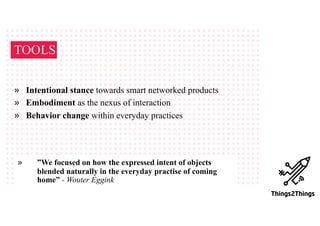
» Intentional stance towards smart networked products
» Embodiment as the nexus of interaction
» Behavior change within everyday practices
» ”We focused on how the expressed intent of objects
blended naturally in the everyday practise of coming
home” - Wouter Eggink
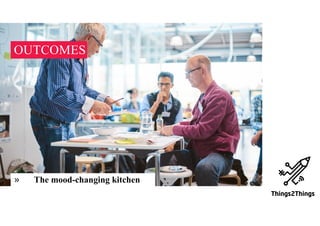
OUTCOMES
» The mood-changing kitchen
OUTCOMES
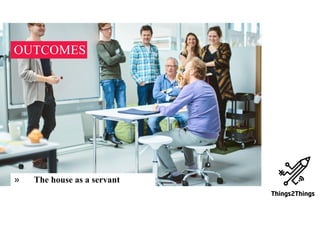
» The house as a servant
OUTCOMES
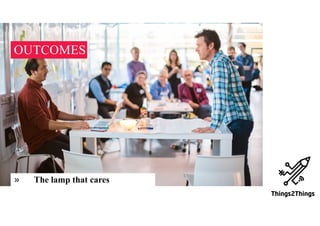
» The lamp that cares
REFLECTIONS
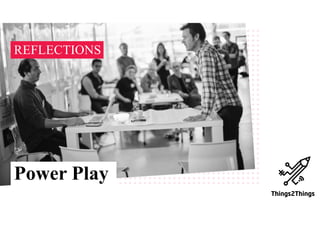
Power Play
REFLECTIONS
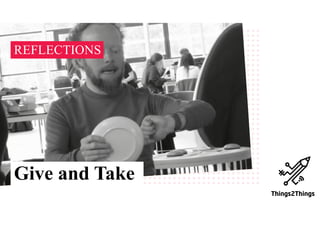
Give and Take
REFLECTIONS
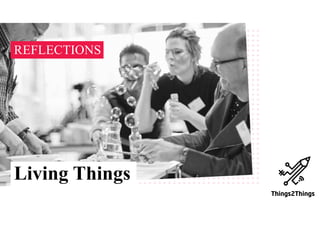
Living Things
“Thank you, are there
any questions?”
- Rozendaal and Eggink
§
DRIVE
Wed, Oct. 26
Organized by:
Funded by:
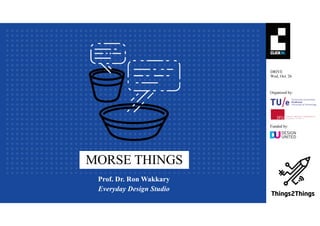
MORSE THINGS
Everyday Design Studio
Prof. Dr. Ron Wakkary
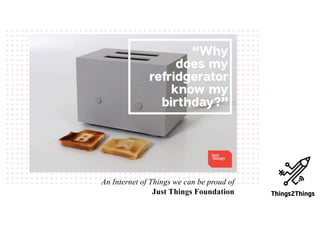
An Internet of Things we can be proud of
Just Things Foundation
thing-centered
not
human-centered
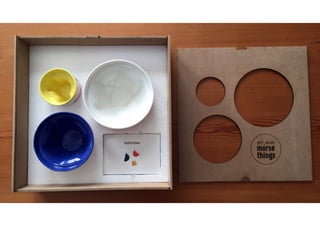
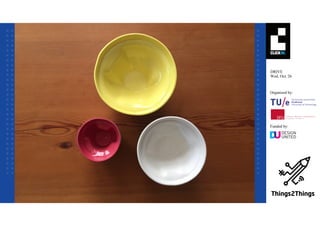
Morse Things
TOOLS
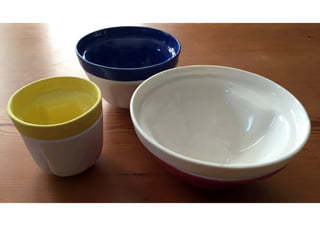
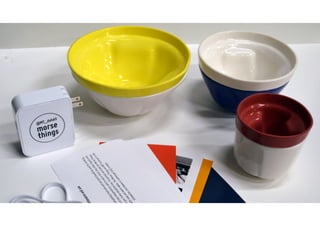
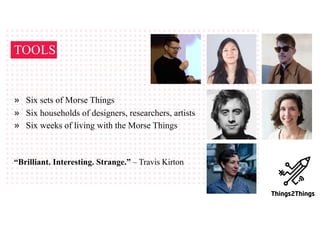
» Six sets of Morse Things
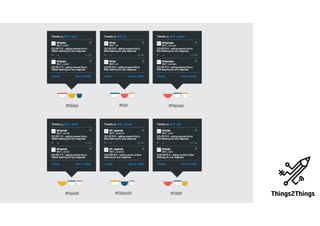
» Six households of designers, researchers, artists
» Six weeks of living with the Morse Things
“Brilliant. Interesting. Strange.” – Travis Kirton
TOOLS
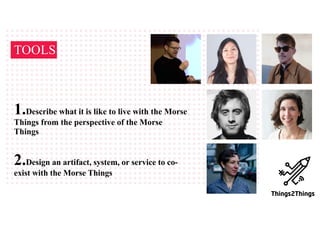
1.Describe what it is like to live with the Morse
Things from the perspective of the Morse
Things
2.Design an artifact, system, or service to co-
exist with the Morse Things
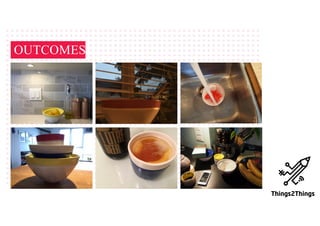
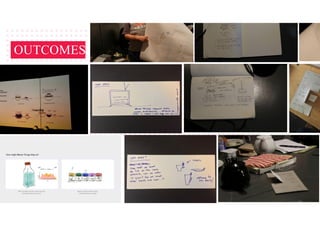
OUTCOMES
OUTCOMES
OUTCOMES
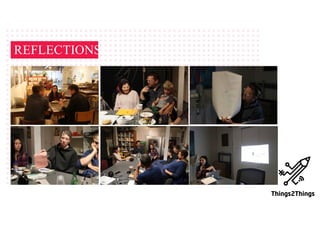
REFLECTIONS
REFLECTIONS
1.It is difficult to take on the
perspective of things – they
“withdraw” from us.
REFLECTIONS
2.The Morse Things form a
“quiet” attachment over
time.
REFLECTIONS
3.The Morse Things are a
“third” thing in the home.
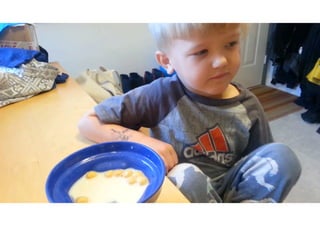
“finally heard a bowl! It's been a
week. I didn't expect that I would be
as surprised or excited as I ended up
being. Had a pretty good rhythm to
it. Dah-do-dah-do-do-dah-dah-do-
dah-dah ... or something like that.”
- Ryan Betts
§
DRIVE
Wed, Oct. 26
Organized by:
Funded by:
§
DRIVE
Wed, Oct. 26
Organized by:
Funded by:
IM/MATERIALS
Connected Everyday Lab & David Derksen Design
Holly Robbins & David Derksen
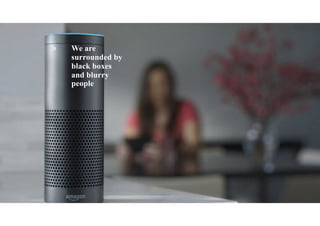
» We are
surrounded by
black boxes
and blurry
people
TOOLS
» “Traces of use” is a design approach that can help uncover the
relationship we have with technology.
» This can shape a relationship with the object that’s based in
mutuality- it communicates how these technologies work and
how we work with them.
» This is even more critical as our technologies are becoming
more complex and are able to collect intimate data about us and
communicate it to others
OUTCOMES
Explored the expressive capabilities of traces to reveal how
data-intensive technologies work in 3 phases
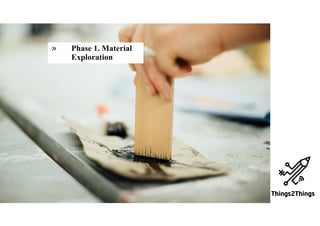
» Phase 1. Material Exploration
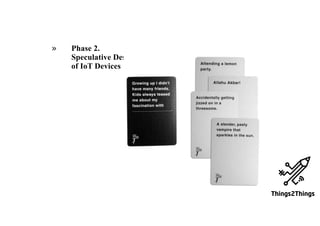
» Phase 2. Speculative Design: Ideation of IoT Devices
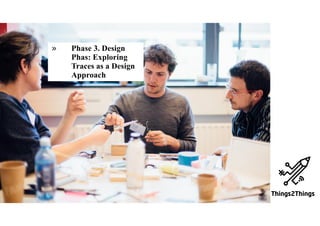
» Phase 3. Design Phase: Exploring Traces as a Design Approach
» Phase 1. Material
Exploration
» Phase 2.
Speculative Design
of IoT Devices
» Phase 3. Design
Phas: Exploring
Traces as a Design
Approach
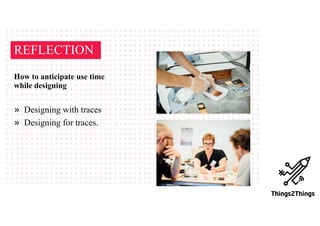
How to anticipate use time
while designing
» Designing with traces
» Designing for traces.
REFLECTION
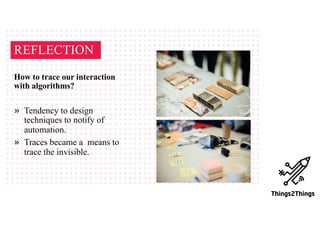
How to trace our interaction
with algorithms?
» Tendency to design
techniques to notify of
automation.
» Traces became a means to
trace the invisible.
REFLECTION
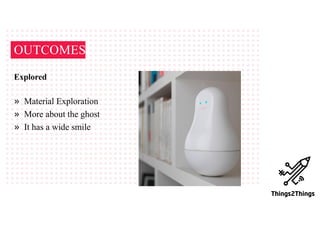
Explored
» Material Exploration
» More about the ghost
» It has a wide smile
OUTCOMES
REFLECTIONS
Traces can be a means to
express how an object works,
which can lead to a greater
understanding of how we use
it, and in the case of connected
technologies, how it uses us.
§
DRIVE
Wed, Oct. 26
Organized by:
Funded by:
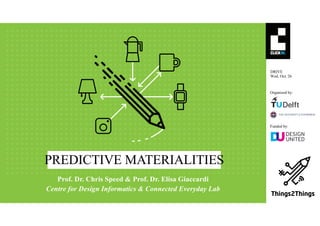
PREDICTIVE MATERIALITIES
Centre for Design Informatics & Connected Everyday Lab
Prof. Dr. Chris Speed & Prof. Dr. Elisa Giaccardi
INTRODUCTION
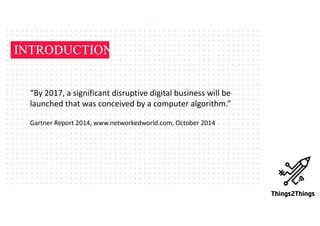
“By	2017,	a	significant	disruptive	digital	business	will	be	
launched	that	was	conceived	by	a	computer	algorithm.”
Gartner	Report	2014,	www.networkedworld.com,	October	2014
INTRODUCTION
INTRODUCTION
TOOLS
» Algorithmic Society
» Machine 2 Machine conversations
TOOLS
» Machine Learning
» Blockchain
» Algorithmic Society
» Machine 2 Machine conversations
TOOLS
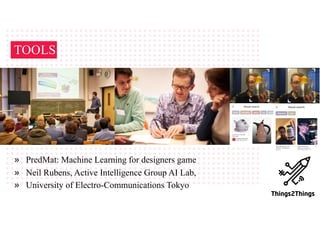
» PredMat: Machine Learning for designers game
» Neil Rubens, Active Intelligence Group AI Lab,
» University of Electro-Communications Tokyo
TOOLS
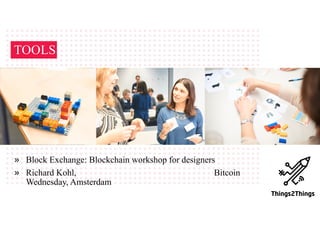
» Block Exchange: Blockchain workshop for designers
» Richard Kohl, Bitcoin
Wednesday, Amsterdam
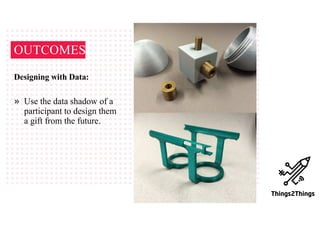
Designing with Data:
» Use the data shadow of a
participant to design them
a gift from the future.
OUTCOMES
Here we have two columns.
One column is for a ghost-like
monitoring device.
» Then, we go bulleted
» More about the ghost
» It has a wide smile
OUTCOMES“I have been following [him] online for quite a bit but I haven’t
met him until recently, so I have been following this constructing,
tech sort of person and I constructed this image of who he is…
On the Flicker, the photos they came in really handy. I tried to
look at text and didn't end up being inspiring. But when I went
back to Flickr pictures, specifically old pictures, I noticed some
kind of change in his stuff; he was kind of sharing more, was my
perception.
Then I devised this idea about whenever anything is shared it will
never be, like, too regular; there will always be some kind of
special experience involved in it, which was a challenge I gave
myself: to make something logical that can do that…so I came up
with this…”
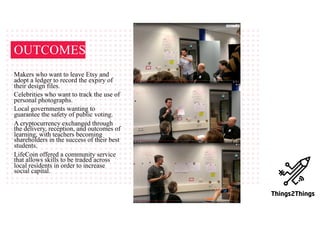
Makers who want to leave Etsy and
adopt a ledger to record the expiry of
their design files.
Celebrities who want to track the use of
personal photographs.
Local governments wanting to
guarantee the safety of public voting.
A cryptocurrency exchanged through
the delivery, reception, and outcomes of
learning, with teachers becoming
shareholders in the success of their best
students.
LifeCoin offered a community service
that allows skills to be traded across
local residents in order to increase
social capital.
OUTCOMES
makers who want to leave Etsy and adopt a
ledger to record the expiry of their design files,
celebrities who want to track the use of
personal photographs, and local governments
wanting to guarantee the safety of public
voting. Team EduCoin presented a
cryptocurrency exchanged through the
delivery, reception, and outcomes of learning,
with teachers becoming shareholders in the
success of their best students. And team
LifeCoin offered a community service that
allows skills to be traded across local residents
in order to increase social capital. LifeCoin is
an assemblage of technologies proposing a
hammer that can trade its owner’s skills with
other tools or users via smart contracting.
» Then, we go bulleted
» More about the ghost
» It has a wide smile
OUTCOMES
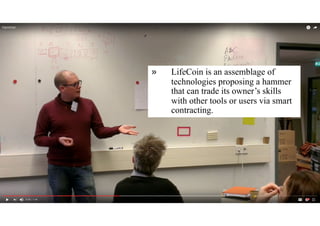
» LifeCoin is an assemblage of
technologies proposing a hammer
that can trade its owner’s skills
with other tools or users via smart
contracting.
REFLECTIONS
REFLECTIONS
• Designers need to exercise and practice the principles of a
technology before they can actually design with it.
• Data is a design material that can anticipate, predict and push
in ways that require nuanced consideration of the contextual
significance and situated value of the data used.
• The key is not to collect lots of data but learn how to use it to
ask interesting questions.
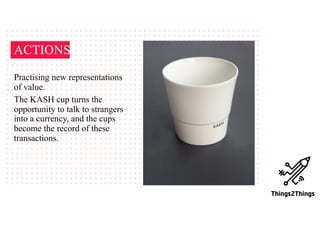
ACTIONS
Practising new representations
of value.
The KASH cup turns the
opportunity to talk to strangers
into a currency, and the cups
become the record of these
transactions.
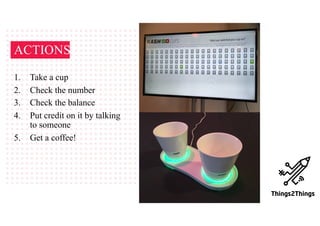
ACTIONS
1. Take a cup
2. Check the number
3. Check the balance
4. Put credit on it by talking
to someone
5. Get a coffee!
§
DRIVE
Wed, Oct. 26
Funded by:
Connected Everyday Lab
Elisa Giaccardi
Coordinated by:
KEY INSIGHTS
TAKE AWAY
As we bring consumers closer to
the creation and distribution of
products and services, industry
will require designers to develop
connections that are trustworthy,
ethical and in the interest of
people.
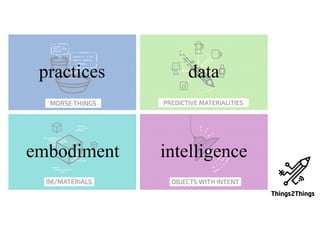
datapractices
embodiment intelligence
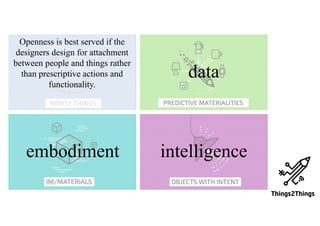
data
Openness is best served if the
designers design for attachment
between people and things rather
than prescriptive actions and
functionality.
embodiment intelligence
practices
embodiment intelligence
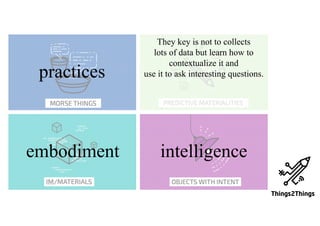
They key is not to collects
lots of data but learn how to
contextualize it and
use it to ask interesting questions.
datapractices
intelligence
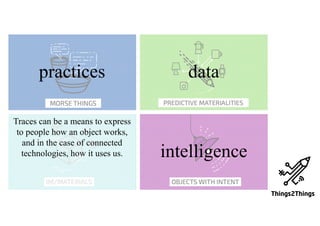
Traces can be a means to express
to people how an object works,
and in the case of connected
technologies, how it uses us.
datapractices
embodiment
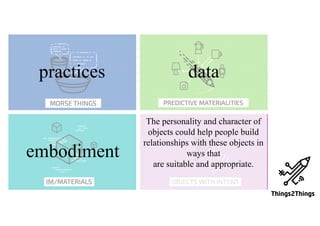
The personality and character of
objects could help people build
relationships with these objects in
ways that
are suitable and appropriate.
» We’ll make
your ideas fly,
literally!
DRIVE 2016 | 26 October: Smart Industry T2T

DRIVE 2016 | 26 October: Smart Industry T2T

  • 3.
    § DRIVE Wed, Oct. 26 Fundedby: Connected Everyday Lab Elisa Giaccardi Coordinated by: TOOLS & EXPERIMENTS
  • 4.
    » Adding achip can help us track and monitor anything » Optimize distribution, maintenance and performance » Make ‘things’ more effective
  • 5.
    REFRAMING IOT » Whereis the human in the loop? » What sort of values do we want to design for? » How do we shift the focus from collecting data to sustaining value?
  • 6.
    » This image further elaborateson the previous slide
  • 7.
    » This image further elaborateson the previous slide
  • 8.
    How can wereframe the Internet of Things as a platform for ‘doing design’ - not just a tool?
  • 10.
  • 11.
    ORGANIZERS Elisa Giaccardi TU Delft ChrisSpeed Un. Edinburgh & TU Delft Marco Rozendaal TU Delft Geke Ludden Univ. Twente Jelle Stienstra NEWCRAFT Matthijs Netten TU Delft Holly Robbins TU Delft David Derksen DD Studio Ron Wakkary SFU & TUe
  • 12.
  • 13.
    “For design tocontribute to world-wide challenges, building communities of ambitious and curious people is of utmost importance.” - Dan van Eijk, Scientific Director, Design United - Bart Ahsmann, Managing Director, Design United
  • 14.
    T2T PROGRAM 13:30 –14:30 Tools, Experiments & Insights 14:30 – 15:00 Break (with performance) 15:00 – 16:00 Next Steps? Innovate! 16:00 Drinks
  • 15.
    § DRIVE Wed, Oct. 26 Organizedby: Funded by: OBJECTS WITH INTENT Connected Everyday Lab & DesignLab Dr. Marco Rozendaal & Dr. Wouter Eggink
  • 16.
    Breathing life intoa product or environment by giving it a personality and acting it out makes for a quick but powerful way of understanding the nuances of good smart product interaction. - Pieter Diepenmaat
  • 20.
    TOOLS » Intentional stancetowards smart networked products » Embodiment as the nexus of interaction » Behavior change within everyday practices » ”We focused on how the expressed intent of objects blended naturally in the everyday practise of coming home” - Wouter Eggink
  • 21.
  • 22.
  • 23.
  • 24.
  • 25.
  • 26.
  • 27.
    “Thank you, arethere any questions?” - Rozendaal and Eggink
  • 28.
    § DRIVE Wed, Oct. 26 Organizedby: Funded by: MORSE THINGS Everyday Design Studio Prof. Dr. Ron Wakkary
  • 29.
    An Internet ofThings we can be proud of Just Things Foundation
  • 30.
  • 35.
    TOOLS » Six setsof Morse Things » Six households of designers, researchers, artists » Six weeks of living with the Morse Things “Brilliant. Interesting. Strange.” – Travis Kirton
  • 36.
    TOOLS 1.Describe what itis like to live with the Morse Things from the perspective of the Morse Things 2.Design an artifact, system, or service to co- exist with the Morse Things
  • 37.
  • 38.
  • 39.
  • 40.
  • 41.
    REFLECTIONS 1.It is difficultto take on the perspective of things – they “withdraw” from us.
  • 42.
    REFLECTIONS 2.The Morse Thingsform a “quiet” attachment over time.
  • 43.
    REFLECTIONS 3.The Morse Thingsare a “third” thing in the home.
  • 44.
    “finally heard abowl! It's been a week. I didn't expect that I would be as surprised or excited as I ended up being. Had a pretty good rhythm to it. Dah-do-dah-do-do-dah-dah-do- dah-dah ... or something like that.” - Ryan Betts
  • 45.
  • 46.
    § DRIVE Wed, Oct. 26 Organizedby: Funded by: IM/MATERIALS Connected Everyday Lab & David Derksen Design Holly Robbins & David Derksen
  • 47.
    » We are surroundedby black boxes and blurry people
  • 49.
    TOOLS » “Traces ofuse” is a design approach that can help uncover the relationship we have with technology. » This can shape a relationship with the object that’s based in mutuality- it communicates how these technologies work and how we work with them. » This is even more critical as our technologies are becoming more complex and are able to collect intimate data about us and communicate it to others
  • 50.
    OUTCOMES Explored the expressivecapabilities of traces to reveal how data-intensive technologies work in 3 phases » Phase 1. Material Exploration » Phase 2. Speculative Design: Ideation of IoT Devices » Phase 3. Design Phase: Exploring Traces as a Design Approach
  • 51.
    » Phase 1.Material Exploration
  • 52.
    » Phase 2. SpeculativeDesign of IoT Devices
  • 53.
    » Phase 3.Design Phas: Exploring Traces as a Design Approach
  • 54.
    How to anticipateuse time while designing » Designing with traces » Designing for traces. REFLECTION
  • 55.
    How to traceour interaction with algorithms? » Tendency to design techniques to notify of automation. » Traces became a means to trace the invisible. REFLECTION
  • 56.
    Explored » Material Exploration »More about the ghost » It has a wide smile OUTCOMES
  • 57.
    REFLECTIONS Traces can bea means to express how an object works, which can lead to a greater understanding of how we use it, and in the case of connected technologies, how it uses us.
  • 58.
    § DRIVE Wed, Oct. 26 Organizedby: Funded by: PREDICTIVE MATERIALITIES Centre for Design Informatics & Connected Everyday Lab Prof. Dr. Chris Speed & Prof. Dr. Elisa Giaccardi
  • 59.
  • 60.
  • 61.
  • 62.
    TOOLS » Algorithmic Society »Machine 2 Machine conversations
  • 63.
    TOOLS » Machine Learning »Blockchain » Algorithmic Society » Machine 2 Machine conversations
  • 64.
    TOOLS » PredMat: MachineLearning for designers game » Neil Rubens, Active Intelligence Group AI Lab, » University of Electro-Communications Tokyo
  • 65.
    TOOLS » Block Exchange:Blockchain workshop for designers » Richard Kohl, Bitcoin Wednesday, Amsterdam
  • 66.
    Designing with Data: »Use the data shadow of a participant to design them a gift from the future. OUTCOMES
  • 67.
    Here we havetwo columns. One column is for a ghost-like monitoring device. » Then, we go bulleted » More about the ghost » It has a wide smile OUTCOMES“I have been following [him] online for quite a bit but I haven’t met him until recently, so I have been following this constructing, tech sort of person and I constructed this image of who he is… On the Flicker, the photos they came in really handy. I tried to look at text and didn't end up being inspiring. But when I went back to Flickr pictures, specifically old pictures, I noticed some kind of change in his stuff; he was kind of sharing more, was my perception. Then I devised this idea about whenever anything is shared it will never be, like, too regular; there will always be some kind of special experience involved in it, which was a challenge I gave myself: to make something logical that can do that…so I came up with this…”
  • 68.
    Makers who wantto leave Etsy and adopt a ledger to record the expiry of their design files. Celebrities who want to track the use of personal photographs. Local governments wanting to guarantee the safety of public voting. A cryptocurrency exchanged through the delivery, reception, and outcomes of learning, with teachers becoming shareholders in the success of their best students. LifeCoin offered a community service that allows skills to be traded across local residents in order to increase social capital. OUTCOMES
  • 69.
    makers who wantto leave Etsy and adopt a ledger to record the expiry of their design files, celebrities who want to track the use of personal photographs, and local governments wanting to guarantee the safety of public voting. Team EduCoin presented a cryptocurrency exchanged through the delivery, reception, and outcomes of learning, with teachers becoming shareholders in the success of their best students. And team LifeCoin offered a community service that allows skills to be traded across local residents in order to increase social capital. LifeCoin is an assemblage of technologies proposing a hammer that can trade its owner’s skills with other tools or users via smart contracting. » Then, we go bulleted » More about the ghost » It has a wide smile OUTCOMES » LifeCoin is an assemblage of technologies proposing a hammer that can trade its owner’s skills with other tools or users via smart contracting.
  • 70.
  • 71.
    REFLECTIONS • Designers needto exercise and practice the principles of a technology before they can actually design with it. • Data is a design material that can anticipate, predict and push in ways that require nuanced consideration of the contextual significance and situated value of the data used. • The key is not to collect lots of data but learn how to use it to ask interesting questions.
  • 72.
    ACTIONS Practising new representations ofvalue. The KASH cup turns the opportunity to talk to strangers into a currency, and the cups become the record of these transactions.
  • 73.
    ACTIONS 1. Take acup 2. Check the number 3. Check the balance 4. Put credit on it by talking to someone 5. Get a coffee!
  • 74.
    § DRIVE Wed, Oct. 26 Fundedby: Connected Everyday Lab Elisa Giaccardi Coordinated by: KEY INSIGHTS
  • 75.
    TAKE AWAY As webring consumers closer to the creation and distribution of products and services, industry will require designers to develop connections that are trustworthy, ethical and in the interest of people.
  • 77.
  • 78.
    data Openness is bestserved if the designers design for attachment between people and things rather than prescriptive actions and functionality. embodiment intelligence
  • 79.
    practices embodiment intelligence They keyis not to collects lots of data but learn how to contextualize it and use it to ask interesting questions.
  • 80.
    datapractices intelligence Traces can bea means to express to people how an object works, and in the case of connected technologies, how it uses us.
  • 81.
    datapractices embodiment The personality andcharacter of objects could help people build relationships with these objects in ways that are suitable and appropriate.
  • 82.
    » We’ll make yourideas fly, literally!