Object Oriented Analysis
&
Design
3/27/2014 1
Syllabus
• Two views of software Developments:
• SSAD and OOAD.
• Why Object –Orientation?
3/27/2014 2
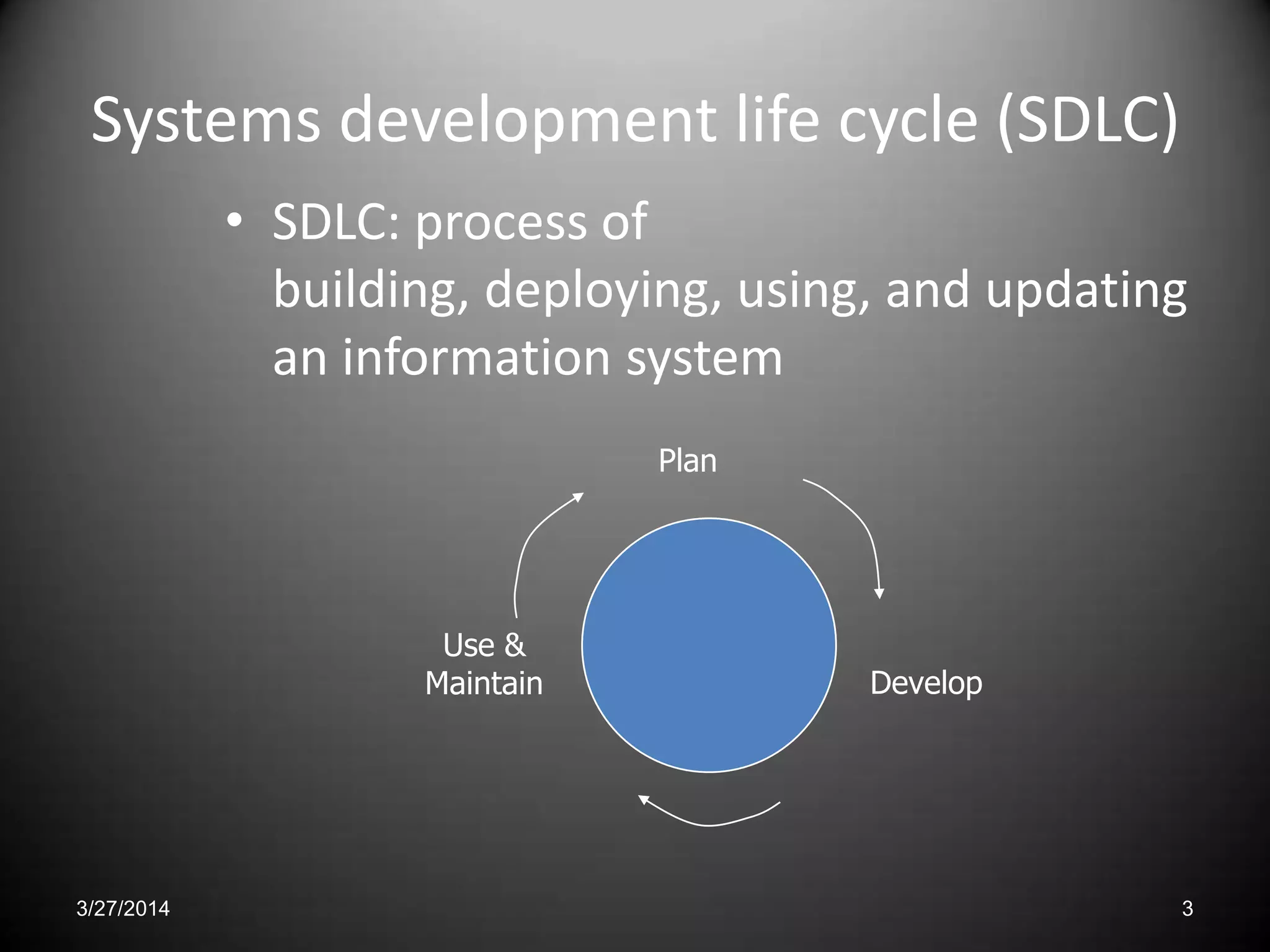
Systems development life cycle (SDLC)
• SDLC: process of
building, deploying, using, and updating
an information system
Plan
Develop
Use &
Maintain
3/27/2014 3
System development methodology
• SD Methodlogy
– Guidelines for developing system.
– Kind of knowledge.
• Two kinds of methodologies
– Structured (since 1970s)
– Newer, rapid development
3/27/2014 4
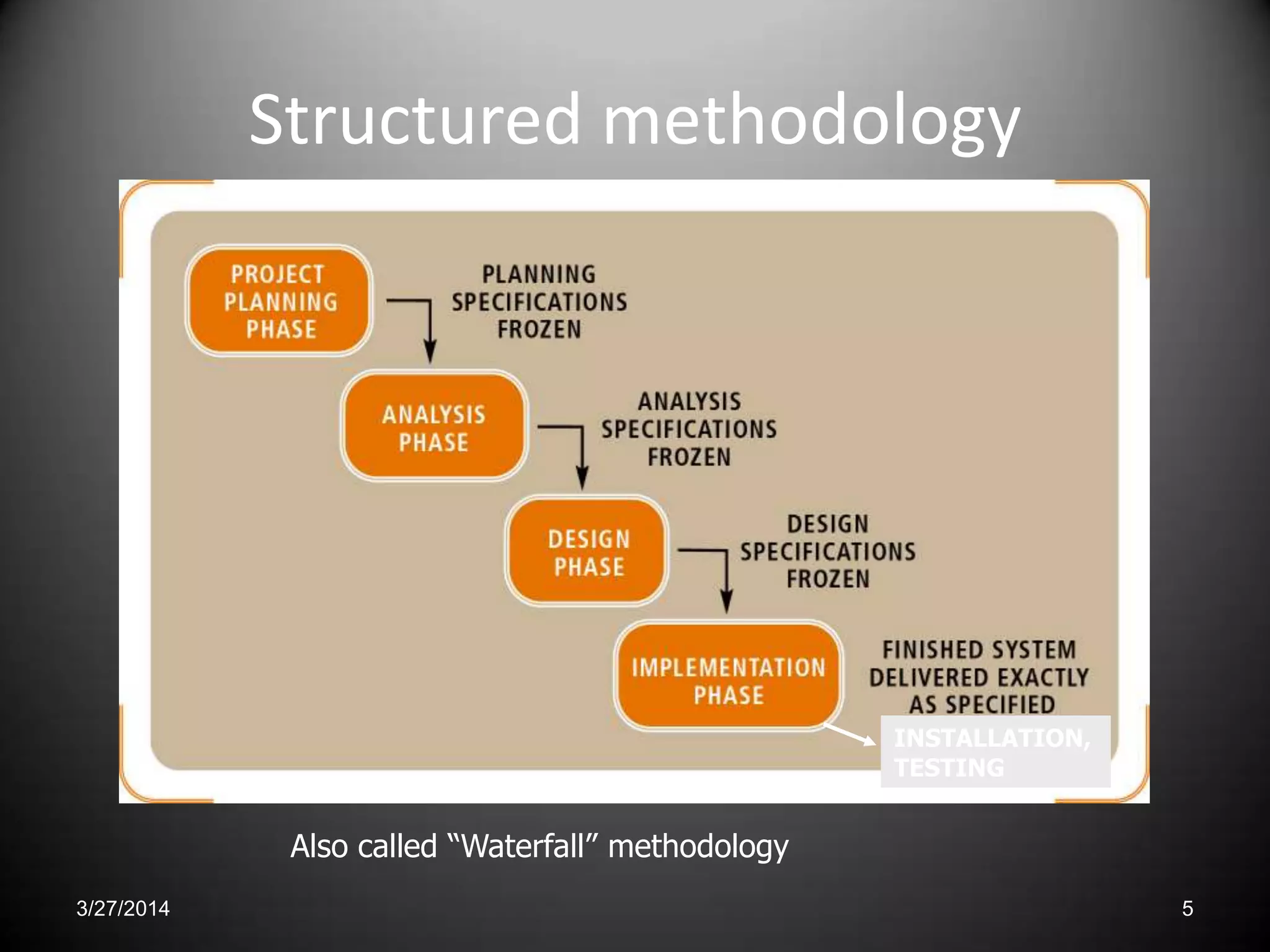
Structured methodology
Also called “Waterfall” methodology
INSTALLATION,
TESTING
3/27/2014 5
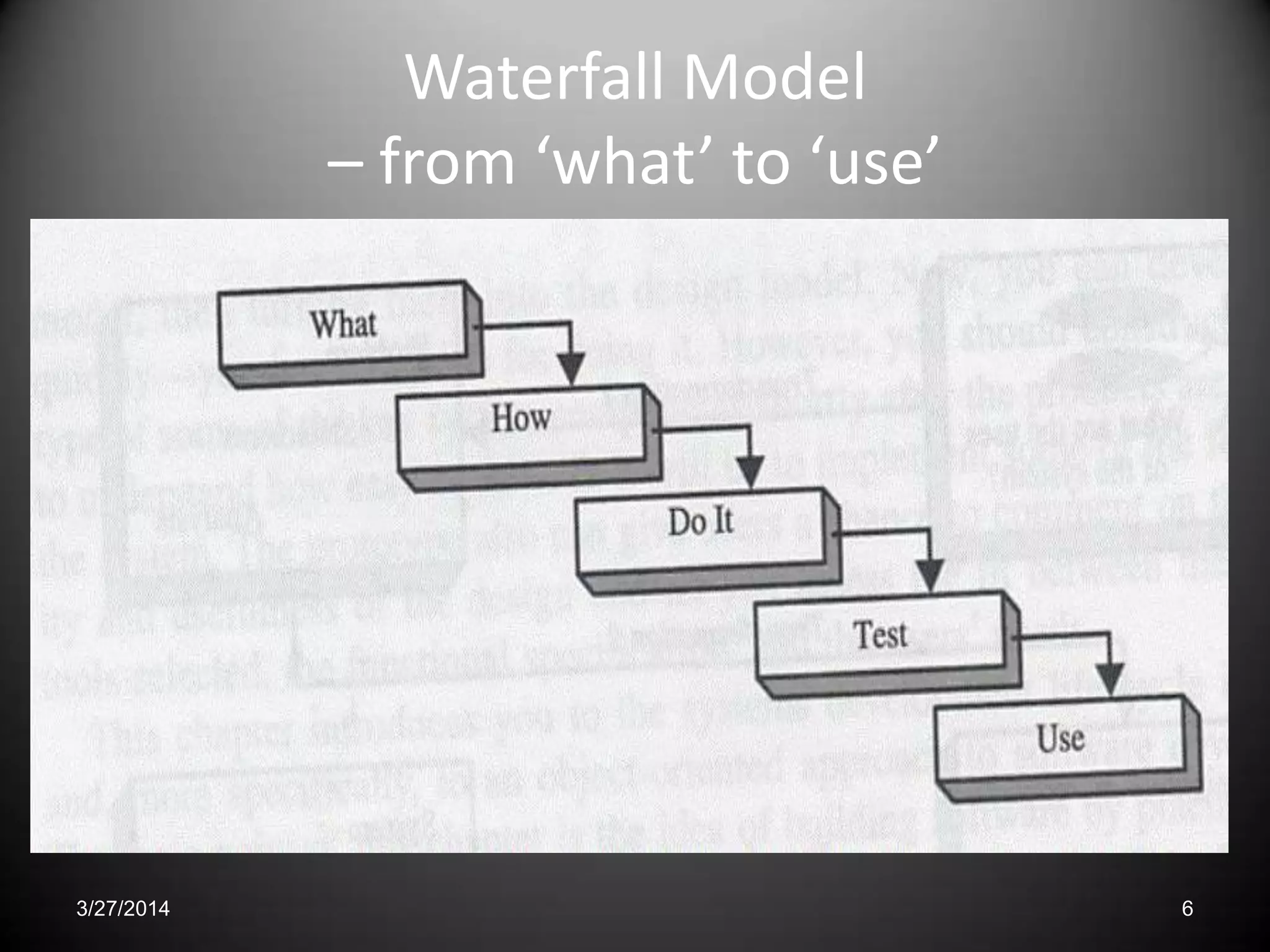
Waterfall Model
– from ‘what’ to ‘use’
3/27/2014 6
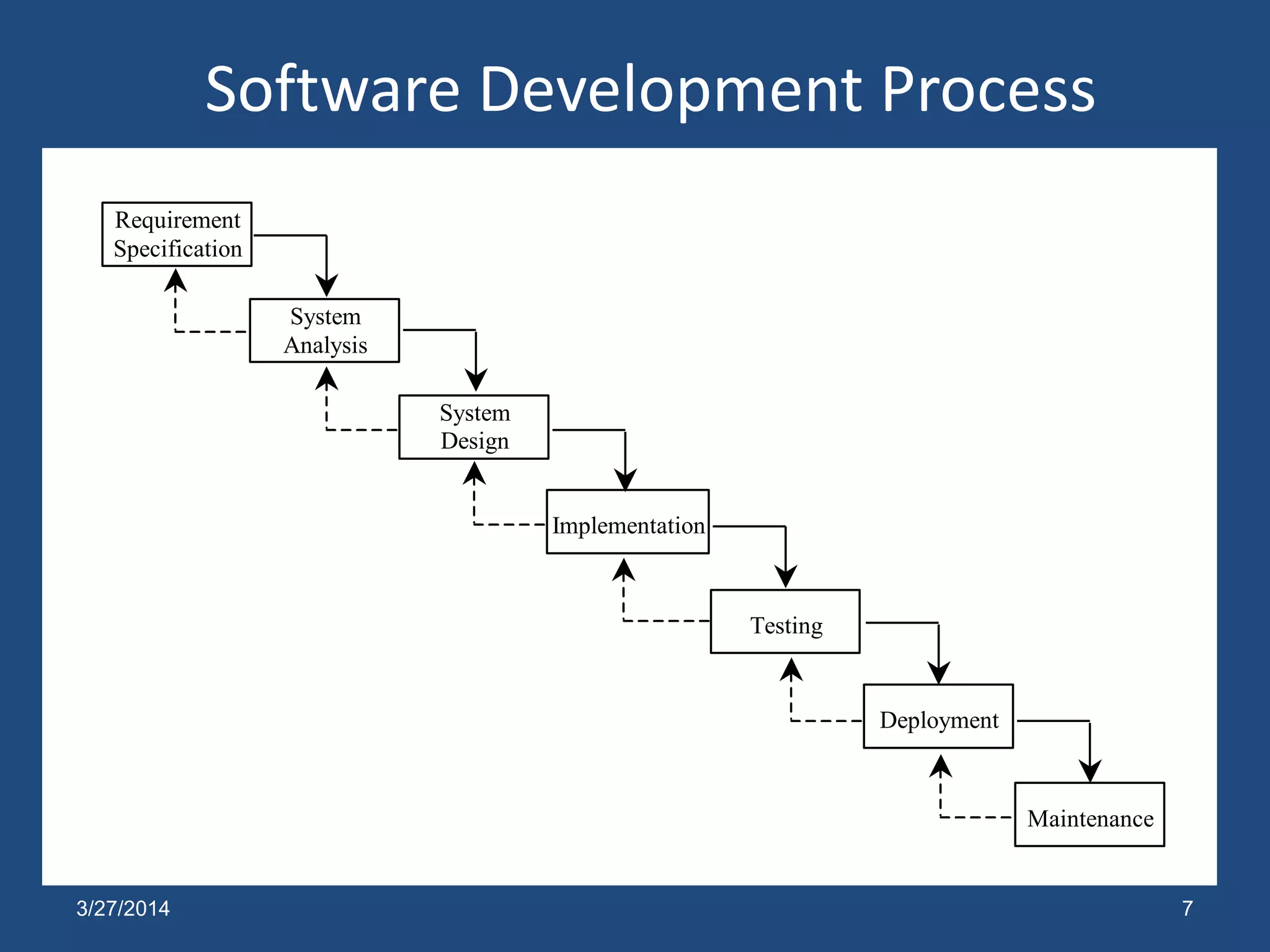
Software Development Process
7
Requirement
Specification
System
Analysis
System
Design
Testing
Implementation
Maintenance
Deployment
3/27/2014
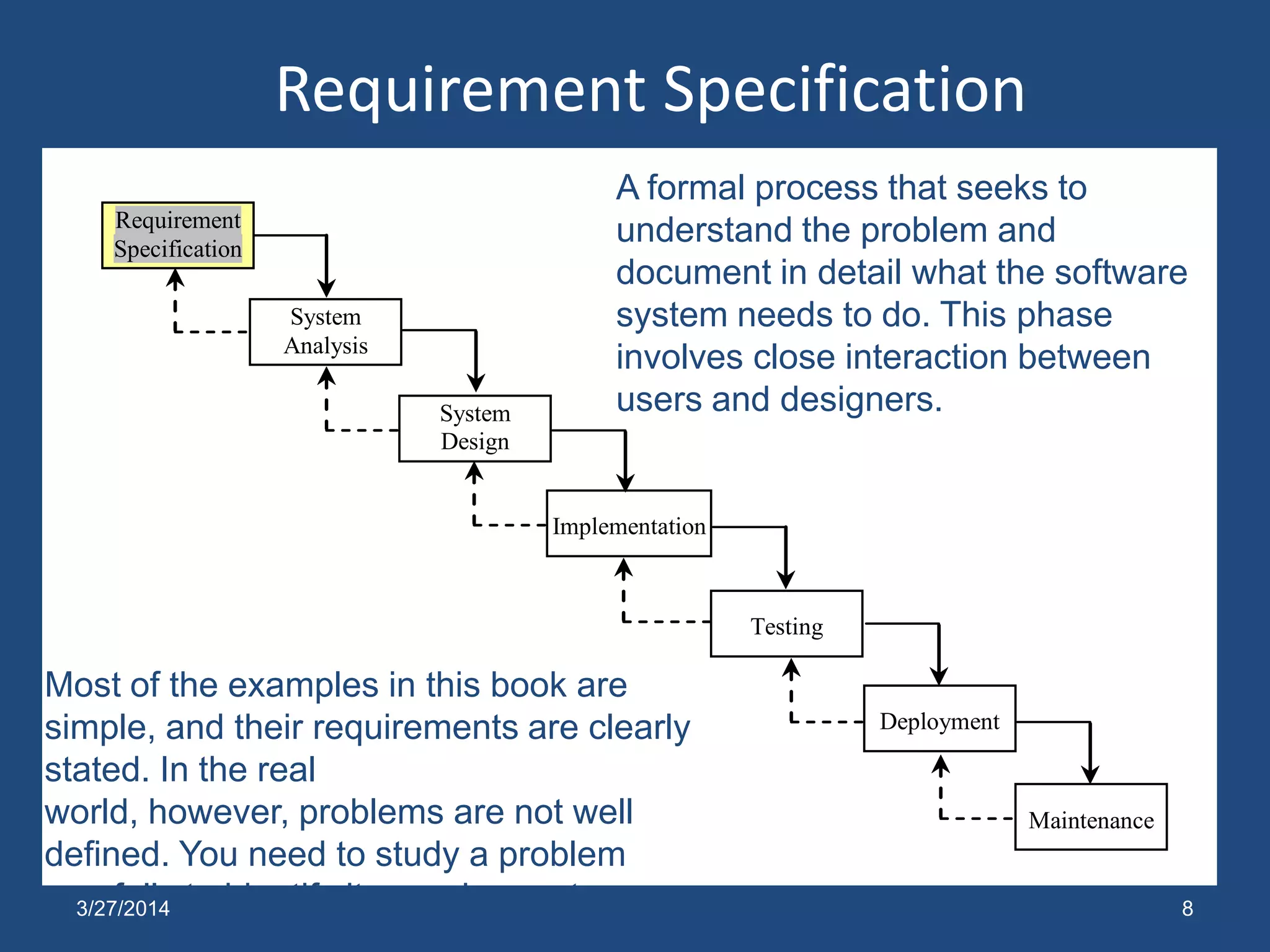
Requirement Specification
8
Requirement
Specification
System
Analysis
System
Design
Testing
Implementation
Maintenance
Deployment
A formal process that seeks to
understand the problem and
document in detail what the software
system needs to do. This phase
involves close interaction between
users and designers.
Most of the examples in this book are
simple, and their requirements are clearly
stated. In the real
world, however, problems are not well
defined. You need to study a problem
carefully to identify its requirements.3/27/2014
System Analysis
9
Requirement
Specification
System
Analysis
System
Design
Testing
Implementation
Maintenance
Deployment
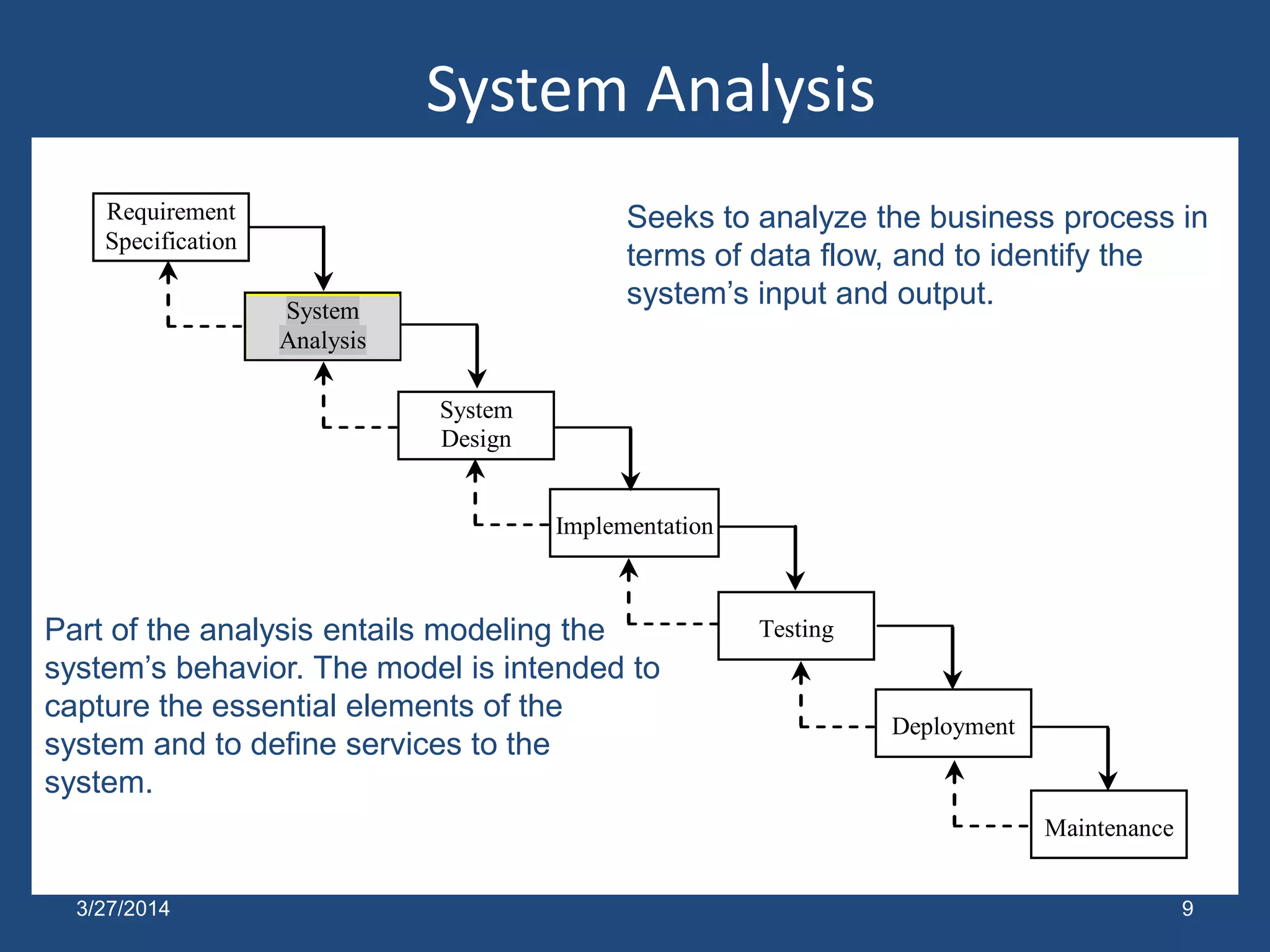
Seeks to analyze the business process in
terms of data flow, and to identify the
system’s input and output.
Part of the analysis entails modeling the
system’s behavior. The model is intended to
capture the essential elements of the
system and to define services to the
system.
3/27/2014
System Design
10
Requirement
Specification
System
Analysis
System
Design
Testing
Implementation
Maintenance
Deployment
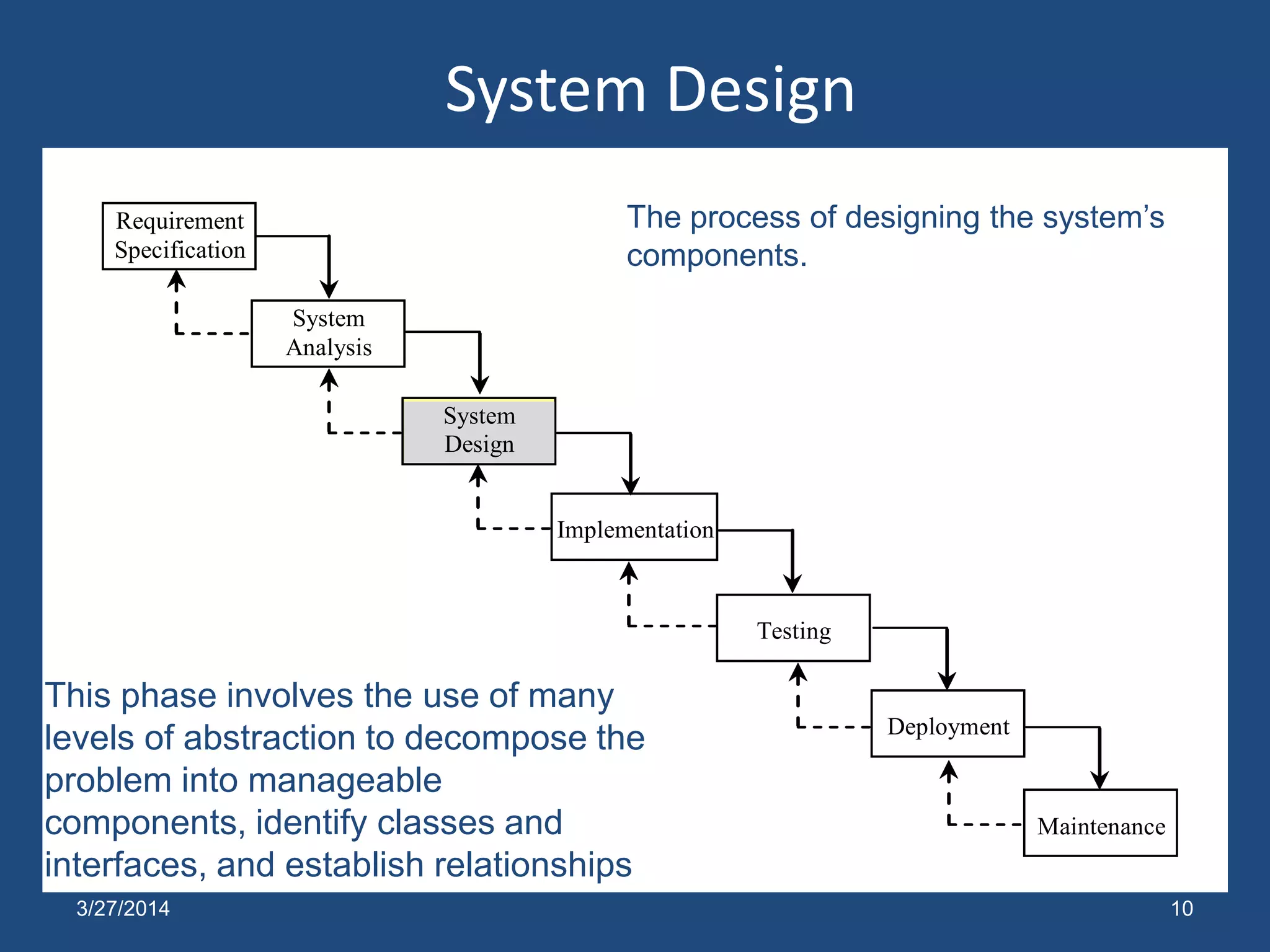
The process of designing the system’s
components.
This phase involves the use of many
levels of abstraction to decompose the
problem into manageable
components, identify classes and
interfaces, and establish relationships
among the classes and interfaces.3/27/2014
Implementation
11
Requirement
Specification
System
Analysis
System
Design
Testing
Implementation
Maintenance
Deployment
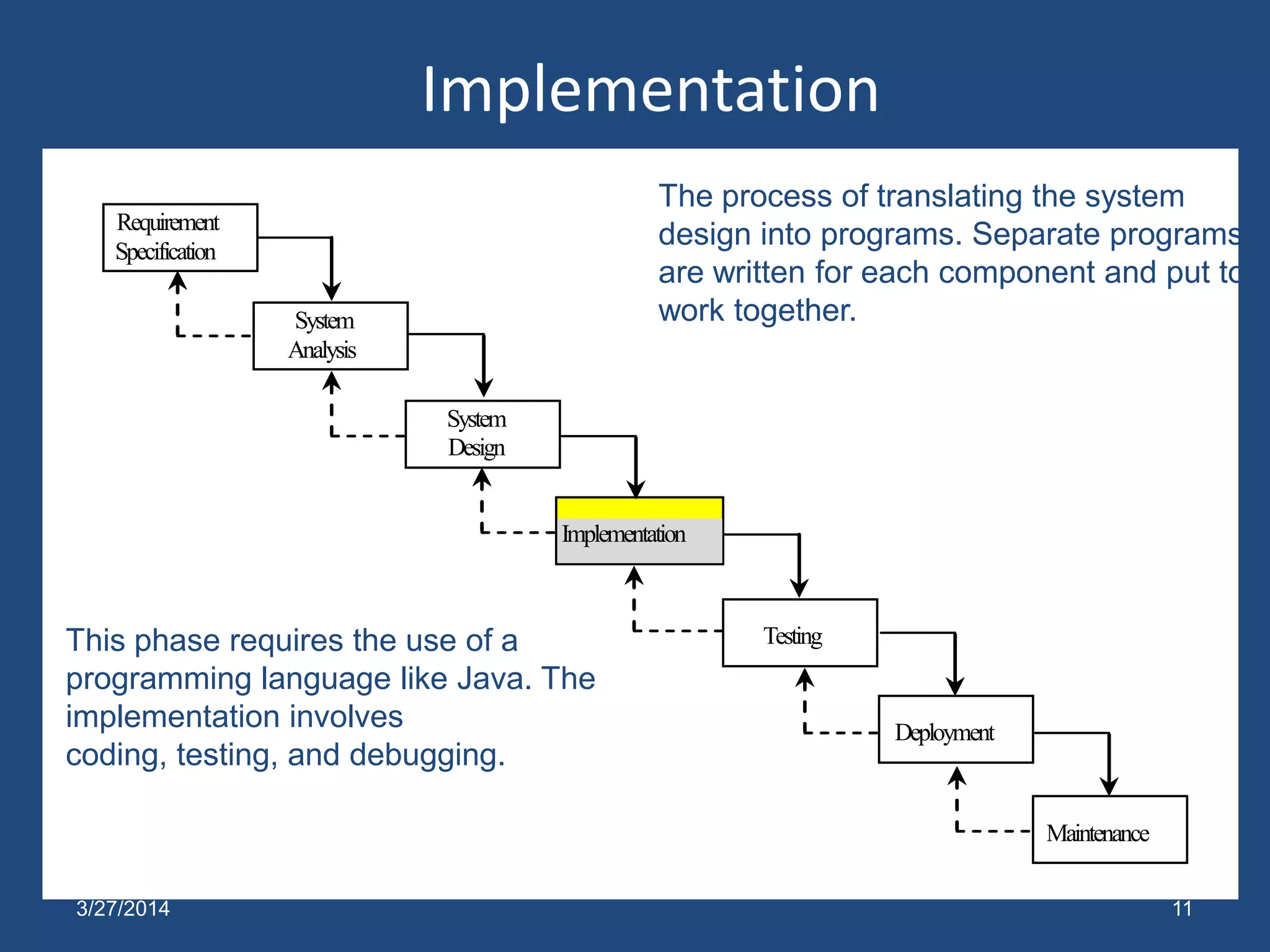
The process of translating the system
design into programs. Separate programs
are written for each component and put to
work together.
This phase requires the use of a
programming language like Java. The
implementation involves
coding, testing, and debugging.
3/27/2014
Testing
12
Requirement
Specification
System
Analysis
System
Design
Testing
Implementation
Maintenance
Deployment
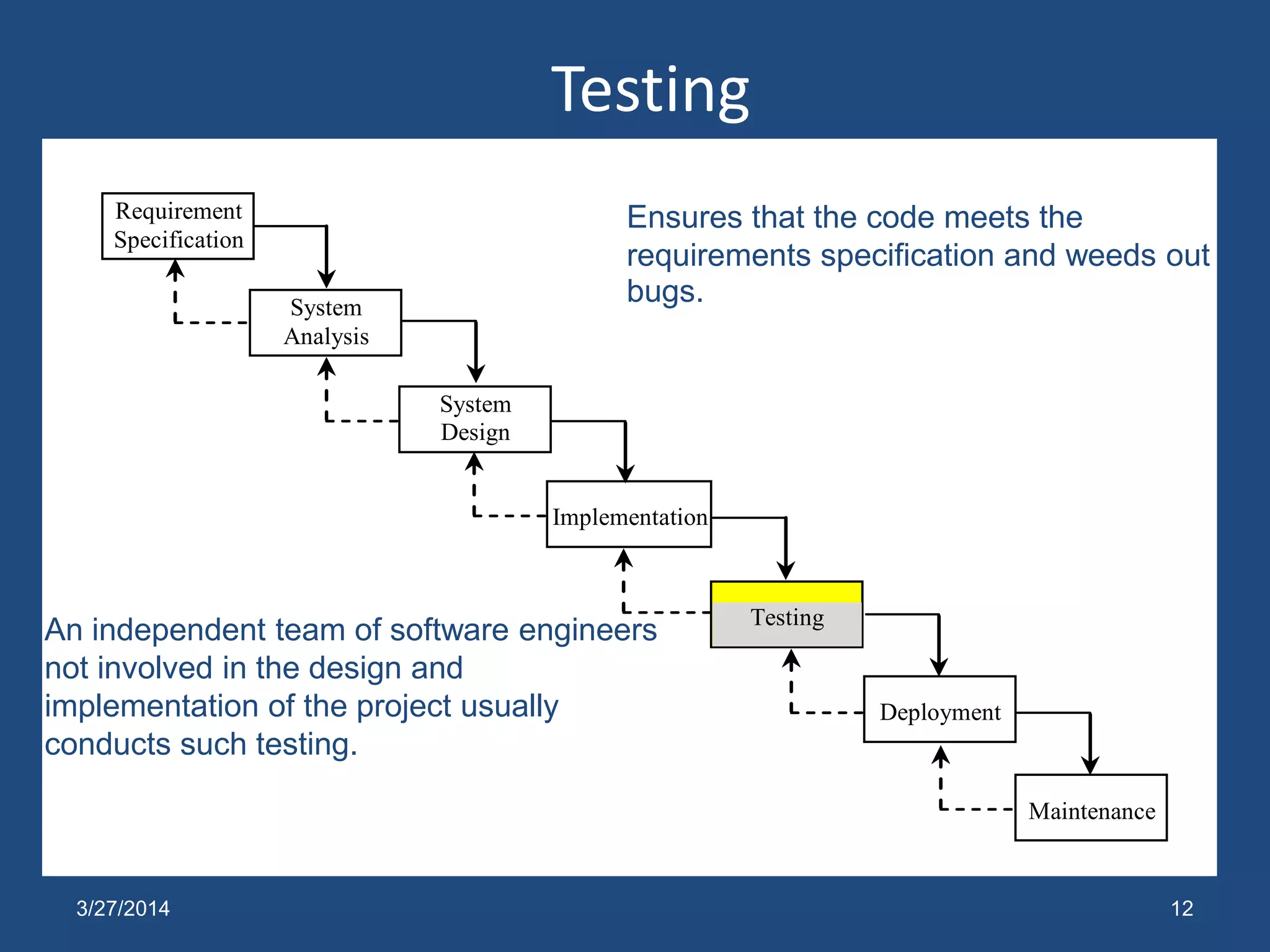
Ensures that the code meets the
requirements specification and weeds out
bugs.
An independent team of software engineers
not involved in the design and
implementation of the project usually
conducts such testing.
3/27/2014
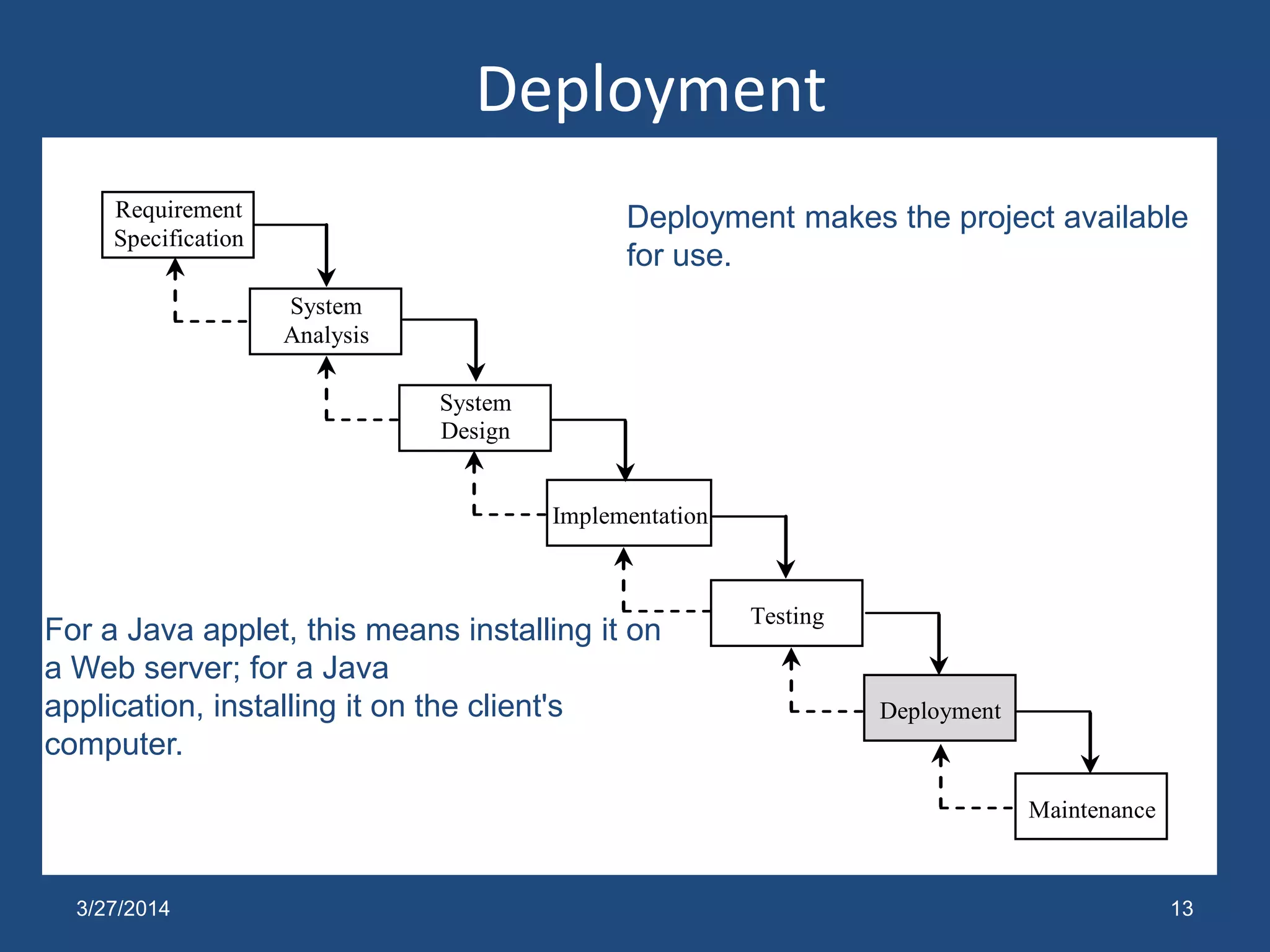
Deployment
13
Requirement
Specification
System
Analysis
System
Design
Testing
Implementation
Maintenance
Deployment
Deployment makes the project available
for use.
For a Java applet, this means installing it on
a Web server; for a Java
application, installing it on the client's
computer.
3/27/2014
Relationships among Classes
• Association
• Aggregation
• Composition
• Inheritance
143/27/2014
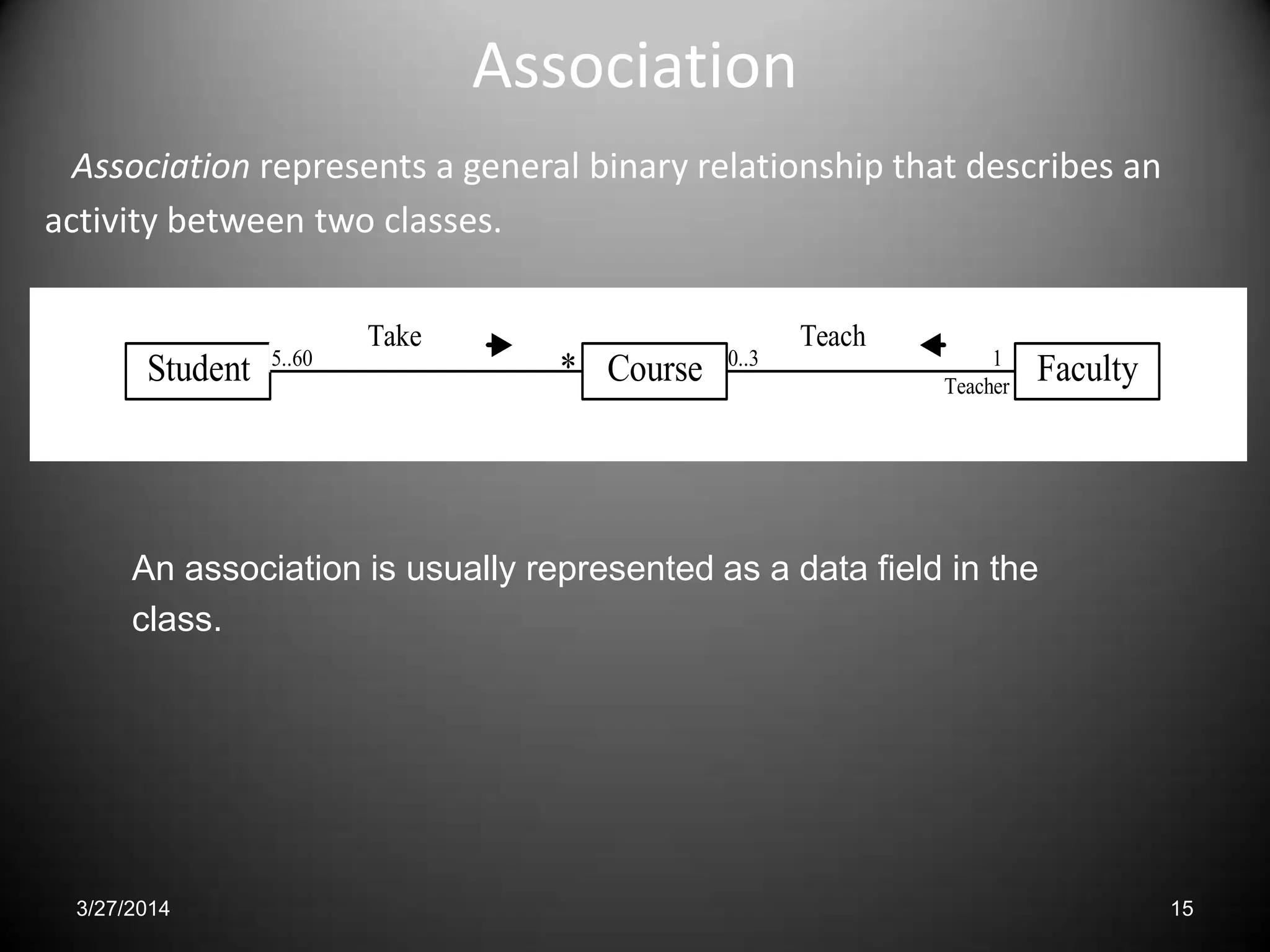
Association
Association represents a general binary relationship that describes an
activity between two classes.
15
Student *5..60
Take Teach
0..3 1
Teacher
FacultyCourse
An association is usually represented as a data field in the
class.
3/27/2014
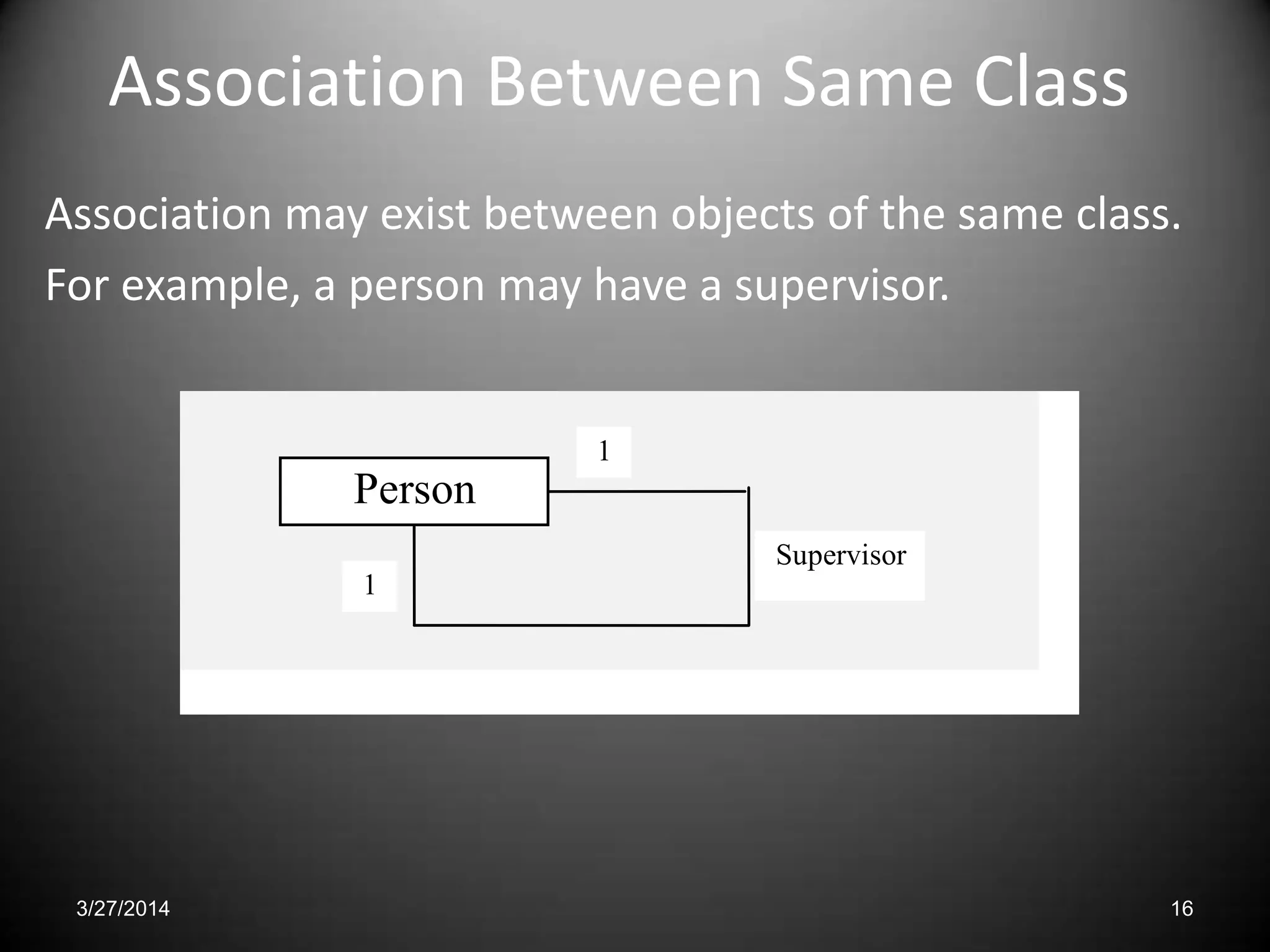
Association Between Same Class
Association may exist between objects of the same class.
For example, a person may have a supervisor.
16
Person
Supervisor
1
1
3/27/2014
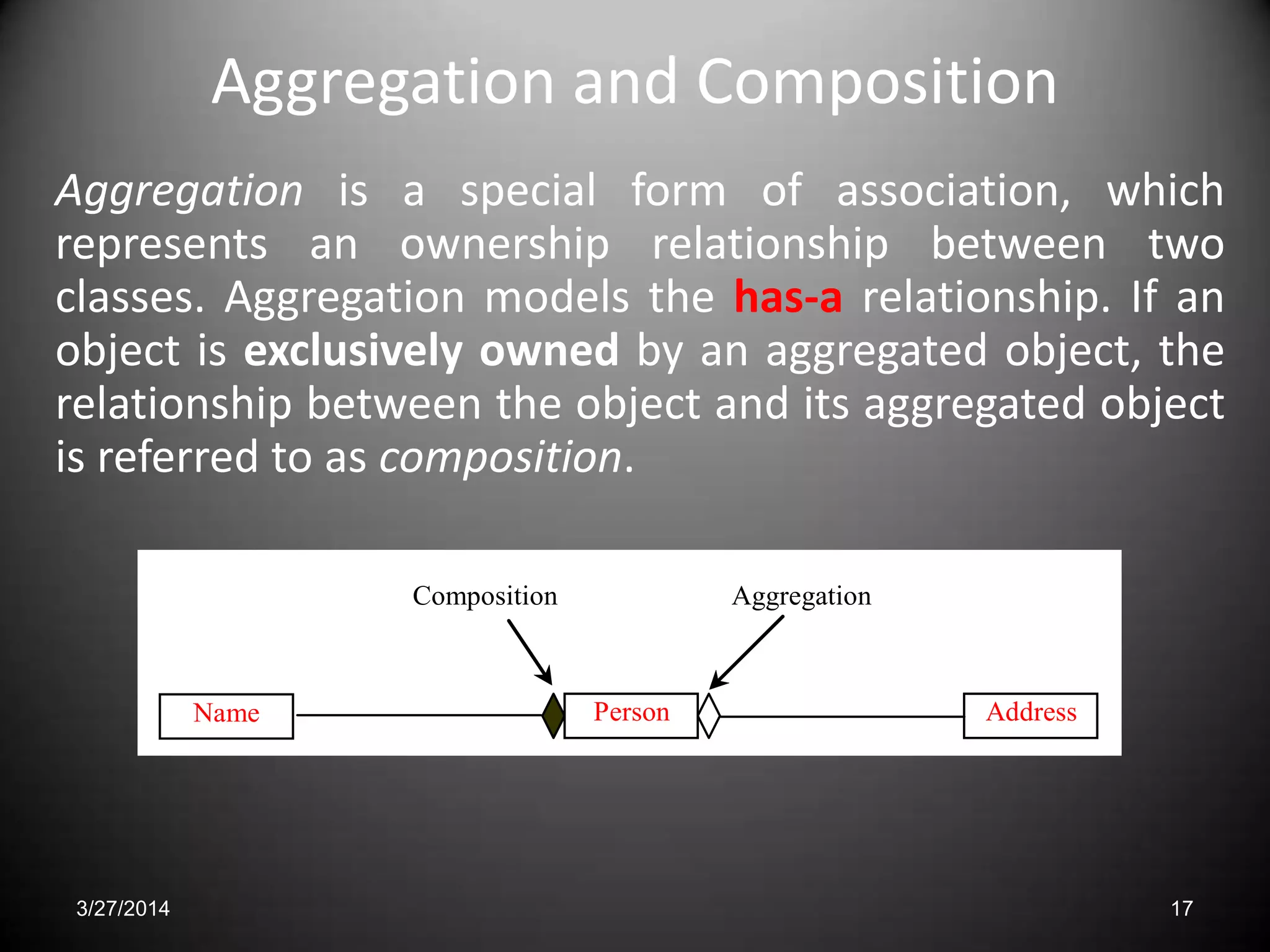
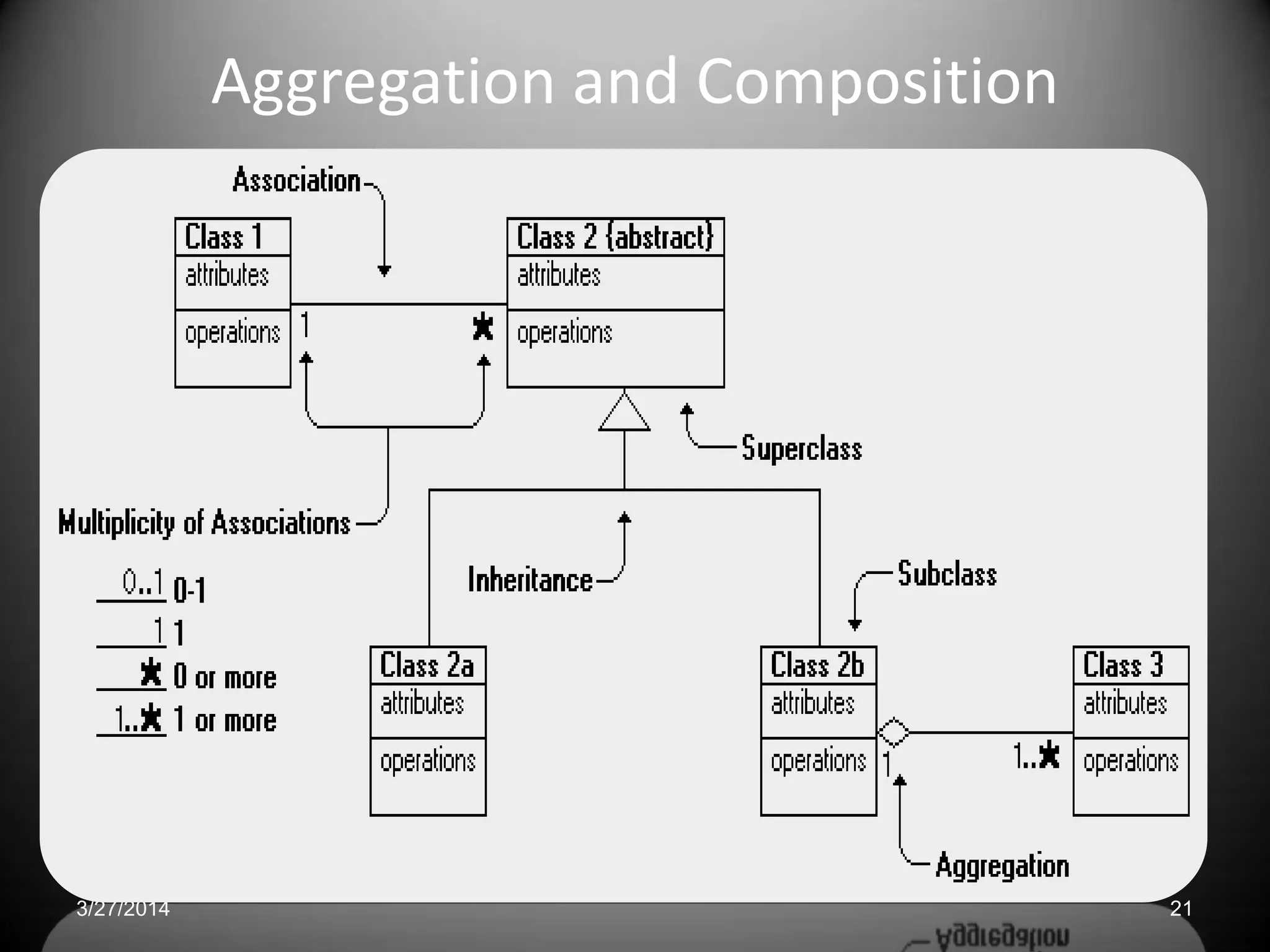
Aggregation and Composition
Aggregation is a special form of association, which
represents an ownership relationship between two
classes. Aggregation models the has-a relationship. If an
object is exclusively owned by an aggregated object, the
relationship between the object and its aggregated object
is referred to as composition.
17
Name AddressPerson
Composition Aggregation
3/27/2014
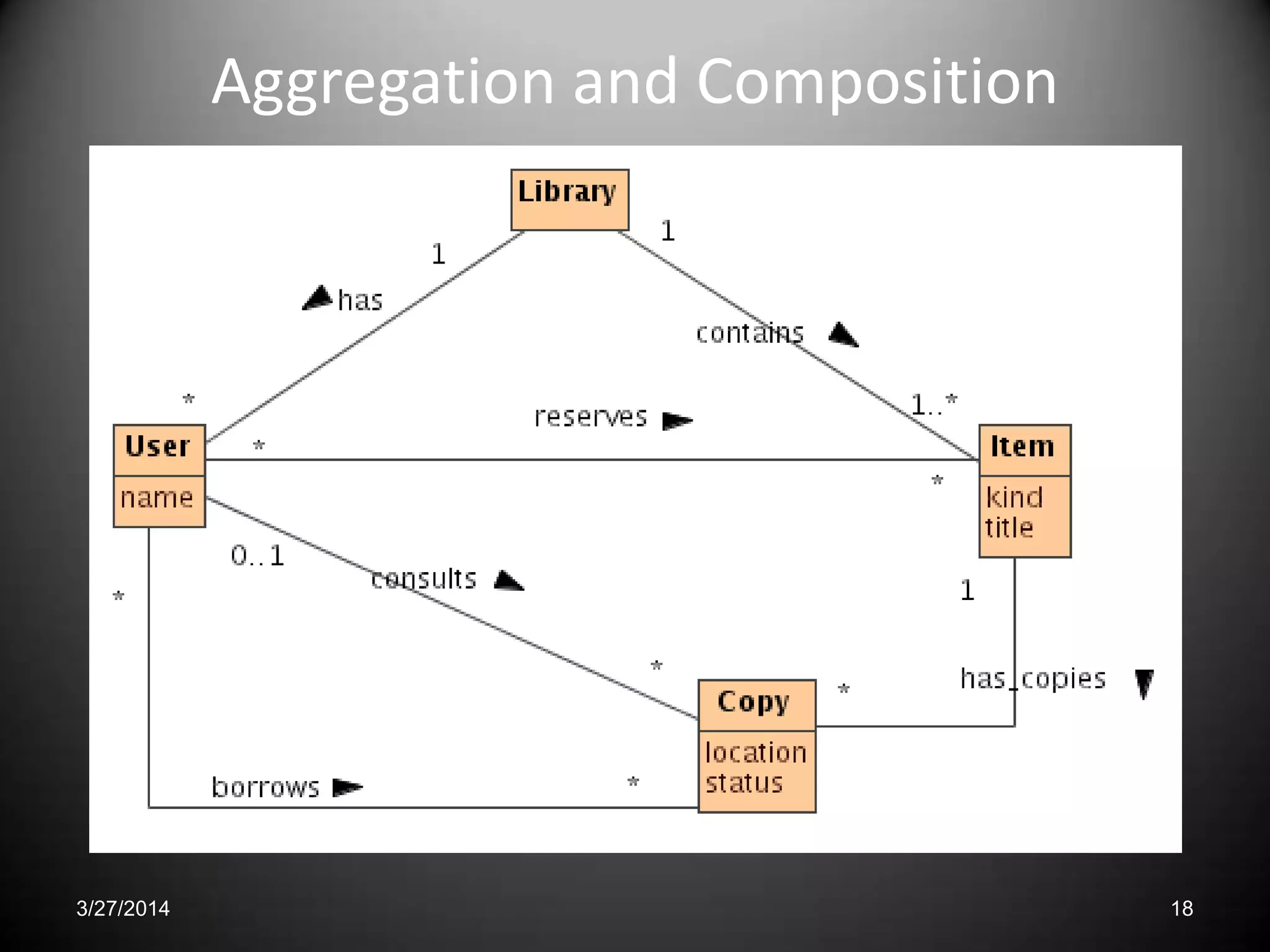
3/27/2014 18
Aggregation and Composition
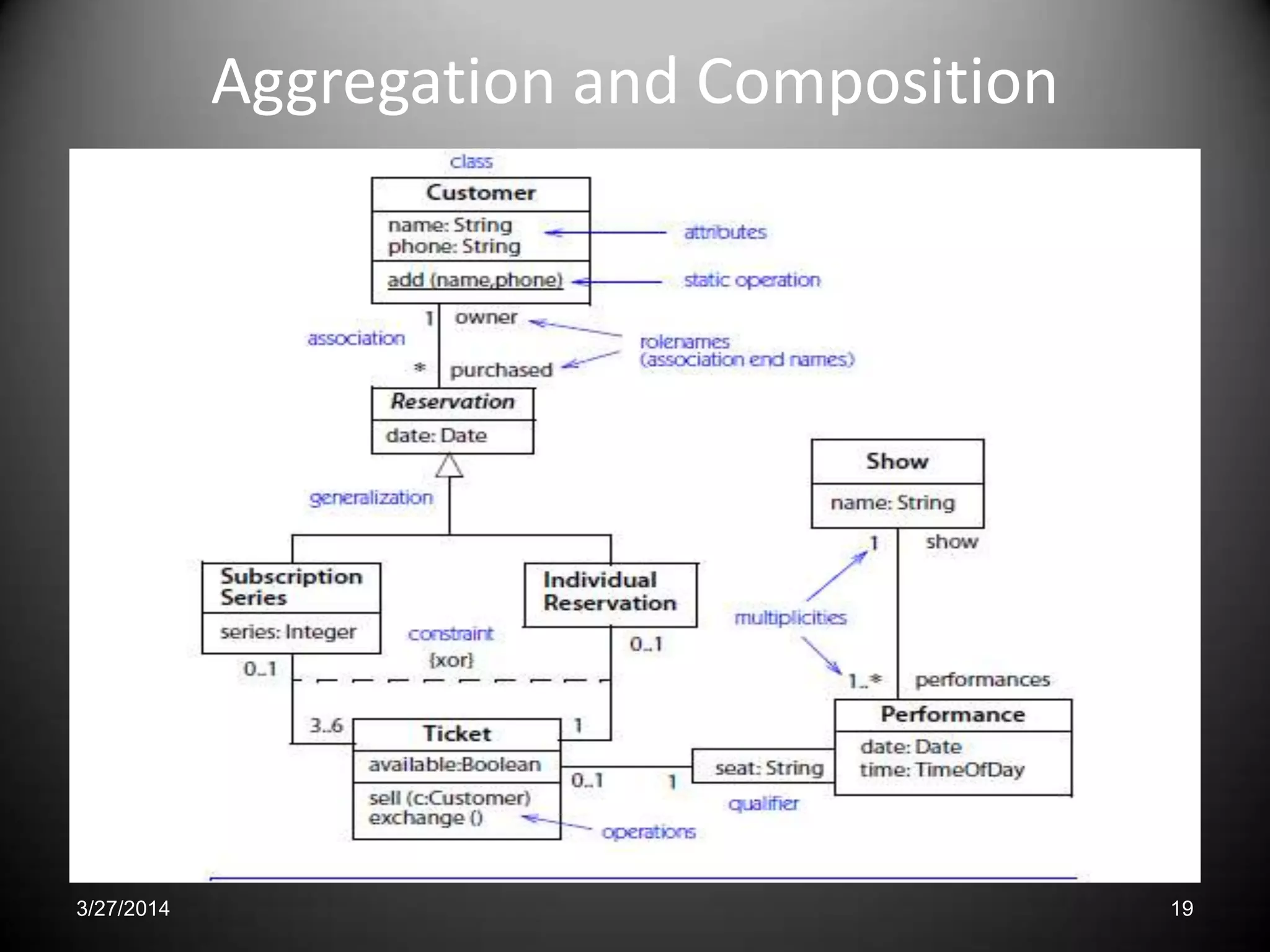
3/27/2014 19
Aggregation and Composition
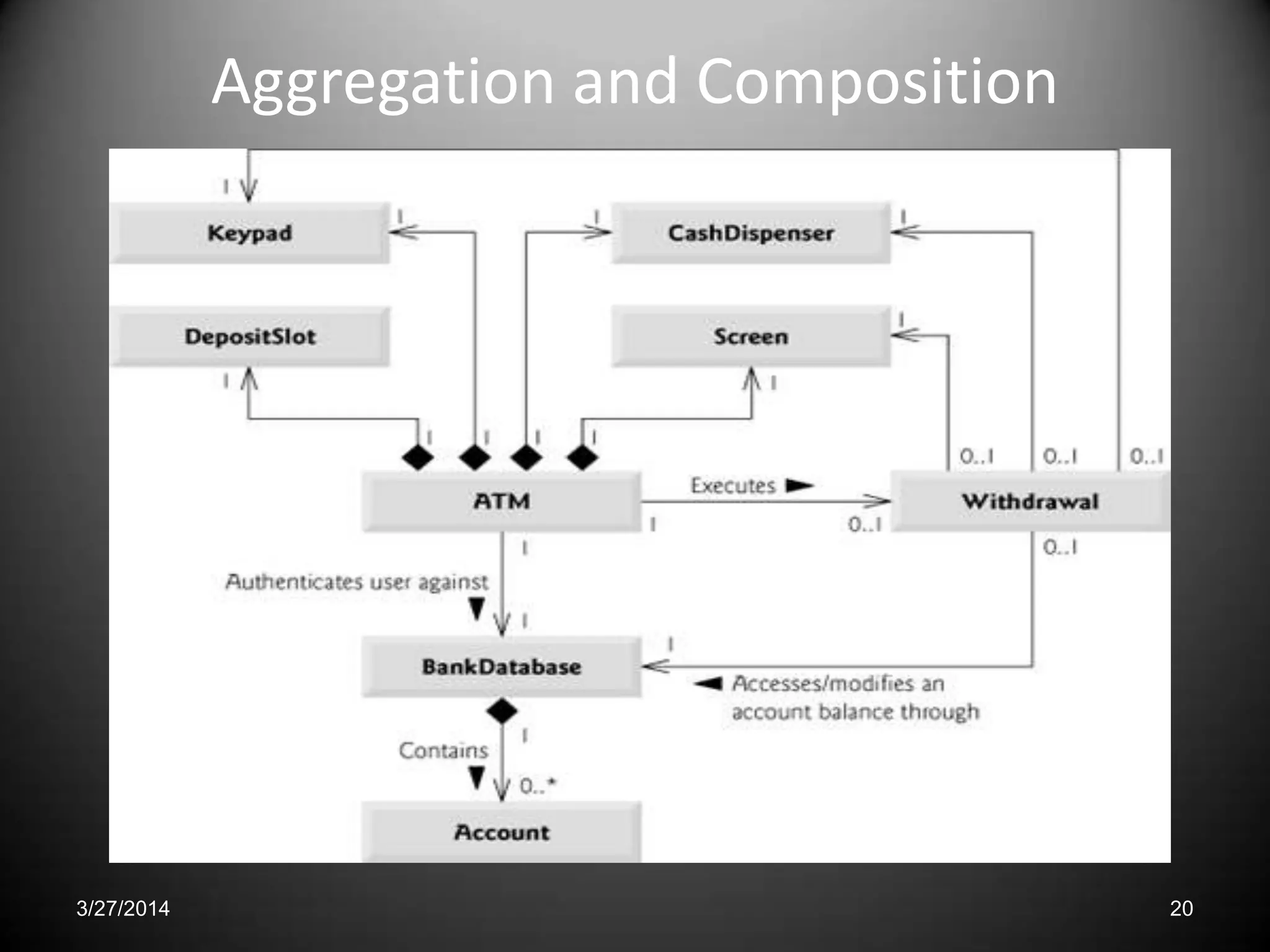
3/27/2014 20
Aggregation and Composition
3/27/2014 21
Aggregation and Composition
3/27/2014 22
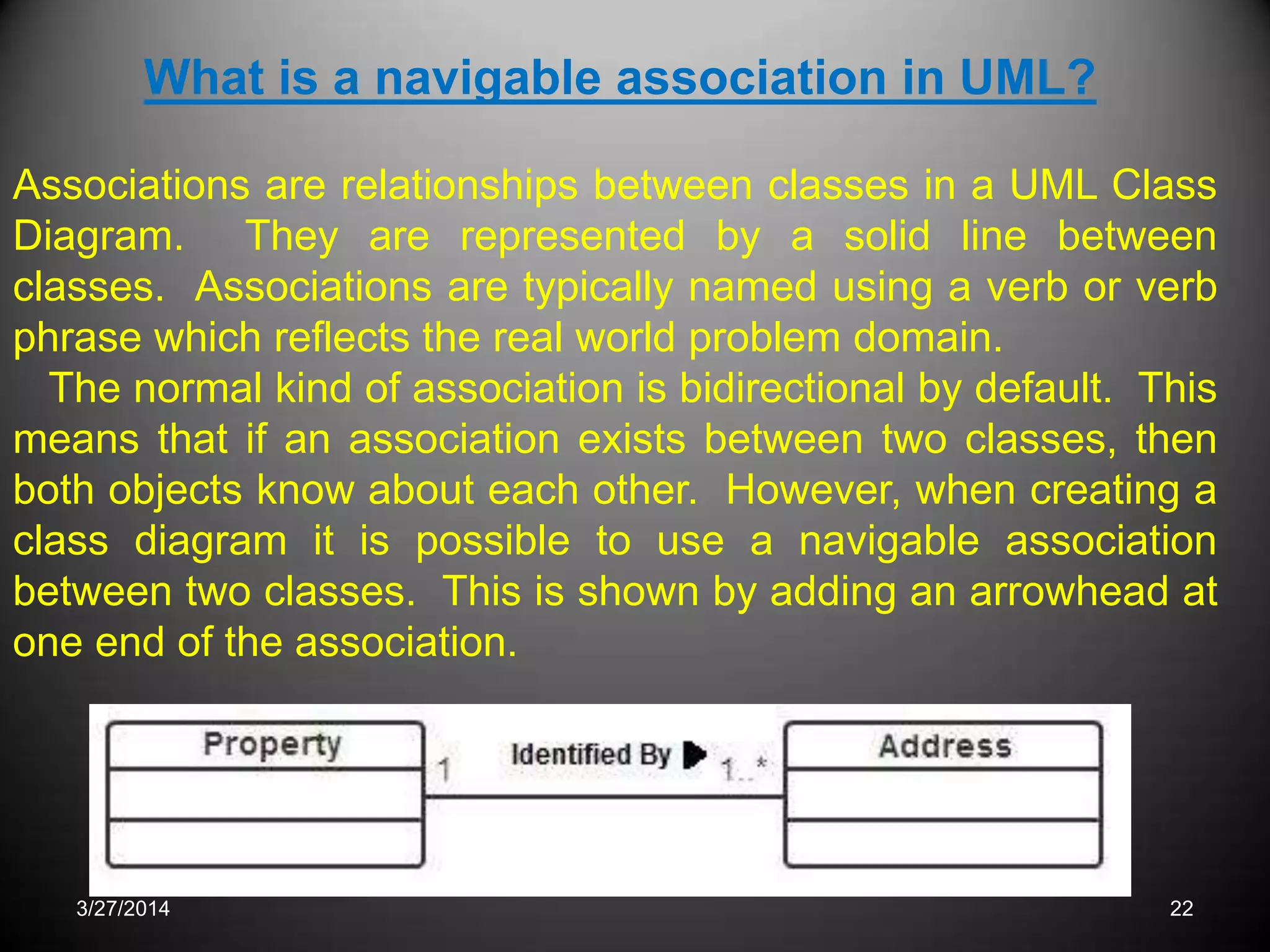
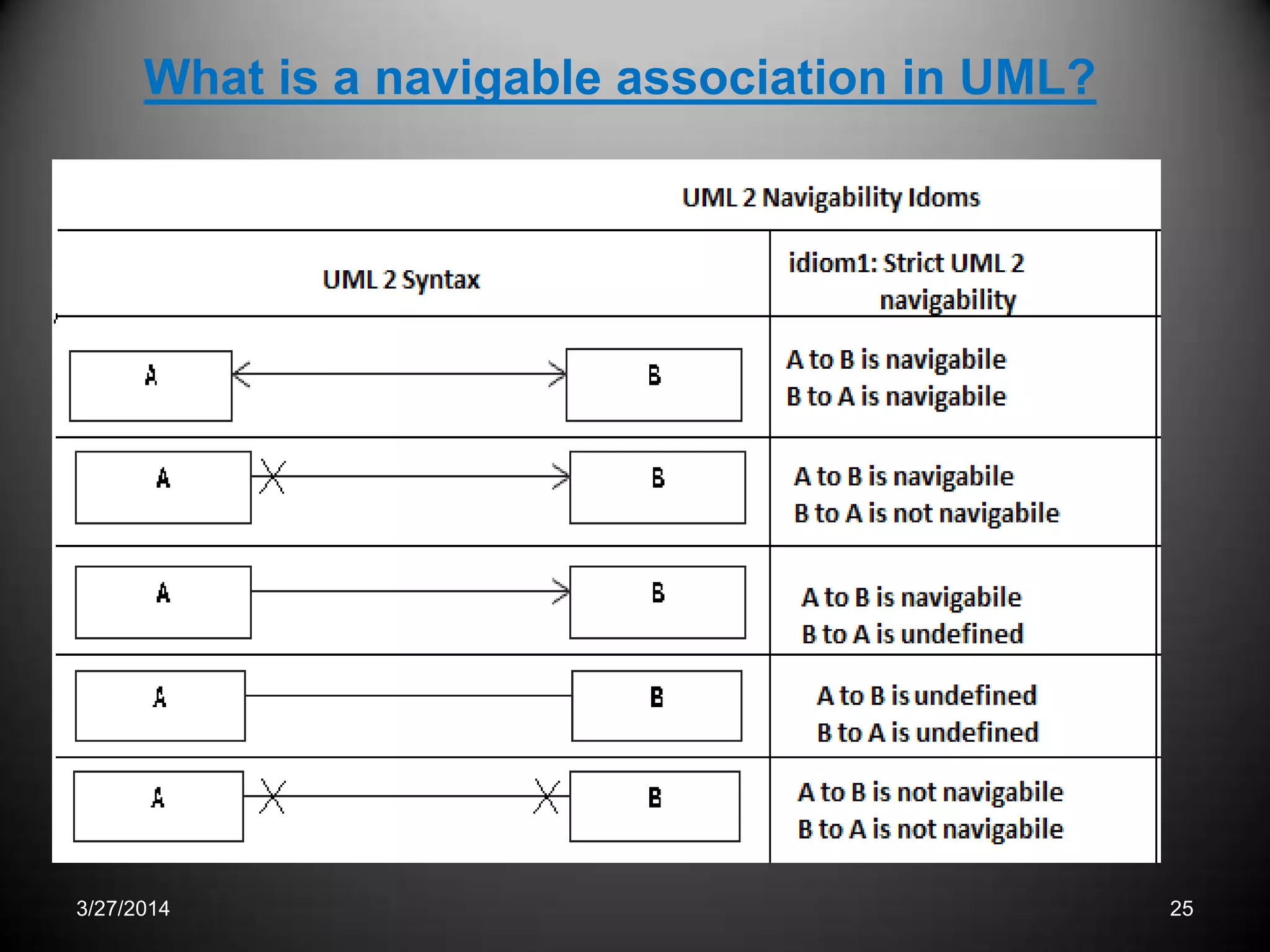
What is a navigable association in UML?
Associations are relationships between classes in a UML Class
Diagram. They are represented by a solid line between
classes. Associations are typically named using a verb or verb
phrase which reflects the real world problem domain.
The normal kind of association is bidirectional by default. This
means that if an association exists between two classes, then
both objects know about each other. However, when creating a
class diagram it is possible to use a navigable association
between two classes. This is shown by adding an arrowhead at
one end of the association.
3/27/2014 23
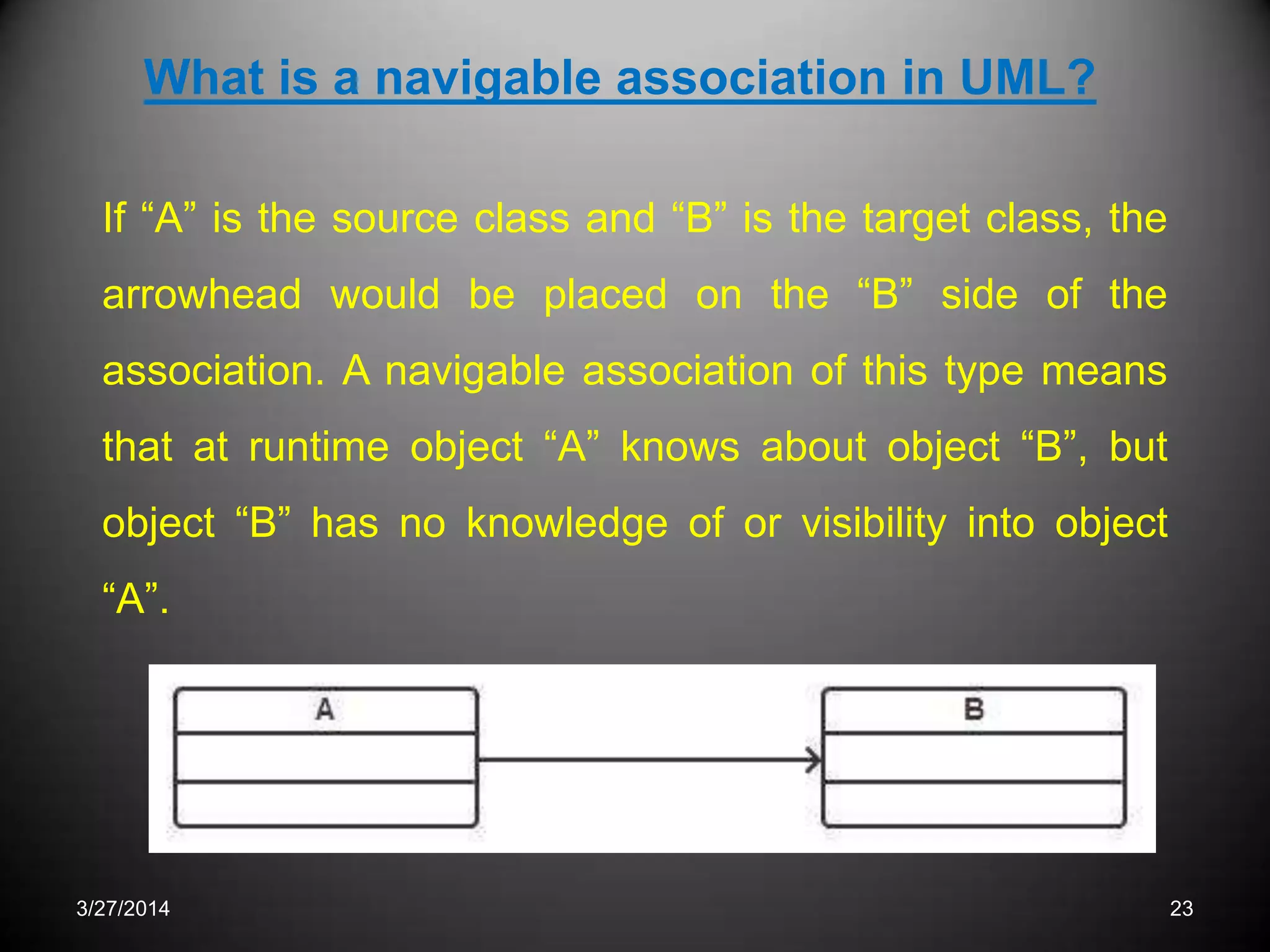
What is a navigable association in UML?
If “A” is the source class and “B” is the target class, the
arrowhead would be placed on the “B” side of the
association. A navigable association of this type means
that at runtime object “A” knows about object “B”, but
object “B” has no knowledge of or visibility into object
“A”.
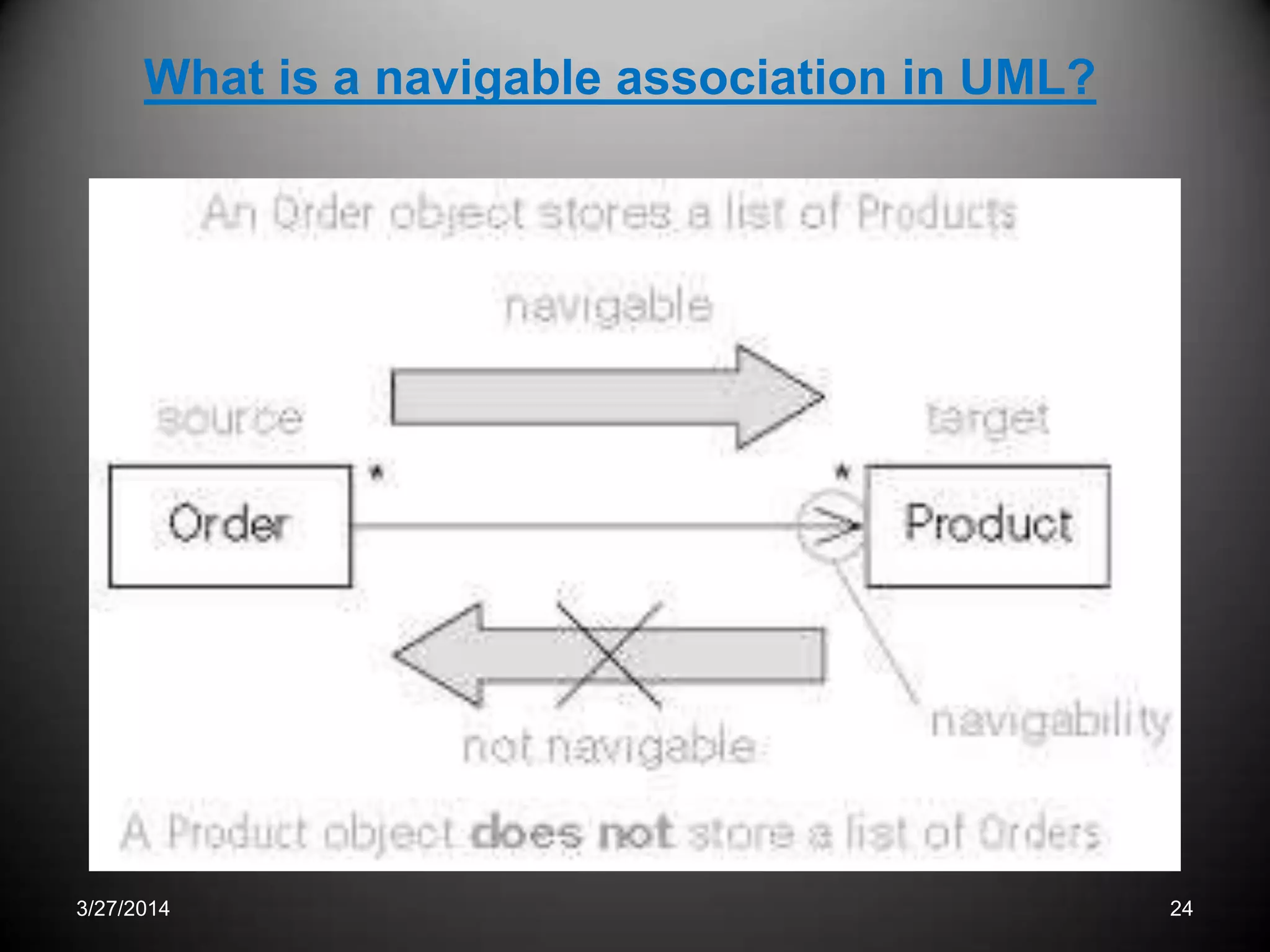
3/27/2014 24
What is a navigable association in UML?
3/27/2014 25
What is a navigable association in UML?
3/27/2014 26
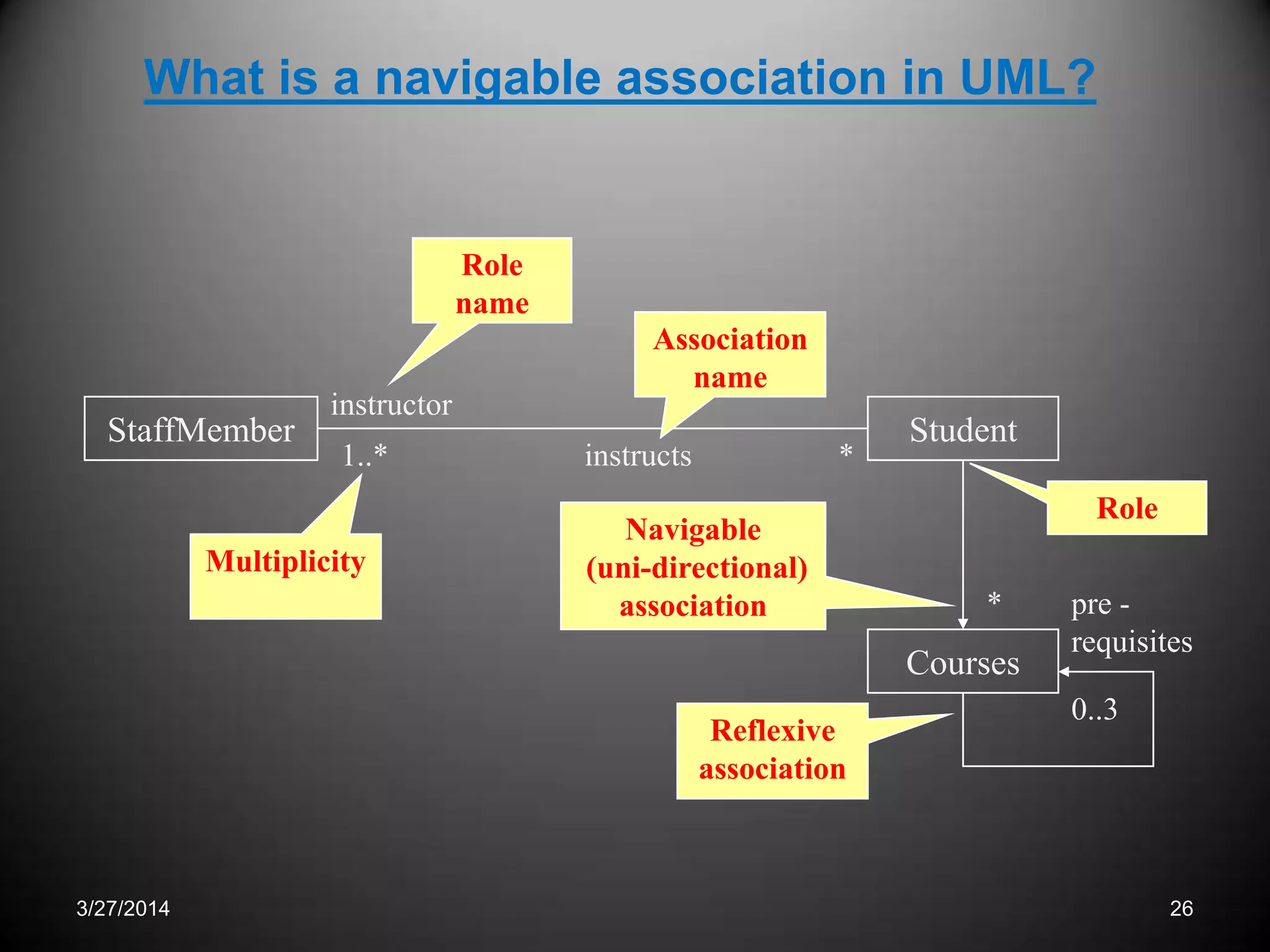
What is a navigable association in UML?
StaffMember Student
1..* *instructs
instructor
Association
name
Role
name
Multiplicity
Navigable
(uni-directional)
association
Courses
pre -
requisites
0..3
Reflexive
association
Role
*
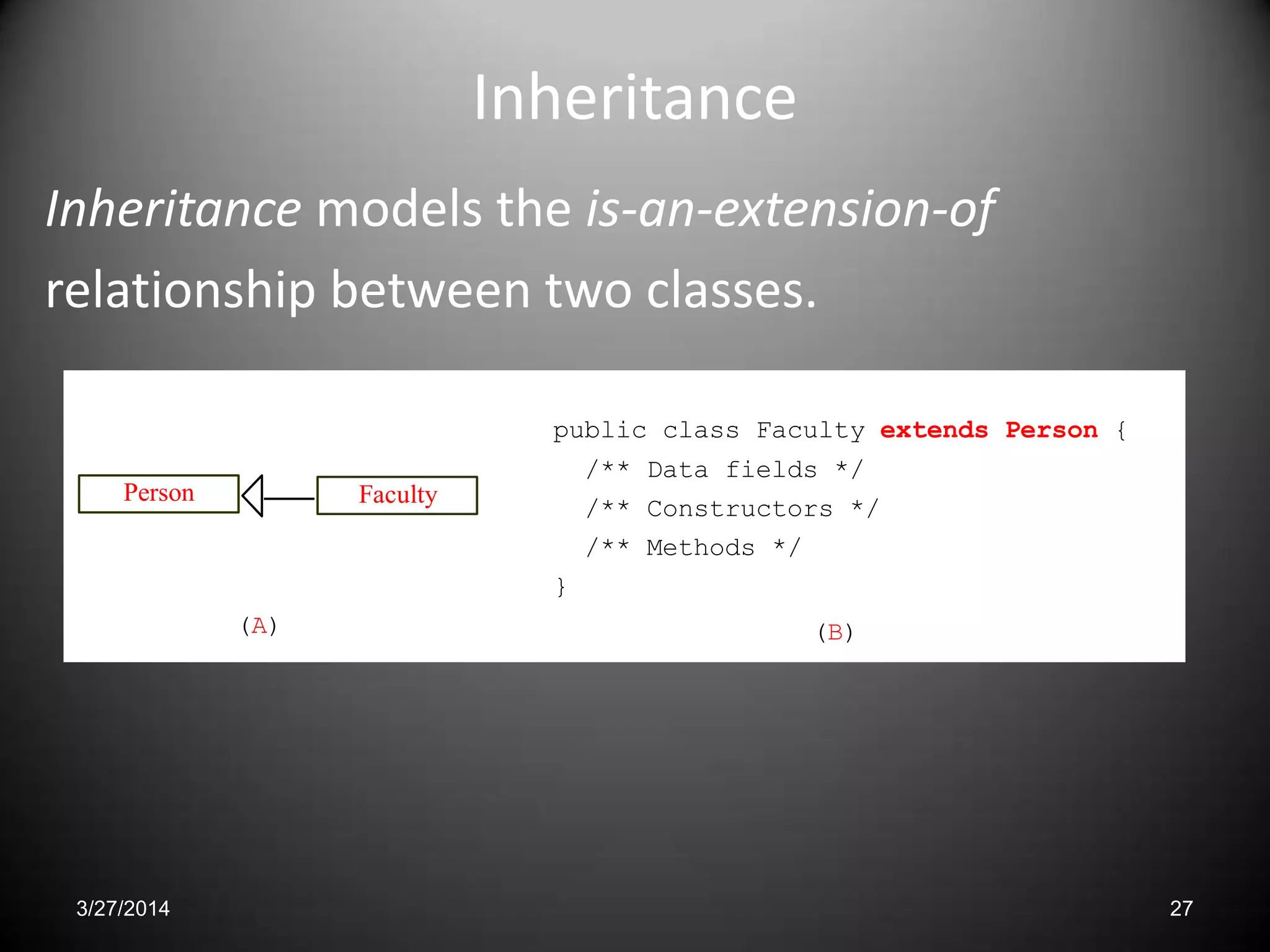
Inheritance
Inheritance models the is-an-extension-of
relationship between two classes.
27
Person Faculty
public class Faculty extends Person {
/** Data fields */
/** Constructors */
/** Methods */
}
(A) (B)
3/27/2014
Objects
• An object is an individual unit which is used as the
basic building block of programs. The term object
is also used to refer to any "thing".
• Each object is capable of receiving
messages, processing data, and sending messages
to other objects.
• Each object can be viewed as an independent little
machine or actor with a distinct role or
responsibility.
283/27/2014
Object – key concept
• Object: Thing (data structure) with data
(attributes) and methods
(behaviors, processes, operations)
• Object “encapsulates” data and processes
• Examples of objects
– Problem domain objects (student, customer)
– User interface (buttons, text boxes)
3/27/2014 29
Object examples
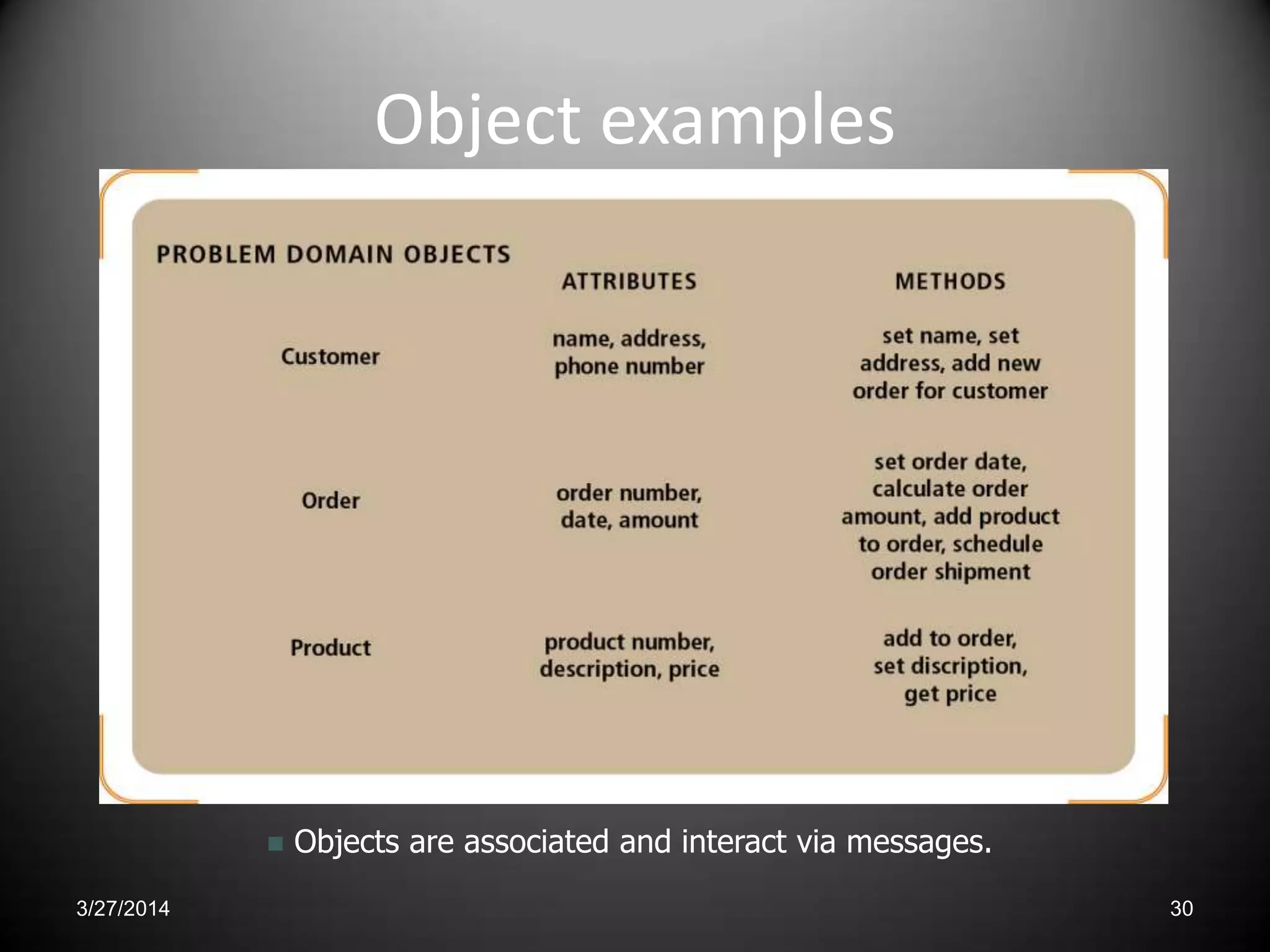
 Objects are associated and interact via messages.
3/27/2014 30
Classes
• Classes are used to group related variables and
functions.
• A class specifies the structure of data which contains
methods (functions) which manipulate the data of the
object and perform tasks. A method is a function with
a special property that it has access to data stored in
an object.
• A class is the most specific type of an object in
relation to a specific layer. A class may also have a
representation (meta-object) at run-time, which
provides run-time support for manipulating the class-
related metadata.
313/27/2014
Class
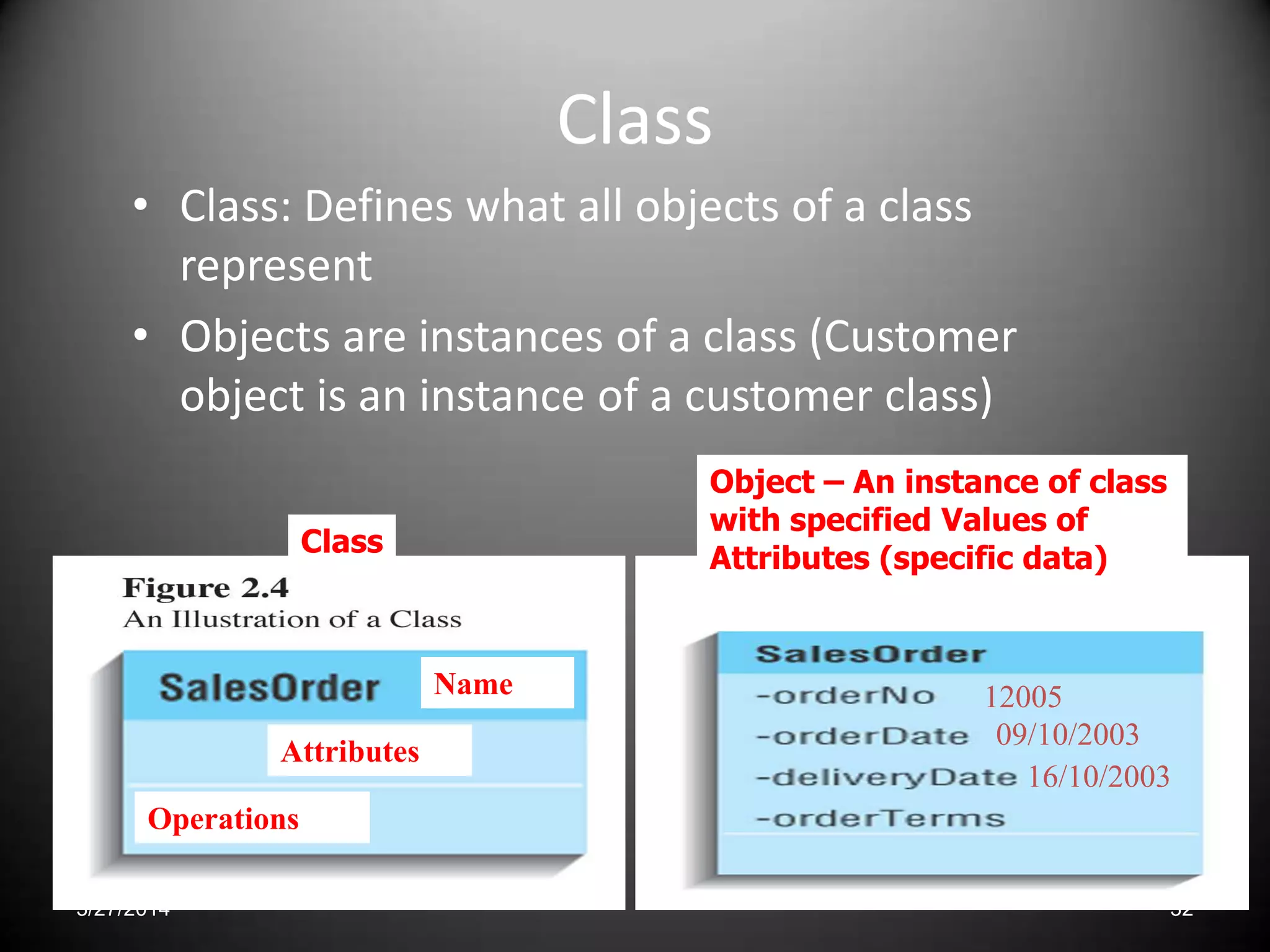
• Class: Defines what all objects of a class
represent
• Objects are instances of a class (Customer
object is an instance of a customer class)
Name
Attributes
Operations
Object – An instance of class
with specified Values of
Attributes (specific data)
12005
09/10/2003
16/10/2003
Class
3/27/2014 32
Inheritance & Specialization/Generalization
 Inheritance: Property of OO systems
allowing for attributes and methods to
be shared among objects.
 Inheritance enables a special
association between classes called
Specialization/Generalization
3/27/2014 33
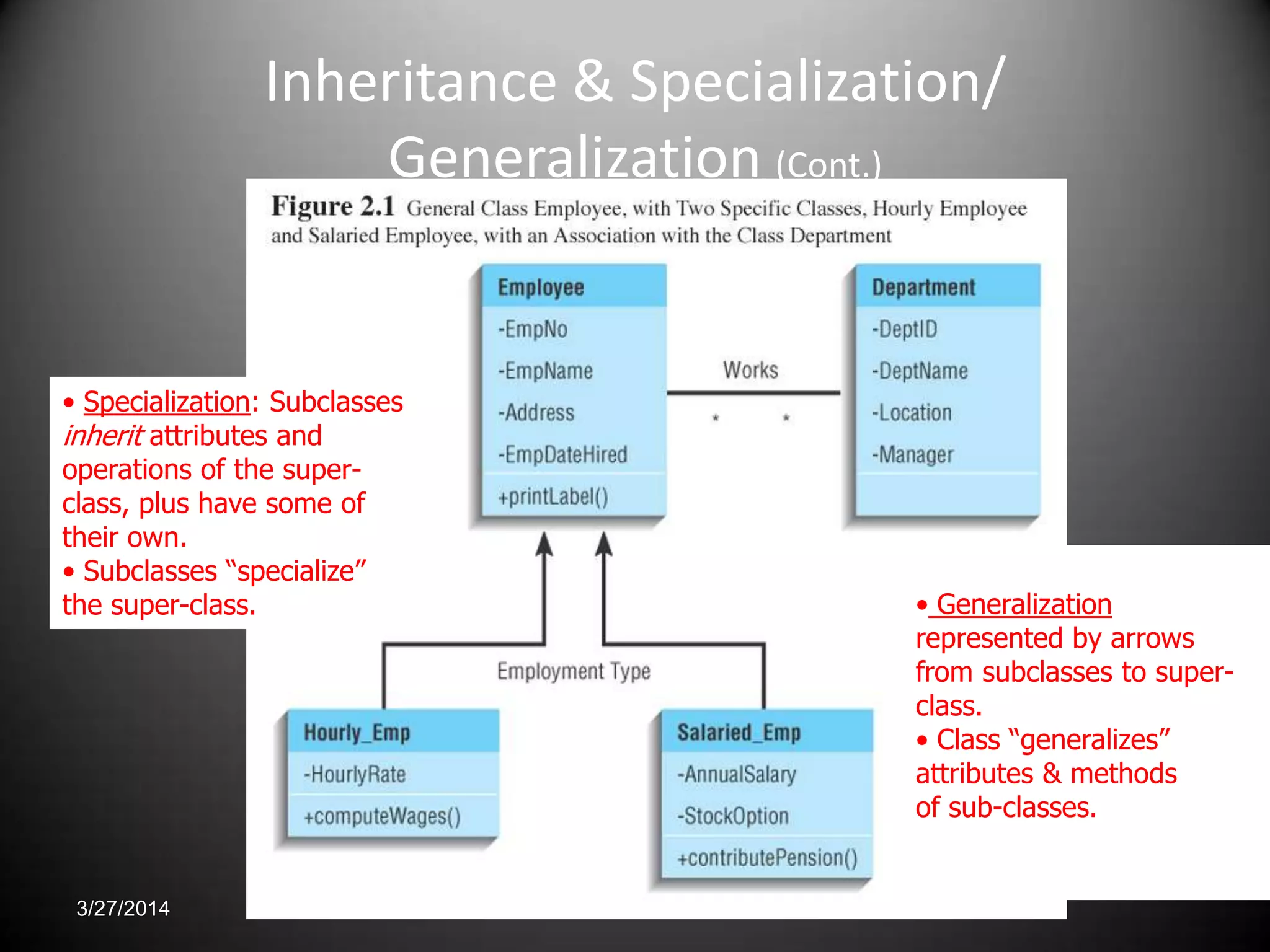
Inheritance & Specialization/
Generalization (Cont.)
34 of 13
• Specialization: Subclasses
inherit attributes and
operations of the super-
class, plus have some of
their own.
• Subclasses “specialize”
the super-class. • Generalization
represented by arrows
from subclasses to super-
class.
• Class “generalizes”
attributes & methods
of sub-classes.
3/27/2014
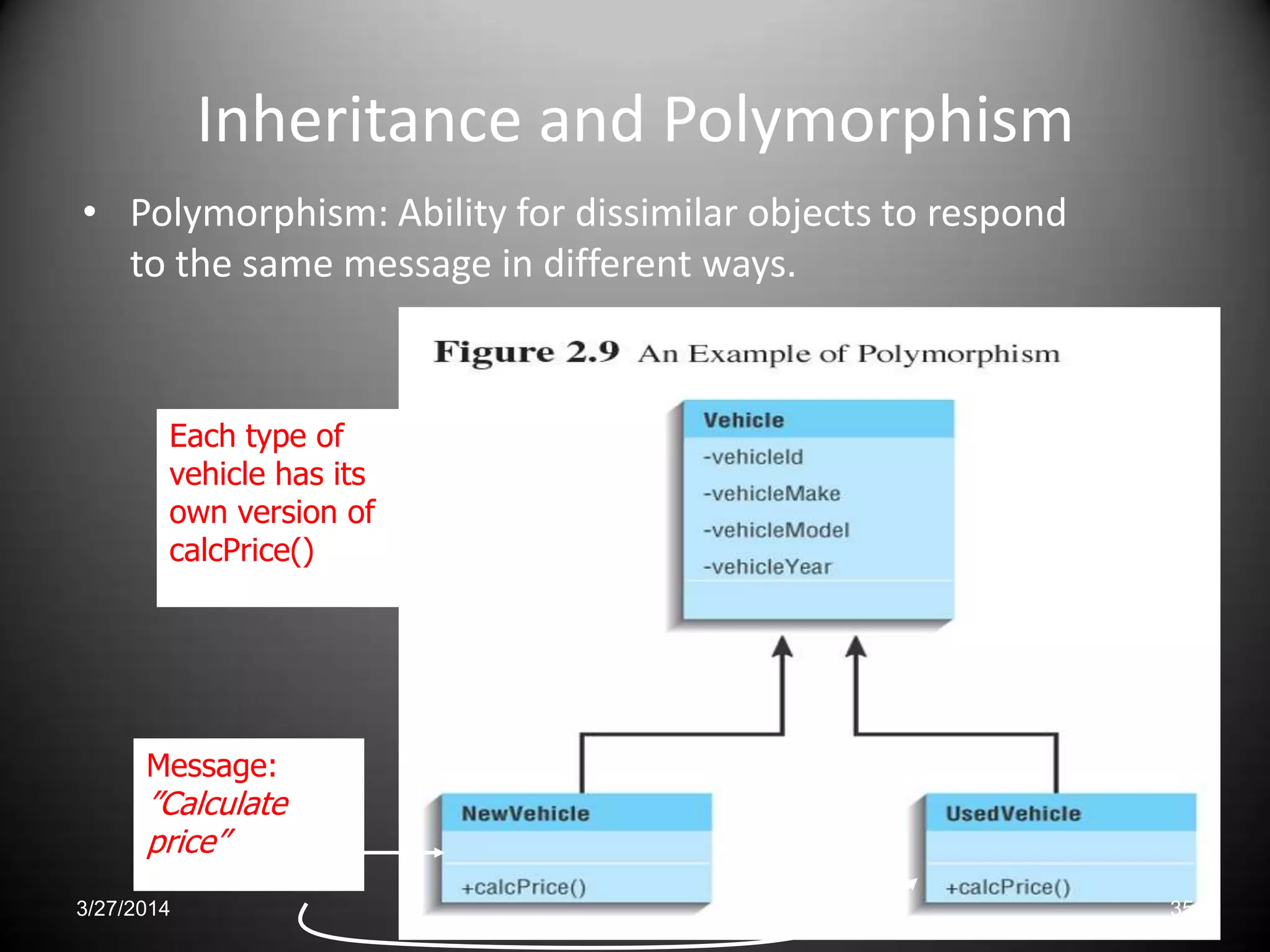
Each type of
vehicle has its
own version of
calcPrice()
Message:
”Calculate
price”
Inheritance and Polymorphism
• Polymorphism: Ability for dissimilar objects to respond
to the same message in different ways.
3/27/2014 35
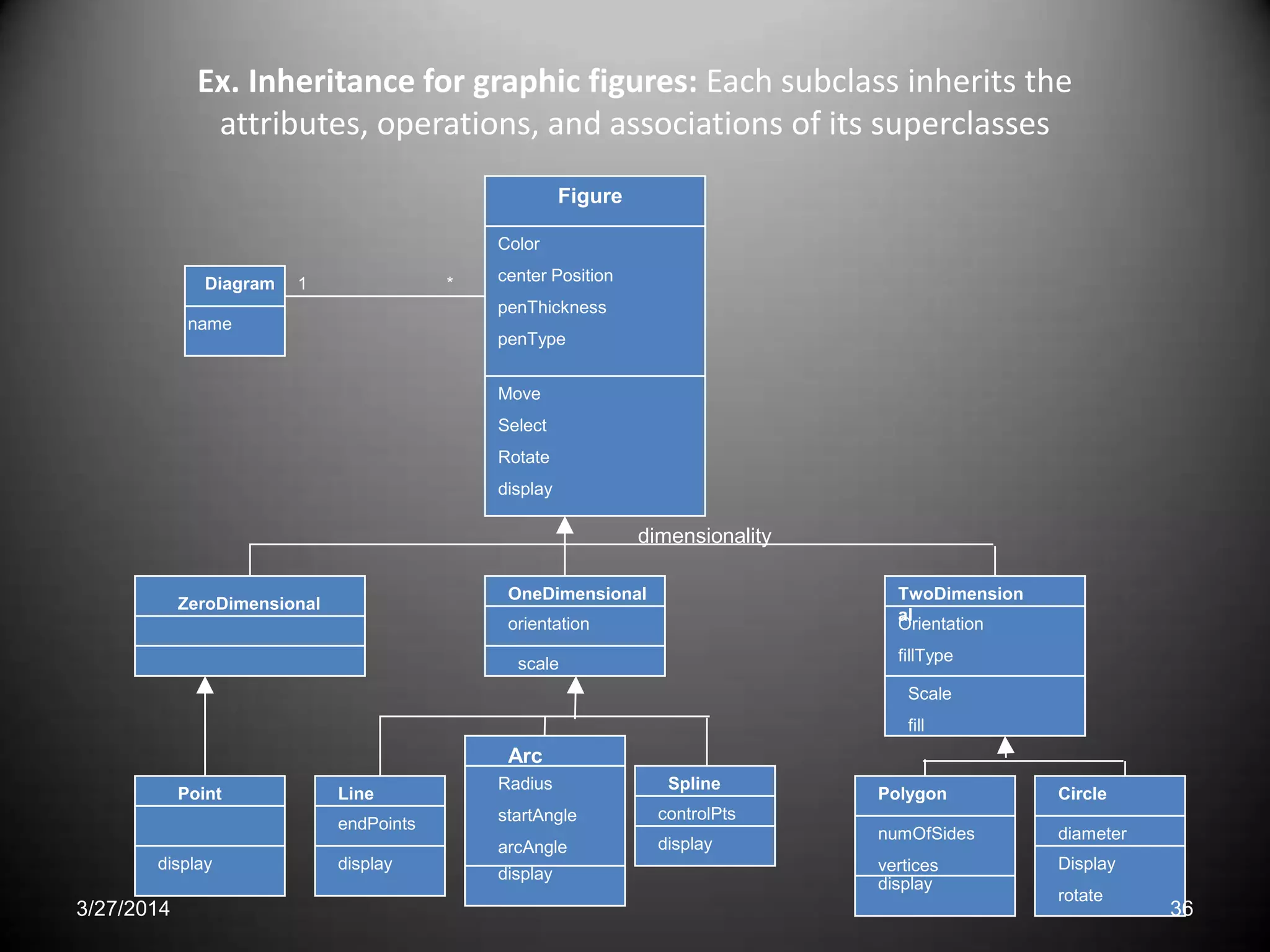
Ex. Inheritance for graphic figures: Each subclass inherits the
attributes, operations, and associations of its superclasses
Figure
Color
center Position
penThickness
penType
Move
Select
Rotate
display
Diagram
name
ZeroDimensional
OneDimensional
orientation
scale
TwoDimension
al
Orientation
fillType
Scale
fill
Point
display
Line
endPoints
display
Arc
Radius
startAngle
arcAngle
display
Spline
controlPts
display
Polygon
numOfSides
vertices
display
Circle
diameter
Display
rotate
Radius
startAngle
arcAngle
display
Arc
Radius
startAngle
arcAngle
display
Arc
Radius
startAngle
arcAngle
display
Arc
Radius
startAngle
arcAngle
display
Arc
Radius
startAngle
arcAngle
display
1 *
dimensionality
3/27/2014 36
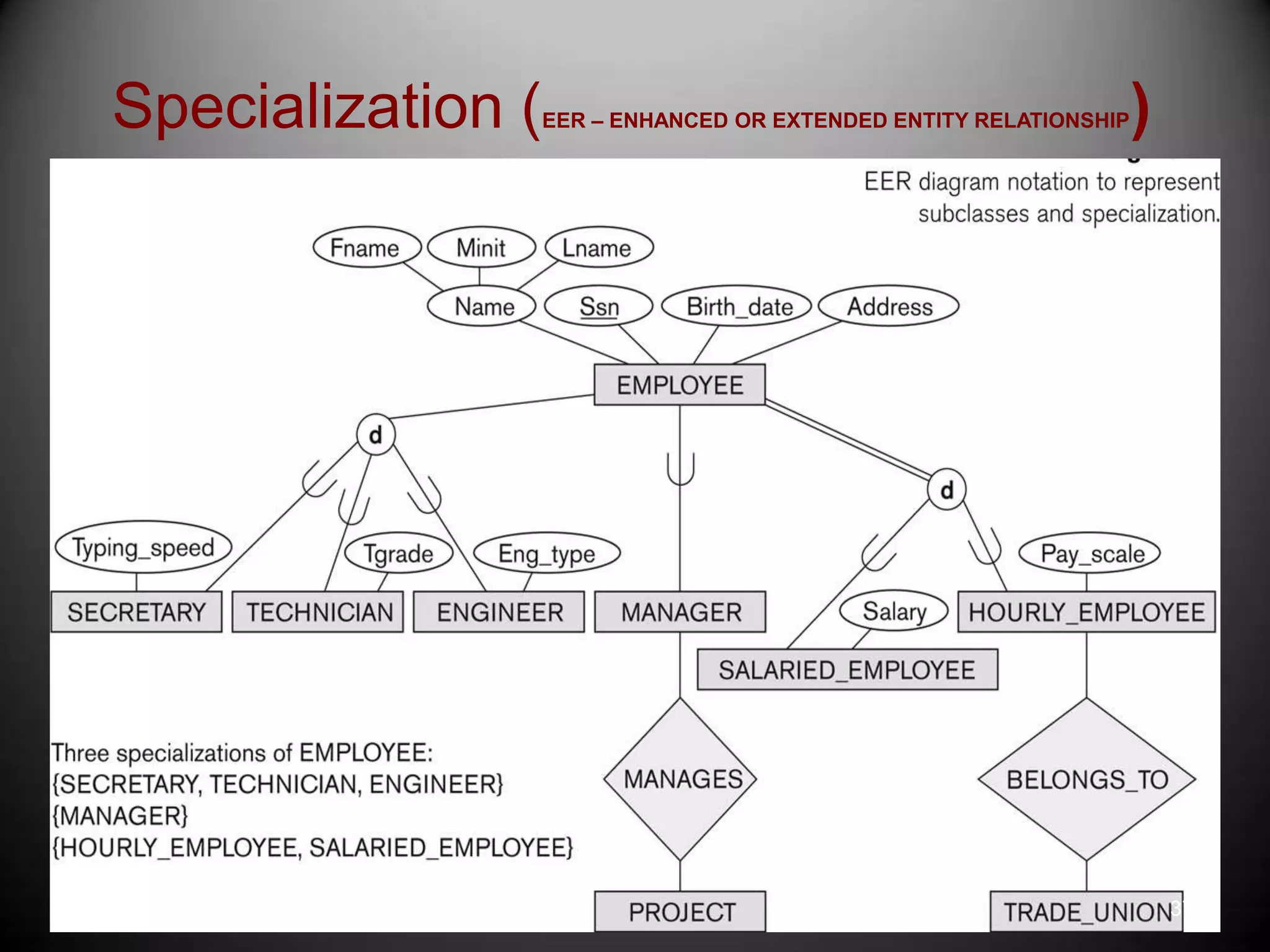
Specialization (EER – ENHANCED OR EXTENDED ENTITY RELATIONSHIP)
3/27/2014 37
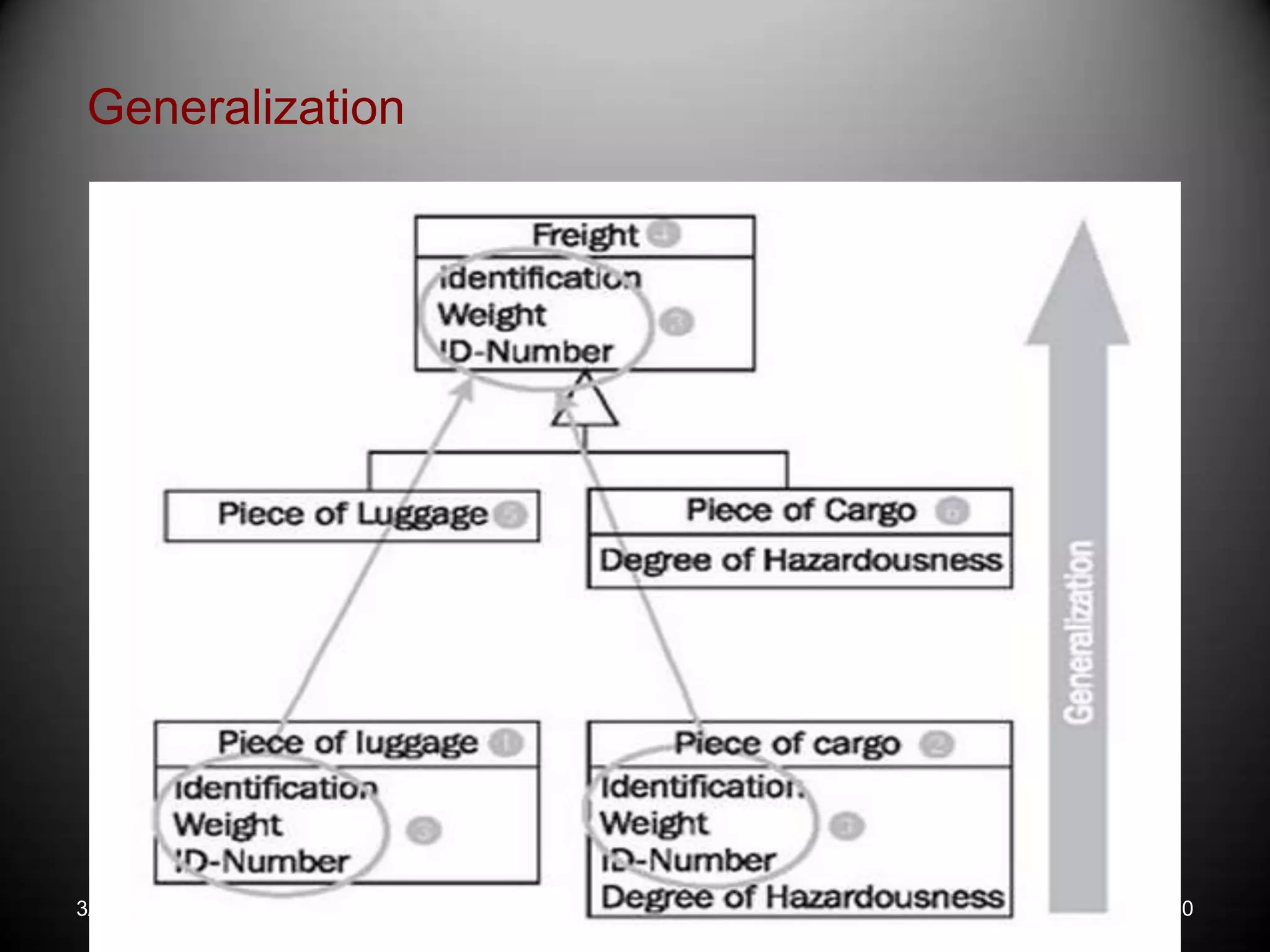
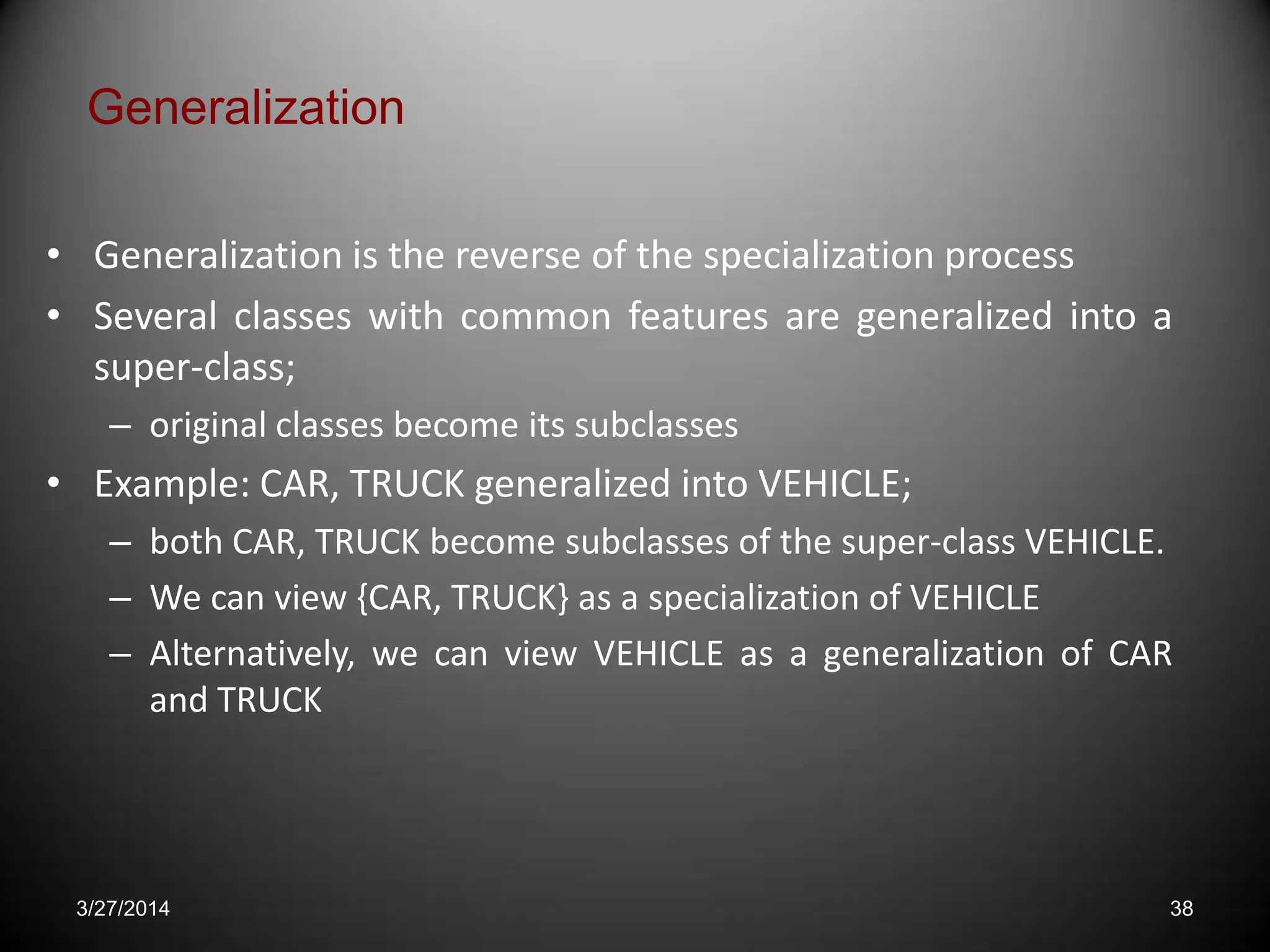
• Generalization is the reverse of the specialization process
• Several classes with common features are generalized into a
super-class;
– original classes become its subclasses
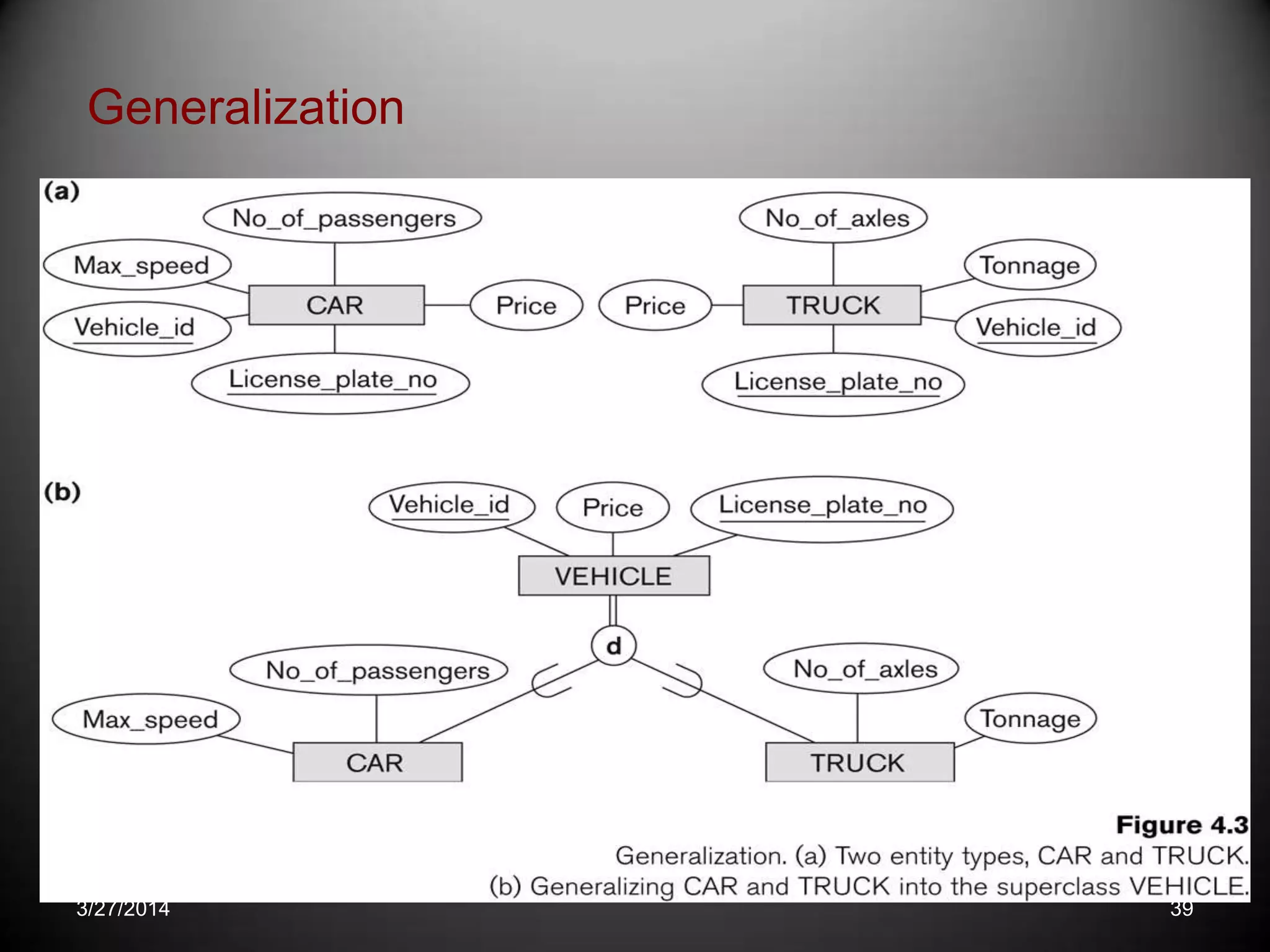
• Example: CAR, TRUCK generalized into VEHICLE;
– both CAR, TRUCK become subclasses of the super-class VEHICLE.
– We can view {CAR, TRUCK} as a specialization of VEHICLE
– Alternatively, we can view VEHICLE as a generalization of CAR
and TRUCK
Generalization
3/27/2014 38
Generalization
3/27/2014 39
Generalization
3/27/2014 40
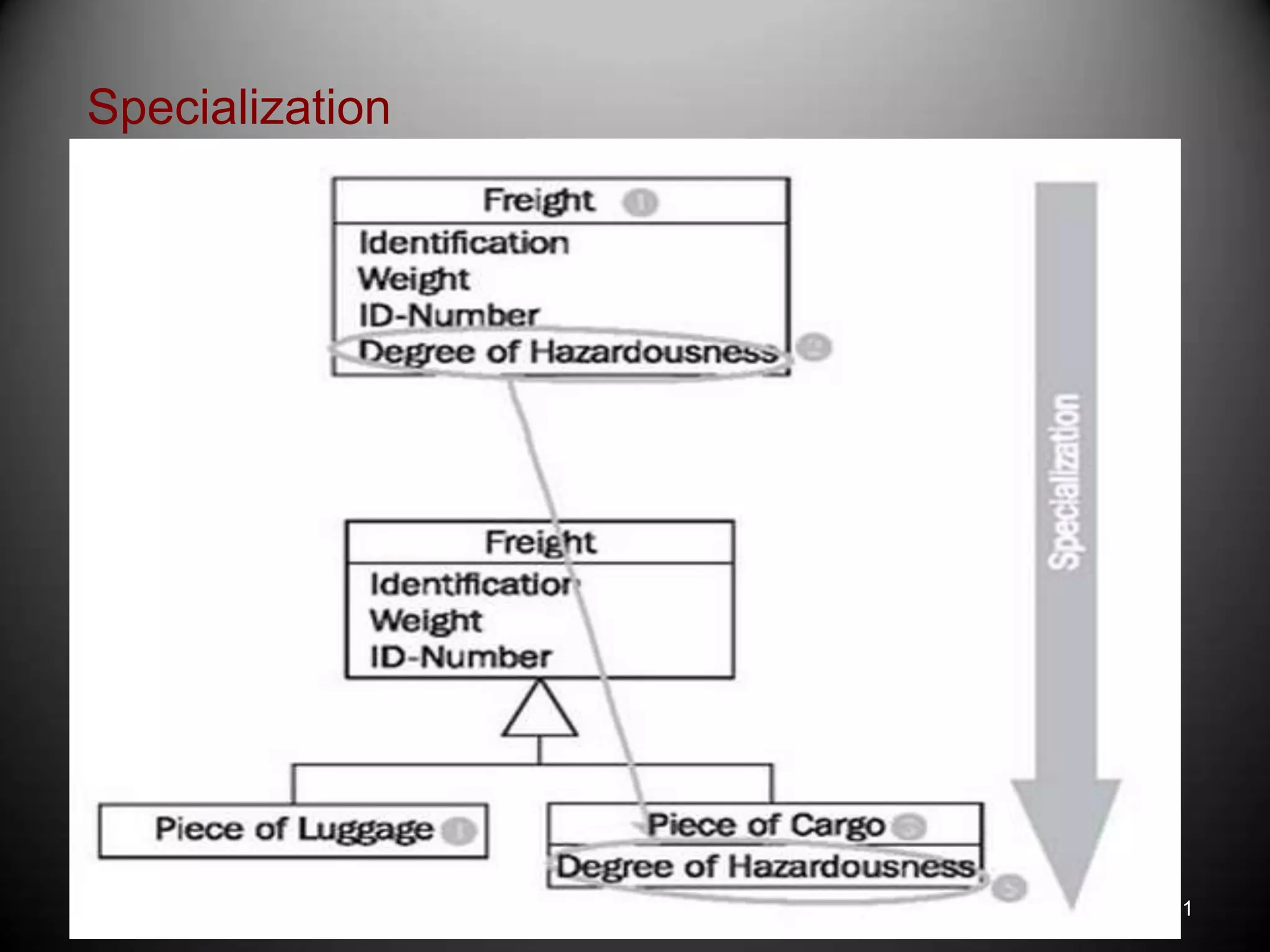
Specialization
3/27/2014 41
Object Oriented Development
• The process of converting a problem specification into an object
oriented program is called as object oriented development.
• This program consists of a group of objects which communicates
with one another.
• These objects can be created or destroyed while the programs
execution as per the need.
423/27/2014
Problems in Shifting from the Traditional Approach
to Object Oriented Development are :
• Initially, the whole process becomes very tedious because –
OO S/W must coexist with the legacy s/w.
Stored data is in relational databases & now it must be
converted into objects.
 Initially, we do not get experienced people to work with.
The staff needs proper training to understand & employ
the OO development & infrastructure.
433/27/2014
Contd.
 Project Management is pervaded (spread)
As the project leaders are not well Knowledgeable
with the new technology, architectural flaws
cannot be detected in the early stages
 Estimation & planning also fails up to some extent.
As most of the estimation models rely upon the
previous data, so a level of mismanagement
occurs.
443/27/2014

Lect1

  • 1.
  • 2.
    Syllabus • Two viewsof software Developments: • SSAD and OOAD. • Why Object –Orientation? 3/27/2014 2
  • 3.
    Systems development lifecycle (SDLC) • SDLC: process of building, deploying, using, and updating an information system Plan Develop Use & Maintain 3/27/2014 3
  • 4.
    System development methodology •SD Methodlogy – Guidelines for developing system. – Kind of knowledge. • Two kinds of methodologies – Structured (since 1970s) – Newer, rapid development 3/27/2014 4
  • 5.
    Structured methodology Also called“Waterfall” methodology INSTALLATION, TESTING 3/27/2014 5
  • 6.
    Waterfall Model – from‘what’ to ‘use’ 3/27/2014 6
  • 7.
  • 8.
    Requirement Specification 8 Requirement Specification System Analysis System Design Testing Implementation Maintenance Deployment A formalprocess that seeks to understand the problem and document in detail what the software system needs to do. This phase involves close interaction between users and designers. Most of the examples in this book are simple, and their requirements are clearly stated. In the real world, however, problems are not well defined. You need to study a problem carefully to identify its requirements.3/27/2014
  • 9.
    System Analysis 9 Requirement Specification System Analysis System Design Testing Implementation Maintenance Deployment Seeks toanalyze the business process in terms of data flow, and to identify the system’s input and output. Part of the analysis entails modeling the system’s behavior. The model is intended to capture the essential elements of the system and to define services to the system. 3/27/2014
  • 10.
    System Design 10 Requirement Specification System Analysis System Design Testing Implementation Maintenance Deployment The processof designing the system’s components. This phase involves the use of many levels of abstraction to decompose the problem into manageable components, identify classes and interfaces, and establish relationships among the classes and interfaces.3/27/2014
  • 11.
    Implementation 11 Requirement Specification System Analysis System Design Testing Implementation Maintenance Deployment The process oftranslating the system design into programs. Separate programs are written for each component and put to work together. This phase requires the use of a programming language like Java. The implementation involves coding, testing, and debugging. 3/27/2014
  • 12.
    Testing 12 Requirement Specification System Analysis System Design Testing Implementation Maintenance Deployment Ensures that thecode meets the requirements specification and weeds out bugs. An independent team of software engineers not involved in the design and implementation of the project usually conducts such testing. 3/27/2014
  • 13.
    Deployment 13 Requirement Specification System Analysis System Design Testing Implementation Maintenance Deployment Deployment makes theproject available for use. For a Java applet, this means installing it on a Web server; for a Java application, installing it on the client's computer. 3/27/2014
  • 14.
    Relationships among Classes •Association • Aggregation • Composition • Inheritance 143/27/2014
  • 15.
    Association Association represents ageneral binary relationship that describes an activity between two classes. 15 Student *5..60 Take Teach 0..3 1 Teacher FacultyCourse An association is usually represented as a data field in the class. 3/27/2014
  • 16.
    Association Between SameClass Association may exist between objects of the same class. For example, a person may have a supervisor. 16 Person Supervisor 1 1 3/27/2014
  • 17.
    Aggregation and Composition Aggregationis a special form of association, which represents an ownership relationship between two classes. Aggregation models the has-a relationship. If an object is exclusively owned by an aggregated object, the relationship between the object and its aggregated object is referred to as composition. 17 Name AddressPerson Composition Aggregation 3/27/2014
  • 18.
  • 19.
  • 20.
  • 21.
  • 22.
    3/27/2014 22 What isa navigable association in UML? Associations are relationships between classes in a UML Class Diagram. They are represented by a solid line between classes. Associations are typically named using a verb or verb phrase which reflects the real world problem domain. The normal kind of association is bidirectional by default. This means that if an association exists between two classes, then both objects know about each other. However, when creating a class diagram it is possible to use a navigable association between two classes. This is shown by adding an arrowhead at one end of the association.
  • 23.
    3/27/2014 23 What isa navigable association in UML? If “A” is the source class and “B” is the target class, the arrowhead would be placed on the “B” side of the association. A navigable association of this type means that at runtime object “A” knows about object “B”, but object “B” has no knowledge of or visibility into object “A”.
  • 24.
    3/27/2014 24 What isa navigable association in UML?
  • 25.
    3/27/2014 25 What isa navigable association in UML?
  • 26.
    3/27/2014 26 What isa navigable association in UML? StaffMember Student 1..* *instructs instructor Association name Role name Multiplicity Navigable (uni-directional) association Courses pre - requisites 0..3 Reflexive association Role *
  • 27.
    Inheritance Inheritance models theis-an-extension-of relationship between two classes. 27 Person Faculty public class Faculty extends Person { /** Data fields */ /** Constructors */ /** Methods */ } (A) (B) 3/27/2014
  • 28.
    Objects • An objectis an individual unit which is used as the basic building block of programs. The term object is also used to refer to any "thing". • Each object is capable of receiving messages, processing data, and sending messages to other objects. • Each object can be viewed as an independent little machine or actor with a distinct role or responsibility. 283/27/2014
  • 29.
    Object – keyconcept • Object: Thing (data structure) with data (attributes) and methods (behaviors, processes, operations) • Object “encapsulates” data and processes • Examples of objects – Problem domain objects (student, customer) – User interface (buttons, text boxes) 3/27/2014 29
  • 30.
    Object examples  Objectsare associated and interact via messages. 3/27/2014 30
  • 31.
    Classes • Classes areused to group related variables and functions. • A class specifies the structure of data which contains methods (functions) which manipulate the data of the object and perform tasks. A method is a function with a special property that it has access to data stored in an object. • A class is the most specific type of an object in relation to a specific layer. A class may also have a representation (meta-object) at run-time, which provides run-time support for manipulating the class- related metadata. 313/27/2014
  • 32.
    Class • Class: Defineswhat all objects of a class represent • Objects are instances of a class (Customer object is an instance of a customer class) Name Attributes Operations Object – An instance of class with specified Values of Attributes (specific data) 12005 09/10/2003 16/10/2003 Class 3/27/2014 32
  • 33.
    Inheritance & Specialization/Generalization Inheritance: Property of OO systems allowing for attributes and methods to be shared among objects.  Inheritance enables a special association between classes called Specialization/Generalization 3/27/2014 33
  • 34.
    Inheritance & Specialization/ Generalization(Cont.) 34 of 13 • Specialization: Subclasses inherit attributes and operations of the super- class, plus have some of their own. • Subclasses “specialize” the super-class. • Generalization represented by arrows from subclasses to super- class. • Class “generalizes” attributes & methods of sub-classes. 3/27/2014
  • 35.
    Each type of vehiclehas its own version of calcPrice() Message: ”Calculate price” Inheritance and Polymorphism • Polymorphism: Ability for dissimilar objects to respond to the same message in different ways. 3/27/2014 35
  • 36.
    Ex. Inheritance forgraphic figures: Each subclass inherits the attributes, operations, and associations of its superclasses Figure Color center Position penThickness penType Move Select Rotate display Diagram name ZeroDimensional OneDimensional orientation scale TwoDimension al Orientation fillType Scale fill Point display Line endPoints display Arc Radius startAngle arcAngle display Spline controlPts display Polygon numOfSides vertices display Circle diameter Display rotate Radius startAngle arcAngle display Arc Radius startAngle arcAngle display Arc Radius startAngle arcAngle display Arc Radius startAngle arcAngle display Arc Radius startAngle arcAngle display 1 * dimensionality 3/27/2014 36
  • 37.
    Specialization (EER –ENHANCED OR EXTENDED ENTITY RELATIONSHIP) 3/27/2014 37
  • 38.
    • Generalization isthe reverse of the specialization process • Several classes with common features are generalized into a super-class; – original classes become its subclasses • Example: CAR, TRUCK generalized into VEHICLE; – both CAR, TRUCK become subclasses of the super-class VEHICLE. – We can view {CAR, TRUCK} as a specialization of VEHICLE – Alternatively, we can view VEHICLE as a generalization of CAR and TRUCK Generalization 3/27/2014 38
  • 39.
  • 40.
  • 41.
  • 42.
    Object Oriented Development •The process of converting a problem specification into an object oriented program is called as object oriented development. • This program consists of a group of objects which communicates with one another. • These objects can be created or destroyed while the programs execution as per the need. 423/27/2014
  • 43.
    Problems in Shiftingfrom the Traditional Approach to Object Oriented Development are : • Initially, the whole process becomes very tedious because – OO S/W must coexist with the legacy s/w. Stored data is in relational databases & now it must be converted into objects.  Initially, we do not get experienced people to work with. The staff needs proper training to understand & employ the OO development & infrastructure. 433/27/2014
  • 44.
    Contd.  Project Managementis pervaded (spread) As the project leaders are not well Knowledgeable with the new technology, architectural flaws cannot be detected in the early stages  Estimation & planning also fails up to some extent. As most of the estimation models rely upon the previous data, so a level of mismanagement occurs. 443/27/2014