Service Quality Concepts
Learning Objectives

• To understand the basis of service quality

• To understand the role of expectations in service
  quality

• To understand the role of service experience in
  service quality

• To understand the service sequence
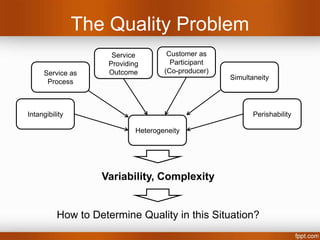
The Quality Problem
                      Service         Customer as
                     Providing         Participant
     Service as      Outcome         (Co-producer)
                                                     Simultaneity
      Process


Intangibility                                               Perishability

                             Heterogeneity


                   Variability, Complexity

          How to Determine Quality in this Situation?

        i.e. How do I measure a good quality haircut?
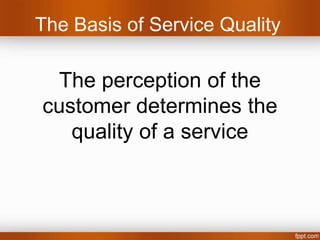
The Basis of Service Quality

 The perception of the
customer determines the
   quality of a service
 (In short: “did I get what I expected – or better?”)


        i.e. Is the haircut what I expected?
The Basis of Perception
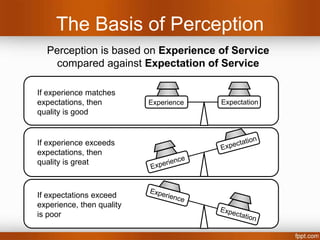
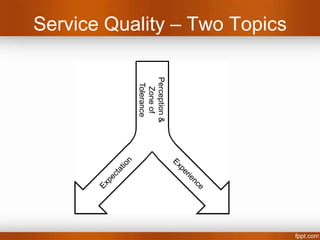
  Perception is based on Experience of Service
    compared against Expectation of Service

If experience matches
expectations, then         Experience   Expectation
quality is good


If experience exceeds
expectations, then
quality is great


If expectations exceed
experience, then quality
is poor
Expectations vs Experience
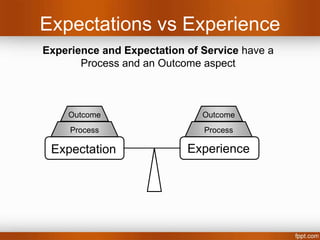
Experience and Expectation of Service have a
       Process and an Outcome aspect
                                               Getting
                                              Something

                     Experiencing
                      Something

    Outcome                         Outcome
     Process                        Process

 Expectation                   Experience
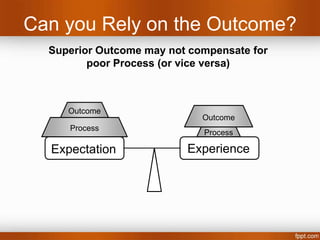
Can you Rely on the Outcome?
  Superior Outcome may not compensate for
         poor Process (or vice versa)


     Outcome
                             Outcome
     Process
                             Process

  Expectation             Experience
Example: Outcome Most Important
       “They were rude but at least
       they fixed my car properly”


        “They were polite but my
         car broke down again”
Example: Process Most Important
       “The concert was great but
        the t-shirts were terrible”


       “The concert was bad but
        they sold great t-shirts”
Example: Both are Important
     “The food was great but
       the staff were rude”


     “The staff were polite but
       the food was terrible”
Part 2: How Expectations Work
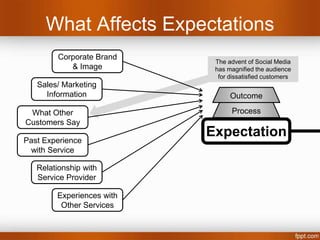
What Affects Expectations
         Corporate Brand
                            The advent of Social Media
            & Image         has magnified the audience
                             for dissatisfied customers
   Sales/ Marketing
     Information                 Outcome

 What Other                      Process
Customers Say

Past Experience
                           Expectation
 with Service

   Relationship with
   Service Provider

        Experiences with
         Other Services
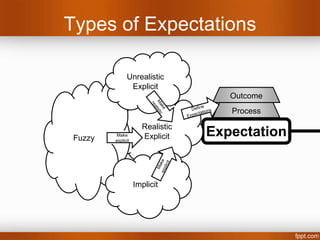
Types of Expectations

               Unrealistic
                Explicit
                                     Outcome
                                     Process
                      Realistic
 Fuzzy    Make
         explicit
                      Explicit    Expectation


                    Implicit
Examples of Expectations
 Explicit Unrealistic: “make                Explicit Realistic: “Short
  me look like Brad Pitt”                      back and sides”


                                Make
                               realistic


                                                                           Make explicit

Fuzzy: “make me look like a                Implicit: “why didn’t you ask
         rockstar”                                    me first?”
Part 3: How Experiences Work
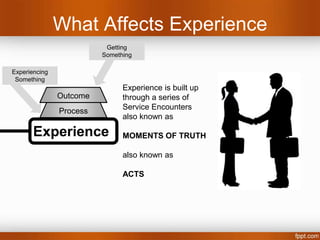
What Affects Experience


             Experience is built up
   Outcome   through a series of:
   Process
             SERVICE ENCOUNTERS

Experience   also known as


             MOMENTS OF TRUTH

             also known as


             ACTS
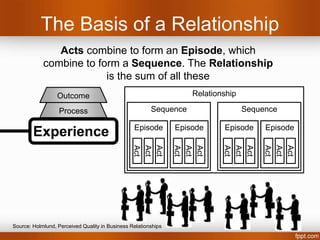
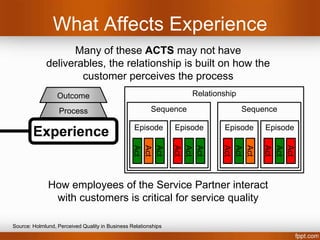
The Basis of a Relationship
             The cumulative effect of these Acts defines the
              overall Service Experience and therefore the
                          Service Relationship
                  Outcome                                       Service Relationship

                  Process                               Sequence                 Sequence

                                                 Episode        Episode     Episode    Episode
        Experience                               Act
                                                 Act
                                                 Act

                                                                Act
                                                                Act
                                                                Act


                                                                            Act
                                                                            Act
                                                                            Act

                                                                                       Act
                                                                                       Act
                                                                                       Act
Source: Holmlund, Perceived Quality in Business Relationships
Part 4: The Service Sequence
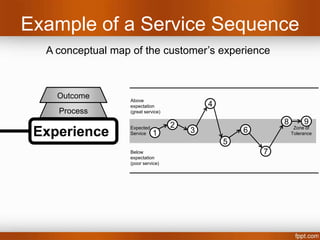
Example of a Service Sequence
  A conceptual map of the customer’s experience


      Above
      expectation               4
      (great service)


                        2                       8        9
      Expected                                       Zone of
      Service    1          3           6           Tolerance
                                    5
      Below                                 7
      expectation
      (poor service)
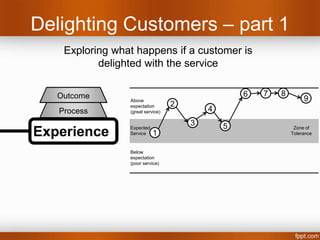
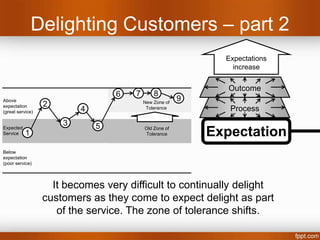
The Dangers of Delighting Customers


                                         6   7       8
       Above                                     New Zone of
                                                               9
       expectation       2
       (great service)           4                Tolerance


       Expected
                             3       5           Old Zone of
       Service    1                              Tolerance


       Below
       expectation
       (poor service)


     It becomes very difficult to continually delight
   customers as they come to expect delight as part
      of the service. The zone of tolerance shifts.
Final Word on Service Quality
• What the customer thinks is critical to service quality

• The outcome and the process need to meet expectations

• What you do defines quality as much as what you say

• Getting expectations right is important

• Service Quality is dynamically built up over a period of
  time through a series of Acts.

Services quality

  • 1.
  • 2.
    Learning Objectives • Tounderstand the basis of service quality • To understand the role of expectations in service quality • To understand the role of service experience in service quality • To understand the service sequence
  • 3.
    The Quality Problem Service Customer as Providing Participant Service as Outcome (Co-producer) Simultaneity Process Intangibility Perishability Heterogeneity Variability, Complexity How to Determine Quality in this Situation? i.e. How do I measure a good quality haircut?
  • 4.
    The Basis ofService Quality The perception of the customer determines the quality of a service (In short: “did I get what I expected – or better?”) i.e. Is the haircut what I expected?
  • 5.
    The Basis ofPerception Perception is based on Experience of Service compared against Expectation of Service If experience matches expectations, then Experience Expectation quality is good If experience exceeds expectations, then quality is great If expectations exceed experience, then quality is poor
  • 6.
    Expectations vs Experience Experienceand Expectation of Service have a Process and an Outcome aspect Getting Something Experiencing Something Outcome Outcome Process Process Expectation Experience
  • 7.
    Can you Relyon the Outcome? Superior Outcome may not compensate for poor Process (or vice versa) Outcome Outcome Process Process Expectation Experience
  • 8.
    Example: Outcome MostImportant “They were rude but at least they fixed my car properly” “They were polite but my car broke down again”
  • 9.
    Example: Process MostImportant “The concert was great but the t-shirts were terrible” “The concert was bad but they sold great t-shirts”
  • 10.
    Example: Both areImportant “The food was great but the staff were rude” “The staff were polite but the food was terrible”
  • 11.
    Part 2: HowExpectations Work
  • 12.
    What Affects Expectations Corporate Brand The advent of Social Media & Image has magnified the audience for dissatisfied customers Sales/ Marketing Information Outcome What Other Process Customers Say Past Experience Expectation with Service Relationship with Service Provider Experiences with Other Services
  • 13.
    Types of Expectations Unrealistic Explicit Outcome Process Realistic Fuzzy Make explicit Explicit Expectation Implicit
  • 14.
    Examples of Expectations Explicit Unrealistic: “make Explicit Realistic: “Short me look like Brad Pitt” back and sides” Make realistic Make explicit Fuzzy: “make me look like a Implicit: “why didn’t you ask rockstar” me first?”
  • 15.
    Part 3: HowExperiences Work
  • 16.
    What Affects Experience Experience is built up Outcome through a series of: Process SERVICE ENCOUNTERS Experience also known as MOMENTS OF TRUTH also known as ACTS
  • 17.
    The Basis ofa Relationship The cumulative effect of these Acts defines the overall Service Experience and therefore the Service Relationship Outcome Service Relationship Process Sequence Sequence Episode Episode Episode Episode Experience Act Act Act Act Act Act Act Act Act Act Act Act Source: Holmlund, Perceived Quality in Business Relationships
  • 18.
    Part 4: TheService Sequence
  • 19.
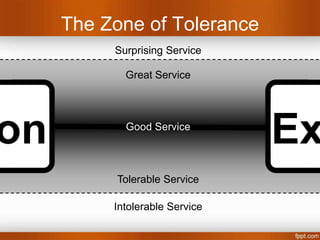
    Example of aService Sequence A conceptual map of the customer’s experience Above expectation 4 (great service) 2 8 9 Expected Zone of Service 1 3 6 Tolerance 5 Below 7 expectation (poor service)
  • 20.
    The Dangers ofDelighting Customers 6 7 8 Above New Zone of 9 expectation 2 (great service) 4 Tolerance Expected 3 5 Old Zone of Service 1 Tolerance Below expectation (poor service) It becomes very difficult to continually delight customers as they come to expect delight as part of the service. The zone of tolerance shifts.
  • 21.
    Final Word onService Quality • What the customer thinks is critical to service quality • The outcome and the process need to meet expectations • What you do defines quality as much as what you say • Getting expectations right is important • Service Quality is dynamically built up over a period of time through a series of Acts.

Editor's Notes

  • #2 Title Slide
  • #3 Services are difficult to graspwhich makes defining quality difficult.IntangibilityIntangibility of services can make quality difficult to quantify without experiencing that quality. This makes services difficult to try out before using them. Service as ProcessGoods are something that customers get, services are something that happens to (or for) customers, and customers are all different.Service Providing and OutcomeServices have a process and an outcome. Customers care about both the process (how the service is delivered) and the outcome (what they get). Customer as Participant (Co-producer)The customer generally participates in a service whereas good are generally pre-produced for the customer. The participation of the customer in the service can add to the variiability of the service.SimultaneityGood are produced and persist and can be used later. Services are produced and consumed at the same time. If the service is temporary, the quality is difficult to measure.PerishabilityManaging capacity is an important element of managing services. When demand exceeds service capacity – customers wait (lowering quality)All this leads to HeterogeneityThe value (and therefore quality) of the service depends on the tastes or requirements of the customer.All this makes defining specific quality measures for a service complex
  • #4 Services are difficult to graspwhich makes defining quality difficult.IntangibilityIntangibility of services can make quality difficult to quantify without experiencing that quality. This makes services difficult to try out before using them. Service as ProcessGoods are something that customers get, services are something that happens to (or for) customers, and customers are all different.Service Providing and OutcomeServices have a process and an outcome. Customers care about both the process (how the service is delivered) and the outcome (what they get). Customer as Participant (Co-producer)The customer generally participates in a service whereas good are generally pre-produced for the customer. The participation of the customer in the service can add to the variiability of the service.SimultaneityGood are produced and persist and can be used later. Services are produced and consumed at the same time. If the service is temporary, the quality is difficult to measure.PerishabilityManaging capacity is an important element of managing services. When demand exceeds service capacity – customers wait (lowering quality)All this leads to HeterogeneityThe value (and therefore quality) of the service depends on the tastes or requirements of the customer.All this makes defining specific quality measures for a service complex
  • #5 The solution to the complexity problem is a customer centric measure. Perceived outcome compared against the expected outcome.In short the quality is good if the customer says “I got what I expected from this service.. …or better”
  • #6 Perceived quality is a relative measure which compares the customers experience of a service against the customers expectations of the service.If experience of the service matches expectations then the quality is good.If experience of the service exceeds expectations then the quality is great.If experience of the service does not meet expectations then the quality is poor.
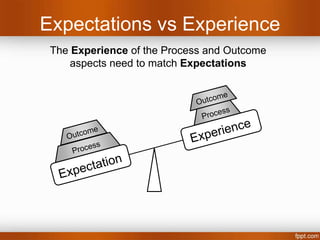
  • #7 For most services, both the process and the outcome quality are important. The both have expectations and they both need to be met.Example: In a restaurant, both the services AND the food are important.
  • #8 If the process is important to the customer, then it needs to meet the customer’s expectations. Example: Good food cannot compensate for poor service or dirty surroundings. If the outcome is important to the customer, then it needs to meet the customer’s expectations.Example: Clean surroundings and polite staff cannot compensate for a bad haircut.
  • #9 Here is an example of a service where the outcome is more important than the process. Good quality process cannot make up for a poor outcome.
  • #10 Here is an example of a service where the process is more important than the outcome. Good quality outcome cannot make up for a poor process.
  • #11 Here is an example of a service where both the process and the outcome are important. A failure of either one affects the perception of the service.
  • #12 Title Slide
  • #13 Customer expectations are set in a number of ways, not all of which the company has control over.It is important to realise that marketing is only part of the story.Past experience, reputation, and what other customers say strongly influences the expectations.In this way the people who deliver the service have a role to play in setting expectations around the quality through previous service situations.What other customers’ say is important, this is called word of mouth. Social media has amplified the audience for dissatisfied customers.
  • #14 Customers have different types of expectations which affect what customers perceive that they should experience from a service. Managing these expectations is half of the equation for managing Service Quality. The four types of expectations are:Fuzzy Expectations: Desire for outcome without clear expectation on how service will fulfil this.Implicit Expectations: Unstated assumption that the service provides this level of quality.Unrealistic Explicit Expectations: Clearly understood expectations that are beyond the capability of the Service Provider to deliver.Realistic Explicit Expectations: Clearly understood expectations that are within the capability of the Service Provider to deliver.Generally the goal is to make fuzzy and implicit expectations into explicit (and realistic) expectations, and to manage down unrealistic expectations.
  • #15 Customers have different types of expectations which affect what customers perceive that they should experience from a service. Managing these expectations is half of the equation for managing Service Quality. The four types of expectations are:Fuzzy Expectations: Desire for outcome without clear expectation on how service will fulfil this.Implicit Expectations: Unstated assumption that the service provides this level of quality.Unrealistic Explicit Expectations: Clearly understood expectations that are beyond the capability of the Service Provider to deliver.Realistic Explicit Expectations: Clearly understood expectations that are within the capability of the Service Provider to deliver.Generally the goal is to make fuzzy and implicit expectations into explicit (and realistic) expectations, and to manage down unrealistic expectations.
  • #16 Title Slide
  • #17 A service encounter is either: Getting something, and/orExperiencing somethingWhen receiving a service and customer may experience many service encounters.
  • #18 Act: A single interaction. Example: ordering a bottle of wine at a hotel restaurantEpisode: All acts that contribute to a specific outcome. Example: having a meal at a hotel restaurantSequence: All acts and sequencesinteractions related to a particular service. Example: a stay in a hotelService Relationship: The total overall customer’s interactions and perceptions of the service provider.Example: Likelihood to stay in a hotel
  • #19 Title Slide
  • #20 The customer’s experience can be mapped through a service sequence. This is an abstract map showing how the perceived quality of service can be affected by the different acts. The customer may have had some great service (Act 4) and some poor service (Act 7).
  • #21 Because expectations are set by previous experiences of the service, continually delighting the customer can create a situation where the customer’s expectations rise. If the last three times you were upgraded to business class, you will experience disappointment if it doesn’t happy on the fourth time.