―The greatest challenge to any thinker is
stating the problem in a way that will allow
solution‖
-Bertrand Russell
Analysing Problems Creatively
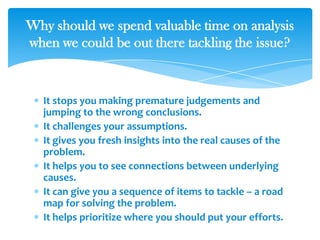
It stops you making premature judgements and
jumping to the wrong conclusions.
It challenges your assumptions.
It gives you fresh insights into the real causes of the
problem.
It helps you to see connections between underlying
causes.
It can give you a sequence of items to tackle – a road
map for solving the problem.
It helps prioritize where you should put your efforts.
Why should we spend valuable time on analysis
when we could be out there tackling the issue?
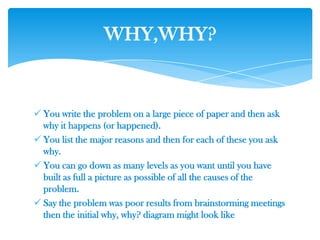
 You write the problem on a large piece of paper and then ask
why it happens (or happened).
 You list the major reasons and then for each of these you ask
why.
 You can go down as many levels as you want until you have
built as full a picture as possible of all the causes of the
problem.
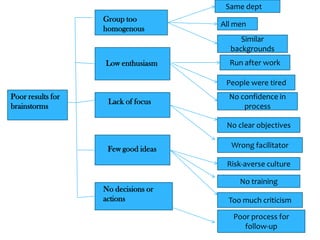
 Say the problem was poor results from brainstorming meetings
then the initial why, why? diagram might look like
WHY,WHY?
Similar
backgrounds
Run after work
People were tired
No confidence in
process
No clear objectives
Wrong facilitator
No training
Too much criticism
Poor results for
brainstorms
Group too
homogenous
Low enthusiasm
Lack of focus
Few good ideas
No decisions or
actions
Same dept
All men
Risk-averse culture
Poor process for
follow-up
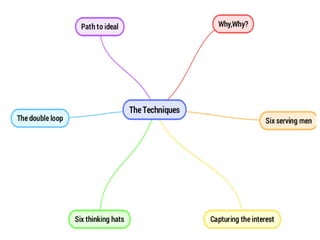
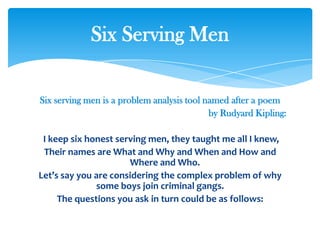
Six serving men is a problem analysis tool named after a poem
by Rudyard Kipling:
I keep six honest serving men, they taught me all I knew,
Their names are What and Why and When and How and
Where and Who.
Let’s say you are considering the complex problem of why
some boys join criminal gangs.
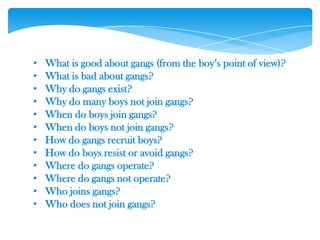
The questions you ask in turn could be as follows:
Six Serving Men
• What is good about gangs (from the boy‘s point of view)?
• What is bad about gangs?
• Why do gangs exist?
• Why do many boys not join gangs?
• When do boys join gangs?
• When do boys not join gangs?
• How do gangs recruit boys?
• How do boys resist or avoid gangs?
• Where do gangs operate?
• Where do gangs not operate?
• Who joins gangs?
• Who does not join gangs?
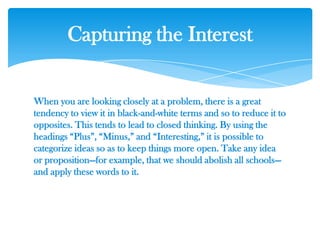
When you are looking closely at a problem, there is a great
tendency to view it in black-and-white terms and so to reduce it to
opposites. This tends to lead to closed thinking. By using the
headings ―Plus‖, ―Minus,‖ and ―Interesting,‖ it is possible to
categorize ideas so as to keep things more open. Take any idea
or proposition—for example, that we should abolish all schools—
and apply these words to it.
Capturing the Interest
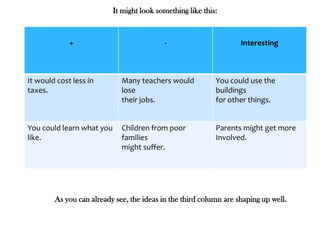
+ - Interesting
It would cost less in
taxes.
Many teachers would
lose
their jobs.
You could use the
buildings
for other things.
You could learn what you
like.
Children from poor
families
might suffer.
Parents might get more
Involved.
As you can already see, the ideas in the third column are shaping up well.
It might look something like this:
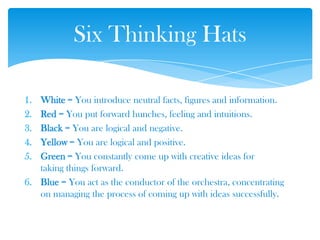
1. White = You introduce neutral facts, figures and information.
2. Red = You put forward hunches, feeling and intuitions.
3. Black = You are logical and negative.
4. Yellow = You are logical and positive.
5. Green = You constantly come up with creative ideas for
taking things forward.
6. Blue = You act as the conductor of the orchestra, concentrating
on managing the process of coming up with ideas successfully.
Six Thinking Hats
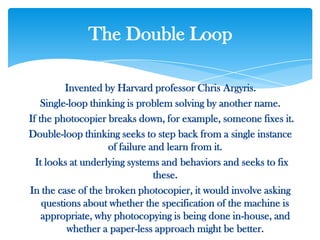
Invented by Harvard professor Chris Argyris.
Single-loop thinking is problem solving by another name.
If the photocopier breaks down, for example, someone fixes it.
Double-loop thinking seeks to step back from a single instance
of failure and learn from it.
It looks at underlying systems and behaviors and seeks to fix
these.
In the case of the broken photocopier, it would involve asking
questions about whether the specification of the machine is
appropriate, why photocopying is being done in-house, and
whether a paper-less approach might be better.
The Double Loop
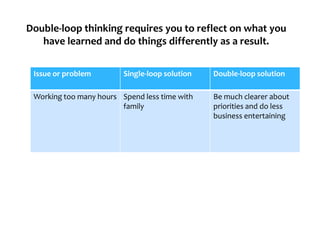
Double-loop thinking requires you to reflect on what you
have learned and do things differently as a result.
Issue or problem Single-loop solution Double-loop solution
Working too many hours Spend less time with
family
Be much clearer about
priorities and do less
business entertaining
Take three blank sheets of paper.
 On the first sheet list the current state of affairs with all the flaws, problems
and difficulties you face.
 On the third sheet write the ideal state you would like to achieve with all
problems solved and everything performing superbly – or however you care
to define ‗ideal‘.
 Then on the top of the middle sheet write ‗The Path‘. Here you have to
define the steps you need to take to get from where you are today to the ideal.
The Path does not contain detailed solutions – this comes later.
It simply lists the big magic solutions that you need. This method helps to define
the problem and the key factors going forward. Each of the steps on the Path
can now become a question that you can address using idea generation
techniques.
The path to Ideal
Problem analysis techniques do not set out to solve
the problem.
They exist to help you to understand the underlying
causes before attempting to find solutions.
They assist you to see the overall nature of the
problem and the interrelated causes.
This in turn helps you to prioritize which areas to
focus on. You can then generate many creative ideas
for each problem, evaluate and select the best ideas
and then build a project plan for solving the
problem.
Summary
How to be a brilliant thinker – Paul Sloane
Power up your mind:learn faster work smarter – Bill
Lucas
References

Analysing problems creatively final

  • 1.
    ―The greatest challengeto any thinker is stating the problem in a way that will allow solution‖ -Bertrand Russell Analysing Problems Creatively
  • 2.
    It stops youmaking premature judgements and jumping to the wrong conclusions. It challenges your assumptions. It gives you fresh insights into the real causes of the problem. It helps you to see connections between underlying causes. It can give you a sequence of items to tackle – a road map for solving the problem. It helps prioritize where you should put your efforts. Why should we spend valuable time on analysis when we could be out there tackling the issue?
  • 4.
     You writethe problem on a large piece of paper and then ask why it happens (or happened).  You list the major reasons and then for each of these you ask why.  You can go down as many levels as you want until you have built as full a picture as possible of all the causes of the problem.  Say the problem was poor results from brainstorming meetings then the initial why, why? diagram might look like WHY,WHY?
  • 5.
    Similar backgrounds Run after work Peoplewere tired No confidence in process No clear objectives Wrong facilitator No training Too much criticism Poor results for brainstorms Group too homogenous Low enthusiasm Lack of focus Few good ideas No decisions or actions Same dept All men Risk-averse culture Poor process for follow-up
  • 6.
    Six serving menis a problem analysis tool named after a poem by Rudyard Kipling: I keep six honest serving men, they taught me all I knew, Their names are What and Why and When and How and Where and Who. Let’s say you are considering the complex problem of why some boys join criminal gangs. The questions you ask in turn could be as follows: Six Serving Men
  • 7.
    • What isgood about gangs (from the boy‘s point of view)? • What is bad about gangs? • Why do gangs exist? • Why do many boys not join gangs? • When do boys join gangs? • When do boys not join gangs? • How do gangs recruit boys? • How do boys resist or avoid gangs? • Where do gangs operate? • Where do gangs not operate? • Who joins gangs? • Who does not join gangs?
  • 8.
    When you arelooking closely at a problem, there is a great tendency to view it in black-and-white terms and so to reduce it to opposites. This tends to lead to closed thinking. By using the headings ―Plus‖, ―Minus,‖ and ―Interesting,‖ it is possible to categorize ideas so as to keep things more open. Take any idea or proposition—for example, that we should abolish all schools— and apply these words to it. Capturing the Interest
  • 9.
    + - Interesting Itwould cost less in taxes. Many teachers would lose their jobs. You could use the buildings for other things. You could learn what you like. Children from poor families might suffer. Parents might get more Involved. As you can already see, the ideas in the third column are shaping up well. It might look something like this:
  • 10.
    1. White =You introduce neutral facts, figures and information. 2. Red = You put forward hunches, feeling and intuitions. 3. Black = You are logical and negative. 4. Yellow = You are logical and positive. 5. Green = You constantly come up with creative ideas for taking things forward. 6. Blue = You act as the conductor of the orchestra, concentrating on managing the process of coming up with ideas successfully. Six Thinking Hats
  • 11.
    Invented by Harvardprofessor Chris Argyris. Single-loop thinking is problem solving by another name. If the photocopier breaks down, for example, someone fixes it. Double-loop thinking seeks to step back from a single instance of failure and learn from it. It looks at underlying systems and behaviors and seeks to fix these. In the case of the broken photocopier, it would involve asking questions about whether the specification of the machine is appropriate, why photocopying is being done in-house, and whether a paper-less approach might be better. The Double Loop
  • 12.
    Double-loop thinking requiresyou to reflect on what you have learned and do things differently as a result. Issue or problem Single-loop solution Double-loop solution Working too many hours Spend less time with family Be much clearer about priorities and do less business entertaining
  • 13.
    Take three blanksheets of paper.  On the first sheet list the current state of affairs with all the flaws, problems and difficulties you face.  On the third sheet write the ideal state you would like to achieve with all problems solved and everything performing superbly – or however you care to define ‗ideal‘.  Then on the top of the middle sheet write ‗The Path‘. Here you have to define the steps you need to take to get from where you are today to the ideal. The Path does not contain detailed solutions – this comes later. It simply lists the big magic solutions that you need. This method helps to define the problem and the key factors going forward. Each of the steps on the Path can now become a question that you can address using idea generation techniques. The path to Ideal
  • 14.
    Problem analysis techniquesdo not set out to solve the problem. They exist to help you to understand the underlying causes before attempting to find solutions. They assist you to see the overall nature of the problem and the interrelated causes. This in turn helps you to prioritize which areas to focus on. You can then generate many creative ideas for each problem, evaluate and select the best ideas and then build a project plan for solving the problem. Summary
  • 15.
    How to bea brilliant thinker – Paul Sloane Power up your mind:learn faster work smarter – Bill Lucas References