Creative Process & Techniques
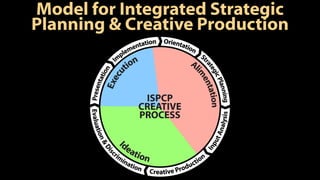
Model for Integrated Strategic
Planning & Creative Production
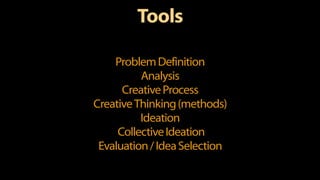
Tools
ProblemDefinition
Analysis
CreativeProcess
CreativeThinking(methods)
Ideation
CollectiveIdeation
Evaluation/IdeaSelection
AssumptionSmashing
Assumptions are extremely powerful creativity inhibitors, because
they represent the world as we perceive it.
Listing all the assumptions that surround a certain problem allows
to review them for illogical argumentation, while also opening the
door to attribute (sub-problem) revision.
By eliminating illogical or irrational arguments, the solver(s) can
focus on a problem definition that is free of judgement.
Moreover, by taking assumptions and applying an inversion
technique, new angles on the problem may be discovered.
AssumptionSmashing
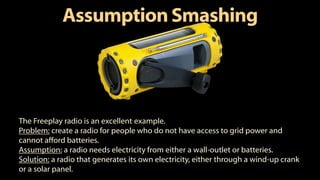
The Freeplay radio is an excellent example.
Problem: create a radio for people who do not have access to grid power and
cannot afford batteries.
Assumption: a radio needs electricity from either a wall-outlet or batteries.
Solution: a radio that generates its own electricity, either through a wind-up crank
or a solar panel.
Listing
Listing is extremely useful in virtually any structured, systematic
thinking and/or ideation effort
Making lists of synonyms, antonyms, advantages, disadvantages,
alternatives, assumptions, bugs, categories, limitations, opposites,
parts, relations, rules, suppositions, and so forth, is practically
always a good starting point for personal and collective creative
thinking processes
Listing
Listing is an integral part of many of the systematic creative
processes or methods described here, because quantity is,
especially at the initial stages of the creative process, far more
important than quality
Fluency – the ability to generate large amounts of ideas or
alternative solutions for a problem – is also part of virtually all
creativity tests, such as the well-known Torrance Tests of Creative
Thinking (TTCT)
Listing
In my experience, Listing is a low-threshold exercise and probably
the simplest, most practical and productive precursor for creative
thinking, even with totally untrained subjects or individuals with
exceptionally well-developed creativity inhibitors.
After all: anybody can make a shopping list.
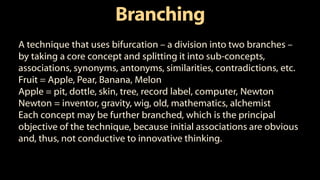
Branching
A technique that uses bifurcation – a division into two branches –
by taking a core concept and splitting it into sub-concepts,
associations, synonyms, antonyms, similarities, contradictions, etc.
Fruit = Apple, Pear, Banana, Melon
Apple = pit, dottle, skin, tree, record label, computer, Newton
Newton = inventor, gravity, wig, old, mathematics, alchemist
Each concept may be further branched, which is the principal
objective of the technique, because initial associations are obvious
and, thus, not conductive to innovative thinking.
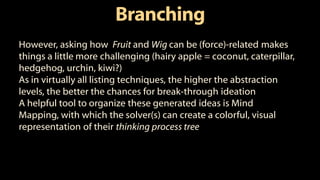
Branching
However, asking how Fruit and Wig can be (force)-related makes
things a little more challenging (hairy apple = coconut, caterpillar,
hedgehog, urchin, kiwi?)
As in virtually all listing techniques, the higher the abstraction
levels, the better the chances for break-through ideation
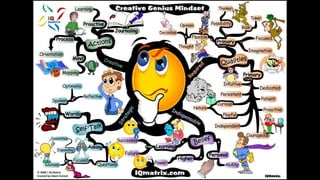
A helpful tool to organize these generated ideas is Mind
Mapping, with which the solver(s) can create a colorful, visual
representation of their thinking process tree
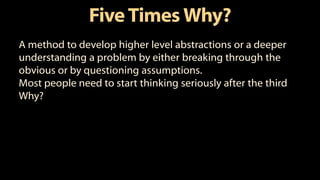
FiveTimes Why?
A method to develop higher level abstractions or a deeper
understanding a problem by either breaking through the
obvious or by questioning assumptions.
Most people need to start thinking seriously after the third
Why?
Circleof Opportunity
The solver(s) state the problem, draw a large circle on a piece of
paper and mark it clockwise.
Each of the 12 points is given an attribute and dice are rolled to
select random pairs.
The selected attributes are then analyzed on their own, side-by-
side and combined to find associations.
Because of the method’s randomness, the list of possible
attribute pairs is virtually unlimited (in the order of 480 million).
CreativeProblemSolving
1 - Osborn’s Checklist.
Although originally developed as a product innovation method,
these thought starters are a practical way to review a problem or
product from multiple angles by asking nine questions:
• Put to other uses?
• Adapt?
• Modify?
• Magnify?
• Minify?
• Substitute?
• Rearrange?
• Reverse?
• Combine?
CreativeProblem Solving
2 – Parnes & van Gundy.
A series of helpful thought-starters
• Divergent thinking: Wouldn’t it be nice if…?, What would happen if…?
• Convergent thinking: identification of hotspots (clusters of similar ideas),
which may deserve attention in a later divergent thinking round
• In what ways might this be helpful, useful, productive, etc.?
• Ownership- and outlook criteria (e.g. urgency, uniqueness, applicability).
The Starting
Point
What is the customer problem?
For students and practitioners alike, finding and
defining an actionable consumer problem is often the
greatest challenge in the creative process.
Especially in those cases where there appears not to be
a consumer problem: recycling, pollution, food waste,
and other, general, ”not-my-problem problems”
What is the customer problem?
Still, unequivocal problem definition is of absolute
essence, whether when solving problems or finding
opportunities, because a poorly defined, badly
focused, fuzzy problem- or opportunity definition
leads inevitably to bad output: poor, or – worse –
useless ideas and a waste of time and other precious
resources.
Differentiation
The definition (for marketing purposes) of one or more

characteristics of a product/service that distinguish it
from its competition
Note that being “different” is not sufficient by itself to
create competitive advantage
CompetitiveAdvantage
A determined aspect, characteristic or attribute of a
product/service that makes it stand out from the
competition in the way it solves a specific consumer
problem
UniqueValue Proposition
A specific, attractive, customer-relevant competitive
aspect of a product/service, BUT seen from the
perspective of the consumer; i.e.: worded in such a
way that the target audience can positively relate to it
We also call this a PROMISE
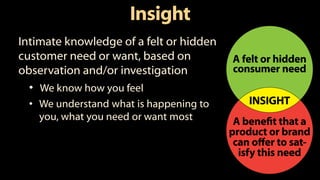
Insight
Intimate knowledge of a felt or hidden
customer need or want, based on
observation and/or investigation
• We know how you feel
• We understand what is happening to
you, what you need or want most
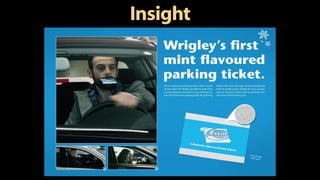
Insight
Reasons to Believe
• Supporting, fact-based evidence for the claim or
promise, usually based on attributes
We are “better”, because...
• 1
• 2
• 3
• Etc.
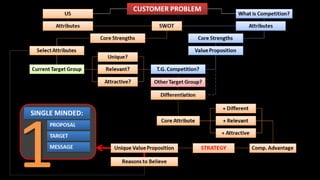
Model for
Attribute-Based
Differentiation
For more information on this model, visit https://www.slideshare.net/gerardprins/building-
competitive-advantage-a-model-examples
6 Common
Creative
Techniques
Analogy
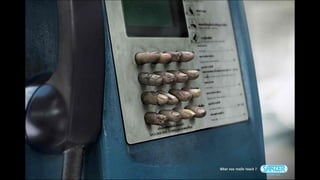
Takes information from one domain (the source) to help solve
a problem in another (the target). Looks for similarity and
uses Is like... or As ... as:
This is like living a dream, As big as a tree. The objective is to
take away focus from the original problem and look for
solutions in the analogy, symbol or representation.
The higher the level of abstraction, the more likely break-
through ideas will occur.
Analogy
Advertising often uses this technique, most notably – though
not exclusively – with animal kingdom analogies:
Playboy bunnies, Ferrari’s rampant horse, Esso’s tiger, La
Coste’s crocodile, the World Wildlife Fund Panda and Twitter’s
bird, to mention a few
Likely the most (ab)used analogy in the history of advertising
is Leonardo da Vinci’s Mona Lisa
Analogy
In advertising, at least, the most effective analogies are
obvious and easy to understand. When recurring to analogy
we must ask: what do we wish to convey?
Bunny = hot; Horse = spirit; Tiger = force; Crocodile = hungry;
Panda = cute, threatened; Bird = freedom; Mona Lisa =
mysterious; Chameleon = ?
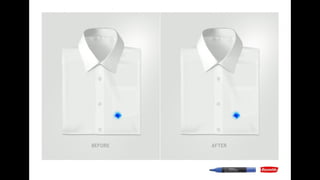
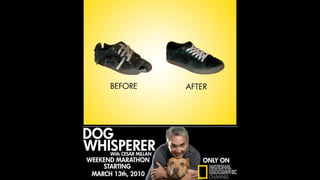
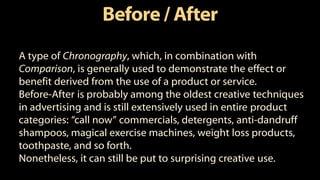
Before/ After
A type of Chronography, which, in combination with
Comparison, is generally used to demonstrate the effect or
benefit derived from the use of a product or service.
Before-After is probably among the oldest creative techniques
in advertising and is still extensively used in entire product
categories: “call now” commercials, detergents, anti-dandruff
shampoos, magical exercise machines, weight loss products,
toothpaste, and so forth.
Nonetheless, it can still be put to surprising creative use.
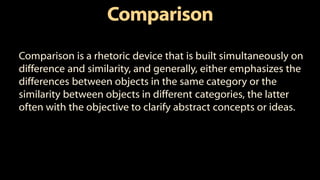
Comparison
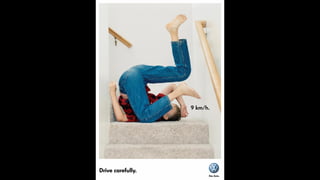
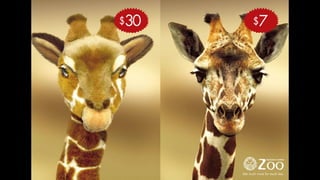
Comparison is a rhetoric device that is built simultaneously on
difference and similarity, and generally, either emphasizes the
differences between objects in the same category or the
similarity between objects in different categories, the latter
often with the objective to clarify abstract concepts or ideas.
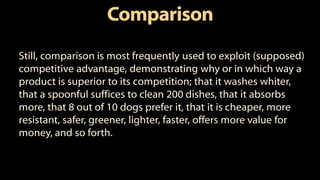
Comparison
Still, comparison is most frequently used to exploit (supposed)
competitive advantage, demonstrating why or in which way a
product is superior to its competition; that it washes whiter,
that a spoonful suffices to clean 200 dishes, that it absorbs
more, that 8 out of 10 dogs prefer it, that it is cheaper, more
resistant, safer, greener, lighter, faster, offers more value for
money, and so forth.
Demonstration
Or Demo. Like comparison, this is a technique that thrives in
the world of detergents, analgesics, diapers, razor blades,
toothpastes and other products for personal hygiene.
Typically shows either how the product works, what the
benefit or the end-result of its use is (Before-After) or, in
combination with Comparison, demonstrates how and why
product A better is than so-called Other Products
Demonstration
Certain brands use a specific demonstration as a mnemonic
device, in which case its use is mandatory.
Examples are Colgate, Head & Shoulders, Oral B, Pampers, and
certain female hygiene brands, among others
Although demonstration is as old as Methuselah and often
unimaginative, it can be put to creative use, which is why it
should never be ruled out beforehand
Exaggeration,Hyperbole
A rhetoric device that employs extreme and obvious
exaggeration, sometimes defined as a lie inserted in truth.
The smartest exaggerations depend on wit and sometimes
comparison or metaphor, as in He can sell refrigerators to
Eskimos or ...Let’s drag these down; they must be as heavy as
bodies (Hannibal, 2001)
More common hyperboles are It hit him like a ton of bricks,
I told you a million times, The class lasted an eternity and She
wept all night, for example.
Exaggeration,Hyperbole
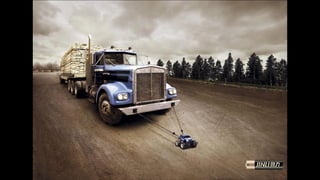
Exaggeration is frequently used in advertising, especially in
combination with humor. Exaggerates the problem, the
solution, the result or the benefit of using a certain product or
service, making it larger, stronger, smaller, smarter, more
absurd, more hilarious
Although the terms hyperbole and exaggeration are often
used without distinction, the evident extremity and, often,
commonness of hyperbole makes it less appropriate for
advertising use
Exaggeration,Hyperbole
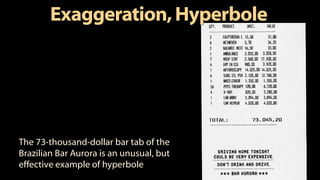
The 73-thousand-dollar bar tab of the
Brazilian Bar Aurora is an unusual, but
effective example of hyperbole
Testimonial
A common creative advertising technique that comes in two
formats
The “expert” testimonial, in which an expert highlights certain
characteristics, demonstrates or recommends the product and
the “celebrity” testimonial, where a well-known person
declares to use the product, demonstrates its use or is shown
using it.
Experts (doctor, dentist, veterinarian, chef, etc.) are most
typically used for OTC and personal care products, analgesics,
soap, toothpaste, etc.
Testimonial
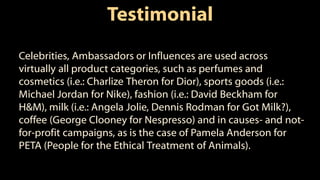
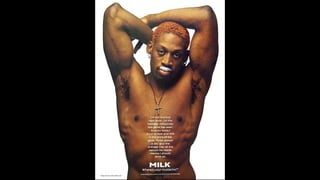
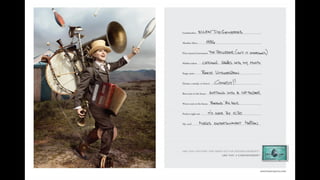
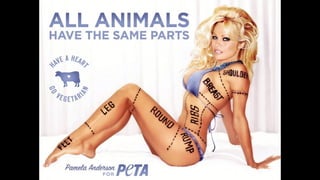
Celebrities, Ambassadors or Influences are used across
virtually all product categories, such as perfumes and
cosmetics (i.e.: Charlize Theron for Dior), sports goods (i.e.:
Michael Jordan for Nike), fashion (i.e.: David Beckham for
H&M), milk (i.e.: Angela Jolie, Dennis Rodman for Got Milk?),
coffee (George Clooney for Nespresso) and in causes- and not-
for-profit campaigns, as is the case of Pamela Anderson for
PETA (People for the Ethical Treatment of Animals).
Testimonial
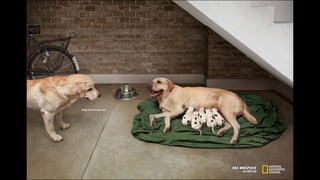
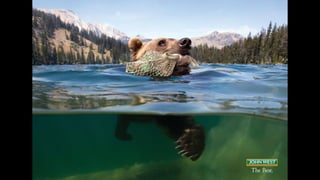
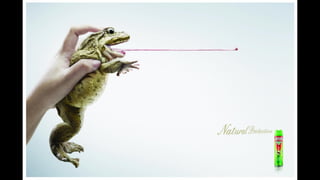
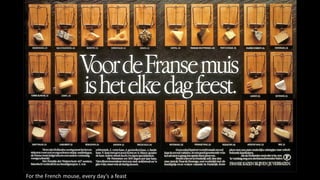
Testimonial may also be used in a figurative way, in
combination with Analogy, often animal analogies
Bear: fish expert, bee: sweet expert, dog: loyalty and frisbee
expert, frog: fly-catching expert, mouse: cheese expert, etc.
For the French mouse, every day’s a feast
Enjoyed this presentation?
More = here:
https://www.slideshare.net/gerardprins/presentations

The creative process, six common creative techniques and examples

  • 1.
  • 2.
    Model for IntegratedStrategic Planning & Creative Production
  • 3.
  • 4.
    AssumptionSmashing Assumptions are extremelypowerful creativity inhibitors, because they represent the world as we perceive it. Listing all the assumptions that surround a certain problem allows to review them for illogical argumentation, while also opening the door to attribute (sub-problem) revision. By eliminating illogical or irrational arguments, the solver(s) can focus on a problem definition that is free of judgement. Moreover, by taking assumptions and applying an inversion technique, new angles on the problem may be discovered.
  • 5.
    AssumptionSmashing The Freeplay radiois an excellent example. Problem: create a radio for people who do not have access to grid power and cannot afford batteries. Assumption: a radio needs electricity from either a wall-outlet or batteries. Solution: a radio that generates its own electricity, either through a wind-up crank or a solar panel.
  • 6.
    Listing Listing is extremelyuseful in virtually any structured, systematic thinking and/or ideation effort Making lists of synonyms, antonyms, advantages, disadvantages, alternatives, assumptions, bugs, categories, limitations, opposites, parts, relations, rules, suppositions, and so forth, is practically always a good starting point for personal and collective creative thinking processes
  • 7.
    Listing Listing is anintegral part of many of the systematic creative processes or methods described here, because quantity is, especially at the initial stages of the creative process, far more important than quality Fluency – the ability to generate large amounts of ideas or alternative solutions for a problem – is also part of virtually all creativity tests, such as the well-known Torrance Tests of Creative Thinking (TTCT)
  • 8.
    Listing In my experience,Listing is a low-threshold exercise and probably the simplest, most practical and productive precursor for creative thinking, even with totally untrained subjects or individuals with exceptionally well-developed creativity inhibitors. After all: anybody can make a shopping list.
  • 9.
    Branching A technique thatuses bifurcation – a division into two branches – by taking a core concept and splitting it into sub-concepts, associations, synonyms, antonyms, similarities, contradictions, etc. Fruit = Apple, Pear, Banana, Melon Apple = pit, dottle, skin, tree, record label, computer, Newton Newton = inventor, gravity, wig, old, mathematics, alchemist Each concept may be further branched, which is the principal objective of the technique, because initial associations are obvious and, thus, not conductive to innovative thinking.
  • 10.
    Branching However, asking howFruit and Wig can be (force)-related makes things a little more challenging (hairy apple = coconut, caterpillar, hedgehog, urchin, kiwi?) As in virtually all listing techniques, the higher the abstraction levels, the better the chances for break-through ideation A helpful tool to organize these generated ideas is Mind Mapping, with which the solver(s) can create a colorful, visual representation of their thinking process tree
  • 12.
    FiveTimes Why? A methodto develop higher level abstractions or a deeper understanding a problem by either breaking through the obvious or by questioning assumptions. Most people need to start thinking seriously after the third Why?
  • 13.
    Circleof Opportunity The solver(s)state the problem, draw a large circle on a piece of paper and mark it clockwise. Each of the 12 points is given an attribute and dice are rolled to select random pairs. The selected attributes are then analyzed on their own, side-by- side and combined to find associations. Because of the method’s randomness, the list of possible attribute pairs is virtually unlimited (in the order of 480 million).
  • 14.
    CreativeProblemSolving 1 - Osborn’sChecklist. Although originally developed as a product innovation method, these thought starters are a practical way to review a problem or product from multiple angles by asking nine questions: • Put to other uses? • Adapt? • Modify? • Magnify? • Minify? • Substitute? • Rearrange? • Reverse? • Combine?
  • 15.
    CreativeProblem Solving 2 –Parnes & van Gundy. A series of helpful thought-starters • Divergent thinking: Wouldn’t it be nice if…?, What would happen if…? • Convergent thinking: identification of hotspots (clusters of similar ideas), which may deserve attention in a later divergent thinking round • In what ways might this be helpful, useful, productive, etc.? • Ownership- and outlook criteria (e.g. urgency, uniqueness, applicability).
  • 16.
  • 17.
    What is thecustomer problem? For students and practitioners alike, finding and defining an actionable consumer problem is often the greatest challenge in the creative process. Especially in those cases where there appears not to be a consumer problem: recycling, pollution, food waste, and other, general, ”not-my-problem problems”
  • 18.
    What is thecustomer problem? Still, unequivocal problem definition is of absolute essence, whether when solving problems or finding opportunities, because a poorly defined, badly focused, fuzzy problem- or opportunity definition leads inevitably to bad output: poor, or – worse – useless ideas and a waste of time and other precious resources.
  • 19.
    Differentiation The definition (formarketing purposes) of one or more characteristics of a product/service that distinguish it from its competition Note that being “different” is not sufficient by itself to create competitive advantage
  • 20.
    CompetitiveAdvantage A determined aspect,characteristic or attribute of a product/service that makes it stand out from the competition in the way it solves a specific consumer problem
  • 21.
    UniqueValue Proposition A specific,attractive, customer-relevant competitive aspect of a product/service, BUT seen from the perspective of the consumer; i.e.: worded in such a way that the target audience can positively relate to it We also call this a PROMISE
  • 22.
    Insight Intimate knowledge ofa felt or hidden customer need or want, based on observation and/or investigation • We know how you feel • We understand what is happening to you, what you need or want most
  • 23.
  • 24.
    Reasons to Believe •Supporting, fact-based evidence for the claim or promise, usually based on attributes We are “better”, because... • 1 • 2 • 3 • Etc.
  • 25.
    Model for Attribute-Based Differentiation For moreinformation on this model, visit https://www.slideshare.net/gerardprins/building- competitive-advantage-a-model-examples
  • 27.
  • 28.
    Analogy Takes information fromone domain (the source) to help solve a problem in another (the target). Looks for similarity and uses Is like... or As ... as: This is like living a dream, As big as a tree. The objective is to take away focus from the original problem and look for solutions in the analogy, symbol or representation. The higher the level of abstraction, the more likely break- through ideas will occur.
  • 29.
    Analogy Advertising often usesthis technique, most notably – though not exclusively – with animal kingdom analogies: Playboy bunnies, Ferrari’s rampant horse, Esso’s tiger, La Coste’s crocodile, the World Wildlife Fund Panda and Twitter’s bird, to mention a few Likely the most (ab)used analogy in the history of advertising is Leonardo da Vinci’s Mona Lisa
  • 31.
    Analogy In advertising, atleast, the most effective analogies are obvious and easy to understand. When recurring to analogy we must ask: what do we wish to convey? Bunny = hot; Horse = spirit; Tiger = force; Crocodile = hungry; Panda = cute, threatened; Bird = freedom; Mona Lisa = mysterious; Chameleon = ?
  • 39.
    Before/ After A typeof Chronography, which, in combination with Comparison, is generally used to demonstrate the effect or benefit derived from the use of a product or service. Before-After is probably among the oldest creative techniques in advertising and is still extensively used in entire product categories: “call now” commercials, detergents, anti-dandruff shampoos, magical exercise machines, weight loss products, toothpaste, and so forth. Nonetheless, it can still be put to surprising creative use.
  • 44.
    Comparison Comparison is arhetoric device that is built simultaneously on difference and similarity, and generally, either emphasizes the differences between objects in the same category or the similarity between objects in different categories, the latter often with the objective to clarify abstract concepts or ideas.
  • 47.
    Comparison Still, comparison ismost frequently used to exploit (supposed) competitive advantage, demonstrating why or in which way a product is superior to its competition; that it washes whiter, that a spoonful suffices to clean 200 dishes, that it absorbs more, that 8 out of 10 dogs prefer it, that it is cheaper, more resistant, safer, greener, lighter, faster, offers more value for money, and so forth.
  • 50.
    Demonstration Or Demo. Likecomparison, this is a technique that thrives in the world of detergents, analgesics, diapers, razor blades, toothpastes and other products for personal hygiene. Typically shows either how the product works, what the benefit or the end-result of its use is (Before-After) or, in combination with Comparison, demonstrates how and why product A better is than so-called Other Products
  • 51.
    Demonstration Certain brands usea specific demonstration as a mnemonic device, in which case its use is mandatory. Examples are Colgate, Head & Shoulders, Oral B, Pampers, and certain female hygiene brands, among others Although demonstration is as old as Methuselah and often unimaginative, it can be put to creative use, which is why it should never be ruled out beforehand
  • 59.
    Exaggeration,Hyperbole A rhetoric devicethat employs extreme and obvious exaggeration, sometimes defined as a lie inserted in truth. The smartest exaggerations depend on wit and sometimes comparison or metaphor, as in He can sell refrigerators to Eskimos or ...Let’s drag these down; they must be as heavy as bodies (Hannibal, 2001) More common hyperboles are It hit him like a ton of bricks, I told you a million times, The class lasted an eternity and She wept all night, for example.
  • 60.
    Exaggeration,Hyperbole Exaggeration is frequentlyused in advertising, especially in combination with humor. Exaggerates the problem, the solution, the result or the benefit of using a certain product or service, making it larger, stronger, smaller, smarter, more absurd, more hilarious Although the terms hyperbole and exaggeration are often used without distinction, the evident extremity and, often, commonness of hyperbole makes it less appropriate for advertising use
  • 61.
    Exaggeration,Hyperbole The 73-thousand-dollar bartab of the Brazilian Bar Aurora is an unusual, but effective example of hyperbole
  • 65.
    Testimonial A common creativeadvertising technique that comes in two formats The “expert” testimonial, in which an expert highlights certain characteristics, demonstrates or recommends the product and the “celebrity” testimonial, where a well-known person declares to use the product, demonstrates its use or is shown using it. Experts (doctor, dentist, veterinarian, chef, etc.) are most typically used for OTC and personal care products, analgesics, soap, toothpaste, etc.
  • 66.
    Testimonial Celebrities, Ambassadors orInfluences are used across virtually all product categories, such as perfumes and cosmetics (i.e.: Charlize Theron for Dior), sports goods (i.e.: Michael Jordan for Nike), fashion (i.e.: David Beckham for H&M), milk (i.e.: Angela Jolie, Dennis Rodman for Got Milk?), coffee (George Clooney for Nespresso) and in causes- and not- for-profit campaigns, as is the case of Pamela Anderson for PETA (People for the Ethical Treatment of Animals).
  • 72.
    Testimonial Testimonial may alsobe used in a figurative way, in combination with Analogy, often animal analogies Bear: fish expert, bee: sweet expert, dog: loyalty and frisbee expert, frog: fly-catching expert, mouse: cheese expert, etc.
  • 75.
    For the Frenchmouse, every day’s a feast
  • 76.
    Enjoyed this presentation? More= here: https://www.slideshare.net/gerardprins/presentations