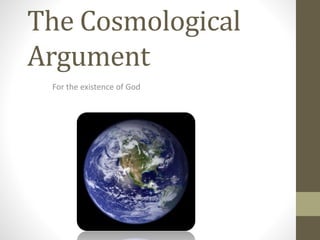
The Cosmological
Argument
For the existence of God
Learning Objectives (Topic)
• To understand how far the cosmological argument seeks
to prove that God exists
• To understand why religious believers argue that the
cosmological argument demonstrates that it is
reasonable to believe in God
• To assess the strengths and weaknesses of the
cosmological argument in order to evaluate it as an
argument to support religious faith
Learning Objectives (Today)
After this lesson, you should be able to :
• Define what the cosmological argument is
• Explain the main objectives of the cosmological argument and
how it seeks to prove the existence of God
• Outline Aristotle’s concept of the Prime Mover
• Compare Aristotle’s Prime Mover with the God of Classical
Theism
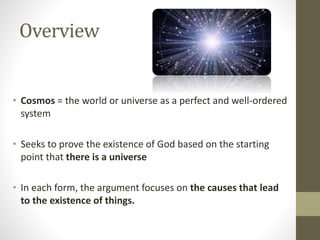
Overview

• Cosmos = the world or universe as a perfect and well-ordered
system
• Seeks to prove the existence of God based on the starting
point that there is a universe
• In each form, the argument focuses on the causes that lead
to the existence of things.
Seeks to answer…
• How did the universe begin?

• Why was the universe created?
• Who created the universe?
Overview…
• Also known as the First Cause Argument
• Derives the conclusion that God exists
from an ‘a posteriori’ premise
• A posteriori = an argument based on the
idea that things can be proved based on
experience.
Overview
• Starting point = observation of our world
• Seeks to prove that the universe and all
that is in it has a cause and that cause is
God.
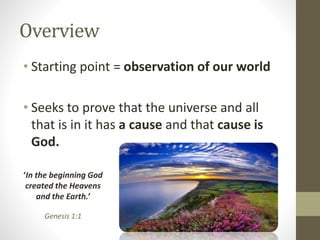
‘In the beginning God
created the Heavens
and the Earth.’
Genesis 1:1
TASK:

• Look out the window.
• List as many ‘natural’ things as you can
see.
• Do these things tell us anything about the
world? If so, What?
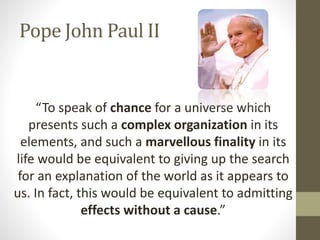
Pope John Paul II

“To speak of chance for a universe which
presents such a complex organization in its
elements, and such a marvellous finality in its
life would be equivalent to giving up the search
for an explanation of the world as it appears to
us. In fact, this would be equivalent to admitting
effects without a cause.”
Overview
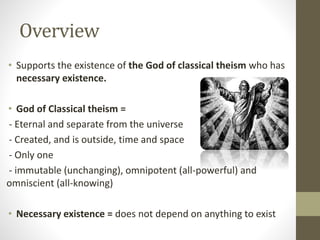
• Supports the existence of the God of classical theism who has
necessary existence.
• God of Classical theism =
- Eternal and separate from the universe
- Created, and is outside, time and space
- Only one
- immutable (unchanging), omnipotent (all-powerful) and
omniscient (all-knowing)
• Necessary existence = does not depend on anything to exist
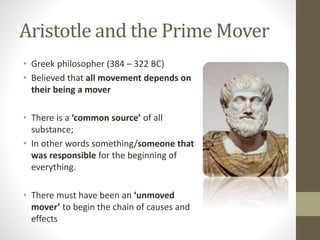
Aristotle and the Prime Mover
• Greek philosopher (384 – 322 BC)
• Believed that all movement depends on
their being a mover
• There is a ‘common source’ of all
substance;
• In other words something/someone that
was responsible for the beginning of
everything.
• There must have been an ‘unmoved
mover’ to begin the chain of causes and
effects
Aristotle …
• Argued that this source is an eternal substance, which exists
necessarily and is immune to change, decay and death.
• Without the unmoved mover, nothing would have come
into existence, this unmoved mover Aristotle calls the Prime
Mover.
• The Prime Mover causes the movement of other things;
not as an efficient cause, but as a final cause.
• In other words, the prime mover does not start off the
movement by giving it some kind of push, but is the
purpose, the teleos, of the movement.
Important definitions
• Efficient cause - a cause that is capable of performing an action and
bringing about the desired result
• E.g. a table and a carpenter
or a boy and a Father.

• Final cause - the reason for something to brought about.
• E.g. a seed turning into an adult plant
Or a sailing boat to sail
• Teleology - the philosophical explanation of phenomena by the
purpose they serve, rather than the causes believed to be behind
them.
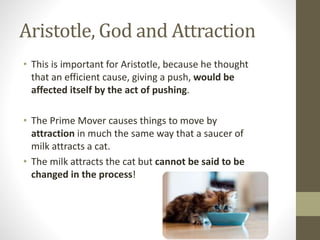
Aristotle, God and Attraction
• This is important for Aristotle, because he thought
that an efficient cause, giving a push, would be
affected itself by the act of pushing.
• The Prime Mover causes things to move by
attraction in much the same way that a saucer of
milk attracts a cat.
• The milk attracts the cat but cannot be said to be
changed in the process!
Aristotle’s conclusion
• The Prime Mover is Perfect, the
universe desires to be so as well and
is therefore attracted to the Prime
Mover.
• For Aristotle the Prime Mover is GOD.
However…
• Aristotle was a deist
• He didn’t believe God watched over the earth or should be
worshipped.
• God is supremely perfect
• Therefore, would have no interest at all in the universe.
• The universe is in space and time, but God is outside space
and time.
• God is supremely happy because God contemplates himself.
• Aristotle considered contemplation
to be the highest end.
TASK
List the similarities and
differences between Aristotle’s
Prime Mover and the God of
classical theism.

Aristotle & the cosmological argument

  • 1.
  • 2.
    Learning Objectives (Topic) •To understand how far the cosmological argument seeks to prove that God exists • To understand why religious believers argue that the cosmological argument demonstrates that it is reasonable to believe in God • To assess the strengths and weaknesses of the cosmological argument in order to evaluate it as an argument to support religious faith
  • 3.
    Learning Objectives (Today) Afterthis lesson, you should be able to : • Define what the cosmological argument is • Explain the main objectives of the cosmological argument and how it seeks to prove the existence of God • Outline Aristotle’s concept of the Prime Mover • Compare Aristotle’s Prime Mover with the God of Classical Theism
  • 4.
    Overview • Cosmos =the world or universe as a perfect and well-ordered system • Seeks to prove the existence of God based on the starting point that there is a universe • In each form, the argument focuses on the causes that lead to the existence of things.
  • 5.
    Seeks to answer… •How did the universe begin? • Why was the universe created? • Who created the universe?
  • 6.
    Overview… • Also knownas the First Cause Argument • Derives the conclusion that God exists from an ‘a posteriori’ premise • A posteriori = an argument based on the idea that things can be proved based on experience.
  • 7.
    Overview • Starting point= observation of our world • Seeks to prove that the universe and all that is in it has a cause and that cause is God. ‘In the beginning God created the Heavens and the Earth.’ Genesis 1:1
  • 8.
    TASK: • Look outthe window. • List as many ‘natural’ things as you can see. • Do these things tell us anything about the world? If so, What?
  • 9.
    Pope John PaulII “To speak of chance for a universe which presents such a complex organization in its elements, and such a marvellous finality in its life would be equivalent to giving up the search for an explanation of the world as it appears to us. In fact, this would be equivalent to admitting effects without a cause.”
  • 10.
    Overview • Supports theexistence of the God of classical theism who has necessary existence. • God of Classical theism = - Eternal and separate from the universe - Created, and is outside, time and space - Only one - immutable (unchanging), omnipotent (all-powerful) and omniscient (all-knowing) • Necessary existence = does not depend on anything to exist
  • 11.
    Aristotle and thePrime Mover • Greek philosopher (384 – 322 BC) • Believed that all movement depends on their being a mover • There is a ‘common source’ of all substance; • In other words something/someone that was responsible for the beginning of everything. • There must have been an ‘unmoved mover’ to begin the chain of causes and effects
  • 12.
    Aristotle … • Arguedthat this source is an eternal substance, which exists necessarily and is immune to change, decay and death. • Without the unmoved mover, nothing would have come into existence, this unmoved mover Aristotle calls the Prime Mover. • The Prime Mover causes the movement of other things; not as an efficient cause, but as a final cause. • In other words, the prime mover does not start off the movement by giving it some kind of push, but is the purpose, the teleos, of the movement.
  • 13.
    Important definitions • Efficientcause - a cause that is capable of performing an action and bringing about the desired result • E.g. a table and a carpenter or a boy and a Father. • Final cause - the reason for something to brought about. • E.g. a seed turning into an adult plant Or a sailing boat to sail • Teleology - the philosophical explanation of phenomena by the purpose they serve, rather than the causes believed to be behind them.
  • 14.
    Aristotle, God andAttraction • This is important for Aristotle, because he thought that an efficient cause, giving a push, would be affected itself by the act of pushing. • The Prime Mover causes things to move by attraction in much the same way that a saucer of milk attracts a cat. • The milk attracts the cat but cannot be said to be changed in the process!
  • 15.
    Aristotle’s conclusion • ThePrime Mover is Perfect, the universe desires to be so as well and is therefore attracted to the Prime Mover. • For Aristotle the Prime Mover is GOD.
  • 16.
    However… • Aristotle wasa deist • He didn’t believe God watched over the earth or should be worshipped. • God is supremely perfect • Therefore, would have no interest at all in the universe. • The universe is in space and time, but God is outside space and time. • God is supremely happy because God contemplates himself. • Aristotle considered contemplation to be the highest end.
  • 17.
    TASK List the similaritiesand differences between Aristotle’s Prime Mover and the God of classical theism.