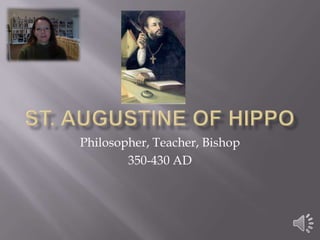
Philosopher, Teacher, Bishop
350-430 AD
•
•
•
•
•

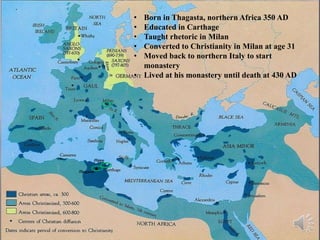
Born in Thagasta, northern Africa 350 AD
Educated in Carthage
Taught rhetoric in Milan
Converted to Christianity in Milan at age 31
Moved back to northern Italy to start
monastery
• Lived at his monastery until death at 430 AD

Hippo
Thagasta
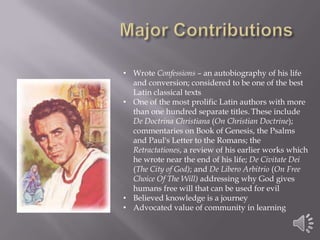
• Wrote Confessions – an autobiography of his life
and conversion; considered to be one of the best
Latin classical texts
• One of the most prolific Latin authors with more
than one hundred separate titles. These include
De Doctrina Christiana (On Christian Doctrine);
commentaries on Book of Genesis, the Psalms
and Paul's Letter to the Romans; the
Retractationes, a review of his earlier works which
he wrote near the end of his life; De Civitate Dei
(The City of God); and De Libero Arbitrio (On Free
Choice Of The Will) addressing why God gives
humans free will that can be used for evil
• Believed knowledge is a journey
• Advocated value of community in learning
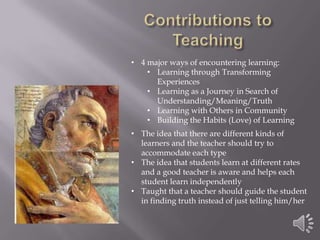
• 4 major ways of encountering learning:
• Learning through Transforming
Experiences
• Learning as a Journey in Search of
Understanding/Meaning/Truth
• Learning with Others in Community
• Building the Habits (Love) of Learning
• The idea that there are different kinds of
learners and the teacher should try to
accommodate each type
• The idea that students learn at different rates
and a good teacher is aware and helps each
student learn independently
• Taught that a teacher should guide the student
in finding truth instead of just telling him/her
•

•

•

•
•

•

Augustine of Hippo. (2013, October 15). Retrieved from
Wikipedia:
http://en.wikipedia.org/wiki/Augustine_of_hippo
Augustine of Hippo/Augustine's Theory of Knowledge. (2013,
July 24). Retrieved from Wikipedia:
http://en.wikiversity.org/wiki/Augustine_of_Hippo/Au
gustine's_Theory_of_Knowledge
anonymous. (2013, October 10). Augustine. Retrieved from
The Internet Encyclopedia of Philosophy:
http.//www.iep.utm.edu
Augustine, S. (CE 397). The Confessions of Saint Augustine.
McCloskey, G. N. (2008). Encounters of Learning: St.
Augustine on Education. Retrieved from St. Augustine
Institute for Learning and Teaching Merrimack College:
http://www.merrimack.edu/academics/augustinian_ped
agogy/documents/encountering_0408.pdf
Mendelson, M. (2010). Saint Augustine. Retrieved from
Stanford Encyclopedia of Philosophy:
http://plato.stanford.edu/entries/augustine

St. augustine slide show

  • 1.
  • 2.
    • • • • • Born in Thagasta,northern Africa 350 AD Educated in Carthage Taught rhetoric in Milan Converted to Christianity in Milan at age 31 Moved back to northern Italy to start monastery • Lived at his monastery until death at 430 AD Hippo Thagasta
  • 3.
    • Wrote Confessions– an autobiography of his life and conversion; considered to be one of the best Latin classical texts • One of the most prolific Latin authors with more than one hundred separate titles. These include De Doctrina Christiana (On Christian Doctrine); commentaries on Book of Genesis, the Psalms and Paul's Letter to the Romans; the Retractationes, a review of his earlier works which he wrote near the end of his life; De Civitate Dei (The City of God); and De Libero Arbitrio (On Free Choice Of The Will) addressing why God gives humans free will that can be used for evil • Believed knowledge is a journey • Advocated value of community in learning
  • 4.
    • 4 majorways of encountering learning: • Learning through Transforming Experiences • Learning as a Journey in Search of Understanding/Meaning/Truth • Learning with Others in Community • Building the Habits (Love) of Learning • The idea that there are different kinds of learners and the teacher should try to accommodate each type • The idea that students learn at different rates and a good teacher is aware and helps each student learn independently • Taught that a teacher should guide the student in finding truth instead of just telling him/her
  • 5.
    • • • • • • Augustine of Hippo.(2013, October 15). Retrieved from Wikipedia: http://en.wikipedia.org/wiki/Augustine_of_hippo Augustine of Hippo/Augustine's Theory of Knowledge. (2013, July 24). Retrieved from Wikipedia: http://en.wikiversity.org/wiki/Augustine_of_Hippo/Au gustine's_Theory_of_Knowledge anonymous. (2013, October 10). Augustine. Retrieved from The Internet Encyclopedia of Philosophy: http.//www.iep.utm.edu Augustine, S. (CE 397). The Confessions of Saint Augustine. McCloskey, G. N. (2008). Encounters of Learning: St. Augustine on Education. Retrieved from St. Augustine Institute for Learning and Teaching Merrimack College: http://www.merrimack.edu/academics/augustinian_ped agogy/documents/encountering_0408.pdf Mendelson, M. (2010). Saint Augustine. Retrieved from Stanford Encyclopedia of Philosophy: http://plato.stanford.edu/entries/augustine