Chapter 2
The
Constitution
Copyright © 2011 Cengage
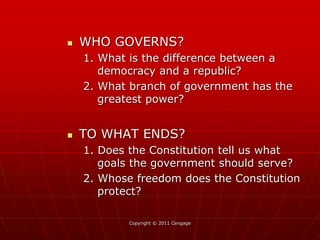
 WHO GOVERNS?
1. What is the difference between a
democracy and a republic?
2. What branch of government has the
greatest power?
 TO WHAT ENDS?
1. Does the Constitution tell us what
goals the government should serve?
2. Whose freedom does the Constitution
protect?
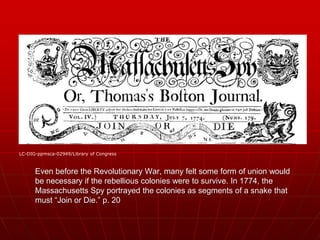
Even before the Revolutionary War, many felt some form of union would
be necessary if the rebellious colonies were to survive. In 1774, the
Massachusetts Spy portrayed the colonies as segments of a snake that
must “Join or Die.” p. 20
LC-DIG-ppmsca-02949/Library of Congress
Copyright © 2011 Cengage
The Problem of Liberty
 The Colonial Mind
• Men will seek power because they are
ambitious, greedy and easily corrupted
 The Real Revolution
 Weaknesses of the Confederation
• Articles of Confederation 1781
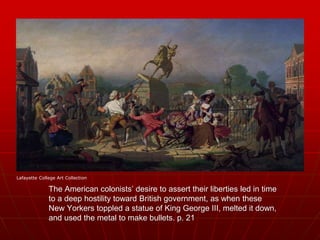
The American colonists’ desire to assert their liberties led in time
to a deep hostility toward British government, as when these
New Yorkers toppled a statue of King George III, melted it down,
and used the metal to make bullets. p. 21
Lafayette College Art Collection
Copyright © 2011 Cengage
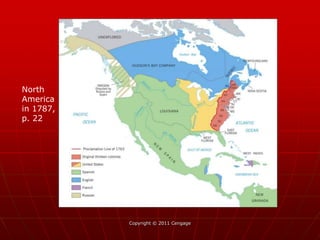
North
America
in 1787,
p. 22
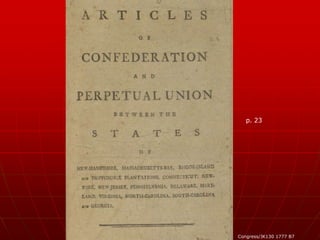
p. 23
Congress/JK130 1777 B7
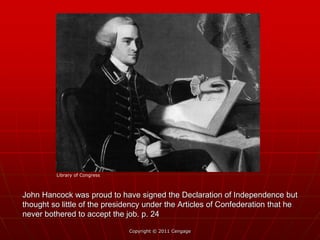
John Hancock was proud to have signed the Declaration of Independence but
thought so little of the presidency under the Articles of Confederation that he
never bothered to accept the job. p. 24
Copyright © 2011 Cengage
Library of Congress
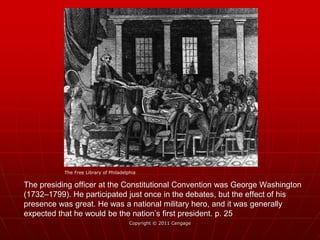
The presiding officer at the Constitutional Convention was George Washington
(1732–1799). He participated just once in the debates, but the effect of his
presence was great. He was a national military hero, and it was generally
expected that he would be the nation’s first president. p. 25
Copyright © 2011 Cengage
The Free Library of Philadelphia
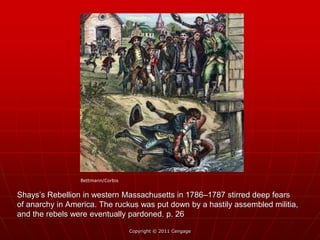
Shays’s Rebellion in western Massachusetts in 1786–1787 stirred deep fears
of anarchy in America. The ruckus was put down by a hastily assembled militia,
and the rebels were eventually pardoned. p. 26
Copyright © 2011 Cengage
Bettmann/Corbis
Copyright © 2011 Cengage
The Constitutional
Convention
 The Lessons of Experience
• State Constitutions
• Shay’s Rebellion
 The Framers
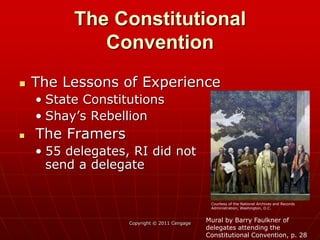
• 55 delegates, RI did not
send a delegate
Mural by Barry Faulkner of
delegates attending the
Constitutional Convention, p. 28
Courtesy of the National Archives and Records
Administration, Washington, D.C.
Copyright © 2011 Cengage
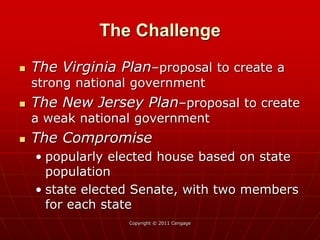
The Challenge
 The Virginia Plan–proposal to create a
strong national government
 The New Jersey Plan–proposal to create
a weak national government
 The Compromise
• popularly elected house based on state
population
• state elected Senate, with two members
for each state
Copyright © 2011 Cengage
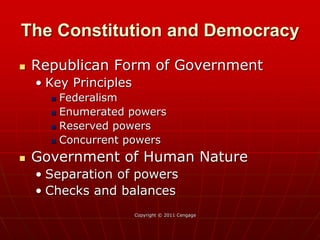
The Constitution and Democracy
 Republican Form of Government
• Key Principles
 Federalism
 Enumerated powers
 Reserved powers
 Concurrent powers
 Government of Human Nature
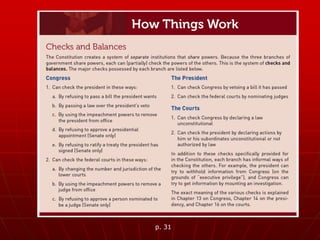
• Separation of powers
• Checks and balances
p. 31
Copyright © 2011 Cengage
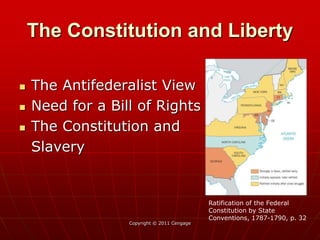
 The Antifederalist View
 Need for a Bill of Rights
 The Constitution and
Slavery
The Constitution and Liberty
Ratification of the Federal
Constitution by State
Conventions, 1787-1790, p. 32
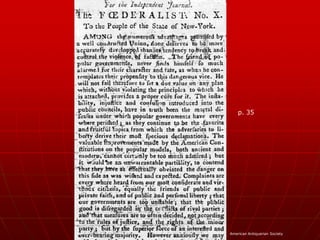
p. 35
American Antiquarian Society
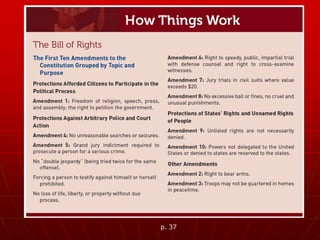
p. 37
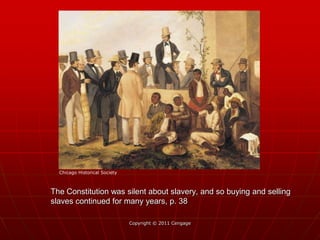
The Constitution was silent about slavery, and so buying and selling
slaves continued for many years, p. 38
Copyright © 2011 Cengage
Chicago Historical Society
Copyright © 2011 Cengage
The Motives of the Framers
 Economic Interests
 The Constitution and Equality
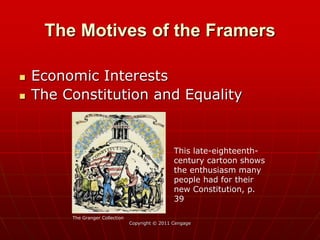
This late-eighteenth-
century cartoon shows
the enthusiasm many
people had for their
new Constitution, p.
39
The Granger Collection
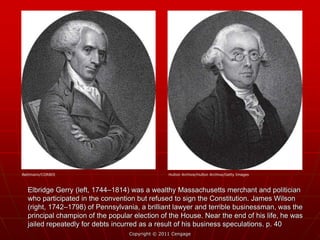
Elbridge Gerry (left, 1744–1814) was a wealthy Massachusetts merchant and politician
who participated in the convention but refused to sign the Constitution. James Wilson
(right, 1742–1798) of Pennsylvania, a brilliant lawyer and terrible businessman, was the
principal champion of the popular election of the House. Near the end of his life, he was
jailed repeatedly for debts incurred as a result of his business speculations. p. 40
Copyright © 2011 Cengage
Bettmann/CORBIS Hulton Archive/Hulton Archive/Getty Images
Copyright © 2011 Cengage
 Reducing the Separation of Powers
 Making the System Less Democratic
• Line-item veto
WHO IS RIGHT?
Constitutional Reform:
Modern Views
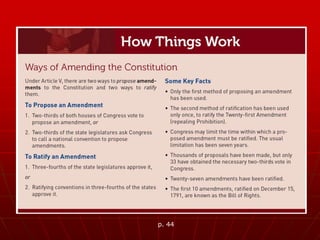
p. 44
WHAT WOULD YOU DO?
MEMORANDUM
To: Elizabeth Anthony, Arkansas state senate majority leader
From: George Morris, chief of staff
Subject: Proposal for a New Constitutional Convention
In the 1990s, Arkansas and several other states approved term limits
for their members of Congress, but the Supreme Court ruled in 1995
that states do not have this authority. Now term-limit advocates are
pursuing a broader strategy, calling for states to approve legislation
that would require Congress to consider several amendment
proposals, including term limits and abolishing the electoral College
to permit the direct popular election of the president. The Arkansas
General Assembly passed such a bill last week, and several senators
in your party have declared their support.
Copyright © 2011 Cengage
Arguments for:
1. Since the Twenty-second Amendment restricts presidents
to two terms, that members of Congress should face similar
limits.
2. Term limits will ensure that national leaders do not become
career politicians.
3. The public favors the direct popular election of the
president; this constitutional convention would make
possible abolishing the electoral College.
Copyright © 2011 Cengage
WHAT WOULD YOU DO?
Arguments against:
1. Limiting members of Congress to two terms would increase
the power of lobbyists, congressional staffers, and
administrative officials.
2. The Electoral College encourages a two-party system; a
direct popular vote for the president would require runoff
elections if no candidate won a majority.
3. The Constitutional Convention of 1787 was held in secret
and involved only a few dozen people; today it would be
heavily covered by the press and involve hundreds, perhaps
thousands of people. No one knows what changes it might
make.
Copyright © 2011 Cengage
WHAT WOULD YOU DO?
Your decision:
Favor legislation?
Oppose legislation?
Copyright © 2011 Cengage
WHAT WOULD YOU DO?

The Constitution

  • 1.
  • 2.
    Copyright © 2011Cengage  WHO GOVERNS? 1. What is the difference between a democracy and a republic? 2. What branch of government has the greatest power?  TO WHAT ENDS? 1. Does the Constitution tell us what goals the government should serve? 2. Whose freedom does the Constitution protect?
  • 3.
    Even before theRevolutionary War, many felt some form of union would be necessary if the rebellious colonies were to survive. In 1774, the Massachusetts Spy portrayed the colonies as segments of a snake that must “Join or Die.” p. 20 LC-DIG-ppmsca-02949/Library of Congress
  • 4.
    Copyright © 2011Cengage The Problem of Liberty  The Colonial Mind • Men will seek power because they are ambitious, greedy and easily corrupted  The Real Revolution  Weaknesses of the Confederation • Articles of Confederation 1781
  • 5.
    The American colonists’desire to assert their liberties led in time to a deep hostility toward British government, as when these New Yorkers toppled a statue of King George III, melted it down, and used the metal to make bullets. p. 21 Lafayette College Art Collection
  • 6.
    Copyright © 2011Cengage North America in 1787, p. 22
  • 7.
  • 8.
    John Hancock wasproud to have signed the Declaration of Independence but thought so little of the presidency under the Articles of Confederation that he never bothered to accept the job. p. 24 Copyright © 2011 Cengage Library of Congress
  • 9.
    The presiding officerat the Constitutional Convention was George Washington (1732–1799). He participated just once in the debates, but the effect of his presence was great. He was a national military hero, and it was generally expected that he would be the nation’s first president. p. 25 Copyright © 2011 Cengage The Free Library of Philadelphia
  • 10.
    Shays’s Rebellion inwestern Massachusetts in 1786–1787 stirred deep fears of anarchy in America. The ruckus was put down by a hastily assembled militia, and the rebels were eventually pardoned. p. 26 Copyright © 2011 Cengage Bettmann/Corbis
  • 11.
    Copyright © 2011Cengage The Constitutional Convention  The Lessons of Experience • State Constitutions • Shay’s Rebellion  The Framers • 55 delegates, RI did not send a delegate Mural by Barry Faulkner of delegates attending the Constitutional Convention, p. 28 Courtesy of the National Archives and Records Administration, Washington, D.C.
  • 12.
    Copyright © 2011Cengage The Challenge  The Virginia Plan–proposal to create a strong national government  The New Jersey Plan–proposal to create a weak national government  The Compromise • popularly elected house based on state population • state elected Senate, with two members for each state
  • 13.
    Copyright © 2011Cengage The Constitution and Democracy  Republican Form of Government • Key Principles  Federalism  Enumerated powers  Reserved powers  Concurrent powers  Government of Human Nature • Separation of powers • Checks and balances
  • 14.
  • 15.
    Copyright © 2011Cengage  The Antifederalist View  Need for a Bill of Rights  The Constitution and Slavery The Constitution and Liberty Ratification of the Federal Constitution by State Conventions, 1787-1790, p. 32
  • 16.
  • 17.
  • 18.
    The Constitution wassilent about slavery, and so buying and selling slaves continued for many years, p. 38 Copyright © 2011 Cengage Chicago Historical Society
  • 19.
    Copyright © 2011Cengage The Motives of the Framers  Economic Interests  The Constitution and Equality This late-eighteenth- century cartoon shows the enthusiasm many people had for their new Constitution, p. 39 The Granger Collection
  • 20.
    Elbridge Gerry (left,1744–1814) was a wealthy Massachusetts merchant and politician who participated in the convention but refused to sign the Constitution. James Wilson (right, 1742–1798) of Pennsylvania, a brilliant lawyer and terrible businessman, was the principal champion of the popular election of the House. Near the end of his life, he was jailed repeatedly for debts incurred as a result of his business speculations. p. 40 Copyright © 2011 Cengage Bettmann/CORBIS Hulton Archive/Hulton Archive/Getty Images
  • 21.
    Copyright © 2011Cengage  Reducing the Separation of Powers  Making the System Less Democratic • Line-item veto WHO IS RIGHT? Constitutional Reform: Modern Views
  • 22.
  • 23.
    WHAT WOULD YOUDO? MEMORANDUM To: Elizabeth Anthony, Arkansas state senate majority leader From: George Morris, chief of staff Subject: Proposal for a New Constitutional Convention In the 1990s, Arkansas and several other states approved term limits for their members of Congress, but the Supreme Court ruled in 1995 that states do not have this authority. Now term-limit advocates are pursuing a broader strategy, calling for states to approve legislation that would require Congress to consider several amendment proposals, including term limits and abolishing the electoral College to permit the direct popular election of the president. The Arkansas General Assembly passed such a bill last week, and several senators in your party have declared their support. Copyright © 2011 Cengage
  • 24.
    Arguments for: 1. Sincethe Twenty-second Amendment restricts presidents to two terms, that members of Congress should face similar limits. 2. Term limits will ensure that national leaders do not become career politicians. 3. The public favors the direct popular election of the president; this constitutional convention would make possible abolishing the electoral College. Copyright © 2011 Cengage WHAT WOULD YOU DO?
  • 25.
    Arguments against: 1. Limitingmembers of Congress to two terms would increase the power of lobbyists, congressional staffers, and administrative officials. 2. The Electoral College encourages a two-party system; a direct popular vote for the president would require runoff elections if no candidate won a majority. 3. The Constitutional Convention of 1787 was held in secret and involved only a few dozen people; today it would be heavily covered by the press and involve hundreds, perhaps thousands of people. No one knows what changes it might make. Copyright © 2011 Cengage WHAT WOULD YOU DO?
  • 26.
    Your decision: Favor legislation? Opposelegislation? Copyright © 2011 Cengage WHAT WOULD YOU DO?

Editor's Notes

  • #7 Place map of North America in 1787, p. 22 here