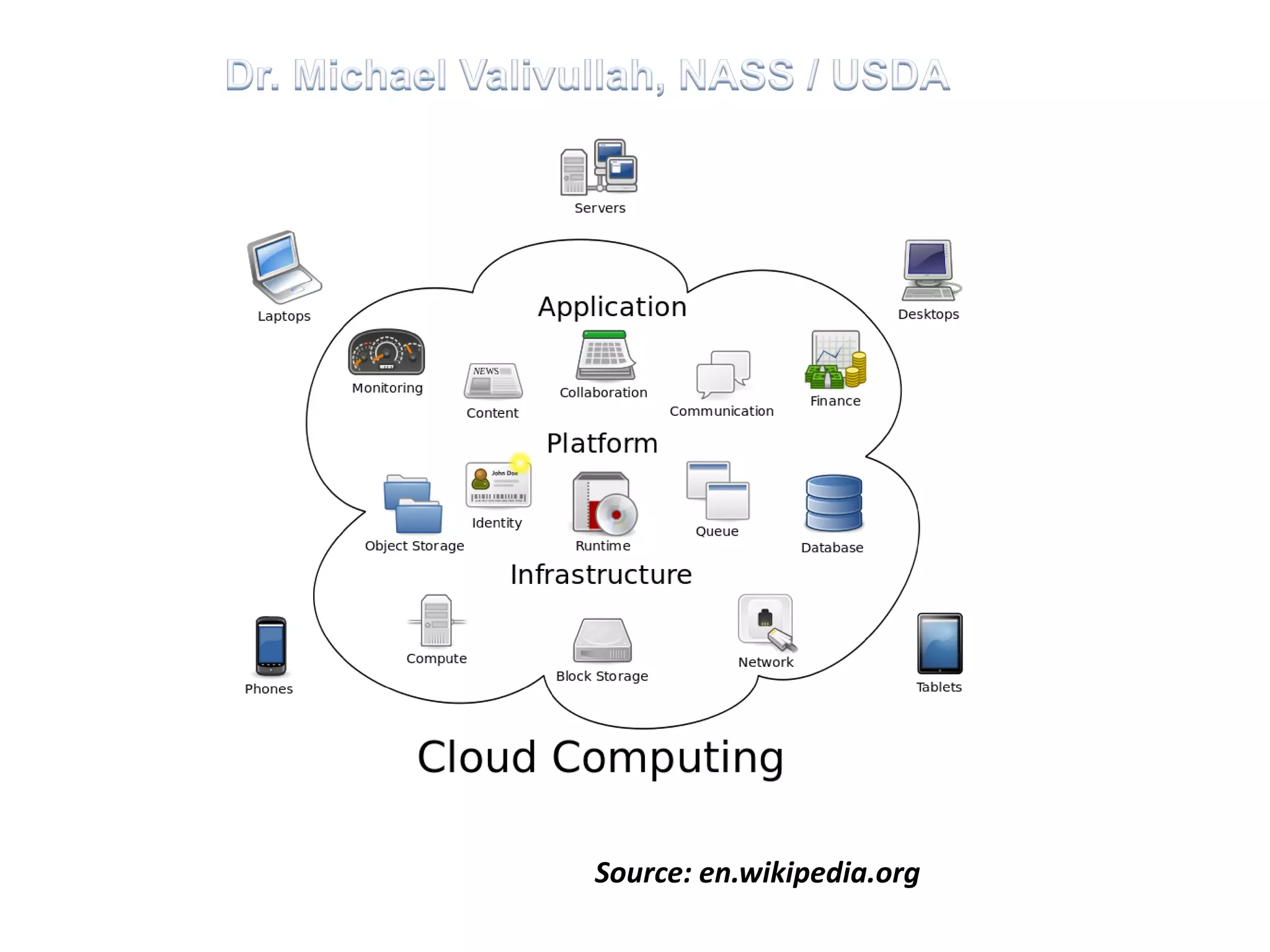
Source: en.wikipedia.org
Disclaimer
   All the opinions expressed and
information provided by me in this
     event are personal. I am not
 representing anyone or any entity,
  private, public or otherwise. Any
 identification, mention of name or
   brand is not an endorsement or
  recommendation. Your own due
      diligence is recommended.
What  is  ‘Cloud  Computing’?


      ‘Leasing’  what  one  needs  in  a  standardized  
                        environment.


7/31/2011                  Cloud Computing - A Primer      3
Analogous to Electricity
    Availability on Demand
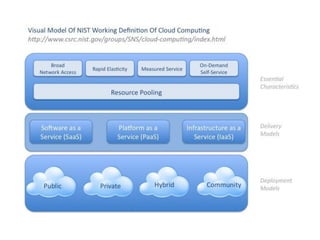
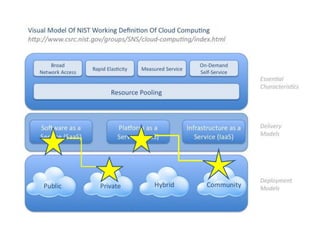
     Broad Network Access
        Rapid Elasticity
      Measurable Service
       Pooled Resources
 (Network, Compute, Storage..)
      Pay for what is used
Cloud Computing = Utility Computing
                                      4
‘Cloud  Computing’- Definition
    ‘Cloud  computing’  is  a  model  for  enabling:  
    Ubiquitous, convenient, on-demand network
    access to a shared pool of configurable
    computing resources (e.g., networks, servers,
    storage, applications, and services) that can
    be rapidly provisioned and released with
    minimal management effort or service
    provider interaction (NIST Pub. 800-146,
    2011).

7/31/2011                Cloud Computing - A Primer   5
Another Definition
‘The  cloud  is  a  flexible  and  scalable  shared  
environment that uses virtualization
technologies to create and distribute
computing resources to users on an as
needed basis, accessed via the internet
browser  and  distributed  over  the  network’.

                 - Stratecast, Frost and Sullivan (2010)
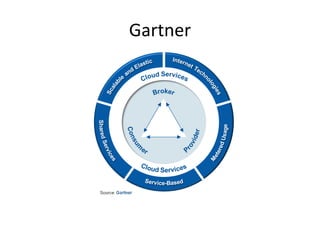
Gartner
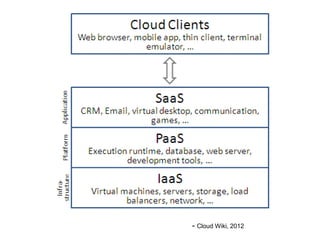
- Cloud Wiki, 2012
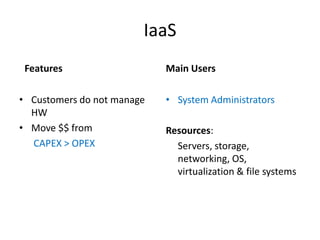
IaaS
 Features                   Main Users

• Customers do not manage   • System Administrators
  HW
• Move $$ from              Resources:
  CAPEX > OPEX                Servers, storage,
                              networking, OS,
                              virtualization & file systems
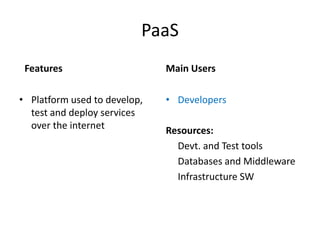
PaaS
 Features                     Main Users

• Platform used to develop,   • Developers
  test and deploy services
  over the internet           Resources:
                                Devt. and Test tools
                                Databases and Middleware
                                Infrastructure SW
SaaS
 Features                       Main Users

• CRM, HRM, eMail,              • End Users
  Communication,
  Collaboration, Office         Resources:
  Productivity Suites and
  Other Apps – Deployed in        Business, operational and
  hosted environment –            administrative applications
  licensed based on
  Subscription – Pay and Play
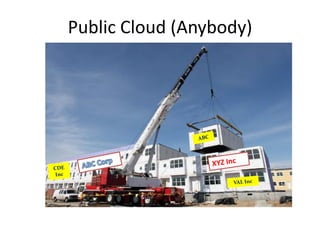
Public Cloud (Anybody)
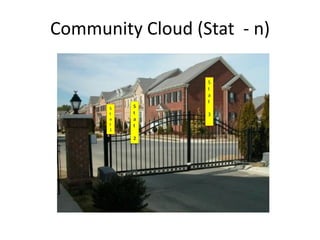
Community Cloud (Stat - n)

                  S
                  t
                  a
                  t
       S   S
       t   t      3
       a   a
       t   t
       1

           2
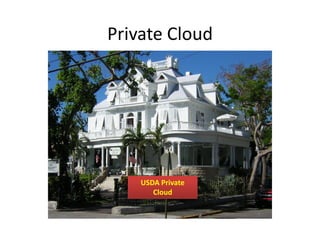
Private Cloud


    USDA Private
       Cloud
Cloud Computing


  Why the Cloud?
Current IT State
• Lengthy time to provision resources
   > Soln: Reduce provisioning time
• IT capacity – needs peaks and valleys hi/lo demand
   > Soln: Even out resources use/release resources as
     needed
• Internal IT staff – do not have the right skill set, time
  and or not enough staff to meet new business
  demands in a reasonable time and cost
   > Soln: Cloud Services
Cloud Benefits
• Drives - Agility; Automation; Self-Service
• Decreases - Business Pain Points, Increases
  efficiency (earlier time to market or
  implementation of a new process, business
  solution)
• Forces - IT + Business Cooperation
• Increases Standardization (e.g., apps, DBs)
• Decreases Complexity
Private Cloud
        Why choose a Private Cloud?
•Peace of mind. Feel ‘secure’  in  their  cloud
  •Are risk averse and / or have mandates
    • Flexibility, Self-Service, Integration,
         Automation, and Metering
  •3rd Party options (hosting) available or
           •In a wait and see mode
•In future they may become hybrid - trend
Private Cloud - Poll
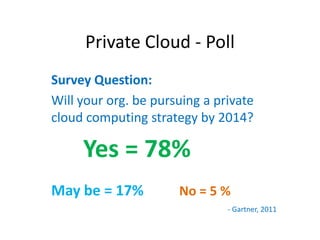
Survey Question:
Will your org. be pursuing a private
cloud computing strategy by 2014?

     Yes = 78%
May be = 17%          No = 5 %
                               - Gartner, 2011
Private Cloud

1.   Not Just virtualization
2.   Not Necessarily decrease cost
3.   Not  Always  ‘on  premise’
4.   Not Just Iaas or PaaS
5.   May Not Always stay private
Public Private – Highlights
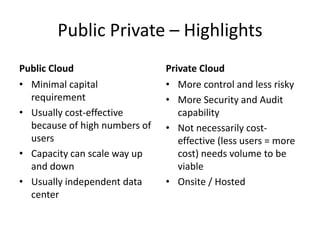
Public Cloud                   Private Cloud
• Minimal capital              • More control and less risky
  requirement                  • More Security and Audit
• Usually cost-effective          capability
  because of high numbers of   • Not necessarily cost-
  users                           effective (less users = more
• Capacity can scale way up       cost) needs volume to be
  and down                        viable
• Usually independent data     • Onsite / Hosted
  center
PUBLIC CLOUD PERFORMANCE

 Not all public clouds are created equal

       Buyer/Subscriber Beware

                 Why?
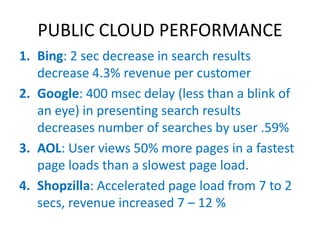
PUBLIC CLOUD PERFORMANCE
1. Bing: 2 sec decrease in search results
   decrease 4.3% revenue per customer
2. Google: 400 msec delay (less than a blink of
   an eye) in presenting search results
   decreases number of searches by user .59%
3. AOL: User views 50% more pages in a fastest
   page loads than a slowest page load.
4. Shopzilla: Accelerated page load from 7 to 2
   secs, revenue increased 7 – 12 %
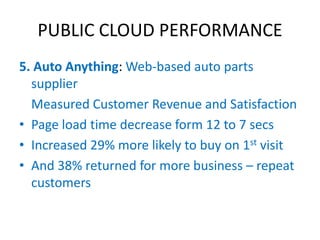
PUBLIC CLOUD PERFORMANCE
5. Auto Anything: Web-based auto parts
  supplier
  Measured Customer Revenue and Satisfaction
• Page load time decrease form 12 to 7 secs
• Increased 29% more likely to buy on 1st visit
• And 38% returned for more business – repeat
  customers
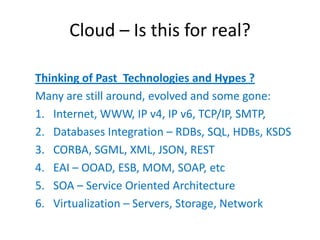
Cloud – Is this for real?

Thinking of Past Technologies and Hypes ?
Many are still around, evolved and some gone:
1. Internet, WWW, IP v4, IP v6, TCP/IP, SMTP,
2. Databases Integration – RDBs, SQL, HDBs, KSDS
3. CORBA, SGML, XML, JSON, REST
4. EAI – OOAD, ESB, MOM, SOAP, etc
5. SOA – Service Oriented Architecture
6. Virtualization – Servers, Storage, Network
Cloud – Is this for real?

7. Cloud – Private, Public, Hybrid (peaked 2 years
   ago)
8. Big Data – Hadoop, No SQL, InMemory DB,
   MongoDG, PIG (last year)
9. MDM – mobile data management / Distributed
   ID Mgmt (now), Identity Management, Mobile
   Computing
US Cloud Growth
Adoption will only grow:
1. The users are seeing the benefits – Agility, Cost
2. Federal Mandates : Cloud First, Shared First, etc.
3. Vendors are addressing user concerns and willing to
   accommodate the rules regulations mandates, audit,
   privacy, etc. (FedRAMP, FISMA, PII, SAS-70, HIPAA, HL-7,
   SOX, A-123, FFMIA, JFMIP, etc) requirements
4. Cloud Service Brokers are becoming more valuable in
   bridging the knowledge gap between cloud providers and
   cloud consumers
European Cloud
The dark cloud of uncertainty is moving away

 The European Leaders have staked out a commitment to:
 Establish a common set of Rules of the Road to develop a
 cohesive market structure among various member nations
 for cloud providers. They want to the public clouds to be
 ‘open,  competitive  and  secure’  so  that  govts. as well as
 public can use them. This drew praise from some leading US
 Tech Trade Associations
                                   - CIO Magazine Oct. 2012
A Cloud Should
1. Should fit the business need – One size does
   not fit all
2. Needs to be agile to accommodate
   enterprise’s  business  process  and  IT  
   operations
3. Able to leverage existing IT infrastructure (rip
   and replace and increased cost will be a DOA)
4. Needs to meet security, compliance & other
   requirements
Cloud Migration – To do List
1. Security – key evaluation criteria
2. Get Senior Management commitment early
3. Cloud provides – automation, provisioning, mgmt
   function
4. But does NOT provide automatic integration with
   different layers of cloud security
5. So requires lots of education and process updates –
   needs time and resources
6. Have  a  cloud  test  ‘sandbox’  for  testing  SW  updates    
   prerelease – to test all cloud layers
Cloud Migration – To do List

7. ‘Deny  all’  except  ‘explicitly  allowed’  creates  
   issues with emergency and operational fixes.
   Therefore, needs a very good CM process,
   controls and governance
Use Case 1. Private Cloud
•   Preparation – deliberate and time consuming
•   Constant Communication
•   Roll out in Stages
•   Set expectations right
•   Training and Expert help – OnSite
•   Training Classes – Cheat Sheets
•   Result
Use Case 2. Community Cloud
1.   13 Federal Agencies
2.   Small Budget – Chip in
3.   Shared Operational Apps
4.   Catalog Devt. – Dummy data
5.   Roll out
6.   Result
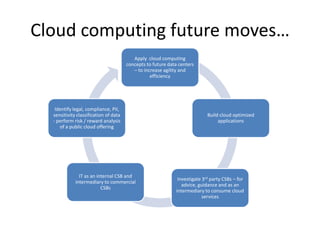
Cloud  computing  future  moves…
                                          Apply cloud computing
                                       concepts to future data centers
                                          – to increase agility and
                                                  efficiency


   Identify legal, compliance, PII,
  sensitivity classification of data                                        Build cloud optimized
  - perform risk / reward analysis                                               applications
     of a public cloud offering


               IT as an internal CSB and
                                                              Investigate 3rd party CSBs – for
             intermediary to commercial
                                                                advice, guidance and as an
                          CSBs
                                                             intermediary to consume cloud
                                                                          services
Future of IT Employees
• Businesses like to keep their IT folks as
internal advisors on evolving cloud services
and as go betweens Cloud Service Brokers
(CSBs)
•Be a solution provider, add value and become
part of the integrated business team
• Modern IDEs / CASE Tools are more powerful
and one does not need to know ‘bits  and  
bytes’  to  develop  an  application or build a
service
Future of IT Expenses

Expense: Businesses do not like upfront IT
expenses (CAPEX) but want to retain or
increase the value derived (agility,
efficiency, peak load mgmt) from the use
of these IT resources. They prefer
predictable    ‘pay  as  you  go’  model    (OPEX)  
Will continue to reduce CAPEX
NIST Cloud Computing Related Publications

NIST Special Publication 500 Series:
NIST Special Publication 500-291, NIST Cloud Computing Standards Roadmap, July
2011

NIST Special Publication 500-292, NIST Cloud Computing Reference Architecture,
September 2011

NIST Special Publication 500-293, US Government Cloud Computing Technology
Roadmap, Release 1.0 (Draft), Volume I High-Priority Requirements to Further USG
Agency Cloud Computing Adoption, November 2011

NIST Special Publication 500-293, US Government Cloud Computing Technology
Roadmap, Release 1.0 (Draft), Volume II Useful Information for Cloud Adopters,
November 2011
NIST Special Publication 800 Series:

NIST Special Publication 800-53A, Revision 1, Guide for Assessing the Security
Controls in Federal Information Systems and Organizations, June 2010
NIST Special Publication 800-125, Guide to Security for Full Virtualization
Technologies, January 2011
NIST Special Publication 800-144, Guidelines on Security and Privacy in Public
Cloud Computing, December 2011
NIST Special Publication 800-145, NIST Definition of Cloud Computing, September
2011
NIST Special Publication 800-146, Cloud Computing Synopsis and
Recommendations, May 2012
NIST Cloud Computing Research Papers

C. Dabrowski and K. Mills, "VM Leakage and Orphan Control in Open-Source Clouds", Proceedings
of IEEE CloudCom 2011, Nov. 29-Dec. 1, Athens, Greece, pp. 554-559.
K. Mills, J. Filliben and C. Dabrowski, "Comparing VM-Placement Algorithms for On-Demand
Clouds", Proceedings of IEEE CloudCom 2011, Nov. 29-Dec. 1, Athens, Greece, pp. 91-98.
C. Dabrowski and K. Mills, "Extended Version of VM Leakage and Ophan Control in Open-Source
Clouds", NIST Publication 909325; an abbreviated version of this paper was published in the
Proceedings of IEEE CloudCom 2011, Nov. 29-Dec. 1, Athens, Greece.
C. Dabrowski and F. Hunt, "Identifying Failure Scenarios in Complex Systems by Perturbing Markov
Chain Models", Proceedings of ASME 2011 Conference on Pressure Vessels & Piping, Baltimore,
MD, July 17-22, 2011.
K. Mills, J. Filliben and C. Dabrowski, "An Efficient Sensitivity Analysis Method for Large Cloud
Simulations", Proceedings of the 4th International Cloud Computing Conference, IEEE, Washington,
D.C., July 5-9, 2011.
Thank you!
Michael.Valivullah@nass.usda.gov

Dr. Michael Valivullah, NASS/USDA - Cloud Computing

  • 1.
  • 2.
    Disclaimer All the opinions expressed and information provided by me in this event are personal. I am not representing anyone or any entity, private, public or otherwise. Any identification, mention of name or brand is not an endorsement or recommendation. Your own due diligence is recommended.
  • 3.
    What  is  ‘Cloud Computing’? ‘Leasing’  what  one  needs  in  a  standardized   environment. 7/31/2011 Cloud Computing - A Primer 3
  • 4.
    Analogous to Electricity Availability on Demand Broad Network Access Rapid Elasticity Measurable Service Pooled Resources (Network, Compute, Storage..) Pay for what is used Cloud Computing = Utility Computing 4
  • 5.
    ‘Cloud  Computing’- Definition ‘Cloud  computing’  is  a  model  for  enabling:   Ubiquitous, convenient, on-demand network access to a shared pool of configurable computing resources (e.g., networks, servers, storage, applications, and services) that can be rapidly provisioned and released with minimal management effort or service provider interaction (NIST Pub. 800-146, 2011). 7/31/2011 Cloud Computing - A Primer 5
  • 6.
    Another Definition ‘The  cloud is  a  flexible  and  scalable  shared   environment that uses virtualization technologies to create and distribute computing resources to users on an as needed basis, accessed via the internet browser  and  distributed  over  the  network’. - Stratecast, Frost and Sullivan (2010)
  • 7.
  • 9.
  • 10.
    IaaS Features Main Users • Customers do not manage • System Administrators HW • Move $$ from Resources: CAPEX > OPEX Servers, storage, networking, OS, virtualization & file systems
  • 11.
    PaaS Features Main Users • Platform used to develop, • Developers test and deploy services over the internet Resources: Devt. and Test tools Databases and Middleware Infrastructure SW
  • 12.
    SaaS Features Main Users • CRM, HRM, eMail, • End Users Communication, Collaboration, Office Resources: Productivity Suites and Other Apps – Deployed in Business, operational and hosted environment – administrative applications licensed based on Subscription – Pay and Play
  • 13.
  • 14.
    Community Cloud (Stat- n) S t a t S S t t 3 a a t t 1 2
  • 15.
    Private Cloud USDA Private Cloud
  • 17.
    Cloud Computing Why the Cloud?
  • 18.
    Current IT State •Lengthy time to provision resources > Soln: Reduce provisioning time • IT capacity – needs peaks and valleys hi/lo demand > Soln: Even out resources use/release resources as needed • Internal IT staff – do not have the right skill set, time and or not enough staff to meet new business demands in a reasonable time and cost > Soln: Cloud Services
  • 19.
    Cloud Benefits • Drives- Agility; Automation; Self-Service • Decreases - Business Pain Points, Increases efficiency (earlier time to market or implementation of a new process, business solution) • Forces - IT + Business Cooperation • Increases Standardization (e.g., apps, DBs) • Decreases Complexity
  • 20.
    Private Cloud Why choose a Private Cloud? •Peace of mind. Feel ‘secure’  in  their  cloud •Are risk averse and / or have mandates • Flexibility, Self-Service, Integration, Automation, and Metering •3rd Party options (hosting) available or •In a wait and see mode •In future they may become hybrid - trend
  • 21.
    Private Cloud -Poll Survey Question: Will your org. be pursuing a private cloud computing strategy by 2014? Yes = 78% May be = 17% No = 5 % - Gartner, 2011
  • 22.
    Private Cloud 1. Not Just virtualization 2. Not Necessarily decrease cost 3. Not  Always  ‘on  premise’ 4. Not Just Iaas or PaaS 5. May Not Always stay private
  • 23.
    Public Private –Highlights Public Cloud Private Cloud • Minimal capital • More control and less risky requirement • More Security and Audit • Usually cost-effective capability because of high numbers of • Not necessarily cost- users effective (less users = more • Capacity can scale way up cost) needs volume to be and down viable • Usually independent data • Onsite / Hosted center
  • 24.
    PUBLIC CLOUD PERFORMANCE Not all public clouds are created equal Buyer/Subscriber Beware Why?
  • 25.
    PUBLIC CLOUD PERFORMANCE 1.Bing: 2 sec decrease in search results decrease 4.3% revenue per customer 2. Google: 400 msec delay (less than a blink of an eye) in presenting search results decreases number of searches by user .59% 3. AOL: User views 50% more pages in a fastest page loads than a slowest page load. 4. Shopzilla: Accelerated page load from 7 to 2 secs, revenue increased 7 – 12 %
  • 26.
    PUBLIC CLOUD PERFORMANCE 5.Auto Anything: Web-based auto parts supplier Measured Customer Revenue and Satisfaction • Page load time decrease form 12 to 7 secs • Increased 29% more likely to buy on 1st visit • And 38% returned for more business – repeat customers
  • 27.
    Cloud – Isthis for real? Thinking of Past Technologies and Hypes ? Many are still around, evolved and some gone: 1. Internet, WWW, IP v4, IP v6, TCP/IP, SMTP, 2. Databases Integration – RDBs, SQL, HDBs, KSDS 3. CORBA, SGML, XML, JSON, REST 4. EAI – OOAD, ESB, MOM, SOAP, etc 5. SOA – Service Oriented Architecture 6. Virtualization – Servers, Storage, Network
  • 28.
    Cloud – Isthis for real? 7. Cloud – Private, Public, Hybrid (peaked 2 years ago) 8. Big Data – Hadoop, No SQL, InMemory DB, MongoDG, PIG (last year) 9. MDM – mobile data management / Distributed ID Mgmt (now), Identity Management, Mobile Computing
  • 29.
    US Cloud Growth Adoptionwill only grow: 1. The users are seeing the benefits – Agility, Cost 2. Federal Mandates : Cloud First, Shared First, etc. 3. Vendors are addressing user concerns and willing to accommodate the rules regulations mandates, audit, privacy, etc. (FedRAMP, FISMA, PII, SAS-70, HIPAA, HL-7, SOX, A-123, FFMIA, JFMIP, etc) requirements 4. Cloud Service Brokers are becoming more valuable in bridging the knowledge gap between cloud providers and cloud consumers
  • 30.
    European Cloud The darkcloud of uncertainty is moving away The European Leaders have staked out a commitment to: Establish a common set of Rules of the Road to develop a cohesive market structure among various member nations for cloud providers. They want to the public clouds to be ‘open,  competitive  and  secure’  so  that  govts. as well as public can use them. This drew praise from some leading US Tech Trade Associations - CIO Magazine Oct. 2012
  • 31.
    A Cloud Should 1.Should fit the business need – One size does not fit all 2. Needs to be agile to accommodate enterprise’s  business  process  and  IT   operations 3. Able to leverage existing IT infrastructure (rip and replace and increased cost will be a DOA) 4. Needs to meet security, compliance & other requirements
  • 32.
    Cloud Migration –To do List 1. Security – key evaluation criteria 2. Get Senior Management commitment early 3. Cloud provides – automation, provisioning, mgmt function 4. But does NOT provide automatic integration with different layers of cloud security 5. So requires lots of education and process updates – needs time and resources 6. Have  a  cloud  test  ‘sandbox’  for  testing  SW  updates     prerelease – to test all cloud layers
  • 33.
    Cloud Migration –To do List 7. ‘Deny  all’  except  ‘explicitly  allowed’  creates   issues with emergency and operational fixes. Therefore, needs a very good CM process, controls and governance
  • 34.
    Use Case 1.Private Cloud • Preparation – deliberate and time consuming • Constant Communication • Roll out in Stages • Set expectations right • Training and Expert help – OnSite • Training Classes – Cheat Sheets • Result
  • 35.
    Use Case 2.Community Cloud 1. 13 Federal Agencies 2. Small Budget – Chip in 3. Shared Operational Apps 4. Catalog Devt. – Dummy data 5. Roll out 6. Result
  • 36.
    Cloud  computing  future moves… Apply cloud computing concepts to future data centers – to increase agility and efficiency Identify legal, compliance, PII, sensitivity classification of data Build cloud optimized - perform risk / reward analysis applications of a public cloud offering IT as an internal CSB and Investigate 3rd party CSBs – for intermediary to commercial advice, guidance and as an CSBs intermediary to consume cloud services
  • 37.
    Future of ITEmployees • Businesses like to keep their IT folks as internal advisors on evolving cloud services and as go betweens Cloud Service Brokers (CSBs) •Be a solution provider, add value and become part of the integrated business team • Modern IDEs / CASE Tools are more powerful and one does not need to know ‘bits  and   bytes’  to  develop  an  application or build a service
  • 38.
    Future of ITExpenses Expense: Businesses do not like upfront IT expenses (CAPEX) but want to retain or increase the value derived (agility, efficiency, peak load mgmt) from the use of these IT resources. They prefer predictable    ‘pay  as  you  go’  model    (OPEX)   Will continue to reduce CAPEX
  • 39.
    NIST Cloud ComputingRelated Publications NIST Special Publication 500 Series: NIST Special Publication 500-291, NIST Cloud Computing Standards Roadmap, July 2011 NIST Special Publication 500-292, NIST Cloud Computing Reference Architecture, September 2011 NIST Special Publication 500-293, US Government Cloud Computing Technology Roadmap, Release 1.0 (Draft), Volume I High-Priority Requirements to Further USG Agency Cloud Computing Adoption, November 2011 NIST Special Publication 500-293, US Government Cloud Computing Technology Roadmap, Release 1.0 (Draft), Volume II Useful Information for Cloud Adopters, November 2011
  • 40.
    NIST Special Publication800 Series: NIST Special Publication 800-53A, Revision 1, Guide for Assessing the Security Controls in Federal Information Systems and Organizations, June 2010 NIST Special Publication 800-125, Guide to Security for Full Virtualization Technologies, January 2011 NIST Special Publication 800-144, Guidelines on Security and Privacy in Public Cloud Computing, December 2011 NIST Special Publication 800-145, NIST Definition of Cloud Computing, September 2011 NIST Special Publication 800-146, Cloud Computing Synopsis and Recommendations, May 2012
  • 41.
    NIST Cloud ComputingResearch Papers C. Dabrowski and K. Mills, "VM Leakage and Orphan Control in Open-Source Clouds", Proceedings of IEEE CloudCom 2011, Nov. 29-Dec. 1, Athens, Greece, pp. 554-559. K. Mills, J. Filliben and C. Dabrowski, "Comparing VM-Placement Algorithms for On-Demand Clouds", Proceedings of IEEE CloudCom 2011, Nov. 29-Dec. 1, Athens, Greece, pp. 91-98. C. Dabrowski and K. Mills, "Extended Version of VM Leakage and Ophan Control in Open-Source Clouds", NIST Publication 909325; an abbreviated version of this paper was published in the Proceedings of IEEE CloudCom 2011, Nov. 29-Dec. 1, Athens, Greece. C. Dabrowski and F. Hunt, "Identifying Failure Scenarios in Complex Systems by Perturbing Markov Chain Models", Proceedings of ASME 2011 Conference on Pressure Vessels & Piping, Baltimore, MD, July 17-22, 2011. K. Mills, J. Filliben and C. Dabrowski, "An Efficient Sensitivity Analysis Method for Large Cloud Simulations", Proceedings of the 4th International Cloud Computing Conference, IEEE, Washington, D.C., July 5-9, 2011.
  • 42.