Presentation on Cloud Computing
Ohio HTCIA 2015 Spring Conference
Salt Fork Lodge
Welcome to Salt Fork Lodge
Hello & Welcome
Tony Godfrey is the CEO / Linux Consultant of
Falconer Technologies (est 2003) specializing in Linux.
He has written several articles on the body of
knowledge of security administration, is a regular
contributor to a variety of Linux publications, and has
written technical content for Linux education nation-
wide at the college level.
He also teaches topics covering Linux, Network
Security, Cisco routers, Cybercrime and System
Forensics.
What is Cloud Computing?
Definition
Cloud Computing is a general term used to describe a
new class of network based computing that takes
place over the Internet…
basically a step on from Utility Computing
a collection/group of integrated and networked
hardware, software and Internet infrastructure
(called a platform).
Using the Internet for communication and
transport provides hardware, software and
networking services to clients
Utility Computing?
Utility Computing is a service provisioning model in
which a service provider makes computing resources
and infrastructure management available to the
customer as needed, and charges them for specific
usage rather than a flat rate.
Continued…
In addition, the platform provides on demand services,
that are always on, anywhere, anytime and any place.
Pay for use and as needed (elastic)
 scale up and down in capacity and functionalities
The hardware and software services are available to
 general public, enterprises, corporations and
businesses markets
Cloud computing is an umbrella term for…
A number of characteristics define cloud data,
applications services and infrastructure:
 Remotely hosted: Services or data are hosted on
remote infrastructure.
 Ubiquitous: Services or data are available from
anywhere.
 Commodified: The result is a utility computing
model similar to traditional that of traditional
utilities, like gas and electricity.
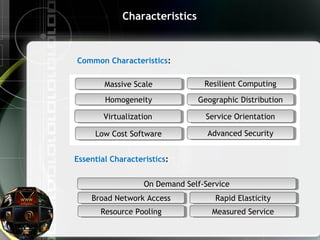
Characteristics
Common Characteristics:
Low Cost SoftwareLow Cost Software
VirtualizationVirtualization Service OrientationService Orientation
Advanced SecurityAdvanced Security
HomogeneityHomogeneity
Massive ScaleMassive Scale Resilient ComputingResilient Computing
Geographic DistributionGeographic Distribution
Essential Characteristics:
Resource PoolingResource Pooling
Broad Network AccessBroad Network Access Rapid ElasticityRapid Elasticity
Measured ServiceMeasured Service
On Demand Self-ServiceOn Demand Self-Service
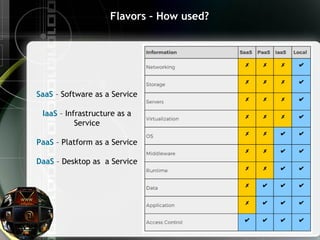
Flavors – How used?
SaaS – Software as a Service
IaaS – Infrastructure as a
Service
PaaS – Platform as a Service
DaaS – Desktop as a Service
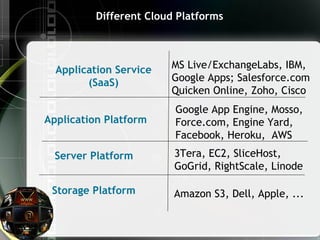
Different Cloud Platforms
Application Service
(SaaS)
Application Platform
Server Platform
Storage Platform Amazon S3, Dell, Apple, ...
3Tera, EC2, SliceHost,
GoGrid, RightScale, Linode
Google App Engine, Mosso,
Force.com, Engine Yard,
Facebook, Heroku, AWS
MS Live/ExchangeLabs, IBM,
Google Apps; Salesforce.com
Quicken Online, Zoho, Cisco
Deployment
Deployment
Public Cloud (off-site and remote) describes cloud
computing where resources are dynamically provisioned
on an on-demand, self-service basis over the Internet,
via web applications/web services, open API, from a
third-party provider who bills on a utility computing
basis.
Deployment
A Private Cloud environment is often the first step for
a corporation prior to adopting a public cloud initiative.
Corporations have discovered the benefits of
consolidating shared services on virtualized hardware
deployed from a primary datacenter to serve local and
remote users.
Deployment
A Hybrid Cloud environment consists of some portion
of computing resources on-site (on premise) and off-site
(public cloud). By integrating public cloud services, users
can leverage cloud solutions for specific functions that
are too costly to maintain on-premise such as virtual
server disaster recovery, backups and test/development
environments.  
Deployment
A Community Cloud is formed when several
organizations with similar requirements share common
infrastructure. Costs are spread over fewer users than a
public cloud but more than a single tenant.
Basic Cloud Characteristics
Cloud is transparent to users and applications, they can
be built in multiple ways such as:
 branded products, proprietary open source,
hardware or software, or just off-the-shelf PCs.
In general, they are built on clusters of PC servers and
off-the-shelf components plus Open Source software
combined with in-house applications and/or system
software.
Cloud and Virtualization
 Run O/S where the physical hardware is unavailable
 Easy to create new machines, backup machines, etc
 Software testing using “clean” installs of operating
systems and software
 Emulate more machines than are physically there
 Timeshare lightly loaded systems on one host
 Debug problems (suspend and resume the problem
machine)
 Run legacy systems!
Cloud Sourcing…Part #1
Why is it becoming a Big Deal:
 Using high-scale/low-cost providers,
 Any time/place access via web browser,
 Rapid scalability; incremental cost and load sharing,
 Can forget need to focus on local IT.
Cloud Sourcing…Part #2
Concerns:
 Performance, reliability, and SLAs,
 Control of data, and service parameters,
 Application features and choices,
 Interaction between Cloud providers,
 No standard API – mix of SOAP and REST!
 Application Program Interface
 Simple Object Access Protocol
 Representational State Transfer
 Privacy, security, compliance, trust…
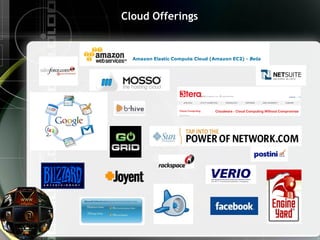
Cloud Offerings
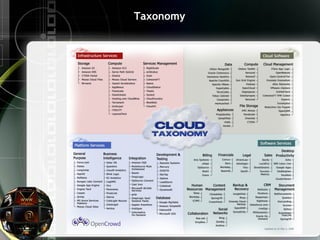
Taxonomy
Cloud Crime?
The definition of computer crime will be extended to
cloud crime, which is basically any crime that involves
cloud computing in the sense that cloud can be the
subject, object, or tool related to the crimes.
The cloud is considered the object when the target of
the crime is the cloud service provider and is directly
affected by the act, such as with Distributed Denial of
Service (DDOS) attacks that target sections of the cloud
or the cloud itself as a whole.
Challenges & Forensics
Challenges – Part 1
In parallel there has been backlash against cloud
computing:
 Use of cloud computing means dependence on others
and that could possibly limit flexibility and
innovation:
The others are likely become the bigger Internet
companies like Google and IBM, who may
monopolise the market.
Some argue that this use of supercomputers is a
return to the time of mainframe computing that
the PC was a reaction against.
Challenges – Part 2
 Security could prove to be a big issue:
It is still unclear how safe out-sourced data is and
when using these services ownership of data is
not always clear.
 There are also issues relating to policy and access:
If your data is stored abroad whose policy do you
adhere to?
What happens if the remote server goes down?
How will you then access files?
There have been cases of users being locked out
of accounts and losing access to data.
Cloud Forensics?
Is it possible?
Cloud forensics is the application of digital forensics in
cloud computing as a subset of network forensics.
Basically, it is a cross-discipline between cloud
computing and digital forensics. As per the official
definition of NIST:
“Digital Forensics is the application of science to the identification,
examination, collection, and analysis of data while preserving the
information and maintaining a strict chain of custody for the data.”
The Three Dimensions of Cloud Forensics
The Technical Dimension
The Organizational Dimension
Chain of Dependencies
The Three Dimensions of Cloud Forensics
The Technical Dimension – the technical dimension
involves a set of tools and procedures needed to carry
out the forensic process in cloud computing
environments. This includes forensic data collection,
elastic/static/live forensics, evidence segregation,
investigations in virtualized environments, and pro-
active preparations.
The Three Dimensions of Cloud Forensics
The Organizational Dimension – when it comes to
forensic investigations in cloud computing
environments, two parties are always involved: the
cloud consumer and the CSP. When the CSP outsources
services to other parties, there is a tendency for the
scope of the investigation to widen. When establishing
the capacity of an organization to investigate cloud
anomalies, each cloud organization need to create a
department, permanent or ad hoc that would be in
charged of internal and external matters.
 CSP – Cloud Service Provider
The Three Dimensions of Cloud Forensics
Chain of Dependencies – CSP and majority of cloud apps
tend to have dependencies on other CSPs. These
dependencies can be highly dynamic, which means
investigation in such a situation will depend on the
investigations of each link in the chain, as well as the
level of complexity of the dependencies. Problems can
arise from interruption or corruption in any of the
numerous links in the chain or even due to lack of
coordination between all the parties involved.
Who needs to be involved?
The chain of Cloud Service Providers, Cloud Customers,
with the chain of dependencies between them taken
into account, has to collaborate and coordinate with
the following parties in order to achieve effective and
efficient forensic activities:
Law Enforcement
Third Parties
Academia
Legal Dimension?
First, the multi-jurisdiction and multi-tenancy
challenges which are considered as top level concerns
among digital forensic experts.
Second, regulations and agreements must be secured in
the legal dimension of cloud forensics in order to
ensure that the investigations will not violate any laws
or regulations in the area where the data is physically
stored.
Legal Dimension?
Third, measures must also be taken to ensure that the
privacy of other individuals or organization sharing the
infrastructure will not be compromised or violated
throughout the forensic activity.
Forth, the Service Level Agreement or SLA, which
defines the terms of use between the cloud customer
and the cloud service provider.
Challenges to Cloud Forensics
The forensic capabilities for cloud organizations in
these three dimensions will be difficult without
hurdling several enormous challenges….
 The legal dimension currently has no agreements among
cloud organizations when it comes to collaborative
investigation
 The majority of SLAs have no terms and conditions
present when it comes to segregation of responsibilities
between the cloud service provider and customer.
Challenges to Cloud Forensics
The forensic capabilities for cloud organizations in
these three dimensions will be difficult without
hurdling several enormous challenges….
 Policies and Cyber laws from different regions must also
do their part in order to resolve conflicts and issues
arising from multi-jurisdiction investigations.
Challenges to Cloud Forensics
The cloud customer tends to encounter issues with
decreased access to forensic data depending on the
cloud model.
For instance, IaaS (Infrastructure as a Service) users
may enjoy straightforward and easy access to all data
required for forensic investigation, but SaaS (Software
as a Service) customers may won’t be able to access
the pertinent data they need.
Challenges to Cloud Forensics
Lack of access to forensic data means that the cloud
customer will be in the dark as to where their data is
physically located, and will only be able to specify the
location of their data at a higher level of abstraction,
typically as a virtual object (“container”).
This is because cloud service providers normally hide
the actual physical location of the data in order to help
data movement and replication.
Challenges to Cloud Forensics
The sheer number of endpoints, particularly mobile
ones, is one of the biggest challenges for data discovery
and evidence collation.
The sheer number of resources connected to the cloud
has a tendency to make the impact of crimes and the
workload of investigation even larger.
Challenges to Cloud Forensics
Time synchronization itself is vital when it comes to the
audit logs used as source of evidence in the
investigations. Accurate time synchronization is one of
the major issues during network forensics.
The biggest problem is the fact that a cloud
environment needs to synchronize timestamps that is
consistent with different devices located over many
different time zones, between equipment, and remote
web clients that include numerous end points.
Challenges to Cloud Forensics
The consolidation of log formats is a traditional issue in
network forensics which is made worse by the scale
issues inherent in the cloud. This makes it even more
difficult to consolidate the log formats or make them
cross-compatible with each other due to the massive
resources present in the cloud.
Some providers intentionally create proprietary log
formats, which introduce major roadblocks in joint
investigations.
Challenges to Cloud Forensics
Similar to other technical forensics, removed data in
the cloud is considered as a vital piece of evidence.
For instance, Amazon’s AWS gives the right to change
the original snapshot only to the AWS account that
created the volume. Once the AWS account owner
deletes data within the domain, the removal of the
mapping starts immediately and is completed within
seconds.
Challenges to Cloud Forensics
After that, there is no longer any way to access the
deleted data remotely, and the storage space once
occupied by said data is made available for future write
operations, and it is very likely that the storage space
will be overwritten by newly stored data. While some
deleted data may still be recoverable from the
snapshot even after deletion, the challenge is in
recovering them, identifying the ownership, and using
the information as a means of plotting out what
happened in the cloud.
FaaS – Forensics as a Service?
Time synchronization itself is vital when it comes to the
audit logs used as source of evidence in the
investigations. Accurate time synchronization is one of
the major issues during network forensics.
The biggest problem is the fact that a cloud
environment needs to synchronize timestamps that is
consistent with different devices located over many
different time zones, between equipment, and remote
web clients that include numerous end points.
Our Example: ownCloud
ownCloud
ownCloud is free and open source software that
operates as a very simple way to set up your own
syncing, Dropbox-like cloud storage system on your own
server or web site. It's also quick and easy to set up,
and doesn't require advanced technical knowledge.
OwnCloud is about as powerful as Dropbox, but it also
allows people to make and share their own apps that
run on ownCloud including text editors, task lists, and
more. That means you can get a little more out of it
then just file syncing if you want.
ownCloud
OwnCloud
LifeHacker
SuSE Studio
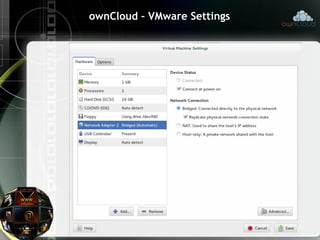
ownCloud – VMware Settings
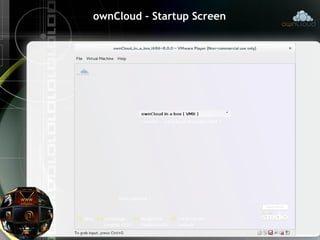
ownCloud – Startup Screen
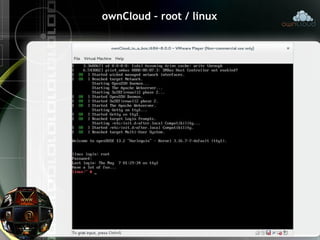
ownCloud – root / linux
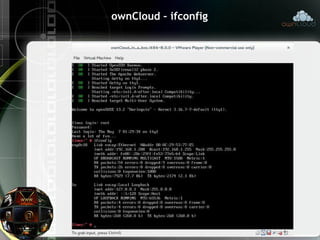
ownCloud – ifconfig
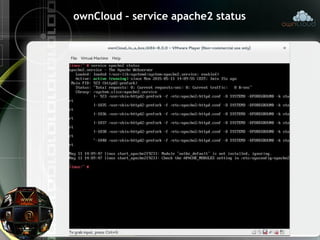
ownCloud – service apache2 status
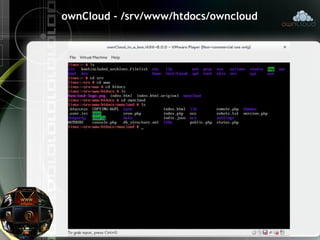
ownCloud - /srv/www/htdocs/owncloud
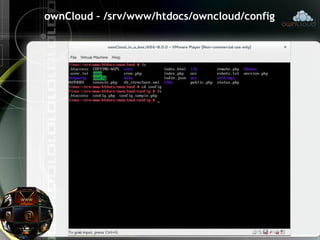
ownCloud – /srv/www/htdocs/owncloud/config
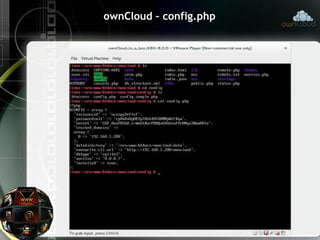
ownCloud – config.php
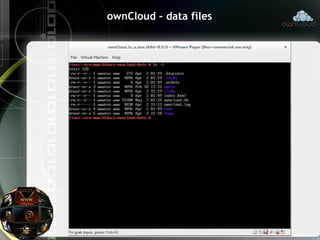
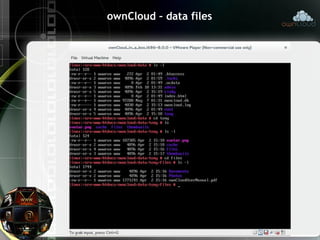
ownCloud – data files
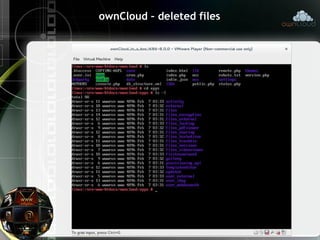
ownCloud – deleted files
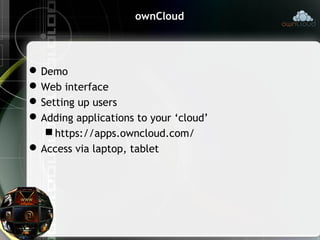
ownCloud
Demo
Web interface
Setting up users
Adding applications to your ‘cloud’
 https://apps.owncloud.com/
Access via laptop, tablet
Welcome Back…
ownCloud – restore data using TestDisk
Take a look at  TestDisk
From  http://cgsecurity.org
TestDisk
TestDisk is powerful free data recovery software! It was
primarily designed to help recover lost partitions
and/or make non-booting disks bootable again when
these symptoms are caused by faulty software: certain
types of viruses or human error (such as accidentally
deleting a Partition Table). Partition table recovery
using TestDisk is really easy.
TestDisk
TestDisk can…
 Fix partition table, recover deleted partition
 Recover FAT32 boot sector from its backup
 Rebuild FAT12/FAT16/FAT32 boot sector
 Fix FAT tables
 Rebuild NTFS boot sector
 Recover NTFS boot sector from its backup
 Fix MFT using MFT mirror
 Locate ext2/ext3/ext4 Backup SuperBlock
TestDisk
TestDisk can also…
 Undelete files from FAT, exFAT, NTFS and ext2
filesystem
 Copy files from deleted FAT, exFAT, NTFS and
ext2/ext3/ext4 partitions.
TestDisk
TestDisk has features for both novices and experts. For
those who know little or nothing about data recovery
techniques, TestDisk can be used to collect detailed
information about a non-booting drive which can then
be sent to a tech for further analysis. Those more
familiar with such procedures should find TestDisk a
handy tool in performing onsite recovery.
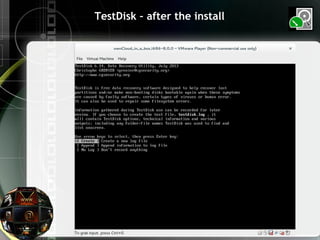
TestDisk – after the install
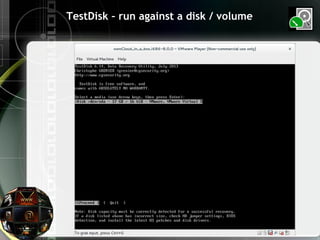
TestDisk – run against a disk / volume
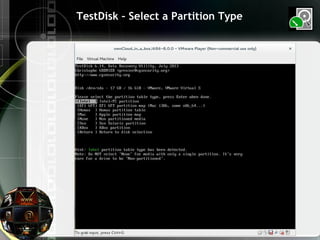
TestDisk – Select a Partition Type
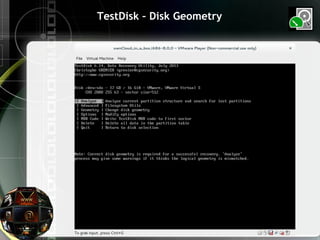
TestDisk – Disk Geometry
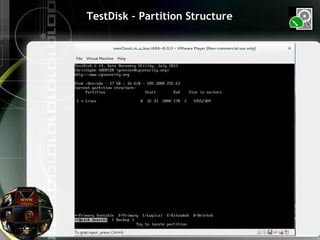
TestDisk – Partition Structure
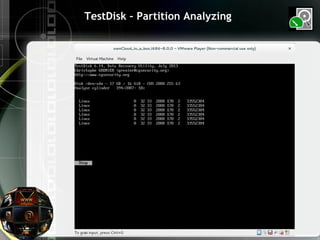
TestDisk – Partition Analyzing
Presentation on Cloud Computing
Contact Info
TonyGodfrey@FalconerTechnologies.com
(216) 282-4TUX / (216) 282-4889
htcia-5-2015

htcia-5-2015

  • 1.
    Presentation on CloudComputing Ohio HTCIA 2015 Spring Conference Salt Fork Lodge
  • 2.
    Welcome to SaltFork Lodge
  • 3.
    Hello & Welcome TonyGodfrey is the CEO / Linux Consultant of Falconer Technologies (est 2003) specializing in Linux. He has written several articles on the body of knowledge of security administration, is a regular contributor to a variety of Linux publications, and has written technical content for Linux education nation- wide at the college level. He also teaches topics covering Linux, Network Security, Cisco routers, Cybercrime and System Forensics.
  • 4.
    What is CloudComputing?
  • 5.
    Definition Cloud Computing isa general term used to describe a new class of network based computing that takes place over the Internet… basically a step on from Utility Computing a collection/group of integrated and networked hardware, software and Internet infrastructure (called a platform). Using the Internet for communication and transport provides hardware, software and networking services to clients
  • 6.
    Utility Computing? Utility Computingis a service provisioning model in which a service provider makes computing resources and infrastructure management available to the customer as needed, and charges them for specific usage rather than a flat rate.
  • 7.
    Continued… In addition, theplatform provides on demand services, that are always on, anywhere, anytime and any place. Pay for use and as needed (elastic)  scale up and down in capacity and functionalities The hardware and software services are available to  general public, enterprises, corporations and businesses markets
  • 8.
    Cloud computing isan umbrella term for… A number of characteristics define cloud data, applications services and infrastructure:  Remotely hosted: Services or data are hosted on remote infrastructure.  Ubiquitous: Services or data are available from anywhere.  Commodified: The result is a utility computing model similar to traditional that of traditional utilities, like gas and electricity.
  • 9.
    Characteristics Common Characteristics: Low CostSoftwareLow Cost Software VirtualizationVirtualization Service OrientationService Orientation Advanced SecurityAdvanced Security HomogeneityHomogeneity Massive ScaleMassive Scale Resilient ComputingResilient Computing Geographic DistributionGeographic Distribution Essential Characteristics: Resource PoolingResource Pooling Broad Network AccessBroad Network Access Rapid ElasticityRapid Elasticity Measured ServiceMeasured Service On Demand Self-ServiceOn Demand Self-Service
  • 10.
    Flavors – Howused? SaaS – Software as a Service IaaS – Infrastructure as a Service PaaS – Platform as a Service DaaS – Desktop as a Service
  • 11.
    Different Cloud Platforms ApplicationService (SaaS) Application Platform Server Platform Storage Platform Amazon S3, Dell, Apple, ... 3Tera, EC2, SliceHost, GoGrid, RightScale, Linode Google App Engine, Mosso, Force.com, Engine Yard, Facebook, Heroku, AWS MS Live/ExchangeLabs, IBM, Google Apps; Salesforce.com Quicken Online, Zoho, Cisco
  • 12.
  • 13.
    Deployment Public Cloud (off-siteand remote) describes cloud computing where resources are dynamically provisioned on an on-demand, self-service basis over the Internet, via web applications/web services, open API, from a third-party provider who bills on a utility computing basis.
  • 14.
    Deployment A Private Cloudenvironment is often the first step for a corporation prior to adopting a public cloud initiative. Corporations have discovered the benefits of consolidating shared services on virtualized hardware deployed from a primary datacenter to serve local and remote users.
  • 15.
    Deployment A Hybrid Cloudenvironment consists of some portion of computing resources on-site (on premise) and off-site (public cloud). By integrating public cloud services, users can leverage cloud solutions for specific functions that are too costly to maintain on-premise such as virtual server disaster recovery, backups and test/development environments.  
  • 16.
    Deployment A Community Cloudis formed when several organizations with similar requirements share common infrastructure. Costs are spread over fewer users than a public cloud but more than a single tenant.
  • 17.
    Basic Cloud Characteristics Cloudis transparent to users and applications, they can be built in multiple ways such as:  branded products, proprietary open source, hardware or software, or just off-the-shelf PCs. In general, they are built on clusters of PC servers and off-the-shelf components plus Open Source software combined with in-house applications and/or system software.
  • 18.
    Cloud and Virtualization Run O/S where the physical hardware is unavailable  Easy to create new machines, backup machines, etc  Software testing using “clean” installs of operating systems and software  Emulate more machines than are physically there  Timeshare lightly loaded systems on one host  Debug problems (suspend and resume the problem machine)  Run legacy systems!
  • 19.
    Cloud Sourcing…Part #1 Whyis it becoming a Big Deal:  Using high-scale/low-cost providers,  Any time/place access via web browser,  Rapid scalability; incremental cost and load sharing,  Can forget need to focus on local IT.
  • 20.
    Cloud Sourcing…Part #2 Concerns: Performance, reliability, and SLAs,  Control of data, and service parameters,  Application features and choices,  Interaction between Cloud providers,  No standard API – mix of SOAP and REST!  Application Program Interface  Simple Object Access Protocol  Representational State Transfer  Privacy, security, compliance, trust…
  • 21.
  • 22.
  • 23.
    Cloud Crime? The definitionof computer crime will be extended to cloud crime, which is basically any crime that involves cloud computing in the sense that cloud can be the subject, object, or tool related to the crimes. The cloud is considered the object when the target of the crime is the cloud service provider and is directly affected by the act, such as with Distributed Denial of Service (DDOS) attacks that target sections of the cloud or the cloud itself as a whole.
  • 24.
  • 25.
    Challenges – Part1 In parallel there has been backlash against cloud computing:  Use of cloud computing means dependence on others and that could possibly limit flexibility and innovation: The others are likely become the bigger Internet companies like Google and IBM, who may monopolise the market. Some argue that this use of supercomputers is a return to the time of mainframe computing that the PC was a reaction against.
  • 26.
    Challenges – Part2  Security could prove to be a big issue: It is still unclear how safe out-sourced data is and when using these services ownership of data is not always clear.  There are also issues relating to policy and access: If your data is stored abroad whose policy do you adhere to? What happens if the remote server goes down? How will you then access files? There have been cases of users being locked out of accounts and losing access to data.
  • 27.
    Cloud Forensics? Is itpossible? Cloud forensics is the application of digital forensics in cloud computing as a subset of network forensics. Basically, it is a cross-discipline between cloud computing and digital forensics. As per the official definition of NIST: “Digital Forensics is the application of science to the identification, examination, collection, and analysis of data while preserving the information and maintaining a strict chain of custody for the data.”
  • 28.
    The Three Dimensionsof Cloud Forensics The Technical Dimension The Organizational Dimension Chain of Dependencies
  • 29.
    The Three Dimensionsof Cloud Forensics The Technical Dimension – the technical dimension involves a set of tools and procedures needed to carry out the forensic process in cloud computing environments. This includes forensic data collection, elastic/static/live forensics, evidence segregation, investigations in virtualized environments, and pro- active preparations.
  • 30.
    The Three Dimensionsof Cloud Forensics The Organizational Dimension – when it comes to forensic investigations in cloud computing environments, two parties are always involved: the cloud consumer and the CSP. When the CSP outsources services to other parties, there is a tendency for the scope of the investigation to widen. When establishing the capacity of an organization to investigate cloud anomalies, each cloud organization need to create a department, permanent or ad hoc that would be in charged of internal and external matters.  CSP – Cloud Service Provider
  • 31.
    The Three Dimensionsof Cloud Forensics Chain of Dependencies – CSP and majority of cloud apps tend to have dependencies on other CSPs. These dependencies can be highly dynamic, which means investigation in such a situation will depend on the investigations of each link in the chain, as well as the level of complexity of the dependencies. Problems can arise from interruption or corruption in any of the numerous links in the chain or even due to lack of coordination between all the parties involved.
  • 32.
    Who needs tobe involved? The chain of Cloud Service Providers, Cloud Customers, with the chain of dependencies between them taken into account, has to collaborate and coordinate with the following parties in order to achieve effective and efficient forensic activities: Law Enforcement Third Parties Academia
  • 33.
    Legal Dimension? First, themulti-jurisdiction and multi-tenancy challenges which are considered as top level concerns among digital forensic experts. Second, regulations and agreements must be secured in the legal dimension of cloud forensics in order to ensure that the investigations will not violate any laws or regulations in the area where the data is physically stored.
  • 34.
    Legal Dimension? Third, measuresmust also be taken to ensure that the privacy of other individuals or organization sharing the infrastructure will not be compromised or violated throughout the forensic activity. Forth, the Service Level Agreement or SLA, which defines the terms of use between the cloud customer and the cloud service provider.
  • 35.
    Challenges to CloudForensics The forensic capabilities for cloud organizations in these three dimensions will be difficult without hurdling several enormous challenges….  The legal dimension currently has no agreements among cloud organizations when it comes to collaborative investigation  The majority of SLAs have no terms and conditions present when it comes to segregation of responsibilities between the cloud service provider and customer.
  • 36.
    Challenges to CloudForensics The forensic capabilities for cloud organizations in these three dimensions will be difficult without hurdling several enormous challenges….  Policies and Cyber laws from different regions must also do their part in order to resolve conflicts and issues arising from multi-jurisdiction investigations.
  • 37.
    Challenges to CloudForensics The cloud customer tends to encounter issues with decreased access to forensic data depending on the cloud model. For instance, IaaS (Infrastructure as a Service) users may enjoy straightforward and easy access to all data required for forensic investigation, but SaaS (Software as a Service) customers may won’t be able to access the pertinent data they need.
  • 38.
    Challenges to CloudForensics Lack of access to forensic data means that the cloud customer will be in the dark as to where their data is physically located, and will only be able to specify the location of their data at a higher level of abstraction, typically as a virtual object (“container”). This is because cloud service providers normally hide the actual physical location of the data in order to help data movement and replication.
  • 39.
    Challenges to CloudForensics The sheer number of endpoints, particularly mobile ones, is one of the biggest challenges for data discovery and evidence collation. The sheer number of resources connected to the cloud has a tendency to make the impact of crimes and the workload of investigation even larger.
  • 40.
    Challenges to CloudForensics Time synchronization itself is vital when it comes to the audit logs used as source of evidence in the investigations. Accurate time synchronization is one of the major issues during network forensics. The biggest problem is the fact that a cloud environment needs to synchronize timestamps that is consistent with different devices located over many different time zones, between equipment, and remote web clients that include numerous end points.
  • 41.
    Challenges to CloudForensics The consolidation of log formats is a traditional issue in network forensics which is made worse by the scale issues inherent in the cloud. This makes it even more difficult to consolidate the log formats or make them cross-compatible with each other due to the massive resources present in the cloud. Some providers intentionally create proprietary log formats, which introduce major roadblocks in joint investigations.
  • 42.
    Challenges to CloudForensics Similar to other technical forensics, removed data in the cloud is considered as a vital piece of evidence. For instance, Amazon’s AWS gives the right to change the original snapshot only to the AWS account that created the volume. Once the AWS account owner deletes data within the domain, the removal of the mapping starts immediately and is completed within seconds.
  • 43.
    Challenges to CloudForensics After that, there is no longer any way to access the deleted data remotely, and the storage space once occupied by said data is made available for future write operations, and it is very likely that the storage space will be overwritten by newly stored data. While some deleted data may still be recoverable from the snapshot even after deletion, the challenge is in recovering them, identifying the ownership, and using the information as a means of plotting out what happened in the cloud.
  • 44.
    FaaS – Forensicsas a Service? Time synchronization itself is vital when it comes to the audit logs used as source of evidence in the investigations. Accurate time synchronization is one of the major issues during network forensics. The biggest problem is the fact that a cloud environment needs to synchronize timestamps that is consistent with different devices located over many different time zones, between equipment, and remote web clients that include numerous end points.
  • 45.
  • 46.
    ownCloud ownCloud is freeand open source software that operates as a very simple way to set up your own syncing, Dropbox-like cloud storage system on your own server or web site. It's also quick and easy to set up, and doesn't require advanced technical knowledge. OwnCloud is about as powerful as Dropbox, but it also allows people to make and share their own apps that run on ownCloud including text editors, task lists, and more. That means you can get a little more out of it then just file syncing if you want.
  • 47.
  • 48.
  • 49.
  • 50.
  • 51.
  • 52.
    ownCloud – serviceapache2 status
  • 53.
  • 54.
  • 55.
  • 56.
  • 57.
  • 58.
  • 59.
    ownCloud Demo Web interface Setting upusers Adding applications to your ‘cloud’  https://apps.owncloud.com/ Access via laptop, tablet
  • 60.
  • 61.
    ownCloud – restoredata using TestDisk Take a look at  TestDisk From  http://cgsecurity.org
  • 62.
    TestDisk TestDisk is powerfulfree data recovery software! It was primarily designed to help recover lost partitions and/or make non-booting disks bootable again when these symptoms are caused by faulty software: certain types of viruses or human error (such as accidentally deleting a Partition Table). Partition table recovery using TestDisk is really easy.
  • 63.
    TestDisk TestDisk can…  Fixpartition table, recover deleted partition  Recover FAT32 boot sector from its backup  Rebuild FAT12/FAT16/FAT32 boot sector  Fix FAT tables  Rebuild NTFS boot sector  Recover NTFS boot sector from its backup  Fix MFT using MFT mirror  Locate ext2/ext3/ext4 Backup SuperBlock
  • 64.
    TestDisk TestDisk can also… Undelete files from FAT, exFAT, NTFS and ext2 filesystem  Copy files from deleted FAT, exFAT, NTFS and ext2/ext3/ext4 partitions.
  • 65.
    TestDisk TestDisk has featuresfor both novices and experts. For those who know little or nothing about data recovery techniques, TestDisk can be used to collect detailed information about a non-booting drive which can then be sent to a tech for further analysis. Those more familiar with such procedures should find TestDisk a handy tool in performing onsite recovery.
  • 66.
    TestDisk – afterthe install
  • 67.
    TestDisk – runagainst a disk / volume
  • 68.
    TestDisk – Selecta Partition Type
  • 69.
  • 70.
  • 71.
  • 72.
  • 73.

Editor's Notes

  • #7 Ref: http://searchdatacenter.techtarget.com/definition/utility-computing
  • #11 http://resources.infosecinstitute.com/overview-cloud-forensics/
  • #24 http://cloudtimes.org/2012/11/05/the-basics-of-cloud-forensics/
  • #28 http://resources.infosecinstitute.com/overview-cloud-forensics/
  • #29 http://cloudtimes.org/2012/11/05/the-basics-of-cloud-forensics/
  • #30 http://cloudtimes.org/2012/11/05/the-basics-of-cloud-forensics/
  • #31 http://cloudtimes.org/2012/11/05/the-basics-of-cloud-forensics/
  • #32 http://cloudtimes.org/2012/11/05/the-basics-of-cloud-forensics/
  • #33 http://cloudtimes.org/2012/11/05/the-basics-of-cloud-forensics/
  • #34 http://cloudtimes.org/2012/11/05/the-basics-of-cloud-forensics/
  • #35 http://cloudtimes.org/2012/11/05/the-basics-of-cloud-forensics/
  • #36 http://cloudtimes.org/2012/11/05/the-basics-of-cloud-forensics/
  • #37 http://cloudtimes.org/2012/11/05/the-basics-of-cloud-forensics/
  • #38 http://cloudtimes.org/2012/11/05/the-basics-of-cloud-forensics/
  • #39 http://cloudtimes.org/2012/11/05/the-basics-of-cloud-forensics/
  • #40 http://cloudtimes.org/2012/11/05/the-basics-of-cloud-forensics/
  • #41 http://cloudtimes.org/2012/11/05/the-basics-of-cloud-forensics/
  • #42 http://cloudtimes.org/2012/11/05/the-basics-of-cloud-forensics/
  • #43 http://cloudtimes.org/2012/11/05/the-basics-of-cloud-forensics/
  • #44 http://cloudtimes.org/2012/11/05/the-basics-of-cloud-forensics/
  • #45 http://cloudtimes.org/2012/11/05/the-basics-of-cloud-forensics/
  • #48 https://owncloud.org/ http://lifehacker.com/5993596/how-to-set-up-your-own-private-cloud-storage-service-in-five-minutes-with-owncloud https://susestudio.com/a/TadMax/owncloud-in-a-box