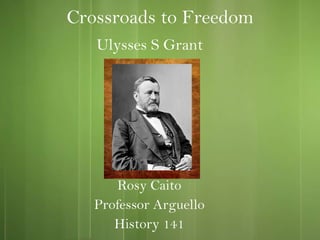
Crossroads to Freedom Rosy Caito Professor Arguello History 141 Ulysses S Grant
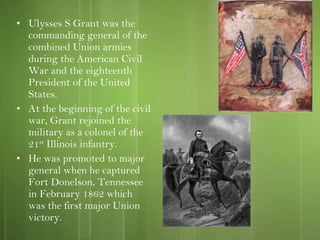
Ulysses S Grant was the commanding general of the combined Union armies during the American Civil War and the eighteenth President of the United States. At the beginning of the civil war, Grant rejoined the military as a colonel of the 21 st  Illinois infantry. He was promoted to major general when he captured Fort Donelson, Tennessee in February 1862 which was the first major Union victory.
Ulysses S Grant’s Achievements Grant earned a reputation as an aggressive general because he seized control of most of Kentucky and Tennessee at the Battle of Shiloh. In 1863, Grant also defeated five Confederate armies and seized Vicksburg. The Vicksburg campaign was one of Grant’s greatest achievements because it brought Union control of the Mississippi River, split the Confederacy, and opened the way for more Union victories and conquests. In 1863, President Abraham Lincoln promoted Grant to lieutenant general. As Commanding General, he confronted Robert E Lee in a series of battles until Lee surrendered at Appomattox in April 1865
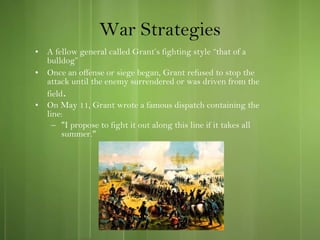
War Strategies A fellow general called Grant’s fighting style “that of a bulldog”  Once an offense or siege began, Grant refused to stop the attack until the enemy surrendered or was driven from the field . On May 11, Grant wrote a famous dispatch containing the line: "I propose to fight it out along this line if it takes all summer."
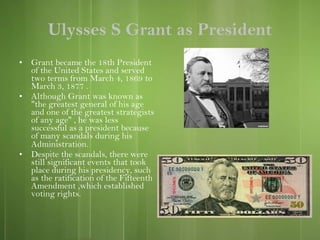
Ulysses S Grant as President Grant became the 18th President of the United States and served two terms from March 4, 1869 to March 3, 1877 . Although Grant was known as "the greatest general of his age and one of the greatest strategists of any age" , he was less successful as a president because of many scandals during his Administration.   Despite the scandals, there were still significant events that took place during his presidency, such as the ratification of the Fifteenth Amendment ,which established voting rights.
Sources http://en.wikipedia.org/wiki/Ulysses_S._Grant http://www.newworldencyclopedia.org/entry/Ulysses_S._Grant http://www.biography.com/articles/Ulysses-S-Grant-9318285?part=1

Ulysses s grant

  • 1.
    Crossroads to FreedomRosy Caito Professor Arguello History 141 Ulysses S Grant
  • 2.
    Ulysses S Grantwas the commanding general of the combined Union armies during the American Civil War and the eighteenth President of the United States. At the beginning of the civil war, Grant rejoined the military as a colonel of the 21 st Illinois infantry. He was promoted to major general when he captured Fort Donelson, Tennessee in February 1862 which was the first major Union victory.
  • 3.
    Ulysses S Grant’sAchievements Grant earned a reputation as an aggressive general because he seized control of most of Kentucky and Tennessee at the Battle of Shiloh. In 1863, Grant also defeated five Confederate armies and seized Vicksburg. The Vicksburg campaign was one of Grant’s greatest achievements because it brought Union control of the Mississippi River, split the Confederacy, and opened the way for more Union victories and conquests. In 1863, President Abraham Lincoln promoted Grant to lieutenant general. As Commanding General, he confronted Robert E Lee in a series of battles until Lee surrendered at Appomattox in April 1865
  • 4.
    War Strategies Afellow general called Grant’s fighting style “that of a bulldog” Once an offense or siege began, Grant refused to stop the attack until the enemy surrendered or was driven from the field . On May 11, Grant wrote a famous dispatch containing the line: "I propose to fight it out along this line if it takes all summer."
  • 5.
    Ulysses S Grantas President Grant became the 18th President of the United States and served two terms from March 4, 1869 to March 3, 1877 . Although Grant was known as "the greatest general of his age and one of the greatest strategists of any age" , he was less successful as a president because of many scandals during his Administration. Despite the scandals, there were still significant events that took place during his presidency, such as the ratification of the Fifteenth Amendment ,which established voting rights.
  • 6.