Objectives:
In this lesson; you are expected to:
1. define a circle and its parts;
2. cooperate in the class discussion; and
3. apply the definition to solve problems.
Motivation
 Draw a point somewhere in the middle of a
sheet of paper.
 Using a ruler, mark 20 other points with 5cm
from the center point.
 Then connect all the points.
What do you see in the illustration
that you draw?
What shape do you recognize?
Illustration 1
.
Circle
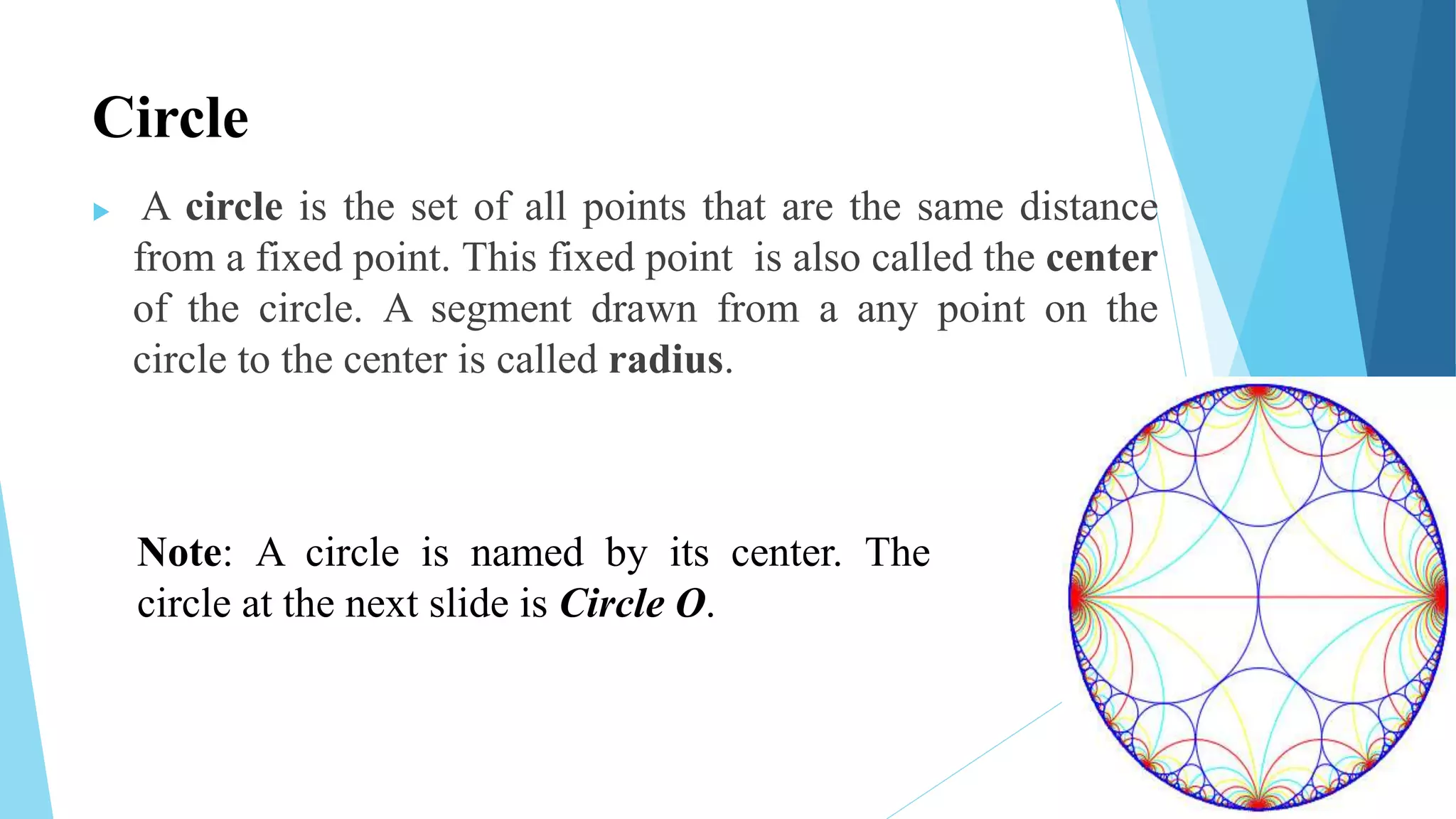
 A circle is the set of all points that are the same distance
from a fixed point. This fixed point is also called the center
of the circle. A segment drawn from a any point on the
circle to the center is called radius.
Note: A circle is named by its center. The
circle at the next slide is Circle O.
.
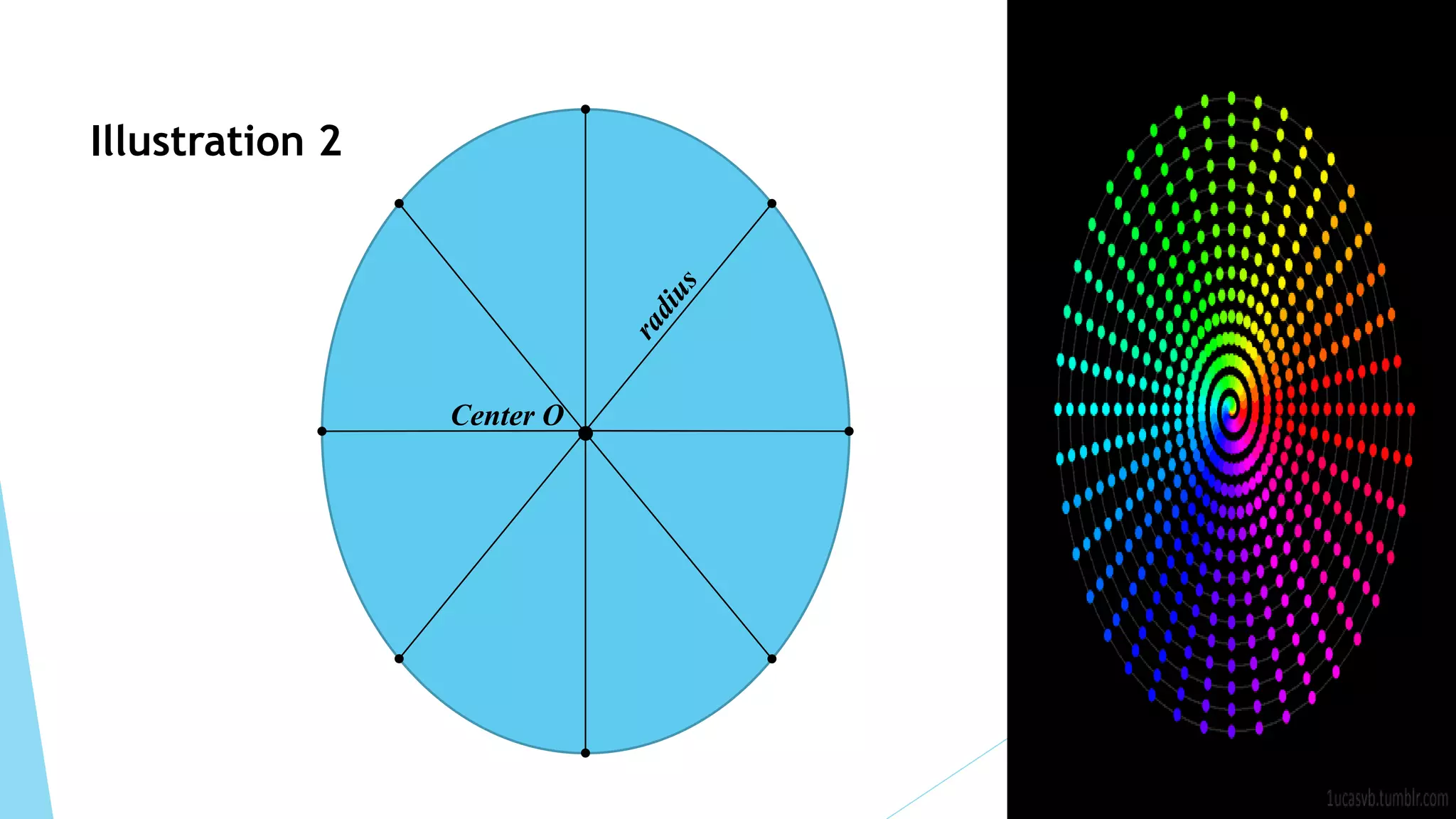
Illustration 2
Center O
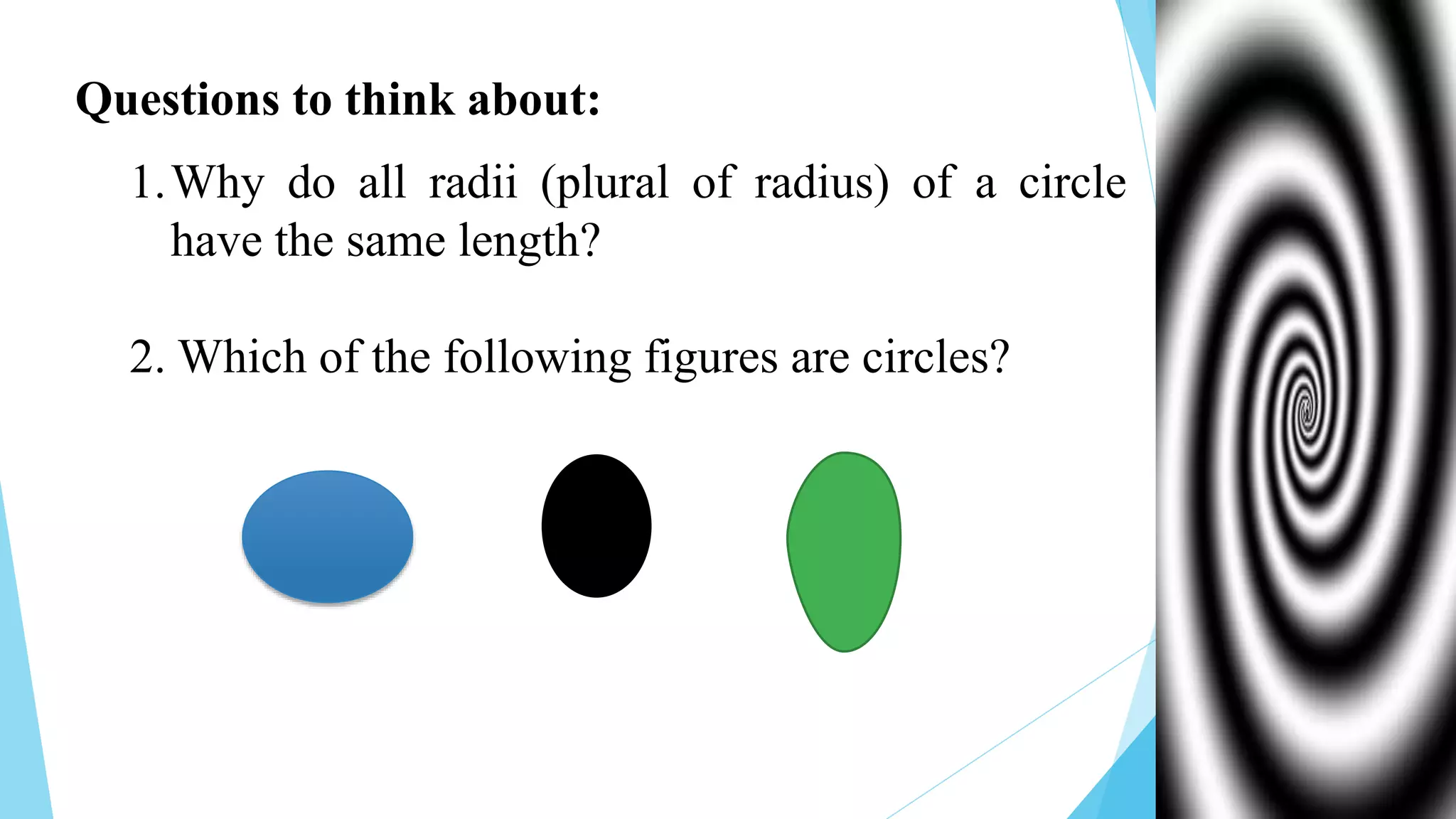
Questions to think about:
1.Why do all radii (plural of radius) of a circle
have the same length?
2. Which of the following figures are circles?
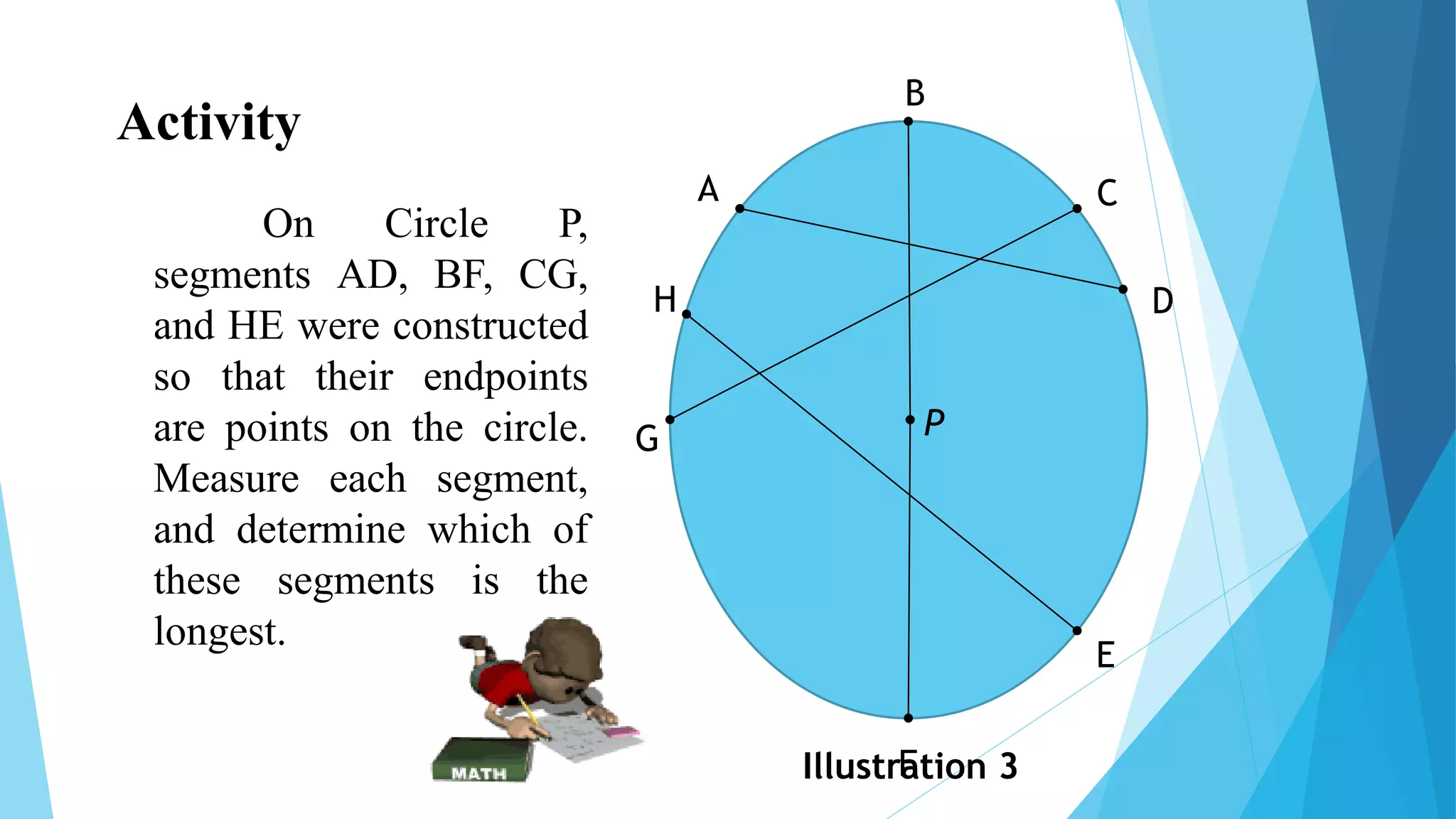
Activity
On Circle P,
segments AD, BF, CG,
and HE were constructed
so that their endpoints
are points on the circle.
Measure each segment,
and determine which of
these segments is the
longest.
Illustration 3
A C
B
G
H
E
D
F
P
Terms Related to Circle
 A chord is a segment that connects any two points of
a circle.
 A diameter is a chord that passes through the center
of a circle. It is the longest chord of a circle and it is
twice the length of a circle radius.
 A central angle is an angle whose vertex is on the
circle’s center, ad whose sides intersect the circle at
two points.
 An Arc is a portion od a circle determined by a
central angle.
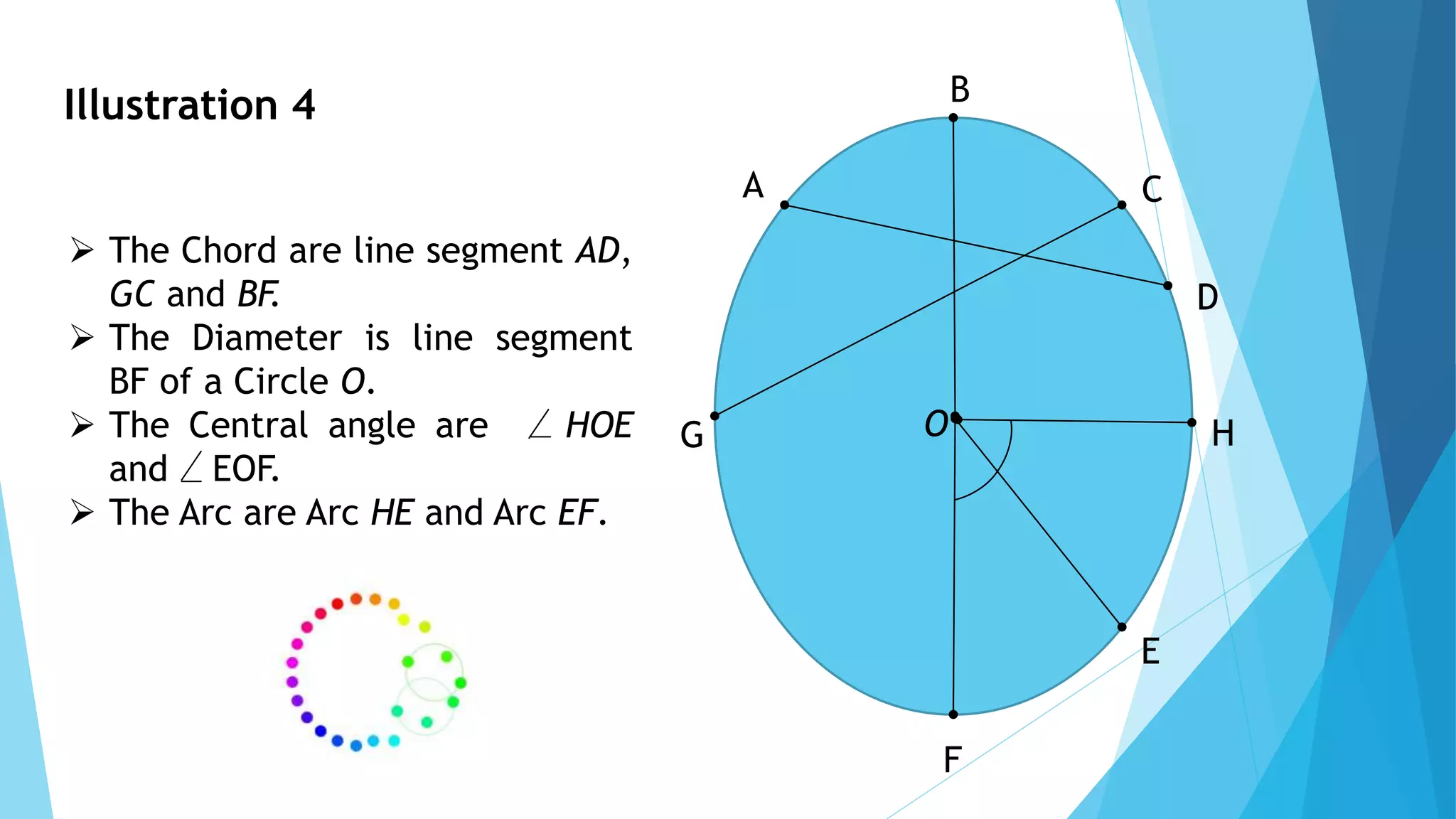
Illustration 4
A C
B
G H
E
D
F
O
 The Chord are line segment AD,
GC and BF.
 The Diameter is line segment
BF of a Circle O.
 The Central angle are HOE
and EOF.
 The Arc are Arc HE and Arc EF.
Activity
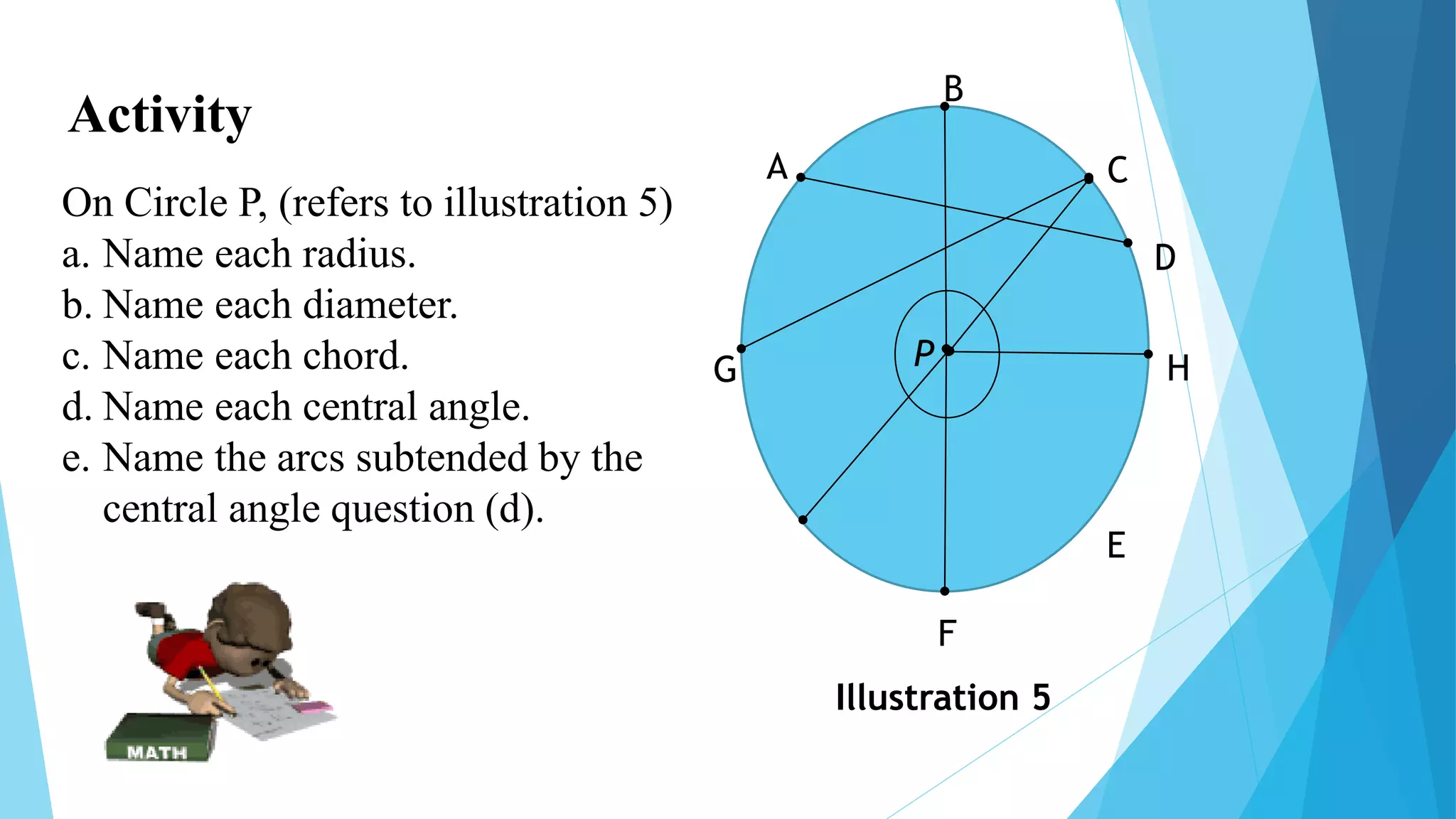
On Circle P, (refers to illustration 5)
a. Name each radius.
b. Name each diameter.
c. Name each chord.
d. Name each central angle.
e. Name the arcs subtended by the
central angle question (d).
Illustration 5
A C
B
G H
E
D
F
P
Evaluation
Determine whether each statement is true or false.
Write T if the is true and F if false.
1. Two radii always have the same length.
2. Two chords always have the same length.
3. All chord are diameters.
4. All diameter are chords.
5. All chords intersect at one point.
6. A radius is not a chord.
7. All diameters intersect at one point.
8. All central angle have the same arc.
9. An arc can drawn based on its central angle.
10. All arc have the same length.
ASSIGNMENT
Using compass, draw a circle whose radius is 5cm.
Then draw the following objects. Write “impossible” if the
object cannot be drawn.
1. One chord measuring 2cm.
2. One chord measuring 10cm.
3. One chord measuring 12cm.
4. Three radii measuring 5cm.
5. One central angle measuring 135°.
6. One central angle measuring 90°.
7. One arc subtended by an angle that measures 35°.
8. Three adjacent central angles, each measures 100°.
THANK YOU FOR LISTENING !!! 
Prepared by: Alrieson C. Tigao

The circle

  • 2.
    Objectives: In this lesson;you are expected to: 1. define a circle and its parts; 2. cooperate in the class discussion; and 3. apply the definition to solve problems.
  • 3.
    Motivation  Draw apoint somewhere in the middle of a sheet of paper.  Using a ruler, mark 20 other points with 5cm from the center point.  Then connect all the points. What do you see in the illustration that you draw? What shape do you recognize?
  • 4.
  • 5.
    Circle  A circleis the set of all points that are the same distance from a fixed point. This fixed point is also called the center of the circle. A segment drawn from a any point on the circle to the center is called radius. Note: A circle is named by its center. The circle at the next slide is Circle O.
  • 6.
  • 7.
    Questions to thinkabout: 1.Why do all radii (plural of radius) of a circle have the same length? 2. Which of the following figures are circles?
  • 8.
    Activity On Circle P, segmentsAD, BF, CG, and HE were constructed so that their endpoints are points on the circle. Measure each segment, and determine which of these segments is the longest. Illustration 3 A C B G H E D F P
  • 9.
    Terms Related toCircle  A chord is a segment that connects any two points of a circle.  A diameter is a chord that passes through the center of a circle. It is the longest chord of a circle and it is twice the length of a circle radius.  A central angle is an angle whose vertex is on the circle’s center, ad whose sides intersect the circle at two points.  An Arc is a portion od a circle determined by a central angle.
  • 10.
    Illustration 4 A C B GH E D F O  The Chord are line segment AD, GC and BF.  The Diameter is line segment BF of a Circle O.  The Central angle are HOE and EOF.  The Arc are Arc HE and Arc EF.
  • 11.
    Activity On Circle P,(refers to illustration 5) a. Name each radius. b. Name each diameter. c. Name each chord. d. Name each central angle. e. Name the arcs subtended by the central angle question (d). Illustration 5 A C B G H E D F P
  • 12.
    Evaluation Determine whether eachstatement is true or false. Write T if the is true and F if false. 1. Two radii always have the same length. 2. Two chords always have the same length. 3. All chord are diameters. 4. All diameter are chords. 5. All chords intersect at one point. 6. A radius is not a chord. 7. All diameters intersect at one point. 8. All central angle have the same arc. 9. An arc can drawn based on its central angle. 10. All arc have the same length.
  • 13.
    ASSIGNMENT Using compass, drawa circle whose radius is 5cm. Then draw the following objects. Write “impossible” if the object cannot be drawn. 1. One chord measuring 2cm. 2. One chord measuring 10cm. 3. One chord measuring 12cm. 4. Three radii measuring 5cm. 5. One central angle measuring 135°. 6. One central angle measuring 90°. 7. One arc subtended by an angle that measures 35°. 8. Three adjacent central angles, each measures 100°.
  • 14.
    THANK YOU FORLISTENING !!!  Prepared by: Alrieson C. Tigao