Dr Simon Du
ff
y of the Centre for Welfare Reform | 6 July 2021
The Case for Basic Income
Talking to Church Action on Poverty She
ffi
eld about UBI
UBILAB
Sheffield
Making the case
Why UBI is going to stay on the political agenda
1. What is Universal Basic Income (UBI)?

2. UBI vs ‘Universal’ ‘Credit’

3. Why UBI is affordable

4. Why UBI doesn’t make people lazy

5. Other benefits of UBI

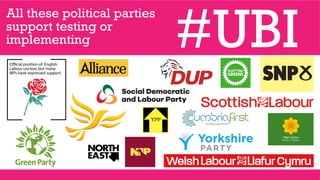
6. Growing political support for UBI

7. UBI and the Church
1. What is Universal Basic Income (UBI)?
A (fairly) standard de
fi
nition
1. As a community we ensure that everybody gets enough money to live on

2. So, we give every single individual enough money to live on (su
ffi
cient)

3. Universal means you get it even if you’re in a family (no dependency)

4. Universal means you get it whatever your lifestyle (no conditionality)

5. Universal means you get it whatever your income (no means-testing)

6. We pay for it by paying taxes on our income (et al.)

7. We give people with higher needs extra income (UBI+)
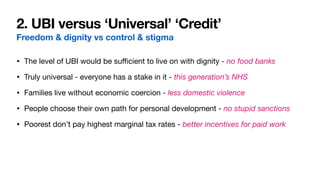
2. UBI versus ‘Universal’ ‘Credit’
Freedom & dignity vs control & stigma
• The level of UBI would be su
ffi
cient to live on with dignity - no food banks

• Truly universal - everyone has a stake in it - this generation’s NHS

• Families live without economic coercion - less domestic violence

• People choose their own path for personal development - no stupid sanctions

• Poorest don’t pay highest marginal tax rates - better incentives for paid work
3. Why UBI is affordable
The redistributional logic of UBI
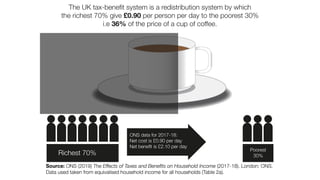
• If we pay for UBI though income tax then UBI redistributes resources from people
above the mean income to people below the mean income. In the UK that means
taking money away from the richest 15% and redistributing it to the poorest 85%.

• In fact it is equivalent to all of us receiving a fair share of the nation’s GDP, by all paying
into the pot a fair share of our income in taxes. Currently the mean per capita income
is (at least) £29,600, and 25% of that is £7,400 (although the full picture is more
complex if we adjust for age and ability).

• This is NOT government spending and it doesn’t stop us paying for public services.

• Equality is generally good for the health of the economy.

• It is a
ff
ordable if we choose it - and there are good reasons to choose it.
4. Why UBI doesn’t make people lazy
Economic security is good for us
• UBI improves the incentive to work (by reducing tax rates to normal levels)

• UBI improves mental health and educational attainment

• Pilots demonstrate that people continue to seek paid work

• People with secure incomes (e.g. rich and pensioners) don’t stop working

• UBI takes away risk of losing bene
fi
ts from trying to work or volunteer

• UBI doesn’t stop us educating, training and supporting each other

• UBI does remove the threat of sanctions and the risk of poverty
5. Other benefits of UBI
From multiple pilots or quasi UBI systems
• Reduces poverty

• Reduces child mortality

• Improves physical health

• Improves mental health

• Improves quality of work life

• Increases entrepreneurship

• Increases home ownership

• Ends bene
fi
t stigma

• Reduces suicides

• Reduces bureaucracy

• Increases solidarity and trust

• Increases citizen action

• Improves life for carers

• Improves life for disabled people

• Reduces domestic violence

• Improves learning and education

• Increases political engagement
6. Growing political support for UBI
What is changing beneath the surface
• Universal Credit (political, not actual) success demonstrates that radical change is possible

• Universal Credit is the reductio ad absurdum of liberal economics = insecurity ∝dependence

• After 40 years trickle-down economics is now bankrupt

• The fragility of current economic model (e.g. banking crash, COVID, AI and robotics, climate crisis,
growing precarity, debt dependency, generational divisions etc.)

• A younger generation waking up to
fi
nd themselves exiled from the baby-boom bene
fi
ts (ie. easy
access to property, education, white collar careers, secure jobs, pensions etc.)

• Growing appetite for a politics of citizenship, equality and justice

• Growing awareness that there are better options than mortgage-backed loans to pump money into
the economy (democratic quantitative easing)
There is nothing natural about radical
economic insecurity. Humans were not
made, by God or Nature, to live in fear of
not having the basic means to live.


It has taken 100 of years of “economic
development” to leave most people with
no secure form of income, property or free
access to resources held in common.
7. UBI and the Church
Is the Church an ally or an enemy of Justice?
• Recognition of need for change by Pope Francis

(Let us Dream: The path to a better future), but…

• Church is entwined with foodbank machinery (5,000+ growing)

• Church wants to stay ‘engaged’ with government (so not too critical)

• Christians tend to be more conservative about bene
fi
ts and work

• Church members (demographically) bene
fi
ciaries of the old regime

• “You’ll always have the poor with you” was NOT an instruction!
Discussion

The Case for UBI

  • 1.
    Dr Simon Du ff yof the Centre for Welfare Reform | 6 July 2021 The Case for Basic Income Talking to Church Action on Poverty She ffi eld about UBI UBILAB Sheffield
  • 2.
    Making the case WhyUBI is going to stay on the political agenda 1. What is Universal Basic Income (UBI)? 2. UBI vs ‘Universal’ ‘Credit’ 3. Why UBI is affordable 4. Why UBI doesn’t make people lazy 5. Other benefits of UBI 6. Growing political support for UBI 7. UBI and the Church
  • 3.
    1. What isUniversal Basic Income (UBI)? A (fairly) standard de fi nition 1. As a community we ensure that everybody gets enough money to live on 2. So, we give every single individual enough money to live on (su ffi cient) 3. Universal means you get it even if you’re in a family (no dependency) 4. Universal means you get it whatever your lifestyle (no conditionality) 5. Universal means you get it whatever your income (no means-testing) 6. We pay for it by paying taxes on our income (et al.) 7. We give people with higher needs extra income (UBI+)
  • 4.
    2. UBI versus‘Universal’ ‘Credit’ Freedom & dignity vs control & stigma • The level of UBI would be su ffi cient to live on with dignity - no food banks • Truly universal - everyone has a stake in it - this generation’s NHS • Families live without economic coercion - less domestic violence • People choose their own path for personal development - no stupid sanctions • Poorest don’t pay highest marginal tax rates - better incentives for paid work
  • 7.
    3. Why UBIis affordable The redistributional logic of UBI • If we pay for UBI though income tax then UBI redistributes resources from people above the mean income to people below the mean income. In the UK that means taking money away from the richest 15% and redistributing it to the poorest 85%. • In fact it is equivalent to all of us receiving a fair share of the nation’s GDP, by all paying into the pot a fair share of our income in taxes. Currently the mean per capita income is (at least) £29,600, and 25% of that is £7,400 (although the full picture is more complex if we adjust for age and ability). • This is NOT government spending and it doesn’t stop us paying for public services. • Equality is generally good for the health of the economy. • It is a ff ordable if we choose it - and there are good reasons to choose it.
  • 14.
    4. Why UBIdoesn’t make people lazy Economic security is good for us • UBI improves the incentive to work (by reducing tax rates to normal levels) • UBI improves mental health and educational attainment • Pilots demonstrate that people continue to seek paid work • People with secure incomes (e.g. rich and pensioners) don’t stop working • UBI takes away risk of losing bene fi ts from trying to work or volunteer • UBI doesn’t stop us educating, training and supporting each other • UBI does remove the threat of sanctions and the risk of poverty
  • 15.
    5. Other benefitsof UBI From multiple pilots or quasi UBI systems • Reduces poverty • Reduces child mortality • Improves physical health • Improves mental health • Improves quality of work life • Increases entrepreneurship • Increases home ownership • Ends bene fi t stigma • Reduces suicides • Reduces bureaucracy • Increases solidarity and trust • Increases citizen action • Improves life for carers • Improves life for disabled people • Reduces domestic violence • Improves learning and education • Increases political engagement
  • 16.
    6. Growing politicalsupport for UBI What is changing beneath the surface • Universal Credit (political, not actual) success demonstrates that radical change is possible • Universal Credit is the reductio ad absurdum of liberal economics = insecurity ∝dependence • After 40 years trickle-down economics is now bankrupt • The fragility of current economic model (e.g. banking crash, COVID, AI and robotics, climate crisis, growing precarity, debt dependency, generational divisions etc.) • A younger generation waking up to fi nd themselves exiled from the baby-boom bene fi ts (ie. easy access to property, education, white collar careers, secure jobs, pensions etc.) • Growing appetite for a politics of citizenship, equality and justice • Growing awareness that there are better options than mortgage-backed loans to pump money into the economy (democratic quantitative easing)
  • 17.
    There is nothingnatural about radical economic insecurity. Humans were not made, by God or Nature, to live in fear of not having the basic means to live. 
 It has taken 100 of years of “economic development” to leave most people with no secure form of income, property or free access to resources held in common.
  • 21.
    7. UBI andthe Church Is the Church an ally or an enemy of Justice? • Recognition of need for change by Pope Francis
 (Let us Dream: The path to a better future), but… • Church is entwined with foodbank machinery (5,000+ growing) • Church wants to stay ‘engaged’ with government (so not too critical) • Christians tend to be more conservative about bene fi ts and work • Church members (demographically) bene fi ciaries of the old regime • “You’ll always have the poor with you” was NOT an instruction!
  • 24.