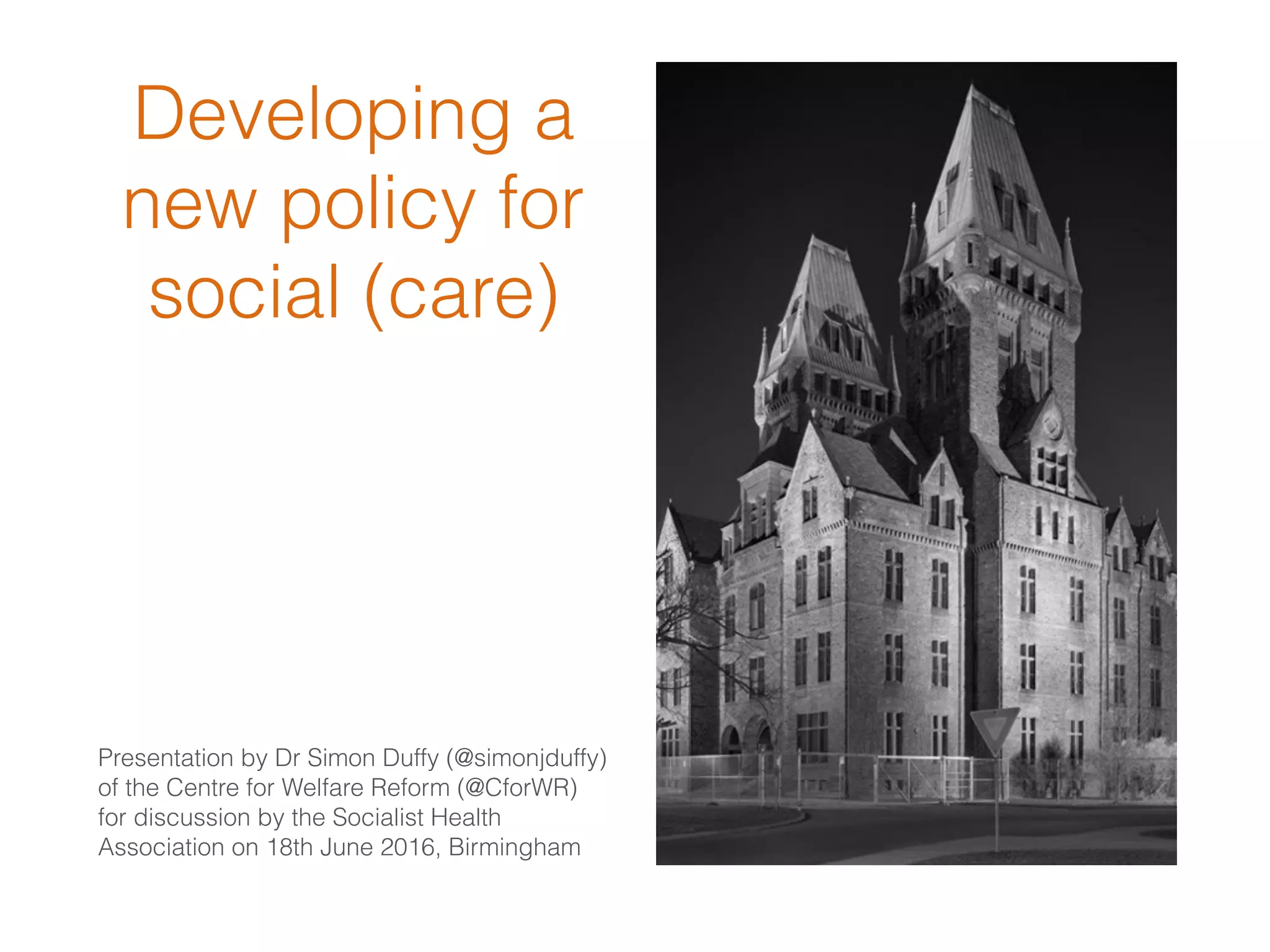
Developing a
new policy for
social (care)
Presentation by Dr Simon Duffy (@simonjduffy)
of the Centre for Welfare Reform (@CforWR)
for discussion by the Socialist Health
Association on 18th June 2016, Birmingham
Old SHA Policy
• Free social care should be introduced progressively starting
with those with greatest needs, such as those with disabilities.
• The SHA will campaign against cuts in Social Care.
• Additional funding for social care is necessary to raise the
quality and professionalize the workforce, with decent pay and
conditions. 
• Public provision of (social) care services should be greatly
increased.
• Integration will bring longer term savings, but the initial net
additional cost has to be met through progressive taxes.  
• Why are we so timid? Why is the right to independent
living not essential to a decent society?
• Why has Labour not campaigned for social (care) or for
disabled people?
• Why is social (care) treated as a ‘service’ given everything
we’ve learned from disabled people and families?
• Why don’t we focus on fair funding not on services?
• Why do we think integration is helpful or even relevant?
Another perspective
Today we shout “Forward!” 

but run backwards instead
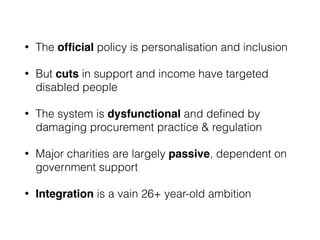
• The official policy is personalisation and inclusion
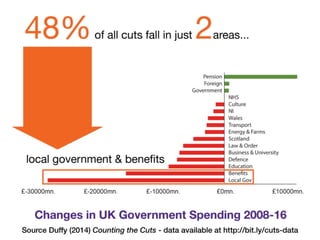
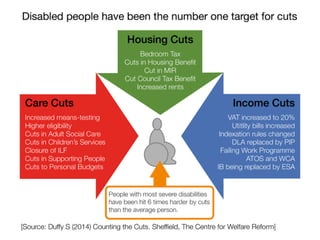
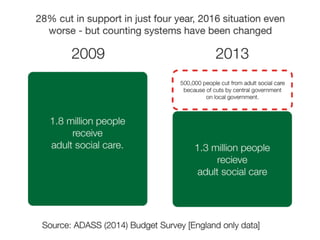
• But cuts in support and income have targeted
disabled people
• The system is dysfunctional and defined by
damaging procurement practice & regulation
• Major charities are largely passive, dependent on
government support
• Integration is a vain 26+ year-old ambition
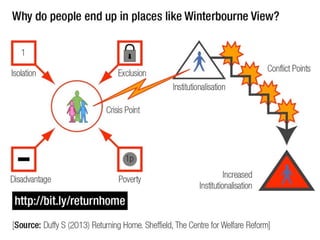
Our current model of social
(care) is deeply flawed
• We have focused on providing professionally
defined services
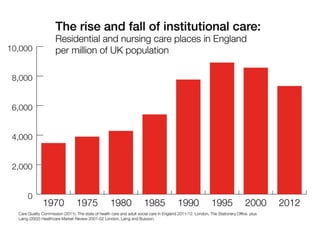
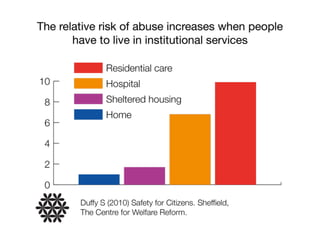
• Such services are primarily institutional and often
ineffective or dangerous
• We persistently fail to support families or to enable
citizenship
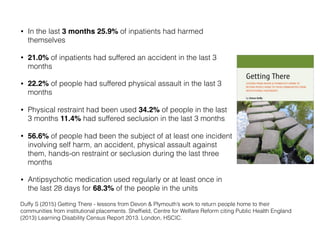
• In the last 3 months 25.9% of inpatients had harmed
themselves
• 21.0% of inpatients had suffered an accident in the last 3
months
• 22.2% of people had suffered physical assault in the last 3
months
• Physical restraint had been used 34.2% of people in the last
3 months 11.4% had suffered seclusion in the last 3 months
• 56.6% of people had been the subject of at least one incident
involving self harm, an accident, physical assault against
them, hands-on restraint or seclusion during the last three
months
• Antipsychotic medication used regularly or at least once in
the last 28 days for 68.3% of the people in the units
Duffy S (2015) Getting There - lessons from Devon & Plymouth’s work to return people home to their
communities from institutional placements. Sheffield, Centre for Welfare Reform citing Public Health England
(2013) Learning Disability Census Report 2013. London, HSCIC.
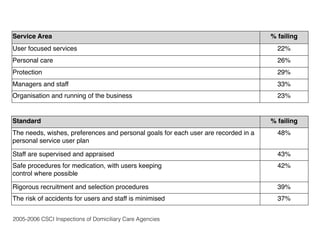
Service Area % failing
User focused services 22%
Personal care 26%
Protection 29%
Managers and staff 33%
Organisation and running of the business 23%
Standard % failing
The needs, wishes, preferences and personal goals for each user are recorded in a
personal service user plan
48%
Staff are supervised and appraised 43%
Safe procedures for medication, with users keeping
control where possible
42%
Rigorous recruitment and selection procedures 39%
The risk of accidents for users and staff is minimised 37%
2005-2006 CSCI Inspections of Domiciliary Care Agencies
We need a new citizenship
model for social (care)
• Purpose of social (care) should be to enable
everyone to be a full citizen, no matter their
impairment
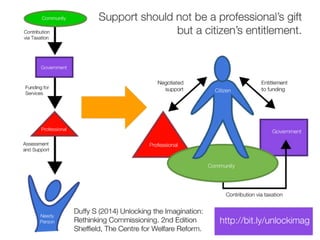
• Support needs to be controlled by citizens and
enable inclusion
• Economics of social (care) should be based on an
understanding of the real factors that promote
inclusion and empowerment (not the cost of
residential care).
Why is social (care) a 

non-partisan issue?
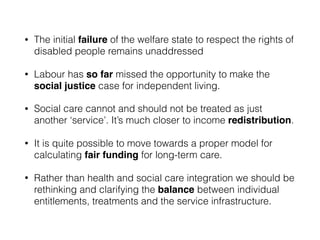
• The initial failure of the welfare state to respect the rights of
disabled people remains unaddressed
• Labour has so far missed the opportunity to make the
social justice case for independent living.
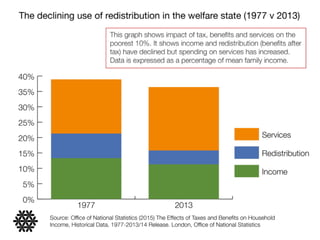
• Social care cannot and should not be treated as just
another ‘service’. It’s much closer to income redistribution.
• It is quite possible to move towards a proper model for
calculating fair funding for long-term care.
• Rather than health and social care integration we should be
rethinking and clarifying the balance between individual
entitlements, treatments and the service infrastructure.
Lessons from
Down Under
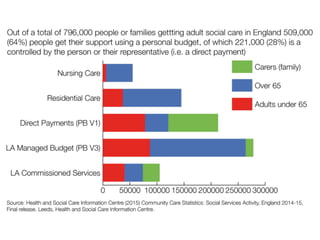
• Australia has introduced the National Disability
Insurance Scheme
• All disabled people (under 65!) will get a fully
funded, non-means-tested, personal budget
• Led to most popular tax ever in a country with one
of the lowest public spending levels in developed
world.
• Similar changes now being introduced for older
people [‘Consumer Directed Care’]
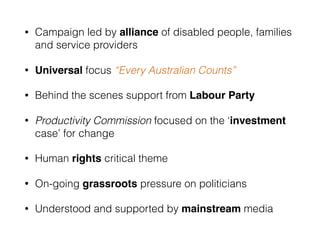
• Campaign led by alliance of disabled people, families
and service providers
• Universal focus “Every Australian Counts”
• Behind the scenes support from Labour Party
• Productivity Commission focused on the ‘investment
case’ for change
• Human rights critical theme
• On-going grassroots pressure on politicians
• Understood and supported by mainstream media
Why not here?
A new beginning?
1. SHA policy should be developed in partnership with and with support of disabled
people themselves.
2. It should be based on human rights and the UN Convention on Rights of Persons
with Disabilities
3. To create a universal non-means-tested right to support necessary for independent
living (for people of all ages, including children and older people)
4. To include disability, mental health and chronic health conditions (This will effectively
end the distinction between personal budgets and personal health budgets.)
5. To be delivered through a balance of individual entitlements (controlled by people and
families) and community-based support (especially peer support).
6. To end tendering and procurement systems and shift focus to community development
7. To create a system of national rights with local community development and
independent advocacy
8. To objectively calculate and fully fund the resources necessary to ensure full
citizenship, ending the undue pressure on families and crisis-inducing high eligibility
thresholds.
9. To restore a commitment to reduce income inequality and free up community
capacity.
• SHA is working with Unite and others to develop a
campaign to protect social care (DPAC are now
invited).
• Initial paper to be drafted for discussion with Brian
Fisher, Caroline Glendinning and DPAC for
presentation to SHA Council in due course.
• To open up discussions with the National
Pensioners Convention.
Next Steps

Developing a new policy for social (care)

  • 1.
    Developing a new policyfor social (care) Presentation by Dr Simon Duffy (@simonjduffy) of the Centre for Welfare Reform (@CforWR) for discussion by the Socialist Health Association on 18th June 2016, Birmingham
  • 2.
    Old SHA Policy •Free social care should be introduced progressively starting with those with greatest needs, such as those with disabilities. • The SHA will campaign against cuts in Social Care. • Additional funding for social care is necessary to raise the quality and professionalize the workforce, with decent pay and conditions.  • Public provision of (social) care services should be greatly increased. • Integration will bring longer term savings, but the initial net additional cost has to be met through progressive taxes.  
  • 3.
    • Why arewe so timid? Why is the right to independent living not essential to a decent society? • Why has Labour not campaigned for social (care) or for disabled people? • Why is social (care) treated as a ‘service’ given everything we’ve learned from disabled people and families? • Why don’t we focus on fair funding not on services? • Why do we think integration is helpful or even relevant? Another perspective
  • 4.
    Today we shout“Forward!” 
 but run backwards instead
  • 5.
    • The officialpolicy is personalisation and inclusion • But cuts in support and income have targeted disabled people • The system is dysfunctional and defined by damaging procurement practice & regulation • Major charities are largely passive, dependent on government support • Integration is a vain 26+ year-old ambition
  • 10.
    Our current modelof social (care) is deeply flawed
  • 11.
    • We havefocused on providing professionally defined services • Such services are primarily institutional and often ineffective or dangerous • We persistently fail to support families or to enable citizenship
  • 14.
    • In thelast 3 months 25.9% of inpatients had harmed themselves • 21.0% of inpatients had suffered an accident in the last 3 months • 22.2% of people had suffered physical assault in the last 3 months • Physical restraint had been used 34.2% of people in the last 3 months 11.4% had suffered seclusion in the last 3 months • 56.6% of people had been the subject of at least one incident involving self harm, an accident, physical assault against them, hands-on restraint or seclusion during the last three months • Antipsychotic medication used regularly or at least once in the last 28 days for 68.3% of the people in the units Duffy S (2015) Getting There - lessons from Devon & Plymouth’s work to return people home to their communities from institutional placements. Sheffield, Centre for Welfare Reform citing Public Health England (2013) Learning Disability Census Report 2013. London, HSCIC.
  • 16.
    Service Area %failing User focused services 22% Personal care 26% Protection 29% Managers and staff 33% Organisation and running of the business 23% Standard % failing The needs, wishes, preferences and personal goals for each user are recorded in a personal service user plan 48% Staff are supervised and appraised 43% Safe procedures for medication, with users keeping control where possible 42% Rigorous recruitment and selection procedures 39% The risk of accidents for users and staff is minimised 37% 2005-2006 CSCI Inspections of Domiciliary Care Agencies
  • 18.
    We need anew citizenship model for social (care)
  • 19.
    • Purpose ofsocial (care) should be to enable everyone to be a full citizen, no matter their impairment • Support needs to be controlled by citizens and enable inclusion • Economics of social (care) should be based on an understanding of the real factors that promote inclusion and empowerment (not the cost of residential care).
  • 26.
    Why is social(care) a 
 non-partisan issue?
  • 28.
    • The initialfailure of the welfare state to respect the rights of disabled people remains unaddressed • Labour has so far missed the opportunity to make the social justice case for independent living. • Social care cannot and should not be treated as just another ‘service’. It’s much closer to income redistribution. • It is quite possible to move towards a proper model for calculating fair funding for long-term care. • Rather than health and social care integration we should be rethinking and clarifying the balance between individual entitlements, treatments and the service infrastructure.
  • 29.
  • 30.
    • Australia hasintroduced the National Disability Insurance Scheme • All disabled people (under 65!) will get a fully funded, non-means-tested, personal budget • Led to most popular tax ever in a country with one of the lowest public spending levels in developed world. • Similar changes now being introduced for older people [‘Consumer Directed Care’]
  • 31.
    • Campaign ledby alliance of disabled people, families and service providers • Universal focus “Every Australian Counts” • Behind the scenes support from Labour Party • Productivity Commission focused on the ‘investment case’ for change • Human rights critical theme • On-going grassroots pressure on politicians • Understood and supported by mainstream media
  • 32.
  • 33.
  • 34.
    1. SHA policyshould be developed in partnership with and with support of disabled people themselves. 2. It should be based on human rights and the UN Convention on Rights of Persons with Disabilities 3. To create a universal non-means-tested right to support necessary for independent living (for people of all ages, including children and older people) 4. To include disability, mental health and chronic health conditions (This will effectively end the distinction between personal budgets and personal health budgets.) 5. To be delivered through a balance of individual entitlements (controlled by people and families) and community-based support (especially peer support). 6. To end tendering and procurement systems and shift focus to community development 7. To create a system of national rights with local community development and independent advocacy 8. To objectively calculate and fully fund the resources necessary to ensure full citizenship, ending the undue pressure on families and crisis-inducing high eligibility thresholds. 9. To restore a commitment to reduce income inequality and free up community capacity.
  • 35.
    • SHA isworking with Unite and others to develop a campaign to protect social care (DPAC are now invited). • Initial paper to be drafted for discussion with Brian Fisher, Caroline Glendinning and DPAC for presentation to SHA Council in due course. • To open up discussions with the National Pensioners Convention. Next Steps