1
Personal Care Savings Bonds
13 June 2013
2
Welcome
Baroness Sally Greengross
Chief Executive
ILC-UK
3
Professor Les Mayhew
Cass Business School
Faculty of Actuarial Science and Insurance
Personal Care Savings Bonds
- a new way of saving towards social
care in later life
4
Why we should encourage
personal saving
• An ageing population is a long term issue
– there are no quick financial fixes
• Many previous attempts at reform have
failed so no easy answers
• Latest reforms are welcome but do not of
themselves bring in new money
• But they do seek to create a ‘space’ in
which to encourage financial services to
play a major role
5
Why else should we be concerned
……the demographics?
• The modal age of death is now 89 years, 10
more than in 1950; this will rise to 93 years by
2030 for both genders
• ONS estimates the population aged 75+ will
double from 5m to 11m by 2050 and the number
aged 85+ will go from 1.5m to over 5m
• The years spent in disability at the end of life is
increasing with obvious financial and other
consequences
6
Why personal care savings bonds?
• Most financial products are aimed at people with
housing wealth, large personal savings or
occupational pensions
• Generally it is assumed that poorer people will
automatically fall back on to the state and have
no incentive to save for their care
• The state shows no desire to fund all social care
needs, only to provide a ‘safety net’
• A safety net is not a recipe for improving quality
of care but simply one for ‘coping’
7
How would PCSBs work?
• Each bond has a nominal value of £1 and is
entered into a monthly prize draw. Both the prize
element and accumulated value are tax free
• Bonds will be normally be purchased out of
taxed income, similar to Premium Bonds and
lottery tickets
• They could be bought over the internet, by
standing order, and from local post offices and
shops
8
How would PCSBs work?
• Cash can only be withdrawn on being assessed
as needing social care or on death
• If they die first, the value of the fund would
transfer to the person’s estate
• Fund values on death could be used to pay for
funeral costs replacing some public expenditure
out of the Social Fund
• Encashed bonds could be used in different ways
by investors assuming a social care need is
triggered and the fund redeemed
9
Setting the payment trigger
• Currently the assessment is made under
the FAC’s system which has four levels
• We are promised a new national
assessment system which is fair and
portable
• It may be possible to link to a different
trigger such as entitlement to Attendance
Allowance
10
Illustrative example
If 12m people purchased £100 worth of bonds on average each year the fund
would grow in value to around £70bn after 70 years. This compares with the
£43bn value of premium bonds which were introduced in 1956 and have
remained popular ever since. If bond-holders re-invested the prize money the
fund would be much bigger.
11
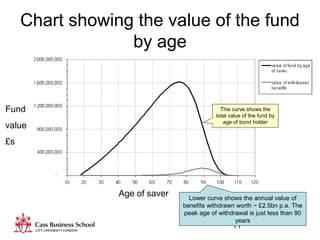
Chart showing the value of the fund
by age
Lower curve shows the annual value of
benefits withdrawn worth ~ £2.5bn p.a. The
peak age of withdrawal is just less than 90
years
Age of saver
This curve shows the
total value of the fund by
age of bond holder
Fund
value
£s
12
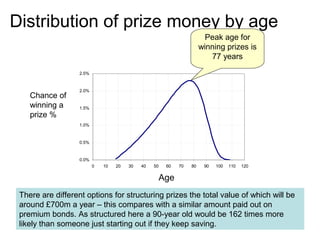
Distribution of prize money by age
0.0%
0.5%
1.0%
1.5%
2.0%
2.5%
0 10 20 30 40 50 60 70 80 90 100 110 120
Age
Probabilityofreceivingaprize
There are different options for structuring prizes the total value of which will be
around £700m a year – this compares with a similar amount paid out on
premium bonds. As structured here a 90-year old would be 162 times more
likely than someone just starting out if they keep saving.
Peak age for
winning prizes is
77 years
Age
Chance of
winning a
prize %
13
The build up phase of the fund
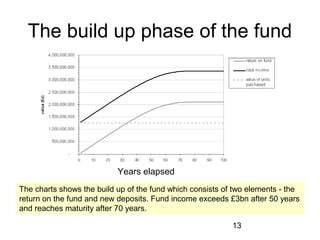
The charts shows the build up of the fund which consists of two elements - the
return on the fund and new deposits. Fund income exceeds £3bn after 50 years
and reaches maturity after 70 years.
Years elapsed
14
Outgo
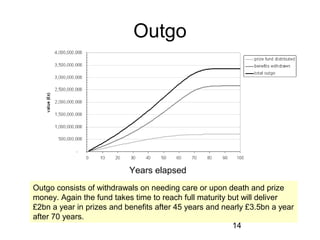
Outgo consists of withdrawals on needing care or upon death and prize
money. Again the fund takes time to reach full maturity but will deliver
£2bn a year in prizes and benefits after 45 years and nearly £3.5bn a year
after 70 years.
Years elapsed
15
Inflation
• The purchasing power of the pound goes down
with inflation
• Protection is maintained by offering long run
rates of interest that are above inflation
• However, there are advantages in keeping the
nominal value of a PCSB at £1
• This does not appear to have affected the
popularity premium bonds which are still valued
at a pound
16
Means testing
• Important that the product is simple and
easy to understand
• Understandable concern if it is believed
the money will be clawed back by means
testing
• If treated as an asset for example the
imputed value of the fund could be
reduced by as much as £2,080 based on
a fund of £10k
17
Who will buy care bonds?
• Any adult can buy PCSBs but they are designed
for people on modest incomes and assets
• They are likely to include people that fall
squarely in the means testing zone
• They could include carers, economically
inactive, disabled and so on
• PCSBs could be gifted as with premium bonds
to parents, friends and others
• Depending on how structured they could be also
bought by wealthier people
18
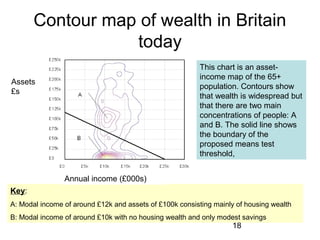
Contour map of wealth in Britain
today
This chart is an asset-
income map of the 65+
population. Contours show
that wealth is widespread but
that there are two main
concentrations of people: A
and B. The solid line shows
the boundary of the
proposed means test
threshold,
Key:
A: Modal income of around £12k and assets of £100k consisting mainly of housing wealth
B: Modal income of around £10k with no housing wealth and only modest savings
Annual income (£000s)
Assets
£s
19
Potential impact on competing LTC
and other related products
• Administration costs of PCSBs are likely to be very low
which will make them very competitive
• The lottery is not a competitor because it appeals for
different reasons and stakes are forfeited
• Insurance is not a competitor as it is likely to be too
expensive for most
• Equity release is designed for home owners and INAs for
people of high net worth at the point of need
• Purchases of Premium Bonds may be affected and there
could be some switching depending on prize structure
and interest rate
20
£0 £5000 £10,000 15,000 £20,000 £25,000 £30,000
Income p.a.
£250k
£225k
£200k
£175k
£150k
£125k
£100k
£75k
£50k
£25k
£0k
Assets
B
D C
Self-fundingE
A
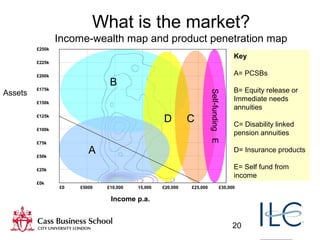
Key
A= PCSBs
B= Equity release or
Immediate needs
annuities
C= Disability linked
pension annuities
D= Insurance products
E= Self fund from
income
What is the market?
Income-wealth map and product penetration map
21
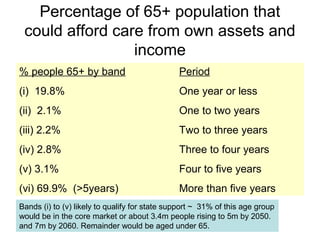
Percentage of 65+ population that
could afford care from own assets and
income
% people 65+ by band Period
(i) 19.8% One year or less
(ii) 2.1% One to two years
(iii) 2.2% Two to three years
(iv) 2.8% Three to four years
(v) 3.1% Four to five years
(vi) 69.9% (>5years) More than five years
Bands (i) to (v) likely to qualify for state support ~ 31% of this age group
would be in the core market or about 3.4m people rising to 5m by 2050.
and 7m by 2060. Remainder would be aged under 65.
22
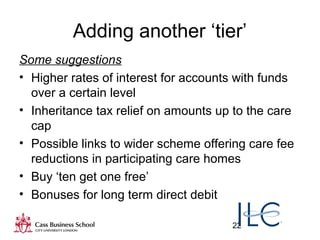
Adding another ‘tier’
Some suggestions
• Higher rates of interest for accounts with funds
over a certain level
• Inheritance tax relief on amounts up to the care
cap
• Possible links to wider scheme offering care fee
reductions in participating care homes
• Buy ‘ten get one free’
• Bonuses for long term direct debit
23
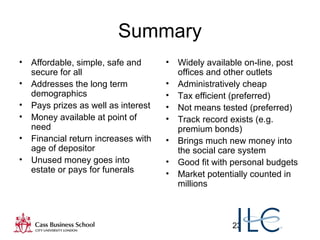
Summary
• Affordable, simple, safe and
secure for all
• Addresses the long term
demographics
• Pays prizes as well as interest
• Money available at point of
need
• Financial return increases with
age of depositor
• Unused money goes into
estate or pays for funerals
• Widely available on-line, post
offices and other outlets
• Administratively cheap
• Tax efficient (preferred)
• Not means tested (preferred)
• Track record exists (e.g.
premium bonds)
• Brings much new money into
the social care system
• Good fit with personal budgets
• Market potentially counted in
millions
24
Discussion and Q&A
• If not PCSBs then what?
• How to make PCSBs bigger, better, sooner?
• Should PCSBs be exempt from means testing?
• Views on possible incentives to attract wealthier investors
• Views on methods of purchase
• Balance between interest rate and prize fund
• Practical issues (e.g. who should run it?)
• Next steps
25
Personal Care Savings Bonds
13 June 2013

Personal care savings bonds

  • 1.
    1 Personal Care SavingsBonds 13 June 2013
  • 2.
  • 3.
    3 Professor Les Mayhew CassBusiness School Faculty of Actuarial Science and Insurance Personal Care Savings Bonds - a new way of saving towards social care in later life
  • 4.
    4 Why we shouldencourage personal saving • An ageing population is a long term issue – there are no quick financial fixes • Many previous attempts at reform have failed so no easy answers • Latest reforms are welcome but do not of themselves bring in new money • But they do seek to create a ‘space’ in which to encourage financial services to play a major role
  • 5.
    5 Why else shouldwe be concerned ……the demographics? • The modal age of death is now 89 years, 10 more than in 1950; this will rise to 93 years by 2030 for both genders • ONS estimates the population aged 75+ will double from 5m to 11m by 2050 and the number aged 85+ will go from 1.5m to over 5m • The years spent in disability at the end of life is increasing with obvious financial and other consequences
  • 6.
    6 Why personal caresavings bonds? • Most financial products are aimed at people with housing wealth, large personal savings or occupational pensions • Generally it is assumed that poorer people will automatically fall back on to the state and have no incentive to save for their care • The state shows no desire to fund all social care needs, only to provide a ‘safety net’ • A safety net is not a recipe for improving quality of care but simply one for ‘coping’
  • 7.
    7 How would PCSBswork? • Each bond has a nominal value of £1 and is entered into a monthly prize draw. Both the prize element and accumulated value are tax free • Bonds will be normally be purchased out of taxed income, similar to Premium Bonds and lottery tickets • They could be bought over the internet, by standing order, and from local post offices and shops
  • 8.
    8 How would PCSBswork? • Cash can only be withdrawn on being assessed as needing social care or on death • If they die first, the value of the fund would transfer to the person’s estate • Fund values on death could be used to pay for funeral costs replacing some public expenditure out of the Social Fund • Encashed bonds could be used in different ways by investors assuming a social care need is triggered and the fund redeemed
  • 9.
    9 Setting the paymenttrigger • Currently the assessment is made under the FAC’s system which has four levels • We are promised a new national assessment system which is fair and portable • It may be possible to link to a different trigger such as entitlement to Attendance Allowance
  • 10.
    10 Illustrative example If 12mpeople purchased £100 worth of bonds on average each year the fund would grow in value to around £70bn after 70 years. This compares with the £43bn value of premium bonds which were introduced in 1956 and have remained popular ever since. If bond-holders re-invested the prize money the fund would be much bigger.
  • 11.
    11 Chart showing thevalue of the fund by age Lower curve shows the annual value of benefits withdrawn worth ~ £2.5bn p.a. The peak age of withdrawal is just less than 90 years Age of saver This curve shows the total value of the fund by age of bond holder Fund value £s
  • 12.
    12 Distribution of prizemoney by age 0.0% 0.5% 1.0% 1.5% 2.0% 2.5% 0 10 20 30 40 50 60 70 80 90 100 110 120 Age Probabilityofreceivingaprize There are different options for structuring prizes the total value of which will be around £700m a year – this compares with a similar amount paid out on premium bonds. As structured here a 90-year old would be 162 times more likely than someone just starting out if they keep saving. Peak age for winning prizes is 77 years Age Chance of winning a prize %
  • 13.
    13 The build upphase of the fund The charts shows the build up of the fund which consists of two elements - the return on the fund and new deposits. Fund income exceeds £3bn after 50 years and reaches maturity after 70 years. Years elapsed
  • 14.
    14 Outgo Outgo consists ofwithdrawals on needing care or upon death and prize money. Again the fund takes time to reach full maturity but will deliver £2bn a year in prizes and benefits after 45 years and nearly £3.5bn a year after 70 years. Years elapsed
  • 15.
    15 Inflation • The purchasingpower of the pound goes down with inflation • Protection is maintained by offering long run rates of interest that are above inflation • However, there are advantages in keeping the nominal value of a PCSB at £1 • This does not appear to have affected the popularity premium bonds which are still valued at a pound
  • 16.
    16 Means testing • Importantthat the product is simple and easy to understand • Understandable concern if it is believed the money will be clawed back by means testing • If treated as an asset for example the imputed value of the fund could be reduced by as much as £2,080 based on a fund of £10k
  • 17.
    17 Who will buycare bonds? • Any adult can buy PCSBs but they are designed for people on modest incomes and assets • They are likely to include people that fall squarely in the means testing zone • They could include carers, economically inactive, disabled and so on • PCSBs could be gifted as with premium bonds to parents, friends and others • Depending on how structured they could be also bought by wealthier people
  • 18.
    18 Contour map ofwealth in Britain today This chart is an asset- income map of the 65+ population. Contours show that wealth is widespread but that there are two main concentrations of people: A and B. The solid line shows the boundary of the proposed means test threshold, Key: A: Modal income of around £12k and assets of £100k consisting mainly of housing wealth B: Modal income of around £10k with no housing wealth and only modest savings Annual income (£000s) Assets £s
  • 19.
    19 Potential impact oncompeting LTC and other related products • Administration costs of PCSBs are likely to be very low which will make them very competitive • The lottery is not a competitor because it appeals for different reasons and stakes are forfeited • Insurance is not a competitor as it is likely to be too expensive for most • Equity release is designed for home owners and INAs for people of high net worth at the point of need • Purchases of Premium Bonds may be affected and there could be some switching depending on prize structure and interest rate
  • 20.
    20 £0 £5000 £10,00015,000 £20,000 £25,000 £30,000 Income p.a. £250k £225k £200k £175k £150k £125k £100k £75k £50k £25k £0k Assets B D C Self-fundingE A Key A= PCSBs B= Equity release or Immediate needs annuities C= Disability linked pension annuities D= Insurance products E= Self fund from income What is the market? Income-wealth map and product penetration map
  • 21.
    21 Percentage of 65+population that could afford care from own assets and income % people 65+ by band Period (i) 19.8% One year or less (ii) 2.1% One to two years (iii) 2.2% Two to three years (iv) 2.8% Three to four years (v) 3.1% Four to five years (vi) 69.9% (>5years) More than five years Bands (i) to (v) likely to qualify for state support ~ 31% of this age group would be in the core market or about 3.4m people rising to 5m by 2050. and 7m by 2060. Remainder would be aged under 65.
  • 22.
    22 Adding another ‘tier’ Somesuggestions • Higher rates of interest for accounts with funds over a certain level • Inheritance tax relief on amounts up to the care cap • Possible links to wider scheme offering care fee reductions in participating care homes • Buy ‘ten get one free’ • Bonuses for long term direct debit
  • 23.
    23 Summary • Affordable, simple,safe and secure for all • Addresses the long term demographics • Pays prizes as well as interest • Money available at point of need • Financial return increases with age of depositor • Unused money goes into estate or pays for funerals • Widely available on-line, post offices and other outlets • Administratively cheap • Tax efficient (preferred) • Not means tested (preferred) • Track record exists (e.g. premium bonds) • Brings much new money into the social care system • Good fit with personal budgets • Market potentially counted in millions
  • 24.
    24 Discussion and Q&A •If not PCSBs then what? • How to make PCSBs bigger, better, sooner? • Should PCSBs be exempt from means testing? • Views on possible incentives to attract wealthier investors • Views on methods of purchase • Balance between interest rate and prize fund • Practical issues (e.g. who should run it?) • Next steps
  • 25.
    25 Personal Care SavingsBonds 13 June 2013

Editor's Notes

  • #4 Good morning everybody. I am les Mayhew from Cass Business School. I work in the faculty of Actuarial Science and Insurance at Cass Business School as does my very able co-author David Smith who is also here today. Before I start first let me make a couple of thank yous. I am very grateful to ILC-UK, particularly to Sally Greengross who not only understands the strategic importance of saving for old age as you would expect but also is open and supportive and innovative ideas. Its been a pleasure working with ILC who have organised this event and for the many fruitful discussions with the ILC team – especially to Nick Kirwan who has just recently joined ILC. I would also like to than Jane Finnerty at SOLLA: Firstly for inviting me to speak at the SOLLA conference in January but also for encouraging me to work up this idea of a bond into a fully fledged research paper. However, I am also grateful for thinking up a more appropriate name for the product I am going to talk about now rather than the rather opaque name I used previously – namely personal care savings bonds. Final acknowledgement is the David Smith a colleague in the Faculty without whom it would not have been possible to complete this research is such a short time. However, notwithstanding this valuable moral support the ideas which we will be talking about were produced independently and are entirely our own. Finally I hope this will be one of a series of papers on social care finance which we hope to produce over the next year in each of the various product areas.
  • #5 Dilnot has generated massive debate but there is a sense that once bill is enacted – that’s it job done. Not true. As previous attempts at reform have demonstrated this is not a simple nut to crack – far from it. The reasons why I say this a long term issue and the population will continue to age throughout most of this century, so we need to lay down long term plans – to provide not just minimal levels of funding for the next few years but also a better quality of care going forward. Government has shown that it is unwilling to change the system of funding care radically e.g. by putting up taxes or turning it into an NHS style system – with good reason because costs and tax implications would be significant. Instead it continue with a safety net approach albeit more generous, and a cap on out of pocket care costs of £72,000. What the current reforms are supposed to do is to create a space for private sector to step in with a range of potential products. But they don’t of themselves bring in much new money only insofar as they will support people whose care costs exceed the cap and some additional support through the means test. The Government is currently working with industry in a number areas such as housing equity and insurance which will be reporting this summer. So the timing of our research paper seems particularly good.
  • #6 No presentation on social care is complete without something on the demographics but I was especially concerned to impress on you the longer tem context. In the last 50 years improvements in life expectancy have been truly remarkable The modal age of death fro men has increased 10 years since 1950 and by 8 years for women. Indeed it is remarkable that men are now catching up with women. In fact the modal age of death will be 93 years by 2030 for both genders such has been the advancement of male life expectancy If that sounds incredulous the modal age of death for Japanese females is now already over 94 years. The number of people aged 85+ will more than treble by 2050 and there is the potential for life expectancy to continue increase through most of the century. This will affect the number of years spent in disability at the end of life with obvious financial and other consequences.
  • #7 The reason for developing the concepts of PCSB came about for four reasons: Most financial products are aimed at people with housing wealth large personal savings or occupational pensions. Indeed, the capped cost model is designed to project housing wealth from the catastrophic care costs experience by a few people in their lives. It is true that the safety net has been extended to people with assets of up to £118k from £23.5k but its effect in terms of bring more tax payers money into social care is actually quite low because of the nature of the means test. So our view was that people including those on low incomes, who have not accumulated an occupational pension, who spent years out of the work force looking after relatives or otherwise not economically active should also be given the opportunity to save. Having said that the way PCSBs are structured means that they could be attractive to a wide range of people including the wealthier.
  • #8 PCSBs are a hybrid between a normal interest bearing savings account and a lottery. Unlike a lottery however the stake is not forfeited; in this sense it is more like a premium bond which can be en-cashed at any time. Unlike premium bonds PCSBs also earn interest. A key difference however is that PCSBs bonds are en-cashable only on needing care. Here is a list of their main features. Prize winners are individual bond holders who can elect to receive the money or re-invest it in more bonds thus increasing their personal fund. So they could elect to receive money if they win, thus softening the prospect of money be locked up for years. Because the fund accumulates with time it means that the chances of winning a prize would increase with age and would reach a maximum value at the point of needing care or at the point of death. It follows that the longer a person lives without triggering social care, the larger the fund will be when it is required. So in this way we convert expected future increases in life expectancy to everybody’s financial advantage. This addresses one of the perceived problems of Long Term Care insurance in which prospective policyholders forfeit their premiums assuming they die without needing care. With PCSBs, even if they do not receive a payment for care, their estate will get the benefit. Payments from the Social Fund can be made to claimants on means-tested benefits and tax credits to help meet the costs of a funeral. Payments are made out of the Social Fund. Over 38,000 payments were made in Great Britain in 2011-12, at a total cost of £47 million. This would represent a small but useful saving on welfare expenditure and would provide cheap form of funeral insurance for people who would not usually buy these products. Bonds could be bought on-line by standing order, from the post office or in shops.
  • #10 What would trigger payment? This is important and there are a number of possibilities. The government is committed to introduce a new assessment system and depending on how it this could be answer. Under the current FACs system, assessments are graded low, moderate, critical or substantial but many LAs only fund critical and substantial. For example there would be nothing to stop the trigger being linked to moderate even if an LA sets the threshold higher. For example it is quite common for a person to have serious long term health conditions but does not qualify under FACs. There doesn’t have to be a single trigger and some people may decide to hold on to their bonds a little longer. But there may be some people who would wish to access their money earlier. It has been suggestive for example that the money could be used for prevention around the home and assisted living technologies for example. So another suggestion is to use eligibility to AA as a trigger which is a lower threshold. People do not have to withdraw if they don’t want to and may prefer to allow their fund to accrue because of their personal circumstances or a bequest motive. Much depends on individual circumstances. Note that the lower threshold trigger the small the fund would be as seems obvious.
  • #11 I will now work through an illustrative example. Our model can produce other scenarios but these are fairly standard actuarial assumptions for this kind of work. We assume that the long term underlying rate of real interest to be 3%, 1% of which goes into a prize pool and 2% is investment return. We need to assume how much people will spend. We have assume £100 a year or £2 week. We further assume a 25% take up among the UK adult population equivalent to about 12m people. To put this into perspective about 70% of the UK adult population or 30m spend on average about £3 a week on the lottery. The number of premium bond holders is 23m or twice what we are assuming in this illustration. So in assuming 12m buyers we are still being fairly conservative. In the following example we assume 20% of investors would trigger care before they died. However, varying this assumption has very little effect on the value of the fund, all other assumptions staying the same. For example, if 50% triggered care the size of the fund on maturity would be only round £1bn less – the effect of bringing payouts forward in time by a couple of years. Our mortality rates are based on 2011 and so will be fairly conservative by the time we get to say 2050.
  • #12 The upper curve represents the aggregate bond values at different ages. It attains its maximum value at age 77 after which it starts to decline as people enter care or die. Based on our assumptions, if we look at individual holdings for individuals who are alive and not in care, then at age 77 the average fund is worth £11k and continues to increase, reaching £14k at age 85 and £18k at age 95. However, this without the re-investment of prize money in which case it could be higher. Also remember that the modal age of death is increasing year by year and so the higher figure of 18k is a better expectation in my view. The total value of the fund is the areas under the curve which comes to £70bn. The lower curve represents the value of the average withdrawals which on these assumptions work out at £2.5bn a year of new money. Withdrawals start as just before age 70 and peak at age 90 before declining as age takes its toll.
  • #13 As comparison premium bonds pay around 1.8m prizes a month to a value of around £50m, with prizes ranging in size from £25 to a single maximum prize of £1m; however, 89% of the prize fund is paid out in prizes of up to £100. The probability of winning a prize increases so long as you are alive for two reasons because as the value of your deposits increase the greater your chance of winning. We have not given a lot of thought to the structuring of prize money in the case of PCSBs – e.g. a large number of small versus few big prizes. This could be an issue for consumer research but the prize structure of premium bonds are a logical starting point. The peak age group that will win most prizes in a given year is 77 years based on current mortality rates and the probability of needing care; however we expect this to gradually increase over time with further declines in mortality.
  • #14 Like all funds including pension funds and ISAs, it takes time for the fund to build up which means that withdrawals in the early years will be small and so expectations about how difference PCSBs could make would need to be managed. This chart shows the build up phase of the fund which has two components: the accumulated interest plus new deposits. The annual fund income exceeds £3bn after 50 years and reaches maturity after 70 years. To put this is perspective the national lottery brings in about £5bn a year.
  • #15 This shows the outgo. Outgo consists of withdrawals on needing care or upon death and prize money. Again the fund takes time to reach full maturity but will deliver £2bn a year in prizes and benefits after 45 years and nearly £3.5bn a year after 70 years
  • #16 Over a long period the purchasing power of the pound will go down due to inflation Protection is afforded by offering long run rates of interest and prizes that are above inflation. How this would work is explained in an annex to the research paper of which you should have copies. The number of PCSBS purchased by individuals would need to increase to keep pace so the question arises whether in future a bond would sell for two £1 say rather than £1. The jury is out on that one and it would be quite far into the future anyway; however just to point out that the premium bond still has the same nominal that it had in 1956 and it has not affected it’s popularity it would seem.
  • #17 In thinking about PCSBs we wanted to minimise and even avoid as many interactions as possible with means testing, and the tax and benefit system, or the need for complex financial advice, all of which would be a big turn off for individuals. This is the case as soon as you start introducing caveats and what is effectively ‘small print’ like in an insurance policy. We were also keen to minimise the impact of means testing in cases where in would remove the incentive to save especially in a scenario whereby the state support would reduce £1 for each pound of income. In the case of PCSBs we anticipate that their accumulated value would normally be treated as an asset and that under current means testing rules for each £1000 and income equivalent to £208 annually would be imputed and deducted from the level state support (a very substantial amount of interest you might say). Our strong preference would be for this to be ignored in the case of this product for three reasons: 1. Savers falling within the means testing zone might feel cheated such that over time it affect the willingness to buy PCSBs; 2. by not deducting it more money would enter the care system and more would be spent on care. However, not everybody will fall back onto means testing and they will get back the full value of the fund depending on the trigger adopted. To summarise if means tested PCSBs would save some public money but if not more money would enter the care system with beneficial effects on care quality and so on.
  • #18 Although designed for people on with low income and assets they could also be bought as gifts for others – for example parents or by wealthier people attracted by the tax free status. These groups fall neatly into two camps as the following charts show and market segmentation aim to show.
  • #19 This chart is a contour map of income and wealth in the 65+ population today. Assets are on the vertical axis and income on the horizontal axis. Generally the contours demonstrate that wealth and income are widely dispersed but the variation in assets is considerably greater than the variation in income which peters out after 25k a year. In fact wealth goes off the scale which here only goes up to £250k. The more concentrated the contours the higher concentrations of people around those asset-income levels. There are two A: these are people with assets of around £100k and an income of 12k and a second group B which have assets of less than £25k but annual incomes also of around £10k. The thing that divides these two groups is home ownership or not: A are home owners and B are not. The solid line is the dividing line for receiving state support under the extended means test proposed by Dilnot. It slopes from left to right because it is based on both one’s assets and income. Above this line you get nothing and below this line you get something. State support is a maximum the closer you are to zero, the corner. The point is that a lot of the people for whom this product would be attractive would be entitled to something but the amount of entitlement is tapered as your asset and income increase until they reach this line.
  • #20 Several competing products in this of personal finance are being actively studied. My preliminary view is that none is likely be on the same level as PCSBs in terms of market value with the possible exception of disability linked annuities. But pensions by themselves would not be sufficient to pay for care. In addition there are many people with no occupational or pension provision. There are a range of other possible interactions which could ripple through which need to be considered. For example with regard to lottery funding for good causes the impact is likely to be small because the lottery is played for different reasons. Just as the lottery did not impact on premium bonds when it was introduced so PCSBs should not impact on the lottery and good causes. This is because the lottery is a pure form of gambling Neither should it alter the market for LTC insurance as this market is effectively non-existent and has never taken off. That is not to say it will never take off in the light of the capped cost model for paying for care but my guess is that it might only be affordable to a few people who are positioned somewhere between the self funders and the means tested. More on this in a moment. It wont compete with equity release because many wont have housing wealth and it should not impact on pensions because many people who will buy this product may not have occupational pensions anyway.
  • #21 Let us look at the different market segments in more detail. Here again is the contour map and means test boundary. A PCSBs would occupy this space people with low to modest assets and low to average income B People buying point of needs products or INAs will tend to occupy this space – these are high net worth individuals with lots of housing wealth or savings but modest retirement incomes C. People with more substantial occupational pensions that would in the future be able to buy disability linked annuities: These are pensions that go up in value upon assessment for care D. LTC insurance – narrow range somewhere between bonds buyers and self funders. Problem is that it is expensive and if you die without needing care you lose your premiums. To work it would need to offer substantial benefits but that would make it even more expensive.
  • #22 One way to identify those that might purchase bonds we can segment that population into bands based on how many years of care they could notionally afford from their own wealth and income. It turns out that bands one to five are likely to be qualify for some state support under the new arrangements. This would equate to about 31% of the 65+ population or 3.4m people, rising to 5m by 2030 and 7m by 2060.
  • #23 The fund will take a few decades to reach a sizeable sum and 70 years to reach maturity. The question asked by Sally for example is whether there are ways to make it more attractive to more investors especially wealthier ones without having an open season for speculators. This needs lots of thought but here are three suggestions (not proposals but ideas). The first is obvious - that is tiering the rates of interest but need to be careful so as not to drive away poorer investors. Second inheritance tax planning is big business. To attract more funds one could offer tax relief on fund values up to a certain point (the care cost cap is again just a suggestion). The final example is to invite care homes to join linked schemes whereby PCSB holders get care home fee reductions or vouchers.