Providing Universal Basic
Income for all Citizens to
Minimize Poverty
Presented by: Rana Alkhalissi
Date: 8/6/2023
The Problem
� Whether working, wealthy, or
impoverished, people require money to
meet important needs such as housing,
clothing, food, and healthcare.
� However, a significant factor or
concern with the issue of money is
whether households earn enough to
meet their requirements.
The Problem (Continued)
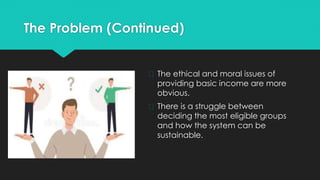
� The ethical and moral issues of
providing basic income are more
obvious.
� There is a struggle between
deciding the most eligible groups
and how the system can be
sustainable.
THESIS STATEMENT
“Although basic income can be a relatively costly initiative, if excellent plans are made, it has the
potential to assist people in meeting their basic needs while also preserving a sustainable economy”
Opposing Position
There are more causes of poverty
that the UBI will not solve by
giving money.
Opposing Position (Continued)
Providing basic pay is an
unsustainable initiative that does
not justify it as a feasible necessity
Validity of the Acceptable Opposing Claims
� It is reasonable to feel that money
might not be the only solution to
poverty.
� Also, the cost issue cannot be
downplayed while considering
universal basic pay.
Why my Claims would improve these
Objections?
� Despite the opposition, providing
universal basic income can significantly
reduce poverty.
� The United States cannot escape that
individuals desperately need financial
assistance to afford basic needs such
as food and shelter.
Why my Claims would improve these
Objections? (Continued)
The issue of waste can easily be solved
by revamping the eligibility criteria to
avoid misappropriation of the
program.
Compromises
FIRST: Parties to this argument can accept is
to define and refine the definition of
“needy” according to the universal basic
income policy and determine if it qualifies
for benefits.
SECOND: Establishing a system that
automatically enlists specific services for
beneficiaries according to their needs and
where they can get what they need
Conclusion
� Although basic income can be expensive, if well-planned, it can help people satisfy their
fundamental requirements while preserving a healthy economy.
Conclusion (Continued)
� Also, universal basic income is a costly initiative that can affect the country’s federal
budgetary allocation costing the taxpayers a huge cut in their income.
REFERENCES
� Azizi, M. R., Atlasi, R., Ziapour, A., Abbas, J., & Naemi, R. (2021). Innovative human resource management
strategies during the COVID-19 pandemic: A systematic narrative review approach. Heliyon, 7(6), e07233.
� Banerjee, A., Niehaus, P., & Suri, T. (2019). Universal basic income in the developing world. Annual Review
of Economics, 11, 959-983.
� de Paz-Báñez, M. A., Asensio-Coto, M. J., Sánchez-López, C., & Aceytuno, M. T. (2020). Is there empirical
evidence on how the implementation of a Universal Basic Income (UBI) affects labour supply? A
systematic review. Sustainability, 12(22), 9459.
� Greenstein, R. (2019). Commentary: Universal Basic Income May Sound Attractive But, If It Occurred,
Would Likelier Increase Poverty Than Reduce It. Center on Budget and Policy Priorities. Accessed
https://www.cbpp.org/research/poverty-and-opportunity/commentary-universal-basic-income-may-
sound-attractive-but-if-it
� Pisani, G. (2022). A justification of basic income beyond a theory of justice. Oñati Socio-Legal Series, 12(4),
737-761.
� Schalin, J. (2013). Federal Student Loan Programs Subsidize Waste And Redistribution To The Wealthy.
Forbes. Accessed https://www.forbes.com/sites/realspin/2013/05/06/federal-student-loan-programs-
subsidize-waste-and-redistribution-to-the-wealthy/?sh=47109d30803d

Providing Universal Basic Income for all Citizens.pptx

  • 1.
    Providing Universal Basic Incomefor all Citizens to Minimize Poverty Presented by: Rana Alkhalissi Date: 8/6/2023
  • 2.
    The Problem � Whetherworking, wealthy, or impoverished, people require money to meet important needs such as housing, clothing, food, and healthcare. � However, a significant factor or concern with the issue of money is whether households earn enough to meet their requirements.
  • 3.
    The Problem (Continued) �The ethical and moral issues of providing basic income are more obvious. � There is a struggle between deciding the most eligible groups and how the system can be sustainable.
  • 4.
    THESIS STATEMENT “Although basicincome can be a relatively costly initiative, if excellent plans are made, it has the potential to assist people in meeting their basic needs while also preserving a sustainable economy”
  • 5.
    Opposing Position There aremore causes of poverty that the UBI will not solve by giving money.
  • 6.
    Opposing Position (Continued) Providingbasic pay is an unsustainable initiative that does not justify it as a feasible necessity
  • 7.
    Validity of theAcceptable Opposing Claims � It is reasonable to feel that money might not be the only solution to poverty. � Also, the cost issue cannot be downplayed while considering universal basic pay.
  • 8.
    Why my Claimswould improve these Objections? � Despite the opposition, providing universal basic income can significantly reduce poverty. � The United States cannot escape that individuals desperately need financial assistance to afford basic needs such as food and shelter.
  • 9.
    Why my Claimswould improve these Objections? (Continued) The issue of waste can easily be solved by revamping the eligibility criteria to avoid misappropriation of the program.
  • 10.
    Compromises FIRST: Parties tothis argument can accept is to define and refine the definition of “needy” according to the universal basic income policy and determine if it qualifies for benefits. SECOND: Establishing a system that automatically enlists specific services for beneficiaries according to their needs and where they can get what they need
  • 11.
    Conclusion � Although basicincome can be expensive, if well-planned, it can help people satisfy their fundamental requirements while preserving a healthy economy.
  • 12.
    Conclusion (Continued) � Also,universal basic income is a costly initiative that can affect the country’s federal budgetary allocation costing the taxpayers a huge cut in their income.
  • 13.
    REFERENCES � Azizi, M.R., Atlasi, R., Ziapour, A., Abbas, J., & Naemi, R. (2021). Innovative human resource management strategies during the COVID-19 pandemic: A systematic narrative review approach. Heliyon, 7(6), e07233. � Banerjee, A., Niehaus, P., & Suri, T. (2019). Universal basic income in the developing world. Annual Review of Economics, 11, 959-983. � de Paz-Báñez, M. A., Asensio-Coto, M. J., Sánchez-López, C., & Aceytuno, M. T. (2020). Is there empirical evidence on how the implementation of a Universal Basic Income (UBI) affects labour supply? A systematic review. Sustainability, 12(22), 9459. � Greenstein, R. (2019). Commentary: Universal Basic Income May Sound Attractive But, If It Occurred, Would Likelier Increase Poverty Than Reduce It. Center on Budget and Policy Priorities. Accessed https://www.cbpp.org/research/poverty-and-opportunity/commentary-universal-basic-income-may- sound-attractive-but-if-it � Pisani, G. (2022). A justification of basic income beyond a theory of justice. Oñati Socio-Legal Series, 12(4), 737-761. � Schalin, J. (2013). Federal Student Loan Programs Subsidize Waste And Redistribution To The Wealthy. Forbes. Accessed https://www.forbes.com/sites/realspin/2013/05/06/federal-student-loan-programs- subsidize-waste-and-redistribution-to-the-wealthy/?sh=47109d30803d