THE BUSINESS OF
SOCIAL WORK
STARTING A PRIVATE
PRACTICE
Learning Objectives
◦ What do you need to consider when opening a private practice in Texas
◦ LCSW license requirements
◦ Cost considerations when opening an office?
◦ Business Plan
◦ Location, location, location
◦ Group practice vs. solo office
◦ Tx Business license and Permits
◦ National Provider Identification
◦ How will I bill my clients?
◦ Medicare, Medicaid, Private Insurance, Cash?
◦ Malpractice Insurance
◦ HIPAA complaints, subpoenas, and other legal issues
◦ Telehealth complications
◦ CoVID-19 and other barriers
10
Things to
know before
going into
Private
Practice
1. You will need to become a Licensed Clinical Social Worker in
order to treat patients as a therapist
2. You will be required to get an additional 2 year post-Masters
supervised experience in a clinical setting before being allowed to
be licensed as a LCSW
3. Supervised experience will have to be paid for by you unless your
employer provides it for free
4. Texas requires examination in order to be licensed as a LCSW
(that is an additional exam different from the LMSW)
5. You will be required to carry malpractice insurance as a private
practitioner (normally, liability is carried by the agency… to a
point*).
10
Things to
know before
going into
Private
Practice
6. Having your own practice is a job and a half. You will need to be
concerned other matters like marketing your practice, staffing,
managing and maintenance
7. A solo practice can be a lonely endeavor. Having other people that
do the same job around you and who are able to share ideas can
be immensely helpful and motivating
8. You will have to decide whether you will accept cash/credit cards
only payments, and/or insurance, Medicaid or Medicare. Also deal
with those who do not pay.
9. You will need other professionals to help with your practice. For
example, an association with a Psychiatrist to prescribe medication
to those patients who need it; an accountant to help with your
books, etc.
10. Self-care will need to be part of the business plan to stay burnout
and compassion fatigue
Traditional Business Plan ~sba.org
◦ Executive summary
◦ Briefly explain what your practice about and why it will be successful. Include your mission statement, services provided, and basic
information about your practice’s leadership team, employees, and location. You should also include financial information and high-
level growth plans if you plan to ask for financing.
◦ Company Description
◦ Go into detail about the problems your practice solves. Be specific, and list out the type of consumers, organizations, or agencies your
company plans to serve.
◦ Market analysis
◦ You'll need a good understanding of your industry outlook and target market. Competitive research will show you what others are
doing and what their strengths are. In your market research, look for trends and themes. What do successful competitors do? Why
does it work? Can you do it better? Now's the time to answer these questions.
◦ Organization and management
◦ Tell your reader how your office will be structured and who will run it.
◦ Describe the legal structure of your business. State whether you have or intend to incorporate your business as a C or an S
corporation, form a general or limited partnership, or if you're a sole proprietor or LLC.
Traditional Business Plan ~sba.org
◦ Services line
◦ Describe what services you offer. Explain how it benefits your customers and what the product lifecycle looks like. If you're
doing research and development for your service or product, explain it in detail.
◦ Marketing and sales
◦ Your goal in this section is to describe how you'll attract and retain customers. You'll refer to this section later when you make
financial projections, so make sure to thoroughly describe your complete marketing and sales strategies.
◦ Funding request
◦ If you're asking for funding, this is where you'll outline your funding requirements. Your goal is to clearly explain how much funding
you’ll need over the next five years and what you'll use it for.
◦ Give a detailed description of how you'll use your funds. Specify if you need funds to buy equipment or materials, pay salaries, or
cover specific bills until revenue increases. Always include a description of your future strategic financial plans, like paying off debt or
selling your business.
Traditional Business Plan ~sba.org
◦ Financial projections
◦ Supplement your funding request with financial projections. Your goal is to convince the reader that your business is stable and will
be a financial success. Provide a prospective financial outlook for the next five years. Include forecasted income statements, balance
sheets, cash flow statements, and capital expenditure budgets. For the first year, be even more specific and use quarterly — or even
monthly — projections. Make sure to clearly explain your projections, and match them to your funding requests.
◦ This is a great place to use graphs and charts to tell the financial story of your business.
◦ Appendix
◦ Use your appendix to provide supporting documents or other materials were specially requested. Common items to include are credit
histories, resumes, product pictures, letters of reference, licenses, permits, or patents, legal documents, permits, and other contracts.
Consider Incorporating Your Practice
◦ Just a like a 501(c)(3), if you are planning to have a solo or group practice you should consider
incorporating first
◦ See last week’s PowerPoints for instructions on how to in Texas
◦ In addition to tax benefits, incorporating will allow you to separate and protect your personal
assets from business assets
Things to consider when looking for Office Space
 High Traffic Area -
Consider an area that is close to a major road or intersection. High
traffic will turn inquiries into clients. Also consider the
marketability of the area not just now but five, ten years from now.
 Privacy
Client privacy and confidentiality should be something highly
considered when choosing a place to office. Not only are you
concerned with not being overheard during appointments, but also
manner of egress and ingress should also be given some thought.
 Cost
What is the cost of the rent? What type of amenities are included?
(Wi-Fi connectivity, utilities, security, etc.) Negotiate a better deal or
consider sharing/shared office space.
Things to consider when looking for Office Space
 Convenience for you and your client -
Remember how much time you will spend at your office. You
probably do not want to spend large portions of your day driving
to your office. Also, on late nights, is it safe for you and your clients
to walk to your car.
 Amenities
Think about your own visits to professional offices. We all like nice
offices – does it have nice bathrooms, vending machines, elevators,
and a proper waiting room.
 Parking
May seem silly but other than safety and proper lighting, you
should consider the availability and how close your clients will be
able to park to your office. The more convenient it is for them to
come to your office, the more it adds to the overall experience.
Should you
open a solo
practice or join
a group
practice?
National Provider Identification
◦ The Health Insurance Portability and Accountability Act of 1996 (HIPAA) requires every mental health
provider to be registered as a National Provider and have an National Provider Identification Number known
as the NPI.
◦ The NPI identifies the specific provider rendering the services and is required for any provider planning
to submit paperwork or electronic claims, or collecting cash from patients.
◦ You may request an individual or group NPI number (which may or may not be necessary if you are part of
group practice)
◦ The application can be found from the National Plan and Provider Enumeration System and it is available
online at https://nppes.cms.hhs.gov.
Tax Identification Number
◦ When opening a private practice, it is best to obtain a tax identification number solely for the
practice.
◦ Doing so separates your personal financial affairs from your professional business.
◦ You may obtain a tax identification number from the federal government by completing IRS
Form SS-4. Forms are available online from the Internal Revenue Service at www.irs.gov.
Professional Liability Insurance
◦ Professional liability insurance is required when opening a private practice. You never know where a
lawsuit may happen and it is better to be safe than sorry.
◦ It is recommended that Social workers that may be subpoenaed as part of custody battles, workers
compensation cases, or other legal proceedings and those who provide consultation or supervision should
also consider having an insurance policy.
◦ Coverage.
◦ The amount of coverage depends on several factors including state regulations, requirements of insurance
companies, and the type of social work practices.
◦ Malpractice coverage comes with two liability limits. The per-claim limit is the maximum coverage you will have for
any single claim. The aggregate limit is the maximum coverage you have for all claims covered by the policy.
◦ Social workers affiliated with managed care organizations and other third-party payers are usually required to have a
specific limit on pay out.
◦ Coverage should be maintained continuously to avoid gaps
How much will you charge for services?
◦ Factors to consider when setting a fee schedule for your practice:
◦ The economy
◦ The geographical location of your office
◦ Insurance payment and other expenses of running your practice
◦ Decide on an amount that is fair and reasonable for your practice based on
cost of doing business and contractual obligation to other professional
◦ Consult with other practitioners, research your area for both typical hourly cost
of therapy and salaries for private practitioner
◦ And of course, decide what you are comfortable with as your salary
Pros. & Cons. of Accepting Insurance
PROS
◦ Brings in a larger number of referrals quickly that are
generated by the insurance carriers
◦ Use of health insurance is the norm for receiving
mental health care nationally
◦ Probably more advantageous for practices in rural
communities
◦ A greater diversity of clients
◦ Gives the practice some credibility in that the insurance
company has credentialed you
◦ Lower cost for the client
◦ Other professionals (doctors) will refer to others in their
same networks
◦ Gives lower income clients an opportunity to use your
services
CONS
◦ Credentialing process is tedious and time consuming
◦ Filing claims is an extra burden and time consuming
◦ Rejected claims stop you from being paid in a timely
manner
◦ Requires having to have other software and systems
in place in order to file the claim
◦ Insurance companies determine your reimbursement
rate
◦ Might require having a medical billing or other
auxiliary staff to handle filing claims
Pros. & Cons. of a Cash-Only Practice
PROS CONS
• You will have to work harder at building
referral sources
• Requires that you educate clients on not using
insurance
• Might lose clients that are searching for a
therapist that will take their insurance
• Potentially smaller referral source pool
• Rural and lower socioeconomic communities
will have limited access to services
• Limits taking on many low income or people
that depend on insurance coverage
• Smaller diversity of clients
• You can charge what you want to with higher
average rates per session
• No delays in getting paid for services
• No claims or paperwork to file
• Less likely to need auxiliary staff
• Will be more appealing to clients of higher
economic standing
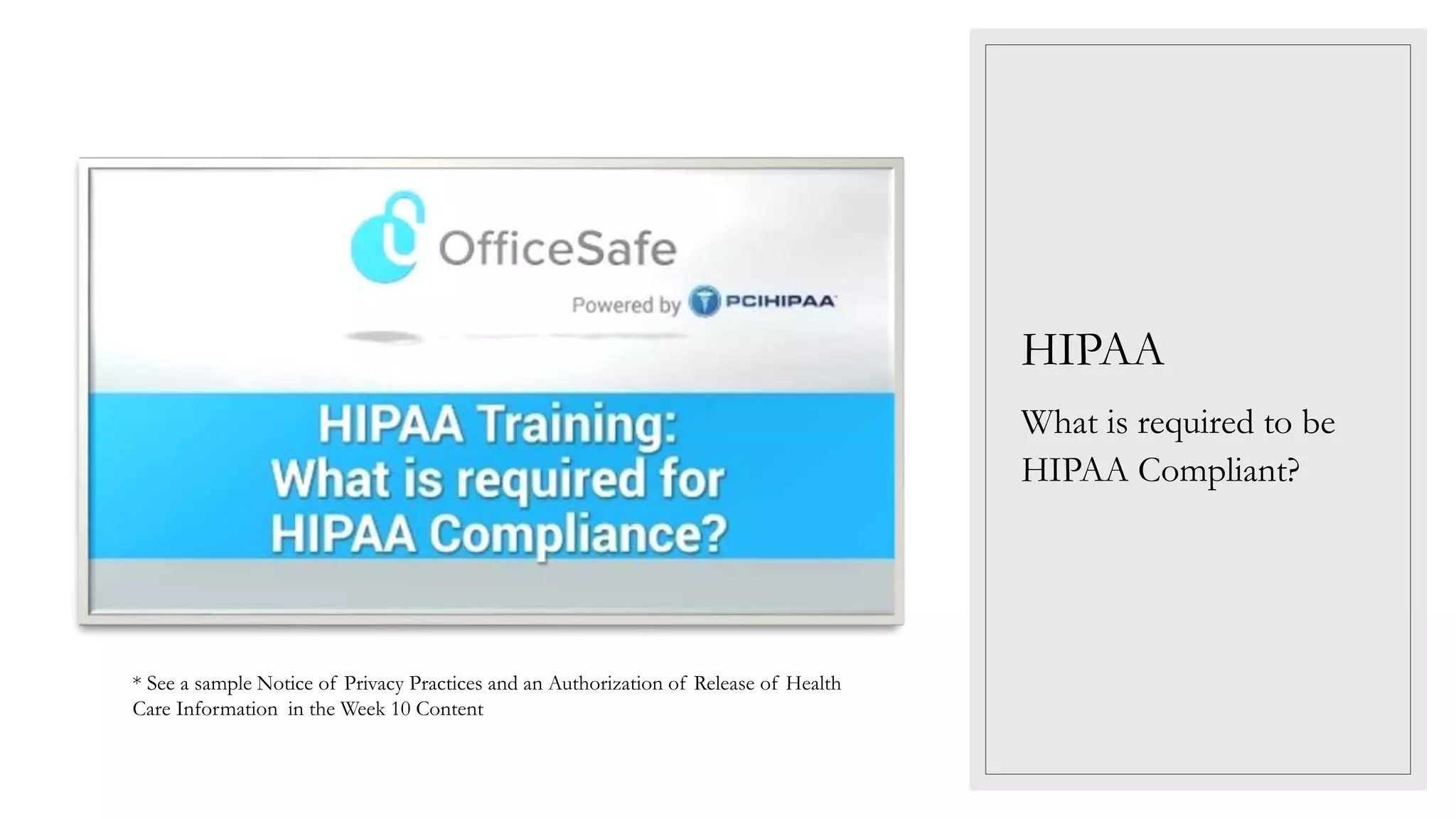
HIPAA
What is required to be
HIPAA Compliant?
* See a sample Notice of Privacy Practices and an Authorization of Release of Health
Care Information in the Week 10 Content
What if I get
subpoenaed?
◦ A subpoena is a legal request for information, whether through a
document, like a record, or by testimony or an in person appearance.
◦ The subpoenaed may be issued by a court or by one of the parties in
the case
◦ There are two types of subpoenas:
◦ General Subpoena – legal command to appear and give oral testimony
◦ Subpoena Duces Tecum – legal command to appear and bring requested
record
◦ Before responding to a subpoena ensure that the subpoena is valid
and that the conditions for disclosing confidential information are
met, whether a client's consent has been given or some other valid
legal reason.
You may need to respond…but
you may also not need to
respond.
What if I get
subpoenaed?
◦ The clinical record and psychotherapy notes, client assessment
forms, billing documents, etc. may be turned over to the court with
appropriate authorization by the client or with a court order.
◦ Your release of the records must still be in accordance with the
requirements of HIPAA (which addresses this situation)
◦ In general, you have a responsibility to maintain confidentiality.
Therapist–patient privilege is a privilege that can be asserted on
behalf of the client, unless:
◦ The client has explicitly waived privilege or signed a valid release,
◦ A legally recognized exception to privilege exists, or
◦ The court orders the psychologist to turn over the client's information
◦ When in doubt, consult an attorney or the NASW (if a member) for
help on whether or not you may release information
You may need to respond…but
you may also not need to
respond.
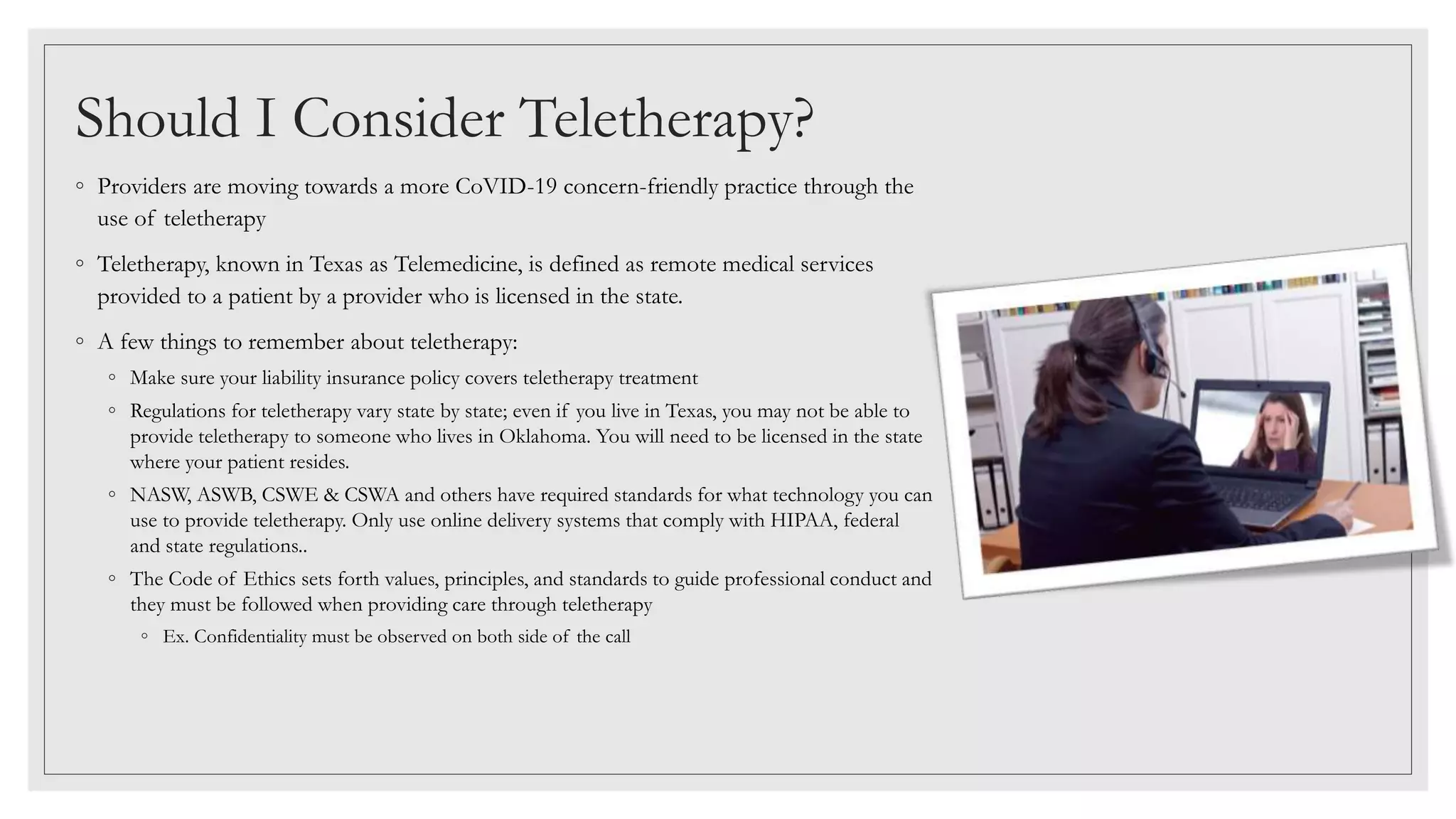
◦ Providers are moving towards a more CoVID-19 concern-friendly practice through the
use of teletherapy
◦ Teletherapy, known in Texas as Telemedicine, is defined as remote medical services
provided to a patient by a provider who is licensed in the state.
◦ A few things to remember about teletherapy:
◦ Make sure your liability insurance policy covers teletherapy treatment
◦ Regulations for teletherapy vary state by state; even if you live in Texas, you may not be able to
provide teletherapy to someone who lives in Oklahoma. You will need to be licensed in the state
where your patient resides.
◦ NASW, ASWB, CSWE & CSWA and others have required standards for what technology you can
use to provide teletherapy. Only use online delivery systems that comply with HIPAA, federal
and state regulations..
◦ The Code of Ethics sets forth values, principles, and standards to guide professional conduct and
they must be followed when providing care through teletherapy
◦ Ex. Confidentiality must be observed on both side of the call
Should I Consider Teletherapy?
Considering Teletheraphy? https://coronavirus.naswassurance.org/considering-
teletherapy/
Leadership Ladders: Opening a New Private Practice.
https://careers.socialworkers.org/documents/Opening%20a%20Private%20Pr
actice.pdf
A Malpractice Insurance Primer By Christina Reardon, MSW
https://www.socialworktoday.com/archive/092310p22.shtml
Taking Insurance vs. Private Pay in Private Practice
https://practiceoftherapy.com/taking-insurance-vs-private-pay-in-private-
practice/
Protecting patient privacy when the court calls
https://www.apa.org/monitor/2016/07-08/ce-corner
Traditional Business Plan from Small Business Administration
www.sba.gov

The business of social work private practice

  • 1.
    THE BUSINESS OF SOCIALWORK STARTING A PRIVATE PRACTICE
  • 2.
    Learning Objectives ◦ Whatdo you need to consider when opening a private practice in Texas ◦ LCSW license requirements ◦ Cost considerations when opening an office? ◦ Business Plan ◦ Location, location, location ◦ Group practice vs. solo office ◦ Tx Business license and Permits ◦ National Provider Identification ◦ How will I bill my clients? ◦ Medicare, Medicaid, Private Insurance, Cash? ◦ Malpractice Insurance ◦ HIPAA complaints, subpoenas, and other legal issues ◦ Telehealth complications ◦ CoVID-19 and other barriers
  • 3.
    10 Things to know before goinginto Private Practice 1. You will need to become a Licensed Clinical Social Worker in order to treat patients as a therapist 2. You will be required to get an additional 2 year post-Masters supervised experience in a clinical setting before being allowed to be licensed as a LCSW 3. Supervised experience will have to be paid for by you unless your employer provides it for free 4. Texas requires examination in order to be licensed as a LCSW (that is an additional exam different from the LMSW) 5. You will be required to carry malpractice insurance as a private practitioner (normally, liability is carried by the agency… to a point*).
  • 4.
    10 Things to know before goinginto Private Practice 6. Having your own practice is a job and a half. You will need to be concerned other matters like marketing your practice, staffing, managing and maintenance 7. A solo practice can be a lonely endeavor. Having other people that do the same job around you and who are able to share ideas can be immensely helpful and motivating 8. You will have to decide whether you will accept cash/credit cards only payments, and/or insurance, Medicaid or Medicare. Also deal with those who do not pay. 9. You will need other professionals to help with your practice. For example, an association with a Psychiatrist to prescribe medication to those patients who need it; an accountant to help with your books, etc. 10. Self-care will need to be part of the business plan to stay burnout and compassion fatigue
  • 5.
    Traditional Business Plan~sba.org ◦ Executive summary ◦ Briefly explain what your practice about and why it will be successful. Include your mission statement, services provided, and basic information about your practice’s leadership team, employees, and location. You should also include financial information and high- level growth plans if you plan to ask for financing. ◦ Company Description ◦ Go into detail about the problems your practice solves. Be specific, and list out the type of consumers, organizations, or agencies your company plans to serve. ◦ Market analysis ◦ You'll need a good understanding of your industry outlook and target market. Competitive research will show you what others are doing and what their strengths are. In your market research, look for trends and themes. What do successful competitors do? Why does it work? Can you do it better? Now's the time to answer these questions. ◦ Organization and management ◦ Tell your reader how your office will be structured and who will run it. ◦ Describe the legal structure of your business. State whether you have or intend to incorporate your business as a C or an S corporation, form a general or limited partnership, or if you're a sole proprietor or LLC.
  • 6.
    Traditional Business Plan~sba.org ◦ Services line ◦ Describe what services you offer. Explain how it benefits your customers and what the product lifecycle looks like. If you're doing research and development for your service or product, explain it in detail. ◦ Marketing and sales ◦ Your goal in this section is to describe how you'll attract and retain customers. You'll refer to this section later when you make financial projections, so make sure to thoroughly describe your complete marketing and sales strategies. ◦ Funding request ◦ If you're asking for funding, this is where you'll outline your funding requirements. Your goal is to clearly explain how much funding you’ll need over the next five years and what you'll use it for. ◦ Give a detailed description of how you'll use your funds. Specify if you need funds to buy equipment or materials, pay salaries, or cover specific bills until revenue increases. Always include a description of your future strategic financial plans, like paying off debt or selling your business.
  • 7.
    Traditional Business Plan~sba.org ◦ Financial projections ◦ Supplement your funding request with financial projections. Your goal is to convince the reader that your business is stable and will be a financial success. Provide a prospective financial outlook for the next five years. Include forecasted income statements, balance sheets, cash flow statements, and capital expenditure budgets. For the first year, be even more specific and use quarterly — or even monthly — projections. Make sure to clearly explain your projections, and match them to your funding requests. ◦ This is a great place to use graphs and charts to tell the financial story of your business. ◦ Appendix ◦ Use your appendix to provide supporting documents or other materials were specially requested. Common items to include are credit histories, resumes, product pictures, letters of reference, licenses, permits, or patents, legal documents, permits, and other contracts.
  • 8.
    Consider Incorporating YourPractice ◦ Just a like a 501(c)(3), if you are planning to have a solo or group practice you should consider incorporating first ◦ See last week’s PowerPoints for instructions on how to in Texas ◦ In addition to tax benefits, incorporating will allow you to separate and protect your personal assets from business assets
  • 9.
    Things to considerwhen looking for Office Space  High Traffic Area - Consider an area that is close to a major road or intersection. High traffic will turn inquiries into clients. Also consider the marketability of the area not just now but five, ten years from now.  Privacy Client privacy and confidentiality should be something highly considered when choosing a place to office. Not only are you concerned with not being overheard during appointments, but also manner of egress and ingress should also be given some thought.  Cost What is the cost of the rent? What type of amenities are included? (Wi-Fi connectivity, utilities, security, etc.) Negotiate a better deal or consider sharing/shared office space.
  • 10.
    Things to considerwhen looking for Office Space  Convenience for you and your client - Remember how much time you will spend at your office. You probably do not want to spend large portions of your day driving to your office. Also, on late nights, is it safe for you and your clients to walk to your car.  Amenities Think about your own visits to professional offices. We all like nice offices – does it have nice bathrooms, vending machines, elevators, and a proper waiting room.  Parking May seem silly but other than safety and proper lighting, you should consider the availability and how close your clients will be able to park to your office. The more convenient it is for them to come to your office, the more it adds to the overall experience.
  • 11.
    Should you open asolo practice or join a group practice?
  • 12.
    National Provider Identification ◦The Health Insurance Portability and Accountability Act of 1996 (HIPAA) requires every mental health provider to be registered as a National Provider and have an National Provider Identification Number known as the NPI. ◦ The NPI identifies the specific provider rendering the services and is required for any provider planning to submit paperwork or electronic claims, or collecting cash from patients. ◦ You may request an individual or group NPI number (which may or may not be necessary if you are part of group practice) ◦ The application can be found from the National Plan and Provider Enumeration System and it is available online at https://nppes.cms.hhs.gov.
  • 13.
    Tax Identification Number ◦When opening a private practice, it is best to obtain a tax identification number solely for the practice. ◦ Doing so separates your personal financial affairs from your professional business. ◦ You may obtain a tax identification number from the federal government by completing IRS Form SS-4. Forms are available online from the Internal Revenue Service at www.irs.gov.
  • 14.
    Professional Liability Insurance ◦Professional liability insurance is required when opening a private practice. You never know where a lawsuit may happen and it is better to be safe than sorry. ◦ It is recommended that Social workers that may be subpoenaed as part of custody battles, workers compensation cases, or other legal proceedings and those who provide consultation or supervision should also consider having an insurance policy. ◦ Coverage. ◦ The amount of coverage depends on several factors including state regulations, requirements of insurance companies, and the type of social work practices. ◦ Malpractice coverage comes with two liability limits. The per-claim limit is the maximum coverage you will have for any single claim. The aggregate limit is the maximum coverage you have for all claims covered by the policy. ◦ Social workers affiliated with managed care organizations and other third-party payers are usually required to have a specific limit on pay out. ◦ Coverage should be maintained continuously to avoid gaps
  • 15.
    How much willyou charge for services? ◦ Factors to consider when setting a fee schedule for your practice: ◦ The economy ◦ The geographical location of your office ◦ Insurance payment and other expenses of running your practice ◦ Decide on an amount that is fair and reasonable for your practice based on cost of doing business and contractual obligation to other professional ◦ Consult with other practitioners, research your area for both typical hourly cost of therapy and salaries for private practitioner ◦ And of course, decide what you are comfortable with as your salary
  • 16.
    Pros. & Cons.of Accepting Insurance PROS ◦ Brings in a larger number of referrals quickly that are generated by the insurance carriers ◦ Use of health insurance is the norm for receiving mental health care nationally ◦ Probably more advantageous for practices in rural communities ◦ A greater diversity of clients ◦ Gives the practice some credibility in that the insurance company has credentialed you ◦ Lower cost for the client ◦ Other professionals (doctors) will refer to others in their same networks ◦ Gives lower income clients an opportunity to use your services CONS ◦ Credentialing process is tedious and time consuming ◦ Filing claims is an extra burden and time consuming ◦ Rejected claims stop you from being paid in a timely manner ◦ Requires having to have other software and systems in place in order to file the claim ◦ Insurance companies determine your reimbursement rate ◦ Might require having a medical billing or other auxiliary staff to handle filing claims
  • 17.
    Pros. & Cons.of a Cash-Only Practice PROS CONS • You will have to work harder at building referral sources • Requires that you educate clients on not using insurance • Might lose clients that are searching for a therapist that will take their insurance • Potentially smaller referral source pool • Rural and lower socioeconomic communities will have limited access to services • Limits taking on many low income or people that depend on insurance coverage • Smaller diversity of clients • You can charge what you want to with higher average rates per session • No delays in getting paid for services • No claims or paperwork to file • Less likely to need auxiliary staff • Will be more appealing to clients of higher economic standing
  • 18.
    HIPAA What is requiredto be HIPAA Compliant? * See a sample Notice of Privacy Practices and an Authorization of Release of Health Care Information in the Week 10 Content
  • 19.
    What if Iget subpoenaed? ◦ A subpoena is a legal request for information, whether through a document, like a record, or by testimony or an in person appearance. ◦ The subpoenaed may be issued by a court or by one of the parties in the case ◦ There are two types of subpoenas: ◦ General Subpoena – legal command to appear and give oral testimony ◦ Subpoena Duces Tecum – legal command to appear and bring requested record ◦ Before responding to a subpoena ensure that the subpoena is valid and that the conditions for disclosing confidential information are met, whether a client's consent has been given or some other valid legal reason. You may need to respond…but you may also not need to respond.
  • 20.
    What if Iget subpoenaed? ◦ The clinical record and psychotherapy notes, client assessment forms, billing documents, etc. may be turned over to the court with appropriate authorization by the client or with a court order. ◦ Your release of the records must still be in accordance with the requirements of HIPAA (which addresses this situation) ◦ In general, you have a responsibility to maintain confidentiality. Therapist–patient privilege is a privilege that can be asserted on behalf of the client, unless: ◦ The client has explicitly waived privilege or signed a valid release, ◦ A legally recognized exception to privilege exists, or ◦ The court orders the psychologist to turn over the client's information ◦ When in doubt, consult an attorney or the NASW (if a member) for help on whether or not you may release information You may need to respond…but you may also not need to respond.
  • 21.
    ◦ Providers aremoving towards a more CoVID-19 concern-friendly practice through the use of teletherapy ◦ Teletherapy, known in Texas as Telemedicine, is defined as remote medical services provided to a patient by a provider who is licensed in the state. ◦ A few things to remember about teletherapy: ◦ Make sure your liability insurance policy covers teletherapy treatment ◦ Regulations for teletherapy vary state by state; even if you live in Texas, you may not be able to provide teletherapy to someone who lives in Oklahoma. You will need to be licensed in the state where your patient resides. ◦ NASW, ASWB, CSWE & CSWA and others have required standards for what technology you can use to provide teletherapy. Only use online delivery systems that comply with HIPAA, federal and state regulations.. ◦ The Code of Ethics sets forth values, principles, and standards to guide professional conduct and they must be followed when providing care through teletherapy ◦ Ex. Confidentiality must be observed on both side of the call Should I Consider Teletherapy?
  • 22.
    Considering Teletheraphy? https://coronavirus.naswassurance.org/considering- teletherapy/ LeadershipLadders: Opening a New Private Practice. https://careers.socialworkers.org/documents/Opening%20a%20Private%20Pr actice.pdf A Malpractice Insurance Primer By Christina Reardon, MSW https://www.socialworktoday.com/archive/092310p22.shtml Taking Insurance vs. Private Pay in Private Practice https://practiceoftherapy.com/taking-insurance-vs-private-pay-in-private- practice/ Protecting patient privacy when the court calls https://www.apa.org/monitor/2016/07-08/ce-corner Traditional Business Plan from Small Business Administration www.sba.gov