Social Work
Documentation
SWK Field Instruction 426
Purposes of Records
 Accurate record keeping supports the worker in planning, implementing,
and evaluating services for each client
 Illustrates patterns of in/effective interventions
 Enhances quality of service – Especially with heavy case loads or in crisis
situations
 Follows the agency/organization/state or other governing body
protocols
Purposes of Records
 Reflects any significant client, family or secondary service provider
contact
 Measures outcomes
 Reminds the worker of services to be provided
 Serves as support for insurance coverage purposes
 Presents accurate history of crisis patterns
National Association of Social Workers Guidelines
(http://socialworkers.org/ -- 3.04: Client Records)
 Ensure that documentation in records is accurate and reflects the
services provided
 Include sufficient and timely documentation in records to facilitate the
delivery of services and to ensure continuity of services provided to
clients in the future
 Documentation should protect clients' privacy to the extent that is
possible and appropriate
 Should include only information that is directly relevant to the delivery of services.
National Association of Social Workers Guidelines
(http://socialworkers.org/ -- 3.04: Client Records)
 Records should be maintained for the number of years required by state
statutes, agency policy or relevant contracts.
 Social workers should store records following the termination of services to ensure
reasonable future access.
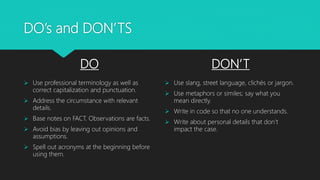
DO’s and DON’TS
DO
 Use professional terminology as well as
correct capitalization and punctuation.
 Address the circumstance with relevant
details.
 Base notes on FACT. Observations are facts.
 Avoid bias by leaving out opinions and
assumptions.
 Spell out acronyms at the beginning before
using them.
DON’T
 Use slang, street language, clichés or jargon.
 Use metaphors or similes; say what you
mean directly.
 Write in code so that no one understands.
 Write about personal details that don’t
impact the case.
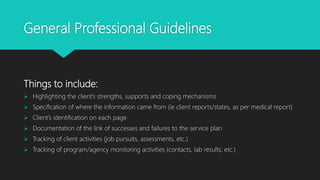
General Professional Guidelines
Things to include:
 Highlighting the client’s strengths, supports and coping mechanisms
 Specification of where the information came from (ie client reports/states, as per medical report)
 Client’s identification on each page
 Documentation of the link of successes and failures to the service plan
 Tracking of client activities (job pursuits, assessments, etc.)
 Tracking of program/agency monitoring activities (contacts, lab results, etc.)
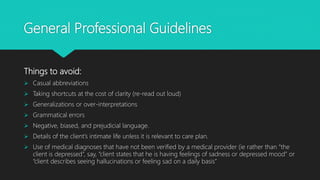
General Professional Guidelines
Things to avoid:
 Casual abbreviations
 Taking shortcuts at the cost of clarity (re-read out loud)
 Generalizations or over-interpretations
 Grammatical errors
 Negative, biased, and prejudicial language.
 Details of the client’s intimate life unless it is relevant to care plan.
 Use of medical diagnoses that have not been verified by a medical provider (ie rather than “the
client is depressed”, say, “client states that he is having feelings of sadness or depressed mood” or
“client describes seeing hallucinations or feeling sad on a daily basis”
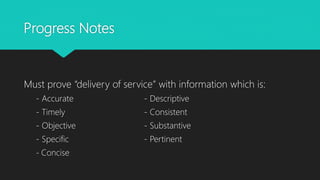
Progress Notes
Must prove “delivery of service” with information which is:
- Accurate - Descriptive
- Timely - Consistent
- Objective - Substantive
- Specific - Pertinent
- Concise
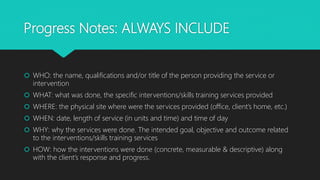
Progress Notes: ALWAYS INCLUDE
 WHO: the name, qualifications and/or title of the person providing the service or
intervention
 WHAT: what was done, the specific interventions/skills training services provided
 WHERE: the physical site where were the services provided (office, client’s home, etc.)
 WHEN: date, length of service (in units and time) and time of day
 WHY: why the services were done. The intended goal, objective and outcome related
to the interventions/skills training services
 HOW: how the interventions were done (concrete, measurable & descriptive) along
with the client’s response and progress.
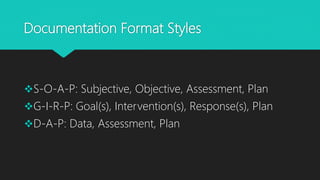
Documentation Format Styles
S-O-A-P: Subjective, Objective, Assessment, Plan
G-I-R-P: Goal(s), Intervention(s), Response(s), Plan
D-A-P: Data, Assessment, Plan
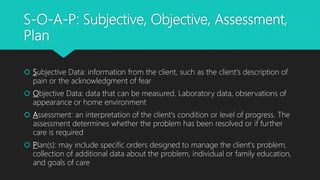
S-O-A-P: Subjective, Objective, Assessment,
Plan
 Subjective Data: information from the client, such as the client's description of
pain or the acknowledgment of fear
 Objective Data: data that can be measured. Laboratory data, observations of
appearance or home environment
 Assessment: an interpretation of the client's condition or level of progress. The
assessment determines whether the problem has been resolved or if further
care is required
 Plan(s): may include specific orders designed to manage the client's problem,
collection of additional data about the problem, individual or family education,
and goals of care
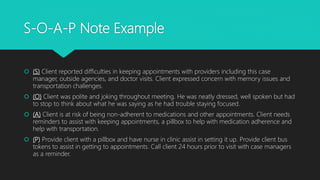
S-O-A-P Note Example
 (S) Client reported difficulties in keeping appointments with providers including this case
manager, outside agencies, and doctor visits. Client expressed concern with memory issues and
transportation challenges.
 (O) Client was polite and joking throughout meeting. He was neatly dressed, well spoken but had
to stop to think about what he was saying as he had trouble staying focused.
 (A) Client is at risk of being non-adherent to medications and other appointments. Client needs
reminders to assist with keeping appointments, a pillbox to help with medication adherence and
help with transportation.
 (P) Provide client with a pillbox and have nurse in clinic assist in setting it up. Provide client bus
tokens to assist in getting to appointments. Call client 24 hours prior to visit with case managers
as a reminder.
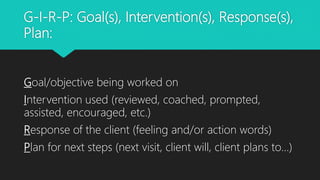
G-I-R-P: Goal(s), Intervention(s), Response(s),
Plan:
Goal/objective being worked on
Intervention used (reviewed, coached, prompted,
assisted, encouraged, etc.)
Response of the client (feeling and/or action words)
Plan for next steps (next visit, client will, client plans to…)
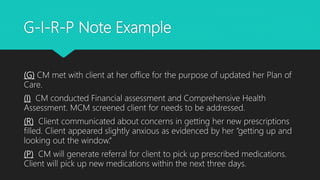
G-I-R-P Note Example
(G) CM met with client at her office for the purpose of updated her Plan of
Care.
(I) CM conducted Financial assessment and Comprehensive Health
Assessment. MCM screened client for needs to be addressed.
(R) Client communicated about concerns in getting her new prescriptions
filled. Client appeared slightly anxious as evidenced by her “getting up and
looking out the window.“
(P) CM will generate referral for client to pick up prescribed medications.
Client will pick up new medications within the next three days.
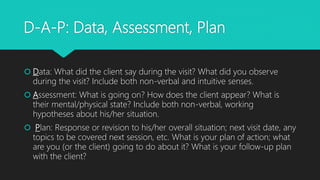
D-A-P: Data, Assessment, Plan
 Data: What did the client say during the visit? What did you observe
during the visit? Include both non-verbal and intuitive senses.
 Assessment: What is going on? How does the client appear? What is
their mental/physical state? Include both non-verbal, working
hypotheses about his/her situation.
 Plan: Response or revision to his/her overall situation; next visit date, any
topics to be covered next session, etc. What is your plan of action; what
are you (or the client) going to do about it? What is your follow-up plan
with the client?
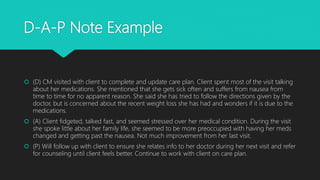
D-A-P Note Example
 (D) CM visited with client to complete and update care plan. Client spent most of the visit talking
about her medications. She mentioned that she gets sick often and suffers from nausea from
time to time for no apparent reason. She said she has tried to follow the directions given by the
doctor, but is concerned about the recent weight loss she has had and wonders if it is due to the
medications.
 (A) Client fidgeted, talked fast, and seemed stressed over her medical condition. During the visit
she spoke little about her family life, she seemed to be more preoccupied with having her meds
changed and getting past the nausea. Not much improvement from her last visit.
 (P) Will follow up with client to ensure she relates info to her doctor during her next visit and refer
for counseling until client feels better. Continue to work with client on care plan.
Tips and Suggestions
Stay organized:
1.) Carry notepad
2.) Take shorthand notes
3.) Make lists and check them off (use client initials)
Maintain encounter log:
1.) This can be your scheduling book/calendar
Account for “case noting” time:
1.) Save time to document
2.) Secure time to document
3.) Use time blocking method
Utilize staff resources to improve:
1.) Documentation software
2.) Templates used by agency
3.) Review your coworkers notes
Image by Socialworktech.com
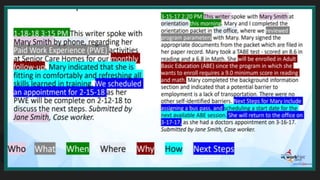
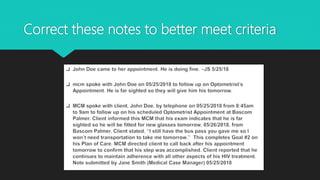
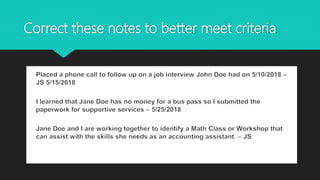
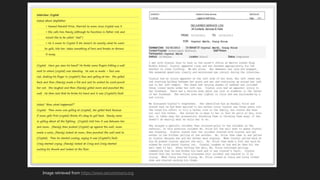
Correct these notes to better meet criteria
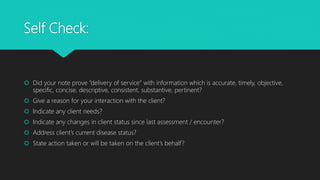
Self Check:
 Did your note prove “delivery of service” with information which is accurate, timely, objective,
specific, concise, descriptive, consistent, substantive, pertinent?
 Give a reason for your interaction with the client?
 Indicate any client needs?
 Indicate any changes in client status since last assessment / encounter?
 Address client’s current disease status?
 State action taken or will be taken on the client’s behalf?
Image retrieved from https://www.oercommons.org
Common Issues within case notes:
 A common problem in case notes is that the plan seems to be an
afterthought.
 Often the plan is just the date of the next session. Sometimes the plan is
left out altogether.
 Your case notes should be thorough enough that a coworker could step
in for you in an emergency and know how and what you are planning to
work on in the next session.
Complete vs Incomplete plans
Examples of case notes with incomplete
plans:
 The plan is to meet with the client next on
4/27/15.
 Plan is to continue to support client with his
goals.
Plans need to include:
 The date of the next appointment
 Issues to be discussed at next session
 Any changes to the current focus of
treatment or goals
Examples of complete plans:
 Plan to meet with client and his wife on 4/24/15 in order to help wife understand and cope with
client’s depression. Writer will contact client’s psychiatrist to coordinate care. Client will complete
daily mood log and bring it to next session.
 Plan: Client will utilize resources and strategies in her safety plan. Writer will contact client by
phone tomorrow, 4/21/15, at 10am to monitor and re-assess client’s suicidal ideation. Writer and
client will meet for session on 4/22/15 at 10am in order to monitor and re-assess client’s
depression and suicidal ideation and continue to work on goal of client using safe coping
strategies.
Plans retrieved from https://socialworkcoaching.com
Resources
Guidelines for Social Work Case Management Documentation. National Association of Social Workers. Retrieved May 25, 2018
from www.socialworkers.org.
Care Plans. ACT. Retrieved May 25, 2018 from www.ctaidscoalition.org/pdf/cmti/care_plans.pdf. Florida HIV/AIDS Case
Management Operating Guidelines. Florida Department of Health. Retrieved June 19, 2018 from
http://www.floridahealth.gov/diseases-andconditions/aids/patient-care/_documents/eligibility-information/Appendix.pdf.
Wohltmann, T. (2015, April 24). Intro to Case Notes for new social workers. OER Commons. Retrieved June 19, 2018, from
https://www.oercommons.org/authoring/8157-intro-tocase-notes-for-new-social-workers.
Case Management and Writing Effective Case Notes. Experience Works. Retrieved June 19, 2018 from
http://www.experienceworks.org /site/ DocServer/ Case_Management_Writing_Effective_Case_Notes.pdf?docID=23124.
Importance of Documentation and Best Practices in Case Notation. Sonya O. Boyne, LMHC UM Comprehensive AIDS Program;
University of Miami.
INTERVIEW VIDEO
 https://youtu.be/q7HMwUS7Hk4

Social work documentation

  • 1.
  • 2.
    Purposes of Records Accurate record keeping supports the worker in planning, implementing, and evaluating services for each client  Illustrates patterns of in/effective interventions  Enhances quality of service – Especially with heavy case loads or in crisis situations  Follows the agency/organization/state or other governing body protocols
  • 3.
    Purposes of Records Reflects any significant client, family or secondary service provider contact  Measures outcomes  Reminds the worker of services to be provided  Serves as support for insurance coverage purposes  Presents accurate history of crisis patterns
  • 4.
    National Association ofSocial Workers Guidelines (http://socialworkers.org/ -- 3.04: Client Records)  Ensure that documentation in records is accurate and reflects the services provided  Include sufficient and timely documentation in records to facilitate the delivery of services and to ensure continuity of services provided to clients in the future  Documentation should protect clients' privacy to the extent that is possible and appropriate  Should include only information that is directly relevant to the delivery of services.
  • 5.
    National Association ofSocial Workers Guidelines (http://socialworkers.org/ -- 3.04: Client Records)  Records should be maintained for the number of years required by state statutes, agency policy or relevant contracts.  Social workers should store records following the termination of services to ensure reasonable future access.
  • 6.
    DO’s and DON’TS DO Use professional terminology as well as correct capitalization and punctuation.  Address the circumstance with relevant details.  Base notes on FACT. Observations are facts.  Avoid bias by leaving out opinions and assumptions.  Spell out acronyms at the beginning before using them. DON’T  Use slang, street language, clichés or jargon.  Use metaphors or similes; say what you mean directly.  Write in code so that no one understands.  Write about personal details that don’t impact the case.
  • 7.
    General Professional Guidelines Thingsto include:  Highlighting the client’s strengths, supports and coping mechanisms  Specification of where the information came from (ie client reports/states, as per medical report)  Client’s identification on each page  Documentation of the link of successes and failures to the service plan  Tracking of client activities (job pursuits, assessments, etc.)  Tracking of program/agency monitoring activities (contacts, lab results, etc.)
  • 8.
    General Professional Guidelines Thingsto avoid:  Casual abbreviations  Taking shortcuts at the cost of clarity (re-read out loud)  Generalizations or over-interpretations  Grammatical errors  Negative, biased, and prejudicial language.  Details of the client’s intimate life unless it is relevant to care plan.  Use of medical diagnoses that have not been verified by a medical provider (ie rather than “the client is depressed”, say, “client states that he is having feelings of sadness or depressed mood” or “client describes seeing hallucinations or feeling sad on a daily basis”
  • 9.
    Progress Notes Must prove“delivery of service” with information which is: - Accurate - Descriptive - Timely - Consistent - Objective - Substantive - Specific - Pertinent - Concise
  • 10.
    Progress Notes: ALWAYSINCLUDE  WHO: the name, qualifications and/or title of the person providing the service or intervention  WHAT: what was done, the specific interventions/skills training services provided  WHERE: the physical site where were the services provided (office, client’s home, etc.)  WHEN: date, length of service (in units and time) and time of day  WHY: why the services were done. The intended goal, objective and outcome related to the interventions/skills training services  HOW: how the interventions were done (concrete, measurable & descriptive) along with the client’s response and progress.
  • 12.
    Documentation Format Styles S-O-A-P:Subjective, Objective, Assessment, Plan G-I-R-P: Goal(s), Intervention(s), Response(s), Plan D-A-P: Data, Assessment, Plan
  • 13.
    S-O-A-P: Subjective, Objective,Assessment, Plan  Subjective Data: information from the client, such as the client's description of pain or the acknowledgment of fear  Objective Data: data that can be measured. Laboratory data, observations of appearance or home environment  Assessment: an interpretation of the client's condition or level of progress. The assessment determines whether the problem has been resolved or if further care is required  Plan(s): may include specific orders designed to manage the client's problem, collection of additional data about the problem, individual or family education, and goals of care
  • 14.
    S-O-A-P Note Example (S) Client reported difficulties in keeping appointments with providers including this case manager, outside agencies, and doctor visits. Client expressed concern with memory issues and transportation challenges.  (O) Client was polite and joking throughout meeting. He was neatly dressed, well spoken but had to stop to think about what he was saying as he had trouble staying focused.  (A) Client is at risk of being non-adherent to medications and other appointments. Client needs reminders to assist with keeping appointments, a pillbox to help with medication adherence and help with transportation.  (P) Provide client with a pillbox and have nurse in clinic assist in setting it up. Provide client bus tokens to assist in getting to appointments. Call client 24 hours prior to visit with case managers as a reminder.
  • 15.
    G-I-R-P: Goal(s), Intervention(s),Response(s), Plan: Goal/objective being worked on Intervention used (reviewed, coached, prompted, assisted, encouraged, etc.) Response of the client (feeling and/or action words) Plan for next steps (next visit, client will, client plans to…)
  • 16.
    G-I-R-P Note Example (G)CM met with client at her office for the purpose of updated her Plan of Care. (I) CM conducted Financial assessment and Comprehensive Health Assessment. MCM screened client for needs to be addressed. (R) Client communicated about concerns in getting her new prescriptions filled. Client appeared slightly anxious as evidenced by her “getting up and looking out the window.“ (P) CM will generate referral for client to pick up prescribed medications. Client will pick up new medications within the next three days.
  • 17.
    D-A-P: Data, Assessment,Plan  Data: What did the client say during the visit? What did you observe during the visit? Include both non-verbal and intuitive senses.  Assessment: What is going on? How does the client appear? What is their mental/physical state? Include both non-verbal, working hypotheses about his/her situation.  Plan: Response or revision to his/her overall situation; next visit date, any topics to be covered next session, etc. What is your plan of action; what are you (or the client) going to do about it? What is your follow-up plan with the client?
  • 18.
    D-A-P Note Example (D) CM visited with client to complete and update care plan. Client spent most of the visit talking about her medications. She mentioned that she gets sick often and suffers from nausea from time to time for no apparent reason. She said she has tried to follow the directions given by the doctor, but is concerned about the recent weight loss she has had and wonders if it is due to the medications.  (A) Client fidgeted, talked fast, and seemed stressed over her medical condition. During the visit she spoke little about her family life, she seemed to be more preoccupied with having her meds changed and getting past the nausea. Not much improvement from her last visit.  (P) Will follow up with client to ensure she relates info to her doctor during her next visit and refer for counseling until client feels better. Continue to work with client on care plan.
  • 19.
    Tips and Suggestions Stayorganized: 1.) Carry notepad 2.) Take shorthand notes 3.) Make lists and check them off (use client initials) Maintain encounter log: 1.) This can be your scheduling book/calendar Account for “case noting” time: 1.) Save time to document 2.) Secure time to document 3.) Use time blocking method Utilize staff resources to improve: 1.) Documentation software 2.) Templates used by agency 3.) Review your coworkers notes Image by Socialworktech.com
  • 20.
    Correct these notesto better meet criteria
  • 21.
    Correct these notesto better meet criteria
  • 22.
    Self Check:  Didyour note prove “delivery of service” with information which is accurate, timely, objective, specific, concise, descriptive, consistent, substantive, pertinent?  Give a reason for your interaction with the client?  Indicate any client needs?  Indicate any changes in client status since last assessment / encounter?  Address client’s current disease status?  State action taken or will be taken on the client’s behalf?
  • 23.
    Image retrieved fromhttps://www.oercommons.org
  • 24.
    Common Issues withincase notes:  A common problem in case notes is that the plan seems to be an afterthought.  Often the plan is just the date of the next session. Sometimes the plan is left out altogether.  Your case notes should be thorough enough that a coworker could step in for you in an emergency and know how and what you are planning to work on in the next session.
  • 25.
    Complete vs Incompleteplans Examples of case notes with incomplete plans:  The plan is to meet with the client next on 4/27/15.  Plan is to continue to support client with his goals. Plans need to include:  The date of the next appointment  Issues to be discussed at next session  Any changes to the current focus of treatment or goals
  • 26.
    Examples of completeplans:  Plan to meet with client and his wife on 4/24/15 in order to help wife understand and cope with client’s depression. Writer will contact client’s psychiatrist to coordinate care. Client will complete daily mood log and bring it to next session.  Plan: Client will utilize resources and strategies in her safety plan. Writer will contact client by phone tomorrow, 4/21/15, at 10am to monitor and re-assess client’s suicidal ideation. Writer and client will meet for session on 4/22/15 at 10am in order to monitor and re-assess client’s depression and suicidal ideation and continue to work on goal of client using safe coping strategies. Plans retrieved from https://socialworkcoaching.com
  • 27.
    Resources Guidelines for SocialWork Case Management Documentation. National Association of Social Workers. Retrieved May 25, 2018 from www.socialworkers.org. Care Plans. ACT. Retrieved May 25, 2018 from www.ctaidscoalition.org/pdf/cmti/care_plans.pdf. Florida HIV/AIDS Case Management Operating Guidelines. Florida Department of Health. Retrieved June 19, 2018 from http://www.floridahealth.gov/diseases-andconditions/aids/patient-care/_documents/eligibility-information/Appendix.pdf. Wohltmann, T. (2015, April 24). Intro to Case Notes for new social workers. OER Commons. Retrieved June 19, 2018, from https://www.oercommons.org/authoring/8157-intro-tocase-notes-for-new-social-workers. Case Management and Writing Effective Case Notes. Experience Works. Retrieved June 19, 2018 from http://www.experienceworks.org /site/ DocServer/ Case_Management_Writing_Effective_Case_Notes.pdf?docID=23124. Importance of Documentation and Best Practices in Case Notation. Sonya O. Boyne, LMHC UM Comprehensive AIDS Program; University of Miami.
  • 28.