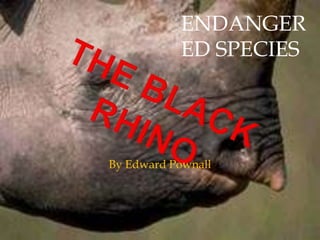
ENDANGER
           ED SPECIES


By Edward Pownall
   Black rhinos live in the south and on the
    eastern sides of Africa
   Black rhinos are threatened by poachers
    hunting them for their ivory horns
   The horns are used in Chinese medicine and
    are used by artists in carvings
   The black rhinos scientific name is Diceros
    bicornis
   Their population is 2 300
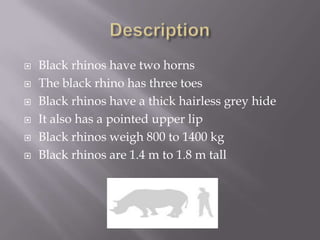
   Black rhinos have two horns
   The black rhino has three toes
   Black rhinos have a thick hairless grey hide
   It also has a pointed upper lip
   Black rhinos weigh 800 to 1400 kg
   Black rhinos are 1.4 m to 1.8 m tall
   Black rhino’s eats woody twigs ,legumes and a
    wide variety of plant species
   The rhinos eat at dusk and dawn
   If water is available the rhino will drink it
   The black rhino has a funny lip used for eating
    plants
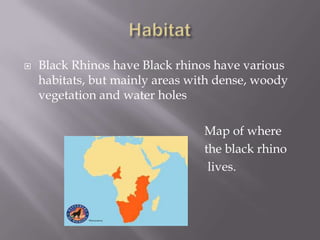
   Black Rhinos have Black rhinos have various
    habitats, but mainly areas with dense, woody
    vegetation and water holes

                                 Map of where
                                 the black rhino
                                  lives.
   Black rhinos are solitary animals
   Rhinos tend to be ill tempered when they are in
    areas that are being disturbed
   Their vocabulary doesn't extend beyond
    growls, grunts, squeaks, snorts and bellows
   When fighting they lower their head and
    charge, reaching up to 30 km/h
   The rhinos closest relationships are between
    the calf and a female; that usually lasts 2-4
    years
   Rhinos have a small bird called oxpecker that
    follows the rhino around; the bird eats ticks it
    finds on the rhino and noisily warns of danger
   In the 70’s and 80’s the rhino population
    declined because of poaching
   The rhino horn is in demand in Asia for
    carving ornamental and a medicine
   The black rhino has no natural predators
   And despite its size it relatively easy for a man
    to kill
   Rhinos have to go to a water hole every day, so
    poachers ambush them there
   There is a dramatic decline in numbers; luckily
    conservation efforts are helping to stop them
    becoming extinct
   Black rhino
    wwf.panda.org/what_we.../rhinoceros/...rhinos/black
    _rhinoceros/ 4/6/12
   Black rhino
    http://en.wikipedia.org/wiki/Black_rhinoceros
    4/8/12
   Black rhino www.kidcyber.com.au/topics/rhino
    7/8/12
   Black rhino www.awf.org 7/8/12
   Map www.defenders.org 17/9/12

The black rhino pro

  • 1.
    ENDANGER ED SPECIES By Edward Pownall
  • 2.
    Black rhinos live in the south and on the eastern sides of Africa  Black rhinos are threatened by poachers hunting them for their ivory horns  The horns are used in Chinese medicine and are used by artists in carvings  The black rhinos scientific name is Diceros bicornis  Their population is 2 300
  • 3.
    Black rhinos have two horns  The black rhino has three toes  Black rhinos have a thick hairless grey hide  It also has a pointed upper lip  Black rhinos weigh 800 to 1400 kg  Black rhinos are 1.4 m to 1.8 m tall
  • 4.
    Black rhino’s eats woody twigs ,legumes and a wide variety of plant species  The rhinos eat at dusk and dawn  If water is available the rhino will drink it  The black rhino has a funny lip used for eating plants
  • 5.
    Black Rhinos have Black rhinos have various habitats, but mainly areas with dense, woody vegetation and water holes Map of where the black rhino lives.
  • 6.
    Black rhinos are solitary animals  Rhinos tend to be ill tempered when they are in areas that are being disturbed  Their vocabulary doesn't extend beyond growls, grunts, squeaks, snorts and bellows  When fighting they lower their head and charge, reaching up to 30 km/h  The rhinos closest relationships are between the calf and a female; that usually lasts 2-4 years
  • 7.
    Rhinos have a small bird called oxpecker that follows the rhino around; the bird eats ticks it finds on the rhino and noisily warns of danger  In the 70’s and 80’s the rhino population declined because of poaching  The rhino horn is in demand in Asia for carving ornamental and a medicine
  • 8.
    The black rhino has no natural predators  And despite its size it relatively easy for a man to kill  Rhinos have to go to a water hole every day, so poachers ambush them there  There is a dramatic decline in numbers; luckily conservation efforts are helping to stop them becoming extinct
  • 9.
    Black rhino wwf.panda.org/what_we.../rhinoceros/...rhinos/black _rhinoceros/ 4/6/12  Black rhino http://en.wikipedia.org/wiki/Black_rhinoceros 4/8/12  Black rhino www.kidcyber.com.au/topics/rhino 7/8/12  Black rhino www.awf.org 7/8/12  Map www.defenders.org 17/9/12